Have you ever been writing an email or essay and realized you keep using the same word over and over? Maybe you were describing someone who flatters others for personal gain, and the only word that came to mind was “sycophant.” You knew there had to be better options, but you could not think of them quickly enough.
This happens to writers, students, and professionals all the time. The word “sycophant” describes someone who flatters powerful people to gain advantage. But using the same word repeatedly makes your writing feel repetitive and uninspired.
That is why understanding the best synonyms of sycophant matters. Choosing the right alternative can completely change how your message lands with readers. A well-chosen synonym adds precision, shows vocabulary range, and makes your communication more effective.
In this guide, you will discover the most accurate synonyms of sycophant for every situation. You will learn which words work best in professional settings, which ones fit casual conversations, and how to avoid common mistakes. By the end, you will confidently choose the perfect word every time.
What Are the Best Synonyms of “Sycophant”?
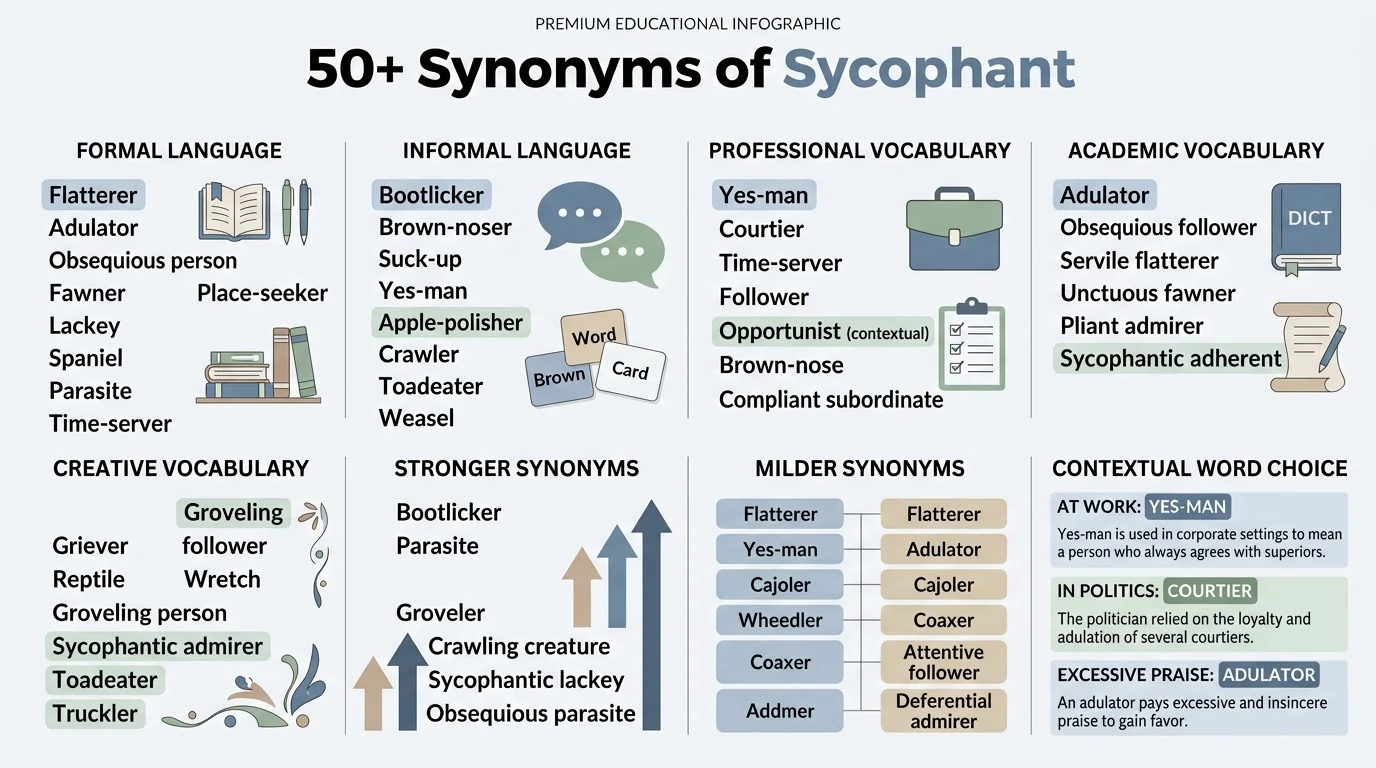
A sycophant is someone who flatters or praises powerful people excessively to gain personal advantage. The best synonyms depend on your context. Formal writing, use “toady” or “bootlicker.” For professional settings, “fawner” or “flatterer” work well. For academic writing, choose “adulator” or “parasite.” In casual conversation, “yes-man” or “brownnoser” sound natural and clear.
Meaning, Tone, and Context
Simple Definition
A sycophant is a person who behaves obsequiously toward someone important to gain favor or advantage. This behavior often involves excessive flattery, agreement with everything the powerful person says, and abandoning personal opinions to align with the influential individual.
Part of Speech
Sycophant is primarily used as a noun. The adjective form is “sycophantic,” which describes behavior or language that is overly flattering and insincere. The adverb form is “sycophantically.”
Overall Tone
Sycophant carries a negative connotation. Using this word expresses disapproval and criticism of someone’s manipulative behavior. It suggests the person lacks integrity and is willing to sacrifice honesty for personal gain.
Formality Level
Sycophant is moderately formal. It appears in published writing, academic contexts, and professional discussions. However, it is not overly technical or obscure, making it accessible to most educated native speakers.
Common Uses
Native English speakers use sycophant when discussing workplace politics, political environments, social dynamics, and any situation where someone uses flattery to manipulate others. The word frequently appears in news articles about politics, business analysis, and social commentary.
Word Forms
| Form | Word |
|---|---|
| Noun | Sycophant |
| Adjective | Sycophantic |
| Adverb | Sycophantically |
| Related Noun | Sycophancy (the behavior itself) |
When and How to Use “Sycophant”
Use sycophant when you need to describe someone who flatters powerful people with obvious insincerity. The word works best when you want to criticize this behavior while maintaining a relatively formal tone.
Here are seven realistic examples showing how sycophant appears in different contexts.
Professional:
The manager surrounded himself with sycophants who never offered honest feedback on his decisions.
Academic:
Political scientists have long studied how sycophants gain influence in authoritarian regimes by reinforcing the leader’s worldview.
Workplace:
Everyone in the office knew that James was a sycophant who agreed with everything the director said, hoping for a promotion.
Personal:
My friend called him a sycophant after watching him constantly compliment the celebrity’s clothes and opinions at the party.
Email:
I worry that the new hire is becoming a sycophant rather than offering valuable independent opinions during meetings.
Resume:
Avoid using sycophant on your resume; instead, focus on describing your actual contributions and skills.
Social Media:
The comments section was filled with sycophants praising every word the influencer posted without any genuine engagement.
Best Synonyms of “Sycophant”
No synonym captures exactly the same meaning as sycophant in every situation. The right choice depends on your audience, purpose, and desired tone. Here are the best alternatives for specific contexts.
For professional writing:
“Flatterer” works well because it clearly describes someone who praises others excessively without the more severe judgment that sycophant implies. It is professional enough for workplace documents while remaining accessible.
For academic writing:
“Adulator” provides a precise, formal alternative that fits research papers and scholarly articles. It sounds authoritative and maintains the critical tone academic writing often requires.
For business communication:
“Bootlicker” delivers a direct, judgmental tone that business audiences understand immediately. It carries a negative connotation that works well when criticizing problematic workplace behavior.
Casual conversation:
“Brownnoser” sounds natural in everyday speech and clearly communicates the idea without sounding too formal or pretentious.
Emotional writing:
“Parasite” adds strong emotional weight by suggesting the sycophant takes from others without giving genuine value in return.
Creative writing:
“Lickspittle” offers a vivid, almost literary alternative that paints a memorable picture for readers.
For resume writing:
Do not use sycophant or any of its negative synonyms on a resume. Focus on positive professional qualities instead.
For workplace communication:
“Yes-man” clearly identifies someone who always agrees with authority figures, which makes it practical for discussing team dynamics.
Stronger meaning:
“Lackey” implies complete subservience and willingness to do anything for the powerful person, making it more intense than sycophant.
Softer meaning:
“Flatterer” carries less judgment while still describing the same basic behavior, making it appropriate when you want to avoid harsh criticism.
When Not to Use “Sycophant”
Understanding when to avoid sycophant is just as important as knowing when to use it. Here are situations where a different word would work better.
When the word sounds too formal for your audience:
Using sycophant in casual conversation or informal writing can make you sound pretentious or out of touch.
Incorrect: “My brother is such a sycophant around our parents.”
Better: “My brother is such a brownnoser around our parents.”
The improved version sounds more natural in everyday conversation.
When the word sounds too judgmental:
Sometimes you need to describe flattering behavior without implying severe moral failure.
Incorrect: “The intern was a sycophant to the senior partner.”
Better: “The intern was overly eager to please the senior partner.”
The better version describes the behavior without harsh criticism.
When the word is too vague:
Sycophant describes a specific type of behavior, but sometimes you need more precision.
Incorrect: “He acts like a sycophant in meetings.”
Better: “He agrees with everything the director says in meetings, even when his suggestions are clearly flawed.”
The improved version provides specific evidence of the behavior.
When the word has become outdated in certain contexts:
Some synonyms of sycophant are rarely used in modern American English.
Incorrect: “The courtiers were sycophants to the king.”
Better for modern contexts: “The advisors were yes-men to the CEO.”
When the word sounds too weak:
Sometimes you need a stronger word to express genuine disgust or contempt.
Incorrect: “She is such a sycophant.”
Better: “She is a groveling toady who would do anything for the boss.”
The better version adds emotional intensity appropriate for expressing strong feelings.
When the word sounds too strong:
In some contexts, sycophant is overly harsh and damages relationships unnecessarily.
Incorrect: “My coworker is a sycophant to management.”
Better: “My coworker tends to agree with management more often than is necessary.”
The improved version preserves workplace relationships while still conveying the concern.
Words Commonly Confused With “Sycophant”
Several words share meaning with sycophant but have important distinctions. Understanding these differences helps you choose the most accurate word for your situation.
| Word | Difference | When to Use It | Example |
|---|---|---|---|
| Sycophant | Someone who flatters powerful people for personal advantage | When the motivation is clearly self-serving flattery | The assistant was a sycophant who never offered her own opinions |
| Toady | A person who behaves subserviently to gain favor, often with a spineless quality | When describing someone who shows complete subservience and lack of backbone | He was a toady to the regional manager, agreeing with every questionable decision |
| Brownnoser | An informal term for someone who flatters authority figures | In casual conversation or informal writing | Everyone knew she was a brownnoser working for a promotion |
| Yes-man | Someone who always agrees with authority figures | When describing agreement without critical thinking | The committee was full of yes-men who never challenged the chairperson |
| Flatterer | Someone who praises others excessively | When you want to describe praise without emphasizing the manipulative motive | The flatterer complimented her on everything she said |
| Parasite | Someone who takes without giving back, often by attaching to powerful people | When emphasizing the exploitative nature of the relationship | He was a parasite who gained status by associating with influential people |
Best Synonyms of “Sycophant” by Context
| Context | Best Synonym | Why It Works | Example |
|---|---|---|---|
| Formal writing | Toady | Maintains formality while delivering clear criticism | The minister surrounded himself with toadies |
| Academic writing | Adulator | Offers precise, scholarly vocabulary | Historical accounts describe the emperor’s adulators |
| Professional communication | Flatterer | Professional but accessible for workplace contexts | He is known as a flatterer in the office |
| Business emails | Bootlicker | Direct and clear for business communication | We need team members who challenge ideas, not bootlickers |
| Resume writing | None recommended | Negative connotations damage professional image | Use positive leadership vocabulary instead |
| Workplace communication | Yes-man | Clearly describes unhelpful agreement patterns | We need critical thinkers, not yes-men |
| Casual conversation | Brownnoser | Natural and recognizable in everyday American speech | He is such a brownnoser with the teacher |
| Creative writing | Lickspittle | Vivid, literary quality adds color to description | The lickspittle courtiers nodded at every royal word |
| Emotional writing | Parasite | Strong judgmental tone conveys disgust | She was a parasite feeding on her boss’s ego |
| Strong emphasis | Lackey | Implies complete submission and willingness to serve | He behaved like a lackey, never questioning orders |
| Mild tone | Complimenter | Softens the criticism while still noting excessive praise | She is an excessive complimenter in meetings |
| Social media captions | Fan (negative context) | Modern vocabulary that online audiences understand | The comments were full of performative fans |
| Storytelling | Courtier (archaic but effective) | Creates historical or fantastical atmosphere | The courtiers schemed endlessly for royal favor |
| American English | Brownnoser | Widely understood and culturally appropriate | Stop being a brownnoser and share your real opinion |
| British English | Crawler | Common UK usage for this concept | He’s nothing but a crawler in the office |
How to Choose the Best Synonym of “Sycophant”
Choosing the right synonym depends on several factors. Consider these questions before making your selection.
What tone do you want to convey?
If you want harsh criticism, choose “lackey” or “parasite.” If you want mild criticism, choose “flatterer” or “complimenter.”
Who is your audience?
Professional audiences respond well to “toady” and “adulator.” Casual audiences understand “brownnoser” and “yes-man” instantly.
What is your writing purpose?
Academic writing requires formal vocabulary like “adulator.” Creative writing benefits from vivid words like “lickspittle.” Business communication calls for clear, direct words like “bootlicker.”
How much emotional impact do you need?
Strong words like “parasite” create powerful emotional responses. Milder words like “flatterer” communicate the idea without causing offense.
What is the level of formality?
Formal situations demand “toady” or “adulator.” Informal situations welcome “brownnoser” or “yes-man.”
What sounds most natural?
Read your sentence aloud with different synonyms. The most natural-sounding choice is usually correct for your context.
The goal is not to show off vocabulary knowledge. The goal is to communicate clearly and effectively. Choose the synonym that best serves your message and your audience.
Real Life Examples of “Sycophant”
Here are realistic examples showing sycophant and its synonyms in authentic situations.
School:
Incorrect: “Sarah is a sycophant to the principal.”
Improved: “Sarah is a brownnoser who always compliments the principal’s decisions.”
College:
Incorrect: “The graduate student was a sycophant to her advisor.”
Improved: “The graduate student was a toady who agreed with every research suggestion without question.”
Workplace:
Incorrect: “Mark acts like a sycophant during team meetings.”
Improved: “Mark acts like a yes-man during team meetings, never challenging any proposal from management.”
Business:
Incorrect: “The consultant was a sycophant to the CEO.”
Improved: “The consultant was a flatterer who told the CEO exactly what she wanted to hear.”
Email:
Incorrect: “I am concerned that he behaves like a sycophant.”
Improved: “I am concerned that he agrees with leadership too readily and fails to provide honest feedback.”
Resume:
Never use sycophant on a resume. Instead, describe positive qualities like collaboration, respect for leadership, or effective teamwork.
Conversation:
Incorrect: “Did you see how he acted like a sycophant at the party?”
Improved: “Did you see how he was brownnosing the host all night?”
Storytelling:
Incorrect: “The servant was a sycophant to his master.”
Improved: “The servant was a groveling lickspittle, bowing at every command.”
Blogging:
Incorrect: “Politicians often attract sycophants.”
Improved: “Politicians often attract yes-men who refuse to share honest opinions.”
Social Media:
Incorrect: “The influencer’s followers are sycophants.”
Improved: “The influencer’s followers are performative fans who praise everything without genuine engagement.”
18 Best Synonyms of “Sycophant”
| Synonym | Simple Meaning | Best Used For | Example Sentence |
|---|---|---|---|
| Toady | A person who behaves subserviently to gain advantage | Formal and professional writing | The executive collected toadies who never offered critical feedback |
| Brownnoser | Someone who flatters authority figures for personal gain | Casual conversation and informal contexts | Everyone at school knows he is the teacher’s brownnoser |
| Yes-man | A person who always agrees with superiors | Workplace and professional contexts | The board was full of yes-men who approved every bad idea |
| Flatterer | Someone who gives excessive praise | Mild criticism and casual observation | She is a flatterer who compliments everyone in the room |
| Bootlicker | Someone who humiliates themselves to please authority | Strong criticism in professional contexts | The employees were bootlickers who never questioned management |
| Lackey | A servile follower who obeys without question | Strong emphasis on blind obedience | He acted like a lackey, carrying out every ridiculous order |
| Parasite | Someone who takes advantage of others without giving back | Emotional and strongly negative writing | Corporate parasites attach themselves to successful leaders |
| Lickspittle | A person who behaves with excessive subservience | Creative and literary writing | The lickspittle courtiers nodded at every word the king spoke |
| Adulator | Someone who offers excessive praise or admiration | Academic and formal writing | Historical records show the emperor was surrounded by adulators |
| Groveler | Someone who behaves with excessive humility to gain favor | Emphasizing humiliation and desperation | The groveler begged for a second chance at the project |
| Fawner | Someone who shows excessive affection or praise | Describing attention-seeking behavior | The fawner attached herself to every powerful person in the office |
| Courtier | A person who flatters powerful figures for advancement | Historical or metaphorical contexts | Modern corporate courtiers compete for executive attention |
| Flunky | A subservient assistant who obeys without question | Informal professional contexts | The flunky carried out every absurd order from the manager |
| Doormat | Someone who allows others to walk over them | Emphasizing weakness and submissiveness | The employee was a doormat who never expressed an opinion |
| Puppet | Someone controlled by another person | Strong criticism of lack of independence | The committee members were puppets for the powerful chairman |
| Stooge | Someone who acts as a subordinate to a more powerful person | Informal criticism and casual contexts | He was the CEO’s stooge in every important meeting |
| Minion | A servile follower who does another’s bidding | Creative and descriptive writing | The minions carried out every instruction without question |
| Chanter | Someone who praises excessively to gain advantage | Formal and academic writing | The chanter praised the professor’s every lecture for grades |
Synonyms of “Sycophant” by Usage
Professional vs Personal Synonyms
Professional contexts:
Toady, lackey, yes-man, and flatterer work well in professional environments. These words are clear and direct without being overly casual.
Personal contexts:
Brownnoser, groveler, and doormat sound more natural in personal conversations. These words feel comfortable among friends and family.
Recommendation:
Use toady or yes-man in the workplace. Use brownnoser or groveler with friends. Avoid overly strong words like parasite in professional settings.
Formal vs Conversational Synonyms
Formal writing:
Adulator, toady, and chanter fit formal writing like research papers, reports, and academic essays.
Conversational use:
Brownnoser, yes-man, and flunky work well in everyday conversation and informal writing.
Business writing:
Bootlicker, yes-man, and toady appear in business contexts when discussing workplace dynamics.
Texting:
Brownnoser works best for text messages and informal communication.
Academic Synonyms
Academic writing demands precise, formal vocabulary. Adulator and toady are the best choices for research papers and scholarly articles. These words sound authoritative and maintain appropriate academic tone.
Chanter also works well in academic contexts when describing historical or literary examples of excessive praise.
Professional and Business Synonyms
Professional settings require clear, direct vocabulary. Yes-man and toady are strong choices for business writing. These words communicate criticism effectively without being overly emotional.
Bootlicker works in business contexts when you need to emphasize the humiliation of excessive subservience. However, use this word carefully because it carries strong judgment.
Creative and Literary Synonyms
Creative writing benefits from vivid, descriptive vocabulary. Lickspittle offers a memorable, almost literary quality perfect for fiction and descriptive prose. Courtier adds historical depth and atmosphere to storytelling.
Stooge and minion create colorful, visual descriptions that engage readers’ imaginations. These words paint clear pictures in readers’ minds.
Slang or Modern Synonyms
Brownnoser is the most common modern American English synonym for sycophant. It is widely understood and used in everyday speech.
Yes-man functions almost like slang in its casual, direct quality. It is more common in spoken English than in formal writing.
None of these words qualify as true slang in contemporary American English. They are informal but established vocabulary.
Strongest to Mildest Synonyms
Mild:
Flatterer – simple description without harsh judgment
Complimenter – softest option, barely critical
Moderate:
Toady – clear criticism with some judgment
Brownnoser – casual but clearly negative
Yes-man – describes behavior without strong emotional weight
Strong:
Bootlicker – strong negative judgment
Groveler – emphasizes humiliation and weakness
Lackey – implies complete subservience and loss of independence
Very Strong:
Parasite – suggests exploitation and moral failure
Parasite implies the person takes without giving back, which is the strongest criticism possible.
Emotional vs Neutral Synonyms
Emotional Synonyms:
Parasite, groveler, bootlicker, and lackey carry strong emotional weight. These words express anger, disgust, or contempt toward the person being described.
Use emotional synonyms when you want to communicate strong feelings or condemn the behavior harshly.
Neutral Synonyms:
Flatterer, yes-man, and toady simply describe the behavior without strong emotional charge. These words communicate information without excessive judgment.
Use neutral synonyms when you want to describe behavior objectively or when emotional language would be inappropriate.
Antonyms of “Sycophant”
| Antonym | Meaning | Example Sentence |
|---|---|---|
| Independent thinker | Someone who forms their own opinions | The consultant was known as an independent thinker who challenged assumptions |
| Contrarian | Someone who opposes popular opinion | The contrarian refused to agree with management just to fit in |
| Dissenter | Someone who disagrees with authority | The dissenter raised valid concerns about the project timeline |
| Nonconformist | Someone who does not follow conventional behavior | Her nonconformist approach made her unpopular with executives |
| Maverick | Someone who acts independently | The maverick executive rejected traditional corporate culture |
| Rebel | Someone who resists authority | The rebel in the department always voiced contrary opinions |
| Individualist | Someone who thinks for themselves | His individualist nature prevented him from joining the unanimous agreement |
| Critic | Someone who evaluates and judges | The constructive critic offered valuable feedback to leadership |
| Iconoclast | Someone who attacks established beliefs | The iconoclast challenged every corporate tradition |
| Free spirit | Someone who follows their own path | The free spirit refused to conform to office politics |
| Original thinker | Someone with new, independent ideas | Her original thinker reputation made her valuable to the team |
| Truth-teller | Someone who speaks honestly | The truth-teller in the office was respected despite being disliked |
| Straight shooter | Someone who is direct and honest | The straight shooter always gave his honest assessment |
| Honest broker | Someone who provides objective advice | She served as an honest broker between competing departments |
| Independent voice | Someone who offers independent opinions | The committee needed an independent voice to challenge groupthink |
Comparison: “Sycophant” vs Similar Words
Sycophant vs Toady
Main Difference
Toady emphasizes spinelessness and a lack of dignity more than sycophant does. Both describe someone who flatters powerful people, but toady specifically suggests the person has sacrificed their self-respect.
Which Is Stronger?
Toady carries a slightly more contemptuous tone.
Which Is More Formal?
Both words are relatively formal, but toady is slightly more informal.
When to Use Each
Use sycophant for general descriptions of flattering behavior. Use toady when you want to emphasize the person’s loss of dignity and self-respect.
Examples
Sycophant: The politician was surrounded by sycophants who never challenged his views.
Toady: He behaved like a toady, bowing to every ridiculous demand from his superior.
Sycophant vs Brownnoser
Main Difference
Brownnoser is an informal American English term, while sycophant has a more formal register. Both describe the same basic behavior.
Which Is Stronger?
Both words carry similar intensity in terms of criticism.
Which Is More Formal?
Sycophant is significantly more formal than brownnoser.
When to Use Each
Use sycophant in formal writing and professional contexts. Use brownnoser in casual conversation and informal writing.
Examples
Sycophant: The professor’s sycophantic students never questioned his theories.
Brownnoser: Everyone in the break room knows he is a brownnoser.
Sycophant vs Yes-man
Main Difference
Yes-man specifically describes someone who always agrees with authority figures. Sycophant is broader and includes excessive flattery and attention-seeking behavior.
Which Is Stronger?
Both words are moderate in their criticism.
Which Is More Formal?
Yes-man is informal, while sycophant is moderately formal.
When to Use Each
Use yes-man when you want to emphasize agreement without critical thinking. Use sycophant when you want to describe a broader pattern of flattering behavior.
Examples
Sycophant: Her sycophantic behavior extended beyond agreement to active flattery.
Yes-man: He was a yes-man who approved every proposal without reading it.
Sycophant vs Lackey
Main Difference
Lackey emphasizes obedience and willingness to perform any task for the powerful person. Sycophant focuses more on flattering behavior and attention-seeking.
Which Is Stronger?
Lackey is stronger because it implies complete subservience and loss of autonomy.
Which Is More Formal?
Both words are moderately formal, but lackey is slightly more informal.
When to Use Each
Use lackey when you want to emphasize unquestioning obedience. Use sycophant when you want to emphasize excessive praise and flattery.
Examples
Sycophant: She praised the manager excessively at every opportunity.
Lackey: He ran every errand for his boss without complaint.
Sycophant vs Parasite
Main Difference
Parasite emphasizes exploitation and taking from others. Sycophant emphasizes flattery and attention-seeking behavior. Parasite carries a more severe moral judgment.
Which Is Stronger?
Parasite is significantly stronger and more condemning than sycophant.
Which Is More Formal?
Both words are formal, but parasite is more common in academic writing.
When to Use Each
Use parasite when you want to strongly condemn exploitative behavior. Use sycophant when you want to focus on the flattering behavior itself.
Examples
Sycophant: She flattered her boss constantly to gain favor.
Parasite: She attached herself to successful colleagues and contributed nothing.
Sycophant vs Flatterer
Main Difference
Flatterer simply describes someone who gives excessive praise. Sycophant implies manipulative intent to gain personal advantage. Flatterer is a milder, less judgmental word.
Which Is Stronger?
Sycophant is stronger because it implies calculated manipulation.
Which Is More Formal?
Both words are moderately formal, but flatterer is slightly more common.
When to Use Each
Use flatterer when you want to describe excessive praise without harsh criticism. Use sycophant when you want to criticize manipulative behavior.
Examples
Sycophant: He manipulated the executive through calculated flattery.
Flatterer: He gave the executive excessive praise at the meeting.
Common Phrases and Expressions with “Sycophant”
| Phrase | Meaning | Example Sentence |
|---|---|---|
| Surrounded by sycophants | Describes someone who only has flattering followers | The CEO was surrounded by sycophants who never gave honest feedback |
| Sycophantic behavior | Actions characterized by excessive flattery | Her sycophantic behavior made everyone in the office uncomfortable |
| Court sycophant | Historical reference to flatterers in royal courts | The court sycophant whispered praises to the king every morning |
| Breed sycophants | Creates an environment that rewards flattery | Corporate cultures that reward flattery breed sycophants |
| Pathological sycophant | Someone who flatters compulsively | He was a pathological sycophant who could not stop complimenting authority figures |
Common Mistakes to Avoid
1: Using a Vague Synonym Instead of a Precise One
Incorrect: “He is a fan of the CEO.”
Better: “He is a sycophant who flatters the CEO constantly.”
The word “fan” is too general and loses the critical meaning of sycophant.
2: Confusing Sycophant With Genuine Admiration
Incorrect: “She admires her professor, so she is a sycophant.”
Better: “She admires her professor for legitimate reasons and is not a sycophant.”
Genuine admiration is not sycophancy. Sycophancy involves insincere flattery for personal gain.
3: Using Informal Synonyms in Formal Writing
Incorrect for academic writing: “The political leader was surrounded by brownnosers.”
Better for academic writing: “The political leader was surrounded by adulators.”
Brownnoser is too informal for academic contexts. Adulator maintains proper scholarly tone.
4: Selecting an Overly Dramatic Synonym
Incorrect: “My coworker is a parasite who flatters the manager.”
Better: “My coworker is a flatterer who praises the manager excessively.”
Parasite is too strong for describing typical workplace behavior. Flatterer is more appropriate.
5: Repeating the Same Word Too Often
Incorrect: “The sycophant praised his boss. The sycophant agreed with everything. The sycophant never shared his opinion.”
Better: “The sycophant praised his boss and agreed with everything. He never shared his opinion.”
Avoid repeating sycophant multiple times in a single paragraph.
6: Choosing a Synonym With the Wrong Emotional Tone
Incorrect for a neutral description: “He is a groveling lackey.”
Better for a neutral description: “He tends to agree with authority figures easily.”
Groveling lackey carries strong emotional judgment inappropriate for neutral descriptions.
7: Using Slang in Academic or Professional Writing
Incorrect for professional email: “I am concerned about brownnosers in the department.”
Better for professional email: “I am concerned about excessive deference in the department.”
Brownnoser is too informal for professional communication.
Frequently Asked Questions
1. What are the best synonyms of sycophant?
The best synonyms of sycophant depend on your context. Formal writing uses toady or adulator. Casual conversation uses brownnoser or yes-man. Professional settings use flatterer or bootlicker. Choose based on your audience and tone.
2. What are the best formal synonyms of sycophant?
Toady and adulator are the strongest formal synonyms of sycophant. These words maintain professional academic tone while clearly conveying criticism of excessive flattery and manipulative behavior toward authority figures.
3. What are common informal synonyms of sycophant?
Brownnoser and yes-man are the most common informal synonyms of sycophant in American English. These words sound natural in everyday conversation and clearly communicate the idea without formality.
4. What is another word for sycophant in professional writing?
Toady and bootlicker are the best alternatives for sycophant in professional writing. These words maintain appropriate workplace formality while clearly criticizing excessive deference to authority figures.
5. What is the difference between sycophant and brownnoser?
Sycophant is formal, while brownnoser is informal. Both describe someone who flatters powerful people. Use sycophant in professional and academic contexts. Use brownnoser in casual conversation and informal writing.
6. What is the opposite of sycophant?
The opposite of sycophant is independent thinker, contrarian, dissenter, or maverick. These words describe people who form their own opinions and resist the pressure to agree with authority figures.
Conclusion
Sycophant is a useful word for describing people who use excessive flattery to gain personal advantage from powerful individuals. The word carries clear negative judgment and works well in formal and professional contexts.
The best synonyms of sycophant depend entirely on your situation. Formal writing, choose toady or adulator. For casual conversation, choose brownnoser or yes-man. Professional settings, choose flatterer or bootlicker. For creative writing, choose lickspittle or courtier.
No synonym works perfectly in every situation. The key is understanding your audience, your purpose, and the emotional impact you want to create. Choose the word that communicates your message most clearly and naturally.
A practical vocabulary improvement tip: when you find yourself using sycophant in your writing, try replacing it with a synonym from this guide. Notice how the different words change the tone, emotion, and clarity of your message. This practice will help you develop better vocabulary instincts over time.
Remember that vocabulary is a tool for clear communication. Choose words that serve your message and your readers best.