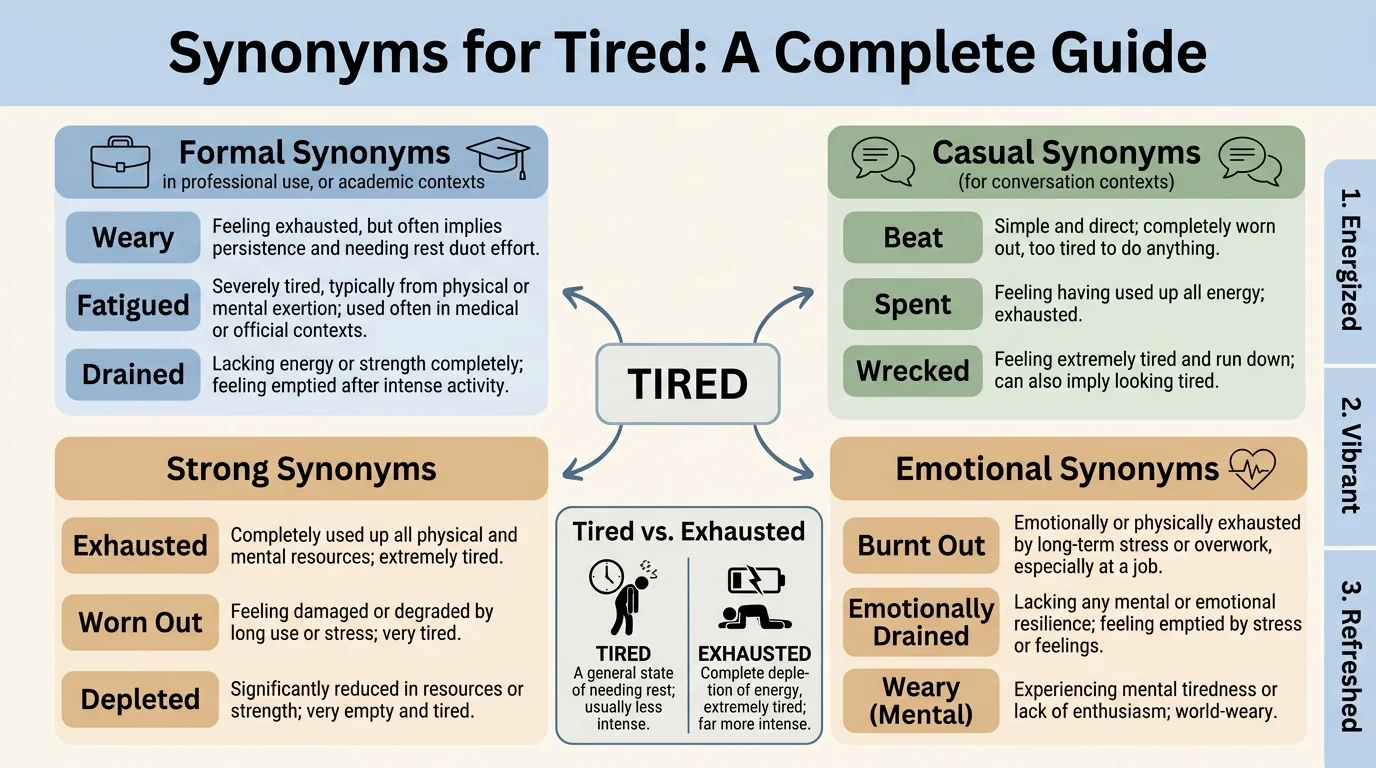
Do you keep using the word “tired” in emails, essays, captions, or conversations? It is a common habit. But repeating the same word makes your writing feel flat and your speech less engaging. You might feel exhausted, drained, or weary, yet you always say “tired.”
This guide will change that. We will explore over 50 synonyms for tired. You will learn the exact meaning of each alternative. You will understand which words work in professional settings, which are best for creative writing, and which fit casual conversations. By the end, you will choose the perfect word every time.
What Does “Tired” Mean?
Tired means feeling a need for rest or sleep due to physical or mental exertion. The best synonyms depend on context. For formal writing, use “fatigued.” casual conversation, try “worn out.” academic work, “enervated” is precise.
For emotional contexts, “drained” works well. creative writing, “weary” adds depth. professional emails, “depleted” is effective. Always match the word to your situation.
Meaning, Tone and Context
Tired is an adjective that describes a lack of energy or a strong desire to rest. Its tone is neutral but leans slightly negative. The formality level is low to moderate, making it appropriate for everyday speech and general writing. Common use cases include describing physical exhaustion after exercise, mental fatigue after study or work, or emotional weariness from stress.
The word can also describe something that feels overused or unoriginal, like a “tired excuse.” Related forms include the noun “tiredness” and the verb “tire,” as in “to tire someone out.” The opposite is “energized” or “refreshed.”
When and How to Use “Tired”
Use “tired” when you need a simple, clear, and direct way to say you need rest. It fits most situations. However, for stronger impact or specific nuance, choose a more precise synonym.
Here are examples of “tired” in different contexts.
Professional context:
After the long meeting, I felt too tired to focus on the remaining reports.
Personal context:
I am so tired after that workout. I think I will take a nap.
Academic context:
The students were visibly tired during the final exam week.
Emotional context:
She felt tired of the constant arguments and needed a break from the relationship.
Creative context:
The old house looked tired with its peeling paint and creaking floors.
Social media caption:
This week has left me feeling tired and ready for a cozy weekend.
Email context:
I am feeling a bit tired today, so I will complete this task tomorrow morning.
Another Word for “Tired”
The best single replacement depends heavily on your context.
For professional writing: use “fatigued.” This word conveys a clinical or formal sense of exhaustion.
For academic writing: use “enervated.” This term implies a loss of vitality or strength.
For casual conversation: use “worn out.” It is relatable and common in everyday speech.
For emotional writing: use “drained.” It suggests energy has been slowly depleted.
For creative writing: use “weary.” It adds a sense of world-weariness and deeper fatigue.
For resume use: you would not say tired. Instead, you might say you are “motivated” or “driven.” If describing a challenge, say you managed a “demanding” project.
For social media captions: use “zonked” for a playful tone or “exhausted” for a relatable one.
For stronger meaning: use “debilitated.” This suggests extreme weakness.
For softer meaning: use “sleepy.” It focuses more on the desire to sleep than general fatigue.
When Not to Use “Tired”
Avoid using “tired” when you need to be specific or formal. It is too vague for professional reports or academic essays.
Incorrect:
The experimental results were tired and uninteresting.
Correct:
The experimental results were repetitive and unoriginal.
Here, “tired” means overused, but “repetitive” is more precise and academic.
Incorrect:
The CEO appeared tired during the shareholder meeting.
Correct:
The CEO appeared fatigued during the shareholder meeting.
“Fatigued” sounds more professional and appropriate for the setting.
Avoid “tired” when you want to express extreme physical weakness.
Incorrect:
After the marathon, I was tired.
Correct:
After the marathon, I was exhausted.
“Exhausted” better captures the severity of the condition.
Words Commonly Confused With “Tired”
People often mix up “tired” with several related words. Here is how to tell them apart.
Tired vs. Sleepy
Tired means you need rest or have low energy. Sleepy specifically means you feel ready to fall asleep. You can be tired without being sleepy if you are mentally fatigued but not drowsy.
Tired vs. Exhausted
Tired is a general lack of energy. Exhausted is a much stronger, more extreme version. Use exhausted when you are completely drained with no energy left.
Tired vs. Weary
Weary implies a deeper sense of being tired from prolonged effort or worry. It has an emotional or mental component. Tired is more often physical or general.
Tired vs. Fatigued
Fatigued is the formal, clinical synonym for tired. It is often used in medical or professional contexts. Tired is more common in everyday language.
Tired vs. Lethargic
Lethargic means you feel sluggish and have no energy. It implies a lack of motivation or physical weakness. Tired is broader and includes the simple need for sleep.
Tired vs. Drained
Drained suggests that your energy has been slowly depleted, like a battery. It often has an emotional component. Tired is a simpler, more general term.
Best Synonym by Context for “Tired”
This table shows the most appropriate synonym for different situations.
| Context | Best Synonym | Why It Works | Example |
|---|---|---|---|
| Formal writing | Fatigued | It sounds objective and clinical. | The patient reported feeling fatigued after the treatment. |
| Academic writing | Enervated | It conveys a loss of vitality in a precise way. | The prolonged study left the participants enervated. |
| Professional business use | Depleted | It suggests resources, including energy, are used up. | Our team is depleted after the intense quarter. |
| Resume use | N/A | Avoid negative words. Use “driven” or “motivated.” | Managed a demanding project while maintaining team morale. |
| Casual conversation | Worn out | It is relatable and common. | I am worn out from running errands all day. |
| Creative writing | Weary | It adds a poetic, world-weary feel. | The weary traveler finally reached the inn. |
| Emotional tone | Drained | It connects physical fatigue to emotional stress. | After the conversation, I felt emotionally drained. |
| Strong intensity | Debilitated | It shows extreme weakness and exhaustion. | The illness left him debilitated for weeks. |
| Soft moderate tone | Sleepy | It focuses on the desire to sleep, not general fatigue. | The warm room made me feel sleepy. |
| Social media captions | Zonked | It is playful and modern. | That workout has me totally zonked. |
Which Synonym Should You Choose?
Choosing the right word is easy when you follow this practical guide.
First, think about the meaning you want to convey. Are you physically tired, mentally tired, or emotionally tired? Use “fatigued” for physical, “enervated” for mental, and “drained” for emotional.
Second, consider formality. In a report, use “fatigued.” In a text, use “worn out.”
Third, think about intensity. For mild tiredness, say “sleepy” or “weary.” For extreme cases, say “debilitated” or “exhausted.”
Fourth, consider your audience. In a professional email to a client, choose “depleted” or “fatigued.” In a personal journal, choose “drained” or “exhausted.”
Finally, let the sentence guide you. If you are describing a person, “weary” adds depth. If you are describing a situation, “draining” describes the feeling.
Real Life Examples of “Tired” in Sentences
Here are examples showing how to use different synonyms for tired in everyday situations.
School context:
The students were exhausted after their three hour final exam.
Workplace context:
My colleague felt drained after back to back meetings all afternoon.
Writing context:
The writer used the word “weary” to describe the protagonist’s long journey.
Conversation context:
I told my friend I felt worn out from my busy week.
Social media context:
This week has me completely zonked. Time for a break.
Email context:
I am feeling quite depleted today, so I will send the report in the morning.
Storytelling context:
The knight, weary from years of battle, finally laid down his sword.
25 Synonyms for “Tired”
Here is a table of 15 accurate synonyms. Each one has a unique meaning and purpose.
| Synonym | Simple Meaning | Best Used For | Example Sentence |
|---|---|---|---|
| Fatigued | Physically or mentally exhausted. | Medical, professional, and formal reports. | The doctor noted that the patient was severely fatigued. |
| Exhausted | Completely used up of energy. | Describing extreme physical or mental effort. | After the marathon, I was completely exhausted. |
| Weary | Tired from prolonged effort or worry. | Creative writing and emotional contexts. | He gave a weary sigh and sat down. |
| Drained | Energy slowly depleted. | Emotional or mental fatigue. | The argument left me feeling emotionally drained. |
| Worn out | Damaged or made tired by use. | Casual conversation and everyday speech. | My old shoes are worn out from all the walking. |
| Depleted | Used up or emptied of resources. | Professional and business contexts. | Our energy reserves are depleted. |
| Enervated | Lacking mental or physical vitality. | Academic and precise writing. | The heat wave left everyone enervated. |
| Debilitated | Weakened in strength. | Describing severe illness or extreme exhaustion. | The long illness debilitated him. |
| Lethargic | Sluggish and lacking energy. | Describing a state of inactivity or apathy. | I felt lethargic all afternoon. |
| Sleepy | Ready to go to sleep. | Soft, moderate tone. | The warm tea made me feel sleepy. |
| Jaded | Tired and bored from too much of something. | Describing emotional fatigue from overexposure. | He is jaded after years in the music industry. |
| Spent | Used up or exhausted. | Casual and literary contexts. | I am completely spent after that long day. |
| Listless | Lacking energy or enthusiasm. | Describing a lack of interest or motivation. | The students looked listless during the lecture. |
| Wan | Pale and tired looking. | Descriptive writing about appearance. | Her wan face showed she had not slept. |
| Pooped | Very tired. | Playful, informal context. | I am pooped after cleaning the whole house. |
Synonym Groups and Usage Differences
Professional vs. Personal Synonyms
Professional contexts require formal, objective words. “Fatigued” and “depleted” are excellent choices. They sound clinical and serious. “Enervated” is also acceptable in academic or scientific writing. Personal contexts are more flexible. You can use “worn out” with family. “Exhausted” works with friends. “Pooped” is funny and casual.
Formal vs. Conversational Synonyms
Formal synonyms include “fatigued,” “enervated,” and “debilitated.” These words belong in reports, official documents, and academic essays. Conversational synonyms include “worn out,” “pooped,” and “zonked.” These are perfect for texts, casual emails, and everyday chats. “Tired” itself sits in the middle.
Academic Synonyms
Academic writing values precision. “Enervated” is a strong choice. It means lacking vitality. “Fatigued” is also used in research and psychology. Avoid vague words like “tired” or “worn out” in formal academic work. Use “debilitated” to describe a physical weakening process.
Professional and Business Synonyms
In the workplace, use “depleted” to describe team energy. Say “fatigued” in a report. These words sound professional. “Exhausted” is acceptable but may be less formal. Use “spent” in a presentation to describe resources. Never use “pooped” or “zonked” in a professional email. It does not sound appropriate.
Creative or Literary Synonyms
Creative writing benefits from words with imagery. “Weary” suggests a heavy, world-weary feeling. “Jaded” implies boredom mixed with fatigue. “Wan” describes a physical appearance. These words add depth and atmosphere. “Listless” shows a lack of energy and interest. Use these to create vivid characters and scenes.
Slang or Modern Synonyms
“Zonked” is a playful slang term. “Pooped” is another fun, informal option. These words are acceptable among friends and on social media. They are too casual for professional writing. “Beat” is another slang synonym. It means very tired. Use it in texts but avoid it in formal contexts.
Strongest vs. Weaker Synonyms
Create an intensity scale from mild to strongest. “Sleepy” and “weary” are on the milder side. “Tired” is in the middle. “Exhausted” and “drained” are stronger. “Debilitated” is among the strongest. It implies a severe condition. “Fatigued” can be mild or severe, depending on context. Choose the intensity to match your feeling.
Emotional vs. Neutral Synonyms
“Drained” and “jaded” have strong emotional components. They suggest fatigue from stress or overexposure. “Weary” often carries emotional weight. “Fatigued” is more neutral and factual. “Enervated” is also neutral and clinical. Choose an emotional synonym to convey a feeling. Choose a neutral one to state a fact.
Antonyms of “Tired”
Here is a table of 15 antonyms for tired. These words represent the opposite states.
| Antonym | Meaning | Example Sentence |
|---|---|---|
| Energetic | Full of energy and vitality. | The children were energetic and playful. |
| Refreshed | Feeling restored and energetic. | I felt refreshed after a good night’s sleep. |
| Rejuvenated | Made to feel young and energetic. | The vacation rejuvenated her spirits. |
| Invigorated | Given energy and vitality. | The cold shower invigorated me. |
| Alert | Vigilant and fully conscious. | The soldiers remained alert during the night. |
| Active | Engaging in physical movement. | He is a very active person. |
| Awake | Not asleep. | She is awake and ready for work. |
| Fresh | Energetic and not tired. | I feel fresh after my morning coffee. |
| Lively | Full of life and energy. | The music made the party lively. |
| Vigorous | Strong and energetic. | She is a vigorous athlete. |
| Rested | Having had enough sleep. | I feel fully rested today. |
| Unflagging | Tireless and persistent. | His unflagging energy inspired the team. |
| Robust | Strong and healthy. | He is a robust and healthy man. |
| Dynamic | Energetic and forceful. | She is a dynamic leader. |
| Zestful | Full of energy and enthusiasm. | He is a zestful performer. |
Comparison: Tired vs. Similar Words
Understanding subtle differences is key to mastering vocabulary. Here are comparisons with commonly confused words.
Tired vs. Fatigued
The main difference is formality. “Tired” is the general, everyday word. “Fatigued” is formal. It is used in medical and professional settings. “Fatigued” implies a deeper, more clinical state. “Tired” can be used by anyone, anywhere.
Which one is stronger? “Fatigued” often suggests a more serious condition.
Which one is more formal? “Fatigued” is much more formal.
Example for Tired:
I am tired after my long walk.
Example for Fatigued:
The pilot reported feeling fatigued after the extended flight.
Tired vs. Exhausted
The main difference is intensity. “Tired” is mild to moderate. “Exhausted” is extreme. You feel tired after a busy day. You feel exhausted after running a marathon.
Which one is stronger? “Exhausted” is much stronger.
Which one is more formal? Neither is highly formal, but “exhausted” is common in all contexts.
Example for Tired:
I feel a bit tired tonight.
Example for Exhausted:
I am completely exhausted after that 10 mile run.
Tired vs. Weary
The main difference is the cause. “Tired” is often physical. “Weary” is often mental or emotional. It is tiredness from prolonged effort, struggle, or worry.
Which one is stronger? “Weary” has a deeper, more profound tone.
Which one is more formal? “Weary” is more literary and poetic.
Example for Tired:
My legs are tired from the hike.
Example for Weary:
She is weary of the constant political debates.
Tired vs. Drained
The main difference is the type of depletion. “Drained” suggests something slowly used up, like a battery. It has a strong emotional component. “Tired” is more general.
Which one is stronger? “Drained” suggests a complete lack of energy.
Which one is more formal? Both are moderate, but “drained” is common in professional contexts.
Example for Tired:
I am tired, so I will go to bed.
Example for Drained:
The emotional conversation left me feeling completely drained.
Tired vs. Lethargic
The main difference is the feeling of sluggishness. “Lethargic” implies a lack of desire to move or do anything. “Tired” simply means you need rest. You can be tired but still active. Lethargic people are inactive.
Which one is stronger? “Lethargic” suggests a more problematic lack of energy.
Which one is more formal? “Lethargic” is more formal and clinical.
Example for Tired:
I am too tired to cook dinner.
Example for Lethargic:
The patient felt lethargic and could not get out of bed.
Tired vs. Sleepy
The main difference is the specific urge to sleep. “Sleepy” means you are ready to fall asleep. “Tired” can mean you need rest, but not necessarily sleep.
Which one is stronger? Neither is stronger; they are different.
Which one is more formal? Both are casual.
Example for Tired:
I am tired after the long meeting.
Example for Sleepy:
The warm room is making me feel sleepy.
Common Phrases and Expressions with “Tired”
These phrases incorporate the word “tired” in common use.
1. Tired of waiting
Meaning: To be bored or impatient because something is taking too long.
Example sentence:
I am tired of waiting for the bus. Let’s just walk.
2. Bone tired
Meaning: Extremely exhausted, as if your bones themselves are tired.
Example sentence:
After moving all day, I am bone tired.
3. Sick and tired
Meaning: Extremely annoyed or bored with something.
Example sentence:
I am sick and tired of his excuses.
4. Tired out
Meaning: Completely exhausted from an activity.
Example sentence:
The children were tired out after playing in the park.
5. Tired old
Meaning: Describing something that is worn out or overused.
Example sentence:
He gave me the same tired old excuse.
6. Tired and emotional
Meaning: A British euphemism for drunk, implying tiredness and emotional instability.
Example sentence:
The politician was tired and emotional after the celebration.
7. Tired blood
Meaning: An old-fashioned term for anemia or a feeling of being run down.
Example sentence:
Her doctor said she had tired blood and needed more iron.
Common Mistakes to Avoid
Avoid these common errors when using synonyms for tired.
1. Using “tired” when a more precise synonym is better
Do not use “tired” in a professional report. Use “fatigued” or “depleted.” Being precise improves your writing.
Incorrect:
The team was tired after the project.
Correct:
The team was depleted after the project.
2. Confusing “tired” with “sleepy”
These are not the same. “Sleepy” means you want to sleep. “Tired” can be physical or mental.
Incorrect:
I am sleepy after my workout.
Correct:
I am tired after my workout.
3. Using a casual synonym in formal writing
Avoid “worn out” or “pooped” in academic essays or business reports.
Incorrect:
The data shows the subjects were worn out.
Correct:
The data shows the subjects were fatigued.
4. Using an overly dramatic synonym for a simple situation
Do not say you are “debilitated” after a short walk.
Incorrect:
I am debilitated after walking the dog.
Correct:
I am tired after walking the dog.
5. Repeating the same word too often
Variety is key. If you use “tired” in every sentence, your writing becomes dull. Use synonyms.
Incorrect:
I am tired. My friend is tired. The whole team is tired.
Correct:
I am exhausted. My friend is worn out. The whole team is drained.
6. Choosing a synonym with the wrong emotional tone
Do not use “jaded” if you are just physically tired. “Jaded” implies boredom and cynicism.
Incorrect:
I am jaded after my long run.
Correct:
I am exhausted after my long run.
7. Using slang in academic or professional writing
“Zonked,” “pooped,” and “beat” are not professional. Save them for casual conversations.
Incorrect:
The CEO looked zonked at the meeting.
Correct:
The CEO looked fatigued at the meeting.
FAQs
1. What is the best synonym for tired?
The best synonym depends on context. For general use, “exhausted” is a strong and common choice. For formal writing, “fatigued” is best.
2. What is a formal synonym for tired?
“Fatigued” is the most common formal synonym. “Enervated” and “debilitated” are also formal and precise options.
3. What is an informal synonym for tired?
“Worn out” is a very common informal synonym. “Pooped” and “zonked” are playful and informal slang terms.
4. What is another word for tired in professional writing?
“Depleted” is excellent for professional contexts. “Fatigued” is also a strong choice for reports and formal communication.
5. What is the difference between tired and fatigued?
“Tired” is a general, everyday word. “Fatigued” is more formal and clinical, often used in medical or professional settings.
6. What is the opposite of tired?
The opposite is “energized.” Other strong antonyms include “refreshed,” “invigorated,” and “rejuvenated.”
Conclusion
Tired is a useful word, but it should not be your only word. English gives you many ways to describe exhaustion, fatigue, and weariness. The best synonym depends on your context, audience, and meaning. Professional writing calls for “fatigued” or “drained.” Casual conversation welcomes “beat” or “worn out.” Creative writing can use “spent” or “languid.” Emotional writing needs “depleted” or “burnt out.”
Your vocabulary grows when you make conscious word choices. Pay attention to the intensity, tone, and formality of each synonym. Practice using new words in different situations. Over time, you will stop reaching for “tired” every time and start choosing words with precision and confidence. Good communication is about saying exactly what you mean, and the right synonym helps you do that.