Do you ever catch yourself using the word “power” repeatedly in your emails, essays, or social media posts? Many writers and professionals struggle to find fresh alternatives.
Repeating the same word makes your writing feel flat and uninspired. This guide will help you find the perfect synonym for power in every situation.
What Does “Power” Mean?
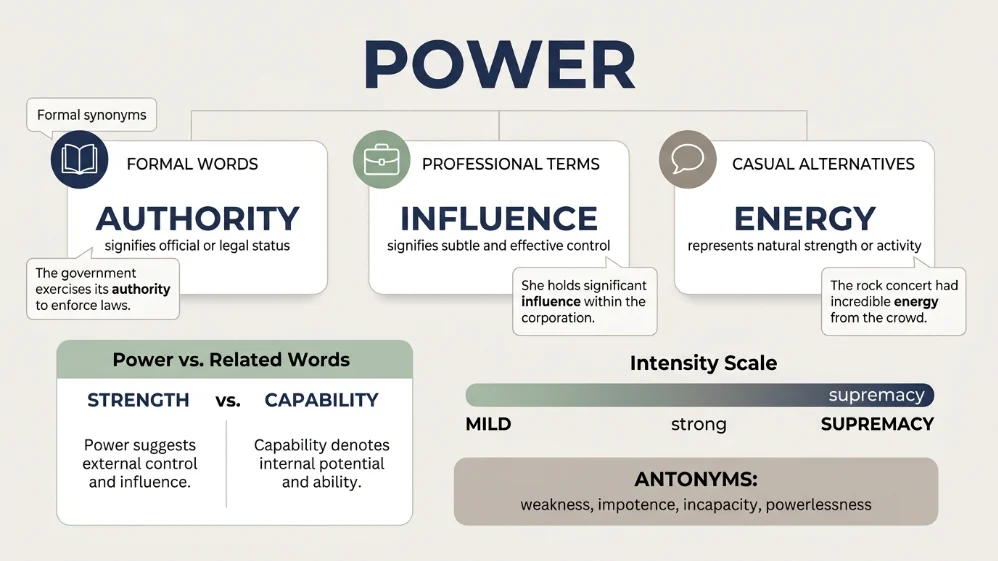
Power means the ability to influence, control, or act effectively. The best synonyms for power depend on context. Use authority for formal settings, strength for physical capacity, energy for personal drive, and influence for social situations. Creative writers might prefer might, while professionals often choose capability or jurisdiction.
Meaning, Tone and Context
- Simple definition: Power is the capacity to produce effects, control outcomes, or exert force.
- Part of speech: Noun (also used as a verb meaning to supply with energy).
- Tone: Neutral but can shift based on context.
- Formality level: Versatile; works in casual and formal writing.
- Common use cases: Leadership, physics, personal development, social dynamics, and engineering.
- Important word forms: Powerful (adjective), powerlessly (adverb), empower (verb), overpower (verb).
When and How to Use “Power”
You should use “power” when referring to general ability, control, or energy without needing specific precision. The word works well in everyday conversation and broad statements.
Here are realistic examples:
Professional: The manager has the power to approve new project budgets.
Personal: She found her inner power to overcome the challenging situation.
Academic: The research examined power dynamics in corporate leadership structures.
Creative: The storm displayed the raw power of nature across the coastline.
Social Media: Finding your personal power changes everything in life.
Resume: Proven ability to leverage power in strategic decision making.
Email: Please confirm who holds the power to authorize this expense request.
Another Word for “Power”
Professional writing
Authority works best when discussing decision making or official control. Use jurisdiction for legal contexts. Competence emphasizes ability without dominance.
Academic writing
Use influence for social science contexts. Agency describes individual capacity. Hegemony works for political theory. Efficacy emphasizes effectiveness.
Casual conversation
Use juice or punch for informal energy. Oomph adds personality to everyday speech. Grit works for personal determination.
Emotional writing
Use might for dramatic effect. Use passion for inner drive. Use determination for personal strength. Use resolve for overcoming obstacles.
Creative writing
Use dominion for territorial control. Use sovereignty for supreme authority. Use potency for concentrated strength. Use supremacy for absolute dominance.
Resume or workplace use
Use leadership for management roles. Use expertise for skill based power. Use influence for persuasive ability. Use decision making authority for clear job responsibilities.
Social media captions
Use vibes for casual energy. Use impact for visible results. Use drive for personal motivation. Use force for bold statements.
Stronger meaning
Use omnipotence, absolute control, or supreme authority for maximum intensity.
Softer meaning
Use capacity, capability, or potential for mild expressions of ability.
When Not to Use “Power”
Avoid “power” when you need precision in professional writing. The word sounds too vague in legal documents, technical reports, and scientific papers.
Example of vague usage: “The device has power.” Better: “The device has 500 watts of electrical output.”
Avoid “power” when discussing formal authority structures. “Authority” or “jurisdiction” sounds more professional in official contexts.
Example of informal usage: “The judge has power over this case.” Better: “The judge has jurisdiction over this case.”
Avoid “power” in emotional contexts when you want to show vulnerability. “Resilience” or “courage” often work better for personal growth narratives.
Example of mismatch: “She showed power after the loss.” Better: “She showed resilience after the loss.”
Avoid casual synonyms like “juice” in academic writing. These informal words reduce credibility in serious work.
Example of inappropriate usage: “The theory has juice.” Better: “The theory has significant influence.”
Words Commonly Confused With “Power”
Power vs. Authority
Power is general ability or control. Authority is legitimate, formal right to make decisions. A security guard has power to ask questions, but a police officer has authority to arrest.
Power vs. Strength
Power implies the ability to produce effects. Strength specifically means physical force or mental fortitude. An engine has power to move a car. A weightlifter has strength to lift heavy objects.
Power vs. Energy
Energy is the capacity to do work or act. Power is the rate of doing work. This distinction matters in physics. In everyday usage, energy refers to personal vitality while power refers to control or force.
Power vs. Influence
Power often implies direct control. Influence suggests indirect persuasion. A CEO has power to fire employees. A trusted advisor has influence over the CEO’s decisions.
Power vs. Might
Might carries a stronger, more dramatic tone. Power is neutral. A superhero uses might to fight villains. A manager uses power to coordinate teams.
Power vs. Capability
Capability emphasizes the potential to do something. Power often suggests the actual ability to achieve results. A student has capability to learn. A teacher has power to grade assignments.
Best Synonym by Context for “Power”
| Context | Best Synonym | Why It Works | Example |
|---|---|---|---|
| Formal writing | Authority | Conveys legitimate, official control | The committee has authority to approve regulations |
| Academic writing | Agency | Emphasizes individual capacity and choice | The study examined student agency in learning |
| Professional business | Influence | Shows persuasive ability without domination | Her influence shaped company strategy |
| Resume use | Leadership | Highlights management and decision making | Demonstrated leadership in cross functional teams |
| Casual conversation | Juice | Adds personality and informal energy | This car has plenty of juice for the road |
| Creative writing | Dominion | Creates dramatic, literary imagery | The dragon claimed dominion over the mountain |
| Emotional tone | Resolve | Conveys personal determination and courage | Her resolve carried her through difficult times |
| Strong intensity | Supremacy | Shows absolute or overwhelming control | The empire maintained supremacy across the region |
| Soft or moderate tone | Capability | Downplays dominance, focuses on ability | The system has capability to process large data |
| Social media captions | Impact | Focuses on visible results and change | Your impact on this community is amazing |
| US usage | Authority | Standard American English for formal contexts | The governor has authority over state matters |
| UK usage | Influence | Common in British professional writing | Her influence in the department is significant |
Which Synonym Should You Choose?
Consider your audience first. Formal documents require authority or jurisdiction. Personal messages work well with strength or energy.
Think about the intensity you want. Use supremacy for absolute power. Choose capability for moderate ability. Match the intensity to your topic.
Check the emotional tone. Use resolve or determination for inspirational writing. Use influence for neutral professional contexts.
Consider the sentence rhythm. Short words like “force” create impact. Longer words like “capability” sound more analytical. Vary your choices for interesting writing.
Real Life Examples of “Power” in Sentences
School: The principal has power to enforce school policies and maintain order.
Workplace: Our team used collective power to complete the project ahead of schedule.
Writing: Good writers understand the power of precise word choice in their work.
Conversation: His personal power made everyone listen when he spoke during meetings.
Social Media: Unlock your power to create the life you want and inspire others to grow.
Resume: Leveraged organizational power to streamline operations across departments.
Email: Please direct all budget questions to the finance team, who holds the power to approve expenditures.
Storytelling: The ancient artifact contained power that no one fully understood or controlled.
15 Synonyms for “Power”
| Synonym | Simple Meaning | Best Used For | Example Sentence |
|---|---|---|---|
| Authority | Official right to make decisions | Professional and legal writing | The board has authority to hire new executives |
| Influence | Indirect ability to shape outcomes | Business and social contexts | Her influence changed the entire project direction |
| Strength | Physical or mental force | Personal development and fitness | He showed incredible strength during the crisis |
| Energy | Vitality and capacity to act | Health and lifestyle writing | She brought positive energy to every meeting |
| Might | Great physical or political force | Literary and dramatic contexts | The warrior used his might to protect the village |
| Capability | Potential or ability to achieve | Technical and academic writing | The software has capability to handle complex calculations |
| Dominion | Control over territory or people | Historical and fantasy writing | The king claimed dominion over all neighboring lands |
| Supremacy | Ultimate or highest authority | Political and competitive contexts | The team established supremacy in the league |
| Command | Control and direction over others | Military and management contexts | He took command of the emergency situation |
| Potency | Concentrated strength or effectiveness | Medical and scientific writing | The medicine showed remarkable potency in trials |
| Jurisdiction | Official legal authority | Legal and governmental writing | This court has jurisdiction over federal cases |
| Agency | Capacity to act independently | Social science and philosophy | Students develop agency through project based learning |
| Grip | Strong control or understanding | Idiomatic and descriptive writing | She has a firm grip on the situation |
| Force | Physical power or coercion | Physics and dramatic contexts | The force of the wind damaged the building |
| Leverage | Strategic advantage or influence | Business and professional writing | Use your network as leverage for career growth |
Synonym Groups and Usage Differences
Professional vs. Personal Synonyms
Professional contexts favor authority, jurisdiction, and leverage. These words suggest formal structures and official capacity. Personal writing often uses strength, energy, and resolve. These words connect to individual experience and internal motivation.
Formal vs. Conversational Synonyms
Formal writing uses authority, jurisdiction, and supremacy. These words appear in legal documents, research papers, and official reports. Conversational writing prefers juice, punch, and grit. These informal alternatives work well in emails, texts, and social media.
Academic Synonyms
Academic writing requires precise terminology. Use agency for individual capacity. Use hegemony for cultural dominance. Use efficacy for practical effectiveness. Use influence for social science contexts. These words demonstrate scholarly understanding and research awareness.
Professional and Business Synonyms
Business writing benefits from influence, leverage, and authority. Use impact for measurable results. Use command for leadership situations. Use decision making capacity for job descriptions. These choices show professional competence and strategic thinking.
Creative or Literary Synonyms
Creative writers choose dominion, might, and sovereignty. Use supremacy for dramatic effect. Use potency for concentrated descriptions. Use grandeur for impressive displays of power. These words add imagery and emotional depth to narratives.
Slang or Modern Synonyms
Juice and punch work well in casual modern contexts. Use vibes for contemporary social media content. These words are acceptable in informal writing but never appropriate for academic or professional documents.
Strongest vs. Weaker Synonyms
Mild alternatives include capacity, ability, and potential. Moderate options include influence, authority, and command. Strong choices include supremacy, omnipotence, and absolute control. Match intensity to your subject and audience.
Emotional vs. Neutral Synonyms
Emotional synonyms include resolve, determination, and courage. Neutral options include capability, authority, and capacity. Choose based on whether you want to inspire or inform.
Antonyms of “Power”
| Antonym | Meaning | Example Sentence |
|---|---|---|
| Weakness | Lack of physical or mental strength | The illness left him with significant weakness |
| Powerlessness | Complete lack of control or influence | She felt powerlessness in the bureaucratic process |
| Inability | Lack of capacity to act or achieve | His inability to focus affected his performance |
| Subordination | Lower position in a hierarchy | The staff accepted their subordination to management |
| Dependence | Reliance on others for support | His dependence on medication created complications |
| Impotence | Lack of effective power | The manager felt impotence when budget cuts occurred |
| Helplessness | Inability to protect oneself | The child’s helplessness moved everyone to action |
| Inferiority | Lower status or quality | The team accepted their inferiority in the competition |
| Subjection | Being controlled by others | The population lived in subjection to the regime |
| Vulnerability | Openness to harm or attack | Her vulnerability made her more relatable to others |
| Disability | Physical or mental limitation | The disability required workplace accommodations |
| Incompetence | Lack of skill or ability | The project failed due to management incompetence |
| Irrelevance | Lack of importance or influence | His opinion had irrelevance in the final decision |
| Ineffectiveness | Failure to produce desired results | The policy showed ineffectiveness over time |
| Domination | Being controlled or ruled | The country resisted domination by foreign powers |
Comparison: Power vs. Similar Words
Power vs. Authority
Main difference: Power is general ability; authority is legitimate right. Authority is stronger in formal contexts. Power is more versatile. Example: “The manager has power over scheduling but authority to fire employees.”
Power vs. Influence
Main difference: Power implies direct control; influence suggests indirect persuasion. Influence is softer and more diplomatic. Power is more direct. Example: “The CEO has power to make decisions, while the advisor has influence over those decisions.”
Power vs. Strength
Main difference: Power emphasizes effectiveness; strength emphasizes force. Strength is more physical. Power is broader. Example: “His physical strength helped him lift the object, but his power came from his strategic thinking.”
Power vs. Might
Main difference: Power is neutral; might is dramatic and literary. Might is stronger in intensity. Power is more versatile. Example: “The army showed its might in battle, but the government showed its power through policy.”
Power vs. Capability
Main difference: Power suggests actual results; capability suggests potential. Capability is softer and more technical. Power implies action. Example: “The system has capability to process data, but its power comes from its speed.”
Power vs. Energy
Main difference: Power is about control and effectiveness; energy is about vitality and action. Energy is more personal. Power is broader. Example: “Her energy made her productive, but her power made her influential.”
Common Phrases and Expressions with “Power”
1. Power of attorney
Meaning: Legal authority to act on someone else’s behalf.
Example sentence: She granted him power of attorney to manage her financial affairs.
2. The powers that be
Meaning: The people in positions of authority.
Example sentence: The powers that be decided to cancel the project without explanation.
3. Power play
Meaning: A strategic move to gain control or advantage.
Example sentence: His decision to hire new staff was a power play that surprised everyone.
4. Power trip
Meaning: Behavior showing enjoyment of authority over others.
Example sentence: The supervisor went on a power trip and alienated the whole team.
5. Power struggle
Meaning: Conflict between people trying to gain control.
Example sentence: The power struggle between department heads delayed the project.
6. To the power of
Meaning: Mathematical notation for exponents.
Example sentence: The value increased to the power of three in just two years.
7. Power lunch
Meaning: A business meal used for networking or decision making.
Example sentence: He closed the deal during a power lunch with the investors.
8. Power dressing
Meaning: Dressing in a way that projects authority.
Example sentence: Her power dressing style earned respect at the boardroom table.
Common Mistakes to Avoid
- Using “power” when a more precise synonym works better. This happens frequently in professional writing where “authority” or “jurisdiction” would clarify meaning.
- Confusing “power” with “strength” in technical contexts. Use “power” for energy transfer rates and “strength” for material resistance.
- Using casual synonyms like “juice” in academic writing. This reduces credibility and sounds unprofessional.
- Using overly dramatic synonyms like “supremacy” for simple situations. This creates unnecessary intensity and sounds unnatural.
- Repeating the same synonym for power too often. Vary your word choice to maintain reader interest and precise meaning.
- Choosing a synonym with the wrong emotional tone. “Force” sounds aggressive while “influence” sounds diplomatic. Match the tone to your context.
- Using slang like “oomph” in professional emails. Save casual alternatives for personal communication.
FAQs
What is the best synonym for power?
The best synonym depends on context. Use authority for formal situations, strength for physical contexts, and influence for professional writing.
What is a formal synonym for power?
Authority and jurisdiction are the most formal synonyms for power. These words work well in legal and official documents.
What is an informal synonym for power?
Juice and punch work as informal synonyms for power. Use them only in casual conversation or social media content.
What is another word for power in professional writing?
Influence and leverage are excellent professional synonyms for power. These words emphasize strategic ability and persuasive capacity.
What is the difference between power and authority?
Power means general ability or control. Authority means legitimate official right to make decisions. Authority is more formal and specific.
What is the opposite of power?
Weakness is the direct opposite of power. Other antonyms include powerlessness, inability, and subordination depending on context.
Conclusion
Power is a versatile word that means the ability to influence, control, or act effectively. The best synonym for power depends on your writing situation. Use authority for formal contexts, strength for physical descriptions, influence for professional settings, and might for creative writing. Remember that precise word choice improves clarity and keeps your audience engaged. Build your vocabulary by practicing these alternatives in your daily writing.