Have you ever read through an email, essay, or story and noticed the word “was” appearing in almost every sentence? Many writers fall into this habit without realizing how much it weakens their writing. The word “was” serves a clear purpose in English, but overusing it makes sentences feel flat and repetitive. When you search for synonyms of was, you are not simply looking for a dictionary swap. You are looking for ways to make your writing more active, vivid, and professional. Choosing the right synonym improves clarity, adjusts tone, and helps you communicate with greater precision in every situation.
What Are the Best Synonyms of “Was”?
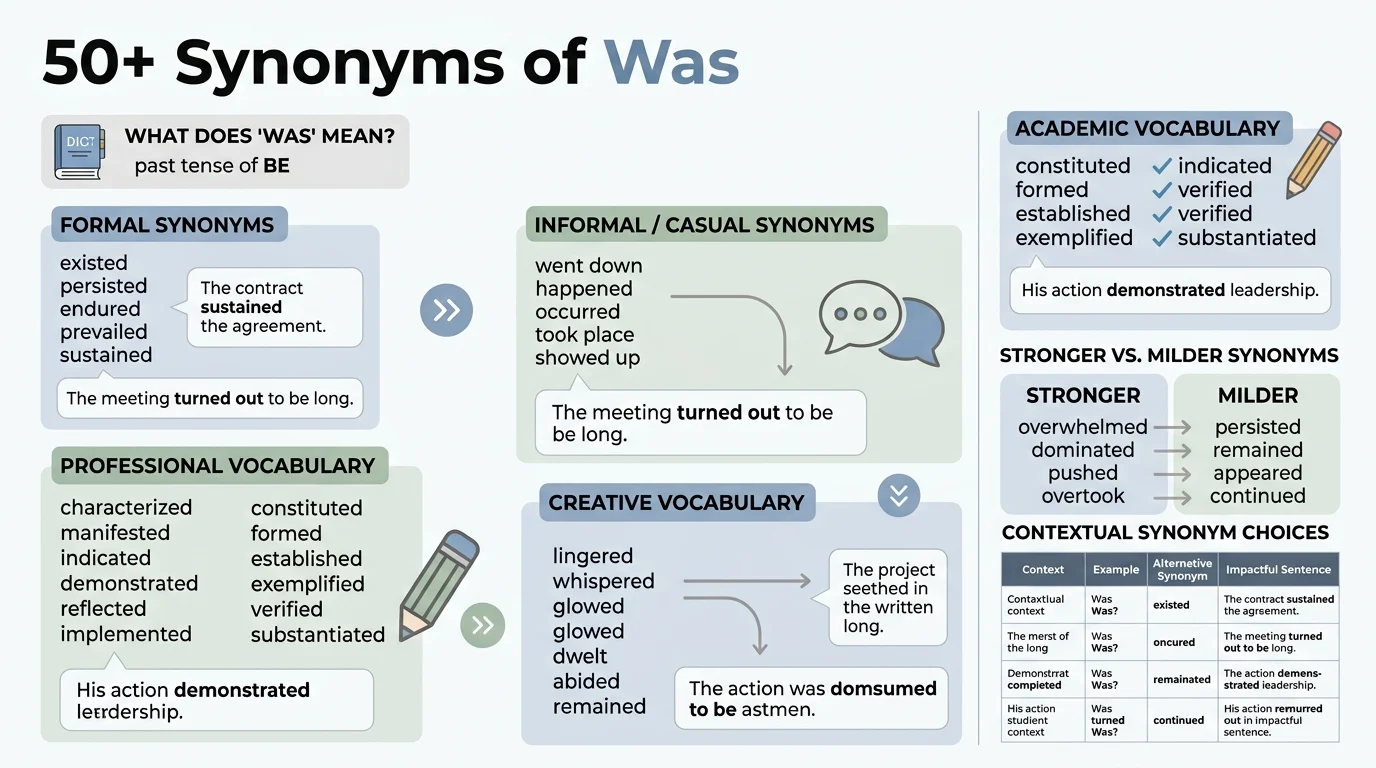
The word “was” is the past tense of “be” and indicates a state of existence, condition, or action in the past. For professional writing, use “served as” or “functioned as.” Creative writing, use “stood,” “remained,” or “appeared.” For casual conversation, “was” usually works fine. Academic writing, use “constituted” or “represented” to sound more authoritative.
Meaning, Tone, and Context
Simple Definition
“Was” is the first and third person singular past tense of the verb “be.” It describes a state, condition, or action that existed in the past.
Part of Speech
Verb (past tense)
Overall Tone
Neutral. The word itself carries no emotional weight or strong connotation.
Formality Level
Neutral. “Was” works in every formality level, from casual texting to formal academic writing.
Common Uses
Native English speakers use “was” constantly in spoken and written English. It appears in:
- Describing past conditions
- Telling stories
- Reporting events
- Making comparisons
- Expressing feelings or states
Word Forms
- Base form: be
- Past tense: was
- Past participle: been
- Present participle: being
- Third person singular present: is
When and How to Use “Was”
The word “was” works perfectly when you need to state a simple past fact without extra emphasis. However, many writers overuse it when stronger verbs would improve their sentences. Use “was” when you want neutral, straightforward communication. Choose alternatives when you need to add action, emotion, or precision.
Here are seven examples showing how “was” works in different contexts.
Professional Context
The project was completed ahead of schedule.
Academic Context
The experiment was conducted under controlled conditions.
Workplace Context
She was responsible for managing the entire department.
Personal Context
I was nervous before my first public speaking event.
Email Context
The document was attached to my previous message.
Resume Context
I was the lead designer for three major product launches.
Social Media Context
Yesterday was the best day of my entire trip.
Best Synonyms of “Was”
No synonym matches “was” perfectly in every situation. Each alternative changes the tone, emphasis, or meaning of your sentence. The best synonym depends entirely on your context, audience, and purpose.
Here are the best synonyms of “was” by writing context.
Professional Writing
Use “served as” when describing a role or position. This synonym sounds confident and active. It implies you made a meaningful contribution rather than simply occupying a space.
Academic Writing
Use “constituted” when describing components or elements. This word sounds precise and authoritative in research contexts.
Business Communication
Use “functioned as” when describing operational roles. This synonym highlights practical contribution and effectiveness.
Casual Conversation
Stick with “was.” Alternatives often sound forced in everyday speech.
Emotional Writing
Use “felt like” when describing subjective experiences. This synonym adds personal depth.
Creative Writing
Use “stood” or “loomed” when describing presence or significance. These verbs add visual imagery.
Resume Writing
Use “acted as” when describing temporary or project based roles. This shows flexibility and initiative.
Workplace Communication
Use “remained” when describing consistency or persistence. This shows reliability.
Stronger Meaning
Use “dominated,” “commanded,” or “presided over” to show authority or influence.
Softer Meaning
Use “seemed” or “appeared” when describing uncertainty or perception.
When Not to Use “Was”
The word “was” becomes a problem when it appears too frequently in your writing. Here are specific situations where you should choose a stronger alternative.
When Your Writing Sounds Too Vague
Sentences using “was” often lack action. Compare “The CEO was at the meeting” with “The CEO dominated the meeting.” The second version shows leadership and presence.
Weak Sentence
He was the manager of the team.
Stronger Sentence
He managed the team effectively.
When You Need More Professional Impact
Resumes filled with “was” sound passive and uninspired. Hiring managers notice candidates who use active, confident language.
Weak Sentence
I was responsible for increasing sales.
Stronger Sentence
I increased sales by 35 percent in one year.
When Your Writing Sounds Too Formal or Too Informal
“Was” works everywhere, but sometimes you need a word that better matches the tone of your message.
Too Informal
The presentation was good.
Better Alternative
The presentation resonated with the audience.
When the Word Sounds Overused
Repetition makes readers lose interest. Vary your word choices to maintain engagement.
Repetitive
The building was tall. The building was old. The building was empty.
Improved Version
The building stood tall. It remained old and empty.
When You Need Stronger Emotional Impact
“Was” communicates facts but not feelings. Choose alternatives that connect with readers emotionally.
Neutral Statement
The movie was sad.
Emotional Statement
The movie left everyone in tears.
Words Commonly Confused With “Was”
Many writers confuse “was” with other past tense verbs. Understanding these differences helps you choose more precise language.
Was vs Were
Difference
“Was” applies to first and third person singular. “Were” applies to second person singular and all plural forms.
When to Use Each
Use “was” with I, he, she, it. Use “were” with you, we, they.
Example with Was
I was happy with the results.
Example with Were
They were happy with the results.
Was vs Had Been
Difference
“Was” describes a past state. “Had been” describes a past state that ended before another past event.
When to Use Each
Use “was” for simple past. Use “had been” for past perfect.
Example with Was
She was tired after the meeting.
Example with Had Been
She had been tired before the meeting started.
Was vs Is
Difference
“Was” refers to the past. “Is” refers to the present.
When to Use Each
Use “was” for past events. Use “is” for current facts.
Example with Was
The store was closed yesterday.
Example with Is
The store is closed today.
Was vs Became
Difference
“Was” describes a static state. “Became” describes a change or transition.
When to Use Each
Use “was” for existing conditions. Use “became” for transformations.
Example with Was
He was a teacher.
Example with Became
He became a teacher after years of training.
Was vs Felt
Difference
“Was” states a fact. “Felt” describes a subjective experience.
When to Use Each
Use “was” for objective statements. Use “felt” for personal impressions.
Example with Was
The room was cold.
Example with Felt
The room felt cold to me.
Was vs Appeared
Difference
“Was” states something as certain. “Appeared” suggests uncertainty or perception.
When to Use Each
Use “was” for definite statements. Use “appeared” for observations.
Example with Was
She was angry.
Example with Appeared
She appeared angry, but I was not sure.
Best Synonyms of “Was” by Context
| Context | Best Synonym | Why It Works | Example |
|---|---|---|---|
| Formal writing | Served as | Emphasizes purposeful contribution | She served as the committee chair for three years. |
| Academic writing | Constituted | Sounds precise and authoritative | The participants constituted a diverse sample population. |
| Professional communication | Acted as | Highlights temporary or specific roles | He acted as the project liaison between departments. |
| Business emails | Functioned as | Shows practical operational value | The new system functioned as our primary data source. |
| Resume writing | Operated as | Projects confidence and action | I operated as the regional sales director. |
| Workplace communication | Remained | Shows consistency and reliability | She remained calm throughout the crisis. |
| Casual conversation | Was | Natural and unforced | The movie was really good. |
| Everyday speaking | Was | No alternative needed | I was at home all day. |
| Creative writing | Stood | Adds visual imagery and presence | The old house stood on the hill. |
| Storytelling | Loomed | Creates tension or significance | The deadline loomed over the entire team. |
| Emotional writing | Felt like | Adds personal depth | It felt like the end of an era. |
| Strong emphasis | Dominated | Shows power or authority | The champion dominated every match. |
| Mild tone | Seemed | Expresses uncertainty or perception | He seemed confused by the question. |
| Social media captions | Was | Concise and works for short content | This view was everything. |
| American English | Was | Standard in all US contexts | The team was ready to start. |
| British English | Was | Standard in all UK contexts | The team was ready to start. |
How to Choose the Best Synonym of “Was”
Choosing the right synonym starts with understanding what you want to communicate. Follow this practical decision guide.
Start with your audience. Professional and academic audiences expect precise, active language. Casual audiences prefer natural, straightforward communication.
Consider your purpose. Are you stating a fact, describing a change, or creating an emotional connection? Facts need accuracy. Changes need transition verbs. Emotions need expressive language.
Think about tone. Formal writing requires words like “constituted” and “served as.” Creative writing allows words like “loomed” and “stood.” Professional writing benefits from “functioned as” and “operated as.”
Evaluate emotional strength. Some alternatives carry more weight than others. “Loomed” feels more dramatic than “was.” “Remained” feels steadier and more reliable.
Read your sentence aloud. If an alternative sounds unnatural, choose a different word. The best synonym sounds natural in context.
Real Life Examples of “Was”
These examples show how choosing stronger alternatives improves everyday communication.
School Assignment
Original: The character was important to the story.
Improved: The character stood at the center of the entire plot.
College Essay
Original: The experience was life changing.
Improved: The experience transformed my entire perspective.
Workplace Email
Original: The meeting was productive.
Improved: The meeting produced several actionable ideas.
Business Presentation
Original: Our approach was effective.
Improved: Our approach delivered measurable results.
Resume Statement
Original: I was responsible for budget management.
Improved: I managed a budget of two million dollars.
Conversation
Original: The restaurant was crowded.
Improved: The restaurant felt overcrowded and noisy.
Storytelling
Original: The night was dark.
Improved: The night remained dark and silent.
Blogging
Original: The product was popular.
Improved: The product resonated with customers immediately.
Social Media
Original: Today was amazing.
Improved: Today exceeded every expectation.
18 Best Synonyms of “Was”
| Synonym | Simple Meaning | Best Used For | Example Sentence |
|---|---|---|---|
| Served as | Held a specific role | Professional and resume writing | She served as the lead researcher on the project. |
| Functioned as | Operated in a particular capacity | Business and technical writing | The device functioned as both a phone and a computer. |
| Acted as | Performed a temporary or specific role | Workplace and project communication | He acted as the team coordinator during the transition. |
| Constituted | Formed or made up something | Academic and formal writing | The findings constituted a major breakthrough. |
| Remained | Continued to be | Workplace and descriptive writing | She remained focused despite the interruptions. |
| Stood | Occupied a position or state | Creative and descriptive writing | The monument stood tall against the skyline. |
| Appeared | Seemed or gave an impression | Observational and uncertain contexts | He appeared surprised by the announcement. |
| Felt like | Gave a subjective impression | Emotional and personal writing | It felt like the right decision at the time. |
| Loomed | Seemed large or threatening | Dramatic and creative writing | The storm loomed over the coastal town. |
| Represented | Stood for or symbolized | Academic and professional writing | The data represented a significant trend. |
| Operated as | Functioned or worked in a role | Business and technical contexts | The department operated as a separate entity. |
| Presided over | Held authority in a situation | Leadership and formal contexts | She presided over the annual conference. |
| Commanded | Controlled or demanded attention | Strong and authoritative writing | The general commanded respect from everyone. |
| Dominated | Prevailed or controlled | Competitive and descriptive contexts | The team dominated the championship season. |
| Seemed | Gave an appearance without certainty | Cautious and observational writing | The solution seemed obvious in hindsight. |
| Existed as | Had reality or being | Philosophical and formal contexts | The concept existed as a theoretical idea. |
| Held the position of | Occupied a formal role | Resume and professional writing | He held the position of vice president for five years. |
| Maintained | Kept or preserved a state | Professional and descriptive writing | She maintained her composure throughout the interview. |
Synonyms of “Was” by Usage
Professional vs Personal Synonyms
Professional settings demand active, confident language. Replace “was” with verbs that show action and contribution.
Best Professional Synonyms
- Served as
- Acted as
- Functioned as
- Operated as
- Maintained
Best Personal Synonyms
- Was
- Felt like
- Seemed
- Appeared
Professional Example
I served as the project lead for three years.
Personal Example
I was happy with the outcome.
Formal vs Conversational Synonyms
Writing requires vocabulary that sounds precise and authoritative.
Formal Synonyms
- Constituted
- Represented
- Presided over
- Existed as
Conversational Synonyms
- Was
- Seemed
- Felt like
Formal Example
The committee constituted a diverse group of experts.
Conversational Example
The party was a lot of fun.
Academic Synonyms
Academic writing values precision and authority. These synonyms work well in research papers, essays, and scholarly discussions.
- Constituted
- Represented
- Served as
- Existed as
- Functioned as
Academic Example
The sample constituted twenty percent of the total population.
Professional and Business Synonyms
These synonyms project confidence and competence in workplace settings.
- Served as
- Operated as
- Acted as
- Functioned as
- Maintained
Business Example
The software operated as the central hub for all customer data.
Creative and Literary Synonyms
Writing benefits from vivid, visual language.
- Stood
- Loomed
- Remained
- Appeared
- Commanded
Creative Example
Mountain stood against the bright blue sky.
Slang or Modern Synonyms
No direct slang equivalents exist for “was” that work in standard writing. The word remains unchanged in informal contexts.
Strongest to Mildest Synonyms
Mild Synonyms
- Was
- Seemed
- Appeared
Moderate Synonyms
- Remained
- Served as
- Acted as
Strong Synonyms
- Functioned as
- Operated as
- Represented
Very Strong Synonyms
- Dominated
- Commanded
- Presided over
- Loomed
Emotional vs Neutral Synonyms
Emotional Synonyms
These words add feeling and personal perspective.
- Felt like
- Loomed
- Commanded
- Dominated
Neutral Synonyms
These words convey information without emotion.
- Was
- Served as
- Functioned as
- Acted as
Antonyms of “Was”
| Antonym | Meaning | Example Sentence |
|---|---|---|
| Became | Changed into or transformed | He became a respected leader in the community. |
| Turned | Changed direction or state | The weather turned cold in the afternoon. |
| Grew | Developed or increased | She grew more confident with each presentation. |
| Changed | Became different | The situation changed dramatically overnight. |
| Shifted | Moved or changed position | Public opinion shifted after the announcement. |
| Transformed | Completely changed form | The company transformed its entire business model. |
| Evolved | Gradually developed | The project evolved into something much larger. |
| Transitioned | Moved from one state to another | The team transitioned to a new leadership structure. |
| Progressed | Moved forward or advanced | Technology progressed faster than anyone expected. |
| Developed | Grew or advanced | The city developed into a major tech hub. |
| Emerged | Came into view or existence | New opportunities emerged from the crisis. |
| Materialized | Became real or tangible | The plan finally materialized after months of work. |
| Surged | Increased suddenly | Demand surged following the product launch. |
| Advanced | Moved forward or progressed | The research advanced significantly each year. |
| Improved | Became better or more effective | Her performance improved after additional training. |
Comparison: “Was” vs Similar Words
Was vs Served As
Main Difference
“Was” states a fact. “Served as” emphasizes purposeful action and contribution.
Which Is Stronger?
“Served as” shows greater intention and effectiveness.
Which Is More Formal?
“Served as” works better in formal and professional contexts.
When to Use Each
Use “was” for simple facts. Use “served as” to highlight meaningful roles.
Example with Was
She was the director of marketing.
Example with Served As
She served as the director of marketing and transformed the entire strategy.
Was vs Acted As
Main Difference
“Was” describes a permanent state. “Acted as” describes temporary or specific roles.
Which Is Stronger?
“Acted as” implies more initiative and adaptability.
Which Is More Formal?
“Acted as” works well in professional contexts.
When to Use Each
Use “was” for permanent positions. Use “acted as” for temporary assignments.
Example with Was
He was the team leader.
Example with Acted As
He acted as the team leader while the manager was away.
Was vs Functioned As
Main Difference
“Was” states existence. “Functioned as” describes how something worked or operated.
Which Is Stronger?
“Functioned as” shows operational value.
Which Is More Formal?
“Functioned as” appears in technical and professional writing.
When to Use Each
Use “was” for simple facts. Use “functioned as” to explain practical purpose.
Example with Was
The room was a storage space.
Example with Functioned As
The room functioned as the primary storage space for the entire department.
Was vs Stood
Main Difference
“Was” states existence. “Stood” adds visual imagery and physical presence.
Which Is Stronger?
“Stood” creates stronger visual impact.
Which Is More Formal?
“Stood” works best in creative and descriptive writing.
When to Use Each
Use “was” for neutral statements. Use “stood” for vivid descriptions.
Example with Was
The building was on the corner.
Example with Stood
The building stood on the corner for over a century.
Was vs Remained
Main Difference
“Was” describes a past state. “Remained” describes continuity over time.
Which Is Stronger?
“Remained” implies persistence and reliability.
Which Is More Formal?
Both work in formal writing, but “remained” suggests more deliberate action.
When to Use Each
Use “was” for simple states. Use “remained” to show consistency.
Example with Was
She was calm.
Example with Remained
She remained calm throughout the difficult negotiation.
Was vs Loomed
Main Difference
“Was” states a neutral fact. “Loomed” creates a sense of threat, importance, or drama.
Which Is Stronger?
“Loomed” carries much stronger emotional weight.
Which Is More Formal?
“Loomed” works in literary and creative writing.
When to Use Each
Use “was” for ordinary statements. Use “loomed” for dramatic emphasis.
Example with Was
The deadline was close.
Example with Loomed
The deadline loomed over the entire team.
Common Phrases and Expressions with “Was”
| Phrase | Meaning | Example Sentence |
|---|---|---|
| As I was saying | Used to return to a previous topic | As I was saying, the project needs more resources. |
| If I was | Used in conditional statements | If I was in charge, I would make different decisions. |
| There was | Used to indicate existence or occurrence | There was a problem with the system yesterday. |
| That was | Used to refer to a past event or statement | That was exactly what I meant to say. |
| It was | Used to refer to a past situation | It was the best decision I ever made. |
| What was | Used to question a past event | What was the main reason for the delay? |
| Was it | Used to ask a yes no question | Was it your first time visiting the city? |
| As it was | Used to describe an existing situation | As it was, we had no choice but to wait. |
Common Mistakes to Avoid
Choosing a Vague Synonym Instead of a Precise One
Incorrect
The building was tall.
Better
The building dominated the city skyline.
Why It Works
The improved version creates a visual image and implies significance.
Confusing “Was” with “Were”
Incorrect
We was planning to attend the meeting.
Better
We were planning to attend the meeting.
Why It Works
“Were” is the correct plural past tense form.
Using an Informal Synonym in Formal Writing
Incorrect
The results were kind of surprising.
Better
The results appeared surprising to the research team.
Why It Works
The improved version sounds more professional and academic.
Selecting an Overly Dramatic Synonym
Incorrect
The snack table loomed over the conference room.
Better
The snack table stood in the conference room.
Why It Works
“Loomed” creates unnecessary drama for a mundane situation.
Repeating “Was” Too Often
Incorrect
The house was old. The house was empty. The house was quiet.
Better
The house stood old and empty. The silence remained heavy throughout every room.
Why It Works
Varying your word choices makes the writing more engaging.
Choosing a Synonym with the Wrong Emotional Tone
Incorrect
The meeting dominated the team’s entire afternoon.
Better
The meeting consumed the team’s entire afternoon.
Why It Works
“Dominated” suggests conflict or competition. “Consumed” better describes time use.
Using Slang in Professional Writing
Incorrect
The project was sort of a big deal.
Better
The project represented a significant milestone.
Why It Works
The improved version sounds professional and credible.
Frequently Asked Questions
What are the best synonyms of “was”?
The best synonyms depend on your context. Use “served as” for professional roles, “stood” for visual descriptions, “remained” for consistency, and “constituted” for academic writing.
What are the best formal synonyms of “was”?
The best formal synonyms include “constituted,” “represented,” “served as,” and “functioned as.” These words sound authoritative and precise in formal writing contexts.
What are common informal synonyms of “was”?
“Was” already works perfectly in informal contexts. Other informal options include “seemed,” “felt like,” and “appeared” when you want to add a personal touch.
What is another word for “was” in professional writing?
Use “served as,” “acted as,” “functioned as,” or “operated as” in professional writing. These synonyms emphasize action, contribution, and practical value.
What is the difference between “was” and “stood”?
“Was” states a neutral past fact. “Stood” adds visual imagery and physical presence. Use “stood” in creative writing to create vivid mental images.
What is the opposite of “was”?
The antonyms of “was” include “became,” “turned,” “changed,” “transformed,” “evolved,” and “progressed.” These words describe transition and change rather than a static past state.
Conclusion
The word “was” serves as a basic building block of English. It helps you state facts about the past without adding extra emphasis or emotion. However, overusing synonyms of was weakens your writing and makes it feel repetitive. The best writers know when to stick with “was” and when to choose stronger alternatives. Professional writing benefits from “served as” and “acted as.” Creative writing comes alive with “stood” and “loomed.” Academic writing gains authority from “constituted” and “represented.” No single synonym works in every context. Your choice should depend on your audience, purpose, and tone. Before you finish any piece of writing, read through it and notice how often you use the word “was.” Challenge yourself to replace at least a few instances with more vivid alternatives. Your readers will notice the difference.