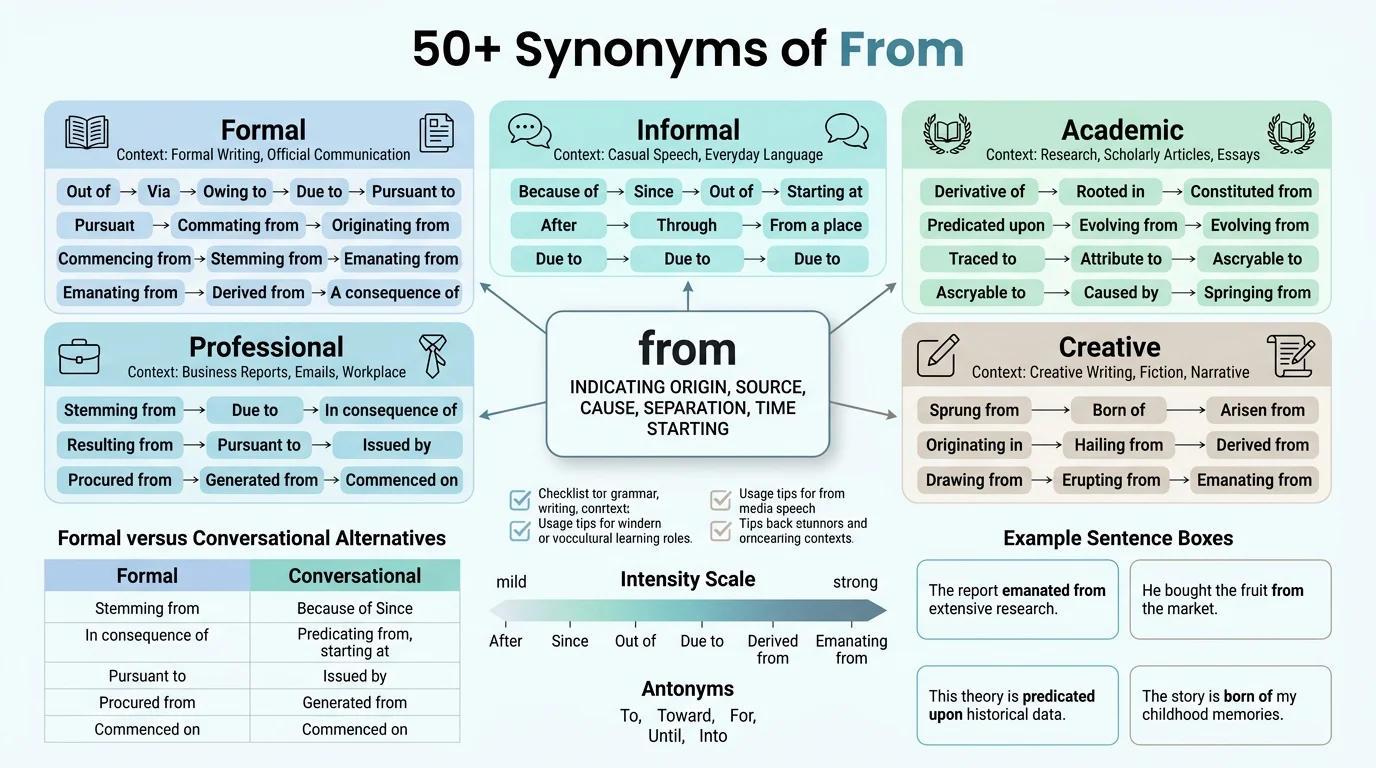
Have you ever stared at a sentence and realized you have used the word “from” three times in two paragraphs? It happens to everyone. Whether you are writing an email, drafting a blog post, or completing a school assignment, repeating the same preposition can make your writing feel dull and uninspired. The good news is that there are many synonyms of from that can add variety, precision, and clarity to your communication. Choosing the right alternative is not about showing off your vocabulary. It is about saying exactly what you mean in a way that sounds natural and professional.
This guide will help you understand the meaning of “from,” explore the best synonyms for every situation, and avoid common mistakes that even experienced writers make.
What Are the Best Synonyms of “From”?
“From” is a preposition that indicates a starting point, origin, source, or separation. The best synonym depends on your context. Formal writing, use “originating in” or “derived from.” For casual conversation, try “out of” or “off.” For professional communication, choose “based on” or “as of.” Academic work, select “originating from” or “proceeding from.”
Meaning, Tone, and Context
Simple Definition
“From” is a preposition that shows where something starts, where it comes from, or what its source is. It marks the beginning point of a movement, a period of time, or an origin.
Part of Speech
Preposition
Overall Tone
Neutral. “From” does not carry strong emotional weight. It simply communicates information about origin, starting point, or source.
Formality Level
Neutral. “From” works in every register from casual conversation to formal academic writing. It is one of the most common prepositions in English.
Common Uses
Native English speakers use “from” in several ways:
- To indicate a physical starting point: She walked from the store to the park.
- To indicate a time starting point: The sale runs from Monday to Friday.
- To indicate origin or source: This gift is from my grandmother.
- To indicate separation or distance: Keep the dog away from the children.
- To indicate a cause or reason: She acted from kindness.
Word Forms
“From” does not have noun, verb, adjective, or adverb forms. It is exclusively a preposition. Related forms include:
When and How to Use “From”
Choose “from” when you need to clearly indicate where something starts, where it comes from, or what its source is. It is the default choice for expressing origin and starting points.
Professional: The report includes data collected from three different departments.
Academic: The researcher obtained the samples from a controlled laboratory environment.
Workplace: Please submit your timesheet from the previous week by Friday.
Personal: I received this beautiful scarf from my sister during her trip to Italy.
Email: I am writing in response to the inquiry we received from your office on Monday.
Resume: Managed a team of twelve from project inception through successful completion.
Social Media: Check out this amazing view from the top of the mountain!
Best Synonyms of “From”
No synonym works perfectly in every situation. Each alternative carries its own nuance in terms of formality, tone, and context. Here are the best synonyms for specific writing situations.
Professional Writing
Based on – This synonym works well when “from” indicates a foundation or starting point for reasoning. It sounds polished and analytical.
Academic Writing
Derived from – This is the gold standard for academic work. It suggests a clear, traceable origin and sounds authoritative.
Business Communication
As of – Use this when “from” marks a specific starting point for a policy, rule, or condition. It is common in official announcements and formal documents.
Casual Conversation
Out of – This is a natural, conversational alternative that works in everyday speech.
Emotional Writing
Away from – When you want to emphasize separation or distance, this phrase adds emotional weight.
Creative Writing
Originating in – This synonym adds a touch of elegance and is perfect for descriptive or literary contexts.
Resume Writing
Beginning with – This phrase works well when describing career progression or project timelines.
Workplace Communication
Starting at – Clear and direct, this synonym is ideal for giving instructions or setting expectations.
Stronger Meaning
Proceeding from – This conveys a sense of logical or sequential flow, making the relationship between ideas feel more deliberate.
Softer Meaning
Coming from – This sounds gentler and more conversational, suitable for personal or informal contexts.
When Not to Use “From”
When It Sounds Too General
“From” can feel vague when you need to specify exactly how something originated.
Less Effective: The information came from various sources.
Better: The information was compiled from peer-reviewed journals, government databases, and industry reports.
Why it works: Being specific about sources makes your writing more credible and informative.
When It Sounds Too Vague in Academic Writing
In academic contexts, “from” often needs to be replaced with more precise language.
Less Effective: The theory was developed from earlier research.
Better: The theory was derived from earlier research conducted by Smith and colleagues.
Why it works: “Derived from” suggests a clear, traceable intellectual lineage.
When It Sounds Too Formal in Casual Conversation
Sometimes “from” feels stiff in everyday speech.
Less Effective: I received this information from my neighbor.
Better: I got this info out of my neighbor.
Why it works: “Out of” sounds more natural and relaxed in casual conversation.
When It Sounds Too Weak for Emphasis
“From” does not convey strong emotion or emphasis.
Less Effective: She kept the children from the danger.
Better: She kept the children away from the danger.
Why it works: “Away from” emphasizes the protective distance more strongly.
When It Sounds Outdated
“From” itself is never outdated, but some constructions using “from” can feel old-fashioned.
Less Effective: From whence he came.
Better: Where he came from.
Why it works: Modern English prefers the simpler construction.
Words Commonly Confused With “From”
From vs Of
Difference: “From” indicates origin or starting point. “Of” indicates belonging, possession, or composition.
When to Use It: Use “from” for origin; use “of” for possession or parts.
Example (from): She is a graduate from Harvard.
Example (of): She is a graduate of Harvard.
From vs Since
Difference: “From” marks a starting point in time. “Since” marks a starting point that continues to the present.
When to Use It: Use “from” for general time ranges; use “since” when the action continues to now.
Example (from): The store is open from 9 AM to 5 PM.
Example (since): The store has been open since 9 AM.
From vs By
Difference: “From” indicates origin or source. “By” indicates the agent or means of action.
When to Use It: Use “from” for source; use “by” for who or what performed the action.
Example (from): This letter is from my boss.
Example (by): This letter was written by my boss.
From vs Out of
Difference: “From” is general. “Out of” specifically suggests movement from inside to outside.
When to Use It: Use “from” for general origin; use “out of” for emergence from within.
Example (from): She came from New York.
Example (out of): She came out of the building.
From vs Off
Difference: “From” is general. “Off” suggests separation from a surface or point.
When to Use It: Use “from” for general separation; use “off” for detachment from a surface.
Example (from): He took the book from the shelf.
Example (off): He took the book off the shelf.
Best Synonyms of “From” by Context
| Context | Best Synonym | Why It Works | Example |
|---|---|---|---|
| Formal writing | Originating in | Sounds authoritative and precise | The tradition is originating in ancient customs |
| Academic writing | Derived from | Suggests traceable intellectual origin | The hypothesis was derived from previous studies |
| Professional communication | Based on | Indicates a logical foundation | Our recommendations are based on the latest data |
| Business emails | As of | Common in official announcements | As of next Monday, the new policy takes effect |
| Resume writing | Beginning with | Highlights career progression | Beginning with my internship, I developed key skills |
| Workplace communication | Starting at | Clear and direct | Starting at 9 AM, we will begin the training session |
| Casual conversation | Out of | Natural and conversational | I heard that out of a friend of mine |
| Everyday speaking | Off | Relaxed and informal | I got this recipe off my mom |
| Creative writing | Originating from | Adds literary elegance | A melody originating from distant lands |
| Storytelling | Proceeding from | Suggests narrative flow | The events proceeded from a single misunderstanding |
| Emotional writing | Away from | Emphasizes separation or loss | She moved away from everything she knew |
| Strong emphasis | Proceeding from | Conveys logical or causal force | The changes proceeded from a clear strategic decision |
| Mild tone | Coming from | Soft and approachable | That idea is coming from a good place |
| Social media captions | Out of | Short and trendy | Straight out of a dream |
| American English | From | The standard choice | She is from Chicago |
| British English | From | Same usage | She is from London |
How to Choose the Best Synonym of “From”
Choosing the right synonym does not have to be complicated. Ask yourself these questions:
What am I trying to communicate?
- If you are indicating origin, consider “derived from,” “originating in,” or “coming from.”
- If you are indicating a starting point, consider “starting at,” “beginning with,” or “as of.”
- If you are indicating separation, consider “away from” or “off.”
Who is my audience?
- For academic readers, use “derived from” or “originating from.”
- For business readers, use “based on” or “as of.”
- For casual readers, use “out of” or “off.”
What tone do I want?
- For a formal tone, choose “originating in” or “proceeding from.”
- For a neutral tone, stick with “from” or use “based on.”
- For a casual tone, choose “out of” or “off.”
How much emphasis do I need?
- For strong emphasis, use “proceeding from” or “away from.”
- For mild emphasis, use “coming from” or “out of.”
The goal is always clarity. Choose the word that communicates your intended message most directly and naturally.
Real Life Examples of “From”
School Assignment
Original: The information for my project came from the library and from online sources.
Improved: The information for my project was gathered from the library and supplemented with online sources.
College Essay
Original: My interest in biology started from a single class I took in high school.
Improved: My interest in biology originated from a single class I took in high school.
Workplace Email
Original: I received the feedback from the client and from the project manager.
Improved: I received the feedback from both the client and the project manager.
Business Report
Original: The data comes from surveys conducted last year.
Improved: The data was derived from surveys conducted last year.
Personal Email
Original: I heard the news from my cousin.
Improved: I heard the news out of my cousin.
Resume Bullet Point
Original: Managed projects from start to finish.
Improved: Managed projects beginning with initial planning through final delivery.
Conversation
Original: Where did you get that idea from?
Improved: Where did you get that idea out of?
Storytelling
Original: The sound came from the forest.
Improved: The sound emerged from the depths of the forest.
Blogging
Original: My tips come from years of experience.
Improved: My tips are drawn from years of experience.
Social Media
Original: View from the top.
Improved: Straight out of a dream, this view.
18 Best Synonyms of “From”
Synonyms of “From” by Usage
Professional vs Personal Synonyms
Professional: Based on, derived from, as of, starting at. These sound polished and appropriate for emails, reports, and presentations.
Personal: Out of, off, coming from. These sound natural and relaxed in conversations with friends and family.
Formal vs Conversational Synonyms
Formal: Originating in, derived from, proceeding from, based on. These fit reports, essays, business writing, and presentations.
Conversational: Out of, off, coming from. These work well in casual conversations and text messages.
Academic Synonyms
For research papers, essays, and academic discussions, choose these precise alternatives:
- Derived from – suggests a clear intellectual lineage
- Originating from – indicates historical or factual origin
- Proceeding from – conveys logical development
- Based on – shows foundation in evidence
These synonyms sound more authoritative and demonstrate careful word choice.
Professional and Business Synonyms
For resumes, interviews, meetings, and client communication:
- Based on – shows strategic thinking
- As of – marks policy or rule changes
- Beginning with – highlights career progression
- Starting at – gives clear instructions
- Derived from – shows analytical skills
These choices project competence and attention to detail.
Creative and Literary Synonyms
For storytelling, fiction, poetry, and descriptive writing:
- Originating in – adds historical depth
- Proceeding from – suggests narrative flow
- Emerging from – creates vivid imagery
- Issuing from – adds formality and elegance
- Springing from – suggests life and energy
These synonyms add texture and emotional resonance to creative work.
Slang or Modern Synonyms
“From” does not have widely used slang equivalents. In very casual speech, some speakers use “off of” (e.g., “I got it off of him”), but this is generally considered informal and should be avoided in professional or academic writing.
Strongest to Mildest Synonyms
Mild: Coming from, out of, off
Moderate: From, based on, starting at
Strong: Derived from, originating in, proceeding from
Very Strong: Away from, emerging from, issuing from
The intensity scale shows how emotional weight and emphasis increase as you move from casual to formal alternatives.
Emotional vs Neutral Synonyms
Emotional Synonyms: Away from, emerging from, springing from. These words carry feeling and imagery.
Neutral Synonyms: From, based on, starting at, derived from. These simply communicate information without added emotion.
Use emotional synonyms when you want to create feeling. Use neutral synonyms when you need to communicate clearly and objectively.
Antonyms of “From”
Comparison: “From” vs Similar Words
From vs Of
Main Difference: “From” indicates origin or starting point. “Of” indicates belonging, possession, or composition.
Which Is Stronger? Neither. They serve completely different functions.
Which Is More Formal? Both are neutral.
When to Use Each: Use “from” for origin. Use “of” for possession.
Examples:
- From: She is a graduate from Harvard.
- Of: She is a graduate of Harvard.
From vs Since
Main Difference: “From” marks a starting point in time. “Since” marks a starting point that continues to the present.
Which Is Stronger? “Since” implies ongoing action, which gives it more temporal weight.
Which Is More Formal? Both are neutral.
When to Use Each: Use “from” for general time ranges. Use “since” when the action continues to now.
Examples:
- From: The store is open from 9 AM to 5 PM.
- Since: The store has been open since 9 AM.
From vs By
Main Difference: “From” indicates origin or source. “By” indicates the agent or means of action.
Which Is Stronger? “By” often implies more direct agency.
Which Is More Formal? Both are neutral.
When to Use Each: Use “from” for source. Use “by” for who or what performed the action.
Examples:
- From: This letter is from my boss.
- By: This letter was written by my boss.
From vs Out of
Main Difference: “From” is general. “Out of” specifically suggests movement from inside to outside.
Which Is Stronger? “Out of” is more vivid and specific.
Which Is More Formal? “From” is more formal. “Out of” is casual.
When to Use Each: Use “from” for general origin. Use “out of” for emergence from within.
Examples:
- From: She came from New York.
- Out of: She came out of the building.
From vs Off
Main Difference: “From” is general. “Off” suggests separation from a surface or point.
Which Is Stronger? “Off” implies more definite detachment.
Which Is More Formal? “From” is more formal. “Off” is casual.
When to Use Each: Use “from” for general separation. Use “off” for detachment from a surface.
Examples:
- From: He took the book from the shelf.
- Off: He took the book off the shelf.
From vs Through
Main Difference: “From” indicates origin. “Through” indicates the medium or channel by which something passes.
Which Is Stronger? “Through” implies a process or journey.
Which Is More Formal? Both are neutral.
When to Use Each: Use “from” for source. Use “through” for channel or medium.
Examples:
- From: I heard the news from my friend.
- Through: I heard the news through my friend.
Common Phrases and Expressions with “From”
From A to Z
Meaning: Covering everything from beginning to end; completely.
Example Sentence: She knows the subject from A to Z after years of study.
From the ground up
Meaning: Starting from the very beginning; building something completely new.
Example Sentence: He built his business from the ground up with no outside investment.
From scratch
Meaning: From the beginning; without using anything that already exists.
Example Sentence: She baked the cake from scratch using only basic ingredients.
From day one
Meaning: From the very beginning.
Example Sentence: From day one, she was the most dedicated employee on the team.
From now on
Meaning: Starting at this moment and continuing into the future.
Example Sentence: From now on, all reports must be submitted by Friday.
From time to time
Meaning: Occasionally; not regularly.
Example Sentence: From time to time, I like to revisit my favorite books.
Far from
Meaning: Not at all; opposite of.
Example Sentence: The project is far from complete.
Common Mistakes to Avoid
1: Choosing a Vague Synonym
Incorrect: The data came from many places.
Better: The data was compiled from three primary sources: customer surveys, sales records, and website analytics.
Why: Being specific makes your writing more credible and informative.
2: Confusing “From” with “Of”
Incorrect: She is a graduate from Harvard (when referring to the institution as a whole).
Better: She is a graduate of Harvard.
Why: “Of” is the standard preposition when referring to being a graduate of an institution.
3: Using an Informal Synonym in Formal Writing
Incorrect: The findings came out of the research study.
Better: The findings were derived from the research study.
Why: “Out of” sounds casual in academic contexts. “Derived from” sounds more professional.
4: Selecting an Overly Dramatic Synonym
Incorrect: The small change proceeded from a minor adjustment.
Better: The small change resulted from a minor adjustment.
Why: “Proceeded from” is too strong for a minor change. Choose a synonym that matches the significance.
5: Repeating the Same Word Too Often
Incorrect: The report from the committee was reviewed by the manager from the finance department.
Better: The report from the committee was reviewed by the finance department manager.
Why: Removing unnecessary repetition improves readability.
6: Choosing a Synonym with the Wrong Emotional Tone
Incorrect: She kept the children from the dangerous situation.
Better: She kept the children away from the dangerous situation.
Why: “Away from” emphasizes protection more strongly than “from” alone.
7: Using Slang in Professional Writing
Incorrect: I got this info off my colleague.
Better: I obtained this information from my colleague.
Why: “Off” and “info” are too casual for professional contexts.
Frequently Asked Questions
1. What are the best synonyms of “from”?
The best synonyms depend on your context. Formal writing, use “derived from” or “originating in.” For casual conversation, use “out of” or “off.” For professional communication, use “based on” or “as of.”
2. What are the best formal synonyms of “from”?
The best formal synonyms include “derived from,” “originating in,” “proceeding from,” and “based on.” These sound authoritative and precise in academic, business, and professional contexts.
3. What are common informal synonyms of “from”?
Common informal synonyms include “out of,” “off,” and “coming from.” These sound natural in everyday conversation, text messages, and casual social media posts.
4. What is another word for “from” in professional writing?
In professional writing, “based on” and “as of” are excellent alternatives. “Based on” works when indicating foundation or reasoning. “As of” works for marking official starting points for policies or rules.
5. What is the difference between “from” and “of”?
“From” indicates origin or starting point. “Of” indicates belonging, possession, or composition. Use “from” for where something comes from. Use “of” for what something belongs to or is made of.
6. What is the opposite of “from”?
The main opposites of “from” are “to,” “toward,” and “into.” “To” indicates direction toward a place. “Toward” indicates movement in a general direction. “Into” indicates movement to the inside.
Conclusion
“From” is a simple but essential preposition that indicates starting points, origins, sources, and separation. While it works well in almost every context, using synonyms can make your writing more varied, precise, and engaging. The best synonym depends on your audience, your tone, and your purpose. Academic writing, choose “derived from” or “originating in.” For professional communication, choose “based on” or “as of.” For casual conversation, choose “out of” or “off.” No synonym works perfectly in every situation, so always consider what you are trying to communicate and who you are communicating with.
The next time you write a sentence and realize you have used “from” too many times, take a moment to consider whether a synonym might serve you better. Your writing will become clearer, more varied, and more enjoyable to read.