You are writing an important email, a college application essay, or a professional report. Halfway through, you realize you have used the word “prejudice” three times in two paragraphs. The repetition makes your writing feel flat and unimaginative. You know there must be a better way to express the same idea, but you are not sure which word fits the context. This is exactly when you need a clear, practical guide to the synonyms of prejudice.
Finding the right synonym is not about showing off a large vocabulary. It is about communicating your message with precision and clarity. The word you choose shapes how your reader understands your point. It sets the tone, conveys emotional weight, and determines whether your writing sounds professional, academic, conversational, or creative. This guide will help you understand the meaning of prejudice, explore its best synonyms, and confidently choose the most accurate word for every situation.
What Are the Best Synonyms of “Prejudice”?
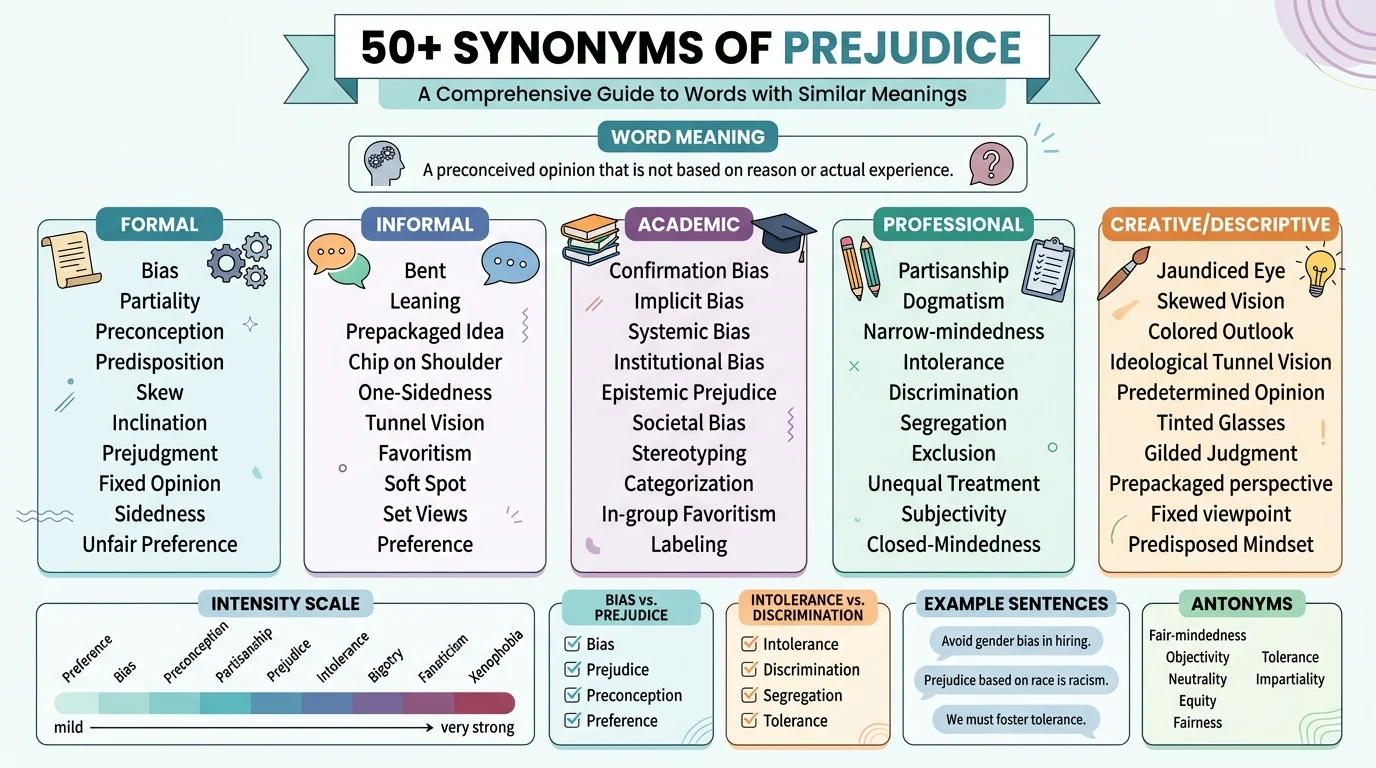
Prejudice means an unfair and unreasonable opinion or feeling formed without enough thought or knowledge. The best synonym for formal writing is “bias.” For casual conversation, use “preconception.” In academic contexts, “partiality” works well. For professional communication, “discrimination” is often the strongest choice. Emotional writing calls for “bigotry,” while creative writing benefits from “jaundiced eye.”
Meaning, Tone, and Context
Simple Definition
Prejudice is a preconceived opinion or feeling that is not based on reason or actual experience. It often involves an unfair dislike or hostility toward a person or group. The word comes from the Latin praejudicium, which means “judgment in advance”.
Part of Speech
Prejudice functions as both a noun and a verb. As a noun, it refers to the opinion or feeling itself. As a verb, it means to influence someone unfairly or to cause harm.
Overall Tone
Prejudice is a negative word. It describes something unfair, unreasonable, and often harmful. Using it signals that you are discussing a serious issue involving judgment, discrimination, or hostility.
Formality Level
Prejudice is a formal to semi-formal word. It is appropriate in academic writing, professional reports, news articles, and serious conversations. It is less common in casual everyday speech, where shorter or simpler words like “bias” or “preconception” are more natural.
Common Uses
Native English speakers use prejudice in several ways. It appears in discussions about social issues, such as racial prejudice, religious prejudice, or gender prejudice. It is also used in legal contexts, where the phrase “without prejudice” means a legal action does not dismiss or harm a claim. In everyday language, people use prejudice to describe unfair judgments about anything from food to music to people.
Word Forms
- Noun: prejudice (e.g., She faced prejudice at work.)
- Verb: prejudice (e.g., The article prejudiced readers against the candidate.)
- Adjective: prejudiced (e.g., He made a prejudiced remark.)
- Adverb: prejudicedly (rarely used)
When and How to Use “Prejudice”
Choose prejudice when you want to describe an unfair, unreasoned opinion or feeling, especially one formed without enough knowledge. It is the right word when the judgment is negative, hostile, or discriminatory. Here are seven realistic examples showing how prejudice appears in different contexts.
Professional: The hiring manager’s prejudice against older candidates was evident in the interview process.
Academic: Researchers have documented how racial prejudice affects educational outcomes in diverse school districts.
Workplace: Our company has a zero-tolerance policy for any form of prejudice in the workplace.
Personal: I realized I had a prejudice against spicy food, but after trying Thai cuisine, my opinion changed completely.
Email: I want to address the prejudice some team members have shown toward our new colleagues from the overseas office.
Resume: Developed and implemented diversity training programs to reduce prejudice and promote inclusion across all departments.
Social Media: We cannot ignore the prejudice that still exists in our communities. It is time to have honest conversations about it.
Best Synonyms of “Prejudice”
No synonym is identical to prejudice in every situation. Each alternative carries its own shade of meaning, emotional weight, and level of formality. The best choice depends on your audience, your purpose, and the specific message you want to convey.
Professional writing: Bias. This word is direct, widely understood, and neutral enough to use in business contexts without sounding overly emotional. It works well in reports, memos, and professional correspondence.
Academic writing: Partiality. This term sounds scholarly and precise. It is ideal for research papers, essays, and academic discussions where you need to describe unfair favoritism in a formal way.
Business communication: Discrimination. When prejudice leads to unfair treatment, discrimination is the most accurate and legally recognized term. Use it in policies, complaints, and serious business discussions.
Casual conversation: Preconception. This word is softer and more conversational. It fits everyday talks about opinions formed without full information, such as preconceptions about a new restaurant or a movie.
Emotional writing: Bigotry. This synonym carries strong emotional weight. It describes intense, stubborn prejudice that is often rooted in hatred. Use it in opinion pieces, personal essays, or when you want to express moral outrage.
Creative writing: Jaundiced eye. This figurative expression adds vivid imagery. It suggests a negative, distorted way of seeing things. It works well in fiction, poetry, and descriptive writing.
Resume writing: Bias awareness or anti-bias. These phrases show that you understand the importance of fairness. They are professional and demonstrate social awareness without sounding accusatory.
Workplace communication: Unfairness. This simple word is clear and direct. It describes the outcome of prejudice without using heavy or confrontational language. It works well in team meetings and internal communications.
Stronger meaning: Bigotry. This is the strongest synonym. It implies deep-seated, often hateful prejudice. Choose it when you want to emphasize the severity of the attitude.
Softer meaning: Preconception. This is the mildest synonym. It suggests a preliminary opinion that may or may not be unfair. It is less accusatory and more neutral.
When Not to Use “Prejudice”
There are times when prejudice is not the best word for your sentence. Here are five situations where you should choose a different synonym instead.
Too general. When you are describing a simple preference or inclination, prejudice is too strong. The word implies unfairness and negativity, which may not fit a harmless preference.
Incorrect: I have a prejudice for chocolate ice cream over vanilla.
Better: I have a preference for chocolate ice cream over vanilla.
Why: Preference describes a simple liking without any unfairness or negative judgment.
Too vague. When you need to specify the type of unfair treatment, prejudice can be too broad. Discrimination is more precise when you are talking about actions, not just opinions.
Incorrect: The company showed prejudice by not promoting her.
Better: The company showed discrimination by not promoting her.
Why: Discrimination refers to specific unfair actions, not just attitudes.
Too formal. In casual conversations with friends or family, prejudice can sound stiff and overly serious. Preconception or bias are more natural choices.
Incorrect: My brother has a prejudice against pineapple on pizza.
Better: My brother has a bias against pineapple on pizza.
Why: Bias is more conversational and less heavy in everyday speech.
Too weak. When the attitude is extreme, hateful, or deeply harmful, prejudice may not be strong enough. Bigotry or racism better convey the severity.
Incorrect: The organization was destroyed by prejudice.
Better: The organization was destroyed by bigotry.
Why: Bigotry implies intense, stubborn hatred that prejudice alone does not fully capture.
Outdated. The legal sense of prejudice meaning “harm” or “detriment” is less common today. In modern writing, words like harm, damage, or detriment are clearer.
Incorrect: The delay operated to the prejudice of the plaintiff.
Better: The delay operated to the detriment of the plaintiff.
Why: Detriment is more commonly used in modern legal and professional writing.
Words Commonly Confused With “Prejudice”
Prejudice vs Bias
Difference: Bias is a preference for or against something, and it can be favorable or unfavorable. Prejudice usually implies an unfavorable opinion and is more unreasoning than bias.
When to Use It: Use bias when the preference is not necessarily negative or when you want a more neutral term. Use prejudice when the opinion is clearly unfair and negative.
Example: The judge showed bias toward the defense. The judge showed prejudice against the defendant.
Prejudice vs Discrimination
Difference: Prejudice is an attitude or opinion. Discrimination is the action or behavior that results from prejudice. You can have prejudice without discriminating, but discrimination usually involves prejudice.
When to Use It: Use prejudice when discussing beliefs or feelings. Use discrimination when discussing unfair treatment or actions.
Example: His prejudice against immigrants was obvious. His discrimination against immigrants included refusing to rent to them.
Prejudice vs Stereotype
Difference: A stereotype is a oversimplified belief about a group. Prejudice is a negative feeling or attitude toward that group based on the stereotype. Stereotypes are beliefs; prejudice is an emotional response.
When to Use It: Use stereotype when describing generalized beliefs. Use prejudice when describing the negative feelings that result from those beliefs.
Example: The stereotype that all teenagers are lazy is harmful. Her prejudice against teenagers prevented her from hiring young workers.
Prejudice vs Bigotry
Difference: Bigotry is an extreme, stubborn form of prejudice. It often involves intolerance and hostility toward those who are different. Prejudice can be milder and less intense.
When to Use It: Use prejudice for general unfair opinions. Use bigotry when the attitude is intense, hateful, and deeply entrenched.
Example: His prejudice made him uncomfortable around people from other cultures. His bigotry led him to actively campaign against immigration.
Prejudice vs Intolerance
Difference: Intolerance is the unwillingness to accept views, beliefs, or behaviors that differ from one’s own. Prejudice is a specific unfair opinion or feeling. Intolerance is a broader refusal to accept difference.
When to Use It: Use intolerance when describing a general lack of acceptance. Use prejudice when describing a specific unfair judgment.
Example: Religious intolerance has caused many wars. His prejudice against Muslims was evident in his comments.
Prejudice vs Partiality
Difference: Partiality is a favorable bias toward someone or something. Prejudice is usually unfavorable. Partiality suggests unfair favoritism, while prejudice suggests unfair dislike.
When to Use It: Use partiality when someone shows unfair favor. Use prejudice when someone shows unfair disfavor.
Example: The teacher’s partiality toward her favorite students was obvious. The teacher’s prejudice against quiet students affected their grades.
Best Synonyms of “Prejudice” by Context
| Context | Best Synonym | Why It Works | Example |
|---|---|---|---|
| Formal writing | Bias | Neutral, widely accepted, and precise | The study found evidence of bias in the selection process. |
| Academic writing | Partiality | Scholarly tone, fits research and essays | The researcher acknowledged her partiality in interpreting the data. |
| Professional communication | Discrimination | Legally recognized, describes unfair treatment | The policy prohibits discrimination based on age. |
| Business emails | Unfairness | Direct, clear, and non-confrontational | We need to address the unfairness in our promotion system. |
| Resume writing | Anti-bias | Demonstrates social awareness and professionalism | Led anti-bias training sessions for 200+ employees. |
| Workplace communication | Preconception | Softer, encourages open discussion | Let’s examine our preconceptions about remote work. |
| Casual conversation | Preconception | Natural, conversational, less heavy | I had a preconception that the movie would be boring. |
| Everyday speaking | Bias | Short, common, easy to use | Everyone has biases, but we can work on them. |
| Creative writing | Jaundiced eye | Vivid imagery, adds color to descriptions | He viewed the proposal through a jaundiced eye. |
| Storytelling | Prejudgment | Suggests a judgment made too early | Her prejudgment of the character led to a surprising twist. |
| Emotional writing | Bigotry | Strong emotional weight, expresses outrage | The bigotry in that community was heartbreaking. |
| Strong emphasis | Bigotry | Conveys intense, hateful prejudice | We must stand against bigotry in all its forms. |
| Mild tone | Preconception | Gentle, suggests a tentative opinion | My preconception about the city changed after I visited. |
| Social media captions | Bias | Short, impactful, fits character limits | Check your bias before you speak. |
| American English | Bias | Most common and versatile choice | His bias affected his judgment. |
| British English | Prejudice | More commonly used in British formal contexts | The tribunal found evidence of prejudice. |
How to Choose the Best Synonym of “Prejudice”
Choosing the right synonym starts with understanding your purpose. Ask yourself these questions before you write.
What is your meaning? Are you describing an unfair opinion, a harmful action, or a simple preference? If you mean an opinion, choose bias or preconception. You mean an action, choose discrimination. If you mean a preference, choose preference or inclination.
What is your tone? Are you writing formally or casually? Formal writing calls for bias, partiality, or discrimination. Casual writing works better with preconception or bias.
Who is your audience? Are you speaking to colleagues, friends, academics, or the general public? Choose words your audience will understand and appreciate. Avoid overly academic words in casual settings and overly casual words in professional settings.
How much emotional strength do you need? Do you want to express mild concern or strong outrage? For mild expressions, use preconception or bias. For strong expressions, use bigotry or discrimination.
What is your writing purpose? Are you informing, persuading, or entertaining? Informative writing benefits from neutral words like bias. Persuasive writing may need stronger words like bigotry. Creative writing can use vivid expressions like jaundiced eye.
Does it sound natural? Read your sentence aloud with the synonym you have chosen. If it sounds awkward or forced, try a different word. The best synonym is the one that fits seamlessly into your sentence.
Real Life Examples of “Prejudice”
School: The history teacher explained how prejudice led to discriminatory laws in the 20th century.
College: In my sociology paper, I argued that prejudice is often learned from family and community rather than personal experience.
Workplace: Her manager’s prejudice against working mothers was clear when he refused to approve flexible hours.
Business: The company revised its hiring practices to eliminate any unconscious prejudice in the recruitment process.
Email: I am writing to express my concern about the prejudice I have observed in our department’s promotion decisions.
Resume: Developed and facilitated workshops on recognizing and reducing prejudice in the workplace.
Conversation: “I think we all have some prejudice we are not aware of,” she said. “It takes effort to recognize it.”
Storytelling: The town was divided by a deep prejudice that had existed for generations, and no one could remember how it started.
Blogging: Prejudice is not always obvious. Sometimes it hides in the assumptions we make about people we do not know.
Social media: Let’s talk about prejudice. Not the obvious kind, but the subtle biases that affect our daily decisions.
18 Best Synonyms of “Prejudice”
Synonyms of “Prejudice” by Usage
Professional vs Personal Synonyms
In professional settings, choose words that are neutral, precise, and widely understood. Bias and discrimination are the strongest choices for workplace communication. They are professional without being overly emotional. In personal conversations, preconception and bias are more natural. They are less heavy and allow for open, honest discussion without sounding accusatory.
Formal vs Conversational Synonyms
Formal writing, including reports, essays, and business documents, benefits from words like partiality, discrimination, and prejudice itself. These words carry authority and precision. Conversational settings, including texting and casual emails, work better with bias, preconception, or unfairness. These words are shorter, simpler, and easier to use in everyday speech.
Academic Synonyms
Academic writing demands precision and authority. Partiality is an excellent choice for research papers and essays because it sounds scholarly and precise. Prejudice itself is also widely used in academic contexts. Bias is common in social science research. These words are appropriate for journals, theses, and academic presentations.
Professional and Business Synonyms
Resumes, interviews, and business emails require professional vocabulary. Anti-bias, diversity awareness, and inclusion are strong choices for resumes. Discrimination is the most precise word for policies and legal contexts. Unfairness works well in internal communications when you want to address an issue without using confrontational language.
Creative and Literary Synonyms
Creative writing benefits from vivid, expressive language. Jaundiced eye adds color and imagery to descriptions. Prejudgment creates tension in storytelling. Prepossession has a literary, old-fashioned feel that works well in period fiction. These words add depth and personality to creative work.
Slang or Modern Synonyms
There are no widely used slang synonyms for prejudice. The topic is serious, and slang would sound inappropriate or dismissive. Stick to standard English when discussing prejudice.
Strongest to Mildest Synonyms
Mild: preconception, preference, inclination.
Moderate: bias, unfairness, one-sidedness.
Strong: prejudice, discrimination, partiality.
Very Strong: bigotry, intolerance, racism, xenophobia.
The emotional intensity increases as you move from mild to very strong. Choose the level that matches the severity of the situation you are describing.
Emotional vs Neutral Synonyms
Emotional Synonyms: bigotry, intolerance, racism, xenophobia, chauvinism. These words carry strong feelings of anger, outrage, or moral condemnation. Use them when you want to express strong emotion or persuade your reader.
Neutral Synonyms: bias, preconception, partiality, unfairness. These words simply communicate information without adding strong emotion. Use them in professional, academic, or objective writing.
Antonyms of “Prejudice”
| Antonym | Meaning | Example Sentence |
|---|---|---|
| Fairness | Just and impartial treatment | The judge was known for her fairness in all cases. |
| Impartiality | Not favoring one side over another | Impartiality is essential for a fair trial. |
| Objectivity | Judgment based on facts, not feelings | Scientific research requires objectivity. |
| Open-mindedness | Willingness to consider new ideas | Open-mindedness allows us to learn from others. |
| Tolerance | Acceptance of different views and beliefs | Tolerance is the foundation of a diverse society. |
| Neutrality | Not supporting either side | The mediator maintained neutrality throughout the negotiation. |
| Justice | Fair and moral treatment | Justice requires that everyone be treated equally. |
| Understanding | Sympathetic awareness of others | Understanding different cultures reduces conflict. |
| Acceptance | Willingness to embrace differences | Acceptance of diversity makes communities stronger. |
| Respect | Regard for the feelings of others | Respect for others is a basic human value. |
| Equality | State of being equal in rights | Equality is a goal worth pursuing. |
| Unbiasedness | Free from prejudice | Unbiasedness is a core value of journalism. |
| Liberality | Openness to new ideas | His liberality made him popular among students. |
| Broad-mindedness | Willingness to accept different views | Broad-mindedness is essential in a globalized world. |
| Equity | Fairness and justice in treatment | Equity ensures that everyone has what they need to succeed. |
Comparison: “Prejudice” vs Similar Words
Prejudice vs Bias
Main Difference: Bias is a broader term that can be favorable or unfavorable. Prejudice is almost always unfavorable and more unreasoning.
Which Is Stronger? Prejudice is stronger. It implies a more deeply held, negative opinion.
Which Is More Formal? Both are formal, but prejudice is slightly more formal.
When to Use Each: Use bias for general preferences or inclinations. Use prejudice for negative, unfair opinions.
Examples:
- Prejudice: His prejudice against the new manager was clear from day one.
- Bias: The study showed a bias toward younger participants.
Prejudice vs Discrimination
Main Difference: Prejudice is an attitude. Discrimination is an action.
Which Is Stronger? Discrimination is often seen as stronger because it involves harmful actions.
Which Is More Formal? Both are formal, but discrimination is more common in legal contexts.
When to Use Each: Use prejudice for beliefs and feelings. Use discrimination for unfair treatment.
Examples:
- Prejudice: Her prejudice against older workers was well known.
- Discrimination: The company was sued for age discrimination.
Prejudice vs Bigotry
Main Difference: Bigotry is an extreme, stubborn form of prejudice.
Which Is Stronger? Bigotry is much stronger. It implies hatred and intolerance.
Which Is More Formal? Both are formal, but bigotry carries more emotional weight.
When to Use Each: Use prejudice for general unfair opinions. Use bigotry for intense, hateful attitudes.
Examples:
- Prejudice: He had a prejudice against people from that region.
- Bigotry: His bigotry made him unable to accept anyone different from himself.
Prejudice vs Stereotype
Main Difference: A stereotype is a belief about a group. Prejudice is a negative feeling toward that group.
Which Is Stronger? Prejudice is stronger because it involves emotion, not just belief.
Which Is More Formal? Both are formal and common in academic writing.
When to Use Each: Use stereotype when describing oversimplified beliefs. Use prejudice when describing negative feelings.
Examples:
- Prejudice: Her prejudice against teenagers affected her teaching.
- Stereotype: The stereotype that all teenagers are lazy is unfair.
Prejudice vs Intolerance
Main Difference: Intolerance is a general unwillingness to accept difference. Prejudice is a specific unfair opinion.
Which Is Stronger? Intolerance is broader and can be just as strong.
Which Is More Formal? Both are formal.
When to Use Each: Use intolerance for a general lack of acceptance. Use prejudice for specific unfair judgments.
Examples:
- Prejudice: His prejudice against immigrants was evident.
- Intolerance: Religious intolerance has caused many conflicts throughout history.
Prejudice vs Partiality
Main Difference: Partiality is unfair favoritism. Prejudice is unfair disfavor.
Which Is Stronger? Prejudice is usually stronger because it involves hostility.
Which Is More Formal? Partiality is more formal and less common in everyday speech.
When to Use Each: Use partiality when someone unfairly favors one person or group. Use prejudice when someone unfairly dislikes a person or group.
Examples:
- Prejudice: The teacher showed prejudice against quiet students.
- Partiality: The teacher showed partiality toward her favorite students.
Common Phrases and Expressions with “Prejudice”
Without prejudice
Meaning: A legal term meaning that a statement or action does not dismiss or harm a legal claim.
Example Sentence: The settlement was reached without prejudice to either party’s future claims.
Racial prejudice
Meaning: Prejudice based on race.
Example Sentence: Racial prejudice remains a serious problem in many societies.
Prejudice against
Meaning: Having an unfair negative opinion about someone or something.
Example Sentence: She had a deep prejudice against people from the rival school.
Prejudice in favor of
Meaning: Having an unfair positive opinion about someone or something.
Example Sentence: His prejudice in favor of Ivy League graduates affected his hiring decisions.
Blind prejudice
Meaning: Prejudice that is completely unreasonable and unthinking.
Example Sentence: Blind prejudice prevented him from seeing the truth.
Cultural prejudice
Meaning: Prejudice based on cultural differences.
Example Sentence: Cultural prejudice can create barriers between communities.
Deep-seated prejudice
Meaning: Prejudice that is firmly established and difficult to change.
Example Sentence: Deep-seated prejudice takes years of education and effort to overcome.
Common Mistakes to Avoid
1: Choosing a vague synonym instead of a precise one.
Incorrect: The company showed prejudice when it fired him.
Better: The company showed discrimination when it fired him.
Why: Discrimination describes the action of unfair treatment more precisely than prejudice, which describes an attitude.
2: Confusing prejudice with a similar word.
Incorrect: His prejudice against spicy food meant he never tried Thai cuisine.
Better: His bias against spicy food meant he never tried Thai cuisine.
Why: Bias is more appropriate for a mild personal preference. Prejudice is too strong for food preferences.
3: Using an informal synonym in formal writing.
Incorrect: The study found that narrow-mindedness affected the participants’ decisions.
Better: The study found that bias affected the participants’ decisions.
Why: Bias is more formal and appropriate for academic writing.
4: Selecting an overly dramatic synonym.
Incorrect: My father’s bigotry against modern art prevented him from visiting museums.
Better: My father’s prejudice against modern art prevented him from visiting museums.
Why: Bigotry is too strong for a simple dislike of art. Prejudice is more appropriate.
5: Repeating the same word too often.
Incorrect: Prejudice is a problem. Prejudice affects everyone. We must fight prejudice.
Better: Prejudice is a problem. Bias affects everyone. We must fight discrimination.
Why: Varying your vocabulary makes your writing more engaging and precise.
6: Choosing a synonym with the wrong emotional tone.
Incorrect: The company’s unfairness was evident in its hiring practices. (Too mild)
Better: The company’s discrimination was evident in its hiring practices. (Stronger and more precise)
Why: Discrimination better conveys the seriousness of the situation.
7: Using slang in academic or professional writing.
Incorrect: The study found that prejudice was a huge problem. (Too informal)
Better: The study found that prejudice was a significant problem.
Why: Significant is more appropriate for academic writing than huge.
Frequently Asked Questions
1. What are the best synonyms of “prejudice”?
The best synonyms depend on context. Formal writing, use “bias.” For casual conversation, use “preconception.” For academic work, use “partiality.” Professional communication, use “discrimination.” For emotional writing, use “bigotry.”
2. What are the best formal synonyms of “prejudice”?
The best formal synonyms are “bias,” “partiality,” “discrimination,” and “preconception.” These words are appropriate for academic papers, professional reports, business emails, and legal documents.
3. What are common informal synonyms of “prejudice”?
Common informal synonyms include “bias,” “preconception,” and “unfairness.” These words are more natural in everyday conversation, social media posts, and casual emails.
4. What is another word for “prejudice” in professional writing?
In professional writing, “bias” and “discrimination” are the strongest choices. “Bias” works for general unfair preferences. “Discrimination” is more precise when describing unfair treatment or actions.
5. What is the difference between “prejudice” and “bias”?
Bias is a broader term that can be favorable or unfavorable. Prejudice usually implies an unfavorable opinion and is more unreasoning than bias. Bias is more neutral; prejudice is almost always negative.
6. What is the opposite of “prejudice”?
The opposites of prejudice include fairness, impartiality, objectivity, open-mindedness, tolerance, and neutrality. These words describe attitudes that are just, unbiased, and accepting of differences.
Conclusion
Prejudice means an unfair and unreasonable opinion formed without enough thought or knowledge. It is a serious word that describes negative judgments, often based on stereotypes and misconceptions. The best synonyms depend entirely on your context.Professional writing, choose bias or discrimination. For casual conversation, choose preconception.Academic work, choose partiality. For emotional writing, choose bigotry. No single synonym works perfectly in every situation. The key is to consider your audience, your tone, and your purpose. Choose the word that communicates your message most clearly and accurately. The next time you reach for the word prejudice, pause and ask yourself if a more precise synonym would serve you better. Your writing will be clearer, stronger, and more effective.