Do you ever find yourself using the word “money” over and over again in your writing? Maybe you are drafting an email, working on a school essay, or updating your resume. You realize that repeating the same word makes your content feel dull and unprofessional.
Finding the right synonyms for money can instantly upgrade your vocabulary and make your communication stronger. Whether you are a student, a blogger, or a business professional, knowing how to talk about money in different ways is an essential skill.
The English language offers a rich variety of words to describe money. Each synonym carries its own tone, formality level, and emotional weight. Some words feel casual and friendly, while others sound serious and academic.
Understanding these differences helps you choose the perfect word for every situation. This guide will teach you the best synonyms for money, how to use them correctly, and when to avoid certain terms.
What Does “Money” Mean?
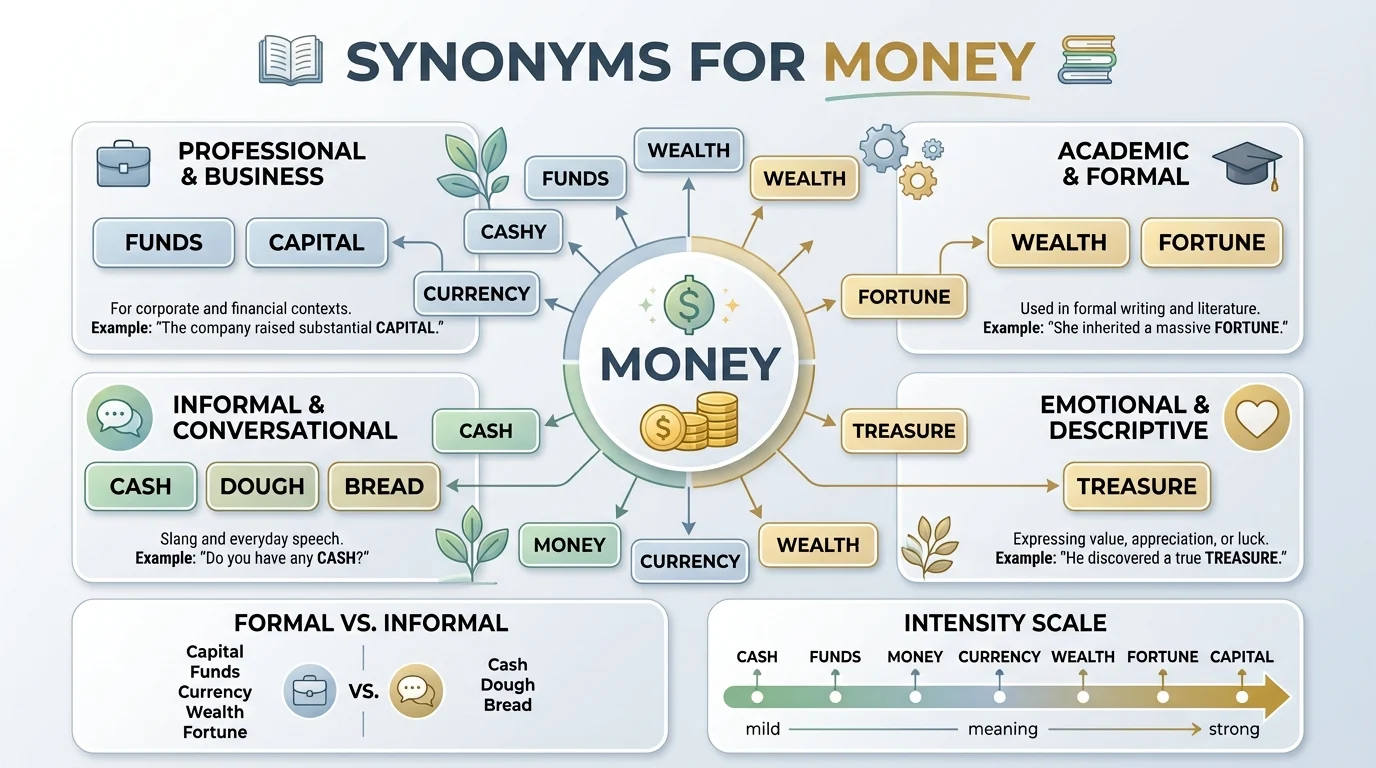
Money is a medium of exchange used to buy goods, pay debts, and measure value. The best synonyms depend on context. Use “currency” for formal writing, “cash” for everyday conversation, “funds” for professional settings, “wealth” for abundance, and “dough” for casual slang. Choose based on your audience and purpose.
Meaning, Tone and Context
- Simple definition: Money is anything generally accepted as payment for goods and services or for settling debts.
- Part of speech: Noun. It is an uncountable noun in its most common form. You say “much money” not “many moneys,” though the plural form exists in legal and financial contexts.
- Positive, negative, or neutral tone: Neutral. Money itself has no inherent emotion, but the context around it can create positive, negative, or neutral associations.
- Formality level: Neutral. “Money” works in all contexts from casual speech to formal writing. It is the safest and most universal term available.
- Common use cases: Daily transactions, financial discussions, business communication, personal budgets, economic analysis, and educational content about finance.
- Important word forms: Monetary (adjective), monetize (verb), moneymaker (noun), moneyless (adjective). These related forms expand your vocabulary even further.
When and How to Use “Money”
Use “money” when you need a clear, straightforward word that everyone understands. It works perfectly in most situations because it is neutral and widely recognized. Do not avoid it entirely; sometimes simple and direct language is the best choice.
Examples:
- Professional: The quarterly report shows that the company allocated sufficient money for research and development.
- Personal: I need to set aside more money each month for my emergency savings fund.
- Academic: Economic historians study how money has evolved from barter systems to digital currencies.
- Emotional: Having money saved gave her the confidence to leave a stressful job and start her own business.
- Creative: The old man believed that money could not buy the happiness he found in his garden.
- Social Media: Money management tips that actually work for people in their twenties. Save this for later.
- Resume: Managed departmental budgets and ensured money was spent efficiently across all projects.
Another Word for “Money”
The best single replacement depends entirely on your situation. Here are the top choices for different contexts.
- Professional writing: Funds. This term implies money set aside for a specific purpose or managed by an organization.
- Academic writing: Currency. This word sounds precise and connects to economic theory and exchange systems.
- Casual conversation: Cash. People use this word constantly in everyday talk about paying for things and daily expenses.
- Emotional writing: Wealth. This term suggests more than just money; it implies abundance, security, and prosperity.
- Creative writing: Treasure. This word adds imagery and a sense of value beyond simple purchasing power.
- Resume or workplace use: Compensation. This term covers salary, benefits, and total financial rewards for work performed.
- Social media captions: Dough. This casual slang word feels fun and relatable for informal posts about spending or earning.
- Stronger meaning: Fortune. This word suggests a very large amount of money that can change someone’s life completely.
- Softer meaning: Change. This word refers to small amounts of money, usually coins or minor cash.
When Not to Use “Money”
Avoid “money” when the context demands more precision or a specific emotional tone. The word is neutral, which can make it feel vague or impersonal in certain situations.
Example of vague usage: “The project needs money to succeed.”
Improved with precision: “The project requires funding from investors to succeed.”
Avoid “money” in professional settings where a more formal term is expected. Business documents, grant proposals, and investment reports often use words like capital, financing, or resources.
Example of weak usage: “The company has enough money to expand.”
Improved for business impact: “The company has sufficient capital to support its expansion strategy.”
Avoid “money” when you want to express emotion or create a specific mood in creative writing. The word lacks the descriptive power of terms like riches, fortune, or treasure.
Example of flat usage: “He found money in the old chest.”
Improved for storytelling: “He discovered a fortune hidden inside the antique chest.”
Avoid repeating “money” multiple times in a single paragraph. The repetition becomes noticeable and makes your writing sound unpolished.
Example of repetition: “Money is important, but money cannot solve every problem. People often think money brings happiness.”
Improved variation: “Money is important, but wealth cannot solve every problem. People often think riches bring happiness.”
Words Commonly Confused With “Money”
Money vs. Currency
Money is the general concept of value exchange. Currency is the specific form money takes in a particular country. You use dollars in the United States, but the concept of money exists everywhere. Currency is more formal and often appears in economic discussions.
Money vs. Cash
Money is the broad term for all forms of value. Cash specifically refers to physical money like bills and coins. When people say cash, they usually mean liquid funds available for immediate spending. Cash feels more concrete and tangible.
Money vs. Wealth
Money refers to the actual currency or funds you have. Wealth includes money plus assets, property, investments, and other valuable resources. Wealth represents a bigger picture of financial status and often implies long term accumulation.
Money vs. Income
Money is a general term for value. Income refers specifically to the money you earn regularly from work, investments, or business activities. Income suggests a flow rather than a fixed amount.
Money vs. Capital
Money is the general term everyone uses. Capital is a more technical term used in business and economics. It refers to money invested in a business or used to generate more money. Capital implies money that works to create additional value.
Best Synonym by Context for “Money”
| Context | Best Synonym | Why It Works | Example |
|---|---|---|---|
| Formal writing | Currency | Sounds precise and academic | The nation’s currency strengthened against major world currencies. |
| Academic writing | Monetary resources | Shows scholarly precision | Monetary resources influence educational outcomes significantly. |
| Professional business | Capital | Implies investment and growth | The startup secured venture capital for its expansion plan. |
| Resume | Compensation | Covers all financial rewards | Managed employee compensation packages and benefits. |
| Casual conversation | Cash | Natural and everyday language | I do not have enough cash for dinner tonight. |
| Creative writing | Treasure | Adds imagery and emotion | The pirate map promised treasure beyond imagination. |
| Emotional tone | Riches | Suggests abundance and prosperity | She valued her family more than all the riches in the world. |
| Strong intensity | Fortune | Implies life changing amounts | His invention earned him a fortune. |
| Soft or moderate | Change | Refers to small amounts | I found some change in my coat pocket. |
| Social media captions | Dough | Fun, slang, and engaging | Making that dough one client at a time. |
| US usage | Money | Universally understood | Money makes the world go round in American culture. |
| UK usage | Quid | Common British slang | That costs twenty quid at the market. |
Which Synonym Should You Choose?
Start by considering your audience. Are you writing for a business executive or a close friend? Professional settings demand words like funds, capital, or compensation. Casual situations invite cash, dough, or bread.
Think about the emotional tone you want to create. Neutral facts call for money or currency. Positive abundance needs wealth or riches. Negative consequences might use debt or liability.
Consider the intensity of your message. Small amounts work with change or pocket money. Large amounts require fortune or millions. Moderate amounts fit cash or savings.
Examine the sentence structure and surrounding words. Your synonym should flow naturally and not create awkward phrasing. Test your choice by reading the sentence aloud.
Remember that variety matters. Use different synonyms throughout your writing to maintain reader interest. Avoid the same word repeatedly even if it is technically correct.
Real Life Examples of “Money” in Sentences
School Context
The economics professor explained how money functions as a store of value in modern societies. Students learned that money facilitates trade far more efficiently than barter systems.
Workplace Context
Our department requested additional funds to complete the marketing campaign before the holiday season. The finance committee approved the budget increase after reviewing the projected returns.
Writing Context
Good writers know that avoiding repetition makes their work more engaging. Instead of using money five times in one paragraph, they rotate through cash, currency, and funds to maintain reader interest.
Conversation Context
“I need to save more money for the trip,” Maria told her friend. “I have been spending too much on eating out and coffee.”
Social Media Context
Five tips to help you manage your money better. Follow for daily financial advice and budgeting strategies that actually work.
Resume Context
Managed over one million dollars in project funds and achieved cost savings of fifteen percent through vendor negotiations.
Email Context
Dear Team, we have received the funding for our new initiative. Please submit your budget proposals by Friday for review.
Storytelling Context
She counted the money carefully, each bill bringing her closer to freedom. After years of struggle, this cash represented a new beginning.
25 Synonyms for “Money”
| Synonym | Simple Meaning | Best Used For | Example Sentence |
|---|---|---|---|
| Cash | Physical bills and coins | Everyday spending | I prefer paying with cash for small purchases. |
| Currency | Official money of a country | Economic discussions | The euro is a widely accepted currency in Europe. |
| Funds | Money available for a purpose | Professional contexts | The project cannot start without sufficient funds. |
| Capital | Money used for investment | Business and finance | They raised capital through an initial public offering. |
| Wealth | Large amount of money and assets | Describing abundance | Her wealth came from smart real estate investments. |
| Fortune | Extremely large amount of money | Dramatic expression | Winning the lottery changed his fortune overnight. |
| Treasure | Valuable money or precious items | Creative writing | The ancient treasure was discovered in a cave. |
| Riches | Great wealth and abundance | Positive emotional tone | He left his riches to charity. |
| Resources | Money as a practical asset | Planning discussions | We need more resources to complete the project. |
| Compensation | Money paid for work | Employment contexts | The compensation package includes bonuses and benefits. |
| Dough | Slang for money | Casual conversation | She is making serious dough with her new business. |
| Bread | Slang for money | Informal talk | He earns good bread as a software engineer. |
| Bucks | Informal term for dollars | Everyday American speech | That new phone costs five hundred bucks. |
| Coins | Physical metallic money | Small amounts | I have some coins for the parking meter. |
| Change | Small coins or minor cash | Small transactions | The cashier gave me my change in quarters. |
| Savings | Money put aside for future | Personal finance | Her savings grew slowly but consistently. |
| Earnings | Money earned from work | Income discussion | His monthly earnings cover all living expenses. |
| Profits | Money made from business | Business contexts | The company’s profits increased by twenty percent. |
| Revenue | Total money received | Financial reporting | Online sales represent a major revenue source. |
| Budget | Planned money allocation | Financial planning | We created a budget to track spending. |
| Assets | Money and valuable possessions | Net worth discussion | Her assets include stocks, bonds, and real estate. |
| Principal | Original money invested | Financial terms | The principal amount earns interest over time. |
| Subsidy | Government money for support | Policy discussions | Farmers receive subsidy payments for certain crops. |
| Allowance | Regular money for expenses | Personal budgeting | His monthly allowance covers groceries and transportation. |
| Remuneration | Money paid for services | Formal employment | The remuneration for the position was excellent. |
Synonym Groups and Usage Differences
Professional vs. Personal Synonyms
Professional contexts require words that sound serious and competent. Use funds, capital, compensation, and revenue in workplace settings. These terms show you understand business language and financial concepts.
Personal conversations allow more relaxed terms. Cash, dough, bucks, and change work well among friends and family. These words feel natural and approachable without sounding overly formal.
The difference matters because word choice affects how others perceive you. Using capital in a casual conversation sounds strange. Using dough in a boardroom meeting undermines your credibility.
Formal vs. Conversational Synonyms
Formal writing in reports, essays, and speeches demands words like currency, remuneration, and monetary resources. These terms maintain the appropriate tone and show respect for the subject matter.
Conversational writing in texts, emails to friends, and casual blog posts allows words like bucks, cash, and bread. These informal choices create a friendly atmosphere and make your writing more relatable.
The key is matching your word choice to your audience. A formal synonym in a casual setting sounds pretentious. A casual synonym in a formal setting sounds unprofessional.
Academic Synonyms
Academic writing requires precision and sophistication. Scholars prefer words like currency, monetary resources, financial capital, and economic assets. These terms appear in research papers, textbooks, and scholarly articles.
Students should use these synonyms in essays to demonstrate vocabulary depth. Professors expect formal academic language in assignments and exams.
Use “monetary” as an adjective to describe resources or systems. This word carries the appropriate academic weight and shows your understanding of economic terminology.
Professional and Business Synonyms
Business communication demands specific vocabulary that conveys competence. Capital, funds, revenue, profits, assets, and compensation are essential words for workplace success.
Use these terms in emails, reports, resumes, and presentations. They show you understand financial concepts and can communicate professionally with colleagues and clients.
Avoid casual synonyms like dough or bread in professional documents. These words undermine your authority and make you seem less serious about your work.
Creative or Literary Synonyms
Creative writing benefits from descriptive and evocative synonyms. Treasure, riches, fortune, and gold add imagery and emotional depth to stories and poems.
Writers can use these words to create atmosphere and convey character attitudes toward money. A miser treasures his gold. A dreamer chases fortune. These choices enrich the narrative.
Use creative synonyms sparingly in professional writing. They enhance storytelling but distract from clear business communication.
Slang or Modern Synonyms
Slang terms like dough, bread, bucks, and scratch add personality to casual writing. These words appear in social media posts, text messages, and informal articles.
Slang works well when you want to connect with younger audiences or create a relaxed tone. It feels current and relatable in the right contexts.
Never use slang in academic papers, professional reports, or formal correspondence. The casual tone conflicts with the seriousness of these formats.
Strongest vs. Weaker Synonyms
Intensity scale from mild to strongest:
Mild: change, coins, allowance, pocket money
Moderate: cash, funds, currency, savings
Strong: wealth, fortune, millions, riches
Strongest: fortune, treasure, inheritance, bounty
Choose the level that matches your message. Small purchases need change. Life changing amounts need fortune.
Emotional vs. Neutral Synonyms
Neutral synonyms present facts without emotion. Money, currency, funds, and resources simply describe value without judgment.
Emotional synonyms add feeling to the discussion. Wealth and riches imply success and happiness. Debt and liability suggest stress and burden.
Choose emotional words when you want to create impact. Choose neutral words for objective analysis and professional documentation.
Antonyms of “Money”
| Antonym | Meaning | Example Sentence |
|---|---|---|
| Debt | Money owed to others | His debt prevented him from buying a house. |
| Poverty | State of being very poor | The family lived in poverty for many years. |
| Bankruptcy | Legal inability to pay debts | The company filed for bankruptcy. |
| Insolvency | Not having enough funds | Insolvency forced them to close the business. |
| Pawn | Item given for a loan | He used his guitar as a pawn. |
| Liability | Financial obligation | The loan became a significant liability. |
| Loss | Money lost instead of gained | The investment resulted in a loss. |
| Worthlessness | Having no monetary value | The old furniture had worthlessness. |
| Deficit | More spending than revenue | The budget deficit grew larger. |
| Scarcity | Lack of money or resources | The scarcity affected everyone. |
| Impoverishment | Making someone poor | Impoverishment followed the economic crisis. |
| Foreclosure | Losing property to a lender | Foreclosure cost them their home. |
| Indebtedness | State of owing money | His indebtedness caused sleepless nights. |
| Arrears | Money owed and overdue | The tenant fell into arrears. |
| Pledge | Property given as security | The house served as a pledge. |
Comparison: Money vs. Similar Words
Money vs. Currency
Main difference: Money is the universal concept. Currency is the specific form money takes in each country.
Which one is stronger: Money is broader and more fundamental.
Which one is more formal: Currency sounds more technical.
Example: “Money exists in every society.” “The currency of Japan is the yen.”
Money vs. Cash
Main difference: Money is any form of value. Cash specifically means physical bills and coins.
Which one is stronger: Money is more comprehensive.
Which one is more formal: Money is acceptable everywhere. Cash is more concrete.
Example: “I need money for rent.” “I only have cash, no credit cards.”
Money vs. Wealth
Main difference: Money is the actual funds. Wealth includes money plus assets like property and investments.
Which one is stronger: Wealth implies greater abundance.
Which one is more formal: Wealth is slightly more formal.
Example: “He has enough money for the trip.” “Her wealth includes stocks, bonds, and real estate.”
Money vs. Income
Main difference: Money is a general term. Income refers to money earned regularly from work.
Which one is stronger: Money is more versatile.
Which one is more formal: Income is more precise.
Example: “Do you have money for lunch?” “His annual income exceeds one hundred thousand dollars.”
Money vs. Capital
Main difference: Money is the general term everyone understands. Capital is money used for investment or business.
Which one is stronger: Capital suggests money that works to create more money.
Which one is more formal: Capital is much more formal and technical.
Example: “I need money for groceries.” “The company raised capital through investors.”
Money vs. Funds
Main difference: Money is the everyday word. Funds are money designated for a specific purpose.
Which one is stronger: Funds feel more organized and allocated.
Which one is more formal: Funds is the more professional choice.
Example: “I spent all my money.” “The funds for the project were approved.”
Common Phrases and Expressions with “Money”
1. Money makes the world go round
Meaning: Money is essential and drives society.
Example sentence: Some people believe money makes the world go round, but others argue that love and kindness are more important.
2. Money talks
Meaning: Money has influence and power.
Example sentence: In politics, money talks and wealthy donors often shape policy decisions.
3. Money does not grow on trees
Meaning: Money is limited and requires effort to obtain.
Example sentence: My father always told me money does not grow on trees, so I learned to budget carefully.
4. For love nor money
Meaning: Impossible to obtain regardless of effort.
Example sentence: I could not find that vintage record for love nor money.
5. Put your money where your mouth is
Meaning: Support your claims with actions or investments.
Example sentence: If you believe this company will succeed, put your money where your mouth is and invest.
6. A money spinner
Meaning: A profitable activity or product.
Example sentence: The new phone case became a real money spinner for the small business.
7. Throw money at something
Meaning: Solve a problem by spending money rather than effort.
Example sentence: The company threw money at the marketing campaign but still did not see results.
8. Money to burn
Meaning: More money than needed, available for luxury.
Example sentence: After selling his startup, he had money to burn and bought a luxury car.
Common Mistakes to Avoid
- Using money when a more precise synonym works better. Improve your writing by choosing specific words like funds, capital, or compensation when appropriate.
- Confusing money with currency in everyday conversation. Currency is the specific type, like dollars or euros. Money is the general concept.
- Using casual synonyms in formal writing. Dough and bread belong in casual contexts. Professional documents need terms like compensation and capital.
- Using overly dramatic synonyms for simple situations. Calling a five dollar bill a fortune sounds silly and exaggerated.
- Repeating the same money related word too often. Rotate through synonyms to maintain reader interest and demonstrate vocabulary range.
- Choosing a synonym with the wrong emotional tone. Using wealth to describe a struggling budget creates confusion. Match the emotion to the situation.
- Using slang in academic or professional writing. Avoid dough, bread, and bucks in formal contexts. These words undermine your credibility and seriousness.
FAQs
What is the best synonym for money?
The best synonym depends on context. Use funds for professional settings, cash for casual conversations, and wealth for emotional emphasis.
What is a formal synonym for money?
Currency and remuneration are formal synonyms. Currency appears in economic discussions. Remuneration refers to payment for services in professional contexts.
What is an informal synonym for money?
Dough, bread, and bucks are informal synonyms. Use these words in casual conversations, text messages, and social media posts with friends.
What is another word for money in professional writing?
Funds, capital, and compensation work well in professional writing. These terms convey seriousness and financial understanding in business contexts.
What is the difference between money and wealth?
Money is the actual currency or funds you have. Wealth includes money plus assets, property, and investments that contribute to your total financial status.
What is the opposite of money?
Poverty, debt, and bankruptcy are opposites of money. These terms describe lack of funds, financial obligations, or inability to pay.
Conclusion
Money is a versatile word that everyone understands. But to communicate like an expert, you need a wide vocabulary of synonyms at your disposal. Each synonym carries its own tone, formality level, and emotional weight. Choose funds or capital for professional documents. Use cash or dough for casual conversations. Select wealth or treasure for creative writing with emotional impact.
The key to better writing is variety. Rotate through different synonyms to keep your content engaging and precise. Match your word choice to your audience, purpose, and context. Avoid overused words and choose the term that fits exactly.
Expand your vocabulary one word at a time. Practice using these synonyms in your daily writing and speaking. The more you use them, the more natural they become. Good language skills open doors and create opportunities.