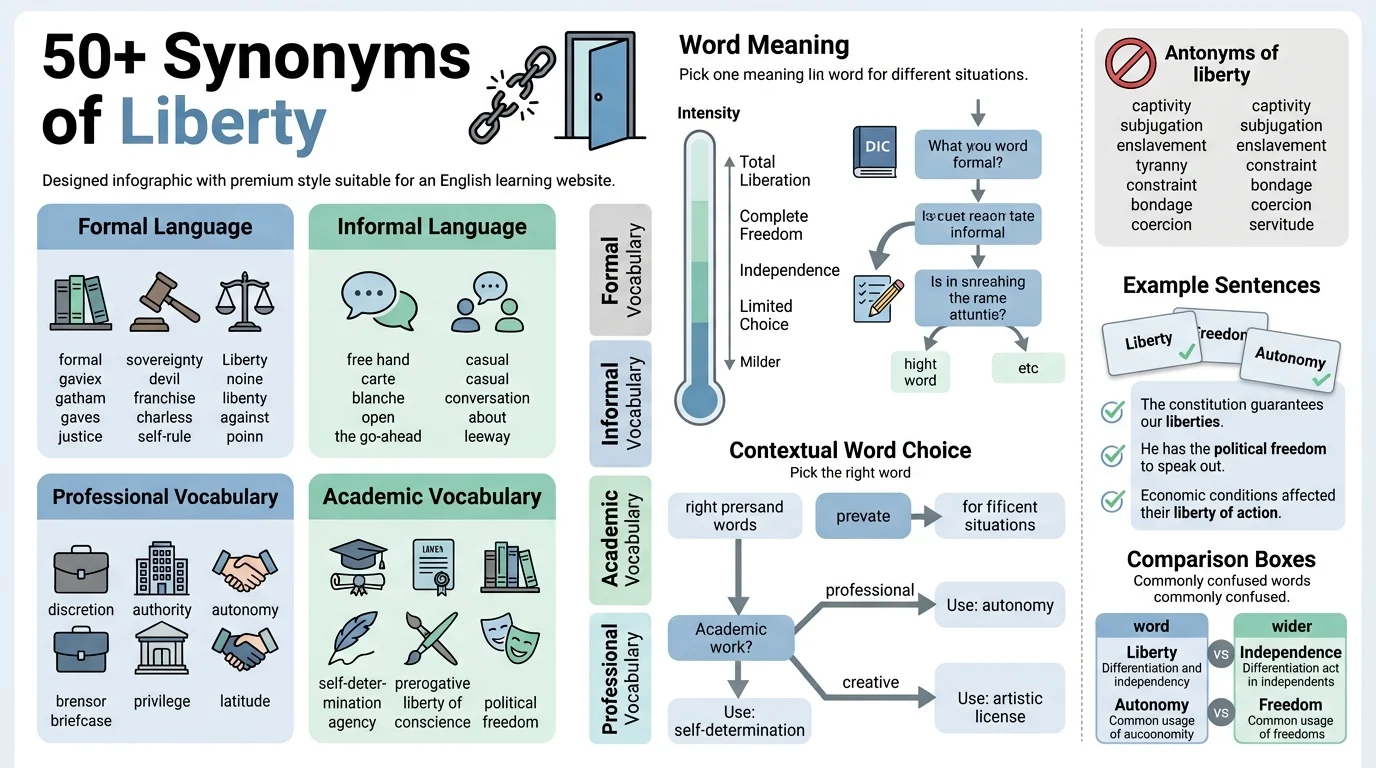
Have you ever found yourself writing an email, an essay, or a social media caption and realized you’ve used the word “freedom” five times in three sentences? You know it’s the right idea, but it feels repetitive and dull. Maybe you’re drafting a resume and want to sound more professional, or you’re a student trying to impress a teacher with more precise vocabulary. This is where exploring the synonyms of liberty becomes incredibly useful. Understanding the subtle differences between words like “autonomy,” “independence,” and “sovereignty” can transform your writing from adequate to excellent, ensuring your message lands with the exact tone and clarity you intend.
What Are the Best Synonyms of “Liberty”?
Liberty means the state of being free from oppressive restrictions or control. It carries a formal, often political tone. For formal writing, choose “autonomy” or “sovereignty.” For casual conversation, “freedom” works best. In academic contexts, use “self-determination.” For professional communication, “independence” is a safe and strong choice.
Meaning, Tone, and Context
Simple Definition
Liberty is the condition of being free from captivity, imprisonment, slavery, or oppressive government control. It also refers to the power or right to act, speak, or think as one wants without hindrance or restraint.
Part of Speech
Noun (plural: liberties).
Overall Tone
Neutral to positive. The word itself is positive, representing a highly valued state of being. However, it can take on a negative connotation in phrases like “take liberties,” which means to act with unwarranted familiarity or to overstep boundaries.
Formality Level
Formal. “Liberty” is a formal word heavily used in legal, political, and philosophical discussions. It appears in foundational documents like the U.S. Declaration of Independence and the Constitution, giving it a weighty, official feel.
Common Uses
Native English speakers commonly use “liberty” in discussions about civil rights, government, and law. It is also used in formal speeches and historical contexts. For example, you might hear about “civil liberties,” “personal liberty,” or the famous quote, “Give me liberty or give me death”. In the military and navy, “liberty” specifically means a short, authorized leave of absence from duty.
Word Forms
- Noun: liberty
- Plural Noun: liberties
- Related Verb: liberate (to set free)
- Related Noun: liberation (the act of setting free)
- Adjective: libertarian (believing in maximum liberty)
When and How to Use “Liberty”
You should choose “liberty” when you want to emphasize freedom from external control, especially from a government or authority. It is the word of choice for formal declarations, legal documents, and serious political discourse. Here are realistic examples across different contexts:
- Professional: “Our company values the liberty of its employees to innovate and take calculated risks.”
- Academic: “The philosopher’s work explores the tension between individual liberty and the needs of the state.”
- Workplace: “Team members have the liberty to set their own schedules as long as they meet their deadlines.”
- Personal: “After years of strict parenting, she finally felt a sense of liberty when she moved into her own apartment.”
- Email: “I am not at liberty to discuss the specifics of the project until the official announcement.”
- Resume: “Successfully advocated for policies that expanded civil liberties for marginalized communities.”
- Social Media: “Celebrating the liberty we have to express ourselves freely. 🗽 #Freedom”
Best Synonyms of “Liberty”
No synonym is a perfect replacement for every situation. Here is your guide to the best synonym of liberty for various contexts.
- Professional writing: Independence. It is straightforward, widely understood, and implies self-reliance without being overly academic.
- Academic writing: Self-determination. This term is precise and theoretical, often used in political science and philosophy to discuss the right of people to choose their own destiny.
- Business communication: Autonomy. This is ideal for discussing teams, departments, or branches that operate with a degree of self-governance.
- Casual conversation: Freedom. It is the most common and versatile word, easily understood by everyone.
- Emotional writing: Emancipation. This word carries a powerful emotional weight, suggesting a release from past oppression or servitude.
- Creative writing: Sovereignty. This evokes images of kingdoms, ultimate power, and complete self-rule, adding a literary flair.
- Resume writing: Autonomy. Highlighting your ability to work autonomously signals to employers that you are a self-starter who needs little supervision.
- Workplace communication: Independence. It communicates that you can handle tasks and make decisions without constant oversight.
- Stronger meaning: Sovereignty. This suggests supreme authority and complete independence, making it a very strong and definitive term.
- Softer meaning: Latitude. This implies freedom to act within certain bounds, suggesting flexibility rather than absolute liberation.
When Not to Use “Liberty”
Using “liberty” in the wrong context can make you sound stiff, overly dramatic, or simply out of touch.
- Too general: When discussing everyday choices like what to eat for breakfast, “liberty” is too grand. Better synonym: Choice or option.
- Too vague: If you are describing the state of being able to move freely after an injury, “liberty” is vague and formal. Better synonym: Mobility.
- Too formal: In a text message to a friend about your weekend plans, saying “I have the liberty to go to the movies” sounds unnatural. Better synonym: Freedom or flexibility.
- Too weak: In a historical essay about a nation’s struggle against a colonizer, “freedom” might feel too weak. Better synonym: Sovereignty or independence.
- Too strong: In a casual workplace discussion about choosing a project, saying “I have the liberty to choose” is overly formal and grand. Better synonym: Option or leeway.
- Outdated: The specific nautical use of “liberty” for shore leave is somewhat dated and specialized. Better synonym: Leave or shore leave.
Rewrite Example:
- Original: “The new manager gave us the liberty to choose our own tools for the project.” (Too formal)
- Better: “The new manager gave us the autonomy to choose our own tools for the project.” (More professional and precise for a work setting)
Words Commonly Confused With “Liberty”
Best Synonyms of “Liberty” by Context
| Context | Best Synonym | Why It Works | Example |
|---|---|---|---|
| Formal writing | Sovereignty | It conveys supreme and undeniable authority. | “The nation’s sovereignty was enshrined in its new constitution.” |
| Academic writing | Self-determination | It is a precise, theoretical term used in political and social sciences. | “The principle of self-determination is central to international law.” |
| Professional communication | Autonomy | It signals self-governance and the ability to work without supervision. | “We encourage autonomy among our team members.” |
| Business emails | Independence | It is clear, professional, and widely understood. | “We are aiming for financial independence in the next quarter.” |
| Resume writing | Initiative | While not a direct synonym, it implies the freedom to act proactively. | “Demonstrated initiative by leading a project that increased efficiency by 20%.” |
| Workplace communication | Leeway | It suggests flexibility within guidelines, which is perfect for workplace dynamics. | “The manager gave us some leeway in how we approach the new client.” |
| Casual conversation | Freedom | It is the most common and natural-sounding word. | I love the freedom of working from home.” |
| Everyday speaking | Choice | It is simple, direct, and focuses on the act of deciding. | “You have the choice to accept or decline the offer.” |
| Creative writing | Unfettered | This is a literary and expressive word meaning “not confined or restricted.” | “He wrote with an unfettered imagination.” |
| Storytelling | Liberation | It implies a dramatic and powerful release from constraint. | “The protagonist’s journey was one of liberation and self-discovery.” |
| Emotional writing | Emancipation | It carries deep emotional weight and historical significance. | “Her emancipation from a toxic relationship was a moment of pure joy.” |
| Strong emphasis | Absolute freedom | It is an emphatic phrase that leaves no room for doubt. | “The artist demanded absolute freedom to create.” |
| Mild tone | Latitude | It suggests flexibility and room to maneuver, not absolute freedom. | “The policy gives employees considerable latitude in their approach.” |
| Social media captions | Freedom | It is short, punchy, and highly relatable. | “Living my best life with the freedom to explore. ✨” |
| American English | Freedom | “Freedom” is the more colloquial and widely used term in American English. | “We hold these truths to be self-evident…” (While the Declaration mentions “liberty,” “freedom” is used more often in daily conversation). |
| British English | Liberty | “Liberty” is used in similar contexts but may appear more frequently in British legal and political discourse. | “The right to liberty is protected under the law.” |
How to Choose the Best Synonym of “Liberty”
Choosing the right word doesn’t have to be a guessing game. Ask yourself these questions to guide your decision:
- What is my audience? If you are writing for a general audience, “freedom” is your safest bet. For a professional or academic audience, “autonomy” or “self-determination” will demonstrate a more sophisticated vocabulary.
- What is my purpose? Are you trying to persuade, inform, or tell a story? “Emancipation” and “liberation” are persuasive and emotional, while “independence” is informative and clear.
- What is the tone? A formal report calls for “sovereignty,” while a personal blog post is better suited for “freedom” or “choice.”
- How strong does the word need to be? For a strong, absolute meaning, choose “sovereignty.” For a softer, more flexible meaning, choose “latitude” or “leeway.”
- Does it sound natural? Read your sentence aloud. If the synonym feels forced or pretentious, choose a simpler word like “freedom” or “choice.
Real Life Examples of “Liberty”
Observing how a word is used in real life is the best way to understand its nuances.
- School: “The school’s dress code was designed to balance student expression with the need for a focused learning environment.” (Replace with: “The school’s dress code was designed to balance student liberty with the need for a focused learning environment.”)
- College: “The university’s new policy on free speech sparked a campus-wide debate about the limits of academic freedom.” (Replace with: “The university’s new policy on free speech sparked a campus-wide debate about the limits of academic liberty.”)
- Workplace: “The new software gives employees the freedom to access files from anywhere.” (Replace with: “The new software gives employees the liberty to access files from anywhere.”)
- Business: “The CEO announced the company’s newfound independence from its parent corporation.” (Replace with: “The CEO announced the company’s newfound liberty from its parent corporation.”)
- Email: “I can’t share that information yet.” (Replace with: “I am not at liberty to share that information yet.”)
- Resume: “Managed a team of 10 with the freedom to make key operational decisions.” (Replace with: “Managed a team of 10 with the liberty to make key operational decisions.”)
- Conversation: “Ever since I got my driver’s license, I’ve felt so free.” (Replace with: “Ever since I got my driver’s license, I’ve felt such a sense of liberty.”)
- Storytelling: “The knight fought to free the kingdom from the tyrant.” (Replace with: “The knight fought to restore liberty to the kingdom.”)
- Blogging: “The digital nomad lifestyle offers the ultimate freedom to work from anywhere in the world.” (Replace with: “The digital nomad lifestyle offers the ultimate liberty to work from anywhere in the world.”)
- Social Media: “Voting is a right and a privilege.” (Replace with: “Voting is a precious liberty we must protect.”)
18 Best Synonyms of “Liberty”
| Synonym | Simple Meaning | Best Used For | Example Sentence |
|---|---|---|---|
| Freedom | The state of being free from restraint. | General, everyday use. | “The bird enjoyed its newfound freedom after being released from its cage.” |
| Independence | Freedom from control or support of others. | Professional and personal contexts. | “Achieving financial independence is a significant milestone.” |
| Autonomy | Self-governance and the right to make one’s own decisions. | Professional and political contexts. | “The department was granted full autonomy to manage its own budget.” |
| Sovereignty | Supreme authority and self-rule, often of a nation. | Formal and political discourse. | “The country fought to protect its sovereignty.” |
| Self-determination | The right of a people to choose their own political status. | Academic and political theory. | “The principle of self-determination is a cornerstone of international law.” |
| Emancipation | The act of being set free from legal, social, or political restrictions. | Historical and emotional writing. | “The emancipation of the slaves was a turning point in American history.” |
| Liberation | The act of setting someone free from imprisonment or oppression. | Dramatic and powerful contexts. | “The liberation of the city was celebrated with great joy.” |
| Immunity | Exemption from something, such as a duty or penalty. | Legal and professional contexts. | “The diplomat was granted diplomatic immunity.” |
| Prerogative | A right or privilege exclusive to a particular person or class. | Formal and legal contexts. | “It is the manager’s prerogative to approve all final decisions.” |
| Carte blanche | Complete freedom to act as one wishes. | Creative and professional contexts. | “The designer was given carte blanche to redecorate the entire office.” |
| Latitude | Freedom to act within broad limits. | Professional and personal contexts. | “The new policy gives employees more latitude in their work schedules.” |
| Leeway | The amount of freedom to move or act that is available. | Everyday and professional speech. | “The project manager allowed us some leeway with the deadline.” |
| Discretion | The freedom to decide what should be done in a particular situation. | Professional and formal contexts. | “Use your discretion when deciding how to handle this client.” |
| Deliverance | The act of being rescued or set free. | Literary and religious contexts. | “The characters prayed for deliverance from their difficult situation.” |
| Home rule | Self-government in local matters by a city or county. | Political and local government contexts. | “The citizens voted in favor of home rule for their county.” |
| Free will | The power of acting without the constraint of necessity or fate. | Philosophical and personal contexts. | “The concept of free will is central to many ethical debates.” |
| Unconstraint | The state of being free from constraint. | Formal and literary contexts. | “She spoke with an unconstraint that was both refreshing and surprising.” |
| Volition | The faculty or power of using one’s will. | Formal and psychological contexts. | “He signed the contract of his own volition, without any pressure.” |
Synonyms of “Liberty” by Usage
Professional vs Personal Synonyms
In the workplace, autonomy, independence, and discretion are the top choices. They signal competence and trustworthiness. In personal life, freedom and choice are more natural and relatable.
- Professional: “Our team values autonomy to make decisions quickly.”
- Personal: “I finally have the freedom to plan my own schedule.”
Formal vs Conversational Synonyms
For formal reports, essays, and presentations, use sovereignty, self-determination, or emancipation. For casual conversations and texting, freedom, leeway, or choice are better.
- Formal: “The treaty recognized the sovereignty of the new nation.”
- Conversational: “I have some leeway with my hours, so I can come in late tomorrow.”
Academic Synonyms
In academic writing, precision is key. Self-determination, autonomy, and sovereignty are authoritative and demonstrate a deep understanding of political and social concepts.
Professional and Business Synonyms
For resumes, interviews, and client communication, use words that highlight your capability and self-sufficiency. Autonomy, initiative, and independence are powerful choices.
- Resume: “Proven ability to work autonomously and manage complex projects.”
- Meeting: “We are seeking greater independence from our suppliers to reduce costs.”
Creative and Literary Synonyms
To add emotion and imagery to your writing, choose more expressive synonyms. Emancipation, liberation, deliverance, and unfettered can bring your stories and poems to life.
- Storytelling: “Her journey was one of liberation, breaking the chains of her past.”
- Poetry: “The unfettered wind swept across the open plains.”
Slang or Modern Synonyms
There is no direct slang equivalent for “liberty.” In modern English, people often use phrases like “do your own thing” or “have free rein,” but these are informal idioms, not synonyms.
Strongest to Mildest Synonyms
The emotional intensity of these synonyms varies greatly.
| Intensity | Synonyms |
|---|---|
| Mild | Choice, leeway, latitude |
| Moderate | Freedom, independence, autonomy |
| Strong | Emancipation, liberation, self-determination |
| Very Strong | Sovereignty, absolute freedom |
Emotional vs Neutral Synonyms
Emotional Synonyms (express strong feelings): Emancipation, liberation, deliverance, sovereignty.
- When to use: When you want to evoke passion, historical weight, or a sense of triumph. “The emancipation of the people was a cause worth fighting for.”
Neutral Synonyms (simply communicate information): Freedom, independence, autonomy, choice.
- When to use: When you want to be clear, professional, and objective. “The department was given autonomy to manage its resources.”
Antonyms of “Liberty”
| Antonym | Meaning | Example Sentence |
|---|---|---|
| Slavery | The state of being a slave; bondage. | “The abolitionists fought tirelessly to end slavery.” |
| Captivity | The condition of being imprisoned or confined. | “The animals were kept in captivity for research purposes.” |
| Imprisonment | The state of being imprisoned. | “He faced a long imprisonment for his crimes.” |
| Bondage | The state of being a slave or servant; servitude. | “The novel tells the story of a people in bondage.” |
| Confinement | The state of being confined; restriction. | “His confinement to a wheelchair did not dampen his spirit.” |
| Restraint | A measure or condition that keeps someone or something under control. | “The prisoner was kept under heavy restraint.” |
| Oppression | Prolonged cruel or unjust treatment or control. | “The people rose up against years of oppression.” |
| Tyranny | Cruel and oppressive government or rule. | “The citizens fled the country to escape the tyranny.” |
| Subjugation | The action of bringing someone or something under domination or control. | “The empire’s goal was the subjugation of all its neighbors.” |
| Dependence | The state of relying on or being controlled by someone or something else. | “His dependence on his parents prevented him from becoming independent.” |
| Constraint | A limitation or restriction. | “The constraints of the budget made the project difficult.” |
| Incarceration | The state of being confined in prison. | “Incarceration rates in the country are among the highest in the world.” |
| Servitude | The state of being a slave or completely subject to someone more powerful. | “He spent his entire life in servitude to a cruel master.” |
| Arrest | The action of seizing someone to take into custody. | “The arrest of the activist sparked a series of protests.” |
| Prohibition | The action of forbidding something. | “The prohibition of alcohol was a significant period in American history.” |
Comparison: “Liberty” vs Similar Words
Liberty vs Freedom
Main Difference: “Liberty” is more formal and often implies freedom from political or legal oppression. “Freedom” is a broader term that can apply to any situation where someone is not restrained.
Which Is Stronger? “Liberty” can be stronger in a legal or political context due to its formal weight. However, “freedom” is more powerful in a personal context.
Which Is More Formal? “Liberty” is significantly more formal.
When to Use Each:
- Liberty: Use in legal, political, or historical writing. “The constitution guarantees the liberty of its citizens.”
- Freedom: Use in everyday speech and writing for general situations. “I have the freedom to choose my own career.”
Examples:
- Liberty: “The prisoners were finally granted their liberty.”
- Freedom: “She enjoyed the freedom of being able to travel wherever she wanted.”
Liberty vs Autonomy
Main Difference: “Liberty” is a broad state of being free. “Autonomy” is the specific right to self-governance and make one’s own decisions.
Which Is Stronger? “Autonomy” is more specific and implies a greater degree of control over one’s own affairs.
Which Is More Formal? Both are formal, but “autonomy” is more commonly used in professional and academic settings.
When to Use Each:
- Liberty: Use when discussing general freedom from oppression. “The people fought for their liberty.”
- Autonomy: Use when discussing the right to make independent decisions. “The regional office has full autonomy to manage its budget.”
Examples:
- Liberty: “The revolution was a fight for liberty and justice.”
- Autonomy: “The manager gave the team autonomy to set their own deadlines.”
Liberty vs Independence
Main Difference: “Liberty” emphasizes freedom from external control. “Independence” emphasizes not being reliant on or controlled by others.
Which Is Stronger? “Independence” is often perceived as a stronger, more concrete achievement.
Which Is More Formal? Both are formal, but “liberty” has a slightly more political and philosophical tone.
When to Use Each:
- Liberty: Use in political or philosophical contexts. “The concept of individual liberty is a cornerstone of democracy.”
- Independence: Use when discussing self-sufficiency or a break from dependence. “She valued her financial independence above all else.”
Examples:
- Liberty: “The nation’s liberty was hard-won.”
- Independence: “The country declared its independence in 1776.”
Liberty vs Sovereignty
Main Difference: “Liberty” is a personal or political freedom. “Sovereignty” is the supreme authority of a state to govern itself.
Which Is Stronger? “Sovereignty” is the strongest term, implying ultimate and absolute power.
Which Is More Formal? “Sovereignty” is an extremely formal and specific political term.
When to Use Each:
- Liberty: Use when discussing the rights of individuals. “The law protects the liberty of all citizens.”
- Sovereignty: Use when discussing the authority of a nation. “The country’s sovereignty was threatened by the invasion.”
Examples:
- Liberty: “The citizens cherished their hard-won liberties.”
- Sovereignty: “The treaty recognized the sovereignty of the new nation.”
Liberty vs Emancipation
Main Difference: “Liberty” is a state of being free. “Emancipation” is the specific act of being set free from legal, social, or political restrictions.
Which Is Stronger? “Emancipation” is a more dramatic and powerful word, often associated with historical struggles like the abolition of slavery.
Which Is More Formal? Both are formal, but “emancipation” is more specific and carries a heavier historical weight.
When to Use Each:
- Liberty: Use to describe the general state of freedom. “The people enjoyed their new-found liberty.”
- Emancipation: Use to describe the act or process of gaining freedom. “The emancipation of the slaves was a monumental achievement.”
Examples:
- Liberty: “The constitution guarantees the liberty of all citizens.”
- Emancipation: “The Emancipation Proclamation was a pivotal moment in U.S. history.”
Liberty vs Latitude
Main Difference: “Liberty” is a broad, absolute freedom. “Latitude” is a more measured freedom to act within certain limits.
Which Is Stronger? “Liberty” is significantly stronger and more absolute.
Which Is More Formal? Both are formal, but “latitude” is often used in professional and technical contexts.
When to Use Each:
- Liberty: Use when discussing fundamental rights. “Freedom of speech is a basic liberty.”
- Latitude: Use when discussing flexibility within a system. “The project manager gave the team considerable latitude in their approach.”
Examples:
- Liberty: “The prisoners were finally granted their liberty.”
- Latitude: “The new policy gives employees more latitude in their work schedules.”
Common Phrases and Expressions with “Liberty”
Common Mistakes to Avoid
1. Using “Liberty” When “Freedom” is More Natural
Incorrect: “I have the liberty to wear what I want to the party.”
Better: “I have the freedom to wear what I want to the party.”
Why: “Liberty” is too formal for casual, personal choices.
2. Confusing “Liberty” with “License”
Incorrect: “The new policy gives us license to work from home.”
Better: “The new policy gives us the liberty to work from home.”
Why: “License” implies permission that can be revoked and often suggests an abuse of freedom.
3. Using “Liberty” When You Mean “Autonomy”
Incorrect: “The team was given liberty to make its own decisions.”
Better: “The team was given autonomy to make its own decisions.”
Why: “Autonomy” is more precise for the context of self-governance in a work setting.
4. Overusing “Liberty” in a Single Piece of Writing
Incorrect: “The new law threatens our liberty. We must fight to protect our liberty. Our children deserve to grow up with liberty.”
Better: “The new law threatens our liberty. We must fight to protect our freedom. Our children deserve to grow up with independence.”
Why: Repeating the same word makes your writing sound dull and uncreative.
5. Using “Liberty” When You Mean “Permit” or “Allow”
Incorrect: “The software liberates you to edit photos.”
Better: “The software allows you to edit photos.”
Why: “Liberate” is a strong word for freeing from oppression, not for simple functionality.
6. Using an Informal Synonym in a Formal Essay
Incorrect: “The citizens fought for their right to do their own thing.”
Better: “The citizens fought for their liberty.”
Why: The phrase “do your own thing” is too informal and vague for serious academic or political writing.
7. Using “Liberty” to Describe the Freedom from a Minor Inconvenience
Incorrect: “The new shortcut gives me liberty from the long commute.”
Better: “The new shortcut frees me from the long commute.”
Why: “Liberty” is too grand a word for such a mundane situation.
Frequently Asked Questions
1. What are the best synonyms of “liberty”?
The best synonyms depend on your context. Everyday use, freedom is the most common. For professional settings, autonomy and independence are excellent choices. Formal or political writing, sovereignty and self-determination are the most precise.
2. What are the best formal synonyms of “liberty”?
The best formal synonyms are sovereignty, self-determination, and emancipation. These words carry significant weight in legal, political, and academic discourse.
3. What are common informal synonyms of “liberty”?
In informal settings, people rarely use direct synonyms of “liberty.” Instead, they use words like freedom, choice, or phrases like leeway and free rein. For example, “I have the freedom to choose my own hours.”
4. What is another word for “liberty” in professional writing?
In professional writing, autonomy is often the best choice. It conveys self-governance and the ability to work independently. Independence is another strong and clear option.
5. What is the difference between “liberty” and “freedom”?
“Liberty” is a more formal word that often refers to political or legal freedom from oppression. “Freedom” is a broader, more general term that can apply to any situation without restraint. For example, you might fight for your liberty, but enjoy the freedom to eat what you like.
6. What is the opposite of “liberty”?
The most direct opposites of “liberty” are slavery, captivity, imprisonment, and bondage. Other strong antonyms include oppression, tyranny, and subjugation.
Conclusion
“Liberty” is a powerful and formal word that describes the state of being free from oppressive control. While it is a cornerstone of political and philosophical language, it is not always the best choice for everyday conversation. By understanding the subtle differences between its many synonyms, you can elevate your writing and speak with greater precision. Remember, there is no single perfect synonym for any word. The best choice depends on your audience, your purpose, and the tone you want to achieve. As a practical tip, the next time you write, challenge yourself to replace the word “freedom” with a more precise synonym like “autonomy” or “latitude” to see how it changes the nuance of your sentence. Exploring the synonyms of liberty is a great way to expand your vocabulary and communicate more effectively.
1 thought on “50+ Synonyms of Liberty | Meanings, Uses, Examples, and Best Alternatives”