You are writing a performance review and need to describe a colleague’s presentation. Updating your resume and want a stronger word than “powerful” to describe your leadership. You are drafting a speech and “powerful” already appears three times.
Powerful is a strong word. But using it too often drains its strength and makes your writing feel repetitive. This guide gives you the right synonyms for powerful, sorted by exact tone, context, and purpose, so your message always lands with the right force.
What Does “Powerful” Mean?
“Powerful” describes someone or something with great strength, influence, authority, or physical force. It applies to people, arguments, emotions, machines, and positions. The best synonyms depend on context: influential for leadership, compelling for arguments, muscular for physical strength, and authoritative for expert voices and institutions.
Meaning, Tone and Context
The word “powerful” carries a strong and commanding tone. It signals strength, control, impact, or dominance depending on the situation.
Part of speech: Adjective
Tone: Strong, assertive, positive when describing capability, negative when describing oppression
Formality level: Neutral to formal
Common use cases: Describing people, arguments, emotions, organizations, machines, and natural forces
Related forms: Power (noun), powerfully (adverb), empower (verb), powerless (adjective)
In professional settings, “powerful” implies effectiveness and influence. In personal descriptions, it can suggest physical strength or emotional depth. The word commands attention, but a more specific synonym often communicates your exact shade of meaning better.
When and How to Use “Powerful”
Use “powerful” when you want a forceful, universally understood adjective. It works when you describe great strength, deep emotional impact, or significant influence.
Here are realistic examples using “powerful” in everyday situations.
She delivered a powerful presentation that secured the client’s approval. (professional)
The study presented powerful evidence supporting the new treatment. (academic)
That movie had a powerful effect on everyone in the theater. (casual)
He felt a powerful sense of gratitude toward his mentor. (emotional)
The novelist created a powerful villain readers could not forget. (creative)
A powerful message can change how people think. (social media)
My previous role taught me powerful lessons about team dynamics. (resume)
Please review the powerful data visualizations before the board meeting. (email)
Another Word for “Powerful”
If you want one solid replacement, “influential” is often your best choice. It covers people, ideas, and organizations with a tone of earned respect. However, the right synonym always depends on your specific situation.
For professional writing, try “influential,” “authoritative,” or “high impact.” For academic writing, use “compelling” or “persuasive.” In casual conversation, “strong” or “intense” fit naturally. For emotional writing, “overwhelming” or “profound” work well.
In creative writing, explore “formidable” or “mighty.” On resumes, “impactful” or “high performing” carry strong professional value. For social media captions, “game changing” or “unstoppable” connect with readers. Choose “omnipotent” for the strongest meaning and “capable” for a softer tone.
When Not to Use “Powerful”
Sometimes “powerful” sounds too intense, too vague, or slightly dramatic for the situation. Describing a routine team meeting as “powerful” can make you sound insincere.
The manager gave a powerful update on quarterly numbers.
The manager gave a clear and insightful update on quarterly numbers.
If something is merely effective, well reasoned, or helpful, use “effective,” “clear,” or “valuable.” Reserve “powerful” for moments that truly carry force, depth, or significant impact.
Words Commonly Confused With “Powerful”
Several words overlap with “powerful” but carry distinct meanings. Understanding the differences keeps your writing precise.
Powerful vs. Strong
Strong describes physical strength, durability, or intensity. Powerful includes strength but adds influence, authority, and emotional impact. A strong coffee has intense flavor. A powerful speech moves people to action.
Powerful vs. Influential
Influential focuses specifically on the ability to shape opinions and decisions. Powerful is broader and can include physical force. A powerful athlete dominates physically. An influential coach shapes the entire sport.
Powerful vs. Authoritative
Authoritative emphasizes knowledge, confidence, and reliability. Powerful can exist without expertise. An authoritative textbook is trusted for accuracy. A powerful argument might be emotionally charged rather than fact based.
Powerful vs. Intense
Intense describes extreme degree or concentration. Powerful describes capacity for force or impact. An intense workout leaves you exhausted. A powerful engine propels the car effortlessly.
Powerful vs. Compelling
Compelling means irresistibly interesting or convincing. It applies mostly to ideas, arguments, and stories. Powerful applies more broadly. A compelling mystery keeps you reading. A powerful thunderstorm shakes the house.
Powerful vs. Dominant
Dominant means exercising control over others, often in a competitive sense. Powerful simply means possessing strength or influence. A dominant team wins repeatedly. A powerful team may win decisively but not consistently.
Best Synonym by Context for “Powerful”
| Context | Best Synonym | Why It Works | Example |
|---|---|---|---|
| Formal writing | Influential | Professional and measured | The influential report shaped public policy for a decade. |
| Academic writing | Compelling | Emphasizes persuasive strength | The researcher presented compelling evidence for her theory. |
| Professional or business use | High impact | Signals measurable results | Our high impact initiatives increased revenue by 30 percent. |
| Resume | Impactful | Demonstrates clear value | Led an impactful restructuring of the supply chain. |
| Casual conversation | Strong | Natural and versatile | She gave a really strong argument during the debate. |
| Creative writing | Formidable | Adds dramatic weight | A formidable fortress guarded the mountain pass. |
| Emotional tone | Profound | Suggests depth and sincerity | His words had a profound effect on everyone present. |
| Strong intensity | Overwhelming | Implies unstoppable force | An overwhelming sense of joy filled the room. |
| Soft or moderate tone | Capable | Understated and positive | She is a capable leader who supports her team consistently. |
| Social media captions | Game changing | Current and energetic | This game changing tool saved me hours this week. |
| US and UK usage | Mighty | Universally understood with slight literary feel | The mighty river carved its path through the canyon. |
Which Synonym Should You Choose?
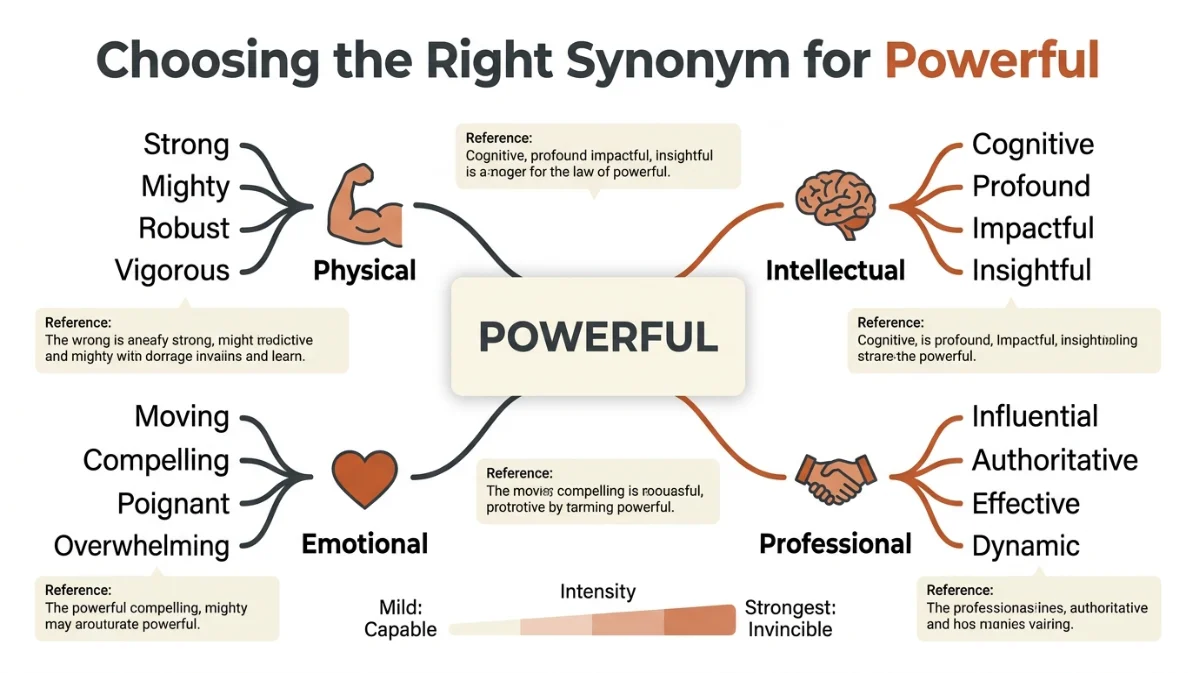
Ask yourself three quick questions. First, what kind of power are you describing? Physical force calls for “strong” or “muscular.” Influence over people calls for “influential” or “persuasive.” Emotional depth calls for “profound” or “overwhelming.” Second, how formal is the setting? Choose “authoritative” for academic papers, “high impact” for business, and “intense” for casual speech. Third, how much intensity feels right? Match a mild word like “capable” to modest achievements and a strong word like “formidable” to exceptional ones.
Real Life Examples of “Powerful” in Sentences
Seeing synonyms in context shows how each word shifts the sentence’s energy.
- School: The professor recommended a compelling book on constitutional law.
- Workplace: Her influential mentorship shaped the careers of many junior staff.
- Writing: The poem’s profound imagery stayed with readers long afterward.
- Conversation: He made a really strong case for trying the new restaurant.
- Social media: This productivity hack is absolutely game changing.
- Resume: Built a high performing sales team from the ground up.
- Email: Thank you for your persuasive points during today’s discussion.
- Storytelling: An unstoppable force of nature swept across the plains.
25 Synonyms for “Powerful”
| Synonym | Simple Meaning | Best Used For | Example Sentence |
|---|---|---|---|
| Influential | Able to shape opinions | Leadership and ideas | She became an influential voice in climate policy. |
| Compelling | Convincing and attention holding | Arguments and stories | The documentary made a compelling case for renewable energy. |
| Authoritative | Confident and reliable | Expert opinions and sources | The judge issued an authoritative ruling on the matter. |
| Strong | Having physical or mental power | Everyday and versatile use | He offered strong support during a difficult time. |
| Intense | Extreme in degree or force | Emotions and experiences | The training camp was an intense physical challenge. |
| Mighty | Impressively large or forceful | Literary and dramatic contexts | The mighty oak had stood for over three centuries. |
| Formidable | Inspiring fear or respect | Challenges and opponents | The team faced a formidable rival in the championship. |
| Dominant | Exercising control over others | Competition and markets | The company held a dominant position in the industry. |
| Potent | Having strong effect | Medicine, symbols, and brief things | The symbol held potent meaning for the community. |
| High impact | Producing significant results | Business and resumes | We focus on high impact projects with measurable outcomes. |
| Persuasive | Good at convincing people | Sales and proposals | Her persuasive pitch won over the entire committee. |
| Forceful | Strong and assertive | Opinions and personalities | He made a forceful argument for immediate action. |
| Robust | Strong and healthy | Systems, data, and bodies | The software runs on a robust security framework. |
| Muscular | Having well developed muscles | Physical descriptions | The muscular athlete trained rigorously every morning. |
| Vigorous | Full of energy and strength | Activity and debate | The committee engaged in a vigorous discussion. |
| Overwhelming | Very great in amount or effect | Emotions and responses | The support from the community was simply overwhelming. |
| Profound | Very deep and meaningful | Insights and experiences | Traveling alone gave her a profound sense of freedom. |
| Staggering | Surprisingly large or powerful | Statistics and impacts | The company reported a staggering increase in growth. |
| Invincible | Too powerful to be defeated | Motivational and epic contexts | The team played with an invincible spirit that season. |
| High octane | Energetic and intense | Modern and fast paced scenarios | The startup operated at a high octane pace from day one. |
| Dynamic | Full of energy and new ideas | Personalities and environments | They are looking for a dynamic manager to lead expansion. |
| Weighty | Having great importance | Decisions and responsibilities | The judge faced a weighty decision that morning. |
| Indomitable | Impossible to defeat or discourage | Human spirit and determination | Her indomitable courage inspired everyone around her. |
| Game changing | Fundamentally altering a situation | Innovation and trends | The game changing technology disrupted the entire sector. |
| Capable | Having the ability to do well | Modest and professional praise | She proved herself a capable and reliable project lead. |
Synonym Groups and Usage Differences
Professional vs. Personal Synonyms
In professional environments, words like “influential,” “high impact,” “authoritative,” and “dynamic” communicate effectiveness and leadership without exaggeration. In personal life, “strong,” “intense,” and “profound” carry emotional warmth and depth.
Telling a friend their support was “profound” expresses deep gratitude. Telling a colleague their report was “authoritative” shows professional respect.
Formal vs. Conversational Synonyms
Formal writing rewards precision and restraint. Use “compelling,” “persuasive,” “influential,” and “authoritative” in reports, essays, and speeches.
Conversational English thrives on directness. Words like “strong,” “intense,” “mighty,” and “heavy” keep dialogue relaxed and natural. A text to a friend might describe a “strong movie,” while a review uses “emotionally compelling film.”
Academic Synonyms
Academic writing values rigorous persuasion and evidential weight. “Compelling” is your strongest academic synonym because it directly claims persuasive force backed by evidence. “Influential” works for describing key studies. “Robust” suits methodological descriptions. Avoid “game changing” or “mind blowing” entirely in scholarly work.
Professional and Business Synonyms
Business communication rewards words that project confidence and measurable results. “High impact” shows strategic thinking. “Dynamic” signals energy and adaptability. “Robust” demonstrates reliable strength. On resumes, “impactful,” “high performing,” and “dynamic” pair effectively with specific achievements and metrics.
Creative or Literary Synonyms
Creative writing benefits from synonyms that paint vivid pictures and stir imagination. “Formidable” adds scale and tension. “Mighty” carries classical weight. “Indomitable” describes unconquerable spirit. “Invincible” works for epic heroes and unstoppable forces.
Slang or Modern Synonyms
Terms like “game changing,” “high octane,” “next level,” and “beast mode” energize social media and casual conversation. They are perfectly acceptable in captions, texts, and informal marketing. Avoid them in academic papers, formal reports, and professional emails where they can sound trendy and imprecise.
Strongest vs. Weaker Synonyms
Think of powerful synonyms on an intensity scale from mild to strongest.
Mild: Capable, competent, solid
Moderate: Strong, effective, dynamic
Strong: Influential, compelling, formidable
Strongest: Omnipotent, invincible, overwhelming, unstoppable
Match the intensity to the actual strength or impact you are describing.
Emotional vs. Neutral Synonyms
“Profound,” “overwhelming,” and “intense” add emotional depth and personal resonance. “Authoritative,” “robust,” and “high impact” stay factual and professional. Choose emotional synonyms when you want readers to feel the weight of an experience. Choose neutral synonyms when you need to describe measurable capability or effectiveness.
Antonyms of “Powerful”
| Antonym | Meaning | Example Sentence |
|---|---|---|
| Weak | Lacking strength or influence | The weak argument failed to convince the audience. |
| Powerless | Without ability to act or influence | Citizens felt powerless against the new regulation. |
| Feeble | Physically or intellectually weak | His feeble attempt to lift the box ended in laughter. |
| Fragile | Easily broken or damaged | The fragile ceasefire lasted only a few days. |
| Ineffective | Not producing the desired result | The ineffective policy cost taxpayers millions. |
| Insignificant | Too small to be important | The error was insignificant compared to the overall success. |
| Impotent | Lacking power to affect change | The committee became an impotent body after the reforms. |
| Submissive | Willing to obey without resistance | The submissive response surprised everyone in the room. |
| Vulnerable | Open to attack or harm | The outdated system remained vulnerable to security threats. |
| Helpless | Unable to defend or act alone | The stranded hikers felt helpless as night approached. |
| Inadequate | Not enough or not good enough | The inadequate resources slowed the research progress. |
| Inferior | Lower in quality or status | The knockoff product was clearly inferior to the original. |
| Defenseless | Completely without protection | The village lay defenseless against the approaching storm. |
| Meek | Quiet and easily imposed upon | Her meek protest went unnoticed during the meeting. |
| Passive | Accepting without active response | A passive approach to leadership rarely inspires teams. |
Comparison: Powerful vs. Similar Words
Powerful vs. Strong
Main difference: Strong emphasizes durability and physical force. Powerful adds influence and authority.
Which one is stronger: Powerful is broader and often feels more intense.
Which one is more formal: Both are neutral. Powerful appears more in formal analysis.
Example: He built a strong wooden frame for the garden. She held a powerful position within the global organization.
Powerful vs. Influential
Main difference: Influential focuses on shaping opinions and decisions. Powerful can describe any type of force.
Which one is stronger: Powerful suggests more direct force. Influential suggests more subtle persuasion.
Which one is more formal: Influential is slightly more formal and specific.
Example: The powerful engine roared to life. The influential economist advised three presidential administrations.
Powerful vs. Intense
Main difference: Intense describes extreme concentration or degree. Powerful describes capacity for force.
Which one is stronger: Intense feels more emotionally charged in personal contexts.
Which one is more formal: Neither is distinctly more formal.
Example: The intense heat made outdoor work dangerous. The powerful corporation controlled multiple industries.
Powerful vs. Authoritative
Main difference: Authoritative implies knowledge and trustworthiness. Powerful implies strength and dominance.
Which one is stronger: Powerful suggests more force. Authoritative suggests more expertise.
Which one is more formal: Authoritative is more formal.
Example: The powerful speaker commanded the stage. The authoritative textbook is cited in hundreds of studies.
Powerful vs. Compelling
Main difference: Compelling means irresistibly interesting. Powerful describes broad strength.
Which one is stronger: Compelling is stronger for arguments and narratives.
Which one is more formal: Compelling is preferred in academic and critical writing.
Example: She gave a powerful kick that broke the board. The lawyer presented a compelling closing argument.
Powerful vs. Dominant
Main difference: Dominant means controlling others through superiority. Powerful means possessing great strength.
Which one is stronger: Dominant carries competitive, controlling energy.
Which one is more formal: Both are neutral. Dominant appears more in scientific and business analysis.
Example: The powerful storm caused widespread damage. The dominant species shapes the entire ecosystem.
Common Phrases and Expressions with “Powerful”
1. A powerful voice
Meaning: Strong influence or literal vocal strength.
Example sentence: She became a powerful voice for education reform in underserved communities.
2. Power behind the throne
Meaning: Someone who wields influence without holding an official position.
Example sentence: Many believed the chief advisor was the real power behind the throne.
3. More power to you
Meaning: An expression of support or encouragement.
Example sentence: You want to run a marathon? More power to you.
4. Power play
Meaning: A strategic move to assert dominance or control.
Example sentence: The sudden policy shift was a clear power play within the executive team.
5. Knowledge is power
Meaning: Being informed gives you an advantage.
Example sentence: She read every industry report because she believed knowledge is power.
6. Power trip
Meaning: Acting in an overbearing way due to having authority.
Example sentence: The new manager’s strict rules felt like a power trip to the entire staff.
7. Power struggle
Meaning: A conflict over who holds control.
Example sentence: The merger triggered a power struggle between the two founding partners.
8. Power through
Meaning: To persist with determination despite difficulty.
Example sentence: We just need to power through the final edits before the deadline.
Common Mistakes to Avoid
Sticking with “powerful” when “influential” or “compelling” is more precise weakens your message. A “powerful leader” could mean many things. An “influential leader” specifically shapes decisions.
Confusing “powerful” with “strong” can make descriptions too broad. A “strong cup of coffee” tastes intense. A “powerful cup of coffee” sounds slightly odd and imprecise.
Using casual synonyms like “game changing” in formal reports reduces professional credibility. Match your vocabulary to your audience’s expectations.
Using an overly dramatic synonym for modest achievements sounds like exaggeration. Calling a minor software update “revolutionary” or “unstoppable” erodes trust.
Repeating the same synonym across a document creates the same monotony you were trying to avoid. Vary your word choice with intention.
Choosing a synonym with the wrong emotional tone can confuse readers. “Overwhelming” carries heavy emotional weight. Using it for a routine task may signal distress rather than productivity.
Using slang like “beast mode” or “next level” in academic or professional writing damages your authority. Save these for social media, casual conversation, and informal marketing.
FAQs
What is the best synonym for powerful?
The best synonym depends on context. “Influential” fits leadership, “compelling” suits arguments, “strong” works casually, and “profound” describes deep emotional or intellectual impact.
What is a formal synonym for powerful?
“Influential,” “authoritative,” and “compelling” are strong formal synonyms. Choose “authoritative” for expert sources and “compelling” for persuasive academic or legal writing.
What is an informal synonym for powerful?
“Strong,” “intense,” “mighty,” and “game changing” are effective informal synonyms. They fit naturally in conversations, texts, and social media captions.
What is another word for powerful in professional writing?
“High impact,” “influential,” “dynamic,” and “robust” work well in professional writing. They show precision and signal effectiveness without exaggeration.
What is the difference between powerful and strong?
“Strong” emphasizes durability and physical capacity. “Powerful” adds influence, authority, and emotional depth. “Powerful” covers a broader range of intensity and impact.
What is the opposite of powerful?
“Weak” is the most direct opposite. Other common antonyms include “powerless,” “ineffective,” “fragile,” “feeble,” and “impotent,” each carrying slightly different meaning.
Conclusion
“Powerful” is a commanding, versatile word that grabs attention. But your writing becomes sharper, more precise, and more persuasive when you choose synonyms that match your specific context, tone, and audience.
Keep a mental list of your favorite alternatives: “compelling” for academic depth, “influential” for leadership impact, “profound” for emotional weight, and “robust” for professional reliability. Ask yourself what kind of power you are describing and pick the word that names that quality directly. The right word does not just describe power. It delivers it.