Do you keep using the word “determined” in your writing? This happens to many students, professionals, and content creators. You write an email, a resume, or a social media caption. Describe someone who never gives up. You use “determined” repeatedly. The text feels repetitive. The message loses its impact.
Finding the right synonyms for determined can transform your communication. This guide will help you choose the perfect word for every situation. You will learn the subtle differences between similar words. You will discover when to use each synonym. Your vocabulary will become more precise and powerful.
Quick Answer: What Does “Determined” Mean?
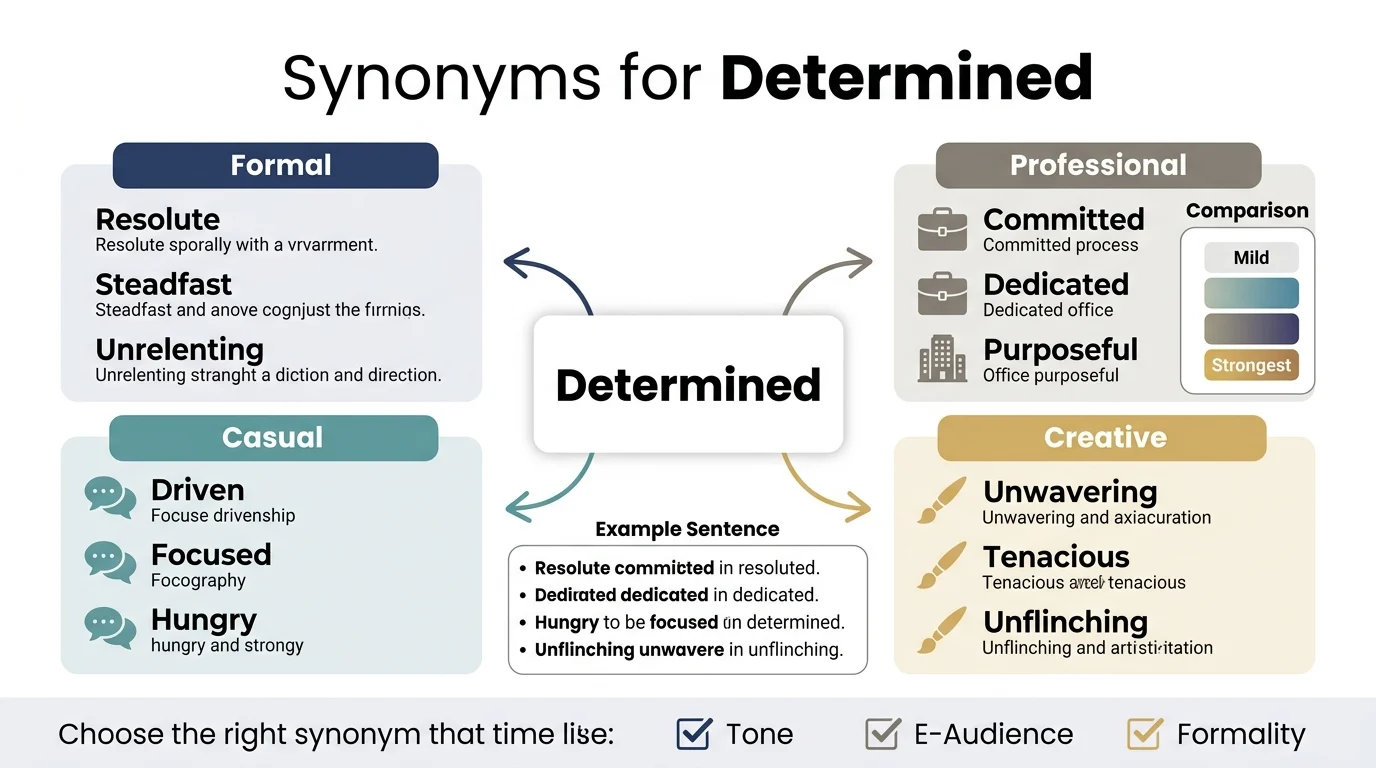
Determined means having a firm decision or a fixed purpose. It describes someone who persists toward a goal despite obstacles. The best synonyms depend on your context. For formal writing, use “resolute” or “persistent.” For casual conversation, try “driven” or “intent.” Creative work, choose “unwavering” or “steadfast.” For professional settings, “committed” and “dedicated” work well.
Meaning, Tone and Context
Simple Definition
Determined refers to a person who has made a firm decision and will not change their mind. It shows a strong will to achieve something.
Part of Speech
Determined is an adjective. The verb form is “determine.” The noun form is “determination.” The adverb form is “determinedly.”
Tone
Determined has a positive tone in most contexts. It suggests strength, focus, and reliability. The word carries admiration for someone’s persistence.
Formality Level
Determined is a neutral word. It works in formal and informal situations. You can use it in academic essays, business emails, and casual conversations.
Common Use Cases
People use determined to describe career goals, personal challenges, academic pursuits, athletic achievements, and creative projects. It appears frequently in resumes, performance reviews, motivational writing, and personal narratives.
Important Word Forms
The opposite of determined is “undetermined” or “irresolute.” Related forms include “determination” (noun), “determinable” (adjective), and “predetermined” (adjective).
When and How to Use “Determined”
Use determined when you want to show that someone has a clear goal and will not be stopped by difficulties. The word works best when describing sustained effort over time.
Here are realistic examples of using determined in different contexts:
Professional context: Sarah remained determined to complete the project on time even when her team lost two members.
Personal context: He was determined to run a marathon before his fortieth birthday.
Academic context: The determined student studied three hours every day for six months to pass the medical entrance exam.
Emotional context: Despite her fear of public speaking, she was determined to deliver the eulogy for her grandmother.
Creative context: The determined artist spent two years perfecting her technique before her first gallery show.
Social media caption: Determined to turn my passion into a career.
Resume context: Determined professional with a track record of exceeding sales targets by 40%.
Another Word for “Determined”
The best single replacement for determined depends entirely on your context. Here are direct suggestions for different situations:
Professional writing: “Committed” shows reliability and dedication to work.
Academic writing: “Persistent” suggests methodical and sustained effort.
Casual conversation: “Driven” feels modern and energetic.
Emotional writing: “Resolute” adds depth and gravity to your message.
Creative writing: “Unwavering” creates vivid imagery of strength.
Resume or workplace use: “Dedicated” signals loyalty and hard work.
Social media captions: “Focused” is concise and relatable.
For stronger meaning: “Tenacious” suggests a fighter who never gives up.
For softer meaning: “Intent” shows purpose without intensity.
When Not to Use “Determined”
Determined sounds too vague when you need to describe specific actions. It also feels too casual for formal legal or scientific writing.
Here is an example where a more precise synonym improves the sentence:
Weak sentence: The determined employee worked hard.
Improved sentence: The tenacious employee pursued every lead until the case was solved.
Use “persistent” when you want to emphasize continued effort over time. Use “resolute” when you need to highlight unwavering conviction. Select “single-minded” when focus is the key quality.
Avoid using determined in situations where the person lacks agency. Do not use it for outcomes that are not voluntary. Use “inevitable” or “unavoidable” instead.
Words Commonly Confused With “Determined”
Many words seem similar to determined but have important differences. Understanding these distinctions will improve your word choice.
- Determined vs. Persistent
Determined focuses on the mental state of decision. Persistent focuses on continuous action over time. A determined person has made a choice. A persistent person keeps acting despite obstacles. - Determined vs. Resolute
Resolute is more formal and carries a sense of moral or principled conviction. Determined is broader and more practical. Use resolute for ethical stances and determined for everyday goals. - Determined vs. Tenacious
Tenacious suggests a clinging quality, like a bulldog holding on to a bone. Determined is more internal and thoughtful. Tenacious implies physical or metaphorical grip. - Determined vs. Obstinate
Obstinate has a negative tone. It suggests unreasonable stubbornness. Determined is positive. It shows admirable persistence. - Determined vs. Stubborn
Stubborn can be positive or negative depending on context. Determined is almost always positive. Stubborn implies resistance to change. Determined implies movement toward a goal. - Determined vs. Driven
Driven suggests an external force motivating a person. Determined suggests internal willpower. Driven people often seem intense. Determined people appear focused and steady.
Best Synonym by Context for “Determined”
| Context | Best Synonym | Why It Works | Example |
|---|---|---|---|
| Formal writing | Resolute | Shows firm conviction and dignity | The board remained resolute in their decision. |
| Academic writing | Persistent | Highlights sustained methodological effort | Persistent research finally yielded results. |
| Professional business | Committed | Signals reliability and dedication | Our team is committed to client satisfaction. |
| Resume or job application | Dedicated | Shows loyalty and work ethic | Dedicated professional with ten years of experience. |
| Casual conversation | Driven | Feels modern and energetic | She is so driven to succeed in her startup. |
| Creative writing | Unwavering | Creates powerful visual imagery | His unwavering spirit inspired everyone around him. |
| Emotional tone | Steadfast | Suggests loyalty and emotional strength | Her steadfast love carried them through hard times. |
| Strong intensity | Tenacious | Implies a fighting spirit | The tenacious athlete refused to accept defeat. |
| Soft or moderate | Intent | Shows purpose without force | She was intent on finishing the chapter. |
| Social media captions | Focused | Concise and relatable | Focused on the goal. Nothing else matters. |
| US usage | Determined | Standard American English | He is determined to make a difference. |
| UK usage | Resolute | More common in British formal writing | The prime minister remained resolute. |
Which Synonym Should You Choose?
Selecting the right synonym requires thinking about your audience and purpose.
Consider the formality of your situation. Use “resolute” for formal reports and speeches. Use “driven” for casual conversations and social media.
Think about emotional intensity. Use “tenacious” when you want to show strength and fight. Use “intent” when you want a softer, more understated quality.
Consider professional value. “Committed” and “dedicated” carry weight in workplace settings. These words signal reliability to employers and colleagues.
Look at your sentence structure. Short sentences benefit from simple synonyms like “focused” or “intent.” Longer sentences can accommodate more complex words like “unwavering” or “persevering.
Match the synonym to the specific action. Are you describing a person or a behavior? Use “resolute” for a person’s character. Use “persistent” for their actions over time.
Real Life Examples of “Determined” in Sentences
Here are examples showing determined across different situations. Notice how stronger synonyms can enhance the meaning.
School context: The determined student attended every office hour session to master the difficult subject. Her persistent efforts eventually earned her top marks.
Workplace context: The determined manager transformed the struggling department into the company’s most profitable division. His resolute leadership made the difference.
Writing context: The determined author submitted her manuscript to fifty publishers before receiving an offer. Her tenacity finally paid off.
Conversation context: You can see how determined she is by the way she talks about her business plan. She is absolutely driven to make it work.
Social media context: Determined to break my personal record this month. Focused and ready.
Resume context: Determined marketing specialist who consistently exceeds performance metrics. Committed to driving measurable results.
Email context: I remain determined to resolve this issue before the deadline. Please let me know how I can support the team.
Storytelling context: Through every setback and disappointment, he remained determined. His unwavering spirit carried him through the darkest days.
25 Synonyms for “Determined”
| Synonym | Simple Meaning | Best Used For | Example Sentence |
|---|---|---|---|
| Resolute | Firm and unwavering in purpose | Formal writing and speeches | The committee remained resolute in its commitment to reform. |
| Persistent | Continuing firmly despite obstacles | Academic and scientific writing | Persistent investigation revealed the truth. |
| Tenacious | Holding on firmly to a goal | Strong emotional writing | Her tenacious spirit inspired everyone in the room. |
| Committed | Dedicated to a cause or activity | Professional and workplace contexts | Our staff is committed to excellent customer service. |
| Dedicated | Devoted completely to something | Resumes and professional profiles | A dedicated teacher who transforms students’ lives. |
| Driven | Highly motivated and focused | Modern business and casual use | A driven entrepreneur who built three successful companies. |
| Unwavering | Steady and constant | Creative and descriptive writing | His unwavering belief in justice guided every decision. |
| Steadfast | Loyal and unchanging | Emotional and personal contexts | Her steadfast friendship helped me through difficult times. |
| Intent | Fully focused on a purpose | Moderate tone and casual use | He was intent on proving his theory correct. |
| Single-minded | Focused completely on one goal | Describing extreme focus | The single-minded athlete trained through injuries. |
| Purposeful | Having a clear aim and direction | Professional and personal growth | Her purposeful approach led to rapid career advancement. |
| Persistent | Continuing despite resistance | Describing long-term effort | Persistent marketing efforts increased brand awareness. |
| Dogged | Stubbornly determined | Describing relentless effort | The dogged journalist uncovered the corruption. |
| Indefatigable | Tireless and untiring | Formal and literary writing | An indefatigable worker who never complained. |
| Unrelenting | Not weakening in strength | Strong and intense situations | Their unrelenting pursuit of excellence set them apart. |
| Obstinate | Stubbornly refusing to change | Negative contexts when needed | His obstinate refusal to compromise slowed progress. |
| Firm | Showing strong belief or purpose | Neutral and balanced writing | She remained firm in her decision to leave. |
| Unflinching | Not showing fear or hesitation | Heroic and courageous contexts | He gave an unflinching account of the tragedy. |
| Resolved | Decided firmly on a course | Formal decision-making contexts | The community resolved to rebuild after the disaster. |
| Hard-working | Diligent and industrious | Casual and professional use | A hard-working employee who never misses a deadline. |
| Diligent | Careful and persistent in work | Academic and professional contexts | Diligent research produced groundbreaking results. |
| Tireless | Working with great energy | Describing sustained effort | Tireless volunteers made the event successful. |
| Unshakable | Not able to be changed | Emotional and spiritual contexts | His unshakable faith guided his actions. |
| Insistent | Demanding something firmly | Communication and negotiation | Her insistent tone left no room for argument. |
| Firm-minded | Having strong opinions | Describing leadership and conviction | A firm-minded leader who stands by her principles. |
Synonym Groups and Usage Differences
Professional vs. Personal Synonyms
Professional synonyms include “committed,” “dedicated,” and “diligent.” These words highlight reliability and work ethic. Use them in resumes, performance reviews, and business correspondence.
Personal synonyms include “steadfast” and “unwavering.” These words emphasize emotional loyalty and personal strength. Use them in personal letters, memoirs, and relationship contexts.
Formal vs. Conversational Synonyms
Formal synonyms such as “resolute,” “indefatigable,” and “unrelenting” work best in reports, essays, and official speeches. These words carry dignity and authority.
Conversational synonyms like “driven,” “focused,” and “intent” feel natural in everyday speech. They connect easily with modern audiences and social media users.
Academic Synonyms
Academic writing requires precise and measured language. “Persistent” works well for research contexts. “Diligent” suits discussions of methodology. “Indefatigable” describes sustained scholarly effort. These words maintain the formal tone required in academic journals and papers.
Professional and Business Synonyms
Business communication values clarity and positivity. “Committed” signals reliability to clients. “Dedicated” appeals to employers. “Purposeful” shows strategic thinking. These words help you present yourself as a serious professional.
Creative or Literary Synonyms
Creative writing benefits from vivid and evocative language. “Unwavering” creates a sense of strength. “Steadfast” suggests loyalty. “Unflinching” adds courage and bravery. “Tenacious” brings energy and fight. These synonyms add depth and imagery to your prose.
Slang or Modern Synonyms
Modern slang uses “hungry” to describe ambitious people. “Grinding” suggests relentless work. “Locked in” means completely focused. These terms work well on social media and in casual conversations. Avoid them in formal writing and professional documents.
Strongest vs. Weaker Synonyms
Here is an intensity scale from mild to strongest:
Mild: Intent, focused, purposeful
Moderate: Determined, committed, dedicated
Strong: Resolute, persistent, steadfast
Strongest: Tenacious, unrelenting, indefatigable, unyielding
Choose your intensity based on the situation. A mild synonym suits a simple goal. A strong synonym fits a major challenge or long-term struggle.
Emotional vs. Neutral Synonyms
Emotional synonyms add depth and feeling. “Steadfast” suggests loyalty and love. “Unwavering” implies faith and conviction. “Tenacious” shows fighting spirit and passion.
Neutral synonyms stay factual and objective. “Persistent” describes repeated action. “Committed” indicates obligation. “Diligent” shows careful work. Use emotional synonyms for personal narratives. Use neutral synonyms for professional and academic contexts.
Antonyms of “Determined”
| Antonym | Meaning | Example Sentence |
|---|---|---|
| Undetermined | Not decided or established | The outcome remained undetermined until the final vote. |
| Hesitant | Pausing before doing something | A hesitant student avoided answering questions. |
| Indecisive | Unable to make decisions | His indecisive nature frustrated the whole team. |
| Irresolute | Lacking firmness of purpose | The irresolute leader failed to inspire confidence. |
| Unresolved | Not settled or concluded | The dispute remained unresolved for months. |
| Uncertain | Not sure or confident | She felt uncertain about her career path. |
| Doubtful | Feeling uncertain about something | He was doubtful about the plan’s success. |
| Vacillating | Alternating between opinions | A vacillating politician who never takes a stand. |
| Hesitating | Pausing due to uncertainty | The hesitating applicant missed the opportunity. |
| Wavering | Moving back and forth in opinion | Wavering commitment led to project delays. |
| Ambivalent | Having mixed feelings | She felt ambivalent about the job offer. |
| Uncommitted | Not dedicated to a cause | Uncommitted employees produce mediocre work. |
| Indifferent | Having no particular interest | An indifferent citizen who never votes. |
| Apathetic | Showing no emotion or interest | Apathetic students slept through the lecture. |
| Aimless | Having no purpose or direction | He wandered through life in an aimless manner. |
Comparison: Determined vs. Similar Words
Determined vs. Resolute
The main difference is the level of formality. Resolute is more formal and dignified. It often suggests moral or principled conviction. Determined is broader and more practical.
Resolute is stronger in formal contexts. It implies unshakable commitment. Determined is more flexible and commonly used.
Example with resolute: The judge remained resolute in applying the law.
Example with determined: She was determined to finish her degree.
Determined vs. Persistent
The main difference is focus. Determined describes a mental state. Persistent describes ongoing action. A determined person has made a decision. A persistent person continues despite obstacles.
Persistent is stronger for describing sustained effort. Determined is stronger for describing initial commitment.
Example with persistent: Persistent campaigning finally changed public opinion.
Example with determined: He was determined to make a difference.
Determined vs. Tenacious
Tenacious suggests a clinging or gripping quality. It implies holding on against resistance. Determined suggests internal willpower and decision making.
Tenacious is stronger when describing physical or metaphorical grip. Determined is stronger for describing purposeful decisions.
Example with tenacious: The tenacious defender blocked every shot.
Example with determined: The determined student studied through the night.
Determined vs. Driven
Driven suggests external motivation. Something outside the person pushes them forward. Determined suggests internal motivation. The person generates their own purpose.
Driven can feel more intense and urgent. Determined feels steady and stable.
Example with driven: The driven athlete pushed through every pain barrier.
Example with determined: The determined artist continued painting despite criticism.
Determined vs. Steadfast
Steadfast suggests loyalty and constancy. It often applies to relationships and beliefs. Determined applies more broadly to goals and tasks.
Steadfast is stronger for describing personal loyalty. Determined is stronger for describing task completion.
Example with steadfast: Her steadfast support never wavered.
Example with determined: He was determined to win the competition.
Determined vs. Obstinate
Obstinate has a negative or neutral tone. It suggests unreasonable stubbornness. Determined has a positive tone. It suggests admirable persistence.
Obstinate is better for describing negative behavior. Determined is better for describing positive traits.
Example with obstinate: His obstinate refusal to listen caused the argument.
Example with determined: Her determined efforts finally succeeded.
Common Phrases and Expressions with “Determined”
1. Determined to succeed
Meaning: Having a strong commitment to achieve success.
Example sentence: She was determined to succeed despite growing up in poverty.
2. Determined effort
Meaning: A concentrated and purposeful attempt to achieve something.
Example sentence: The determined effort of the team led to the project’s success.
3. Determined look
Meaning: A facial expression showing firm resolve.
Example sentence: He gave her a determined look and walked toward the stage.
4. Determined attitude
Meaning: A mindset focused on achieving goals despite obstacles.
Example sentence: Her determined attitude inspired everyone in the office.
5. Determined voice
Meaning: A tone of speech that conveys firmness and conviction.
Example sentence: She spoke in a determined voice that silenced the crowd.
6. Dead set on
Meaning: Completely determined to do something.
Example sentence: He is dead set on buying that house no matter the cost.
7. Bent on
Meaning: Determined to achieve something, often with negative consequences.
Example sentence: The criminal was bent on revenge.
8. Hell bent on
Meaning: Extremely determined, often in a reckless way.
Example sentence: She was hell bent on proving everyone wrong.
Common Mistakes to Avoid
1. Using determined when a more precise synonym is better
Weak usage: The determined dog chased the ball.
Better usage: The persistent dog chased the ball for hours.
2. Confusing determined with stubborn
Determined is positive. Stubborn can be negative. Use determined for admirable persistence. Use stubborn for unreasonable resistance.
3. Using a casual synonym in formal writing
Wrong: The CEO was hungry for market share.
Right: The CEO was resolute in expanding market share.
4. Using an overly dramatic synonym for a simple situation
Overly dramatic: The tenacious gardener planted tomatoes.
Better: The diligent gardener planted tomatoes.
5. Repeating the same word too often
Repetitive: He was determined to win. His determined approach impressed everyone. His determination showed in his actions.
Better: He was determined to win. His resolute approach impressed everyone. His tenacity showed in his actions.
6. Choosing a synonym with the wrong emotional tone
Wrong tone: The obstinate volunteer worked through the night.
Better tone: The dedicated volunteer worked through the night.
7. Using slang in academic or professional writing
Wrong: The research team was locked in on their hypothesis.
Right: The research team remained committed to their hypothesis.
FAQs
What is the best synonym for determined?
The best synonym depends on context. For formal writing, choose “resolute.” For professional settings, choose “committed.” Casual conversation, choose “driven.” For creative writing, choose “unwavering.”
What is a formal synonym for determined?
Formal synonyms for determined include “resolute,” “indefatigable,” “unrelenting,” and “steadfast.” These words work well in academic papers, official documents, and formal speeches.
What is an informal synonym for determined?
Informal synonyms include “driven,” “focused,” “intent,” and “hungry.” These words are common in everyday conversation, social media, and casual writing.
What is another word for determined in professional writing?
Professional synonyms for determined are “committed,” “dedicated,” “diligent,” and “purposeful.” These words highlight reliability, work ethic, and strategic thinking in the workplace.
What is the difference between determined and stubborn?
Determined has a positive tone and suggests admirable persistence. Stubborn can be negative and suggests unreasonable resistance to change. Use determined for goals. Use stubborn for attitudes.
What is the opposite of determined?
The opposite of determined includes “undetermined,” “hesitant,” “indecisive,” “irresolute,” and “uncertain.” These words describe a lack of firm purpose or commitment.
Conclusion
Determined describes a person with a firm decision and unwavering commitment to a goal. The best synonym depends on your context, audience, and desired tone.
Formal writing benefits from “resolute” and “indefatigable.” Professional contexts respond well to “committed” and “dedicated.” Creative writing comes alive with “unwavering” and “tenacious.” Casual conversation feels natural with “driven” and “focused.”
Always consider the situation. Think about intensity, emotional weight, and formality. Choose words that match your message and your audience. A single carefully chosen synonym can transform your writing from ordinary to exceptional.
Remember to verify definitions with trusted dictionaries such as Cambridge, Oxford, Merriam Webster, Collins, or Britannica for the most accurate and current usage guidance.