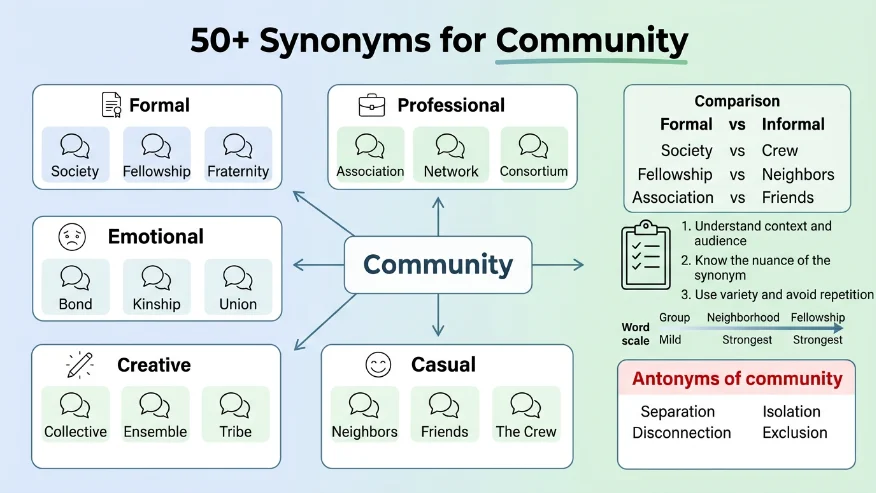
Finding the right word can make your writing feel clearer, warmer, and more precise. The word community is useful, but it may not fit every sentence. You may need a more formal option for an essay, a fresh term for a blog, or a casual expression for everyday conversation.
So, what is another word for community? A synonym for community can include words such as group, society, network, collective, neighborhood, circle, fellowship, or association, depending on the context. The best choice changes with your meaning. For example, network works well for professional connections, while neighborhood focuses on people living in the same area.
In this guide, you’ll find 50+ community synonyms with simple meanings and examples. We’ll also cover another word for communities in an essay, the synonym of community in different contexts, and even slang for community used in casual online spaces. These alternatives can help your writing sound more natural, specific, and engaging in 2026.
What Does Community Mean?
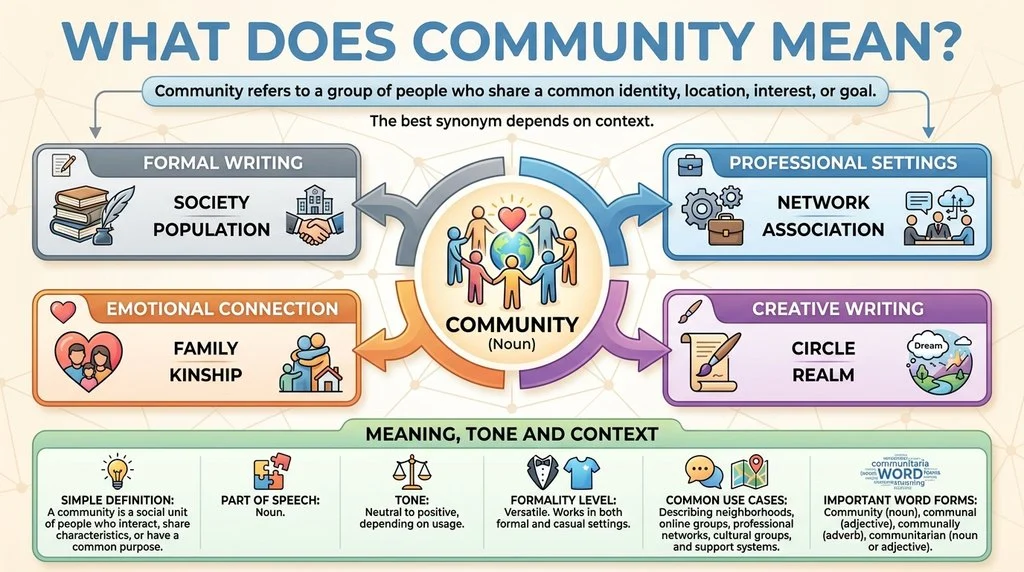
Community refers to a group of people who share a common identity, location, interest, or goal. The best synonym depends on context. For formal writing, use “society” or “population.”
Professional settings, choose “network” or “association.” For emotional connection, select “family” or “kinship.” For creative writing, try “circle” or “realm.”
Meaning, Tone and Context
- Simple definition: A community is a social unit of people who interact, share characteristics, or have a common purpose.
- Part of speech: Noun.
- Tone: Neutral to positive, depending on usage.
- Formality level: Versatile. It works in both formal and casual settings.
- Common use cases: Describing neighborhoods, online groups, professional networks, cultural groups, and support systems.
- Important word forms: Community (noun), communal (adjective), communally (adverb), communitarian (noun or adjective).
When and How to Use “Community”
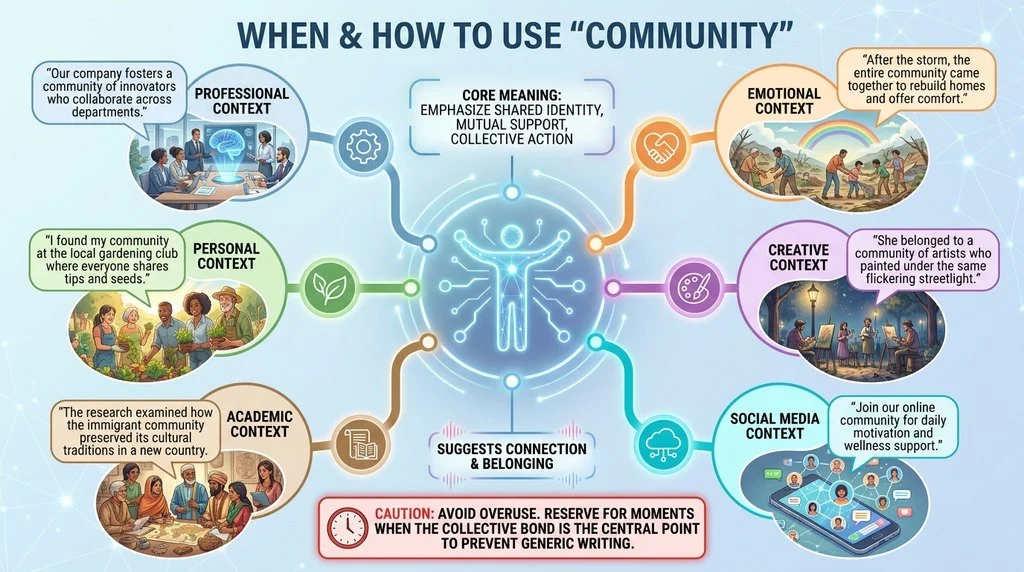
The word “community” is best used when you want to emphasize shared identity, mutual support, or collective action. It suggests connection and belonging. However, overusing it can make your writing feel generic. Reserve it for moments when the collective bond is the central point.
Professional context example: “Our company fosters a community of innovators who collaborate across departments.
Personal context example: “I found my community at the local gardening club where everyone shares tips and seeds.
Academic context example: “The research examined how the immigrant community preserved its cultural traditions in a new country.
Emotional context example: “After the storm, the entire community came together to rebuild homes and offer comfort.
Creative context example: “She belonged to a community of artists who painted under the same flickering streetlight.”
Social media example: “Join our online community for daily motivation and wellness support.
Another Word for “Community”
The best single replacement depends entirely on your message and audience.
- Professional writing: Network
- Academic writing: Society
- Casual conversation: Group
- Emotional writing: Family
- Creative writing: Circle
- Resume or workplace: Association
- Social media captions: group
- Stronger meaning: Collective
- Softer meaning: Neighborhood
When Not to Use “Community”
The word “community” sounds too vague when you need precision. It can feel too casual for formal legal or technical documents. It may also seem too warm or emotional when you need a neutral, factual tone.
Vague example: “The community has concerns.”
Improved: “Residents in the surrounding neighborhoods have expressed concerns.”
Too casual for formal writing: “The scientific community agreed.”
Improved: “Researchers in the field reached a consensus.”
Too emotional for neutral reporting: “The business community reacted.”
Improved: “Local business owners responded.”
Words Commonly Confused With “Community”
Several words overlap with “community” but carry distinct meanings. Knowing the difference helps you choose wisely.
Community vs. Society:
“Community” emphasizes smaller, personal connections. “Society” refers to a larger, more structured population. Use “community” for a local group and “society” for a broad system.
Community vs. Group:
“Community” implies shared values and emotional ties. “Group” is neutral and simply means a collection of people. Use “group” for casual references and “community” for deeper bonds.
Community vs. Population:
“Population” is statistical and impersonal. It refers to all inhabitants of a place. Use “population” in demographics and “community” in social contexts.
Community vs. Association:
“Association” suggests formal membership and organization. “Community” feels more organic. Use “association” for professional bodies and “community” for informal gatherings.
Community vs. Network:
“Network” focuses on connections and communication channels. “Community” focuses on shared identity. Use “network” in professional contexts and “community” in social contexts.
Community vs. Neighborhood:
“Neighborhood” is strictly geographic. “Community” can be geographic or based on interest. Use “neighborhood” for physical locations and “community” for broader connections.
Best Synonym by Context for “Community”
| Context | Best Synonym | Why It Works | Example |
|---|---|---|---|
| Formal Writing | Society | Sounds authoritative and structural | “The study examined how modern society shapes individual behavior.” |
| Academic Writing | Population | Precise and research oriented | “The population sample included diverse ethnic backgrounds.” |
| Professional Business | Network | Emphasizes valuable connections | “She expanded her professional network through industry events.” |
| Resume Writing | Association | Shows formal membership and commitment | “Served as treasurer for the local housing association.” |
| Casual Conversation | Group | Simple and universally understood | “Our book group meets every Tuesday evening.” |
| Creative Writing | Circle | Adds imagery and intimacy | “He moved within a close circle of trusted friends.” |
| Emotional Tone | Family | Conveys deep care and loyalty | “The theater company became her family.” |
| Strong Intensity | Collective | Highlights unified action and power | “The collective demanded immediate policy changes.” |
| Soft Moderate Tone | Neighborhood | Gentle and approachable | “The neighborhood welcomed the new family with open arms.” |
| US Usage | Neighborhood | Common and relatable | “The neighborhood association planned a summer festival.” |
| UK Usage | Estate | Refers to housing developments | “The council estate had a strong sense of community spirit.” |
Which Synonym Should You Choose?
Choosing the right synonym requires you to consider four factors: meaning, formality, emotional intensity, and audience.
First, think about the specific relationship you want to describe. Is it based on location, interest, profession, or emotion? Choose a word that matches that foundation.
Second, assess the formality of your setting. Academic and legal writing demand precise, formal words like “society” or “population.” Casual conversations allow for “group”.
Third, consider the emotional weight. If you want to inspire warmth, use “family” or “circle.” If you need neutrality, stick with “population” or “network.”
Finally, think about your reader. Will they respond better to professional or personal language? Tailor your choice to their expectations.
Real Life Examples of “Community” in Sentences
School context:
“The student community organized a charity drive for local shelters. Teachers and parents joined the effort enthusiastically.”
Workplace context:
“Our remote team has built a supportive community through weekly video check ins. This connection reduces isolation and boosts morale.”
Writing context:
“In her memoir, she describes the literary community that nurtured her early work. These mentors shaped her unique voice.”
Conversation context:
“I miss the community I had in my old neighborhood. Everyone knew each other’s names and stories.”
Social media context:
“Our fitness community shares daily workout tips and progress photos. Members encourage each other to stay consistent.”
Resume context:
“Developed a community outreach program that increased volunteer participation by 40 percent. This initiative strengthened local partnerships.”
Email context:
“Thank you for being part of our customer community. Your feedback helps us improve our products and services.”
Storytelling context:
“The small fishing village had a community that relied on the sea. They celebrated each catch and mourned every loss together.”
25 Synonyms for “Community”
| Synonym | Simple Meaning | Best Used For | Example Sentence |
|---|---|---|---|
| Society | A structured group with shared institutions | Formal academic writing | “Modern society faces complex environmental challenges.” |
| Population | All inhabitants of a specific area | Research and demographics | “The population of the city grew rapidly over the decade.” |
| Network | Interconnected people with shared goals | Professional settings | “She leveraged her professional network to find a new job.” |
| Association | Formal organization with members | Workplace and resumes | “He joined the teachers association for professional development.” |
| Group | Any collection of people | Casual and general use | “The study group met every Thursday at the library.” |
| Circle | Close knit group with personal ties | Creative and emotional writing | “Her inner circle knew about her plans before anyone else.” |
| Family | People with deep emotional bonds | Emotional and personal contexts | “His colleagues felt like family after years of teamwork.” |
| Collective | Unified group acting together | Strong and activist contexts | “The collective negotiated better wages for all workers.” |
| Neighborhood | Geographic local area | US casual conversations | “The neighborhood celebrated the new park opening.” |
| Public | The general population | Formal and civic contexts | “The public expressed concern about the new policy.” |
| Fellowship | Shared purpose with camaraderie | Academic and religious contexts | “She received a fellowship to study abroad.” |
| Guild | Professional or trade group | Historical and craft contexts | “The writers guild advocated for fair contracts.” |
| Clientele | Regular customers or patrons | Business and service contexts | “The restaurant attracted a loyal clientele.” |
| Constituency | Voters or supporters in a district | Political and advocacy contexts | “The senator addressed her constituency on the issue.” |
| Fraternity | Group with shared interests or bonds | Formal and Greek contexts | “The fraternity hosted a charity fundraiser.” |
| Body | Organized group with a purpose | Formal and institutional contexts | “The student body voted for new representatives.” |
| Congregation | Religious group or gathering | Religious contexts | “The congregation sang hymns together every Sunday.” |
| Cult | Group with intense devotion | Negative or critical contexts | “The cult isolated its members from outside influence.” |
| Clan | Extended family | Cultural and historical contexts | “The clan gathered for the annual festival.” |
| Community | Shared identity group | General use | “The online community supported the creator.” |
| Settlement | Small community in a new area | Historical and geographic contexts | “The settlement grew into a thriving town.” |
| Municipality | Local government or district | Legal and administrative contexts | “The municipality approved the new building project.” |
| Class | Group with similar status or interests | Social and educational contexts | “The working class demanded better conditions.” |
| Nation | Large political community | Political and global contexts | “The nation celebrated its independence day.” |
Synonym Groups and Usage Differences
Professional vs. Personal Synonyms
Professional synonyms focus on structure, purpose, and formal connections. Personal synonyms emphasize emotional bonds, shared experiences, and intimacy.
Use “network,” “association,” or “clientele” in professional settings. Use “circle,” “family,” in personal contexts.
Formal vs. Conversational Synonyms
Formal synonyms work in reports, essays, speeches, and official documents. Conversational synonyms fit texts, emails, and casual writing.
Formal words include “society,” “population,” and “constituency.” Conversational words include “group,” “neighborhood,” and “gang.”
Academic Synonyms
Academic writing requires precision and neutrality. Choose words that sound objective and research oriented.
Society,” “population,” and “fellowship” are strong academic choices. They avoid emotional language and emphasize structure.
Professional and Business Synonyms
Business communication values clarity and professionalism. Use words that convey credibility and purpose.
“Network,” “association,” and “clientele” work well in emails, resumes, and presentations. They show formal engagement and value.
Creative or Literary Synonyms
Creative writing benefits from imagery and emotional depth. Choose words that paint vivid pictures and evoke feelings.
“Circle,” “realm,” and “clan” add texture and atmosphere. They help readers visualize the group and its connections.
Slang or Modern Synonyms
Modern slang words for community include “crew,” “squad,. These words are acceptable in social media, casual conversations, and brand messaging.
Avoid them in academic, professional, or formal settings. They can seem unprofessional or childish.
Strongest vs. Weaker Synonyms
Intensity scale from mild to strongest:
Mild: Group, set, collection
Moderate: Network, association, neighborhood
Strong: Community, society, population
Strongest: Collective, nation, fraternity
Emotional vs. Neutral Synonyms
Emotional synonyms add warmth and connection. Neutral synonyms stay factual and objective.
Emotional: Family, clan, fellowship
Neutral: Population, group, body, public
Antonyms of “Community”
| Antonym | Meaning | Example Sentence |
|---|---|---|
| Individual | One single person | “The individual acted alone without community support.” |
| Isolation | State of being alone | “His isolation from the group made him feel lonely.” |
| Alienation | Feeling disconnected | “Alienation from the community led to depression.” |
| Division | Separation into parts | “Division among members weakened the organization.” |
| Seclusion | Removed from society | “She lived in seclusion away from the community.” |
| Solitude | Being alone by choice | “He enjoyed solitude more than community life.” |
| Anonymity | Unknown or unnamed | “Anonymity in the city made her feel invisible.” |
| Disconnection | Lack of connection | “Disconnection from the group caused misunderstandings.” |
| Hostility | Unfriendly opposition | “Hostility replaced the community’s former harmony.” |
| Conflict | Disagreement or struggle | “Conflict divided the community into opposing sides.” |
| Detachment | Emotional separation | “His detachment from the group was noticeable.” |
| Estrangement | Loss of connection | “Estrangement from her family lasted for years.” |
| Rivalry | Competition between groups | “Rivalry between the two factions grew intense.” |
| Segregation | Separation by group | “Segregation destroyed the community’s unity.” |
| Discord | Lack of agreement | “Discord among members prevented progress.” |
Comparison: Community vs. Similar Words
Community vs. Society
Main difference: Community is smaller and more personal. Society is larger and more institutional.
Community is stronger in emotional connection. Society is more formal.
Example for community: “The community rallied around the family after the fire.”
Example for society: “Society must address systemic inequality.”
Community vs. Group
Main difference: Community implies shared values and belonging. Group is neutral and generic.
Community is stronger in emotional and relational meaning. Group is more formal in organizational settings.
Example for community: “She found her community among fellow artists.”
Example for group: “The study group met for three hours.”
Community vs. Population
Main difference: Community emphasizes social bonds. Population emphasizes numbers and statistics.
Community is stronger in qualitative meaning. Population is more formal in research contexts.
Example for community: “The fishing community depended on the river.”
Example for population: “The population of the city exceeded one million.”
Community vs. Association
Main difference: Community is organic and informal. Association is formal and membership based.
Community is stronger in emotional warmth. Association is more formal in professional contexts.
Example for community: “The immigrant community celebrated their heritage.”
Example for association: “She joined the medical association for networking.”
Community vs. Network
Main difference: Community focuses on identity and belonging. Network focuses on connections and opportunities.
Community is stronger in emotional meaning. Network is more formal in business contexts.
Example for community: “The online community supported each other through challenges.”
Example for network: “His professional network helped him secure the job.”
Community vs. Neighborhood
Main difference: Neighborhood is strictly geographic. Community can be geographic or interest based.
Community is stronger in relational meaning. Neighborhood is more formal in local government contexts.
Example for community: “The gaming community organized a worldwide tournament.”
Example for neighborhood: “The neighborhood association planted trees along the street.”
Common Phrases and Expressions with “Community”
1. Sense of Community
Meaning: A feeling of belonging and connection to a group.
Example sentence: “The small town had a strong sense of community that made newcomers feel welcome.”
2. Community Spirit
Meaning: Enthusiasm and cooperation among members of a group.
Example sentence: “Community spirit was evident during the annual cleanup event.”
3. Community Service
Meaning: Voluntary work done to benefit the local area.
Example sentence: “She completed 100 hours of community service at the local shelter.”
4. Community Outreach
Meaning: Efforts to connect with and support the local population.
Example sentence: “The hospital increased its community outreach programs in underserved areas.”
5. Community Engagement
Meaning: Active participation and involvement in local affairs.
Example sentence: “Community engagement improved after the town hall meetings began.”
6. Community Center
Meaning: A public building used for local activities and gatherings.
Example sentence: “The community center offered free yoga classes every morning.”
7. Community Leader
Meaning: A person who guides or represents a local group.
Example sentence: “The community leader organized a food drive for struggling families.”
8. Community Chest
Meaning: A shared fund for local projects and support.
Example sentence: “The community chest provided grants for small business owners.”
Common Mistakes to Avoid
- Using “community” when a more precise synonym is better. Instead of saying “the business community,” say “local business owners.”
- Confusing “community” with “society.” Use “community” for smaller groups and “society” for larger systems.
- Using a casual synonym like “crew” in formal writing. This can undermine your credibility.
- Using an overly dramatic synonym like “family” for a simple professional group. This can seem insincere.
- Repeating “community” too often in a single paragraph. Vary your word choice to keep writing fresh.
- Choosing a synonym with the wrong emotional tone. For example, using “cult” when you mean “fellowship” can offend readers.
- Using slang like “squad” or “crew” in academic or professional writing. These words are too casual for those settings.
FAQs
What is the best synonym for community?
The best synonym depends on context. Use “network” professionally, “society” academically, and “circle” creatively.
What is a formal synonym for community?
“Population,” “society,” and “constituency” are formal synonyms for community.
What is an informal synonym for community?
“Group,” “neighborhood,” and “crew” are informal synonyms for community.
What is another word for community in professional writing?
“Network,” “association,” and “clientele” work well in professional writing.
What is the difference between community and society?
Community is smaller and more personal. Society is larger and more institutional.
What is the opposite of community?
Isolation, alienation, and solitude are opposites of community.
Conclusion
Community is a powerful word that describes connection, belonging, and shared purpose. However, its overuse can weaken your writing. By choosing precise synonyms, you can communicate more clearly and effectively. Match your word choice to your audience, context, and emotional goal. Use formal words like “society” for academic work. Select professional words like “network” for business settings. Use emotional words like “family” for personal messages. The right word makes your message stronger and more memorable. Practice using these alternatives in your daily writing. Your vocabulary will grow, and your readers will appreciate the clarity.