Have you ever found yourself writing an email, an essay, or a social media caption and realized you have used the word “catalyst” three times in two paragraphs? You know the word fits, but repeating it makes your writing feel stale and lazy. You want variety, but you are not sure which alternative actually works in that specific sentence.
This is where understanding the synonyms of catalyst becomes valuable. Choosing the right synonym does more than just avoid repetition. It sharpens your meaning, adjusts your tone, and makes your communication more precise. Whether you are writing a business proposal, a college essay, or a simple text message, the word you choose shapes how your message lands.
This guide will help you move beyond guessing. You will learn what “catalyst” really means, which synonyms fit each context, and how to avoid common mistakes. By the end, you will choose the right word with confidence every time.
What Are the Best Synonyms of “Catalyst”?
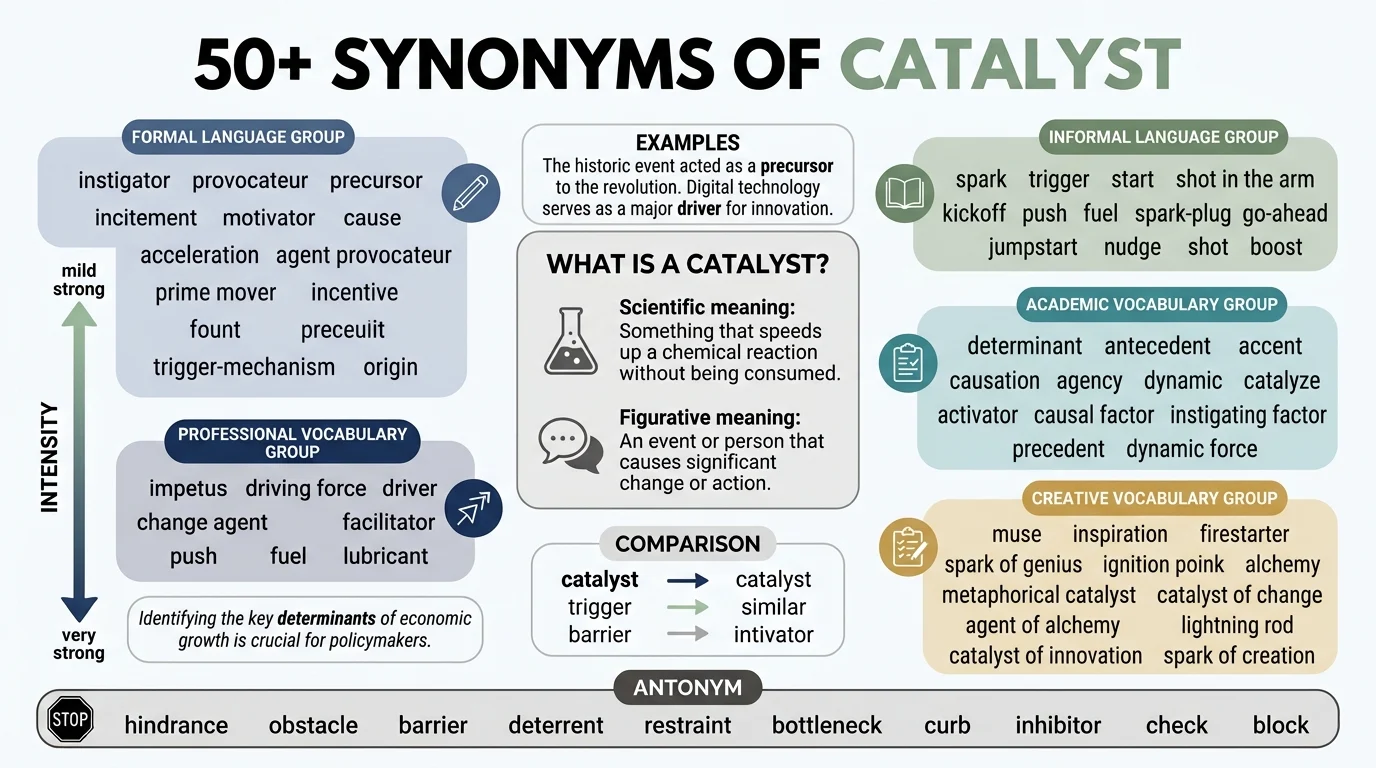
A catalyst is something or someone that causes or speeds up a change or reaction without being consumed or permanently altered in the process. Formal writing, choose stimulus or impetus. For casual conversation, use spark or trigger. Academic work, accelerator or activator work well. For professional settings, driver or instigator are strong choices. Emotional or creative writing, inspiration or spark add impact.
Meaning, Tone, and Context
Simple Definition
A catalyst is a substance, person, or event that initiates or accelerates change while remaining unchanged itself.
Part of Speech
Noun (countable). The plural form is catalysts.
Overall Tone
Neutral. The word itself does not carry a positive or negative emotional charge. Its tone depends entirely on the change it describes.
Formality Level
Formal to semi-formal. “Catalyst” appears frequently in academic writing, scientific reports, business communication, and journalism. It is less common in casual everyday speech.
Common Uses
Native English speakers use “catalyst” in two main ways.
First, in chemistry and science, it refers to a substance that speeds up a chemical reaction. Enzymes in the human body are natural catalysts.
Second, in everyday language, it describes a person or event that causes important change. For example, a new policy might act as a catalyst for economic growth, or a difficult experience might become a catalyst for personal development.
Word Forms
- Noun: catalyst
- Verb: catalyze (to cause or accelerate change)
- Adjective: catalytic (relating to or functioning as a catalyst)
- Adverb: catalytically
When and How to Use “Catalyst”
Choose “catalyst” when you want to emphasize that something or someone started a process of change without being consumed by it. The word works best when you need to sound knowledgeable, precise, and slightly formal. It adds weight to your writing and signals that you understand the mechanics of change.
Here are seven realistic examples showing how “catalyst” appears in different contexts.
Professional
The new software update acted as a catalyst for improved team productivity across all departments.
Academic
The researcher identified the enzyme as the primary catalyst in the metabolic pathway.
Workplace
Her presentation served as a catalyst for a complete redesign of our customer onboarding process.
Personal
Moving to a new city was the catalyst that pushed me to finally start my own business.
Email
We believe this partnership will be the catalyst we need to enter the European market successfully.
Resume
Served as a catalyst for organizational change by introducing agile methodologies that reduced project timelines by 30 percent.
Social Media
That one conversation was the catalyst for everything that followed. Sometimes the smallest moments create the biggest shifts.
Best Synonyms of “Catalyst”
No synonym is identical to “catalyst” in every situation. Each alternative carries its own shade of meaning, emotional weight, and level of formality. The best choice depends on your audience, your purpose, and the specific change you are describing.
Here are the best synonyms for common writing situations.
Professional writing: driver or impetus. These words sound authoritative and businesslike without being overly technical.
Academic writing: accelerator or activator. These terms maintain scientific precision while remaining accessible.
Business communication: stimulus or trigger. These words are clear, direct, and widely understood in corporate settings.
Casual conversation: spark or push. These words are conversational and easy to understand.
Emotional writing: inspiration or motivation. These words add a human, feeling-oriented dimension.
Creative writing: spark or catalyst itself. “Spark” works beautifully for storytelling because it suggests sudden, vivid ignition.
Resume writing: instigator or driver. These words suggest proactive leadership and initiative.
Workplace communication: catalyst or stimulus. Both are professional without sounding pretentious.
Stronger meaning: provocation or incitement. These words suggest forceful or even aggressive change.
Softer meaning: influence or prompt. These words suggest gentle guidance rather than forceful action.
When Not to Use “Catalyst”
Using “catalyst” is not always the best choice. Sometimes the word sounds too formal, too vague, or simply out of place. Here are situations where you should choose a different word.
When the word sounds too general
If you are describing a minor change or a small influence, “catalyst” might exaggerate the situation.
Less effective: The new coffee machine was a catalyst for better morale in the office.
Better: The new coffee machine was a boost for morale in the office.
“Boost” is more natural and appropriate for a small, everyday improvement.
When the word sounds too formal
In casual conversation or text messages, “catalyst” can sound stiff and unnatural.
Less effective: Our conversation was the catalyst for my decision to quit.
Better: Our conversation pushed me to quit.
“Pushed” is simpler, more direct, and sounds like something a real person would say.
When the word sounds too vague
If you need to specify exactly what caused the change, “catalyst” might not provide enough detail.
Less effective: The event was a catalyst.
Better: The event triggered a series of policy changes.
“Triggered” is more specific and action-oriented.
When the word sounds too weak
If you are describing a massive, undeniable force of change, “catalyst” might sound too mild.
Less effective: The revolution was a catalyst for political reform.
Better: The revolution forced political reform.
“Forced” conveys the necessary urgency and power.
When the word sounds outdated
In some contexts, especially modern business writing, “catalyst” can feel slightly old-fashioned. Words like driver or accelerator often sound more current.
Words Commonly Confused With “Catalyst”
Several words are often confused with “catalyst.” Understanding the differences will help you choose the right one.
Catalyst vs. Stimulus
Difference: A catalyst initiates change without being consumed. A stimulus is simply something that causes a response. The key distinction is that a catalyst remains unchanged, while a stimulus does not carry that implication.
When to use it: Use “stimulus” when you want to describe any cause of a response, especially in economics or psychology.
Example: The tax cut provided a much-needed stimulus for the struggling economy.
Catalyst vs. Trigger
Difference: A trigger sets off a specific, often immediate reaction. A catalyst can work more gradually and continuously. Triggers are often associated with negative or explosive events.
When to use it: Use “trigger” when you need to describe a sudden, direct cause-and-effect relationship.
Example: The announcement triggered a sharp drop in stock prices.
Catalyst vs. Impetus
Difference: Impetus refers to the force or energy that drives something forward. Catalyst refers to the agent that starts the process. Impetus is about momentum; catalyst is about initiation.
When to use it: Use “impetus” when you want to emphasize forward movement and energy.
Example: The grant provided the impetus for launching the research project.
Catalyst vs. Accelerator
Difference: An accelerator speeds up an existing process. A catalyst can both start and speed up a process. In chemistry, “accelerator” is sometimes used as a direct synonym.
When to use it: Use “accelerator” when the process is already underway and you want to emphasize increased speed.
Example: The new manufacturing technique acted as an accelerator for production.
Catalyst vs. Instigator
Difference: An instigator deliberately provokes or starts something, often with negative connotations. A catalyst can be neutral or unintentional.
When to use it: Use “instigator” when you want to emphasize intentional action, especially in conflict or controversy.
Example: He was the instigator of the protest movement.
Catalyst vs. Provocateur
Difference: A provocateur deliberately provokes a reaction, often for political or social purposes. A catalyst does not require intent.
When to use it: Use “provocateur” when the agent is deliberately trying to cause a reaction.
Example: The journalist was known as a provocateur who stirred up public debate.
Best Synonyms of “Catalyst” by Context
| Context | Best Synonym | Why It Works | Example |
|---|---|---|---|
| Formal writing | Impetus | Sounds authoritative and precise | The report provided the impetus for regulatory reform. |
| Academic writing | Accelerator | Maintains scientific precision | The enzyme acts as an accelerator in the reaction. |
| Professional communication | Driver | Suggests leadership and control | She was the primary driver of the initiative. |
| Business emails | Stimulus | Clear and widely understood | The partnership served as a stimulus for growth. |
| Resume writing | Instigator | Shows proactive leadership | Instigated a company-wide diversity program. |
| Workplace communication | Catalyst | Professional and neutral | The training was a catalyst for improved performance. |
| Casual conversation | Spark | Conversational and vivid | His idea sparked the whole project. |
| Everyday speaking | Push | Simple and direct | I just needed a little push to get started. |
| Creative writing | Spark | Adds imagery and emotion | The letter was the spark that ignited her journey. |
| Storytelling | Inciting incident | Precise narrative term | The disappearance was the inciting incident of the novel. |
| Emotional writing | Inspiration | Adds human warmth | Her story was the inspiration for my own career change. |
| Strong emphasis | Provocation | Suggests forceful change | The comment was a provocation that led to debate. |
| Mild tone | Influence | Gentle and non-confrontational | His advice was a subtle influence on my decision. |
| Social media captions | Spark | Short, punchy, and engaging | This trip was the spark I needed. |
| American English | Catalyst | Standard term across all contexts | The new policy was a catalyst for change. |
How to Choose the Best Synonym of “Catalyst”
Choosing the right synonym comes down to answering a few simple questions about your writing situation.
Consider your audience
Are you writing for academics, business professionals, or friends? Academic and professional audiences expect more formal language. Casual audiences appreciate simpler, more conversational words.
Consider your purpose
Are you trying to sound authoritative, emotional, or neutral? Your purpose should guide your word choice. If you want to sound powerful and decisive, choose driver or instigator. If you want to sound warm and inspiring, choose inspiration or spark.
Consider the strength of the change
Is the change dramatic or subtle? Strong changes call for strong words like provocation or force. Subtle changes call for milder words like influence or prompt.
Consider the tone of your writing
Is your writing formal, informal, or somewhere in between? Match your synonym to your overall tone. A formal report should use formal synonyms. A personal blog post can use more casual alternatives.
Consider naturalness
Does the synonym sound natural in your sentence? Read the sentence aloud. If it sounds awkward or forced, choose a different word. The best synonym is the one that flows naturally while conveying your intended meaning.
Real Life Examples of “Catalyst”
Here are realistic examples showing how “catalyst” and its synonyms appear in everyday communication.
School
The science fair project was a catalyst for my interest in biology.
College
Her research on climate change became the catalyst for her entire academic career.
Workplace
The new manager acted as a catalyst, bringing fresh energy to a stagnant team.
Business
The acquisition was the catalyst that transformed the company from a local player to a global competitor.
Email
I wanted to share a resource that served as a catalyst for my own professional growth. I hope it helps you too.
Resume
Catalyzed a 40 percent increase in customer retention through a redesigned loyalty program.
Conversation
“You know what was the real catalyst for all this? That random conversation we had at the coffee shop.”
Storytelling
The mysterious letter arrived on a Tuesday. It was the catalyst that unraveled everything she thought she knew.
Blogging
Sometimes failure is the catalyst we need to finally pursue what we truly want.
Social media
This book was the catalyst for changing my entire mindset. Highly recommend.
18 Best Synonyms of “Catalyst”
Synonyms of “Catalyst” by Usage
Professional vs Personal Synonyms
In professional settings, words like driver, instigator, and impetus project authority and competence. These words suggest that you understand how change happens and that you can take credit for initiating it.
In personal conversations, words like spark, push, and inspiration feel warmer and more relatable. These words connect with people on an emotional level rather than an intellectual one.
Formal vs Conversational Synonyms
Formal writing, including reports, essays, and business presentations, benefits from words like impetus, stimulus, and accelerator. These words sound precise and authoritative.
Casual conversations, texting, and social media posts call for simpler words like spark, trigger, or push. These words are easy to understand and sound natural in everyday speech.
Academic Synonyms
In academic writing, precision matters. Accelerator, activator, and precipitant are strong choices because they carry specific scientific or technical meanings. Catalyst itself remains the gold standard in chemistry and biology. Using these words signals that you understand the material at a deeper level.
Professional and Business Synonyms
For resumes, interviews, meetings, and client communication, choose words that suggest leadership and results. Driver, instigator, and catalyst itself are excellent choices. These words show that you take initiative and produce measurable outcomes. In performance reviews, catalyst and driver highlight your contributions to team success.
Creative and Literary Synonyms
Storytelling, fiction, and poetry benefit from vivid, emotional language. Spark suggests sudden ignition and potential. Inspiration suggests a transformative influence. Catalyst itself works well in literary contexts because it carries scientific weight while remaining accessible. In narrative terms, the inciting incident is the catalyst that sets the plot in motion.
Slang or Modern Synonyms
“Catalyst” does not have widely recognized slang equivalents. In casual speech, people might say game-changer, turning point, or wake-up call to describe a similar concept. These phrases are informal and should be avoided in professional or academic writing.
Strongest to Mildest Synonyms
Mild
- Influence
- Prompt
- Motivation
Moderate
- Stimulus
- Impetus
- Driver
Strong
- Trigger
- Instigator
- Provocation
Very Strong
- Precipitant
- Force
- Incitement
Emotional vs Neutral Synonyms
Emotional Synonyms
Inspiration, motivation, and spark carry emotional weight. These words suggest that change is driven by feelings, passion, or personal connection. Use them when you want to connect with readers on an emotional level.
Neutral Synonyms
Accelerator, activator, and impetus simply communicate information. These words describe change without adding emotional coloring. Use them in scientific, technical, or strictly professional contexts where objectivity matters.
Antonyms of “Catalyst”
| Antonym | Meaning | Example Sentence |
|---|---|---|
| Inhibitor | A substance that slows down a reaction | The inhibitor prevented the chemical reaction from occurring. |
| Impediment | Something that blocks or hinders progress | The lack of funding was an impediment to the project. |
| Deterrent | Something that discourages action | The high cost was a deterrent for many potential applicants. |
| Obstacle | Something that stands in the way | The regulatory hurdles were an obstacle to innovation. |
| Blockage | Something that physically or metaphorically blocks | The bureaucratic blockage stalled the entire process. |
| Hurdle | A difficulty that must be overcome | The language barrier was a hurdle for international collaboration. |
| Barrier | Something that prevents progress | The trade barrier limited market access. |
| Hindrance | Something that causes delay or difficulty | The outdated software was a hindrance to productivity. |
| Restraint | Something that limits or controls | The budget restraint prevented any new hiring. |
| Constraint | A limitation or restriction | Time constraints made the project difficult. |
| Check | Something that stops or slows progress | The economic downturn put a check on expansion plans. |
| Curb | Something that restrains or limits | The new regulations put a curb on corporate spending. |
| Brake | Something that slows down progress | The supply chain issues acted as a brake on production. |
| Dampener | Something that reduces enthusiasm or activity | The bad news was a dampener on team morale. |
| Anticatalyst | A substance that opposes catalysis | The anticatalyst neutralized the effect of the enzyme. |
Comparison: “Catalyst” vs Similar Words
Catalyst vs Stimulus
Main Difference
A catalyst initiates change without being consumed. A stimulus is simply any cause of a response. The key distinction is that a catalyst remains unchanged, while a stimulus does not carry that implication.
Which Is Stronger?
“Catalyst” is stronger because it suggests a fundamental, structural change. “Stimulus” often describes a temporary or partial response.
Which Is More Formal?
Both are formal, but “catalyst” is more technical. “Stimulus” appears frequently in economics and psychology.
When to Use Each
Use “catalyst” when something fundamentally changes a situation. Use “stimulus” when something provokes a response, especially in economics or psychology.
Examples
- Catalyst: The new policy was a catalyst for economic reform.
- Stimulus: The tax cut provided a stimulus for consumer spending.
Catalyst vs Trigger
Main Difference
A trigger sets off a specific, often immediate reaction. A catalyst can work more gradually.
Which Is Stronger?
“Trigger” is stronger in terms of immediacy. “Catalyst” is stronger in terms of lasting impact.
Which Is More Formal?
“Catalyst” is more formal. “Trigger” is widely used in both formal and informal contexts.
When to Use Each
Use “trigger” for sudden, explosive events. Use “catalyst” for gradual, transformative change.
Examples
- Catalyst: The mentorship program was a catalyst for career growth.
- Trigger: The announcement triggered a sell-off in the stock market.
Catalyst vs Impetus
Main Difference
Impetus refers to the force or energy that drives something forward. Catalyst refers to the agent that starts the process.
Which Is Stronger?
“Impetus” emphasizes momentum and energy. “Catalyst” emphasizes initiation and transformation.
Which Is More Formal?
Both are formal, but “impetus” is more common in academic and philosophical writing.
When to Use Each
Use “impetus” when you want to emphasize forward movement. Use “catalyst” when you want to emphasize the starting point.
Examples
- Catalyst: The documentary was a catalyst for public awareness.
- Impetus: The grant provided the impetus for the research.
Catalyst vs Accelerator
Main Difference
An accelerator speeds up an existing process. A catalyst can both start and speed up a process.
Which Is Stronger?
“Catalyst” is stronger because it implies initiation as well as acceleration.
Which Is More Formal?
Both are formal and technical.
When to Use Each
Use “accelerator” when the process is already underway. Use “catalyst” when the process is just beginning.
Examples
- Catalyst: The enzyme was the catalyst for the reaction.
- Accelerator: The new equipment was an accelerator for production.
Catalyst vs Instigator
Main Difference
An instigator deliberately provokes or starts something, often with negative connotations. A catalyst can be neutral or unintentional.
Which Is Stronger?
“Instigator” is stronger in terms of intentionality and often carries a negative charge.
Which Is More Formal?
“Catalyst” is more formal and neutral. “Instigator” is often used in legal or conflict-related contexts.
When to Use Each
Use “instigator” when intentional provocation is implied. Use “catalyst” for neutral or unintentional initiation.
Examples
- Catalyst: The economic crisis was a catalyst for political change.
- Instigator: He was the instigator of the workplace conflict.
Catalyst vs Spark
Main Difference
A spark is a small, sudden starting point. A catalyst can be more sustained and ongoing.
Which Is Stronger?
“Catalyst” implies a more substantial and lasting impact. “Spark” implies a momentary ignition.
Which Is More Formal?
“Catalyst” is formal. “Spark” is informal and conversational.
When to Use Each
Use “spark” for creative, emotional, or casual contexts. Use “catalyst” for formal, academic, or professional contexts.
Examples
- Catalyst: The new CEO was a catalyst for cultural change.
- Spark: Her idea sparked a new direction for the team.
Common Phrases and Expressions with “Catalyst”
Catalyst for change
Meaning: Something that causes significant transformation.
Example: The new policy was a catalyst for change in the healthcare industry.
Act as a catalyst
Meaning: To cause or accelerate change.
Example: Her leadership acted as a catalyst for innovation.
Serve as a catalyst
Meaning: To function as the cause of change.
Example: The workshop served as a catalyst for new ideas.
Catalyst for reform
Meaning: Something that causes political or social improvement.
Example: The scandal was a catalyst for reform in the banking sector.
Catalyst for growth
Meaning: Something that drives expansion or development.
Example: The investment was a catalyst for growth in the tech sector.
Catalytic effect
Meaning: The accelerating or transformative impact of a catalyst.
Example: The new manager had a catalytic effect on team performance.
Common Mistakes to Avoid
Choosing a vague synonym instead of a precise one
Incorrect: The event was a thing that caused change.
Better: The event was a catalyst for change.
The vague version lacks impact and clarity. The precise version communicates exactly what happened.
Confusing catalyst with a similar word
Incorrect: The new policy was a stimulus for reform. (If the policy fundamentally changed the system)
Better: The new policy was a catalyst for reform.
“Catalyst” suggests fundamental change. “Stimulus” suggests a temporary boost.
Using an informal synonym in formal writing
Incorrect: The research was the spark for the entire project. (In an academic paper)
Better: The research was the catalyst for the entire project.
“Spark” is too casual for academic writing. “Catalyst” maintains the required formality.
Selecting an overly dramatic synonym
Incorrect: The minor feedback was a provocation for change.
Better: The minor feedback was a prompt for change.
“Provocation” is too strong for a small, routine situation. “Prompt” is more appropriate.
Repeating the same word too often
Incorrect: The catalyst for the project was X. The catalyst for the team was Y. The catalyst for success was Z.
Better: The catalyst for the project was X. The driver for the team was Y. The impetus for success was Z.
Variety keeps your writing fresh and engaging.
Choosing a synonym with the wrong emotional tone
Incorrect: The tragedy was an inspiration for the community. (If the tone should be neutral)
Better: The tragedy was a catalyst for community action.
“Inspiration” implies a positive emotional response. “Catalyst” is neutral and appropriate for a difficult topic.
Using slang in academic or professional writing
Incorrect: The new policy was a total game-changer for the industry. (In a business report)
Better: The new policy was a catalyst for industry transformation.
“Game-changer” is too informal for professional reports. “Catalyst” maintains the necessary professionalism.
Frequently Asked Questions
What are the best synonyms of catalyst?
The best synonyms depend on your context. Formal writing, use impetus or stimulus. For casual conversation, use spark or trigger. For academic work, use accelerator or activator.
What are the best formal synonyms of catalyst?
The best formal synonyms include impetus, stimulus, accelerator, and precipitant. These words maintain a professional tone while precisely conveying the meaning of initiating or speeding up change.
What are common informal synonyms of catalyst?
Common informal synonyms include spark, push, trigger, and boost. These words are conversational and work well in everyday speech, text messages, and social media posts.
What is another word for catalyst in professional writing?
In professional writing, strong alternatives include driver, instigator, and impetus. These words suggest leadership, initiative, and the ability to produce results, making them ideal for resumes, business communication, and performance reviews.
What is the difference between catalyst and stimulus?
A catalyst initiates change without being consumed or permanently altered. A stimulus is simply anything that causes a response. A catalyst implies a more fundamental and lasting transformation.
What is the opposite of catalyst?
The opposite of catalyst is inhibitor, which slows down or prevents a reaction. Other antonyms include impediment, deterrent, obstacle, and hindrance.
Conclusion
“Catalyst” is a powerful word that describes anything that initiates or accelerates change without being consumed in the process. Whether you are writing a scientific paper, a business proposal, or a personal email, choosing the right synonym will make your writing clearer and more effective.
No synonym works perfectly in every situation. The best choice depends on your audience, your purpose, and the specific change you are describing. Formal writing, choose impetus or stimulus. For casual conversation, choose spark or trigger. For professional contexts, choose driver or instigator. Academic work, choose accelerator or activator.
The next time you reach for the word “catalyst,” pause and consider your options. Think about your audience and your tone. Choose the word that communicates your message most precisely. Your readers will notice the difference, and your writing will be stronger for it.
Here is one practical tip: Keep a list of your favorite synonyms nearby. When you write, refer to the list and challenge yourself to use a different synonym each time you need to describe change. Over time, these words will become natural parts of your vocabulary.