You have probably used the word “information” three times in a single email, caption, or essay without even noticing. A student writes “I need information for my project.” A professional types “Please share the information.” A job seeker adds “Information about processes” on a resume. It feels safe, but it quickly becomes repetitive and vague.
This guide gives you over 50 precise synonyms for information. You will learn exactly which word fits a formal report, a casual chat, a resume bullet, or a creative story. No fluff. Just practical, example driven vocabulary choices you can use immediately.
Quick Answer: What Does “Information” Mean?
Information means facts, details, or knowledge about a specific subject, person, or event. The best synonyms depend on context: “data” for technical accuracy, “details” for everyday talk, “facts” for objective truth, “intelligence” for strategic insight, and “content” for media and creative work.
Meaning, Tone and Context
- Simple definition: Information is knowledge communicated or received concerning a particular fact or circumstance.
- Part of speech: Noun.
- Tone: Neutral. It does not automatically add emotion or judgment.
- Formality level: Neutral to formal. It fits professional, academic, and everyday English comfortably.
- Common use cases: Business emails, academic papers, news reports, instructions, resumes, everyday conversation.
- Important word forms: The verb “inform” means to give information. The adjective “informational” describes something that provides information. The opposite concepts include misinformation and ignorance.
When and How to Use “Information”
Information works best when you need a general noun for communicated knowledge. Use it when the exact nature of the facts is not the main focus. Below are realistic examples labeled by context.
Professional email
“I will forward the client information once the contract is signed.”
Academic writing
“This study collects information about consumer behavior across three age groups.”
Social media caption
“Swipe up for more information on the sale.”
Casual conversation
“Do you have any information about the road closure?”
Resume bullet point
“Gathered and organized project information for monthly stakeholder reports.”
News headline
“New information has emerged regarding the policy change.”
Research context
“The survey provided information that challenged the original hypothesis.”
Another Word for “Information”
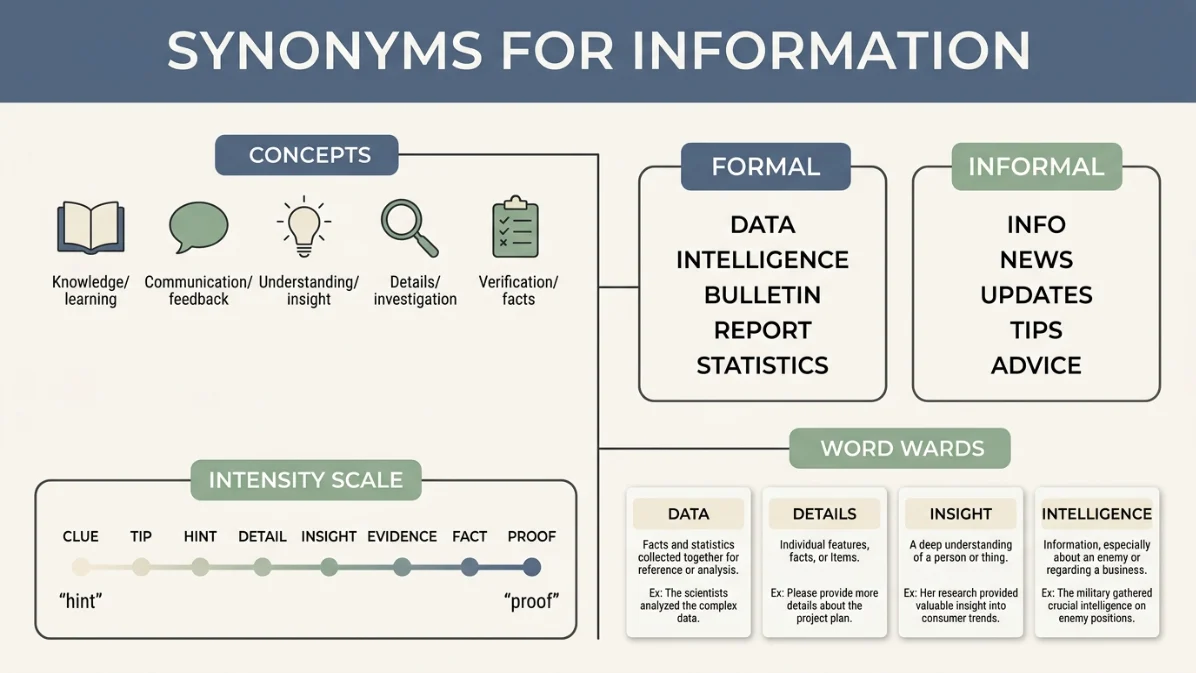
The best single replacement depends entirely on what you want to emphasize. “Details” works for specifics. “Data” works for technical or numerical facts. “Intelligence” works for strategic or investigative material.
Direct suggestions:
Professional writing: details, facts, specifics
Academic writing: data, findings, evidence
Casual conversation: info, details, stuff (informal)
Emotional writing: insight, revelation, understanding
Creative writing: material, content, clues
Resume or workplace: knowledge, expertise, insights
Social media captions: details, facts, tips
Stronger meaning: intelligence, evidence, proof
Softer meaning: hint, sign, indication
When Not to Use “Information”
The word often sounds too vague, too formal, or too weak for situations that need emotional color or precision.
Consider this sentence: “The book gave me a lot of information.” It is correct but lifeless. A stronger version could be “The book offered deep insight into the immigrant experience.” If you are telling a friend about a party, “I’ll send you the information” feels stiff. “I’ll send you the details” sounds natural and warm. In resumes, “information about sales” becomes sharper as “sales data analysis” or “market intelligence.”
Words Commonly Confused With “Information”
Information overlaps with several related words, but using them interchangeably can weaken your meaning.
Data: Raw, unprocessed facts and statistics. Information is data that has been organized or interpreted. Use “data” for numbers and research; use “information” for the meaning drawn from it.
Knowledge: Understanding gained through experience or study. Information becomes knowledge when you internalize it. Use “knowledge” for personal expertise.
Facts: Individual pieces of true information. “Facts” emphasize verifiable truth. “Information” can include opinions or unverified reports.
Details: Specific, often small pieces of information. “Details” adds a sense of granularity. It feels lighter and more conversational.
Intelligence: Information gathered for strategic, security, or competitive purposes. It implies secrecy, analysis, or sensitive value.
Content: Information packaged for a medium like a website, video, or book. Use “content” in media and digital contexts.
Best Synonym by Context for “Information”
| Context | Best Synonym | Why It Works | Example |
|---|---|---|---|
| Formal writing | data | Implies objectivity and precision | The report presents data from three independent sources. |
| Academic writing | findings | Shows research based evidence | Our findings suggest a direct link between sleep and memory. |
| Professional or business | details | Sounds polite, specific, and actionable | Please send me the project details by noon. |
| Resume | insights | Highlights analytical ability | Delivered weekly market insights to the leadership team. |
| Casual conversation | info | Short, friendly, and completely natural | I’ll text you the info about the meetup. |
| Creative writing | material | Suggests content that can be shaped | She collected enough material for a full novel. |
| Emotional tone | insight | Adds depth and personal understanding | His letter gave me real insight into his struggles. |
| Strong intensity | intelligence | Implies secret or strategic value | The team gathered intelligence before the launch. |
| Soft or moderate tone | hint | Suggests a small amount of useful information | There was a hint of disappointment in her voice. |
| Social media captions | details | Invites clicks without sounding pushy | Tap for all the details on the collection. |
| US and UK usage | information | Same in both; “info” is widely informal in both regions | Please provide further information regarding the claim. |
Which Synonym Should You Choose?
Start by asking yourself three quick questions. First, what is the purpose: am I reporting facts, sharing casual updates, or persuading? Second, who is the audience: a professor, a friend, a recruiter? Third, what feeling do I want: neutral and professional or warm and personal? Match the formality of your synonym to the situation. If the sentence feels bland, replace “information” with “insight” or “discovery” to add life. If you need to sound authoritative, choose “data” or “evidence.” When in doubt, the simpler word “details” makes most sentences cleaner and more human.
Real Life Examples of “Information” in Sentences
Seeing the word across different situations makes the switch to stronger synonyms feel natural.
School
Original: “I need more information for my history paper.”
Better: “I need more concrete facts for my history paper.”
Workplace
Original: “Can you share the information from the call?”
Better: “Can you share the key takeaways from the call?”
Writing
Original: “The article contains a lot of information.”
Better: “The article is packed with useful insights.”
Conversation
Original: “Thanks for the information.”
Better: “Thanks for filling me in on the details.”
Social media
Original: “Link in bio for information.”
Better: “Link in bio for all the specifics.”
Resume
Original: “Responsible for updating client information.”
Better: “Maintained accurate client profiles and account data.”
Email
Original: “I am writing to request information.”
Better: “I am writing to request additional details on the warranty.”
Storytelling
Original: “He had information that could change everything.”
Better: “He held a secret that could change everything.”
25 Synonyms for Information
Below are 15 of the most useful and accurate synonyms. Each one offers a distinct shade of meaning so you can pick the right word for the right moment.
| Synonym | Simple Meaning | Best Used For | Example Sentence |
|---|---|---|---|
| Data | Raw facts and figures | Technical, research | The data shows a clear trend in user behavior. |
| Details | Specific pieces of information | Everyday, professional | I love the small details in your travel story. |
| Facts | Information known to be true | Arguments, reports | Stick to the facts during the interview. |
| Knowledge | Information understood deeply | Education, expertise | Her knowledge of ancient history is remarkable. |
| Intelligence | Secret or strategic information | Security, business | The market intelligence shaped our pricing. |
| Material | Information used as input | Creative, media | We have enough material for two podcast episodes. |
| Content | Digital or packaged information | Social media, marketing | The website content feels fresh and inviting. |
| Input | Information contributed | Collaboration, feedback | We value your input on the design draft. |
| Feedback | Evaluative information | Workplace, learning | The editor gave constructive feedback on the piece. |
| Findings | Discovered information | Research, science | The findings support a need for policy change. |
| Specifics | Precise information | Instructions, plans | Let’s discuss the specifics of the contract tomorrow. |
| Insights | Deep understanding | Thought leadership, analysis | The book offers fresh insights into leadership. |
| Documentation | Recorded formal information | Legal, technical | Keep all documentation for audit purposes. |
| News | Recently received information | Media, conversation | The news about the merger surprised everyone. |
| Clues | Small pieces of information | Mystery, investigation | The detective found clues in the old letters. |
Synonym Groups and Usage Differences
Professional vs. Personal Synonyms
Professional contexts thrive on words like “data,” “specifics,” “findings,” and “documentation.” These sound credible and precise. In personal life, “details,” “info,” “news,” and “updates” feel warm and approachable. Saying “I’ll share the specifics” works for a client. Saying “I’ll send the details” works for a friend.
Formal vs. Conversational Synonyms
Formal writing demands “evidence,” “material,” or “intelligence” when appropriate. Conversational English leans on “info,” “stuff,” or “the scoop.” An academic paper might discuss “empirical data,” while a text message just says “Got the info. Thanks!”
Academic Synonyms
Essays and research papers gain authority with “evidence,” “findings,” “data,” and “literature.” These words signal scholarly rigor. Avoid vague “information” when you can specify “prior studies,” “quantitative data,” or “documented findings.”
Professional and Business Synonyms
In emails, presentations, and reviews, “insights,” “metrics,” “updates,” and “particulars” add executive polish. A resume bullet that says “synthesized competitor information” becomes stronger as “consolidated competitive intelligence.”
Creative or Literary Synonyms
Writers often prefer “material,” “lore,” “fragments,” or “whispers” to build texture. “Information” can sound clinical in fiction. Replace it with something that matches the mood: “scattered clues,” “hidden knowledge,” or “forgotten details.”
Slang or Modern Synonyms
“Info” is universally safe for casual talk and informal messages. “Deets” is playful and common in social captions and friendly chats. The phrase “the 411” is a US slang term meaning the latest information or gossip. These are never appropriate for resumes, academic papers, or official emails.
Strongest vs. Weakest Synonyms
Intensity scale from mild to strongest:
Hint → Clue → Detail → Fact → Data → Insight → Intelligence → Evidence → Proof
A “hint” barely suggests something. “Proof” confirms it absolutely. Choose based on how certain and forceful the information is.
Emotional vs. Neutral Synonyms
Neutral synonyms like “data,” “facts,” and “documentation” report without feeling. Emotional and subjective words such as “insight,” “revelation,” and “wisdom” carry personal meaning. Use “insight” when you want to show that the information changed your perspective.
Antonyms of “Information”
Antonyms represent a lack, distortion, or concealment of information.
| Antonym | Meaning | Example Sentence |
|---|---|---|
| Ignorance | Lack of knowledge | The policy was based on ignorance of the real issue. |
| Misinformation | False or inaccurate information | Social media can spread misinformation quickly. |
| Disinformation | Deliberately misleading information | The campaign used disinformation to confuse voters. |
| Secrecy | Intentional hiding of information | The company maintained total secrecy about the product. |
| Silence | Absence of communicated information | Her silence on the matter raised questions. |
| Confusion | State of unclear information | The instructions caused confusion among the users. |
| Falsehood | An untrue piece of information | The article was filled with obvious falsehoods. |
| Deception | Information intended to trick | The witness was found guilty of deception. |
| Ambiguity | Information open to interpretation | The contract’s ambiguity led to a legal dispute. |
| Vagueness | Lack of specific information | I was frustrated by the vagueness of his reply. |
| Nonsense | Information with no logical meaning | He dismissed the report as complete nonsense. |
| Fiction | Invented information | The book blurs the line between fiction and truth. |
| Unfamiliarity | State of not knowing information | My unfamiliarity with the software slowed the work. |
| Inaccuracy | Information that contains errors | Check the data for any inaccuracy before publishing. |
| Withholding | Refusal to provide information | Withholding crucial facts damaged the negotiation. |
Comparison: Information vs. Similar Words
Information vs. Data
Main difference: Data is raw and unprocessed; information is data with meaning.
Which one is stronger: Information is more meaningful; data is more foundational.
Which one is more formal: Both are formal. Data is more technical.
Example for information: The information clearly showed the drop in sales.
Example for data: The raw data set contains thousands of entries.
Information vs. Knowledge
Main difference: Information is what you receive; knowledge is what you understand and retain.
Which one is stronger: Knowledge implies deeper internalization.
Which one is more formal: Knowledge can feel more personal and profound.
Example for information: He gave me all the information I needed.
Example for knowledge: Her knowledge of Japanese cinema impressed the panel.
Information vs. Facts
Main difference: Facts are always true and verifiable; information can include opinions or unconfirmed reports.
Which one is stronger: Facts carry an aura of undeniable truth.
Which one is more formal: Both are standard. Facts is more argumentative.
Example for information: The website provides information on home remedies.
Example for facts: The lawyer presented the facts of the case.
Information vs. Details
Main difference: Details are specific, small elements that make up the full picture.
Which one is stronger: Details feels more concrete and granular.
Which one is more formal: Details is slightly more conversational and friendly.
Example for information: Thank you for sending the information about the event.
Example for details: I love the details you included in the invitation design.
Information vs. Intelligence
Main difference: Intelligence is information with strategic value, often gathered systematically.
Which one is stronger: Intelligence implies analysis and importance.
Which one is more formal: Intelligence is formal, often used in military and business.
Example for information: The report contained general market information.
Example for intelligence: The agency gathered intelligence on emerging threats.
Information vs. Content
Main difference: Content is information shaped for a specific medium or audience.
Which one is stronger: Content is more creative and marketing oriented.
Which one is more formal: Content is neutral but feels modern and digital.
Example for information: The library offers information on local history.
Example for content: She creates content for three different social platforms.
Common Phrases and Expressions with “Information”
1. For your information (FYI)
Meaning: Used to politely share helpful or correcting information.
Example sentence: For your information, the meeting has been moved to 3 PM.
2. Information overload
Meaning: A state of being overwhelmed by too much information at once.
Example sentence: After ten hours of research, I was dealing with serious information overload.
3. Inside information
Meaning: Confidential information known only to a small group.
Example sentence: Trading stocks based on inside information is illegal.
4. Piece of information
Meaning: A single fact or detail.
Example sentence: Every piece of information helps the investigation.
5. Information age
Meaning: The modern era defined by easy access to digital information.
Example sentence: In the information age, digital literacy is essential.
6. Information highway
Meaning: The internet, seen as a route for data and communication.
Example sentence: Small businesses thrived by using the information highway wisely.
7. Need to know information
Meaning: Information restricted to people who require it for a specific purpose.
Example sentence: The manager only shared need to know information with the team.
8. Confidential information
Meaning: Private or secret information protected from disclosure.
Example sentence: You must handle all client records as confidential information.
Common Mistakes to Avoid
- Using “information” when a more precise synonym works better. “The presentation had a lot of information” becomes sharper as “The presentation was rich with actionable insights.”
- Confusing “information” with “data.” Avoid saying “The data suggests we change strategy” when you mean “The information we gathered suggests.”
- Using a casual synonym like “info” or “deets” in formal writing. A cover letter stating “I have strong info analysis skills” damages your credibility.
- Choosing an overly dramatic synonym for a simple situation. Saying “I received intelligence about the party” sounds unnatural when “I got the details about the party” is all you need.
- Repeating the same word too often in a paragraph. Vary your choices between “facts,” “details,” “insights,” and “findings” to keep the reader engaged.
- Picking a synonym with the wrong emotional tone. “Evidence” sounds confrontational. “Hint” sounds too weak. Match the word weight to the message.
- Using slang in academic or professional writing. Never include “the 411” or “deets” in an essay, report, or business proposal.
FAQs
What is the best synonym for information?
It depends on context. “Details” works best in everyday use. “Data” fits technical writing. “Intelligence” suits strategic or investigative situations.
What is a formal synonym for information?
“Data,” “particulars,” “material,” and “documentation” are strong formal alternatives. Choose “particulars” for legal contexts and “documentation” for official records.
What is an informal synonym for information?
“Info” is the most common informal synonym. In very casual talk, “deets” or “the 411” work with friends but not in professional settings.
What is another word for information in professional writing?
“Specifics,” “insights,” “metrics,” and “findings” elevate professional writing. They sound precise and action oriented without being stiff.
What is the difference between information and data?
Data refers to raw numbers and unprocessed facts. Information is data that has been organized, interpreted, or given context and meaning.
What is the opposite of information?
Common opposites include ignorance, misinformation, secrecy, and silence. Each highlights a lack, distortion, or hiding of facts.
Conclusion
Information is a flexible and neutral word that serves as a reliable placeholder, but strong communicators reach for more exact synonyms. Choosing “insight” over “information” adds wisdom. Choosing “details” over “information” adds warmth. The key is to match the word with the situation, audience, and emotional weight you intend. A simple vocabulary rule: any time you write “information,” pause for three seconds and ask if “facts,” “specifics,” or “findings” would say it better. That tiny habit will sharpen your writing permanently.