You are writing an email about a difficult colleague, and you keep typing the same word over and over. Or you are drafting a character description for a story, and every sentence feels repetitive. Whether you are working on an essay, a professional report, or a social media caption, finding the right word matters. The word narcissist appears frequently in modern conversations, but using it too often can make your writing feel flat. That is why understanding the best synonyms of narcissist can transform your communication. Choosing the right alternative improves clarity, adjusts your tone, and helps you express exactly what you mean without sounding repetitive or unclear.
What Are the Best Synonyms of “Narcissist”?
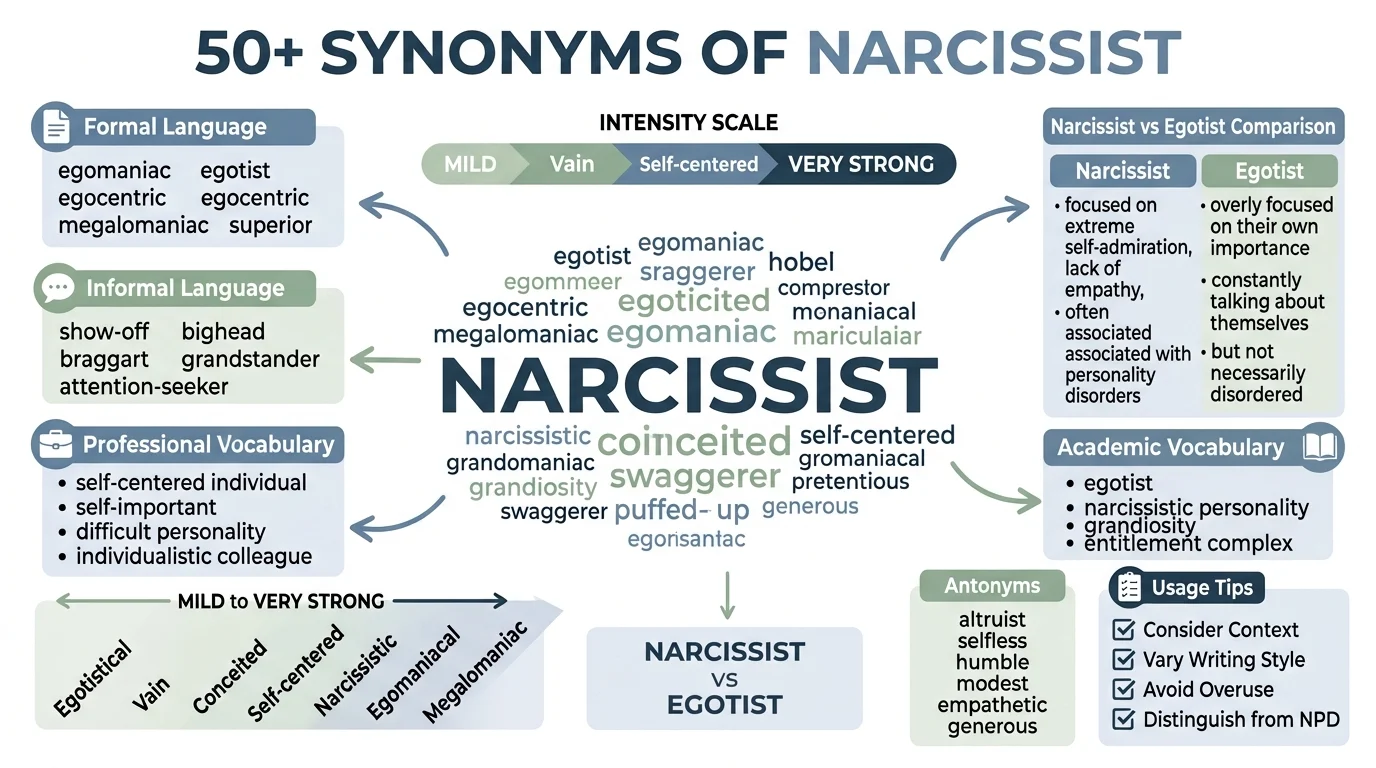
A narcissist is someone with an excessive interest in themselves, an inflated sense of importance, and a lack of concern for others. Formal writing, use egomaniac or self-important person. For casual conversation, try show-off or bighead. Professional settings, self-centered individual or egotist work well. Emotional or creative writing, self-obsessed or vain add the right tone.
Meaning, Tone, and Context
Simple Definition
A narcissist is a person who is excessively preoccupied with themselves, their appearance, and their importance. They often lack genuine empathy for others and expect constant admiration. The word comes from Greek mythology, where Narcissus fell in love with his own reflection.
Part of Speech
Noun. The adjective form is and the noun form for the trait is narcissism.
Overall Tone
Negative. Calling someone a narcissist is almost always a criticism. It suggests selfishness, vanity, and a lack of consideration for others.
Formality Level
Neutral to semi-formal. The word appears in everyday conversation, psychology texts, and professional writing. It is not overly academic but is widely understood across contexts.
Common Uses
Native English speakers use narcissist in several situations:
- Describing someone who constantly talks about themselves
- Discussing difficult relationships or workplace dynamics
- Referring to public figures who seem self-absorbed
- Writing about psychological topics or personality traits
- Critiquing behavior in social media or popular culture
Word Forms
| Form | Word |
|---|---|
| Noun | narcissist |
| Noun (trait) | narcissism |
| Adverb | narcissistically |
| Variant | narcist (less common) |
When and How to Use “Narcissist”
Choose narcissist when you need a precise term for someone who demonstrates excessive self-focus, a need for admiration, and a lack of empathy. It is appropriate in both casual and professional contexts but carries strong negative weight.
Examples by Context
Professional
“Our team lead is a narcissist who takes credit for everyone else’s work.”
Academic
“The study examined how narcissists respond to criticism compared to individuals with healthy self-esteem.”
Workplace
“Working with a narcissist can be exhausting because they rarely acknowledge other people’s contributions.”
Personal
“I realized my friend was a narcissist when she never asked about my life during our conversations.”
“I am struggling to collaborate with a colleague who behaves like a narcissist and dismisses all feedback.”
Resume
(Avoid using narcissist on a resume. Instead describe positive traits like confident or self-assured.)
“Dealing with a narcissist in your life? Here are three signs to watch for.”
Best Synonyms of “Narcissist”
No synonym is identical in every situation. The best choice depends on your audience, your tone, and what you want to emphasize.
Best Synonyms by Context
Professional Writing: self-centered individual – neutral and factual without being overly harsh.
Academic Writing: egotist – precise and commonly used in psychology and social sciences.
Business Communication: egomaniac – strong but professional when describing difficult behavior.
Casual Conversation: show-off or bighead – informal and easy to understand.
Emotional Writing: self-obsessed – conveys frustration or disappointment effectively.
Creative Writing: vain or conceited – adds literary flair and descriptive power.
Resume Writing: Never use narcissist on a resume. Use confident, self-assured, or ambitious instead.
Workplace Communication: egotistical – describes behavior without diagnosing a personality disorder.
Stronger Meaning: megalomaniac – implies an obsession with power and grandiosity.
Softer Meaning: self-absorbed – describes the behavior without the clinical weight.
When Not to Use “Narcissist”
Situation 1: Too General
Narcissist is a strong word. Using it for someone who is merely confident or occasionally self-focused is overkill.
Incorrect: “My brother is a narcissist because he likes taking selfies.”
Better: “My brother is a bit vain about his appearance.”
Situation 2: Too Vague
Sometimes narcissist does not capture the specific behavior you want to describe.
Incorrect: “She is such a narcissist.” (What does she actually do?)
Better: “She constantly interrupts others to talk about her achievements.”
Situation 3: Too Informal for Professional Documents
In formal reports or business proposals, narcissist can sound overly casual or judgmental.
Incorrect: “The CEO is a narcissist who ignores feedback.”
Better: “The CEO demonstrates a pattern of disregarding input from team members.”
Situation 4: Too Strong for Mild Behaviors
Using narcissist for everyday selfishness can damage relationships and seem unfair.
Incorrect: “My coworker is a narcissist because he forgot my birthday.”
Better: “My coworker can be thoughtless at times.”
Situation 5: Outdated in Some Contexts
While narcissist is not outdated, some older synonyms like swellhead or bighead sound dated in formal writing.
Words Commonly Confused With “Narcissist”
Narcissist vs Egotist
Difference: An egotist has an inflated sense of self-worth and talks about themselves constantly. A narcissist goes further, lacking empathy and needing admiration from others.
When to Use It: Use egotist for someone who is boastful and self-centered. Use narcissist for someone whose self-focus harms relationships.
Example (egotist): “He is such an egotist that every conversation becomes about his accomplishments.”
Example (narcissist): “She is a narcissist who cannot acknowledge anyone else’s feelings.”
Narcissist vs Egocentric
Difference: Egocentric means being self-centered and seeing everything from your own perspective. Narcissist implies a more extreme, pathological level of self-focus.
When to Use It: Use egocentric for everyday self-centeredness. Use narcissist for more severe behavior.
Example (egocentric): “Teenagers can be egocentric, but most grow out of it.”
Example (narcissist): “His behavior has destroyed every relationship he has had.”
Narcissist vs Conceited
Difference: Conceited means having an excessively high opinion of yourself. Narcissist includes this but also involves a lack of empathy and a need for admiration.
When to Use It: Use conceited for vanity and pride. Use narcissist for a deeper pattern of self-absorption.
Example (conceited): “She is too conceited to admit when she is wrong.”
Example (narcissist): “He is a narcissist who cannot handle any criticism.”
Narcissist vs Vain
Difference: Vain focuses on excessive pride in appearance or achievements. Narcissist is broader, covering self-importance, lack of empathy, and need for admiration.
When to Use It: Use vain for someone obsessed with looks or status. Use narcissist for deeper personality traits.
Example (vain): “He spends hours in front of the mirror because he is so vain.”
Example (narcissist): “The narcissist expected everyone to admire his new car.”
Narcissist vs Megalomaniac
Difference: A megalomaniac is obsessed with power, wealth, and grandiosity. A narcissist may also seek admiration but not necessarily power on a grand scale.
When to Use It: Use megalomaniac for someone who craves power and control. Use narcissist for someone who craves admiration and attention.
Example (megalomaniac): “The dictator was a megalomaniac who wanted to conquer the world.”
Example (narcissist): “The manager is a narcissist who demands constant praise.”
Narcissist vs Self-Absorbed
Difference: Self-absorbed describes someone preoccupied with their own thoughts and feelings. Narcissist implies a more deliberate, harmful pattern of behavior.
When to Use It: Use self-absorbed for mild or temporary self-focus. Use narcissist for persistent, damaging behavior.
Example (self-absorbed): “She is so self-absorbed that she forgot our meeting.”
Example (narcissist): “The narcissist manipulated everyone to get what he wanted.”
Best Synonyms of “Narcissist” by Context
| Context | Best Synonym | Why It Works | Example |
|---|---|---|---|
| Formal writing | egomaniac | Precise and widely recognized | “The egomaniac refused to consider any alternative viewpoints.” |
| Academic writing | egotist | Commonly used in psychology literature | “Egotists often struggle with collaborative research environments.” |
| Professional communication | self-centered individual | Neutral and objective | “We need to address the behavior of this self-centered individual.” |
| Business emails | egotistical | Professional without being overly harsh | “His egotistical approach is affecting team morale.” |
| Resume writing | confident | Positive and professional | “Confident leader with a track record of delivering results.” |
| Workplace communication | self-important | Describes behavior without diagnosing | “Her self-important attitude alienates her colleagues.” |
| Casual conversation | show-off | Informal and easy to understand | “He is such a show-off at parties.” |
| Everyday speaking | bighead | Lighthearted and informal | “Don’t be such a bighead about your promotion.” |
| Creative writing | vain | Adds descriptive depth | “The vain prince admired his reflection in every mirror.” |
| Storytelling | conceited | Creates vivid character descriptions | “The conceited villain underestimated his opponents.” |
| Emotional writing | self-obsessed | Conveys frustration and disappointment | “I am tired of her self-obsessed monologues.” |
| Strong emphasis | megalomaniac | Implies extreme grandiosity | “The megalomaniac CEO envisioned himself as a modern emperor.” |
| Mild tone | self-absorbed | Gentle and less accusatory | “He can be self-absorbed, but he means well.” |
| American English | narcissist | Standard and widely used | “She is a classic narcissist who loves attention.” |
How to Choose the Best Synonym of “Narcissist”
Choosing the right synonym depends on several factors. Here is a practical decision guide.
1. Consider Your Meaning
Are you describing someone who is simply proud? Use conceited or vain. Are you describing someone who lacks empathy and exploits others? Use narcissist or egomaniac.
2. Consider Your Audience
For professional audiences, choose self-centered or egotistical. For friends and family, show-off or bighead work well.
3. Consider Your Tone
A neutral tone calls for self-absorbed or egocentric. A critical tone calls for narcissist or egomaniac. A lighthearted tone calls for bighead or show-off.
4. Consider Emotional Strength
Mild: self-absorbed, vain
Moderate: egotist, conceited
Strong: narcissist, egomaniac
Very Strong: megalomaniac, pathological narcissist
5. Consider Your Writing Purpose
For professional emails, choose neutral terms. Creative writing, choose descriptive terms. For academic papers, choose precise psychological terms.
6. Consider Natural Sounding Usage
The best synonym sounds natural in your sentence. Read your sentence aloud. If it feels forced or awkward, try a different word.
Real Life Examples of “Narcissist”
School
“The group project failed because one member acted like a narcissist and ignored everyone else’s ideas.”
College
“My psychology professor explained that a narcissist often has fragile self-esteem beneath the arrogance.”
Workplace
“Dealing with a narcissist at work requires setting firm boundaries and documenting everything.”
Business
“The narcissist in the corner office demanded weekly praise from his entire team.”
“I am finding it difficult to work with someone who behaves like a narcissist and takes credit for my work.”
Resume
(Replace with positive language.) “Self-motivated professional with strong leadership skills.”
Conversation
“I think my ex was a narcissist. She never asked how I was doing.”
Storytelling
“The narcissist king built monuments to himself while his people starved.”
Blogging
“How to recognize a narcissist in your social circle before they cause too much damage.”
“Narcissist alert: 5 signs someone only cares about themselves.”
18 Best Synonyms of “Narcissist”
Synonyms of “Narcissist” by Usage
Professional vs Personal Synonyms
Professional (Workplace, Business, Formal):
- egomaniac
- egotist
- self-centered individual
- self-important person
- egotistical
These words sound serious and appropriate for emails, reports, and meetings.
Personal (Conversations, Social Media, Casual):
- show-off
- bighead
- braggart
- blowhard
- ego-tripper
These words sound natural in everyday conversations with friends and family.
Formal vs Conversational Synonyms
Formal (Reports, Essays, Business Writing, Presentations):
- egomaniac
- egotist
- egocentric
- personality
- self-important
Conversational (Casual Conversations, Texting, Social Media):
- show-off
- bighead
- braggart
- blowhard
- self-absorbed
Academic Synonyms
For research papers, essays, and academic discussions, choose precise terminology:
- egotist – commonly used in psychology and social sciences
- egocentric – describes self-focused cognitive patterns
- personality – clinical term for diagnostic contexts
- pathological narcissist – indicates severe, clinically significant behavior
These words sound authoritative and demonstrate academic rigor.
Professional and Business Synonyms
For resumes, interviews, meetings, presentations, performance reviews, and client communication:
- egomaniac – strong but professional for describing difficult colleagues
- egotist – precise and widely understood in business contexts
- self-centered individual – neutral and factual
- egotistical – describes behavior without diagnosing
- self-important – professional criticism without harshness
These words fit professional settings while maintaining appropriate tone.
Creative and Literary Synonyms
For storytelling, fiction, poetry, descriptive writing, and speeches:
- vain – adds imagery and emotional depth
- conceited – creates vivid character descriptions
- swaggerer – evokes a specific visual image
- braggart – adds color to dialogue and narration
- self-obsessed – conveys psychological depth
- megalomaniac – suggests epic, larger-than-life characters
These words enhance descriptive writing and bring characters to life.
Slang or Modern Synonyms
- narc – informal abbreviation used in online discussions and self-help contexts
- ego-tripper – modern slang for someone seeking ego gratification
Where acceptable: Casual conversations, social media, blogs, online forums.
Where to avoid: Professional writing, academic papers, business communication, formal reports.
Strongest to Mildest Synonyms
Intensity Scale
| Level | Synonym | Emotional Weight |
|---|---|---|
| Mild | self-absorbed | Low |
| Mild | vain | Low |
| Mild | self-centered | Low |
| Moderate | conceited | Medium |
| Moderate | egotist | Medium |
| Moderate | egocentric | Medium |
| Strong | narcissist | High |
| Strong | egomaniac | High |
| Strong | self-important | High |
| Very Strong | megalomaniac | Very High |
| Very Strong | pathological narcissist | Very High |
How Intensity Changes
Mild synonyms describe everyday self-focus without harsh judgment. Moderate synonyms suggest noticeable self-importance. Strong synonyms imply significant personality issues. Very strong synonyms suggest severe, potentially clinical problems.
Emotional vs Neutral Synonyms
Emotional Synonyms (Express Stronger Feelings)
These words carry emotional weight and often express frustration, disappointment, or anger:
- narcissist – implies moral judgment and criticism
- egomaniac – suggests extreme selfishness
- megalomaniac – implies dangerous ambition
- blowhard – expresses annoyance and contempt
- braggart – conveys irritation with boastfulness
Best used when: You want to express strong disapproval or describe harmful behavior.
Neutral Synonyms (Communicate Information Without Emotion)
These words describe behavior factually without added emotional charge:
- self-centered – objective description of behavior
- egocentric – psychological term without judgment
- self-absorbed – describes preoccupation without harshness
- egotist – neutral psychological term
Best used when: You need to describe behavior professionally or objectively.
Antonyms of “Narcissist”
Comparison: “Narcissist” vs Similar Words
Narcissist vs Egotist
Main Difference: An egotist talks about themselves constantly and has an inflated ego. A narcissist lacks empathy and requires admiration from others.
Which Is Stronger? Narcissist is stronger because it implies a lack of empathy and potential harm to relationships.
Which Is More Formal? Both are formal, but egotist appears more frequently in academic psychology.
When to Use Each:
- Use egotist for someone who is boastful and self-centered.
- Use narcissist for someone whose self-focus is extreme and damaging.
Examples:
- Egotist: “He is such an egotist that he interrupts everyone to talk about himself.”
- Narcissist: “She is a narcissist who cannot acknowledge anyone else’s success.”
Narcissist vs Egocentric
Main Difference: Egocentric means viewing everything from your own perspective. Narcissist involves active self-promotion and a need for admiration.
Which Is Stronger? Narcissist is stronger and implies more severe behavior.
Which Is More Formal? Egocentric is more formal and clinical.
When to Use Each:
- Use egocentric for describing natural self-focus.
- Use narcissist for describing harmful, attention-seeking behavior.
Examples:
- Egocentric: “Teenagers can be egocentric as they develop their identity.”
- Narcissist: “The narcissist dominated every conversation and dismissed others’ opinions.”
Narcissist vs Conceited
Main Difference: Conceited means having an excessively high opinion of yourself. Narcissist includes this but also involves a lack of empathy.
Which Is Stronger? Narcissist is stronger because it implies a pattern of behavior, not just an attitude.
Which Is More Formal? Conceited is less formal than narcissist.
When to Use Each:
- Use conceited for someone who is vain and prideful.
- Use narcissist for someone whose self-focus harms others.
Examples:
- Conceited: “He is too conceited to admit when he is wrong.”
- Narcissist: “The narcissist expected everyone to admire his work.”
Narcissist vs Vain
Main Difference: Vain focuses on excessive pride in appearance or achievements. Narcissist is broader, covering self-importance, lack of empathy, and need for admiration.
Which Is Stronger? Narcissist is stronger and more comprehensive.
Which Is More Formal? Narcissist is more formal and clinical.
When to Use Each:
- Use vain for someone obsessed with looks or status.
- Use narcissist for deeper personality traits.
Examples:
- Vain: “She spends hours on her appearance because she is so vain.”
- Narcissist: “The narcissist could not handle any criticism of his work.”
Narcissist vs Megalomaniac
Main Difference: A megalomaniac is obsessed with power and grandiosity. A narcissist seeks admiration but may not crave power.
Which Is Stronger? Megalomaniac is stronger and implies a more extreme, often dangerous personality.
Which Is More Formal? Both are formal, but megalomaniac is more specific.
When to Use Each:
- Use megalomaniac for someone who craves power and control.
- Use narcissist for someone who craves admiration and attention.
Examples:
- Megalomaniac: “The dictator was a megalomaniac who wanted to conquer neighboring countries.”
- Narcissist: “The manager is a narcissist who demands constant praise from his team.”
Narcissist vs Self-Absorbed
Main Difference: Self-absorbed describes preoccupation with your own thoughts and feelings. Narcissist implies a more deliberate, harmful pattern of behavior.
Which Is Stronger? Narcissist is stronger and implies more severe behavior.
Which Is More Formal? Self-absorbed is less formal than narcissist.
When to Use Each:
- Use self-absorbed for mild or temporary self-focus.
- Use narcissist for persistent, damaging behavior.
Examples:
- Self-absorbed: “She is so self-absorbed that she forgot our meeting.”
- Narcissist: “The narcissist manipulated everyone to get what he wanted.”
Common Phrases and Expressions with “Narcissist”
1: ” personality disorder”
Meaning: A diagnosable mental health condition characterized by grandiosity, need for admiration, and lack of empathy.
Example Sentence: “The psychologist diagnosed him with personality disorder after a thorough evaluation.”
2: “Malignant narcissist”
Meaning: A severe form of narcissism that includes antisocial behavior, paranoia, and sadism.
Example Sentence: “The malignant narcissist not only craved admiration but also enjoyed harming others.”
3: “Vulnerable narcissist”
Meaning: A type of narcissist who appears insecure and sensitive but still displays self-centered traits.
Example Sentence: “The vulnerable narcissist seemed shy but constantly sought reassurance about their worth.”
4: “Grandiose narcissist”
Meaning: A narcissist who displays overt arrogance, entitlement, and self-importance.
Example Sentence: “The grandiose narcissist bragged about achievements that were mostly imaginary.”
5: ” supply”
Meaning: The admiration and attention that narcissists seek from others.
Example Sentence: “He constantly sought supply through social media likes and comments.”
6: ” injury”
Meaning: The emotional pain a narcissist feels when their self-image is threatened.
Example Sentence: “Any criticism caused a injury that made him lash out angrily.”
7: ” rage”
Meaning: An intense angry reaction when a narcissist’s self-esteem is threatened.
Example Sentence: “When she challenged his authority, he responded with rage.”
Common Mistakes to Avoid
1: Using “Narcissist” for Any Selfish Behavior
Incorrect: “My sister is a narcissist because she didn’t share her dessert.”
Better: “My sister can be selfish sometimes.”
Why: Narcissist is a strong word that implies a pattern of behavior, not a single action.
2: Confusing “Narcissist” with “Egotist”
Incorrect: “He is a narcissist because he talks about himself too much.”
Better: “He is an egotist who dominates every conversation.”
Why: An egotist talks about themselves constantly, but a narcissist goes further by lacking empathy and needing admiration.
3: Using Informal Synonyms in Formal Writing
Incorrect: “The CEO is a bighead who ignores feedback.”
Better: “The CEO displays egotistical behavior and disregards feedback.”
Why: Bighead is too informal for professional contexts.
4: Selecting an Overly Dramatic Synonym
Incorrect: “My coworker is a megalomaniac because he wants a promotion.”
Better: “My coworker is ambitious to the point of being self-centered.”
Why: Megalomaniac implies an obsession with power on a grand scale, which is excessive for everyday ambition.
5: Repeating the Same Word Too Often
Incorrect: “The narcissist in our office is difficult. The narcissist takes credit for everything. The narcissist never listens.”
Better: “The egomaniac in our office is difficult. He takes credit for everything. He never listens.”
Why: Using synonyms adds variety and makes your writing more engaging.
6: Choosing a Synonym with the Wrong Emotional Tone
Incorrect: “He is a self-absorbed monster who ruined my life.”
Better: “His self-absorbed behavior has been very hurtful.”
Why: Using emotional language inappropriately can make your writing sound dramatic or unprofessional.
7: Using Slang in Academic or Professional Writing
Incorrect: “The study found that narcs often have trouble with relationships.”
Better: “The study found that individuals with traits often have trouble with relationships.”
Why: Narc is slang and inappropriate for academic contexts.
Frequently Asked Questions
1. What are the best synonyms of “narcissist”?
The best synonyms depend on context. Formal writing, use egomaniac or egotist. For casual conversation, use show-off or bighead. For professional settings, use self-centered individual or egotistical.
2. What are the best formal synonyms of “narcissist”?
The best formal synonyms include egomaniac, egotist, egocentric, and self-important person. These words are appropriate for academic papers, professional reports, and business communication.
3. What are common informal synonyms of “narcissist”?
Common informal synonyms include show-off, bighead, braggart, blowhard, and ego-tripper. These words work well in casual conversations, social media, and everyday writing.
4. What is another word for “narcissist” in professional writing?
In professional writing, use egomaniac, egotist, self-centered individual, or egotistical. These terms sound serious and appropriate for workplace communication, emails, and business documents.
5. What is the difference between “narcissist” and “egotist”?
An egotist has an inflated sense of self-worth and talks about themselves constantly. A narcissist goes further by lacking empathy, needing admiration, and often harming relationships. Narcissist is the stronger, more serious term.
6. What is the opposite of “narcissist”?
The opposite of a narcissist is someone who is altruistic, selfless, humble, compassionate, or empathetic. An altruist or humanitarian cares deeply about others without seeking personal gain.
Conclusion
A narcissist is someone with excessive self-focus, an inflated sense of importance, and a lack of empathy for others. While narcissist is the most precise term for this personality pattern, many synonyms can help you communicate more effectively in different contexts. Professional writing, choose egomaniac or egotist. For casual conversations, try show-off or bighead. For creative writing, consider vain or conceited. Remember that no synonym works perfectly in every situation. The best word depends on your audience, your tone, and your purpose. When you understand the subtle differences between the synonyms of narcissist, you can choose the word that communicates exactly what you mean. One practical tip: before you use any synonym, read your sentence aloud to make sure it sounds natural and conveys the right emotional tone.