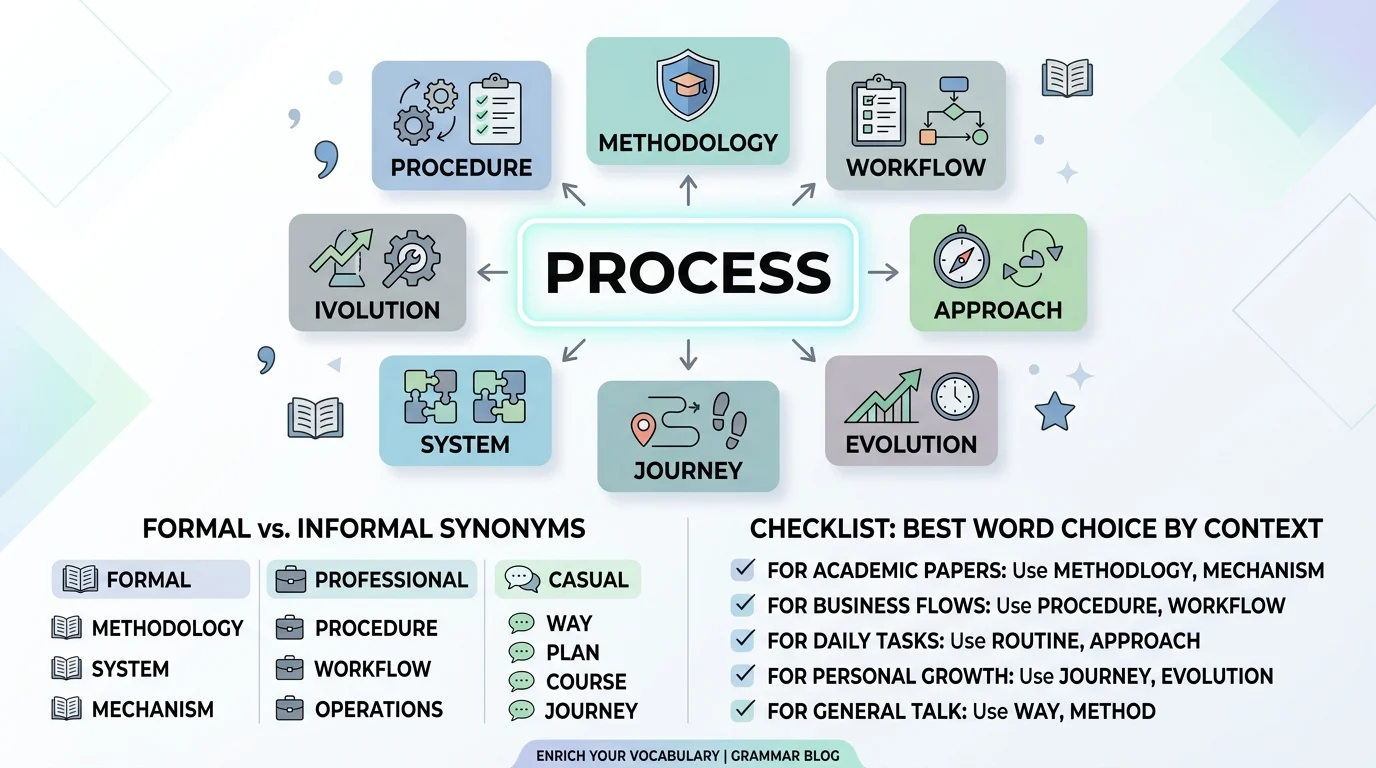
Do you find yourself repeating the word “process” too often in your writing? You are not alone. Many writers, students, and professionals rely on this single term when describing how things work, develop, or get done. The result can feel repetitive and dull.
Your emails, essays, and reports deserve more variety. This guide will help you break that habit. You will discover dozens of powerful alternatives that fit every situation. Whether you write for school, work, or creative projects, these synonyms will make your language sharper and more engaging.
What Does “Process” Mean?
A process is a series of actions or steps taken to achieve a particular result. For formal writing, choose “procedure” or “method.” casual conversation, try “approach” or “way.” academic work, select “methodology” or “system.” For professional use, “workflow” or “protocol” work well. creative writing, consider “journey” or “evolution.”
Meaning, Tone and Context
Simple definition
A process is a sequence of events, actions, or changes that lead to a specific outcome. It can be natural, like growth, or designed, like a manufacturing system.
Part of speech
Process functions as a noun and a verb. As a noun, it refers to the sequence itself. As a verb, it means to handle or deal with something systematically.
Positive, negative, or neutral tone
The word process is neutral. Its tone depends entirely on the context. A “healing process” sounds positive. A “decline process” sounds negative. Most business and academic uses remain neutral.
Formality level
Process sits comfortably in the middle. It works in casual conversation, professional reports, and academic papers. The word is versatile enough for almost any situation.
Common use cases
People use process when discussing workflows, learning, manufacturing, decision making, natural events, and personal growth. It appears in business meetings, school essays, scientific papers, and everyday conversation.
Important word forms
The noun form is process. The verb form is also process. Related forms include processed, processing, and processor. The adjective procedural connects to process but describes the formal rules rather than the steps themselves.
When and How to Use “Process”
The word process works best when you want to describe a series of steps without emphasizing any particular detail. It is your default choice for general situations. When you need more precision, choose a synonym that adds specific meaning.
Professional context
Our team developed a new process for handling customer complaints. The process includes three stages of review before we issue a resolution.
Academic context
The research process involved data collection, analysis, and peer review. This process took eighteen months to complete.
Personal context
My morning process includes meditation, exercise, and a healthy breakfast. This process helps me stay focused throughout the day.
Creative context
The creative process rarely follows a straight line. Artists often describe their process as a series of discoveries and revisions.
Social media context
Building a loyal following is a slow process. Share your process to help others understand your journey.
Email context
I have attached the process document for your review. Please let me know if any steps in the process need clarification.
Resume context
Developed a streamlined process that reduced production time by thirty percent. This process improvement saved the company over one hundred thousand dollars annually.
Another Word for “Process”
The best single replacement depends on your context and what you want to emphasize. Here are the top choices for different situations.
Professional writing
Procedure works best for workplace communication. It implies established rules and expected steps.
Academic writing
Methodology fits research and scholarly work. It suggests a systematic approach based on established principles.
Casual conversation
Approach feels natural in everyday speech. It suggests a personal way of handling things.
Emotional writing
Journey works beautifully for personal growth and transformation. It adds warmth and depth to the basic idea of a process.
Creative writing
Evolution suggests organic change over time. It works well for character development and natural phenomena.
Resume or workplace use
Workflow emphasizes efficiency and productivity. It shows you understand how tasks connect in a professional setting.
Social media captions
Method works perfectly for short, clear posts. It sounds practical and approachable.
Stronger meaning
Ordeal suggests difficulty and challenge. Use this when you want to emphasize struggle.
Softer meaning
Routine implies comfortable regularity. This works when you want to downplay effort.
When Not to Use “Process”
Process can sound too vague or mechanical in many situations. You should avoid it when you need to show emotion or when you want to highlight specific details.
Too vague example
Original sentence: The process of making friends is hard.
Improved sentence: Making friends takes time and patience.
The second version feels more personal and direct. It removes the clinical tone.
Too casual for formal writing
Original sentence: The process we used for the experiment was solid.
Improved sentence: The experimental methodology proved reliable.
Formal writing demands more precise language. Methodology sounds more academic and trustworthy.
Too formal for casual speech
Original sentence: I am in the process of cooking dinner.
Improved sentence: I am cooking dinner right now.
Casual conversation calls for simpler language. The direct version sounds more natural.
Too mechanical for emotional topics
Original sentence: The process of grief follows no timeline.
Improved sentence: Grief unfolds differently for everyone.
Emotional writing needs warmth. The second version acknowledges human experience without sounding clinical.
Too general for specific actions
Original sentence: We need a process for this problem.
Improved sentence: We need a clear plan for this problem.
Plan suggests thoughtful organization. Process sounds too generic for urgent situations.
Words Commonly Confused With “Process”
Process vs. Procedure
A process describes the overall sequence. A procedure describes specific formal rules. Procedure is more rigid and official. Process is broader and more flexible.
Process vs. System
A system includes all the parts working together. A process focuses on the sequence of actions. System is bigger. is a part of the system.
Process vs. Method
Method emphasizes how something is done. Process emphasizes the steps themselves. Method focuses on technique.focuses on sequence.
Process vs. Workflow
Workflow specifically refers to work activities. Process can apply to anything. Workflow is limited to professional tasks.
Process vs. Progress
Progress describes forward movement. Process describes the journey itself. Progress measures advancement. describes the activities.
Process vs. Routine
Routine suggests regular repetition. Process suggests purpose and outcome. Routine is about habit. Process is about achieving results.
Best Synonym by Context for “Process”
| Context | Best Synonym | Why It Works | Example |
|---|---|---|---|
| Formal writing | Procedure | Sounds official and established | The procedure requires three signatures |
| Academic writing | Methodology | Conveys scholarly precision | The methodology included surveys and interviews |
| Professional business | Workflow | Emphasizes efficiency | We optimized the workflow to reduce delays |
| Resume writing | System | Shows organizational ability | Created a system that improved accuracy |
| Casual conversation | Approach | Sounds natural and personal | His approach to problem solving works well |
| Creative writing | Journey | Adds emotional depth | The creative journey changed her perspective |
| Emotional tone | Evolution | Suggests meaningful growth | The evolution of their friendship was beautiful |
| Strong intensity | Ordeal | Emphasizes difficulty | The ordeal tested everyone’s patience |
| Soft moderate | Routine | Downplays effort | Their daily routine keeps things running smoothly |
| Social media | Method | Short and clear | My method for staying productive every day |
| Technical writing | Protocol | Indicates precise rules | The protocol must be followed exactly |
| Personal development | Growth | Highlights positive change | Personal growth happens through consistent effort |
| Manufacturing | Production | Directly relates to output | The production line runs twenty four hours daily |
| Problem solving | Strategy | Suggests careful planning | Our strategy involves multiple review stages |
| Decision making | Framework | Provides structure | The framework guides all major decisions |
Which Synonym Should You Choose?
Choosing the right synonym requires you to think about your audience, purpose, and the emotion you want to convey.
Consider your audience
Formal audiences expect words like procedure and methodology. Casual audiences prefer approach and way. Professional audiences respond well to workflow and system.
Consider your purpose
If you want to show efficiency, choose workflow. If you want to show academic rigor, choose methodology. If you want to show personal growth, choose journey.
Consider emotional intensity
Strong emotions call for words like ordeal and evolution. Neutral situations work well with procedure and system. Positive experiences benefit from growth and development.
Consider professional value
Resumes benefit from system, workflow, and framework. These words demonstrate competence and organization.
Consider sentence flow
Choose synonyms that fit the rhythm of your sentence. Shorter words like method and way work well in tight spaces. Longer words like methodology work better in formal writing.
Real Life Examples of “Process” in Sentences
School context
The writing process for my thesis involved months of research. My professor praised the methodical approach I used.
Workplace context
Our team refined the hiring procedure to attract better candidates. The new workflow cut the average hiring time in half.
Writing context
Every novelist follows a unique creative process. Some writers begin with character development while others start with plot structure.
Conversation context
What is your approach to learning new skills? My method involves daily practice and regular feedback.
Social media context
Sharing my creative journey has connected me with amazing people. The growth I have experienced has been incredible.
Resume context
Implemented a system that reduced errors by forty percent. The protocol I developed became the company standard.
Email context
Please review the attached procedure document. The workflow outlined in this document will guide our team through the transition.
Storytelling context
Her journey from student to leader inspired everyone around her. The evolution of her confidence was remarkable to witness.
25 Synonyms
| Synonym | Simple Meaning | Best Used For | Example Sentence |
|---|---|---|---|
| Procedure | Official set of rules | Formal and legal contexts | The hospital procedure requires patient consent |
| Method | Systematic way of doing | Academic and technical | Their research method proved highly effective |
| Workflow | Sequence of work tasks | Business and professional | The new workflow increased team productivity |
| System | Organized set of parts | Organizational contexts | Our quality system meets international standards |
| Approach | Personal way of doing | Casual and professional | His creative approach solved the problem quickly |
| Methodology | Scientific or research system | Academic and scholarly | The methodology section explained every step |
| Protocol | Official rules and guidelines | Technical and medical | The safety protocol must be followed precisely |
| Technique | Skilled method of doing | Artistic and practical | Her painting technique produces stunning results |
| Operation | Functioning system or action | Technical and mechanical | The operation runs smoothly every day |
| Practice | Established way of doing | Professional and routine | Best practice requires regular team meetings |
| Progression | Forward movement through steps | Personal development | The progression from beginner to expert takes time |
| Evolution | Gradual change and development | Creative and natural contexts | The evolution of technology changed everything |
| Journey | Personal transformative experience | Emotional and creative | Her writing journey inspired many readers |
| Growth | Positive development over time | Personal and professional | Professional growth requires continuous learning |
| Development | Advancement through stages | Business and career | Product development follows a strict timeline |
| Sequence | Particular order of events | Scientific and logical | The sequence of events was carefully documented |
Synonym Groups and Usage Differences
Professional vs. Personal Synonyms
Professional synonyms emphasize efficiency and results. Words like workflow, system, and procedure belong in business settings. They sound competent and organized. Personal synonyms focus on individual experience. Words like journey, growth, and routine fit conversations about daily life. They sound warm and relatable. Choose professional synonyms for emails and reports. Choose personal synonyms for social media and conversations.
Formal vs. Conversational Synonyms
Formal synonyms appear in official documents and academic papers. Methodology, procedure, and protocol carry authority. Conversational synonyms sound natural in everyday speech. Approach, method, and way work well in casual settings. Formal writing demands precision. Conversational writing values clarity. Match your synonym to your medium.
Academic Synonyms
Academic writing requires words that demonstrate rigor. Methodology appears in research papers. Framework structures theoretical discussions. System describes complex relationships. These words signal scholarly competence. They show you understand the subject deeply. Use them in essays, dissertations, and journal articles.
Professional and Business Synonyms
Business writing values efficiency and clarity. Workflow describes operational efficiency. System suggests organized thinking. Strategy indicates careful planning. These words demonstrate professional competence. Use them in reports, presentations, and resumes. They communicate your ability to manage complex situations.
Creative or Literary Synonyms
Creative writing benefits from words with emotional weight. Journey suggests transformation. Evolution implies organic change. Growth adds positive momentum. These words create vivid imagery. They help readers connect emotionally. Use them in stories, poetry, and personal narratives.
Slang or Modern Synonyms
Modern English rarely uses slang equivalents for process. The word is too precise for casual alternatives. Some speakers use “flow” to describe creative or work processes. Others use “deal” in very casual contexts. These are not recommended for professional or academic use. Stick to standard synonyms for clarity.
Strongest vs. Weaker Synonyms
Mild intensity
Routine, way, practice
Moderate intensity
Method, system, procedure
Strong intensity
Ordeal, evolution, progression
Strongest intensity
Transformation, overhaul, revolution
Choose mild words for daily activities. moderate words for professional contexts. Choose strong words for significant changes or challenges.
Emotional vs. Neutral Synonyms
Neutral synonyms stick to facts. Procedure, methodology, and workflow describe steps without emotion. Emotional synonyms add feeling. Journey, growth, and evolution suggest personal significance. Use neutral words in official documents. Use emotional words in personal stories and creative writing.
Antonyms of “Process”
| Antonym | Meaning | Example Sentence |
|---|---|---|
| Chaos | Complete disorder | The project descended into chaos without leadership |
| Stagnation | Lack of movement or progress | Economic stagnation hurt the company’s growth |
| Halt | Complete stop | The halt in production cost thousands of dollars |
| Disorganization | Lack of structure or order | Their disorganization caused repeated delays |
| Inaction | Doing nothing | Inaction was not an option for the team |
| Randomness | Lack of predictable order | The randomness of the results made analysis difficult |
| Neglect | Failure to care for something | Neglect of the system caused it to fail |
| Disruption | Interruption of normal flow | The disruption affected every department |
| Disorder | Lack of organized arrangement | Disorder in the files made them hard to find |
| Confusion | State of being bewildered | Confusion about the steps wasted valuable time |
| Inefficiency | Lack of productivity | The inefficiency of the old method was obvious |
| Standstill | Complete stop of movement | The standstill lasted for several hours |
| Breakdown | Failure of a system | The breakdown required emergency repairs |
| Disarray | State of disorder | Disarray in the workflow caused errors |
| Paralysis | Inability to act or move | Analysis paralysis prevented any decisions |
Comparison: Process vs. Similar Words
Process vs. Procedure
The main difference lies in flexibility. Process describes any sequence of actions. Procedure describes official, established rules. Procedure is more rigid and formal. Process is more general and adaptable. Procedure works for legal and medical contexts. Process works for almost everything else.
Process example
The hiring process includes several interview rounds.
Procedure example
The company procedure requires background checks for all candidates.
Process vs. Method
Method focuses on the technique or approach. Process focuses on the sequence of steps. Method answers the question “how.” Process answers the question “what happens next.” Method is more about skill. Process is more about order.
Method example
Her teaching method emphasizes hands on learning.
Process example
The learning process builds confidence gradually.
Process vs. System
System includes all interconnected parts. Process is a sequence of actions within that system. System is bigger and more comprehensive. Process is a component. System describes structure. Process describes action.
System example
The company’s financial system tracks every transaction.
Process example
The approval process requires three signatures.
Process vs. Workflow
Workflow specifically applies to work and tasks. Process can describe anything. Workflow is professional. Process is universal. Workflow emphasizes efficiency. Process emphasizes sequence.
Workflow example
Our daily workflow begins with team stand up meetings.
Process example
The process of making coffee takes five minutes.
Process vs. Routine
Routine suggests regular repetition and habit. Process suggests purpose and intentional action. Routine is about consistency. Process is about achieving results. Routine feels comfortable. Process feels purposeful.
Routine example
His morning routine never changes.
Process example
The creative process requires experimentation.
Process vs. Progress
Progress measures advancement and improvement. Process describes the activities themselves. Progress is about results. Process is about the journey. Progress is forward movement. Process is the steps taken.
Progress example
She made significant progress on the project.
Process example
The review process takes two weeks to complete.
Common Phrases and Expressions with “Process”
1. In the process of
Meaning
Currently engaged in doing something.
Example sentence
I am in the process of revising my entire manuscript.
2. Process of elimination
Meaning
Finding an answer by removing wrong options.
Example sentence
We used the process of elimination to identify the problem.
3. Process improvement
Meaning
Making a system or procedure better.
Example sentence
Our team focuses on continuous process improvement.
4. Due process
Meaning
Fair and proper legal procedures.
Example sentence
Everyone deserves due process under the law.
5. Natural process
Meaning
Something that happens without human intervention.
Example sentence
Aging is a natural process that affects everyone.
6. Creative process
Meaning
The steps involved in making art or solving problems.
Example sentence
Her creative process involves long walks and sketching.
7. Process data
Meaning
To organize and analyze information.
Example sentence
The software processes data faster than humans can.
8. Process thinking
Meaning
Focusing on steps and systems rather than outcomes.
Example sentence
Process thinking helps teams identify improvement opportunities.
Common Mistakes to Avoid
Using process when a more precise synonym works better
Process is too general for many situations. If you mean procedure, say procedure. If you mean journey, say journey. Precision improves your writing significantly.
Confusing process with progress
Process describes the steps. Progress describes the advancement. They are related but different. Using them incorrectly confuses readers.
Using a casual synonym in formal writing
Approach and way sound casual. Methodology and procedure sound formal. Match your synonym to your context. Formal writing demands formal language.
Using an overly dramatic synonym for simple situations
Ordeal suggests great difficulty. Journey suggests personal significance. Do not use these for routine tasks. Save dramatic language for dramatic situations.
Repeating the same word too often
Variety improves readability. Use different synonyms throughout your writing. This keeps readers engaged and shows vocabulary range.
Choosing a synonym with the wrong emotional tone
Every synonym carries emotional weight. Evolution sounds positive. Ordeal sounds negative. Choose words that match your intended tone.
Using slang in academic or professional writing
Avoid modern slang in formal contexts. Standard English works best for serious writing. Save casual language for personal communication.
FAQs
What is the best synonym for process?
The best synonym depends on your context. Use procedure for formal situations, workflow for business, and journey for personal growth.
What is a formal synonym for process?
Procedure and methodology are excellent formal synonyms. They suggest official rules and systematic approaches to achieving results.
What is an informal synonym for process?
Approach and way are good informal alternatives. They sound natural in everyday conversation and casual writing.
What is another word for process in professional writing?
Workflow and system work well in professional contexts. They emphasize efficiency and organization in the workplace.
What is the difference between process and procedure?
Process describes any sequence of actions. Procedure describes official, established rules that must be followed precisely.
What is the opposite of process?
Chaos, stagnation, and disorder are common opposites. They describe situations without structure or forward movement.
Conclusion
Process is a useful word, but variety makes your writing stronger. The right synonym adds precision, emotion, and clarity to your sentences. Always consider your audience, purpose, and tone before choosing a word. Professional contexts benefit from workflow and procedure. Academic writing thrives on methodology and framework. Personal stories come alive with journey and growth. Creative work shines with evolution and development. The more carefully you choose your words, the more effectively you communicate. Start practicing with these synonyms today. Your writing will become richer and more engaging.