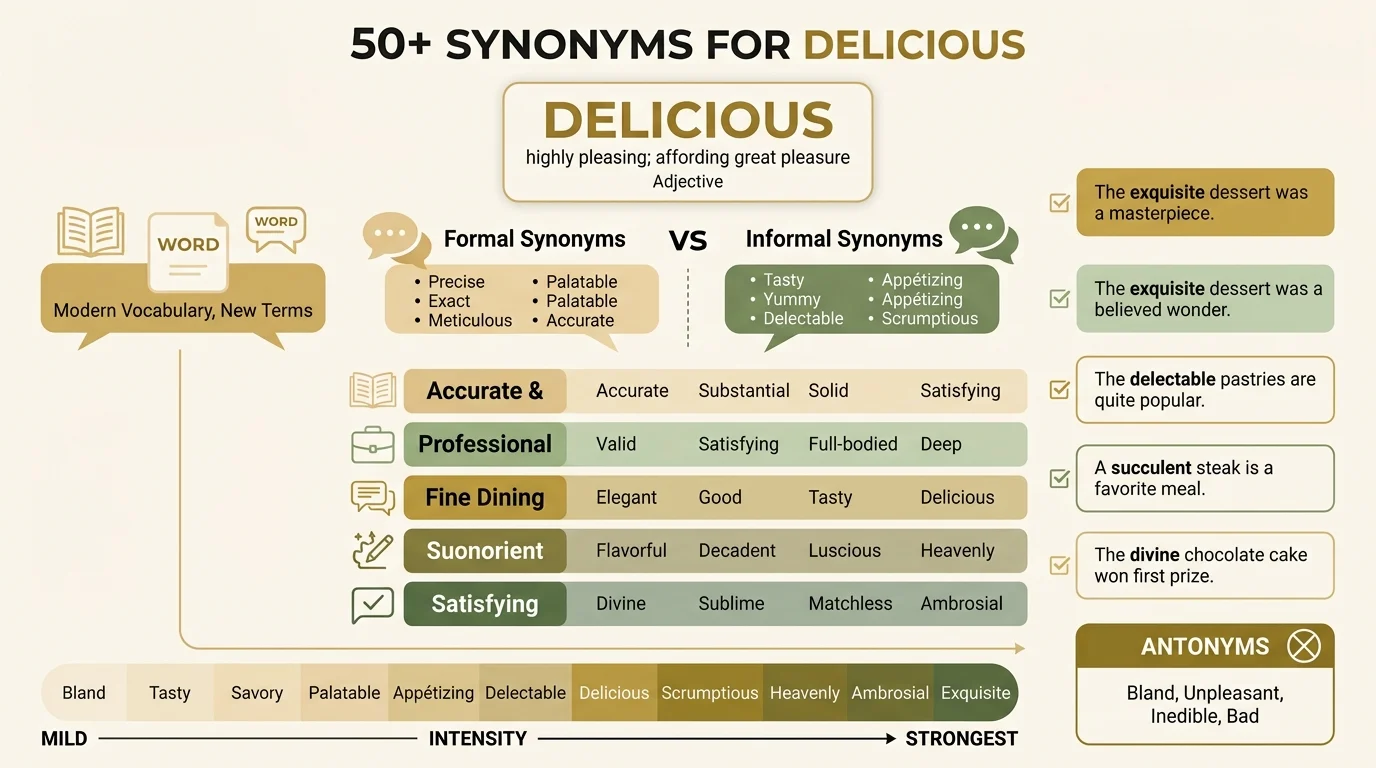
Do you ever find yourself stuck repeating the word “delicious” over and over again? You describe a meal, a dessert, or a new recipe, and the same word keeps showing up in your writing or conversations.
You are not alone. Many English learners, students, writers, and professionals struggle to move beyond this one common adjective. The good news is that English offers a rich vocabulary of alternatives that add variety, precision, and flair to your language.
Whether you are writing a food blog post, a restaurant review, a professional email, or even a creative story, the right synonym can make your message more engaging. This guide will help you master 50 powerful alternatives for “delicious” and show you exactly when and how to use each one.
By the end of this article, you will never feel stuck again. You will confidently choose the perfect word for every situation, from formal essays to casual social media captions.
What Does “Delicious” Mean?
The word “delicious” means highly pleasing to the taste or smell. It describes food, drinks, or anything with a delightful flavor. The best synonyms depend on context. formal writing, try “delectable” or “savory.” For casual conversations, use “yummy” or “tasty.” stronger emotional impact, choose “scrumptious” or “mouthwatering.” For professional settings, consider “flavorful” or “palatable.”
Meaning, Tone and Context
Simple Definition
Delicious refers to something that gives great pleasure to the senses, especially taste and smell. It describes food, beverages, or any edible item that tastes excellent.
Part of Speech
Delicious is an adjective.
Positive, Negative, or Neutral Tone
This word has a positive tone. It always expresses approval and enjoyment.
Formality Level
Delicious is moderately formal. It is appropriate in most situations, including casual conversations, professional writing, and academic work.
Common Use Cases
People use delicious to describe meals, desserts, snacks, drinks, recipes, and restaurant experiences. It also appears in reviews, food blogs, social media posts, and everyday conversations.
Important Word Forms
Noun form: deliciousness. Example: The deliciousness of this cake is remarkable.
Adverb form: deliciously. Example: The soup was deliciously warm.
Opposite or antonym: bland, tasteless, or unappetizing.
Related form: More delicious, most delicious.
When and How to Use “Delicious”
Use “delicious” when you want to express that food tastes wonderful. It works well when you need a safe, neutral, and widely understood adjective. It is suitable for nearly every situation, from casual chats to formal writing.
However, overusing this word can make your language feel repetitive and unoriginal. That is why varying your vocabulary is so important.
Here are realistic examples of using “delicious” across different contexts:
- Professional Context: “The caterer prepared a delicious meal for the entire conference team.”
- Casual Conversation: “This pizza is absolutely delicious. Where did you order it?”
- Social Media Caption: “Best brunch ever. The avocado toast was delicious and beautifully presented.”
- Academic Writing: “The study examined how aroma influences perception of delicious food in consumer behavior.”
- Restaurant Review: “The chef’s signature pasta dish was delicious and perfectly seasoned.”
- Personal Email: “Thank you for having us over. The lasagna was delicious, and we truly enjoyed the evening.”
- Creative Writing: “She took a bite of the warm bread and closed her eyes, savoring the delicious taste of butter and herbs.”
Another Word for “Delicious”
The best single replacement for “delicious” depends on your context and audience. Here are the top alternatives for specific situations:
- Professional Writing: “Flavorful.” This word sounds polished and descriptive without being too casual.
- Academic Writing: “Palatable.” This term is formal and suitable for research papers or academic discussions.
- Casual Conversation: “Tasty.” This is the most natural and common alternative for everyday speech.
- Emotional Writing: “Mouthwatering.” This adds excitement and sensory appeal to your description.
- Creative Writing: “Savory.” This word adds depth and a sensory quality to descriptions.
- Resume or Workplace Use: “Culinary.” Use this when describing skills or experiences related to food preparation.
- Social Media Captions: “Yummy.” This is playful, short, and perfect for Instagram or TikTok.
- Stronger Meaning: “Scrumptious.” This expresses more enthusiasm and delight.
- Softer Meaning: “Pleasant.” This is less intense and works for subtle compliments.
When Not to Use “Delicious”
When It Sounds Too Vague
Using “delicious” for everything can make your writing feel generic. If you are describing a complex dish with multiple layers of flavor, a more precise word will create a stronger impact.
Weak Sentence: “The curry was delicious.”
Improved Sentence: “The curry had a rich, complex flavor with layers of aromatic spices.”
When It Sounds Too Casual
While “delicious” is not overly informal, some situations call for more sophisticated vocabulary. Academic papers, professional reports, and formal speeches benefit from more precise alternatives.
Weak Sentence: “The experiment showed that participants found the samples delicious.”
Improved Sentence: “The experiment showed that participants found the samples highly palatable.”
When It Sounds Too Weak
Sometimes a situation calls for stronger expression. If you want to convey intense enjoyment, “delicious” may not be enough.
Weak Sentence: “The chocolate cake was delicious.”
Improved Sentence: “The chocolate cake was absolutely divine.”
When It Sounds Too General
If you are writing a food review, you need specific words that paint a clear picture. “Delicious” does not tell readers anything about texture, aroma, or flavor profile.
Weak Sentence: “The dish was delicious.”
Improved Sentence: “The dish had a tender texture and a bold, smoky flavor.”
Words Commonly Confused With “Delicious”
Delicious vs. Tasty
“Tasty” is more casual and commonly used in everyday speech. “Delicious” is slightly more formal and expressive. Both are positive, but “tasty” sounds simpler and more direct.
Example for Tasty: “This snack is really tasty.”
Example for Delicious: “This gourmet meal is absolutely delicious.”
Delicious vs. Delectable
“Delectable” is much more formal and elegant. It suggests refined pleasure and high quality. Use it for formal writing or describing luxurious foods. “Delicious” is more versatile and widely used.
Example for Delectable: “The restaurant served a delectable array of French pastries.”
Example for Delicious: “I love the delicious pancakes at this local diner.”
Delicious vs. Scrumptious
“Scrumptious” is more playful and emotional. It suggests excitement and enthusiastic enjoyment. “Delicious” is neutral and widely applicable.
Example for Scrumptious: “This cheesecake is absolutely scrumptious. I could eat it every day.”
Example for Delicious: “The cheesecake was delicious, and everyone enjoyed it.”
Delicious vs. Yummy
“Yummy” is very informal and childlike. Use it only in casual settings with friends or on social media. “Delicious” is suitable for all audiences.
Example for Yummy: “This ice cream is so yummy.”
Example for Delicious: “This ice cream has a delicious, creamy texture.”
Delicious vs. Flavorful
“Flavorful” focuses on the presence of strong, distinct tastes. “Delicious” focuses on overall enjoyment. A dish can be flavorful but not necessarily delicious to everyone.
Example for Flavorful: “This curry is incredibly flavorful with a perfect blend of spices.”
Example for Delicious: “The entire meal was delicious from start to finish.”
Delicious vs. Savory
“Savory” specifically describes food that is salty, spicy, or herb flavored, not sweet. “Delicious” can describe any good tasting food, including desserts.
Example for Savory: “The savory aroma of roasted garlic filled the kitchen.”
Example for Delicious: “The chocolate mousse was rich and delicious.”
Delicious vs. Palatable
“Palatable” is formal and often neutral. It simply means the food is acceptable or agreeable to taste. It does not carry the same enthusiasm as “delicious.”
Example for Palatable: “The hospital food was surprisingly palatable.”
Example for Delicious: “The homemade lasagna was absolutely delicious.”
Best Synonym by Context for “Delicious”
| Context | Best Synonym | Why It Works | Example |
|---|---|---|---|
| Formal Writing | Delectable | Adds elegance and sophistication | “The banquet featured a delectable selection of seasonal dishes.” |
| Academic Writing | Palatable | Sounds precise and objective | “Participants rated the palatable samples more favorably.” |
| Professional Business | Flavorful | Sounds descriptive and competent | “Our new menu offers flavorful options for every dietary preference.” |
| Resume or Workplace | Culinary | Highlights professional food related skills | “Developed culinary expertise in international cuisine.” |
| Casual Conversation | Tasty | Natural and widely understood | “This burger is really tasty. Let’s come back here.” |
| Creative Writing | Savory | Adds sensory depth and imagery | “The savory aroma of roasted vegetables drifted through the kitchen.” |
| Emotional Tone | Mouthwatering | Creates excitement and desire | “The mouthwatering dessert display made everyone stop and stare.” |
| Strong Intensity | Scrumptious | Conveys enthusiastic delight | “The freshly baked cookies were absolutely scrumptious.” |
| Soft or Moderate | Pleasant | Subtle and understated | “The tea had a pleasant, mild flavor.” |
| Social Media Captions | Yummy | Playful and engaging | “This yummy bowl of goodness is my new favorite lunch.” |
| Restaurant Reviews | Divine | Expresses exceptional quality | “The chocolate souffle was divine, light and perfectly sweet.” |
| Food Blogs | Luscious | Describes rich, indulgent foods | “The luscious cream filling made this pastry unforgettable.” |
| Cooking Shows | Robust | Highlights bold, strong flavors | “The robust sauce paired perfectly with the grilled steak.” |
| Family Dinner | Appetizing | Describes food that looks and smells good | “The appetizing roast chicken was the star of Sunday dinner.” |
| Fine Dining | Exquisite | Suggests refinement and artistry | “The chef presented an exquisite plate of tuna tartare.” |
Which Synonym Should You Choose?
Consider Your Meaning
Ask yourself what you really want to say. Are you describing flavor intensity, quality, or overall enjoyment? “Flavorful” focuses on taste while “delicious” focuses on pleasure.
Consider Your Formality Level
Match your word to the situation. “Delectable” works for formal writing, “tasty” works for casual conversations, and “scrumptious” works for emotional expression. Always consider your audience.
Consider Emotional Intensity
How strong is your feeling? “Pleasant” is mild, “delicious” is moderate, and “divine” is intense. Choose a word that matches your emotional enthusiasm.
Consider Professional Value
In professional settings, use words that sound polished and precise. “Flavorful” and “palatable” are safe choices. Avoid overly casual words like “yummy” in business communications.
Consider Sentence Context
Look at the words around your chosen synonym. Some synonyms pair better with certain nouns. “Savory” works with meats and cheeses, while “luscious” works with desserts and creamy foods.
Consider Your Audience
Who are you writing or speaking for? A formal audience appreciates precise vocabulary. A casual audience prefers simple, relatable words. Always consider what will resonate best.
Real Life Examples of “Delicious” in Sentences
School Examples
The cafeteria offered a delicious variety of fresh salads and sandwiches.
Students in the cooking club learned how to make delicious, healthy snacks.
The science experiment tested how different temperatures affect delicious food flavors.
The teacher brought delicious homemade muffins to celebrate the end of exams.
The food drive collected delicious, nonperishable items for local families.
Workplace Examples
The client meeting ended on a positive note with a delicious catered lunch.
Employees appreciated the delicious treats at the holiday party.
The product launch event featured delicious appetizers that impressed the guests.
The new office kitchen provides delicious coffee and snacks for staff.
The team building event included a delicious potluck dinner with dishes from around the world.
Writing Examples
The food critic described the dish as delicious and beautifully presented.
Her article included delicious recipes that readers could make at home.
The novel painted a delicious picture of French countryside cuisine.
He wrote a deliciously detailed review of the five course tasting menu.
The blog post shared delicious, budget friendly meal ideas for families.
Conversation Examples
“This pasta is seriously delicious. Can I have the recipe?”
“The barbecue last weekend was amazing. Everything was so delicious.”
“I love this restaurant. Their fried chicken is consistently delicious.”
“The soup is warm and delicious. Just what I needed on a cold day.”
“The smoothie is delicious and so refreshing. You should try it.”
Social Media Examples
“Taco Tuesday never looked so delicious. 🌮”
“Just baked the most delicious chocolate chip cookies. Recipe coming soon.”
“This delicious bowl of ramen made my whole week better.”
“Sunday brunch goals. Everything on this plate was delicious.”
“Best smoothie bowl in town. Fresh, healthy, and absolutely delicious.”
Email Examples
“Thank you for the delicious meal and wonderful hospitality.”
“The snacks you sent were delicious and greatly appreciated by the whole team.”
“Please share the recipe for that delicious cake you brought to the meeting.”
“We are hosting a potluck and would love to try your delicious homemade lasagna.”
“Thank you for recommending that restaurant. The food was absolutely delicious.”
Storytelling Examples
The aroma of delicious spices filled the air as the stew simmered on the stove.
She took a bite and closed her eyes, overcome by the delicious combination of sweet and salty.
The market was alive with delicious smells from every corner.
He savored every delicious moment of the meal, remembering his grandmother’s cooking.
The delicious scent of freshly baked bread led him to the little bakery on the corner.
25 Synonyms for “Delicious”
| Synonym | Simple Meaning | Best Used For | Example Sentence |
|---|---|---|---|
| Tasty | Good flavor, simple and direct | Everyday conversation | “This pasta is really tasty and satisfying.” |
| Scrumptious | Exceptionally delightful, exciting | Emotional or enthusiastic contexts | “The chocolate brownie was absolutely scrumptious.” |
| Delectable | Highly pleasing, elegant and refined | Formal writing, fine dining | “The chef created a delectable seven course tasting menu.” |
| Savory | Pleasant, often salty or spicy | Describing non sweet foods | “The savory meat pie was the highlight of the meal.” |
| Mouthwatering | Makes you want to eat immediately | Descriptive writing, food marketing | “The burger looked so mouthwatering that I ordered two.” |
| Flavorful | Full of distinct and enjoyable taste | Professional or descriptive contexts | “This curry is incredibly flavorful with rich spices.” |
| Palatable | Acceptable or agreeable to taste | Formal, academic, or neutral contexts | “The plant based options were surprisingly palatable.” |
| Yummy | Very tasty, casual and playful | Social media, children, informal settings | “This ice cream is so yummy. Can I have more?” |
| Appetizing | Looks or smells good enough to eat | Describing appearance or aroma | “The appetizing display of pastries drew everyone inside.” |
| Luscious | Rich, sweet, and highly enjoyable | Desserts, creamy foods, indulgent descriptions | “The luscious chocolate mousse melted in my mouth.” |
| Divine | Exceptionally good, almost heavenly | Expressing intense enjoyment | “The tiramisu was absolutely divine and unforgettable.” |
| Exquisite | Beautifully made and very fine | Fine dining, luxury food experiences | “We enjoyed an exquisite dinner at the Michelin star restaurant.” |
| Tempting | Attractive and hard to resist | Describing food that looks appealing | “The tempting dessert tray was impossible to ignore.” |
| Succulent | Juicy and tender, especially meats | Describing meat, fruits, or tender foods | “The roast chicken was succulent and perfectly seasoned.” |
| Rich | Full, heavy, and deeply satisfying | Describing creamy, buttery, or complex foods | “The cheesecake was rich and absolutely delicious.” |
| Zesty | Lively, tangy, and refreshing | Describing citrus or bright flavors | “The zesty lime dressing made the salad so vibrant.” |
| Tangy | Sharp, slightly sour, and lively | Describing foods with a bright acidic taste | “The tangy barbecue sauce added a perfect kick.” |
| Robust | Strong, bold, and full flavored | Describing hearty foods with deep flavor | “The stew had a robust, savory flavor that warmed me.” |
| Dainty | Delicate and elegantly flavored | Light foods, pastries, refined dishes | “The dainty French macarons were a delicious treat.” |
| Delish | Short, modern, and playful slang | Social media, informal conversations | “This smoothie bowl is so delish and healthy too.” |
| Ambrosial | Exceptionally pleasing, godlike | Poetic, literary, or creative contexts | “The ambrosial dessert was worthy of the gods.” |
| Piquant | Pleasantly sharp or spicy | Describing foods with a bite or kick | “The piquant salsa added a wonderful heat to the dish.” |
| Nectarous | Sweet like nectar | Describing fruits, sweet beverages | “The nectarous peaches were perfectly ripe and sweet.” |
| Gourmet | High quality and sophisticated | Describing fine or specialty foods | “The gourmet cheese platter was delicious and elegant.” |
| Savorous | Full of pleasing flavor | Formal or descriptive writing | “The savorous broth was simmered for hours.” |
Synonym Groups and Usage Differences
Professional vs. Personal Synonyms
“Delicious” works in both professional and personal contexts. However, some synonyms lean more heavily one way. “Flavorful” and “palatable” are safer for professional settings because they sound objective and measured. “Tasty” and “yummy” feel more personal and informal. Choose based on who you are speaking to and the situation.
Formal vs. Conversational Synonyms
Formal writing requires words that sound sophisticated and precise. “Delectable,” “exquisite,” and “palatable” are excellent choices for essays, reports, and speeches. Conversational contexts welcome simpler words like “tasty,” “yummy,” and “delish.” These words feel natural and friendly in everyday chats.
Academic Synonyms
Academic writing calls for precise, formal language. “Palatable” is a strong choice because it sounds objective and scientific. “Flavorful” and “savorous” also work well. Avoid emotional or playful words like “scrumptious” or “yummy” in research papers and academic essays.
Professional and Business Synonyms
In the workplace, choose words that sound polished and competent. “Flavorful” is excellent for product descriptions. “Palatable” works for presentations. “Savory” is great for describing menu items or food related products. Avoid overly casual slang in professional communications.
Creative or Literary Synonyms
Creative writing benefits from vivid, descriptive words. “Luscious,” “succulent,” and “ambrosial” add sensory depth. “Divine” and “exquisite” create a sense of wonder. These words help readers visualize and taste the food through your writing.
Slang or Modern Synonyms
Modern slang includes “delish,” which is a shortened, playful version of delicious. This word works well on social media, in text messages, and among friends. However, avoid slang in formal or professional writing where a more standard synonym is expected.
Strongest vs. Weaker Synonyms
Intensity scale from mild to strongest:
- Pleasant (mild)
- Palatable (neutral)
- Tasty (moderate)
- Flavorful (moderate)
- Delicious (moderate)
- Delectable (strong)
- Scrumptious (strong)
- Mouthwatering (strong)
- Divine (very strong)
- Ambrosial (very strong)
Emotional vs. Neutral Synonyms
Emotional synonyms like “scrumptious,” “divine,” and “mouthwatering” carry strong feelings of excitement and joy. Neutral synonyms like “palatable” and “flavorful” focus on factual description without strong emotion. Match your choice to the tone you want to create.
Antonyms of “Delicious”
| Antonym | Meaning | Example Sentence |
|---|---|---|
| Bland | Lacking flavor or excitement | “The soup was bland and needed more seasoning.” |
| Tasteless | Having no flavor at all | “The overcooked chicken was dry and tasteless.” |
| Unappetizing | Not appealing to eat | “The gray, unappetizing meat sat on the plate.” |
| Disgusting | Extremely unpleasant to taste | “The spoiled milk tasted absolutely disgusting.” |
| Revolting | Gross or offensive to the senses | “The smell coming from the kitchen was revolting.” |
| Nauseating | Causing queasiness or disgust | “The overly sweet dessert was nauseating.” |
| Foul | Highly unpleasant in taste or smell | “The stale bread had a foul, musty odor.” |
| Repulsive | Causing strong disgust | “The texture of the dish was repulsive to me.” |
| Inedible | Not suitable for eating | “The burned casserole was completely inedible.” |
| Unpalatable | Not pleasant to taste | “The medicine was unpalatable but necessary.” |
| Vile | Extremely unpleasant or bad | “The cheap wine had a vile, chemical aftertaste.” |
| Sickening | Causing feelings of disgust | “The rich, greasy food was sickening after two bites.” |
| Terrible | Very bad in quality | “The fast food burger was terrible and overcooked.” |
| Horrible | Very unpleasant or bad | “The leftover fish had a horrible smell.” |
| Awful | Extremely bad or unpleasant | “The food at that restaurant was awful.” |
Comparison: Delicious vs. Similar Words
Delicious vs. Tasty
Main Difference: “Tasty” is more casual and direct. “Delicious” is more expressive and slightly formal. “Tasty” focuses on flavor, while “delicious” focuses on overall enjoyment.
Which One Is Stronger: “Delicious” is stronger and more enthusiastic than “tasty.”
Which One Is More Formal: “Delicious” is more formal and versatile.
Example for Delicious: “The gourmet meal was absolutely delicious.”
Example for Tasty: “This snack is tasty and satisfying.”
Delicious vs. Delectable
Main Difference: “Delectable” is much more formal and refined. It suggests elegance and high quality. “Delicious” is suitable for everyday use.
Which One Is Stronger: “Delectable” is stronger in terms of refinement and elegance.
Which One Is More Formal: “Delectable” is much more formal.
Example for Delicious: “I had a delicious sandwich for lunch today.”
Example for Delectable: “The restaurant is known for its delectable French cuisine.”
Delicious vs. Scrumptious
Main Difference: “Scrumptious” is more emotional and playful. It suggests excitement and enthusiastic enjoyment. “Delicious” is more neutral.
Which One Is Stronger: “Scrumptious” is stronger in emotional impact.
Which One Is More Formal: “Delicious” is more formal.
Example for Delicious: “The chocolate cake was delicious and moist.”
Example for Scrumptious: “The chocolate cake was absolutely scrumptious. I want more.”
Delicious vs. Savory
Main Difference: “Savory” specifically describes non sweet foods with salty, spicy, or herb flavors. “Delicious” describes any good tasting food, including desserts.
Which One Is Stronger: Both can be strong but in different ways. “Savory” is more specific.
Which One Is More Formal: “Savory” is slightly more formal.
Example for Delicious: “The lemon tart was light and delicious.”
Example for Savory: “The savory mushroom risotto was perfectly cooked.”
Delicious vs. Mouthwatering
Main Difference: “Mouthwatering” describes food that looks or smells so good it makes you want to eat immediately. “Delicious” describes the actual taste experience.
Which One Is Stronger: “Mouthwatering” is stronger in creating desire and anticipation.
Which One Is More Formal: “Delicious” is more formal.
Example for Delicious: “The meal was delicious from the first bite.”
Example for Mouthwatering: “The mouthwatering display of pastries drew a crowd.”
Delicious vs. Palatable
Main Difference: “Palatable” is neutral and formal. It simply means acceptable or agreeable to taste. “Delicious” expresses enjoyment and approval.
Which One Is Stronger: “Delicious” is much stronger in approval.
Which One Is More Formal: “Palatable” is more formal and academic.
Example for Delicious: “I truly enjoyed the delicious meal.”
Example for Palatable: “The options were palatable and well received by guests.”
Common Phrases and Expressions with “Delicious”
1. Deliciously Good
Meaning: Extremely good, especially in taste or quality. This phrase emphasizes how wonderfully something tastes.
Example Sentence: “The homemade cookies were deliciously good, and everyone asked for the recipe.”
2. Absolutely Delicious
Meaning: Completely and unmistakably delicious. This phrase adds intensity and enthusiasm.
Example Sentence: “The lasagna was absolutely delicious, with layers of rich sauce and melted cheese.”
3. Deliciously Tempting
Meaning: So appealing that it is hard to resist. This phrase is often used for desserts and indulgent foods.
Example Sentence: “The chocolate truffles looked deliciously tempting in the display case.”
4. Deliciously Fragrant
Meaning: Having a wonderful and pleasant smell. This phrase focuses on aroma.
Example Sentence: “The kitchen was filled with the deliciously fragrant smell of garlic and herbs.”
5. Deliciously Creamy
Meaning: Having a smooth, rich, and creamy texture. This phrase is common for sauces, soups, and desserts.
Example Sentence: “The soup was deliciously creamy and full of fresh vegetables.”
6. Deliciously Sweet
Meaning: Pleasantly sweet in flavor. This phrase is often used for fruits, desserts, and baked goods.
Example Sentence: “The ripe strawberries were deliciously sweet and juicy.”
7. Deliciously Satisfying
Meaning: Fully pleasing and fulfilling. This phrase describes food that leaves you content.
Example Sentence: “The hearty stew was deliciously satisfying on a cold winter night.”
8. Deliciously Complex
Meaning: Having many layers of interesting flavor. This phrase is used for sophisticated or gourmet foods.
Example Sentence: “The wine had a deliciously complex flavor with hints of berries and oak.”
Common Mistakes to Avoid
1. Using “Delicious” When a More Precise Synonym Is Better
“Delicious” is a general word that does not provide specific details. If you want to describe texture, flavor intensity, or aroma, choose a more precise synonym. For example, “succulent” is better for juicy meat, and “zesty” is better for tangy flavors.
2. Confusing “Delicious” with a Related Word
Many learners confuse “delicious” with “delectable” or “tasty.” Remember that “delicious” is versatile, “delectable” is formal, and “tasty” is casual. Using the wrong one can sound unnatural or inappropriate for your context.
3. Using a Casual Synonym in Formal Writing
Words like “yummy” and “delish” are playful and informal. They do not belong in academic essays, professional reports, or formal speeches. Always match your word choice to the formality level of your situation.
4. Using an Overly Dramatic Synonym for a Simple Situation
Using “divine” or “ambrosial” to describe a simple sandwich sounds exaggerated and unnatural. Save these powerful words for truly exceptional food experiences. Choose moderate words like “tasty” or “flavorful” for everyday meals.
5. Repeating the Same Word Too Often
Even “delicious” becomes dull when repeated too many times. Vary your vocabulary to keep your writing fresh and engaging. Use this guide to find the perfect alternative for each situation.
6. Choosing a Synonym with the Wrong Emotional Tone
Each synonym carries a different emotional weight. “Pleasant” sounds mild and unenthusiastic. “Scrumptious” sounds excited and joyful. Choose a word that matches your true feelings and the tone of your message.
7. Using Slang in Academic or Professional Writing
Slang words like “delish” or “yummy” are too casual for professional environments. These words can make you sound unprofessional or immature. Stick with standard, formal synonyms in workplace and academic settings.
FAQs
1. What is the best synonym for delicious?
The best synonym depends on your context. For casual conversation, “tasty” works perfectly. formal writing, “delectable” is an excellent choice. For emotional expression, “scrumptious” adds enthusiasm and delight.
2. What is a formal synonym for delicious?
Formal synonyms include “delectable,” “palatable,” and “exquisite.” These words are suitable for academic writing, professional reports, and formal speeches. They sound sophisticated and precise without being overly casual.
3. What is an informal synonym for delicious?
Informal synonyms include “yummy,” “delish,” and “tasty.” These words work well in casual conversations, text messages, and social media posts. They are friendly, simple, and easy to understand.
4. What is another word for delicious in professional writing?
“Flavorful” and “palatable” are excellent choices for professional writing. They sound objective, polished, and appropriate for workplace communications. Avoid overly emotional or casual synonyms in business settings.
5. What is the difference between delicious and tasty?
“Tasty” is more casual and focuses on good flavor. “Delicious” is slightly more formal and expresses overall enjoyment. Use “tasty” for everyday conversations and “delicious” when you want a more expressive adjective.
6. What is the opposite of delicious?
The opposite of delicious includes words like “bland,” “tasteless,” “unappetizing,” and “disgusting.” These words describe food that lacks flavor or is unpleasant to taste. Choose the right antonym based on the degree of unpleasantness.
Conclusion
“Delicious” is a useful and widely understood word, but English offers many more exciting alternatives. By learning these synonyms, you can express yourself with greater precision, variety, and flair. The best word for any situation depends on your context, audience, and the emotional intensity you want to convey.
Remember to match your vocabulary to the formality of your setting. Use formal words like “delectable” for academic and professional writing. Choose casual words like “yummy” for social media and friendly conversations. Select vivid words like “mouthwatering” for creative and descriptive writing.
The key to better vocabulary is practice. Start by replacing “delicious” with one new synonym each day. Soon, you will naturally choose the perfect word for every situation. Your writing will become more engaging, your speaking more expressive, and your communication more effective.
Before publishing your content, verify definitions using trusted dictionaries such as Cambridge, Oxford, Merriam Webster, Collins, or Britannica. Accurate usage builds trust and credibility with your audience.