Have you ever written an email and realized you used the word “issues” three times in two sentences? You are not alone. Many writers, students, and professionals fall into this habit. The word “issues” feels safe and familiar. But overusing it makes your writing sound vague and repetitive.
This guide will help you break free from that pattern. You will learn exactly what “issues” means and when to use it. More importantly, you will discover dozens of powerful synonyms that fit different situations. Whether you are writing a resume, an academic essay, or a casual text, you will find the perfect word here.
What Does “Issues” Mean?
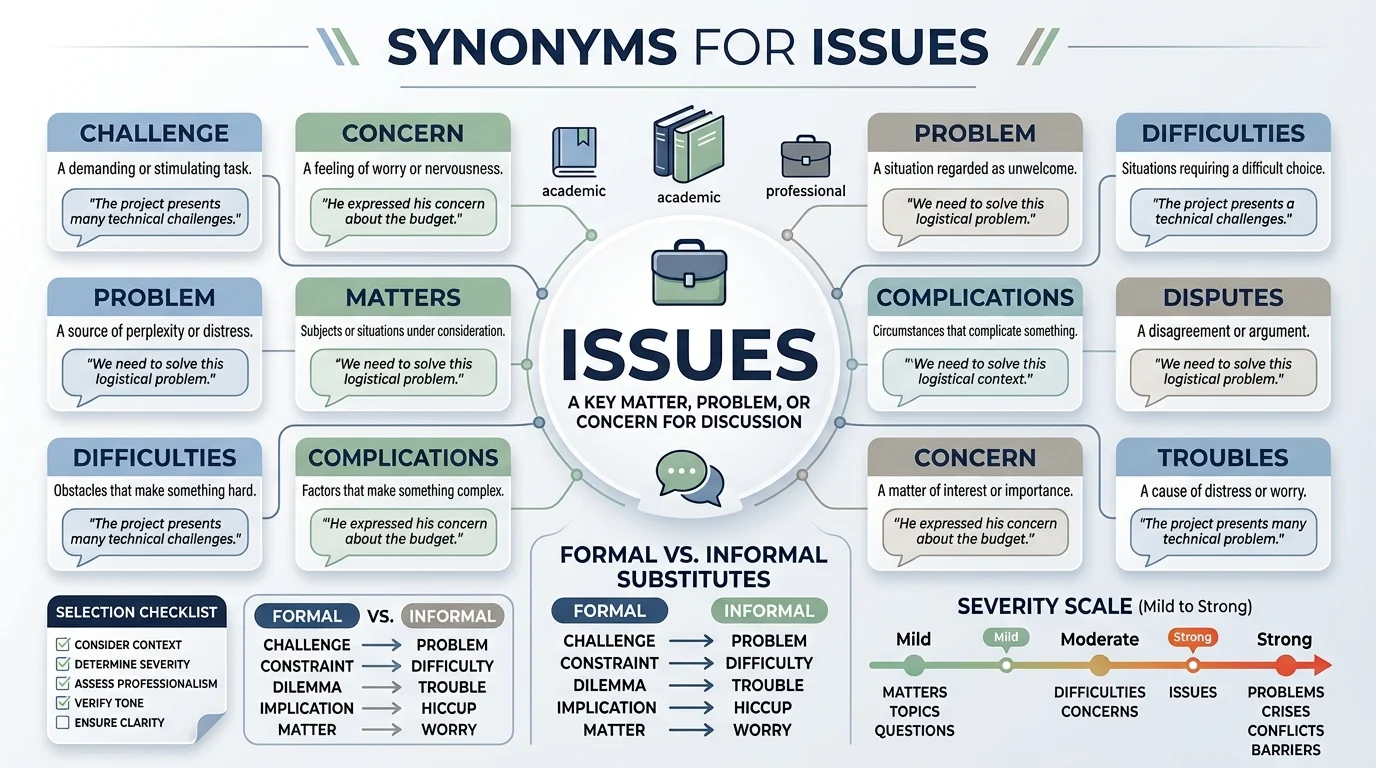
“Issues” means problems, challenges, or topics that require attention or resolution. The best synonyms depend on your context. For formal writing, use “challenges” or “concerns.” professional settings, choose “obstacles” or “complications.” casual conversation, “problems” or “glitches” work well. For emotional situations, “struggles” or “difficulties” are more appropriate.
Meaning, Tone and Context
- Simple definition: Issues are matters of concern, problems to solve, or subjects for discussion.
- Part of speech: Noun. Also used as a verb meaning to publish or distribute.
- Tone: Neutral to slightly negative depending on context.
- Formality level: Medium. Issues works in both professional and casual settings.
- Common use cases: Workplace communication, academic writing, news reporting, everyday conversation, and social media.
- Important word forms: Issue (noun), issued (verb), issuing (verb), issuer (noun).
When and How to Use “Issues”
Use “issues” when you need a general word for challenges or concerns. It works in almost any context. But be careful. In formal writing, “issues” can sound too vague. In casual conversation, it can sound too serious.
Professional example: “The team identified several issues with the new software update.”
Personal example: “We have some issues with the plumbing in the new house.”
Academic example: “The study addresses ethical issues in artificial intelligence research.”
Emotional example: “She has been dealing with personal issues for months.”
Creative example: “The character’s unresolved issues drive the entire plot.”
Social media caption: “Working through some issues, but we will get there.”
Email example: “I am writing to discuss the outstanding issues from our last meeting.”
Resume example: “Resolved technical issues that improved system performance by 20 percent.”
Another Word for “Issues”
The best single replacement for “issues” depends entirely on your context.
Professional writing: Use “concerns” when you need a diplomatic tone. Use “obstacles” when talking about project barriers.
Academic writing: Use “challenges” for research problems. Use “questions” for intellectual debates.
Casual conversation: Use “problems” for everyday situations. Use “glitches” for minor technical troubles.
Emotional writing: Use “struggles” for personal difficulties. Use “burdens” for heavy emotional weight.
Creative writing: Use “conflicts” for story tension. Use “dilemmas” for moral choices.
Resume use: Use “solutions” to show problem solving. Use “improvements” to highlight positive outcomes.
Social media captions: Use “hurdles” for a motivational tone. Use “hiccups” for minor setbacks.
Stronger meaning: Use “crises” for urgent situations. Use “catastrophes” for extreme problems.
Softer meaning: Use “matters” for neutral topics. Use “points” for discussion items.
When Not to Use “Issues”
“Issues” sounds too vague when you need specific language. It becomes weak in resumes and professional writing. It also feels too formal for very casual situations.
Weak sentence: “We had issues with the project timeline.”
Better sentence: “We encountered delays in the project timeline.”
Weak sentence: “The employee has attendance issues.”
Better sentence: “The employee has been late to work seven times this month.”
Weak sentence: “There are issues with my computer.”
Better sentence: “My computer keeps freezing during video calls.”
Words Commonly Confused With “Issues”
“Issues” vs. “Problems”: Problems are specific difficulties. Issues are broader matters of concern. Problems often have clear solutions. may require discussion or management.
“Issues” vs. “Challenges”: Challenges suggest opportunities for growth. Issues feel more neutral or negative. Challenges inspire action. require handling.
“Issues” vs. “Concerns”: Concerns are worries or interests. Issues are objective matters. Concerns are emotional. Issues are factual.
“Issues” vs. “Difficulties”: Difficulties imply struggle. can be simple or complex. Difficulties are harder to overcome. can be minor.
“Issues” vs. “Complications”: Complications make things more complex. Issues can be straightforward. Complications arise from existing problems.
“Issues” vs. “Quandaries”: Quandaries are puzzling situations. Issues can be clear problems. Quandaries involve confusion or choice.
Best Synonym by Context for “Issues”
| Context | Best Synonym | Why It Works | Example |
|---|---|---|---|
| Formal writing | Concerns | Sounds professional and diplomatic | The committee addressed concerns about the new policy |
| Academic writing | Challenges | Shows intellectual rigor | Researchers face significant challenges in clinical trials |
| Professional | Obstacles | Emphasizes barriers to success | We overcame major obstacles during the merger |
| Resume use | Improvements | Highlights positive outcomes | Implemented improvements that reduced costs by 15 percent |
| Casual conversation | Problems | Direct and easy to understand | We have some problems with the internet connection |
| Creative writing | Conflicts | Adds dramatic tension | The central conflicts drive the character development |
| Emotional tone | Struggles | Shows personal difficulty | Her struggles with anxiety were finally improving |
| Strong intensity | Crises | Indicates urgent situations | The company faced a financial crisis last quarter |
| Soft or moderate | Matters | Neutral and gentle | We need to discuss these matters privately |
| Social media | Hurdles | Motivational and positive | Every hurdle is a chance to grow stronger |
| US usage | Problems | Most common in American English | The project has some problems we need to fix |
Which Synonym Should You Choose?
Your choice depends on four factors: meaning, formality, emotional intensity, and audience.
Start by identifying the specific situation. Is this a workplace issue or a personal problem? Workplace situations often need professional language like “concerns” or “obstacles.” Personal situations allow more casual words like “problems” or “glitches.”
Consider your audience. Formal writing requires precise, measured language. Academic papers demand words like “challenges” or “questions.” Business emails work well with “concerns” or “complications.”
Think about emotional intensity. Are you describing a minor inconvenience or a major crisis? Use “hiccups” for small problems and “catastrophes” for serious situations. Match your language to the severity.
Finally, test your choice. Read the sentence with your new synonym. Does it sound natural? Does it convey the right tone? If something feels off, try another option.
Real Life Examples of “Issues” in Sentences
School example: “The students raised issues about the new grading system.” Better: “The students raised concerns about fairness in the new grading system.”
Workplace example: “We are having issues with the new software.” Better: “We are encountering technical complications with the new software.”
Writing example: “The article discusses issues in modern education.” Better: “The article examines systemic challenges in modern education.”
Conversation example: “I have some issues with the plan.” Better: “I have some reservations about the plan.”
Social media example: “Dealing with life issues right now.” Better: “Navigating life hurdles with patience and grace.”
Email example: “Please address the issues in the report.” Better: “Please address the inconsistencies in the report.”
Storytelling example: “The hero faced many issues on his journey.” Better: “The hero confronted countless obstacles on his journey.”
25 Synonyms for “Issues”
| Synonym | Simple Meaning | Best Used For | Example Sentence |
|---|---|---|---|
| Problems | General difficulties | Everyday situations | We solved the problems with the new system |
| Challenges | Difficulties that inspire growth | Professional and personal development | His challenges made him stronger |
| Concerns | Worries or interests needing attention | Diplomatic communication | The board raised concerns about the budget |
| Obstacles | Barriers blocking progress | Project management | We removed every obstacle in our path |
| Complications | Complex difficulties | Medical or technical writing | The surgery had unforeseen complications |
| Difficulties | Hard situations requiring effort | Academic and professional use | She overcame many difficulties in her career |
| Hurdles | Obstacles that can be overcome | Motivational speaking | Each hurdle teaches a valuable lesson |
| Glitches | Minor technical problems | Technology and casual talk | The app had some glitches after the update |
| Setbacks | Temporary delays or failures | Business and personal growth | The project faced several setbacks |
| Dilemmas | Difficult choices between options | Ethical and moral discussions | He faced a moral dilemma in the courtroom |
| Crises | Urgent and dangerous situations | Emergency or critical writing | The country addressed a public health crisis |
| Conflicts | Disagreements or struggles | Storytelling and relationships | Their conflicts created powerful drama |
| Quandaries | Confusing puzzling situations | Philosophical writing | The philosopher examined human quandaries |
| Obstructions | Physical or figurative blocks | Legal or technical writing | The obstruction prevented any progress |
| Burdens | Heavy responsibilities or weights | Emotional or descriptive writing | She carried emotional burdens for years |
| Inconveniences | Minor annoyances | Customer service | We apologize for the inconvenience caused |
| Disputes | Arguments or disagreements | Legal and diplomatic contexts | The dispute was settled out of court |
| Troubles | General difficulties | Casual conversation | His troubles began when he lost his job |
| Drawbacks | Negative aspects or disadvantages | Product reviews | The system has a few drawbacks |
| Faults | Defects or weaknesses | Technical and personal contexts | The design has several critical faults |
| Grievances | Complaints or resentments | Workplace and legal settings | The employee filed a formal grievance |
| Predicaments | Difficult or embarrassing situations | Storytelling and casual use | She found herself in an awkward predicament |
| Impediments | Things that slow progress | Formal and academic writing | Lack of funding is the main impediment |
| Flaws | Imperfections or weaknesses | Product and character analysis | The theory has a significant flaw |
| Mishaps | Small accidents or errors | Casual and storytelling | The wedding had a few minor mishaps |
Synonym Groups and Usage Differences
Professional vs. Personal Synonyms
Professional synonyms include “obstacles,” “complications,” and “impediments.” These sound serious and businesslike. Personal synonyms include “troubles,” “burdens,” and “glitches.” These feel more intimate and casual.
Formal vs. Conversational Synonyms
Formal words work in reports and academic papers. Use “impediments,” “obstructions,” and “complications.” Conversational words suit texts and friendly emails. Use “problems,” “glitches,” and “mishaps.”
Academic Synonyms
Academic writing needs precise language. Use “challenges” for research difficulties. “quandaries” for theoretical puzzles. Use “dilemmas” for ethical questions. These words show intellectual depth.
Professional and Business Synonyms
Business communication requires professional synonyms. Use “concerns” for diplomatic situations. Use “obstacles” for project barriers. “complications” for complex problems. These words maintain a professional tone.
Creative or Literary Synonyms
Creative writing benefits from vivid language. Use “conflicts” for story tension. Use “burdens” for emotional weight. “predicaments” for character dilemmas. These words add depth to your writing.
Strongest vs. Weaker Synonyms
Mild intensity: “glitches,” “inconveniences,” “mishaps.” These describe minor problems.
Medium intensity: “challenges,” “difficulties,” “hurdles.” These describe common obstacles.
Strongest intensity: “crises,” “catastrophes,” “emergencies.” These describe urgent severe situations.
Emotional vs. Neutral Synonyms
Emotional synonyms include “struggles,” “burdens,” and “troubles.” These words carry feelings and personal weight. Neutral synonyms include “matters,” “points,” and “items.” These stay factual and detached.
Antonyms of “Issues”
| Antonym | Meaning | Example Sentence |
|---|---|---|
| Solutions | Answers to problems | We found solutions for every challenge |
| Advantages | Positive benefits | The new system offers many advantages |
| Benefits | Helpful effects | Regular exercise has clear benefits |
| Improvements | Positive changes | We made improvements to the process |
| Strengths | Positive qualities | Her strengths include problem solving |
| Assets | Valuable resources | His technical skills are valuable assets |
| Resolutions | Settlements of problems | The dispute reached a peaceful resolution |
| Answers | Responses to questions | The research provided clear answers |
| Certainties | Things known for sure | We have certainties about the outcome |
| Clarifications | Explanations that remove confusion | The manager offered helpful clarifications |
| Breakthroughs | Sudden progress | The team made major breakthroughs |
| Remedies | Cures or fixes | Natural remedies helped her condition |
| Solutions | Fixes for problems | The software update provided solutions |
| Accomplishments | Achievements or successes | Her accomplishments impressed everyone |
| Resolutions | Firm decisions or solutions | New Year resolutions often fail |
Comparison: Issues vs. Similar Words
Issues vs. Problems
Main difference: Problems are specific difficulties. Issues are broader matters. Problems often have clear solutions. Issues may require discussion.
Which is stronger: Problems feel more direct and serious. Issues can feel mild and general.
Which is more formal: Both are moderately formal. Issues sounds slightly more professional.
Example with issues: “We need to address the issues in the report.” This sounds measured and professional.
Example with problems: “We need to fix the problems in the report.” This sounds direct and action oriented.
Issues vs. Challenges
Main difference: Challenges suggest opportunities for growth. Issues suggest difficulties to manage.
Which is stronger: Challenges can be inspiring. Issues feel neutral or negative.
Which is more formal: Both are formal enough for professional use. Challenges has a more positive tone.
Example with issues: “The project has budget issues.” This states a problem factually.
Example with challenges: “The project faces budget challenges.” This frames the problem as something to overcome.
Issues vs. Concerns
Main difference: Concerns are worries or interests. Issues are objective matters.
Which is stronger: Issues are concrete. Concerns are emotional.
Which is more formal: Both are formal. Concerns often sounds more diplomatic.
Example with issues: “The data shows several issues.” This is a factual statement.
Example with concerns: “The data raises several concerns.” This shows worry about the data.
Issues vs. Difficulties
Main difference: Difficulties imply active struggle. Issues can be passive or active.
Which is stronger: Difficulties feels more intense. Issues can be minor.
Which is more formal: Both are acceptable. Difficulties works well in academic writing.
Example with issues: “There are issues with the computer.” This is neutral.
Example with difficulties: “The computer presents difficulties for users.” This shows user struggle.
Issues vs. Complications
Main difference: Complications make situations more complex. Issues can be straightforward.
Which is stronger: Complications suggest more severity. Issues can be simple.
Which is more formal: Complications is more formal and precise.
Example with issues: “We found issues in the data.” This is general.
Example with complications: “We found complications in the data analysis.” This suggests complex problems.
Issues vs. Obstacles
Main difference: Obstacles block progress. Issues may not block anything.
Which is stronger: Obstacles are concrete barriers. Issues are vague.
Which is more formal: Obstacles is very professional. Issues is more general.
Example with issues: “The team faced issues.” This is vague.
Example with obstacles: “The team faced obstacles.” This shows clear barriers.
Common Phrases and Expressions with “Issues”
1. Have issues with something
Meaning: To dislike or have problems with something.
Example: “I have issues with the new policy at work.”
2. Take issue with something
Meaning: To disagree with or challenge something.
Example: “I take issue with your conclusion about the data.”
3. Issue a statement
Meaning: To officially release or publish a statement.
Example: “The company issued a statement about the incident.”
4. At issue
Meaning: The subject being discussed or disputed.
Example: “The main point at issue is the budget allocation.”
5. Make an issue of something
Meaning: To treat something as more important than it is.
Example: “Please do not make an issue of this minor mistake.”
6. Core issues
Meaning: The most important underlying problems.
Example: “We need to address the core issues in this debate.”
7. Side issues
Meaning: Less important topics or problems.
Example: “Let us focus on the main topic, not side issues.”
8. Issue resolution
Meaning: The process of solving problems.
Example: “The team focused on issue resolution all afternoon.”
Common Mistakes to Avoid
- Using “issues” when a specific synonym fits better. Instead of “communication issues,” try “communication barriers.” Be precise.
- Confusing “issues” with “problems” in formal writing. “Problems” sounds more direct. “Issues” sounds diplomatic. Choose based on your goal.
- Using casual synonyms in formal writing. Avoid “glitches” in business reports. Use “complications” or “obstacles” instead.
- Using overly dramatic synonyms for simple situations. Do not call a minor mistake a “crisis.” Save strong words for serious situations.
- Repeating “issues” multiple times in one paragraph. Vary your language. Use “challenges,” “obstacles,” and “concerns” to keep writing fresh.
- Choosing synonyms with the wrong emotional tone. “Struggles” implies personal difficulty. “Concerns” sounds professional. Match the tone to your message.
- Using slang in academic or professional writing. Avoid “hiccups” and “glitches” in formal contexts. Save these for casual conversation.
FAQs
What is the best synonym for issues?
The best synonym depends on context. Use “challenges” for professional situations and “problems” for everyday conversation.
What is a formal synonym for issues?
“Concerns,” “obstacles,” and “complications” are excellent formal synonyms. “Impediments” works well in very formal writing.
What is an informal synonym for issues?
“Glitches,” “hiccups,” and “problems” are good informal synonyms. “Troubles” also works in casual settings.
What is another word for issues in professional writing?
“Obstacles,” “challenges,” and “complications” work well professionally. “Concerns” is good for diplomatic situations.
What is the difference between issues and problems?
Issues are broader matters of concern. Problems are specific difficulties. Issues often require discussion. Problems need solutions.
What is the opposite of issues?
“Solutions,” “resolutions,” and “advantages” are opposites. “Benefits” and “strengths” also work as positive alternatives.
Conclusion
“Issues” is a useful word, but it should not dominate your vocabulary. Now you have dozens of alternatives. You know when to use “challenges” instead of “problems.” understand the difference between “concerns” and “complications.” You can choose the perfect word for any situation.
Remember to consider your audience and purpose. Professional settings need precise language. Academic writing requires formal synonyms. Casual conversation allows lighter words. Emotional situations need words that carry feeling.
Keep this guide handy. Review it when you notice yourself using “issues” repeatedly. Experiment with new synonyms. Your writing will become more clear, professional, and engaging. The right word makes all the difference.