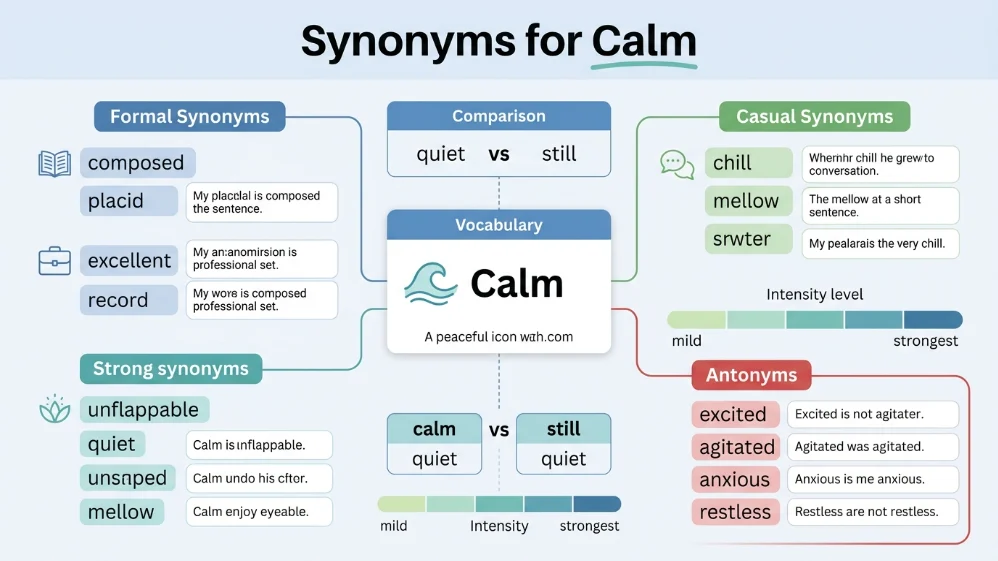
Do you find yourself using the word “calm” over and over again in your writing? Perhaps you are writing an email to a stressed colleague, describing a peaceful scene in a story, or crafting a professional response to a difficult situation.
Many people rely on this single word for everything from emotional states to weather descriptions. This guide will help you expand your vocabulary with powerful synonyms for calm that fit every context, tone, and situation.
What Does Calm Mean?
Calm means a state of peace, stillness, or freedom from agitation. The best synonyms for calm depend on your context. For formal writing, choose composed or serene.
Casual use, try chill or mellow. For emotional situations, use peaceful or tranquil. For professional settings, use poised or levelheaded.
Meaning, Tone and Context
- Simple definition
Calm describes a lack of strong emotion, disturbance, or excitement. It refers to a quiet state of mind, weather, or environment. - Part of speech
Calm functions as an adjective, noun, and verb. As an adjective, it describes a person, place, or situation. As a noun, it refers to the state itself. As a verb, it means to make someone or something calm. - Positive, negative, or neutral tone
Calm has a positive tone overall. It suggests control, peace, and stability. However, in some contexts, it can imply a lack of energy or excitement. - Formality level
Calm works in both formal and informal settings. It is neutral enough for any situation. - Common use cases
People use calm for emotions, weather, oceans, personalities, responses to stress, and workplace interactions. - Important word forms
The noun form is calmness. The adverb is calmly. The verb forms include calmed and calming. The opposite is agitated or anxious.
When and How to Use “Calm”
Use calm when you want to describe a lack of disturbance. It works best for general situations where peace or stillness is the main idea. For stronger emotional control, consider alternatives like composed or unruffled. Peaceful environments, choose serene or tranquil. For weather, use still or placid.
Here are examples of calm in different contexts:
Professional context
The manager remained calm during the crisis and guided the team through every challenge.
Personal context
She took a deep breath to stay calm before her job interview.
Academic context
The study measured how calm participants felt after the meditation session.
Emotional context
His calm voice reassured everyone in the room during the difficult conversation.
Creative context
The lake was so calm that it perfectly mirrored the mountains above.
Social media context
This playlist keeps me calm and focused while I work from home.
Email context
I appreciate your calm approach to resolving this issue with the client.
Another Word for “Calm”
The best single replacement for calm depends entirely on what you want to express. Here are direct suggestions for various situations:
Professional writing
Use composed. It shows control and dignity in workplace situations.
Academic writing
Use placid. It describes a stable, undisturbed state in research contexts.
Casual conversation
Use chill. It works perfectly for everyday talk among friends.
Emotional writing
Use peaceful. It captures deep inner quiet and emotional safety.
Creative writing
Use serene. It adds beautiful imagery to descriptive passages.
Resume or workplace use
Use levelheaded. It highlights decision making skills under pressure.
Social media captions
Use mellow. It feels modern and relatable for lifestyle content.
Stronger meaning
Use unflappable. It describes someone who never loses composure.
Softer meaning
Use gentle. It suggests mildness without the weight of full calmness.
When Not to Use “Calm”
Calm sounds too vague when you need to describe specific types of peace or control. It also feels too weak for situations requiring strength or intense focus.
Consider this vague example: “The leader was calm during the emergency.” This tells us little about how the leader actually behaved.
A better choice: “The leader remained unflappable during the emergency and directed every rescue effort with precision.”
Calm also sounds too casual for formal academic writing that demands precise language.
Avoid calm in weather reports when describing dangerous stillness before a storm. Use ominous or unsettling instead.
Words Commonly Confused With “Calm”
Quiet
Quiet means low noise or silence. Calm means peace or lack of agitation. Use quiet for sound levels. Use calm for emotional or environmental states.
Still
Still means absence of movement. Calm includes movement but with peace. Use still for objects or water. Use calm for people or emotions.
Peaceful
Peaceful implies harmony and absence of conflict. Calm describes emotional regulation. Use peaceful for environments. Use calm for personal states.
Serene
Serene suggests a higher level of beauty and clarity. Calm is more general. Use serene for breathtaking peace. Use calm for everyday situations.
Composed
Composed focuses on self control. Calm focuses on the absence of disturbance. Use composed for people in control. Use calm for both people and situations.
Placid
Placid describes a naturally peaceful disposition. Calm can be temporary. Use placid for easygoing personalities. Use calm for temporary states.
Best Synonym by Context for “Calm”
| Context | Best Synonym | Why It Works | Example |
|---|---|---|---|
| Formal writing | Composed | Shows dignity and control | The witness remained composed throughout the testimony. |
| Academic writing | Placid | Describes stable conditions | The placid environment supported accurate experimental results. |
| Professional business | Levelheaded | Highlights smart decision making | Her levelheaded response prevented a client dispute. |
| Resume use | Unflappable | Demonstrates crisis management ability | Unflappable project manager who delivered results under tight deadlines. |
| Casual conversation | Chill | Feels natural and relatable | He is so chill about everything that happens. |
| Creative writing | Serene | Adds beautiful imagery | The serene meadow stretched endlessly toward the horizon. |
| Emotional tone | Peaceful | Captures inner harmony | She felt peaceful for the first time in months. |
| Strong intensity | Unruffled | Shows resilience under pressure | He remained unruffled even when the system crashed. |
| Soft moderate tone | Gentle | Suggests mildness without intensity | Her gentle approach calmed the frightened child. |
| Social media captions | Mellow | Modern and lifestyle friendly | Mellow vibes and good coffee make this morning perfect. |
Which Synonym Should You Choose?
Choose based on what you want to emphasize. For emotional control, select composed or unflappable. For peaceful settings, pick serene or tranquil. Casual situations, use chill or mellow. For professional communication, choose levelheaded or poised.
Consider the formality level of your writing. Academic papers demand precise words like placid. Social media posts welcome modern terms like chill. Business emails need professional words like composed.
Pay attention to the intensity you need. Strong situations require unruffled or unflappable. Simple descriptions work best with peaceful or still. Match your word to the emotional weight of your sentence.
Check your audience. A child understands gentle better than serene. A poetry reader appreciates tranquil more than calm. Tailor your choice to who will read your words.
Real Life Examples of “Calm” in Sentences
School context
The teacher stayed calm while the students worked on their challenging exam.
Workplace context
She delivered the bad news in a calm manner that kept morale high.
Writing context
The author described the calm ocean with vivid and beautiful detail.
Conversation context
Just stay calm and we will figure out this problem together.
Social media context
Here is my calm morning routine for better productivity.
Resume context
Demonstrated calm leadership during the company merger process.
Email context
Please remain calm as we work through these technical difficulties.
Storytelling context
The calm before the storm made everyone feel uneasy and alert.
25 Synonyms for “Calm”
| Synonym | Simple Meaning | Best Used For | Example Sentence |
|---|---|---|---|
| Composed | In full control of emotions | Professional situations | She remained composed during the difficult board meeting. |
| Serene | Beautifully peaceful and clear | Creative writing and descriptions | The serene garden offered a perfect escape from city noise. |
| Placid | Naturally easygoing and unbothered | Describing personalities | His placid nature made him an excellent mediator. |
| Tranquil | Deeply quiet and undisturbed | Emotional or environmental peace | The tranquil lake reflected the golden sunset. |
| Unruffled | Not disturbed despite stress | Crisis and pressure situations | He stayed unruffled when the presentation failed. |
| Levelheaded | Practical and sensible under pressure | Business and workplace contexts | Her levelheaded advice saved the project from failure. |
| Peaceful | Free from conflict or disturbance | General emotional states | The peaceful atmosphere helped everyone relax. |
| Mellow | Relaxed and free from intensity | Casual and social settings | We enjoyed a mellow evening with good friends. |
| Still | Completely without movement | Describing water or air | The still morning air carried no sound at all. |
| Gentle | Mild and soft in manner | Personal interactions | His gentle voice reassured the anxious patient. |
| Unflappable | Never losing composure | High pressure jobs | The unflappable pilot landed the plane safely. |
| Poised | Gracefully composed and ready | Public speaking and presentations | She stood poised and confident at the podium. |
| Collected | Mentally together and organized | Professional and personal control | He remained collected despite the unexpected news. |
| Sedate | Calm in a quiet dignified way | Formal and traditional settings | The sedate ceremony proceeded without any issues. |
| Restful | Providing peace and relaxation | Describing environments or activities | The restful vacation renewed her energy completely. |
Synonym Groups and Usage Differences
Professional vs. Personal Synonyms
Professional synonyms like composed, levelheaded, and poised show control and competence. They work best in emails, meetings, and client interactions. Personal synonyms like mellow, chill, and peaceful fit conversations with friends and family. They feel warmer and more relatable.
Formal vs. Conversational Synonyms
Formal synonyms include sedate, composed, and placid. They belong in reports, academic essays, and professional speeches. Conversational synonyms like chill, mellow, and easygoing appear in texts, social media, and daily talk. Avoid formal words in casual contexts and casual words in formal writing.
Academic Synonyms
Academic writing prefers placid, stable, and undisturbed. These words sound precise and objective. Researchers use them to describe experimental conditions, participant states, and environmental factors. They avoid emotional weight and stay factual.
Professional and Business Synonyms
Business communication values levelheaded, unflappable, and composed. These words demonstrate emotional intelligence and leadership potential. They work well in resumes, performance reviews, and client correspondence. They show you can handle pressure.
Creative or Literary Synonyms
Creative writing benefits from serene, tranquil, and peaceful. These words add imagery and emotional depth. They paint vivid pictures for readers. Poets and novelists use them to create atmosphere and mood.
Strongest vs. Weaker Synonyms
Here is an intensity scale from mild to strongest:
Mild: gentle, mellow
Moderate: peaceful, still
Strong: composed, serene
Stronger: unruffled, tranquil
Strongest: unflappable, imperturbable
Choose based on how much emotional control or peace you want to emphasize.
Emotional vs. Neutral Synonyms
Emotional synonyms like peaceful, serene, and tranquil carry positive feelings. They describe inner states and emotional experiences. Neutral synonyms like composed and levelheaded focus on behavior and control. They describe observable actions without emotional weight.
Antonyms of “Calm”
| Antonym | Meaning | Example Sentence |
|---|---|---|
| Anxious | Filled with worry and fear | She felt anxious before her important presentation. |
| Agitated | Disturbed and upset | The agitated crowd demanded immediate answers. |
| Turbulent | Chaotic and unstable | The turbulent weather delayed all flights. |
| Stormy | Wild and uncontrolled | Their stormy argument lasted for hours. |
| Nervous | Easily frightened or worried | He became nervous whenever he spoke in public. |
| Restless | Unable to relax or settle | The restless child could not sit still. |
| Frenzied | Wildly excited or uncontrolled | The frenzied shoppers rushed into the store. |
| Panicked | Overcome with sudden fear | The panicked passengers evacuated the building. |
| Volatile | Likely to change rapidly and unpredictably | The volatile stock market worried investors. |
| Tense | Stretched tight with stress | The tense atmosphere made everyone uncomfortable. |
| Chaotic | In complete disorder | The chaotic scene required immediate intervention. |
| Distressed | Suffering from anxiety or pain | The distressed mother searched for her child. |
| Upset | Unhappy or disappointed | He felt upset about the canceled vacation. |
| Frazzled | Exhausted and nervous | The frazzled employee needed a break. |
| Unsettled | Not calm or stable | The unsettled weather made planning difficult. |
Comparison: Calm vs. Similar Words
Calm vs. Quiet
The main difference is focus. Calm describes emotional or environmental peace. Quiet describes low sound levels. Quiet is stronger for noise reduction. Calm is more formal in most contexts. Quiet example: The library was quiet enough to study. Calm example: She stayed calm during the emergency.
Calm vs. Still
Still means completely without motion. Calm can include gentle movement. Still is stronger for describing lack of motion. Calm is more formal for emotional states. Still example: The water was still as glass. Calm example: His calm demeanor reassured everyone.
Calm vs. Peaceful
Peaceful suggests harmony and freedom from conflict. Calm focuses on absence of disturbance. Peaceful is stronger for positive environments. Calm is more formal for describing control. Peaceful example: The peaceful village had no crime. Calm example: She gave a calm response to the criticism.
Calm vs. Serene
Serene implies beautiful, elevated peace. Calm is more ordinary and general. Serene is stronger for visual descriptions. Calm is more formal for emotional regulation. Serene example: The serene mountain view took her breath away. Calm example: He remained calm throughout the interview.
Calm vs. Composed
Composed emphasizes self control and dignity. Calm emphasizes lack of agitation. Composed is stronger for professional poise. Calm is more formal for general use. Composed example: The composed speaker handled every question perfectly. Calm example: Please stay calm while we resolve this issue.
Calm vs. Placid
Placid describes a naturally peaceful temperament. Calm can be a temporary state. Placid is stronger for describing personalities. Calm is more formal for situational use. Placid example: The placid horse never spooked at anything. Calm example: The calm sea made sailing enjoyable.
Common Phrases and Expressions with “Calm”
1. Calm before the storm
Meaning: A quiet period before something bad happens.
Example sentence: The office was quiet, but everyone knew it was the calm before the storm.
2. Keep calm and carry on
Meaning: Stay composed and continue with your work.
Example sentence: Even when deadlines approach, keep calm and carry on with your tasks.
3. Calm down
Meaning: Relax or become less angry or excited.
Example sentence: Please calm down and tell me what happened.
4. Calm and collected
Meaning: Composed and in control of emotions.
Example sentence: She walked into the exam room calm and collected.
5. Stay calm
Meaning: Remain composed during a difficult situation.
Example sentence: The lifeguard told everyone to stay calm and swim to shore.
6. Calm waters
Meaning: A peaceful and untroubled situation.
Example sentence: After months of conflict, the team finally enjoyed calm waters.
7. Calm demeanor
Meaning: A consistently composed and peaceful outward appearance.
Example sentence: His calm demeanor made him an excellent crisis manager.
Common Mistakes to Avoid
- Using calm when a more precise synonym is better
Instead of saying “the calm lake,” try “the still lake” or “the placid lake” for more accuracy. - Confusing calm with quiet
Calm describes emotional or environmental peace. Quiet describes low noise levels. Use quiet for sound and calm for emotions. - Using a casual synonym in formal writing
Avoid “chill” in business reports. Use “composed” or “levelheaded” instead for professional contexts. - Using an overly dramatic synonym for a simple situation
Do not use “unflappable” for someone who simply waited patiently. Save strong words for genuine challenges. - Repeating the same word too often
Rotate between calm, peaceful, serene, and composed to keep your writing interesting and varied. - Choosing a synonym with the wrong emotional tone
Do not use “placid” to describe someone who is actively controlling their emotions. Use “composed” instead. - Using slang in academic or professional writing
Avoid “mellow” and “chill” in formal papers. These words belong in casual conversation and social media.
FAQs
What is the best synonym for calm?
The best synonym depends on context. Use composed for professional settings, serene for creative writing, and mellow for casual conversation.
What is a formal synonym for calm?
Composed and placid are excellent formal synonyms for calm. They work well in academic papers, business reports, and professional communication.
What is an informal synonym for calm?
Chill and mellow are the most common informal synonyms for calm. They fit casual conversations, texts, and social media posts perfectly.
What is another word for calm in professional writing?
Levelheaded and unflappable are strong professional alternatives. They demonstrate emotional intelligence and decision making ability under pressure.
What is the difference between calm and serene?
Calm is general and ordinary. Serene suggests beautiful, elevated peace. Serene is stronger for visual descriptions and emotional depth.
What is the opposite of calm?
The opposite of calm includes anxious, agitated, turbulent, and nervous. These words describe disturbance, worry, and lack of peace.
Conclusion
Calm is a versatile word that describes peace, stillness, and emotional control. The best synonym depends entirely on your context, audience, and desired tone. For professional writing, choose composed or levelheaded. For creative work, select serene or tranquil. Casual talk, use mellow or chill. Match your word to your situation and your readers will understand your meaning clearly. Expanding your vocabulary with these synonyms will make your writing more precise, engaging, and effective. Always consider the emotional weight, formality level, and intensity you need before selecting the perfect word.
1 thought on “50+ Synonyms for Calm | Meanings, Examples and Best Alternatives”