Do you find yourself using the word “caring” over and over again in your writing, emails, or conversations? You are not alone. Many people rely on this single word to express kindness, attention, and concern.
But English offers a rich vocabulary of alternatives that can make your communication more precise and engaging. Whether you are writing a resume, crafting a heartfelt message, or describing someone’s personality, choosing the right synonym matters.
This guide will help you master over 50 synonyms for caring. You will learn the subtle differences between each word. discover which words work best in professional settings versus casual conversations. You will also avoid common mistakes that even advanced speakers make.
Let us explore the world of caring synonyms together.
What Does “Caring” Mean?
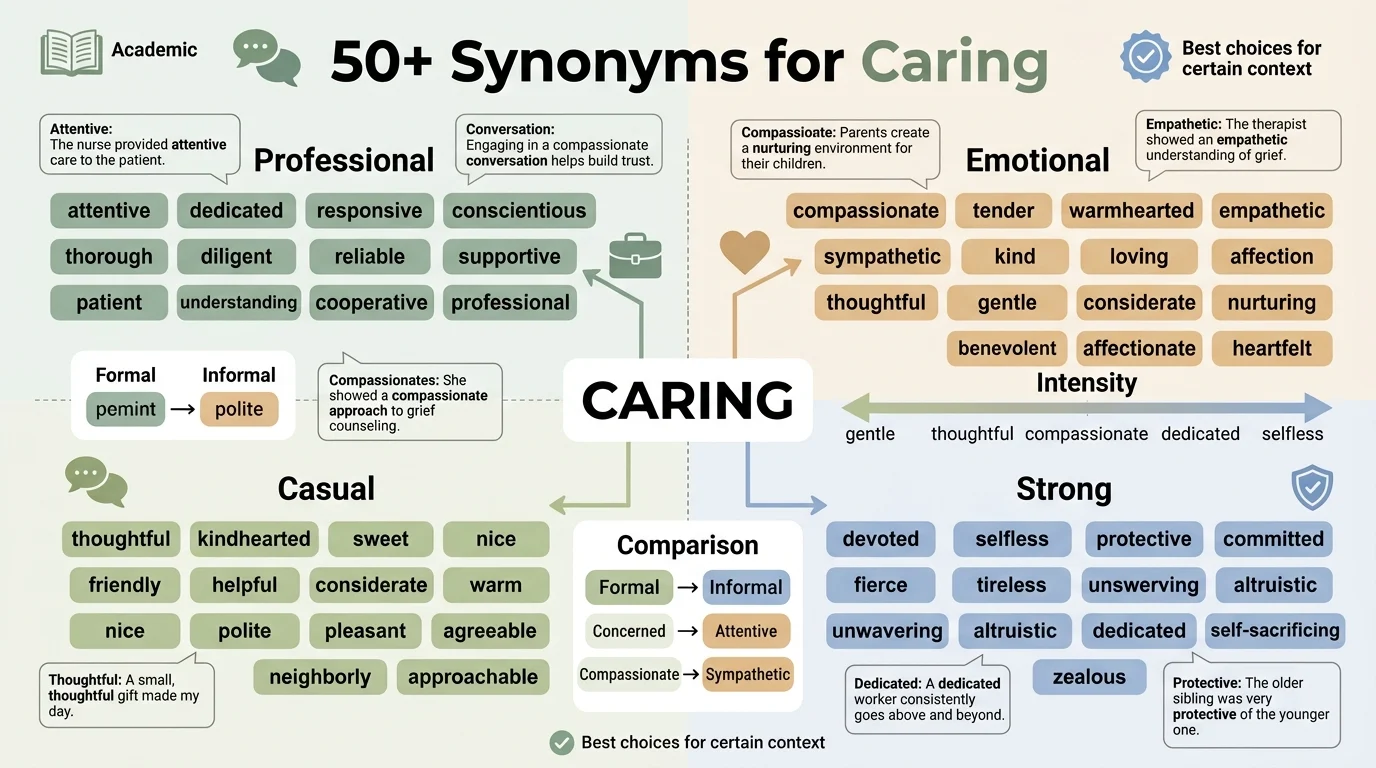
Caring describes a thoughtful, attentive, and compassionate concern for others. The best synonyms depend on your context. For professional writing, use “attentive” or “conscientious.” emotional or personal writing, use “compassionate” or “tender.” For casual conversation, use “thoughtful” or “kind.” Choose the word that matches your tone and situation.
Meaning, Tone and Context
Caring is a versatile word that carries a warm, positive meaning. It describes people who show kindness and concern for others.
Simple Definition
Caring means showing concern, kindness, and attention toward others. It involves being aware of other people’s needs and feelings.
Part of Speech
Caring is primarily used as an adjective. It can also function as a noun when referring to the act of caring.
Tone
The tone of caring is positive and warm. It never carries negative connotations unless used sarcastically.
Formality Level
Caring is neutral in formality. It works well in both casual and professional contexts. However, some synonyms work better in specific settings.
Common Use Cases
You might use caring to describe a person’s personality. You could use it to describe someone’s actions or behavior. It often appears in personal letters, performance reviews, and character descriptions.
Important Word Forms
The verb form is “care.” The noun form is “care.” The adjective form is “caring.” The opposite is “uncaring.” Related forms include “carefully” and “carefulness.”
When and How to Use “Caring”
Use caring when you want to describe genuine concern for someone’s wellbeing. It works best when the concern is sincere and noticeable. Avoid using caring when you need a more specific or stronger word.
Here are realistic examples showing how to use caring in different situations.
Professional Context
Our manager creates a caring environment where every team member feels supported and valued.
Personal Context
My grandmother was the most caring person I have ever known. She always remembered everyone’s birthdays and favorite foods.
Academic Context
The study examined how caring teaching practices affect student engagement and academic performance.
Emotional Context
His caring words during that difficult time meant more to me than anything else.
Creative Writing Context
The caring nurse stayed past her shift to ensure the frightened child felt safe and comfortable.
Social Media Caption
Grateful for all the caring friends who showed up when I needed them most. You know who you are.
Email Context
Thank you for your caring response to my concerns. I truly appreciate your understanding and support.
Resume Context
Recognized for creating a caring workplace culture that improved employee retention by 25 percent.
Another Word for “Caring”
The best single replacement for caring depends entirely on your context. Here are the most effective alternatives for different situations.
Professional Writing
Use “attentive” when you want to sound polished and workplace appropriate. It suggests careful focus on details and people.
Academic Writing
Use “compassionate” for research papers or scholarly work. It carries a formal, precise tone suitable for academic audiences.
Casual Conversation
Use “thoughtful” for everyday speech. It feels natural and accessible without being too formal.
Emotional Writing
Use “tender” when describing deep emotional care. It adds warmth and vulnerability to your message.
Creative Writing
Use “devoted” for storytelling. It suggests unwavering commitment and loyalty.
Resume or Workplace Use
Use “dedicated” to show professional commitment. It demonstrates reliability and strong work ethic.
Social Media Captions
Use “kindhearted” for engaging, friendly social media content. It feels warm and approachable.
Stronger Meaning
Use “compassionate” when you need a word with more emotional weight. It implies deep understanding and active concern.
Softer Meaning
Use “gentle” when you want to express care without intensity. It suggests a mild, tender approach.
When Not to Use “Caring”
Caring sometimes sounds too vague or general. It lacks the precision needed in certain situations.
When Describing Professional Expertise
Caring does not convey skill or competence. A doctor can be caring, but you also need to describe their medical expertise.
Weak Example
Our caring accountant managed our finances.
Improved Example
Our meticulous accountant managed our finances with precision and care.
When Describing Strict Standards
Caring sounds too soft when you need to describe high standards or rigorous attention.
Weak Example
The caring inspector checked every detail.
Improved Example
The thorough inspector checked every detail with great diligence.
When Describing Urgent Situations
Caring feels too gentle for emergency contexts. You need words that convey immediate action.
Weak Example
The caring firefighters rescued the family.
Improved Example
The heroic firefighters rescued the family from the burning building.
When Describing Tough Love
Caring does not capture situations where care requires discipline or firmness.
Weak Example
My caring coach pushed me to work harder.
Improved Example
My demanding coach pushed me to work harder because he believed in my potential.
When You Need Stronger Emotional Impact
Caring sometimes feels too mild for deeply emotional situations.
Weak Example
Her caring words helped me recover.
Improved Example
Her compassionate words helped me recover from my deepest grief.
Words Commonly Confused With “Caring”
Several words overlap with caring but carry distinct meanings. Understanding these differences will improve your word choice.
Caring vs. Kind
Kind describes a pleasant, helpful nature. It is broader than caring and does not necessarily imply emotional investment.
Caring vs. Compassionate
Compassionate involves deep sympathy and active desire to help. It is stronger and more emotional than caring.
Caring vs. Thoughtful
Thoughtful emphasizes consideration and mindfulness of others’ needs. It is more deliberate than caring.
Caring vs. Attentive
Attentive focuses on careful observation and responsiveness. It is more action oriented than caring.
Caring vs. Considerate
Considerate involves thinking about how your actions affect others. It is more about behavior than feeling.
Caring vs. Loving
Loving implies stronger affection and emotional attachment. It is deeper and more intimate than caring.
Best Synonym by Context for “Caring”
| Context | Best Synonym | Why It Works | Example |
|---|---|---|---|
| Formal Writing | Compassionate | It maintains professionalism while showing emotional intelligence | The committee recognized her compassionate leadership style |
| Academic Writing | Benevolent | It sounds scholarly and precise for research contexts | The study explored benevolent behaviors in educational settings |
| Professional Business | Attentive | It suggests focus, detail orientation, and employee focus | Our attentive customer service team resolved every issue quickly |
| Resume Writing | Dedicated | It demonstrates commitment and reliability to employers | Dedicated professional with ten years of healthcare experience |
| Casual Conversation | Thoughtful | It feels natural and accessible for everyday speech | My thoughtful neighbor brought me soup when I was sick |
| Creative Writing | Devoted | It adds emotional depth and narrative richness | The devoted mother sacrificed everything for her children |
| Emotional Tone | Tender | It conveys vulnerability and deep emotional care | His tender words healed wounds I thought would never close |
| Strong Intensity | Compassionate | It shows powerful empathy and active concern | The compassionate volunteer spent every weekend at the shelter |
| Soft Moderate Tone | Gentle | It expresses care without overwhelming intensity | Her gentle approach made the frightened child feel safe |
| Social Media Captions | Kindhearted | It feels warm, engaging, and shareable online | Kindhearted people make the world a better place every day |
| US Usage | Caring | Standard American English usage across all contexts | The caring teacher stayed after school to help struggling students |
| UK Usage | Considerate | More commonly used in British English for similar meaning | He was a considerate host who ensured everyone felt welcome |
Which Synonym Should You Choose?
Selecting the right synonym requires thinking about your purpose, audience, and tone.
Consider Your Meaning
Ask yourself what aspect of caring you want to emphasize. Are you describing emotional concern, thoughtful actions, or professional attention? Choose a word that matches your specific meaning.
Consider Formality
Match your word to your setting. Use formal synonyms like “compassionate” in professional documents. Use casual words like “thoughtful” in personal messages.
Consider Emotional Intensity
Think about how strong your message needs to be. Use intense words like “devoted” for deep emotional content. Use milder words like “gentle” for lighter situations.
Consider Professional Impact
For workplace writing, choose words that sound competent and reliable. “Attentive” and “dedicated” create better professional impressions than “nice” or “kind.”
Consider Sentence Flow
Read your sentence aloud with different synonyms. The best word will sound natural and fit smoothly into your sentence structure.
Real Life Examples of “Caring” in Sentences
These examples show how caring and its synonyms appear in everyday situations. Each example uses a different context to help you choose the right word.
School Context
The caring teacher noticed that Maria seemed distracted and quietly asked if everything was okay after class.
Workplace Context
Our attentive supervisor remembers every employee’s birthday and work anniversary, making everyone feel valued.
Writing Context
Her compassionate essay about mental health awareness moved the entire audience to tears.
Conversation Context
My thoughtful friend called just to check on me during a difficult week.
Social Media Context
Celebrating the dedicated nurses who work tirelessly to keep our community healthy and safe.
Resume Context
Compassionate social worker with five years of experience supporting at risk youth and their families.
Email Context
Thank you for your considerate response to my concerns about the project timeline.
Storytelling Context
The devoted lighthouse keeper braved the storm every night to guide ships safely to shore.
25 Synonyms for “Caring”
| Synonym | Simple Meaning | Best Used For | Example Sentence |
|---|---|---|---|
| Compassionate | Deep sympathy and active desire to help | Emotional writing and personal situations | The compassionate doctor held the patient’s hand during the difficult diagnosis |
| Attentive | Careful focus on details and people | Professional and workplace contexts | The attentive waiter noticed we needed more water before we even asked |
| Thoughtful | Considerate and mindful of others’ needs | Casual conversation and personal messages | My thoughtful coworker brought coffee for everyone on Monday morning |
| Considerate | Thinking about how actions affect others | Social situations and everyday use | The considerate neighbor always kept her music low late at night |
| Devoted | Deep commitment and loyalty | Creative writing and relationship contexts | The devoted father attended every single one of his daughter’s soccer games |
| Tender | Gentle and emotionally warm | Romantic and deeply personal situations | Her tender touch comforted the crying child immediately |
| Kindhearted | Naturally good and warm natured | Social media and friendly descriptions | The kindhearted volunteer spent every Saturday at the animal shelter |
| Dedicated | Committed and hardworking | Resume and professional achievements | Dedicated teacher who transformed struggling students into confident learners |
| Benevolent | Charitable and well meaning | Formal and academic writing | The benevolent organization provided food and shelter for thousands |
| Sympathetic | Understanding and sharing feelings | Personal support and emotional situations | My sympathetic boss gave me time off when my grandmother passed away |
| Warmhearted | Affectionate and emotionally open | Personal descriptions and friendly contexts | The warmhearted host made every guest feel like family |
| Nurturing | Supporting growth and development | Parenting and development contexts | Her nurturing approach helped the shy child develop confidence |
| Protective | Looking after and defending others | Safety and guardian situations | The protective mother bear kept her cubs close in the forest |
| Responsive | Quick to respond and help | Professional service and support contexts | The responsive customer service team solved my issue in minutes |
| Empathetic | Understanding and sharing feelings deeply | Psychological and emotional contexts | The empathetic counselor created a safe space for trauma survivors |
| Supportive | Providing help and encouragement | Teamwork and relationship contexts | My supportive partner encouraged me to pursue my dreams |
| Watchful | Vigilant and alert to needs | Protective or supervisory contexts | The watchful lifeguard noticed the struggling swimmer immediately |
| Tenderhearted | Easily moved to sympathy and care | Emotional and literary contexts | The tenderhearted girl cried when she saw the abandoned puppy |
| Humanitarian | Concerned with human welfare | Global and social justice contexts | The humanitarian worker traveled to disaster zones to provide aid |
| Charitable | Generous in giving help | Community and philanthropic contexts | The charitable foundation funded schools in developing countries |
| Loving | Deep affection and care | Romantic and family contexts | The loving grandmother baked cookies for her grandchildren every Sunday |
| Patient | Tolerant and understanding | Challenging or difficult situations | The patient tutor explained the concept until her student understood completely |
| Selfless | Putting others before yourself | Heroic and sacrificial contexts | The selfless rescuer ran into the burning building to save the trapped family |
| Altruistic | Unselfish concern for others | Academic and philosophical contexts | The altruistic donation saved thousands of lives in the affected region |
Synonym Groups and Usage Differences
Professional vs. Personal Synonyms
Professional synonyms focus on action and competence. They show care through effective behavior. Attentive, responsive, and dedicated work well in workplace settings.
Personal synonyms focus on emotion and connection. They show care through feeling and relationship. Compassionate, warmhearted, and thoughtful suit personal situations.
Formal vs. Conversational Synonyms
Formal synonyms appear in academic writing, reports, and professional documents. Benevolent, altruistic, and compassionate sound polished and precise.
Conversational synonyms appear in everyday speech and casual writing. Kindhearted, thoughtful, and warmhearted feel natural and approachable.
Academic Synonyms
Academic writing requires precise, formal language. Benevolent describes institutional or structural kindness. Altruistic describes selfless concern from a philosophical perspective. Compassionate provides emotional precision in social science writing.
Professional and Business Synonyms
Professional contexts value competence and reliability. Attentive shows careful focus on customers or employees. Dedicated demonstrates commitment to work. Responsive shows quick, effective action.
Creative or Literary Synonyms
Creative writing benefits from vivid, emotionally rich words. Devoted suggests unwavering loyalty. Tender describes gentle, vulnerable care. Warmhearted creates visual warmth and emotional connection.
Slang or Modern Synonyms
Slang synonyms for caring are rare and often informal. “Sweet” appears in casual conversation among friends. “Good vibes” describes positive, caring energy in modern speech. These words are acceptable in social media and casual contexts.
Strongest vs. Weaker Synonyms
Intensity scale from mildest to strongest:
Gentle (soft) to Thoughtful (considerate) to Attentive (careful) to Kindhearted (warm) to Devoted (committed) to Compassionate (deep feeling) to Protective (defensive) to Selfless (sacrificial)
Emotional vs. Neutral Synonyms
Emotional synonyms add feeling and warmth. Compassionate, tender, and loving express deep emotion. They work best in personal or creative writing.
Neutral synonyms stay factual and professional. Attentive, responsive, and dedicated focus on action. They work best in business and academic contexts.
Antonyms of “Caring”
| Antonym | Meaning | Example Sentence |
|---|---|---|
| Uncaring | Lacking concern for others | The uncaring landlord ignored all requests for basic repairs |
| Callous | Emotionally hardened and insensitive | His callous remarks deeply hurt the grieving family |
| Indifferent | Showing no interest or concern | The indifferent manager never noticed her employees’ struggles |
| Neglectful | Failing to provide proper care | The neglectful pet owner forgot to feed his dog for two days |
| Cold | Lacking warmth or emotion | Her cold response made him feel completely unwelcome |
| Heartless | Cruel and lacking compassion | The heartless corporation fired workers without warning |
| Cruel | Causing pain or suffering | His cruel words destroyed her confidence completely |
| Thoughtless | Not considering others’ feelings | His thoughtless joke offended everyone in the room |
| Hardhearted | Unfeeling and unsympathetic | The hardhearted official refused to grant the family’s request |
| Apathetic | Showing no emotion or interest | The apathetic students ignored the teacher’s passionate lesson |
| Detached | Emotionally disconnected | The detached doctor gave the news without any sympathy |
| Unfeeling | Lacking sensitivity or emotion | His unfeeling response shocked everyone in the room |
| Distant | Emotionally remote and cold | Her distant manner made it difficult to build any connection |
| Unsympathetic | Not understanding others’ feelings | The unsympathetic boss demanded she return to work immediately |
Comparison: Caring vs. Similar Words
Caring vs. Kind
The main difference is emotional investment. Caring implies deeper concern and attention. Kind describes pleasant, helpful behavior without necessarily requiring emotional depth.
Caring is stronger in emotional meaning. Kind is more general and casual.
Caring is neutral in formality. Kind is slightly more casual.
Caring example: The caring nurse stayed with the patient all night.
Kind example: The kind neighbor waved hello every morning.
Caring vs. Compassionate
Compassionate involves active sympathy and desire to relieve suffering. It is more intense than caring and suggests deeper understanding.
Compassionate is significantly stronger in emotional intensity. Caring is milder.
Compassionate is slightly more formal. Caring is neutral.
Compassionate example: The compassionate doctor volunteered in disaster zones.
Caring example: The caring teacher helped struggling students after school.
Caring vs. Thoughtful
Thoughtful emphasizes deliberate consideration of others’ needs. It focuses on actions and planning rather than general emotional warmth.
Thoughtful and caring are similar in strength.
Thoughtful and caring are both neutral in formality.
Example: My thoughtful friend brought my favorite coffee.
Caring example: My caring friend always asks how I am doing.
Caring vs. Attentive
Attentive focuses on observation and responsiveness. It suggests careful watching and quick action. Caring focuses more on emotional concern than on specific actions.
Attentive and caring are comparable in strength.
Attentive is more formal and professional. Caring is neutral.
Attentive example: The attentive server noticed our empty glasses immediately.
Caring example: The caring host made sure everyone felt comfortable.
Caring vs. Considerate
Considerate focuses on how actions affect others. It involves thinking before acting. Caring focuses more on general concern and warmth.
Considerate and caring are similar in strength.
Considerate and caring are both neutral in formality.
Example: The considerate guest helped clean up after dinner.
Caring example: The caring guest asked about the host’s wellbeing.
Caring vs. Loving
Loving implies much stronger affection and emotional attachment. It is deeper, more intimate, and usually reserved for close relationships.
Loving is significantly stronger than caring in emotional intensity.
Loving is more personal and intimate. Caring is more general.
Loving example: The loving husband brought his wife breakfast in bed every morning.
Caring example: The caring husband supported his wife through her career change.
Common Phrases and Expressions with “Caring”
1. Caring Nature
Meaning: A person’s natural tendency to show concern and kindness to others.
Example sentence: Her caring nature made her the perfect candidate for the nursing program.
2. Caring Gesture
Meaning: An action that demonstrates thoughtfulness and concern for someone else.
Example sentence: Sending flowers to her grieving friend was a truly caring gesture.
3. Caring Environment
Meaning: A setting where people feel supported, valued, and emotionally safe.
Example sentence: The school created a caring environment where every student could thrive.
4. Caring Attitude
Meaning: A mindset focused on other people’s wellbeing and happiness.
Example sentence: His caring attitude transformed the office culture for the better.
5. Caring Relationship
Meaning: A connection characterized by mutual concern, support, and emotional investment.
Example sentence: They built a caring relationship based on trust and genuine affection.
6. Caring Professional
Meaning: Someone who combines competence with genuine concern for those they serve.
Example sentence: She is a caring professional who treats every patient like family.
7. Caring Community
Meaning: A group of people who look after each other and share a sense of collective responsibility.
Example sentence: The caring community rallied together to help the fire victims rebuild their homes.
8. Caring Heart
Meaning: A person who naturally feels deep concern and love for others.
Example sentence: He has a caring heart that always puts others’ needs before his own.
Common Mistakes to Avoid
1. Using Caring When a More Precise Synonym Is Better
Caring sometimes sounds too vague. Choose a word that matches your exact meaning.
Mistake: She was a caring employee.
Better: She was a dedicated employee who always met her deadlines.
2. Confusing Caring with Its Related Words
Some learners confuse caring with careful or careless. These words have completely different meanings.
Mistake: Be caring with that fragile equipment.
Correct: Be careful with that fragile equipment.
3. Using Casual Synonyms in Formal Writing
Words like “sweet” or “nice” sound unprofessional in formal documents.
Mistake: The nice supervisor helped everyone.
Better: The supportive supervisor helped everyone achieve their goals.
4. Using Overly Dramatic Synonyms for Simple Situations
Words like “devoted” or “selfless” are too strong for everyday situations.
Mistake: My devoted coworker brought me coffee.
Better: My thoughtful coworker brought me coffee.
5. Repeating the Same Word Too Often
Repeating caring multiple times in one paragraph sounds repetitive and boring.
Mistake: She was a caring person with a caring attitude who showed caring behavior.
Better: She was a compassionate person with a thoughtful attitude who showed kindhearted behavior.
6. Choosing a Synonym with the Wrong Emotional Tone
Some synonyms carry emotional weight that might not fit your situation.
Mistake: The warmhearted accountant balanced my taxes.
Better: The attentive accountant balanced my taxes carefully.
7. Using Slang in Academic or Professional Writing
Slang words for caring are inappropriate in formal contexts.
Mistake: The sweet teacher helped us learn.
Better: The dedicated teacher facilitated our learning effectively.
FAQs
1. What is the best synonym for caring?
The best synonym depends on context. For professional use, try attentive or dedicated. emotional writing, use compassionate or tender. For casual conversation, use thoughtful or kindhearted.
2. What is a formal synonym for caring?
Compassionate is formal and widely accepted in professional and academic writing. Benevolent also works well in formal contexts.
3. What is an informal synonym for caring?
Thoughtful works well in casual situations. Kindhearted sounds friendly and approachable. Sweet is used among friends in everyday conversation.
4. What is another word for caring in professional writing?
Attentive emphasizes focus and responsiveness. Dedicated shows commitment and reliability. Responsive highlights quick action and helpfulness.
5. What is the difference between caring and compassionate?
Caring is more general and mild. Compassionate is stronger and implies active sympathy and desire to relieve suffering.
6. What is the opposite of caring?
Uncaring is the direct opposite. Other antonyms include callous, indifferent, neglectful, and cold.
Conclusion
Caring is a warm and positive word that describes genuine concern for others. However, English offers a rich vocabulary of alternatives that can make your writing and speaking more precise and engaging.
The best synonym depends on your context, audience, and purpose. Professional settings call for words like attentive or dedicated. Emotional writing benefits from compassionate or tender. Casual conversation works well with thoughtful or kindhearted.
Remember that choosing the right word shows attention to detail and respect for your audience. It demonstrates your command of the English language and your ability to communicate with precision.
Keep this guide handy whenever you need to describe care, kindness, or concern. Your vocabulary will grow stronger with practice. Your communication will become more effective and engaging.