Have you ever caught yourself using the word “situation” over and over again in an email, essay, or conversation? You are not alone.
This common word appears everywhere. It fills our writing, our speech, and even our social media captions. But relying on it too often makes your language feel vague and repetitive.
Learning synonyms for situation helps you sound more precise, professional, and engaging. Whether you are writing a resume, sending a business email, or crafting a creative story, the right word makes all the difference.
This guide will show you the best alternatives for every context. You will learn when to use each synonym, which ones sound formal or casual, and how to avoid common mistakes.
What Does “Situation” Mean?
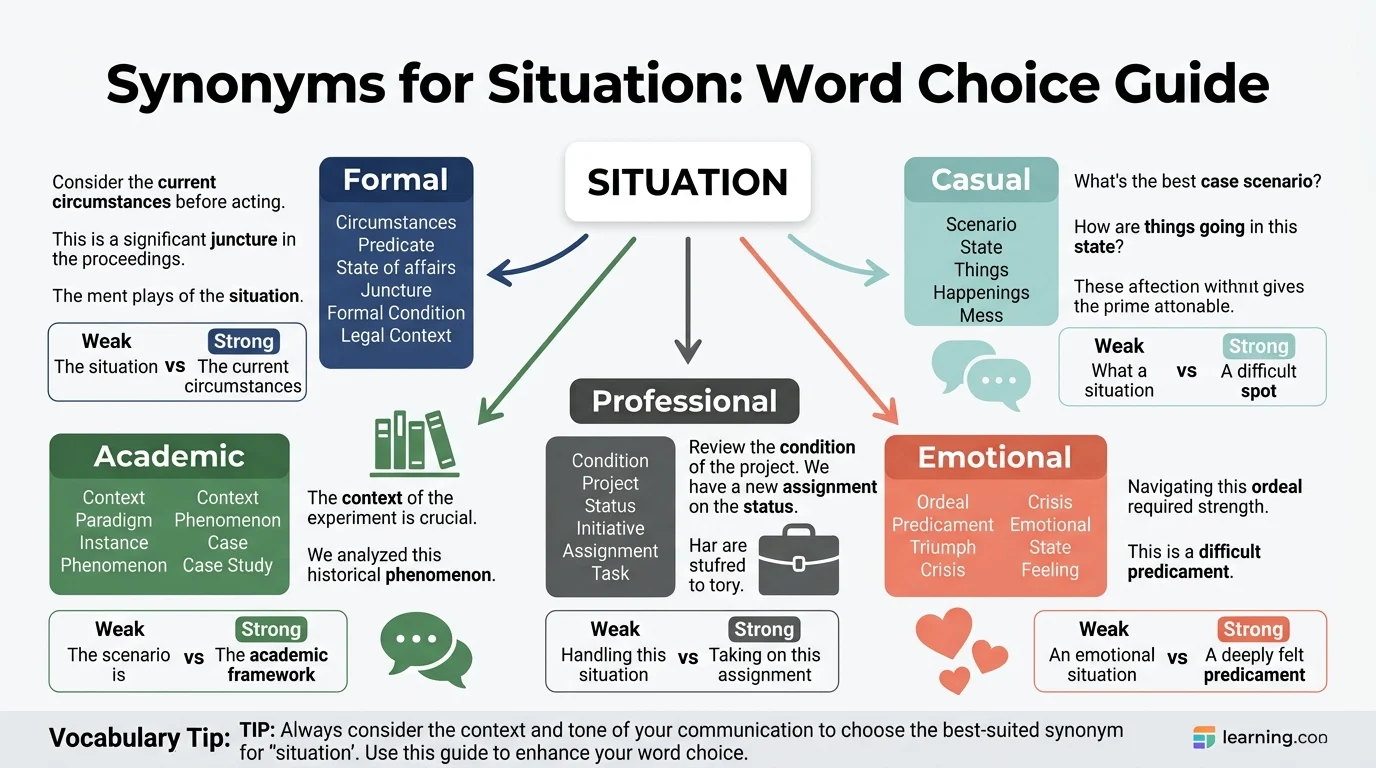
Situation refers to a set of circumstances, conditions, or events occurring at a particular time and place. The best synonyms depend on your context. For formal writing, use circumstance or condition. casual conversation, try scenario or setup.professional communication, choose status or position. For emotional tone, use predicament or dilemma. Academic writing favors context or environment.
Meaning, Tone and Context
Simple Definition
Situation means the combination of conditions, facts, and events that exist at a specific time or place. It describes what is happening and the surrounding factors that influence it.
Part of Speech
Situation is a noun.
Tone
Situation has a neutral tone. It does not carry strong positive or negative feelings on its own. The emotion comes from the words and context around it.
Formality Level
Situation works in all formality levels. It fits casual conversation, formal reports, and everything in between. This versatility makes it useful but also easy to overuse.
Common Use Cases
People use situation to describe problems, events, jobs, relationships, travel, and everyday life. It appears in business meetings, school essays, personal stories, news reports, and social media.
Important Word Forms
Situational is the adjective form. This describes something related to or dependent on a particular situation. For example, situational awareness or situational factors.
When and How to Use “Situation”
Use situation when you need a general word for what is happening. It works best when the details are clear from context or when you want to stay neutral.
Here are realistic examples in different contexts:
Professional context
We need to assess the current situation before making any decisions about the project timeline.
Personal context
My living situation has changed now that my roommate moved to another city.
Academic context
The historical situation in Europe during that period influenced many political developments.
Emotional context
She found herself in a difficult situation when both friends asked for her opinion.
Creative context
The situation grew more complicated as each new character entered the scene.
Social media caption
Current situation: coffee, laptop, and a deadline that keeps getting closer.
Email context
I am writing to update you on the situation regarding our vendor contract renewal.
Resume context
Managed complex situations involving client disputes and resolved them efficiently.
Another Word for “Situation”
The best single replacement depends entirely on what you want to say. Here are direct suggestions for different needs:
Professional writing
Circumstance works well. It sounds formal and precise.
Example: We must evaluate the circumstance before proceeding.
Academic writing
Context is excellent for scholarly work. It suggests a broader framework.
Example: The historical context explains these economic patterns.
Casual conversation
Scenario feels natural and modern.
Example: Imagine this scenario: you are waiting for a bus that never arrives.
Emotional writing
Predicament adds a sense of difficulty or trouble.
Example: His financial predicament caused him great anxiety.
Creative writing
Setting describes the physical or social environment.
Example: The setting was a busy train station during rush hour.
Resume or workplace use
Status shows current standing or progress.
Example: I updated the status of all outstanding customer requests.
Social media captions
Vibe is a modern, casual choice.
Example: Current vibe: sunny patio with good music.
Stronger meaning
Crisis indicates serious trouble.
Example: The company faced a crisis when sales dropped by forty percent.
Softer meaning
Position suggests a more neutral observation.
Example: Let me explain my position on this matter.
When Not to Use “Situation”
Situation sounds too vague when you need precise details. It becomes a crutch word that weakens your message.
Consider this weak sentence:
The situation in the office was not good.
Now compare it with a more precise version:
The office atmosphere felt tense after the budget announcement.
Here are more examples where situation fails to deliver clarity:
Too vague for professional feedback
Weak: Her situation at work is improving.
Better: Her performance metrics have increased by twenty percent this quarter.
Too casual for academic writing
Weak: The situation in the economy changed.
Better: Economic indicators shifted following the policy adjustment.
Too weak for emotional expression
Weak: I am in a bad situation right now.
Better: I am struggling with overwhelming stress and need support.
Words Commonly Confused With “Situation”
Many words seem similar to situation but have distinct meanings. Understanding these differences improves your word choice.
Situation vs. Circumstance
Situation focuses on what is happening now. Circumstance emphasizes the conditions or facts surrounding an event.
Use situation for the immediate state. Use circumstance for background factors.
Example for situation: The situation at the border is tense.
Example for circumstance: The economic circumstances forced many businesses to close.
Situation vs. Condition
Situation relates to events and occurrences. Condition relates to the state or quality of something.
Use situation for events. Use condition for state of being.
Example for situation: The political situation remains unstable.
Example for condition: The car is in excellent condition.
Situation vs. Context
Situation describes the immediate scene. Context describes the broader background or framework.
Use situation for the current state. Use context for the surrounding information.
Example for situation: The situation in the meeting was awkward.
Example for context: In the context of global trade, these tariffs make sense.
Situation vs. Scenario
Situation describes what is real. Scenario describes a possible or imagined sequence of events.
Use situation for reality. Use scenario for hypotheticals.
Example for situation: Our current situation requires immediate attention.
Example for scenario: Consider a worst case scenario where funding is cut.
Situation vs. Predicament
Situation is neutral. Predicament implies a difficult or problematic state.
Use situation for general states. Use predicament for trouble.
Example for situation: Let me explain our situation.
Example for predicament: I am in a real predicament with this deadline.
Situation vs. Position
Situation refers to circumstances. Position refers to viewpoint, rank, or physical location.
Use situation for events. Use position for stance or status.
Example for situation: The situation demands a quick response.
Example for position: My position on this issue is clear.
Best Synonym by Context for “Situation”
| Context | Best Synonym | Why It Works | Example |
|---|---|---|---|
| Formal writing | Circumstance | Sounds professional and precise | The circumstance requires careful consideration. |
| Academic writing | Context | Suggests broader analytical framework | The historical context explains these findings. |
| Professional business | Status | Shows current standing clearly | Please provide a status update on the merger. |
| Resume writing | Challenge | Highlights problem solving ability | Addressed complex challenges with creative solutions. |
| Casual conversation | Scenario | Feels natural and conversational | This scenario happens all the time. |
| Creative writing | Setting | Creates vivid descriptive imagery | The setting was a foggy London street. |
| Emotional tone | Predicament | Conveys difficulty and struggle | Her predicament broke my heart. |
| Strong intensity | Crisis | Signals urgent serious matters | The company faced a financial crisis. |
| Soft moderate tone | Position | Offers neutral professional observation | Let me clarify my position on this. |
| Social media captions | Vibe | Modern and relatable for casual use | Weekend vibe: beach, sun, and relaxation. |
| Workplace communication | Climate | Describes team or organizational tone | The workplace climate improved after the new policy. |
| News reporting | Crisis | Indicates serious breaking events | The humanitarian crisis continues to grow. |
Which Synonym Should You Choose?
Choosing the right synonym depends on four key factors: meaning, formality, emotion, and audience.
First, think about what you actually mean. Are you describing a problem, a state, an environment, or an event? Each situation has a specific nuance that different synonyms capture better.
Second, consider your formality level. Business reports demand formal words like circumstance or condition. Social media posts welcome casual words like vibe or setup. Academic essays prefer context or environment.
Third, evaluate the emotional intensity. Do you want to sound neutral, serious, dramatic, or mild? Crisis carries heavy weight. Scenario feels neutral. Setup sounds light and casual.
Fourth, think about your audience. Professionals appreciate precise business language. Friends respond to casual modern words. Teachers expect academic vocabulary.
The best practice is to read your sentence without the word situation and ask what you truly want to express. Then choose the synonym that fits that meaning exactly.
Real Life Examples of “Situation” in Sentences
These examples show how situation and its synonyms work across different real life contexts.
School example
The classroom situation improved after the teacher introduced group activities.
The classroom atmosphere became more collaborative after the teacher introduced group activities.
Workplace example
Our team faced a difficult situation when the client changed the requirements.
Our team encountered a significant challenge when the client changed the requirements.
Writing example
The situation in the novel became more complicated in chapter three.
The plot grew more intricate in chapter three of the novel.
Conversation example
I told my friend about my situation with the new job.
I explained my new job circumstances to my friend.
Social media example
Current situation: waiting for my coffee order.
Current vibe: patiently waiting for my coffee order.
Resume example
Handled high pressure situations with calm professionalism.
Navigated high pressure challenges with calm professionalism.
Email example
I would like to discuss the situation regarding our partnership.
I would like to discuss our partnership status.
Storytelling example
The situation was perfect for a surprise celebration.
The setting was perfect for a surprise celebration.
25 Synonyms for “Situation”
| Synonym | Simple Meaning | Best Used For | Example Sentence |
|---|---|---|---|
| Circumstance | The conditions surrounding an event | Formal professional writing | The circumstance forced us to change our strategy. |
| Context | The broader background or framework | Academic and analytical writing | The social context influenced every decision she made. |
| Scenario | A possible or actual sequence of events | Casual conversation and planning | Imagine a scenario where you win the lottery. |
| Condition | The state or quality of something | Describing health or status | The condition of the equipment needs assessment. |
| Status | Current standing or progress | Business and workplace updates | Please check the status of your application. |
| Setting | The physical or social environment | Creative and descriptive writing | The mountain setting provided breathtaking views. |
| Predicament | A difficult or unpleasant situation | Emotional or troubling contexts | His predicament left him with no good options. |
| Dilemma | A choice between two difficult options | Moral or decision based contexts | She faced a dilemma about accepting the job. |
| Crisis | A time of intense difficulty or danger | Serious urgent situations | The healthcare crisis affected millions. |
| Position | A viewpoint or standing | Professional and formal contexts | My position on the matter remains unchanged. |
| Vibe | The atmosphere or feeling | Social media and casual speech | The cafe had a relaxed and welcoming vibe. |
| Challenge | A difficult task or problem | Resume and professional contexts | The challenge required innovative thinking. |
| State | The condition of something | General descriptive use | The state of the project is promising. |
| Environment | Surrounding conditions | Academic and professional use | The work environment encourages creativity. |
| Climate | The general atmosphere or attitude | Organizational and social contexts | The political climate shifted dramatically. |
| Scene | A place or setting | Casual and creative writing | The scene at the concert was electric. |
| Affair | A matter or event | Formal and sometimes diplomatic use | This affair requires immediate attention. |
| Occurrence | An event or incident | Neutral descriptive use | This occurrence surprised everyone. |
| Event | A significant happening | General and news contexts | The main event attracted thousands of visitors. |
| Prospect | A possible future situation | Planning and business contexts | Let us evaluate the prospect for growth. |
| Orientation | Position or direction | Technical and professional use | The orientation of the building maximizes sunlight. |
| Posture | A stance or attitude | Professional and diplomatic contexts | The company posture on sustainability is strong. |
| Standing | Status or reputation | Professional and social contexts | Her standing in the community is excellent. |
| Spot | A particular place | Casual informal contexts | I found a perfect spot for lunch. |
| Placement | Position or arrangement | Professional and academic contexts | The placement of resources affects efficiency. |
Synonym Groups and Usage Differences
Professional vs. Personal Synonyms
Professional synonyms sound formal and measured. They include status, standing, position, circumstance, and condition. These words work well in emails, reports, and meetings.
Personal synonyms feel warmer and more connected. They include vibe, scene, setup, and spot. These words are better for talking with friends or posting on social media.
Choose professional words when your reputation matters. Choose personal words when you want to build connection.
Formal vs. Conversational Synonyms
Formal synonyms belong in reports, essays, and speeches. They include circumstance, condition, context, environment, and position. These words sound educated and polished.
Conversational synonyms appear in texts, casual emails, and daily talk. They include scenario, setup, vibe, scene, and spot. These words sound approachable and natural.
Mixing both styles can confuse your reader. Stay consistent with your chosen formality level.
Academic Synonyms
Academic writing values precision and clarity. The best academic synonyms for situation include context, environment, condition, circumstance, and state.
These words suggest careful analysis and thorough understanding. They fit research papers, essays, and scholarly articles.
For example, instead of “the situation in education,” write “the educational context.” Instead of “the situation with climate change,” write “the environmental condition.”
Professional and Business Synonyms
Business communication requires clear, actionable language. The strongest business synonyms include status, position, standing, climate, and challenge.
These words sound professional and forward looking. They show leadership and problem solving ability.
Use status for updates, position for stances, and challenge for obstacles. These choices demonstrate business fluency and competence.
Creative or Literary Synonyms
Creative writing rewards vivid and specific language. The best creative synonyms include setting, scene, environment, climate, and atmosphere.
These words paint pictures in the reader’s mind. They add depth and sensory detail to your writing.
Instead of “the situation was tense,” try “the atmosphere was charged with tension.” Instead of “the romantic situation,” try “the romantic setting.”
Slang or Modern Synonyms
Slang synonyms for situation are acceptable only in very casual contexts. These include vibe, setup, spot, and scene.
These words work well on social media, in texts, and with friends. They sound contemporary and relatable.
However, avoid them in professional writing, academic papers, or formal speeches. They can make you sound unprofessional or immature.
Strongest vs. Weaker Synonyms
Intensity scale from mild to strongest:
Mild: position, status, condition, state
Moderate: circumstance, context, scenario, setting
Strong: predicament, dilemma, challenge
Strongest: crisis, emergency, catastrophe
Choose mild words for neutral updates. moderate words for descriptive writing.strong words for serious matters. Choose strongest words only for urgent, dangerous, or critical situations.
Emotional vs. Neutral Synonyms
Emotional synonyms add feeling and drama to your writing. These include predicament, dilemma, crisis, and challenge. They suggest struggle, difficulty, or importance.
Neutral synonyms stay factual and objective. These include status, condition, context, and circumstance. They report information without emotional weight.
Consider your purpose. Emotional words engage readers. Neutral words build credibility. Use both strategically.
Antonyms of “Situation”
| Antonym | Meaning | Example Sentence |
|---|---|---|
| Normalcy | A state of being normal or usual | After the chaos, we returned to normalcy. |
| Stability | A steady and unchanging state | The economy showed welcome stability. |
| Certainty | A definite or fixed condition | The certainty of the schedule helped everyone. |
| Routine | A regular established pattern | She found comfort in her daily routine. |
| Order | A well organized state | The librarian maintained perfect order. |
| Resolution | A solution or final outcome | The resolution came after months of discussion. |
| Agreement | A shared understanding | Both parties reached a full agreement. |
| Solution | An answer to a problem | We found a simple solution to the issue. |
| Calm | A peaceful and quiet state | The calm after the storm was remarkable. |
| Simplicity | An uncomplicated state | The simplicity of the design impressed everyone. |
| Certainty | Having no doubt or confusion | The certainty of the outcome reassured us. |
| Clarity | A clear and understandable state | The manager brought clarity to the process. |
| Constancy | A state of being unchanging | The constancy of her support helped him succeed. |
| Fixedness | A permanent unchanging state | The fixedness of the schedule pleased the team. |
| Permanence | A lasting or enduring state | The permanence of the contract gave everyone confidence. |
Comparison: Situation vs. Similar Words
Situation vs. Circumstance
Main difference: Situation focuses on the immediate state. Circumstance focuses on surrounding facts and conditions.
Which one is stronger: Both are neutral in strength.
Which one is more formal: Circumstance is slightly more formal.
Example for situation: The situation at the office requires attention.
Example for circumstance: The economic circumstances forced budget cuts.
Situation vs. Context
Main difference: Situation describes what is happening. Context describes the broader background.
Which one is stronger: Neither is stronger. They serve different purposes.
Which one is more formal: Context is more academic.
Example for situation: The situation in the classroom was chaotic.
Example for context: Historical context helps explain these events.
Situation vs. Scenario
Main difference: Situation is real or current. Scenario can be hypothetical or imagined.
Which one is stronger: Scenario suggests more detail and planning.
Which one is more formal: Scenario is moderately formal.
Example for situation: Our current situation demands patience.
Example for scenario: Consider a scenario where the market crashes.
Situation vs. Predicament
Main difference: Situation is neutral. Predicament implies difficulty or trouble.
Which one is stronger: Predicament is much stronger emotionally.
Which one is more formal: Predicament is moderately formal.
Example for situation: The situation is under control.
Example for predicament: I am in a financial predicament.
Situation vs. Position
Main difference: Situation refers to circumstances. Position refers to stance, rank, or location.
Which one is stronger: Position sounds more deliberate and chosen.
Which one is more formal: Position is more formal.
Example for situation: The situation changed suddenly.
Example for position: My position on this issue is clear.
Situation vs. Setting
Main difference: Situation is abstract. Setting is physical and descriptive.
Which one is stronger: Setting provides more vivid imagery.
Which one is more formal: Both have similar formality.
Example for situation: The situation felt awkward.
Example for setting: The setting was a beautiful garden.
Common Phrases and Expressions with “Situation”
1. Win win situation
Meaning: A situation where everyone benefits.
Example sentence: The new partnership created a win win situation for both companies.
2. No win situation
Meaning: A situation where no positive outcome is possible.
Example sentence: The manager faced a no win situation with the conflicting deadlines.
3. Under the circumstances
Meaning: Given the current situation or conditions.
Example sentence: Under the circumstances, we decided to postpone the event.
4. Situational awareness
Meaning: Understanding what is happening around you.
Example sentence: The pilot maintained excellent situational awareness during the flight.
5. Save the situation
Meaning: To rescue or improve a difficult situation.
Example sentence: His quick thinking helped save the situation.
6. Size up the situation
Meaning: To assess or evaluate a situation.
Example sentence: She paused to size up the situation before speaking.
Common Mistakes to Avoid
1. Using Situation When a More Precise Synonym Is Better
Situation is too general for many contexts. Replace it with specific words like problem, opportunity, challenge, or condition.
Mistake: The situation with my car is bad.
Better: My car has a serious engine problem.
2. Confusing Situation with Setting
Situation refers to circumstances. Setting refers to physical location or environment.
Mistake: The restaurant situation was romantic.
Better: The restaurant setting was romantic.
3. Using a Casual Synonym in Formal Writing
Avoid words like vibe, setup, or scene in professional documents.
Mistake: The vibe in the meeting was productive.
Better: The meeting atmosphere was productive.
4. Using an Overly Dramatic Synonym for a Simple Situation
Reserve crisis and predicament for truly serious matters.
Mistake: I faced a crisis when I forgot my lunch.
Better: I encountered a minor problem when I forgot my lunch.
5. Repeating the Same Word Too Often
Variety improves your writing. Alternate between appropriate synonyms.
Mistake: The situation was difficult. The situation required change. The situation improved.
Better: The circumstance was difficult. It required change. The condition improved.
6. Choosing a Synonym with the Wrong Emotional Tone
Match your word’s emotion to your message.
Mistake: We enjoyed the crisis at the party.
Better: We enjoyed the lively atmosphere at the party.
7. Using Slang in Academic or Professional Writing
Slang undermines your credibility in formal contexts.
Mistake: The setup for the experiment was perfect.
Better: The experimental conditions were optimal.
FAQs
1. What is the best synonym for situation?
The best synonym depends on context. For professional use, choose circumstance or status. For casual use, choose scenario or vibe. academic use, choose context or environment.
2. What is a formal synonym for situation?
Circumstance and condition are excellent formal synonyms. They appear in business reports, academic papers, and professional correspondence.
3. What is an informal synonym for situation?
Scenario and vibe work well informally. They fit social media posts, texts, and casual conversations with friends.
4. What is another word for situation in professional writing?
Status, position, and circumstance are strong choices for professional writing. They sound polished and precise in workplace communication.
5. What is the difference between situation and circumstance?
Situation focuses on the immediate state. Circumstance focuses on surrounding conditions and background factors.
6. What is the opposite of situation?
Normalcy, stability, and order represent opposites. They describe states of calm, routine, and organization rather than changing circumstances.
Conclusion
Situation is a useful and flexible word, but relying on it too much weakens your language. The best communicators choose precise words that match their meaning, audience, and context.
Remember that formal writing benefits from circumstance and condition. Casual conversation welcomes scenario and vibe. Academic work demands context and environment. Emotional moments call for predicament and challenge.
The key to better vocabulary is awareness. Notice when you use situation and ask yourself if a more specific word would improve your message. Practice replacing it with stronger alternatives.
Your words shape how others perceive you. Choose them with care, and your writing and speaking will become clearer, more engaging, and more professional.