Introduction
Do you find yourself using the word “care” repeatedly in your writing? You are not alone. Many writers, students, and professionals lean on this single word far too often. Whether you are drafting an important email, writing a college essay, or crafting a social media caption, overusing “care” can make your language feel flat.
This guide explores the rich variety of synonyms for care. You will discover exactly which word fits each situation. By the end, you will have precise alternatives for every context, from formal reports to casual conversations.
What Does “Care” Mean?
The word “care” means to feel concern, interest, or responsibility toward someone or something. In formal writing, consider “attend to” or “tend.” For casual use, “look after” works well. Academic contexts prefer “scrutinize” or “examine.” Professional settings often use “manage” or “oversee.” Emotional writing benefits from “cherish” or “treasure.” Creative contexts might use “nurture” or “cultivate.”
Meaning, Tone and Context
Simple Definition
Care refers to the attention, concern, or responsibility you show toward people, tasks, or objects. It also describes the act of providing for someone’s needs or looking after something valuable.
Part of Speech
Care functions as both a noun and a verb. As a noun, it represents the feeling of concern or the act of supervision. As a verb, it describes the action of being attentive or concerned.
Tone
The tone of care is generally positive or neutral. It carries warmth and responsibility. However, the tone shifts dramatically based on which synonym you choose.
Formality Level
Care is a neutral word. It works in almost any setting. Its synonyms range from highly formal to very casual. You must match the formality to your audience.
Common Use Cases
You will use care in professional emails, academic papers, personal letters, social media posts, and everyday conversation. It appears in healthcare, education, business, and personal relationships.
Important Word Forms
The adjective form is “careful” or “caring.” The adverb is “carefully.” The opposite forms include “careless” and “carelessness.” Related nouns include “caregiver,” “caretaker,” and “healthcare.”
When and How to Use “Care”
You should use care when you want to express concern or attention in a general way. It works best for everyday situations where precision is not critical. For more specific meanings, choose a targeted synonym.
Professional Context
The manager will care for the team’s well being during the project.
Personal Context
I truly care about my grandmother’s health and happiness.
Academic Context
The researcher must care for the data with great attention to detail.
Emotional Context
She cares deeply for her childhood friend despite the distance.
Creative Context
The artist cares for each brushstroke as if it holds a secret meaning.
Social Media Caption
I care about this planet, so I choose sustainable products every day.
Resume Writing
Cared for client accounts and maintained strong relationships throughout the year.
Casual Conversation
I care about what happens to this neighborhood.
Another Word for “Care”
The best single replacement depends entirely on your context. Here are direct suggestions for each situation.
Professional Writing
Use “manage” when you oversee processes. Use “administer” for official duties. “Supervise” works for leadership roles.
Academic Writing
“Examine” fits research contexts. “Analyze” works for data review. “Scrutinize” shows thorough attention.
Casual Conversation
“Look after” sounds natural. “Mind” works in British English. “Watch over” feels protective.
Emotional Writing
“Cherish” expresses deep affection. “Treasure” shows high value. “Adore” conveys intense fondness.
Creative Writing
“Nurture” suggests growth. “Cultivate” implies development. “Tend” feels gentle and attentive.
Resume or Workplace
“Oversee” demonstrates leadership. “Coordinate” shows organization. “Handle” indicates capability.
Social Media Captions
“Support” fits advocacy posts. “Stand for” shows principles. “Root for” expresses encouragement.
Stronger Meaning
“Protect” implies defense. “Guard” suggests vigilance. “Safeguard” indicates serious responsibility.
Softer Meaning
“Notice” shows awareness. “Consider” indicates thought. “Mind” suggests mild attention.
When Not to Use “Care”
Care sounds too vague in many situations. It fails to communicate specific actions or emotions.
Too Vague for Professional Reports
Instead of “I care for the budget,” say “I manage the budget.” The second option shows clear responsibility.
Too Casual for Academic Papers
Instead of “care for the results,” use “scrutinize the results.” Academic writing demands precision.
Too Weak for Safety Contexts
Instead of “care for the equipment,” use “maintain the equipment.” Maintenance implies specific action.
Too General for Emotional Depth
Instead of “I care about you,” try “I cherish you.” The stronger word carries more emotional weight.
Too Passive for Leadership
Instead of “care for the team,” say “lead the team.” Leadership implies active responsibility.
Words Commonly Confused With “Care”
Care vs. Concern
Care implies active attention. Concern suggests worry or interest without action. You care for a patient. You feel concern about the weather.
Care vs. Worry
Care is positive and responsible. Worry is negative and anxious. You care for your children. You worry about their safety.
Care vs. Attention
Care includes emotional investment. Attention is purely observational. You care for a garden. You pay attention to a lecture.
Care vs. Maintenance
Care is holistic and emotional. Maintenance is mechanical and routine. You care for your car. You perform maintenance on the engine.
Care vs. Custody
Care suggests nurturing. Custody implies legal responsibility. Parents care for their children. Lawyers handle custody agreements.
Care vs. Treatment
Care is ongoing and relational. Treatment is specific and procedural. Doctors provide care. They administer treatment for illnesses.
Best Synonym by Context for “Care”
| Context | Best Synonym | Why It Works | Example |
|---|---|---|---|
| Formal Writing | Attend To | Sounds professional and responsible | The committee will attend to all submitted proposals |
| Academic Writing | Scrutinize | Shows analytical thoroughness | Researchers scrutinize every data point carefully |
| Professional Business | Manage | Indicates control and responsibility | She manages the entire customer service department |
| Resume Writing | Oversee | Demonstrates leadership capability | Oversaw a team of fifteen sales representatives |
| Casual Conversation | Look After | Feels natural and warm | Can you look after my plants while I travel |
| Creative Writing | Nurture | Suggests growth and tenderness | She nurtures her creative talents every day |
| Emotional Tone | Cherish | Expresses deep affection | I cherish every moment with my family |
| Strong Intensity | Protect | Shows serious commitment | We must protect our natural resources |
| Soft Moderate Tone | Consider | Suggests thoughtful awareness | Please consider the feelings of others |
| Social Media | Support | Signals solidarity and advocacy | Support local businesses in your community |
| Healthcare | Tend | Suggests gentle medical attention | Nurses tend to patients around the clock |
Which Synonym Should You Choose?
Your choice depends on four key factors. First, consider your audience. Formal readers expect professional language. Casual readers appreciate warmth.
Second, evaluate your purpose. Are you showing emotion or completing a task? Emotional contexts need warmer words. Task oriented contexts need action words.
Third, think about intensity. How strong should your meaning be? Mild situations call for softer synonyms. Serious matters demand stronger language.
Fourth, examine your sentence structure. Some synonyms fit certain grammatical patterns better than others. Test each option in your sentence.
For professional documents, choose “manage” or “oversee.” personal messages, pick “cherish” or “look after.” For academic work, select “examine” or “analyze.” creative writing, use “nurture” or “cultivate.”
Real Life Examples of “Care” in Sentences
School Context
The teacher cares for each student’s individual learning needs.
Workplace Context
Our department cares for all client accounts with dedication.
Writing Context
Good writers care for every word they place on the page.
Conversation Context
I care about what happens to this community.
Social Media Context
We care for the environment by reducing plastic waste.
Resume Context
Cared for high value accounts and maintained 98 percent retention.
Email Context
I care about resolving this issue quickly for you.
Storytelling Context
The old man cared for the garden as if it were his child.
Healthcare Context
Nurses care for patients around the clock with compassion.
Leadership Context
Great leaders care for their teams by removing obstacles.
25 Synonyms for “Care”
| Synonym | Simple Meaning | Best Used For | Example Sentence |
|---|---|---|---|
| Nurture | Support growth | Emotional and creative contexts | Parents nurture their children’s curiosity |
| Tend | Look after gently | Healthcare and gardening | She tends the garden every morning |
| Manage | Handle responsibility | Professional and business | He manages the entire department |
| Oversee | Supervise activities | Leadership and management | The director oversees all operations |
| Attend To | Give attention | Formal writing | Please attend to this matter immediately |
| Scrutinize | Examine carefully | Academic and research | The committee will scrutinize every application |
| Cherish | Hold dear | Emotional writing | I cherish the memories of our trip |
| Treasure | Value highly | Personal relationships | She treasures her grandmother’s necklace |
| Look After | Take care of | Casual conversation | Can you look after my dog this weekend |
| Watch Over | Supervise protectively | Family and children | Grandparents watch over the children |
| Protect | Keep safe | Safety and security | The organization protects endangered species |
| Safeguard | Protect carefully | Legal and official | The policy safeguards employee rights |
| Cultivate | Develop purposefully | Creative and business | Cultivate strong relationships with clients |
| Supervise | Watch and direct | Employment and safety | The foreman supervises construction workers |
| Mind | Pay attention to | British casual usage | Mind your own business, please |
| Sustain | Maintain over time | Environmental and business | Sustain your energy throughout the day |
| Maintain | Keep in good condition | Technical and routine | Maintain your equipment properly |
| Preserve | Keep from harm | Historical and cultural | Preserve the natural beauty of the area |
| Regard | Consider thoughtfully | Professional correspondence | We regard this as a priority matter |
| Heed | Pay attention to | Formal warnings | Heed the advice of experienced mentors |
| Minister To | Provide care | Religious and healthcare | The chaplain ministers to patients |
Synonym Groups and Usage Differences
Professional vs. Personal Synonyms
Professional synonyms focus on responsibility and action. “Manage” and “oversee” show control. “Coordinate” and “administer” demonstrate organization. These words belong in emails, reports, and workplace conversations.
Personal synonyms emphasize emotion and relationship. “Cherish” and “treasure” express deep feeling. “Look after” and “watch over” show warmth. These words fit letters to family, messages to friends, and emotional writing.
Formal vs. Conversational Synonyms
Formal synonyms work in reports, essays, and speeches. “Attend to” and “scrutinize” sound proper. “Administer” and “safeguard” appear in official documents. These words command respect.
Conversational synonyms suit casual writing, texts, and emails. “Look after” and “mind” feel natural. “Check on” and “watch over” sound friendly. These words build connection.
Academic Synonyms
Academic writing demands precision and objectivity. “Scrutinize” shows careful examination. “Analyze” suggests methodical study. “Evaluate” indicates assessment. “Examine” works for research contexts. These words demonstrate scholarly rigor.
Professional and Business Synonyms
Workplace communication requires clarity and authority. “Manage” shows leadership. “Oversee” indicates supervision. “Coordinate” demonstrates organization. “Handle” suggests capability. “Administer” shows official responsibility. These words build professional credibility.
Creative or Literary Synonyms
Creative writing benefits from vivid, evocative language. “Nurture” suggests gentle growth. “Cultivate” implies intentional development. “Tend” feels pastoral and careful. “Foster” suggests encouragement. “Cherish” expresses deep affection. These words add emotional depth.
Slang or Modern Synonyms
Modern casual usage includes words like “look out for” and “have someone’s back.” These phrases work in texts and social media. They feel supportive and contemporary. However, they fail in professional or academic contexts. Use them only with familiar audiences.
Strongest vs. Weaker Synonyms
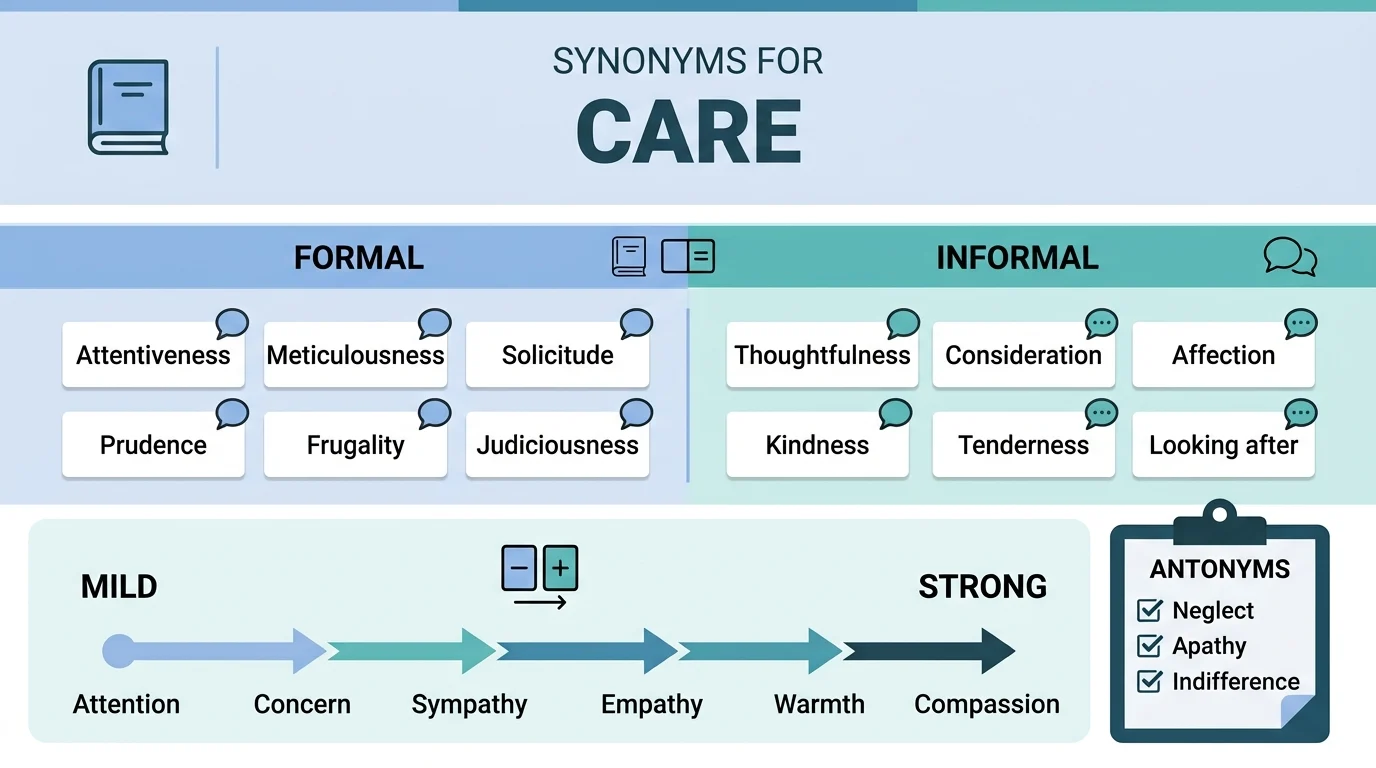
The intensity scale ranges from mild to powerful. Mild options include “consider” and “notice.” Moderate choices include “look after” and “mind.” Strong words include “safeguard” and “protect.” The strongest options are “cherish” and “treasure.” Choose based on your emotional commitment.
Emotional vs. Neutral Synonyms
Emotional synonyms add feeling to your writing. “Cherish” and “treasure” express love. “Protect” shows commitment. “Nurture” demonstrates tenderness. These words connect with readers on a personal level.
Neutral synonyms stay factual and objective. “Manage” and “oversee” describe tasks. “Administer” and “coordinate” indicate process. “Supervise” and “handle” show function. These words work in professional and academic settings.
Antonyms of “Care”
| Antonym | Meaning | Example Sentence |
|---|---|---|
| Neglect | Fail to care for properly | He neglected his responsibilities entirely |
| Ignore | Pay no attention to | She ignored the warning signs completely |
| Overlook | Fail to notice | The supervisor overlooked the mistake |
| Abandon | Give up completely | They abandoned the project halfway through |
| Disregard | Pay no attention | He disregarded the safety guidelines |
| Forget | Fail to remember | I forgot to complete the task |
| Dismiss | Reject as unimportant | The manager dismissed the complaint |
| Discard | Throw away | They discarded the old equipment |
| Negligence | Lack of proper care | The negligence caused serious problems |
| Carelessness | Lack of attention | His carelessness led to errors |
| Indifference | Lack of interest | Her indifference was obvious |
| Apathy | Lack of concern | Voter apathy affects elections |
| Detachment | Emotional distance | His detachment seemed cold |
| Unconcern | Lack of worry | Her unconcern surprised everyone |
| Inattention | Failure to pay attention | The inattention caused the accident |
Comparison: Care vs. Similar Words
Care vs. Concern
Care involves active attention and action. Concern involves worry without necessarily acting. You care for a sick friend by visiting them. You feel concern about their health from a distance. it is more engaged and practical.
Care vs. Worry
Care is constructive and positive. Worry is destructive and negative. You care for your child by providing safety. You worry about your child’s future without taking action. Care leads to solutions. Worry leads to anxiety.
Care vs. Attention
Care includes emotional investment. Attention is purely mental focus. You care for your garden with love. You pay attention to a boring lecture without feeling involved. it is warmer and more personal.
Care vs. Maintenance
Care is holistic and relational. Maintenance is mechanical and routine. You care for your car by driving it with respect. You perform maintenance by changing the oil. Care considers the whole object. Maintenance follows specific procedures.
Care vs. Custody
Care suggests nurturing and support. Custody implies legal control. Parents care for their children with love. Courts decide custody arrangements legally. Care is personal. Custody is official.
Care vs. Treatment
Care is ongoing and comprehensive. Treatment is specific and limited. Doctors provide care for your overall health. They administer treatment for specific conditions. Care is long term. Treatment is targeted.
Common Phrases and Expressions with “Care”
1. Take Care Of
Meaning: To handle or look after someone or something.
Example: Can you take care of the paperwork while I am away?
2. Care For
Meaning: To like or feel affection toward someone.
Example: I care for my neighbor very much.
3. With Care
Meaning: In a careful or gentle manner.
Example: Please handle these fragile items with care.
4. Care About
Meaning: To feel concern or interest in something.
Example: She cares about environmental issues deeply.
5. Handle With Care
Meaning: Treat something gently and cautiously.
Example: These documents are confidential and should be handled with care.
6. Tender Loving Care
Meaning: Affectionate and attentive treatment.
Example: The rescued animals received tender loving care.
7. Care Package
Meaning: A package of useful items sent to someone.
Example: We sent a care package to our son at college.
8. Care Home
Meaning: A residential facility providing care.
Example: My grandmother lives in a care home now.
Common Mistakes to Avoid
Mistake 1: Using Care When a More Precise Synonym Works Better
Instead of saying “I care for the project,” say “I manage the project.” The second option sounds more professional and specific.
Mistake 2: Confusing Care With Worry
Care is positive attention. Worry is negative anxiety. Say “I care about your health” instead of “I worry about your health.” The first option sounds supportive.
Mistake 3: Using Casual Synonyms in Formal Writing
Avoid “look after” in official documents. Use “attend to” or “supervise” for professional contexts. These words sound more authoritative.
Mistake 4: Using Overly Dramatic Synonyms for Simple Situations
Do not say “I cherish my coffee mug” unless it holds special meaning. Use “I like” or “I appreciate” for ordinary objects.
Mistake 5: Repeating Care Too Often in Writing
Vary your word choice. Use “manage,” “oversee,” and “handle” in professional writing. Use “cherish,” “treasure,” and “nurture” in personal contexts.
Mistake 6: Choosing a Synonym With the Wrong Emotional Tone
Match your word to your feeling. Do not use “protect” when you mean “appreciate.” Choose words that accurately reflect your emotional state.
Mistake 7: Using Slang in Academic or Professional Writing
Avoid “look out for” in formal contexts. Use “supervise” or “monitor” instead. Slang undermines your credibility in professional settings.
FAQs
What is the best synonym for care?
The best synonym depends on your context. “Manage” works for professional writing. “Cherish” fits emotional contexts. “Examine” suits academic work. Choose based on your audience and purpose.
What is a formal synonym for care?
“Attend to” serves as a formal synonym for care. “Administer” and “supervise” also work well in official documents. These words sound professional and authoritative.
What is an informal synonym for care?
“Look after” works as an informal synonym. “Mind” and “watch over” also fit casual contexts. These words feel warm and approachable.
What is another word for care in professional writing?
“Manage” works best in professional writing. “Oversee” and “coordinate” also serve well. These words show leadership and responsibility.
What is the difference between care and concern?
Care involves active attention. Concern suggests worry without action. You care for someone by helping them. You feel concern about their problems.
What is the opposite of care?
“Neglect” is the clearest opposite of care. “Ignore” and “overlook” also work as antonyms. These words describe failure to pay attention.
Conclusion
Care is a versatile word with many shades of meaning. It can express attention, concern, responsibility, compassion, and devotion. Choosing the right synonym depends on your context, audience, and purpose.
Professional contexts call for words like “diligence” and “supervision.” Emotional contexts benefit from “compassion” and “devotion.” Casual situations welcome “thoughtfulness” and “kindness.”
Your vocabulary grows stronger when you understand the subtle differences between synonyms. Start using these alternatives today. Your writing will become more precise and engaging.
Remember to verify definitions using trusted dictionaries such as Cambridge, Oxford, Merriam Webster, Collins, or Britannica before publishing any important content. Accurate word choice builds trust with your readers.