Have you ever found yourself writing an email, an essay, or a social media caption and realized you have used the word “subtle” three times in two paragraphs? You are not alone. Many writers, students, and professionals reach for this versatile word when they need to describe something that is not obvious, overly delicate, or cleverly indirect. But relying on the same word over and over can make your writing feel repetitive and less precise. Understanding the full range of synonyms of subtle allows you to communicate with greater clarity, tone, and impact. Whether you are drafting a business report, crafting a resume, or writing a novel, choosing the right word makes all the difference.
What Are the Best Synonyms of “Subtle”?
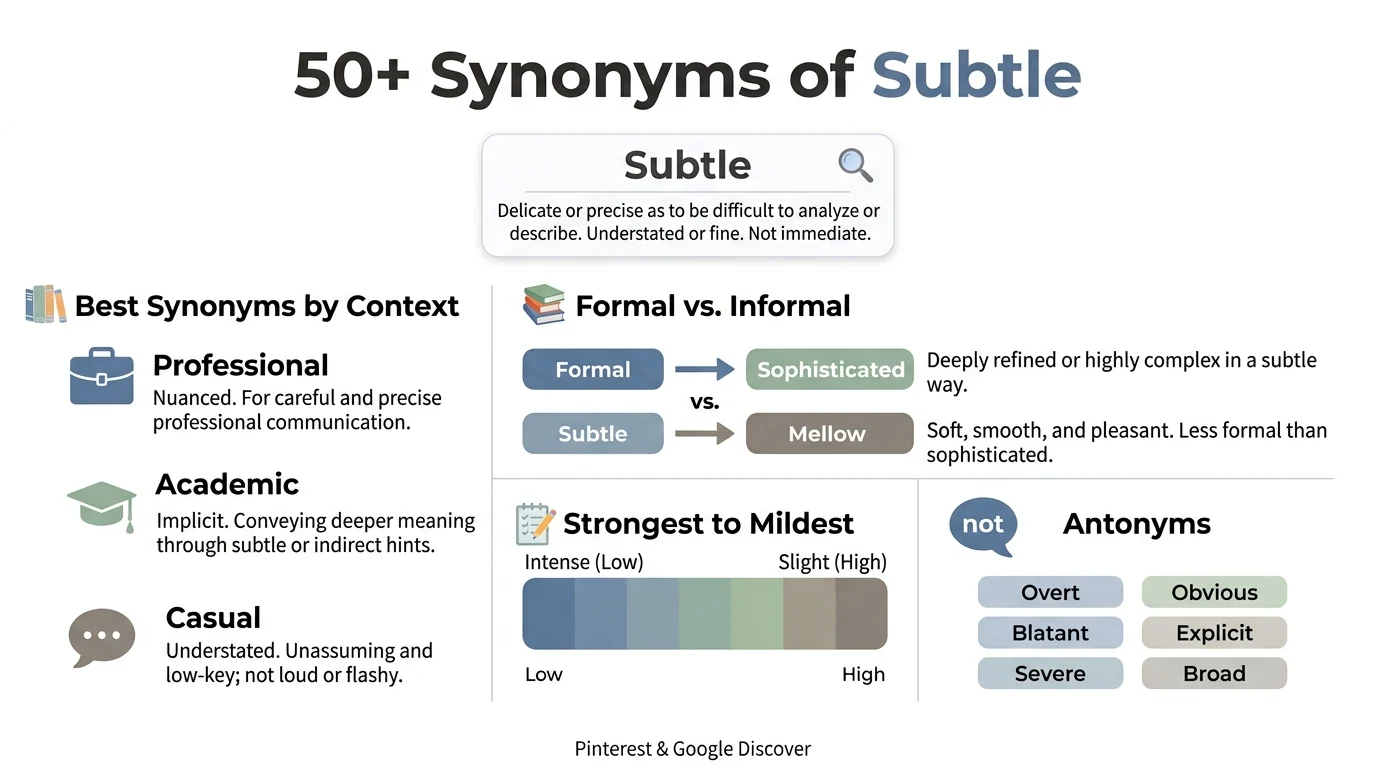
Subtle describes something that is not immediately obvious, often because it is delicate, complex, or requires careful attention to notice. Formal writing, choose nuanced or refined. For casual conversation, use low-key or quiet. For academic writing, imperceptible or elusive work well. In professional communication, understated and indirect are strong choices.
Meaning, Tone, and Context
Simple Definition
Something that is subtle is not obvious or easily understood. It can refer to a change that is so slight that it is difficult to detect, a flavor that is delicate and complex, or a method that is clever and indirect.
Part of Speech
Subtle is an adjective (subtler, subtlest).
Overall Tone
The tone of subtle is neutral. It can be positive when praising someone’s perceptiveness or a delicate flavor. It can be slightly negative when describing a hidden or insidious influence.
Formality Level
Semi-formal to neutral. Subtle is appropriate in almost any context, from academic papers to everyday conversation.
Common Uses
Native English speakers use subtle to describe:
- Changes or differences: “a subtle shift in attitude”
- Flavors, smells, or colors: “a subtle hint of vanilla”
- Ideas or arguments: “a subtle distinction”
- People or methods: “a subtle approach”
Word Forms
When and How to Use “Subtle”
Choose “subtle” when you want to describe something that requires a keen eye, a sensitive palate, or careful thought to perceive. It is the perfect word for situations where obviousness would ruin the effect.
7 Realistic Examples
- Professional: “The marketing campaign used subtle cues to appeal to environmentally conscious consumers.”
- Academic: “The study revealed a subtle correlation between sleep patterns and cognitive performance.”
- Workplace: “Her subtle leadership style empowered the team without micromanaging.”
- Personal: “There was a subtle tension in the room that no one wanted to acknowledge.”
- Email: “I noticed a subtle error in the report that I think we should correct before publishing.”
- Resume: “Developed a subtle yet effective strategy for improving customer retention rates.”
- Social Media: “The color palette of this photo has a subtle vintage feel.”
Best Synonyms of “Subtle”
No synonym is identical in every situation. The best choice depends on your context, audience, and the specific shade of meaning you want to convey.
- Professional writing: Understated – It conveys elegance and restraint, which are valued in professional settings.
- Academic writing: Nuanced – It suggests a deep understanding of complex details and multiple layers of meaning.
- Business communication: Indirect – It is useful when discussing strategies that are not straightforward.
- Casual conversation: Low-key – It is a relaxed and modern way to say something is not over-the-top.
- Emotional writing: Delicate – It implies sensitivity and a gentle touch.
- Creative writing: Elusive – It adds a sense of mystery and something that is hard to pin down.
- Resume writing: Refined – It suggests sophistication and polish.
- Workplace communication: Tactful – It emphasizes diplomacy and careful handling.
- Stronger meaning: Profound – It suggests deep significance that is not immediately apparent.
- Softer meaning: Faint – It describes something that is barely perceptible.
When Not to Use “Subtle”
Using “subtle” is not always the best choice. Here are situations where it falls short.
The Meaning Is Too General
- Incorrect: “The instructions were subtle.” (This is vague.)
- Better: “The instructions were ambiguous.” (This is more precise about the confusion.)
- Why: “Ambiguous” clearly states that the instructions are open to multiple interpretations, while “subtle” does not.
When the Tone Is Too Formal
- Incorrect: “The party was subtle.” (This sounds awkward.)
- Better: “The party was low-key.” (This is more natural for casual conversation.)
- Why: “Low-key” is the common way Americans describe a relaxed, modest event.
When the Word Is Too Weak
- Incorrect: “There was a subtle problem with the software.” (This underplays the severity.)
- Better: “There was an insidious problem with the software.” (This implies the problem is hidden and harmful.)
- Why: “Insidious” conveys a sense of danger or creeping harm that “subtle” lacks.
A More Direct Word Is Needed
- Incorrect: “He gave a subtle refusal.”
- Better: “He gave a polite refusal.”
- Why: If the refusal was clear and courteous, “polite” is more direct and accurate.
Words Commonly Confused With “Subtle”
Subtle vs. Nuanced
- Difference: “Subtle” means hard to notice. “Nuanced” means having many small, complex details or layers of meaning.
- When to Use “Nuanced”: Use it to describe arguments, performances, or policies that are sophisticated and consider many factors.
- Example: “The actor gave a nuanced performance that captured every emotion of the character.”
Vs. Understated
- Difference: “Subtle” is about being hard to detect. “Understated” is about being deliberately restrained and modest, often in style or design.
- When to Use “Understated”: Use it for fashion, decor, or personal style that is elegant but not flashy.
- Example: “Her understated dress was the epitome of quiet elegance.”
Subtle vs. Delicate
- Difference: “Subtle” often refers to non-physical things like ideas or differences. “Delicate” often refers to physical things that are easily broken or require gentle handling.
- When to Use “Delicate”: Use it for fragile objects, sensitive situations, or gentle actions.
- Example: “The delicate porcelain vase required careful packing.”
Vs. Slight
- Difference: “Slight” means small in amount or degree. “Subtle” means not obvious, which can be because it is slight, but also because it is complex or indirect.
- When to Use “Slight”: Use it to emphasize the small size or degree of something.
- Example: “There was a slight delay in the schedule.”
Subtle vs. Faint
- Difference: “Faint” means barely perceptible, often to the senses. “Subtle” often implies that something is intentionally designed to be noticed despite being quiet or small.
- When to Use “Faint”: Use it for sounds, smells, or marks that are very weak.
- Example: “I could hear a faint whisper from the other room.”
Best Synonyms of “Subtle” by Context
| Context | Best Synonym | Why It Works | Example |
|---|---|---|---|
| Formal writing | Nuanced | Shows a deep understanding of complex issues. | “The report offers a nuanced analysis of the economic trends.” |
| Academic writing | Elusive | Suggests a concept that is difficult to define or grasp. | “The meaning of the poem remains elusive to many scholars.” |
| Professional comm. | Understated | Conveys professionalism and restraint. | “Her understated confidence made a strong impression.” |
| Business emails | Indirect | Useful for discussing strategies without being too forward. | “We should take an indirect approach to this negotiation.” |
| Resume writing | Refined | Implies sophistication and developed skill. | “Possesses a refined ability to manage complex projects.” |
| Workplace comm. | Tactful | Emphasizes diplomacy and careful word choice. | “He gave a tactful response to the difficult question.” |
| Casual conversation | Low-key | A relaxed, modern way to describe something modest. | “The party was pretty low-key, just a few friends.” |
| Everyday speaking | Quiet | A simple, natural word for something not loud or obvious. | “She had a quiet way of getting things done.” |
| Creative writing | Ethereal | Adds a poetic, otherworldly quality. | “The room was filled with an ethereal glow.” |
| Storytelling | Insidious | Creates suspense by implying hidden danger. | “An insidious doubt began to creep into his mind.” |
| Emotional writing | Gentle | Suggests a soft, kind, or mild feeling. | “He offered a gentle reminder of her promise.” |
| Strong emphasis | Profound | Indicates deep significance that is not immediately obvious. | “The movie had a profound impact on my worldview.” |
| Mild tone | Slight | Focuses on the small size or degree of something. | “There was only a slight difference in their opinions.” |
| Social media | Muted | Describes colors, tones, or styles that are soft and not bright. | “I love the muted colors in this photo.” |
How to Choose the Best Synonym of “Subtle”
Selecting the perfect synonym is a practical decision. Ask yourself these questions to guide your choice:
- What is the meaning? Are you describing something that is hard to detect, complex, or cleverly indirect? If it’s hard to detect, consider faint or imperceptible. If it’s complex, nuanced is your word. If it’s indirect, understated or low-key might fit.
- Who is my audience? Are you writing for a professor, a boss, a friend, or the general public? For academic or professional audiences, choose nuanced, refined, or elusive. For friends, low-key or quiet sounds more natural.
- What is the emotional strength? Do you want to sound positive, neutral, or slightly negative? Delicate and refined have positive connotations. Insidious has a negative one. Slight and faint are more neutral.
- What is the purpose of my writing? Are you trying to persuade, inform, entertain, or describe? For persuasion, tactful or indirect might be strategic. For description, ethereal or muted can create vivid imagery.
- Does it sound natural? Read your sentence aloud with the synonym in place. If it sounds forced or awkward, try a different word. The best choice is the one that communicates your message most clearly and naturally.
Real Life Examples of “Subtle”
School
- Original: “The teacher gave us a subtle hint about the test.”
- Improved: “The teacher gave us a veiled hint about the test.” (“Veiled” suggests the hint was deliberately concealed.)
College
- Original: “There was a subtle difference between the two theories.”
- Improved: “There was a nuanced difference between the two theories.” (“Nuanced” acknowledges the complexity of the theories.)
Workplace
- Original: “His subtle criticism of the project was noted.”
- Improved: “His pointed criticism of the project was noted.” (“Pointed” makes the criticism more direct and noticeable.)
Business
- Original: “We need a subtle marketing strategy.”
- Improved: “We need a sophisticated marketing strategy.” (“Sophisticated” implies a higher level of complexity and intelligence.)
- Original: “There is a subtle issue with the attached file.”
- Improved: “There is a minor issue with the attached file.” (“Minor” is more direct if the issue is small and not complex.)
Resume
- Original: “Used subtle persuasion to close deals.”
- Improved: “Used tactful persuasion to close deals.” (“Tactful” is a stronger, more professional word for a resume.)
Conversation
- Original: “The food had a subtle spicy flavor.”
- Improved: “The food had a gentle spicy flavor.” (“Gentle” is a more common and natural choice in casual speech.)
Storytelling
- Original: “A subtle fear began to grow in her.”
- Improved: “An insidious fear began to grow in her.” (“Insidious” creates a more ominous and compelling atmosphere.)
Blogging
- Original: “The design uses subtle colors.”
- Improved: “The design uses muted colors.” (“Muted” is a more specific and descriptive term for color palettes.)
Social Media
- Original: “Feeling subtle today.”
- Improved: “Feeling low-key today.” (“Low-key” is the common slang for this sentiment.)
18 Best Synonyms of “Subtle”
| Synonym | Simple Meaning | Best Used For | Example Sentence |
|---|---|---|---|
| Nuanced | Having many small, complex details. | Academic writing, critiques, analysis. | “Her nuanced interpretation of the data impressed the committee.” |
| Understated | Restrained and not showy. | Professional settings, design, fashion. | “The room’s understated elegance created a calming atmosphere.” |
| Elusive | Difficult to find, catch, or achieve. | Creative writing, describing concepts. | “Happiness can be an elusive goal for many people.” |
| Refined | Improved and polished to a high degree. | Resumes, professional profiles. | “He has a refined sense of style and a sharp business acumen.” |
| Faint | Barely perceptible; weak. | Describing sounds, smells, or marks. | “There was a faint smile on her lips.” |
| Slight | Small in amount or degree. | Everyday descriptions, minor differences. | “I felt a slight pain in my back.” |
| Delicate | Easily broken; requiring gentle handling. | Physical objects, sensitive situations. | “The delicate negotiations required a great deal of patience.” |
| Low-key | Relaxed, modest, and not intense. | Casual conversation, social events. | “I’m having a low-key birthday dinner with family.” |
| Tactful | Showing sensitivity and discretion. | Workplace communication, diplomacy. | “Her tactful response diffused the tense situation.” |
| Indirect | Not straight or direct; roundabout. | Business, strategy, communication. | “He took an indirect route to get the information he needed.” |
| Quiet | Not loud; making little or no noise. | General descriptions, personal traits. | “She is a quiet person who prefers to listen rather than speak.” |
| Muted | Not bright or vibrant; subdued. | Describing colors, sounds, or tones. | “The artist used a muted color palette for the landscape.” |
| Profound | Very great or intense; having deep meaning. | Emotional writing, philosophical topics. | “The book had a profound effect on my thinking.” |
| Insidious | Proceeding in a gradual, subtle way, but harmful. | Storytelling, describing dangers. | “The insidious spread of misinformation is a serious threat.” |
| Imperceptible | Impossible to perceive by the senses. | Academic or scientific writing. | “The change in temperature was almost imperceptible.” |
| Gentle | Mild, kind, and not harsh. | Emotional writing, personal descriptions. | “He gave her a gentle reminder of the appointment.” |
| Ethereal | Extremely delicate and light; heavenly. | Creative writing, poetry. | “The ethereal beauty of the sunset left us speechless.” |
| Veiled | Not expressed directly; disguised. | Writing about hidden meanings or hints. | “The politician’s veiled threat was concerning.” |
Synonyms of “Subtle” by Usage
Professional vs. Personal Synonyms
In professional settings, choose words that convey competence and sophistication: understated, tactful, refined. In personal conversations, simpler and more relaxed words like low-key, quiet, gentle are better. For example, you might describe a colleague’s leadership style as understated in a meeting, but tell a friend that your weekend was low-key.
Formal vs. Conversational Synonyms
For formal writing such as reports, essays, and business correspondence, use nuanced, elusive, imperceptible. These words demonstrate a strong vocabulary. For texting or casual conversations, slight, faint, low-key are more appropriate.
Academic Synonyms
In academic writing, precision is key. Nuanced, elusive, imperceptible, and refined are excellent choices. They suggest a careful and authoritative analysis. For instance, a researcher might write, “The data reveals a nuanced pattern that eludes simple explanation.”
Professional and Business Synonyms
For resumes, interviews, and client communication, tactful, understated, and refined are powerful. They show that you are a skilled communicator. A resume bullet point like “Negotiated contracts with a tactful and effective approach” is more impressive than one using “subtle.”
Creative and Literary Synonyms
For storytelling, fiction, and poetry, words like ethereal, insidious, veiled, and elusive add depth and emotion. They help create atmosphere and suspense. A writer might describe a character’s motive as veiled or a danger as insidious.
Slang or Modern Synonyms
The most relevant modern synonym is low-key. It is widely used in American English to describe something that is modest, relaxed, or understated. While it is perfect for social media and casual talk, it is too informal for academic or professional writing.
Strongest to Mildest Synonyms
This scale shows how emotional intensity changes from mild to very strong.
| Intensity | Synonym | Example |
|---|---|---|
| Mild | Slight | “There was a slight breeze.” |
| Mild | Faint | “I heard a faint noise.” |
| Moderate | Quiet | “She has a quiet confidence.” |
| Moderate | Understated | “His understated humor was very effective.” |
| Strong | Nuanced | “The film offers a nuanced perspective on war.” |
| Strong | Profound | “The experience had a profound impact on her.” |
| Very Strong | Insidious | “The insidious influence of the cult was terrifying.” |
Emotional vs. Neutral Synonyms
Emotional Synonyms
Words like insidious, ethereal, delicate, and profound carry strong feelings. Insidious creates fear. Ethereal evokes wonder. Use these when you want to affect the reader’s emotions.
Neutral Synonyms
Words like slight, faint, understated, and indirect simply communicate information. They are objective and do not add emotional weight. Use these in reports, instructions, and factual writing.
Antonyms of “Subtle”
Comparison: “Subtle” vs Similar Words
Subtle vs. Nuanced
- Main Difference: Subtle means hard to notice. Nuanced means having many complex, small details.
- Which Is Stronger? Nuanced is stronger in the context of complexity and depth.
- Which Is More Formal? Both are formal, but nuanced is particularly academic.
- When to Use Each: Use subtle for a change or hint. Use nuanced for an argument, performance, or policy.
- Examples:
- Subtle: “There was a subtle shift in his tone.”
- Nuanced: “The article provides a nuanced view of the conflict.”
Vs. Understated
- Main Difference: Subtle is about being hard to detect. Understated is about being deliberately restrained.
- Which Is Stronger? Understated implies a conscious choice, which can make it seem more powerful.
- Which Is More Formal? Both are professional, but understated is very common in business and design.
- When to Use Each: Use subtle for changes or differences. Use understated for style, elegance, or communication.
- Examples:
- Subtle: “The flavor was subtle but distinct.”
- Understated: “Her understated dress was the perfect choice for the gala.”
Subtle vs. Delicate
- Main Difference: Subtle often refers to non-physical things like ideas. Delicate often refers to physical things that are fragile.
- Which Is Stronger? Delicate can imply a need for careful handling, which can be stronger in some contexts.
- Which Is More Formal? Both are neutral, but delicate is often used in formal contexts to describe sensitive situations.
- When to Use Each: Use subtle for flavors, differences, and hints. Use delicate for objects, fabrics, and situations that require tact.
- Examples:
- Subtle: “The wine has a subtle oak flavor.”
- Delicate: “The delicate fabric should be hand-washed.”
Vs. Slight
- Main Difference: Slight means small in size or degree. Subtle means not obvious.
- Which Is Stronger? Subtle often implies more complexity.
- Which Is More Formal? Both are neutral, but slight is more common in everyday speech.
- When to Use Each: Use slight to emphasize a small amount. Use subtle to emphasize that something is hard to notice.
- Examples:
- Slight: “There was a slight problem with the plan.”
- Subtle: “There was a subtle problem with the plan.” (This implies the problem was cleverly hidden.)
Subtle vs. Faint
- Main Difference: Faint means barely perceptible, often due to weakness. Subtle often implies something is intentionally not obvious.
- Which Is Stronger? Subtle can imply more intention and complexity.
- Which Is More Formal? Both are neutral.
- When to Use Each: Use faint for sounds, smells, or physical sensations. Use subtle for hints, differences, and strategies.
- Examples:
- Faint: “I detected a faint smell of smoke.”
- Subtle: “She gave a subtle hint that she wanted to leave.”
Vs. Indirect
- Main Difference: Subtle means not obvious. Indirect means not straight or direct in course or action.
- Which Is Stronger? Indirect is more specific about the path or method.
- Which Is More Formal? Both are neutral, but indirect is common in professional communication.
- When to Use Each: Use subtle for things that are hard to perceive. Use indirect for routes, communication, or methods that are roundabout.
- Examples:
- Subtle: “The painting has a subtle political message.”
- Indirect: “He took an indirect route to avoid traffic.”
Common Phrases and Expressions with “Subtle”
Subtle difference
- Meaning: A difference that is not easy to notice or describe.
- Example Sentence: “There is a subtle difference between the two shades of blue.”
Hint
- Meaning: A hint that is not obvious or direct.
- Example Sentence: “She dropped a subtle hint about what she wanted for her birthday.”
Subtle change
- Meaning: A change that is small and not easily noticed.
- Example Sentence: “His attitude underwent a subtle change after the promotion.”
Subtle flavor
- Meaning: A flavor that is delicate and not overpowering.
- Example Sentence: “The soup had a subtle flavor of lemon and herbs.”
Approach
- Meaning: A method or strategy that is not aggressive or direct.
- Example Sentence: “We need a subtle approach to convince the board.”
Subtle smile
- Meaning: A slight, often enigmatic smile.
- Example Sentence: “He gave a subtle smile, as if he knew a secret.”
Common Mistakes to Avoid
1. Choosing a Vague Synonym
- Mistake: Using “subtle” when you mean “vague.”
- Incorrect: “The instructions were subtle.” (This implies the instructions were clever, which is likely not the intent.)
- Better: “The instructions were vague.” (This clearly states they were unclear.)
- Why: “Vague” is more direct and accurate when describing a lack of clarity.
2. Confusing “Subtle” with “Slight”
- Mistake: Using “slight” when you want to emphasize that something is hard to notice, not just small.
- Incorrect: “There was a slight difference in their opinions.” (This focuses on the small size of the difference.)
- Better: “There was a subtle difference in their opinions.” (This emphasizes that the difference is hard to detect.)
- Why: “Subtle” is the right choice when the difficulty of perception is the key point.
3. Using an Informal Synonym in Formal Writing
- Mistake: Using “low-key” in a business report.
- Incorrect: “The marketing campaign was low-key.”
- Better: “The marketing campaign was understated.”
- Why: “Understated” is more professional and appropriate for a formal document.
4. Selecting an Overly Dramatic Synonym
- Mistake: Using “insidious” for a harmless change.
- Incorrect: “There was an insidious change in the weather.” (This implies the change is harmful.)
- Better: “There was a subtle change in the weather.” (This is neutral and accurate.)
- Why: “Insidious” has a negative connotation of hidden harm and should be reserved for such contexts.
5. Repeating the Same Word Too Often
- Mistake: Using “subtle” three times in a short paragraph.
- Incorrect: “The artist’s subtle use of color created a subtle mood. His subtle brushstrokes were remarkable.”
- Better: “The artist’s refined use of color created a quiet mood. His delicate brushstrokes were remarkable.”
- Why: Using synonyms improves the rhythm and interest of your writing.
6. Using the Wrong Emotional Tone
- Mistake: Using “subtle” when you mean “tactful” in a sensitive situation.
- Incorrect: “He gave a subtle response to the criticism.” (This doesn’t convey the careful diplomacy involved.)
- Better: “He gave a tactful response to the criticism.” (This shows he was sensitive and discreet.)
- Why: “Tactful” is more precise in interpersonal situations.
7. Using Slang in Professional Writing
- Mistake: Using “low-key” in a job application.
- Incorrect: “I am a low-key leader.”
- Better: “I am an understated leader.” or “I have a quiet leadership style.”
- Why: “Low-key” is too casual for a professional context.
Frequently Asked Questions
1. What are the best synonyms of “subtle”?
The best synonyms depend on the context. General use, nuanced, understated, and refined are excellent. For casual conversation, low-key is a great choice. For creative writing, consider elusive or ethereal.
2. What are the best formal synonyms of “subtle”?
The best formal synonyms include nuanced, imperceptible, elusive, and refined. These words are appropriate for academic papers, professional reports, and formal business communication.
3. What are common informal synonyms of “subtle”?
The most common informal synonym is low-key. Other options include quiet, gentle, and slight. These are perfect for conversations with friends, social media posts, and personal emails.
4. What is another word for “subtle” in professional writing?
In professional writing, understated is an excellent choice. It conveys restraint and sophistication. Tactful is also very effective when describing interpersonal communication or negotiation strategies.
5. What is the difference between “subtle” and “nuanced”?
Subtle means hard to notice or understand. Nuanced means having many small, complex details or layers of meaning. You might notice a subtle change in someone’s mood, but a nuanced argument considers many different perspectives.
6. What is the opposite of “subtle”?
The opposite of subtle is obvious, blatant, or *conspicuous. These words describe things that are easily seen, heard, or understood without any effort.
Conclusion
The word “subtle” is a valuable addition to your vocabulary. It describes the delicate, the complex, and the not-so-obvious aspects of the world around us. While it is a versatile word, the best communicators know that no single word works perfectly in every situation. By exploring the many synonyms of subtle, you can choose the exact word that fits your meaning, tone, and audience. Whether you opt for the academic precision of nuanced, the professional restraint of understated, or the casual cool of low-key, your writing will become clearer, more engaging, and more effective. The next time you are about to write “subtle,” pause and consider if one of its many synonyms might be the better choice.