Have you ever read through an email or essay and noticed the word “of” appearing in nearly every sentence? Many writers rely on this small preposition without realizing how often it clutters their writing. Finding better synonyms of “of” can transform your sentences from repetitive and vague to clear and professional. Choosing the right alternative improves clarity, reduces wordiness, and helps your reader understand relationships between ideas more quickly. This guide will show you exactly when and how to replace “of” with stronger, more precise words.
What Are the Best Synonyms of “Of”?
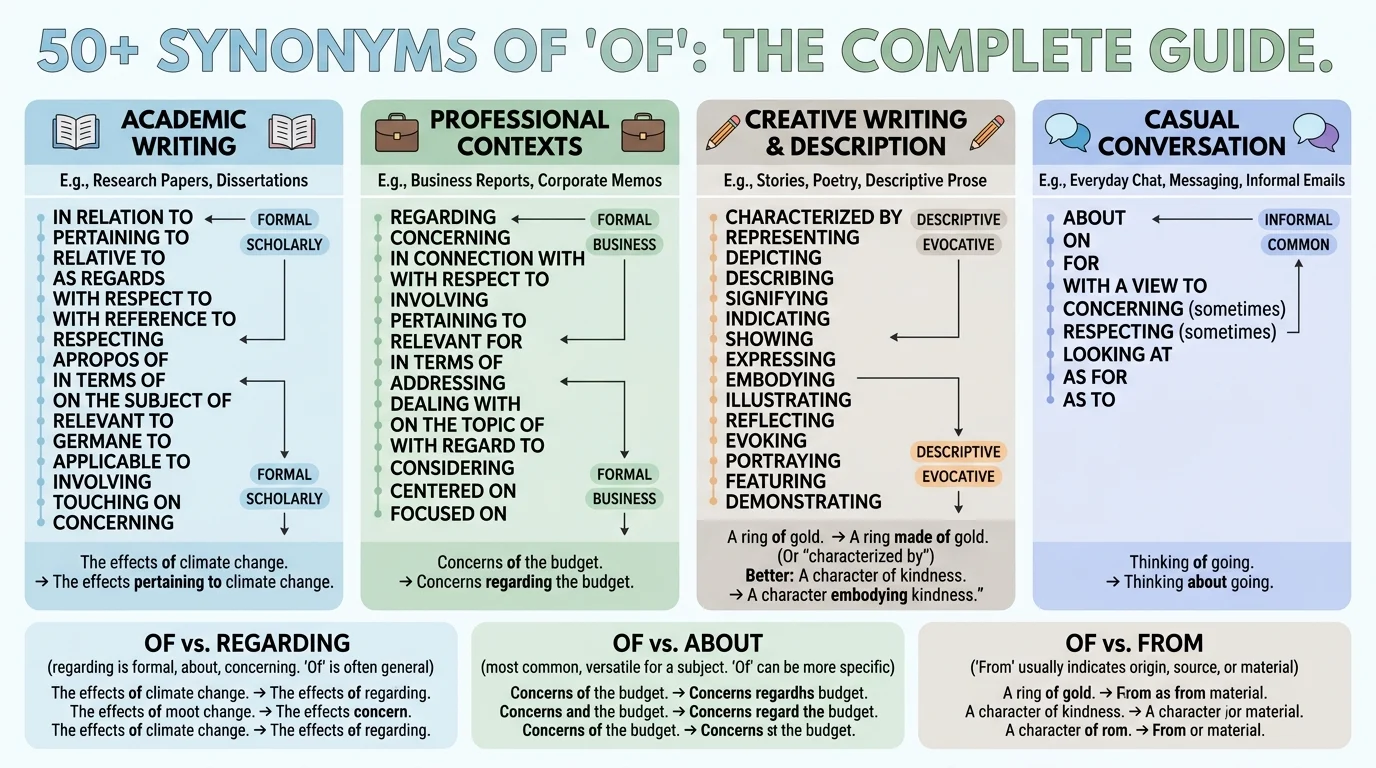
The word “of” indicates relationship, possession, origin, or connection between nouns. It carries a neutral tone and appears across all formality levels. For formal writing, use “concerning,” “regarding,” or “pertaining to.” For casual conversation, try “about” or “from.” In professional communication, choose “with respect to” or “in relation to.” Academic writing benefits from “with regard to” and “as regards.” Creative writing often uses “belonging to” or “associated with” for variety.
Meaning, Tone, and Context
Simple Definition
“Of” is a preposition that shows connections between words. It indicates belonging, origin, cause, direction, or reference.
Part of Speech
Preposition
Overall Tone
Neutral. The word itself carries no emotional weight and serves primarily as a grammatical connector.
Formality Level
Neutral. “Of” works in every setting from casual texting to Supreme Court opinions.
Common Uses
Native English speakers use “of” constantly in everyday speech and writing. Appears in phrases showing possession, such as “the cover of the book.” Indicates origin, like “people of New York.” It connects topics, as in “discussion of climate change.” Appears in measurements, including “a cup of sugar.” It shows relationships in phrases like “friend of mine.” It also appears in countless fixed expressions, such as “a lot of” and “kind of.”
Word Forms
The word “of” only functions as a preposition. It has no noun, verb, adjective, or adverb forms.
When and How to Use “Of”
Choose “of” when you need a neutral connector between two nouns. It works best when the relationship is clear without additional explanation. Use it for possession, origin, topic reference, and measurements.
Professional Context
The annual report of the marketing department showed significant growth.
Academic Context
The theory of evolution continues to generate scholarly debate.
Workplace Context
The director of operations approved the new budget proposal.
Personal Context
My favorite pair of jeans finally wore out.
Email Context
I am writing in response to your inquiry of February 15.
Resume Context
Managed a team of fifteen sales professionals.
Social Media Context
A collection of photos from our weekend trip.
Best Synonyms of “Of”
No synonym perfectly replaces “of” in every situation. The best alternative depends on whether you need to show possession, origin, topic, or relationship. Here are the best choices for specific contexts.
Professional Writing
Use “with respect to” or “concerning.” These phrases sound polished and precise in business documents. They show you are addressing a specific topic clearly.
Academic Writing
Choose “regarding” or “pertaining to.” These words signal scholarly precision and help readers understand exactly what subject you are discussing.
Business Communication
Use “in relation to” for general business writing. This phrase is professional without sounding overly formal.
Casual Conversation
Say “about” or “from.” These words sound natural and friendly in everyday speech.
Emotional Writing
Use “belonging to” or “connected with.” These alternatives add warmth and personal connection.
Creative Writing
Choose “of” sparingly. Use “from,” “among,” or “within” to create variety and rhythm in descriptive passages.
Resume Writing
Use “for,” “with,” or “in” to show responsibilities more actively than “of.”
Workplace Communication
Use “concerning” for memos and internal updates. It sounds professional without stiffness.
Stronger Meaning
Use “belonging to” when ownership matters. Use “derived from” when origin is important.
Softer Meaning
Use “about” to keep the tone casual. Use “connected to” to soften the relationship between ideas.
When Not to Use “Of”
When It Sounds Too General
Using “of” repeatedly makes writing feel vague and unconnected.
Example: The goals of the project of the new manager of the department.
Better: The department’s new manager has specific project goals.
When It Sounds Too Formal for Casual Writing
Using “of” in short texts can feel stiff.
Example: I am in need of coffee.
Better: I need coffee.
When It Creates Unnecessary Wordiness
“Of” often adds extra words without adding meaning.
Example: The issue of funding needs to be addressed.
Better: The funding issue needs to be addressed.
When You Need Stronger Possession
“The book of my father” sounds awkward compared to “my father’s book.”
Better: My father’s book.
Words Commonly Confused With “Of”
Of vs Off
Difference: “Of” shows connection or relationship. “Off” means away from or disconnected.
When to Use It: Use “of” to link nouns. Use “off” to show separation.
Example: The top of the table was scratched. She fell off the chair.
Of vs From
Difference: “Of” often shows possession or belonging. “From” specifically shows origin or source.
When to Use It: Use “of” for general connections. Use “from” when you want to emphasize where something came.
Example: The pages of the book are torn. The recipe came from my grandmother.
Of vs About
Difference: “Of” shows general connection. “About” indicates the subject of discussion.
When to Use It: Use “of” for neutral relationships. Use “about” when you are explaining or discussing something.
Example: She wrote a poem of love. She wrote a poem about love.
Of vs With
Difference: “Of” shows connection or possession. “With” shows accompaniment or instrumentality.
When to Use It: Use “of” to show belonging. Use “with” to show something accompanies something else.
Example: The handle of the door was broken. She opened the door with a key.
Of vs For
Difference: “Of” shows connection or belonging. “For” shows purpose or benefit.
When to Use It: Use “of” to show relationship. Use “for” to show why something exists or who benefits.
Example: The importance of this matter is clear. This matter is important for the team.
Best Synonyms of “Of” by Context
| Context | Best Synonym | Why It Works | Example |
|---|---|---|---|
| Formal writing | Concerning | Signals professional attention to a topic | We need to discuss matters concerning the budget. |
| Academic writing | Pertaining to | Indicates scholarly relevance | The data pertaining to climate change was analyzed. |
| Professional communication | With respect to | Shows careful consideration | With respect to your request, we have approved it. |
| Business emails | Regarding | Clear and concise for topic lines | Regarding our meeting tomorrow, I have sent the agenda. |
| Resume writing | For | Shows responsibility actively | Managed marketing strategy for the Northeast region. |
| Workplace communication | In relation to | Practical for internal updates | In relation to the new policy, all staff must attend training. |
| Casual conversation | About | Natural and friendly | What were you talking about earlier? |
| Everyday speaking | From | Emphasizes source clearly | This gift is from my sister. |
| Creative writing | Among | Adds poetic texture | The secrets among the family were finally revealed. |
| Storytelling | Within | Creates a sense of depth | The truth within her words was undeniable. |
| Emotional writing | Belonging to | Adds warmth and ownership | The necklace belonging to my grandmother holds great value. |
| Strong emphasis | Derived from | Shows clear origin | This theory is derived from earlier research. |
| Mild tone | Connected to | Softens the relationship | The issue is connected to broader concerns. |
| Social media captions | For | Short and engaging | A moment for celebration. |
| American English | About | Most common and versatile | Let’s talk about your plans. |
How to Choose the Best Synonym of “Of”
Consider your audience first. Professional readers expect formal alternatives like “concerning” and “regarding.” Academic readers respond well to “pertaining to” and “with regard to.” Casual readers prefer “about” and “from.”
Consider your purpose. You want to show ownership, use “belonging to” or the possessive form. If you want to show origin, use “from.” If you want to introduce a topic, use “about” or “regarding.”
Consider your tone. Formal documents benefit from precise alternatives. Creative writing benefits from variety. Professional communication requires clarity above all.
Consider natural sound. Read your sentence aloud. If “of” sounds repetitive, replace it. If the alternative sounds forced, keep “of.” The goal is clear, natural communication.
Real Life Examples of “Of”
School
The teacher reviewed the topics of the upcoming exam. She suggested focusing on the chapters concerning world history.
College
The professor discussed theories pertaining to behavioral economics. Her lecture on decision making attracted many students.
Workplace
The team leader addressed concerns regarding the new software. She explained the benefits for the entire department.
Business
The CEO spoke with respect to quarterly earnings. She emphasized the company’s growth in international markets.
Email
Thank you for your message about the conference. I have attached the schedule for your review.
Resume
Managed projects for multiple Fortune 500 clients. Led teams in relation to product development initiatives.
Conversation
What do you think about the new restaurant downtown? I heard great things from my coworkers.
Storytelling
The house at the end of the street held secrets among its walls. The stories within those rooms had never been told.
Blogging
Here are my thoughts about creating better work habits. The strategies for productivity often start with small changes.
Social Media
Celebrating five years of growth. Grateful for the support from our incredible community.
18 Best Synonyms of “Of”
| Synonym | Simple Meaning | Best Used For | Example Sentence |
|---|---|---|---|
| About | Concerning a topic | Casual and conversational writing | Let’s talk about your vacation plans. |
| Regarding | In reference to | Business emails and formal letters | Regarding your application, we have made a decision. |
| Concerning | Relating to a matter | Professional and official documents | We need to address issues concerning safety. |
| Pertaining to | Relating specifically to | Academic writing and research | The data pertaining to population growth is concerning. |
| With respect to | Considering something | Formal business communication | With respect to your proposal, we have some questions. |
| In relation to | Connected with | General professional writing | In relation to our previous discussion, here is an update. |
| Connected to | Linked with | Neutral and clear explanations | The problem is connected to outdated equipment. |
| Associated with | Related to | Professional and academic contexts | The risks associated with this procedure are minimal. |
| Belonging to | Owned by | Showing possession clearly | The property belonging to the estate is listed for sale. |
| Derived from | Originating from | Explaining origins and sources | This recipe is derived from an ancient family tradition. |
| From | Indicating origin | Everyday speech and writing | She received a gift from her grandmother. |
| Among | Within a group | Creative and descriptive writing | The trust among the team members was strong. |
| Within | Inside or contained in | Formal and creative writing | The answer lies within the document. |
| For | Indicating purpose | Short and practical sentences | We need a plan for the project. |
| With | Accompanied by | Showing association | She collaborated with her colleagues. |
| In | Indicating inclusion | Standard professional writing | We found improvements in the data. |
| Between | Connecting two things | Specific relationships | The relationship between the two variables is clear. |
| Through | By means of | Showing process or method | We achieved success through collaboration. |
Synonyms of “Of” by Usage
Professional vs Personal Synonyms
Professional settings favor formal alternatives. “Regarding,” “concerning,” and “with respect to” appear frequently in business writing. These words show attention to detail and respect for the reader. Personal conversations prefer “about,” “from,” and simpler expressions. These words sound natural and friendly in everyday communication.
Formal vs Conversational Synonyms
Formal writing requires precision. “Pertaining to” works well in reports and essays. “With regard to” suits presentations and academic papers. “Concerning” fits business writing and official correspondence. Conversational writing uses “about” almost exclusively. Texting and casual emails rarely need alternatives to “of” because the word works naturally in short sentences.
Academic Synonyms
Academic writing benefits from “pertaining to” and “with regard to.” These phrases signal scholarly precision. “In relation to” works well in research papers. “Concerning” appears frequently in academic discussions. These alternatives help readers understand exactly what subjects you are addressing.
Professional and Business Synonyms
Resumes benefit from “for” and “with” to show responsibilities actively. Business emails use “regarding” and “in relation to” for clarity. Presentations use “with respect to” to signal important topics. These alternatives show professionalism without sounding pretentious.
Creative and Literary Synonyms
Storytelling uses “among,” “within,” and “between” to create depth. Poetry uses “of” sparingly but often pairs it with metaphor. Descriptive writing benefits from “belonging to” and “connected with.” These alternatives add variety and emotional resonance.
Slang or Modern Synonyms
Slang alternatives to “of” do not exist in standard English. The word is too fundamental to have informal replacements. However, modern writing often omits “of” entirely in short forms, such as “kind of” becoming “kinda.” These shortened forms work only in casual writing.
Strongest to Mildest Synonyms
Mild: “About,” “from,” “for”
Moderate: “Regarding,” “concerning,” “in relation to”
Strong: “Pertaining to,” “with respect to,” “derived from”
Very Strong: “Belonging to,” “associated with”
Emotional vs Neutral Synonyms
Emotional Synonyms:
“Belonging to” adds warmth and ownership. “Connected with” suggests a meaningful relationship. “Among” creates a sense of community.
Neutral Synonyms:
“Regarding” simply introduces a topic. “Concerning” states a relationship. “From” indicates source without emotion.
Use emotional synonyms when you want to add feeling to your writing. Use neutral synonyms when you need to communicate information clearly.
Antonyms of “Of”
“Of” does not have direct antonyms because it shows relationship rather than describing something. However, words that indicate separation or disconnection serve as functional opposites.
| Antonym | Meaning | Example Sentence |
|---|---|---|
| Without | Lacking something | She completed the project without any assistance. |
| Apart from | Separate from | Apart from the budget issues, everything is fine. |
| Aside from | Excluding | Aside from the minor errors, your work is excellent. |
| Except | Not including | Everyone attended except the manager. |
| Excluding | Leaving out | Excluding travel costs, the event was affordable. |
| Separate from | Not connected to | The new policy is separate from the old regulations. |
| Independent of | Not depending on | The results are independent of the sample size. |
| Unrelated to | Not connected with | This matter is unrelated to our discussion. |
| Different from | Not the same as | Her approach is different from mine. |
| Disconnected from | Not linked to | The decision is disconnected from reality. |
| Free of | Not containing | This product is free of artificial colors. |
| Devoid of | Completely lacking | The report was devoid of meaningful data. |
| Lacking | Missing something | The proposal is lacking in detail. |
| Outside of | Beyond or apart from | Outside of work, she enjoys painting. |
| Beyond | Further than | The solution lies beyond our current thinking. |
Comparison: “Of” vs Similar Words
Of vs About
Main Difference: “Of” shows general connection. “About” specifically indicates the subject of discussion or concern.
Which Is Stronger? Neither is stronger. They serve different purposes.
Which Is More Formal? “Of” appears in all contexts. “About” is slightly less formal but still acceptable in professional writing.
When to Use Each: Use “of” for possession and general relationships. Use “about” when discussing or explaining something.
Examples:
- Of: The importance of teamwork cannot be overstated.
- About: We need to talk about teamwork.
Of vs From
Main Difference: “Of” shows relationship or possession. “From” specifically indicates origin or source.
Which Is Stronger? “From” is stronger when origin matters.
Which Is More Formal? Both are neutral and work in all contexts.
When to Use Each: Use “of” for general connections. Use “from” to emphasize where something comes from.
Examples:
- Of: The people of this city are friendly.
- From: She comes from a small town.
Of vs Regarding
Main Difference: “Of” shows general connection. “Regarding” specifically introduces a topic in professional contexts.
Which Is Stronger? “Regarding” is stronger and more intentional.
Which Is More Formal? “Regarding” is more formal and professional.
When to Use Each: Use “of” for casual connections. Use “regarding” in business and formal writing.
Examples:
- Of: The question of funding remains.
- Regarding: Regarding funding, we have several options.
Of vs Concerning
Main Difference: “Of” is neutral. “Concerning” signals that a topic requires attention.
Which Is Stronger? “Concerning” carries more weight and urgency.
Which Is More Formal? “Concerning” is more formal and official.
When to Use Each: Use “of” for neutral statements. Use “concerning” when addressing important matters.
Examples:
- Of: The discussion of salaries was brief.
- Concerning: Concerning salaries, we need to review the budget.
Of vs Pertaining to
Main Difference: “Of” is general. “Pertaining to” is specific and scholarly.
Which Is Stronger? “Pertaining to” is more precise.
Which Is More Formal? “Pertaining to” is highly formal and academic.
When to Use Each: Use “of” in everyday writing. Use “pertaining to” in academic and research contexts.
Examples:
- Of: The rules of the game are simple.
- Pertaining to: The rules pertaining to academic conduct are strict.
Of vs With
Main Difference: “Of” shows connection or possession. “With” shows accompaniment or instrumentality.
Which Is Stronger? Neither is stronger. They show different relationships.
Which Is More Formal? Both are neutral.
When to Use Each: Use “of” to show belonging. Use “with” to show something accompanies something else.
Examples:
- Of: The title of the book is memorable.
- With: She wrote the book with her colleague.
Common Phrases and Expressions with “Of”
| Phrase | Meaning | Example Sentence |
|---|---|---|
| A lot of | Many or much | She has a lot of experience in marketing. |
| A couple of | Two or a few | We need a couple of days to finish the project. |
| Kind of | Somewhat or rather | The movie was kind of disappointing. |
| Out of | From within or beyond | We are out of office supplies. |
| Of course | Naturally or certainly | Of course, I will attend the meeting. |
| In need of | Requiring something | The organization is in need of volunteers. |
| On the part of | By someone | This was a generous gesture on the part of the manager. |
Common Mistakes to Avoid
1: Using “of” Too Frequently
Incorrect: The results of the study of the effects of the new policy of the government were surprising.
Better: The government’s new policy effects were surprising.
Why: Removing unnecessary “of” makes the sentence clearer and more direct.
2: Confusing “Of” and “Off”
Incorrect: He fell of the chair.
Better: He fell off the chair.
Why: “Off” means away from. “Of” shows connection. Using the wrong word changes the meaning entirely.
3: Using “Of” in Place of a Possessive
Incorrect: The book of my sister is on the shelf.
Better: My sister’s book is on the shelf.
Why: The possessive form is shorter and more natural.
4: Using an Informal Alternative in Formal Writing
Incorrect: The report is about the budget.
Better: The report regarding the budget.
Why: “Regarding” sounds more professional in business contexts.
5: Using an Overly Formal Alternative in Casual Writing
Incorrect: What are you thinking pertaining to the movie?
Better: What are you thinking about the movie?
Why: “Pertaining to” sounds unnatural in casual conversation.
6: Choosing a Vague Alternative
Incorrect: We need to discuss matters connected to the project.
Better: We need to discuss matters concerning the project.
Why: “Concerning” more clearly indicates the subject of discussion.
7: Omitting “Of” Where It Is Necessary
Incorrect: She is a friend mine.
Better: She is a friend of mine.
Why: “Of” is grammatically required in this expression.
Frequently Asked Questions
1. What are the best synonyms of “of”?
The best alternatives depend on context. “Regarding” and “concerning” work well for professional writing. “About” is best for casual conversation. “Pertaining to” suits academic contexts.
2. What are the best formal synonyms of “of”?
Formal alternatives include “concerning,” “regarding,” “pertaining to,” and “with respect to.” These words signal professionalism and precision in business and academic writing.
3. What are common informal synonyms of “of”?
Informal writing rarely needs alternatives to “of,” but “about” and “from” work naturally in casual contexts. In texting, people often shorten “kind of” to “kinda.”
4. What is another word for “of” in professional writing?
Use “regarding” or “concerning” for business contexts. “in relation to” for internal communication. Use “with respect to” in formal business correspondence.
5. What is the difference between “of” and “from”?
“Of” shows general connection or possession. “From” specifically indicates origin or source. “A friend of mine” shows relationship. “A gift from my sister” shows source.
6. What is the opposite of “of”?
“Of” does not have a direct antonym. Words indicating separation, such as “without” and “apart from,” serve as functional opposites when showing disconnection.
Conclusion
“Of” is one of the most common words in English, and for good reason. It connects ideas clearly and simply. But overusing it makes writing feel clunky and vague. The best synonyms of “of” depend entirely on your audience and purpose. Professional writing benefits from “regarding” and “concerning.” Academic writing gains precision from “pertaining to.” Casual conversation works best with “about” and “from.” No single alternative works everywhere. The key is to think about what relationship you want to show. Then choose the word that communicates that relationship most clearly. Your readers will notice the difference.