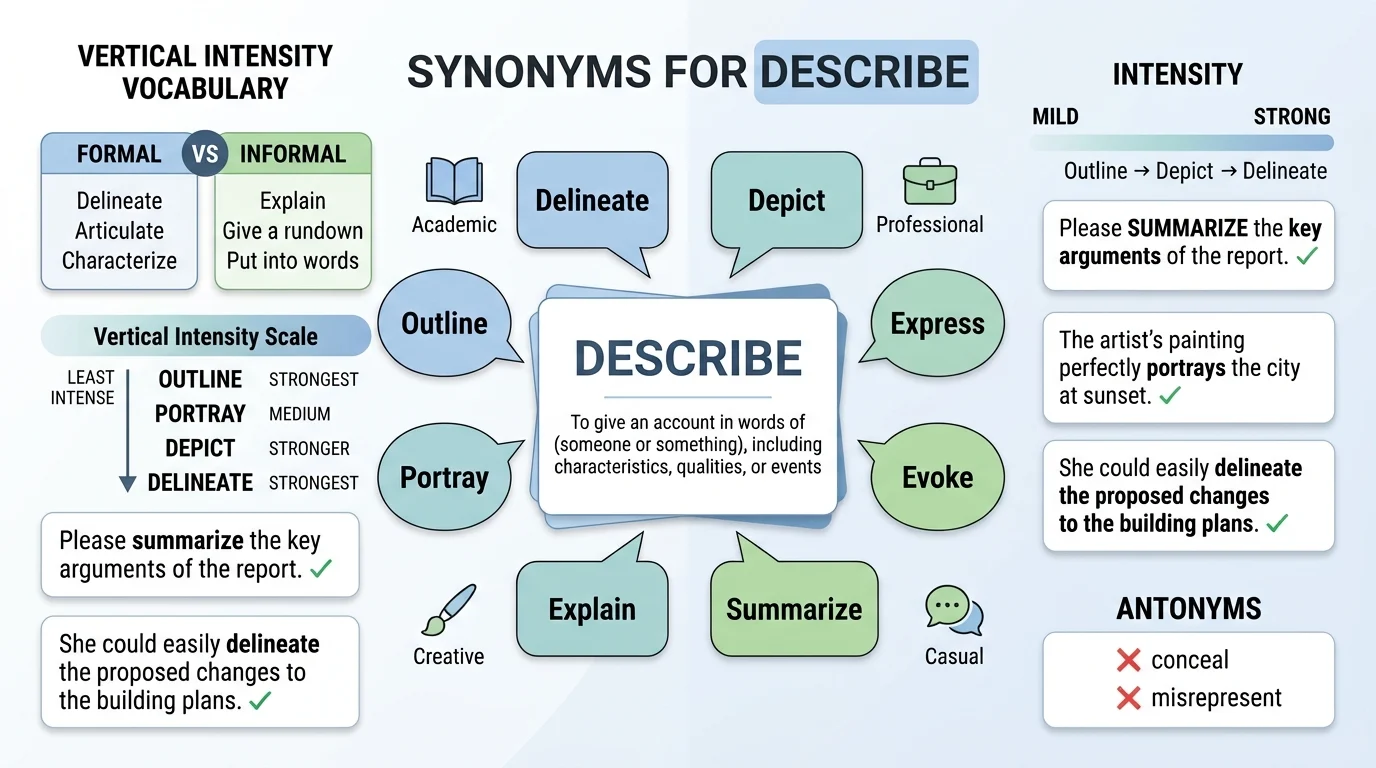
Finding the right words can make your writing clearer, sharper, and more engaging. Sometimes, describe feels too common, especially when you are writing an essay, article, story, or professional piece. That is when you may need another word for describe that fits your exact meaning and tone. The best synonym for describe depends on what you are trying to say. You might use explain, portray, depict, outline, illustrate, or characterize instead. Each word adds a slightly different meaning.
In this guide, you will discover useful synonyms for describe, including common synonyms of describe and alternatives for different writing situations. If you are searching for another word to describe a person, place, idea, or experience, you will find practical options here. We also cover describes synonym choices and synonyms of describes for better sentence variety. For students, we explain another word for describe in an essay and show how to choose the most natural alternative.
What Does “Describe” Mean?
Describe means to give an account of something in words. It involves explaining features, qualities, or details. The best synonyms depend on context. formal writing, use “delineate” or “depict”. For casual use, try “explain” or “tell about”. For emotional writing, choose “portray” or “evoke”. professional settings, “outline” or “summarize” work well.
Meaning, Tone and Context
Simple Definition
Describe means to represent something through language. You use words to create a picture or explanation for someone else.
Part of Speech
Describe is a verb. It is an action word. You describe something when you talk or write about it.
Other forms include:
- Description (noun)
- Descriptive (adjective)
- Describable (adjective)
- Described (past tense)
Positive, Negative, or Neutral Tone
Describe is neutral. It carries no emotional weight on its own. The tone depends on what you describe and how you do it.
Formality Level
Describe is standard. It works in formal and informal situations. You can use it in academic papers, business emails, and casual conversations.
Common Use Cases
People describe things constantly. You describe your day to a friend. describe a product to a customer. You describe a concept to a student. describe an event in a report.
Important Word Forms
The noun form is “description”. This refers to the actual account you give. The adjective is “descriptive”, which means providing details. The opposite form is “indescribable”, meaning impossible to put into words.
When and How to Use “Describe”
describe when you need to give basic information. Use it when you want to explain features or characteristics. Use it when the situation is neutral and straightforward.
Do not use describe when you need stronger language.not use it for highly emotional situations. Do not use it when a more precise word fits better.
Here are examples of describe in different contexts.
Professional Context
The report describes our quarterly sales performance in detail.
Personal Context
Can you describe your ideal vacation destination for me?
Academic Context
The researcher describes the experiment methodology in chapter three.
Creative Context
The poet describes the sunset with beautiful imagery and feeling.
Social Media Context
This video describes exactly how I feel about Monday mornings.
Email Context
Please describe the issue you are experiencing with the software.
Casual Context
I cannot describe how excited I am about this weekend trip.
Resume Context
My previous role required me to describe complex solutions to non technical clients.
Another Word for “Describe”
The best single replacement depends on your situation. Here are the top choices for different needs.
Professional Writing
Use “delineate” for precise, detailed explanations. This word shows you are thorough and careful.
Academic Writing
Use “depict” to show you are representing information accurately and objectively.
Casual Conversation
Use “explain” when you want to make something clear to a friend or family member.
Emotional Writing
Use “portray” to add feeling and depth to your descriptions.
Creative Writing
Use “evoke” to suggest images and emotions without stating them directly.
Resume or Workplace
Use “summarize” when you need to be concise and professional.
Social Media Captions
Use “showcase” to highlight the best features of something.
Stronger Meaning
Use “paint” to indicate a vivid and artistic description.
Softer Meaning
Use “outline” for a brief, general overview.
When Not to Use “Describe”
Describe is too vague for many situations. It gives no sense of the writer’s opinion. adds no emotional weight. It does not suggest the level of detail.
Consider this sentence:
“The manager described the project status.”
This is clear but weak. It tells us nothing about how the manager spoke. It gives no sense of urgency or importance.
Now look at this improved version:
“The manager summarized the project status for the team.”
“Summarized” suggests brevity and focus. It implies the manager gave key points only.
Here is another example:
“She described her feelings about the news.”
This is flat and emotionless. A better choice:
“She expressed her feelings about the news.”
“Expressed” suggests personal emotion and sharing. It makes the sentence more human and relatable.
Use describe only when you need a neutral, basic word. Choose stronger alternatives for more impact.
Words Commonly Confused With “Describe”
Many words seem similar to describe. They are not always interchangeable. Understanding the differences will improve your writing.
Describe vs. Explain
Describe focuses on what something is like. Explain focuses on why something happens. You describe a storm by mentioning rain and wind. You explain a storm by discussing weather patterns.
Describe vs. Define
Define gives a precise meaning. Describe gives characteristics and features. You define a term in a dictionary. You describe a person to a friend.
Describe vs. Portray
Portray adds emotional weight and artistic depth. Describe is neutral and factual. A biographer portrays a historical figure. A news report describes an event.
Describe vs. Depict
Depict suggests visual representation. Describe works for any sensory experience. An artist depicts a scene in a painting. A writer describes a scene in words.
Describe vs. Narrate
Narrate tells a story with a sequence of events. Describe gives a static account. A memoir narrates a person’s life story. A travel guide describes a city.
Describe vs. Relate
Relate suggests personal connection and storytelling. Describe is more detached. A grandfather relates his war experiences. A textbook describes historical events.
Describe vs. Detail
Detail means to list specific items or steps. Describe gives a general account. You detail all the expenses in a budget. You describe your overall financial situation.
Describe vs. Characterize
Characterize focuses on distinctive qualities. Describe covers all features. You characterize someone as ambitious. You describe their appearance and behavior.
Best Synonym by Context for “Describe”
| Context | Best Synonym | Why It Works | Example |
|---|---|---|---|
| Formal Writing | Delineate | Shows precision and careful attention | The author delineates the theoretical framework clearly. |
| Academic Writing | Depict | Indicates objective representation | The study depicts the relationship between variables. |
| Professional Business | Outline | Suggests clear structure and clarity | Please outline your proposal for the new project. |
| Resume Writing | Summarize | Shows ability to be concise and effective | Summarized key findings for executive leadership. |
| Casual Conversation | Explain | Simple and natural for everyday talk | Can you explain how this works to me? |
| Creative Writing | Evoke | Suggests imagery without direct statements | The writer evokes a sense of nostalgia and longing. |
| Emotional Tone | Portray | Adds depth and human feeling | The film portrays grief with honesty and sensitivity. |
| Strong Intensity | Paint | Creates vivid mental images | She paints a remarkable picture of her childhood home. |
| Soft or Moderate Tone | Sketch | Suggests a brief or partial account | He sketched the main points of his argument. |
| Social Media Captions | Showcase | Highlights attractive features effectively | These photos showcase our new collection beautifully. |
| US Usage | Describe | Standard word works well in all contexts | Describe your experience with customer service. |
| UK Usage | Describe | Standard word works well in all contexts | Describe your experience with customer service. |
Which Synonym Should You Choose?
Choosing the right synonym requires careful thought. Consider these factors before making your selection.
Consider Your Meaning
What exactly are you trying to say? Are you giving facts? you sharing emotions? Are you creating imagery? The meaning determines the best word.
Consider Your Formality
Who is your audience? A professor expects formal language. A friend prefers casual speech. A client wants professional communication. Match your word to the situation.
Consider Your Emotional Intensity
How strong should your message feel? Do you want neutrality? Do you want passion? you want subtlety? Choose words that match your desired tone.
Consider Your Professional Value
Some words sound more impressive than others. “Delineate” shows precision. “Summarize” shows conciseness. “Portray” shows sensitivity. Pick words that make you look good.
Consider Your Sentence Context
How does the word fit in your sentence? Does it sound natural? Does it flow well? it add meaning or just complexity? Good writing feels smooth and effortless.
Follow this simple rule. If you are describing something ordinary, use describe. you need more impact, choose a stronger synonym. If you need precision, pick a more specific word.
Real Life Examples of “Describe” in Sentences
These examples show how describe works in everyday situations. Notice how stronger synonyms improve the sentences.
School Context
The teacher asked the students to describe their summer vacations. The best student depicted a vivid scene of swimming in crystal clear lakes.
Workplace Context
The analyst described the market trends in her presentation. She delineated each factor affecting consumer behavior.
Writing Context
The author describes the city in the opening chapter. He evokes the busy streets and quiet alleys with careful detail.
Conversation Context
My grandmother described her first visit to New York City. She related every detail of that memorable trip.
Social Media Context
This influencer describes her daily routine for her followers. She showcases her wellness habits and beauty products.
Resume Context
Responsible for describing product features to clients. Summarized technical specifications for non technical buyers.
Email Context
Please describe the problem you are facing with the account. Outline the steps you have already taken to resolve it.
Storytelling Context
He described the moment he met his wife. He portrayed their first conversation with warmth and humor.
15 Synonyms for “Describe”
| Synonym | Simple Meaning | Best Used For | Example Sentence |
|---|---|---|---|
| Depict | Show or represent clearly | Academic and formal writing | The graph depicts the steady increase in sales. |
| Portray | Describe with emotion or artistic depth | Creative and emotional writing | The author portrays rural life with affection. |
| Delineate | Describe precisely with detail | Professional and formal documents | The policy delineates employee responsibilities. |
| Outline | Give a brief overview | Summaries and presentations | Let me outline the main points of my argument. |
| Explain | Make something clear and understandable | Teaching and everyday conversation | Can you explain this math problem to me? |
| Express | Convey feelings or opinions | Personal and emotional communication | She expressed her concerns about the plan. |
| Evoke | Bring images or feelings to mind | Creative and descriptive writing | The music evokes memories of childhood summers. |
| Characterize | Describe distinctive qualities | Analysis and criticism | Critics characterize the film as groundbreaking. |
| Detail | List specific items or steps | Instructions and reports | The manual details every step of the process. |
| Present | Offer information for consideration | Formal speeches and proposals | The CEO will present the company vision. |
| Report | Give an account based on observation | News and professional settings | The journalist reported on the protest. |
| Recount | Tell a story based on experience | Personal narratives and history | Survivors recounted their harrowing experiences. |
| Illustrate | Make clear with examples or visuals | Teaching and explanatory writing | Let me illustrate this concept with an example. |
| Sketch | Describe roughly or briefly | Quick overviews and initial descriptions | She sketched the basic idea during our meeting. |
| Summarize | Give a concise version | Reports and executive summaries | Please summarize your findings for the board. |
Synonym Groups and Usage Differences
Professional vs. Personal Synonyms
Professional synonyms like “delineate” and “outline” show competence. They suggest you are organized and thorough. Personal synonyms like “express” and “relate” show emotion. They suggest you are sharing something meaningful.
Choose professional words for work environments. Choose personal words for friends and family. Mix them carefully when writing to colleagues you know well.
Formal vs. Conversational Synonyms
Formal words work in reports, essays, and speeches. “Delineate”, “depict”, and “characterize” are good choices. Conversational words work in texts and casual emails. “Explain”, “tell”, and “give details” are more natural.
Always consider your audience. A formal email to a client demands professional language. A text to a friend needs simple words. writing requires precise vocabulary.
Academic Synonyms
Academic writing demands clarity and precision. “Depict” shows objective representation. “Characterize” indicates careful analysis. “Delineate” suggests thorough explanation. “Illustrate” helps readers understand complex ideas.
These words impress professors and reviewers. They show you understand academic conventions. Use them in research papers, theses, and scholarly articles.
Professional and Business Synonyms
Business communication values conciseness. “Summarize” shows you respect people’s time. “Outline” suggests organized thinking. “Present” indicates confidence and professionalism. “Report” implies objectivity and reliability.
These words work well in emails, reviews, and presentations. They make you sound competent and trustworthy. Avoid overly emotional synonyms in professional settings.
Creative or Literary Synonyms
Creative writing benefits from vivid language. “Evoke” creates imagery without being obvious. “Portray” adds depth to characters and scenes. “Paint” suggests artistry and beauty. “Recount” gives personal stories authenticity.
These words make your writing memorable. They engage readers’ emotions and imaginations. Use them in fiction, poetry, and personal essays.
Slang or Modern Synonyms
Slang changes quickly. “Break down” means to explain clearly. “Spill” means to share details, often gossip. “Give the lowdown” means to provide all information.
Use slang only with people who understand it. Avoid it in professional or academic writing. Stick to standard English when your audience is diverse.
Strongest vs. Weaker Synonyms
Intensity scale from mild to strongest:
- Mention (very mild)
- Outline (mild)
- Describe (neutral)
- Depict (moderate)
- Detail (moderate)
- Portray (strong)
- Evoke (very strong)
- Paint (strongest creative)
Emotional vs. Neutral Synonyms
Emotional synonyms add feeling to your writing. “Portray” suggests how someone is perceived. “Evoke” creates emotional responses. “Express” shares personal feelings.
Neutral synonyms stay factual. “Describe” gives facts without emotion. “Outline” provides structure without feeling. “Summarize” condenses information objectively.
Antonyms of “Describe”
| Antonym | Meaning | Example Sentence |
|---|---|---|
| Conceal | Hide from view or knowledge | She tried to conceal her disappointment. |
| Misrepresent | Give false or misleading account | The article misrepresents the facts. |
| Distort | Twist the truth or reality | Do not distort my words to suit your argument. |
| Ignore | Pay no attention to something | The report ignores the most important factor. |
| Overlook | Fail to notice or consider | We cannot overlook these critical details. |
| Misstate | State something incorrectly | The witness misstated the time of the incident. |
| Generalize | Make broad statements without details | Do not generalize about all teenagers this way. |
| Simplify | Make something less complex | He simplified the explanation for beginners. |
| Withhold | Keep back from someone | The company withheld important information. |
| Omit | Leave out or exclude | The summary omits many relevant points. |
| Misquote | Quote incorrectly or inaccurately | The journalist misquoted the politician. |
| Disguise | Give a false appearance | The mild tone disguises his true anger. |
| Mask | Cover or hide something | Her smile masks her real feelings. |
| Minimize | Make something seem less important | He minimized the impact of the error. |
| Confuse | Make unclear or difficult to understand | Do not confuse the issue with irrelevant details. |
Comparison: Describe vs. Similar Words
Describe vs. Explain
The main difference is purpose. Describe answers what and how. Explain answers why and how.
Which one is stronger? Explain is stronger for causal connections. Describe is better for sensory details.
Which one is more formal? Both are equally formal. They work in all writing situations.
Example with describe:
“The article describes the new technology.”
Example with explain:
“The article explains why the new technology works better.”
Describe vs. Define
Define sets exact boundaries. Describe gives general features.
Which one is stronger? Define is stronger for precise meaning. Describe is better for overall understanding.
Which one is more formal? Define is more formal. It is common in academic and legal writing.
Example with describe:
“Please describe your job responsibilities.”
Example with define:
“Please define the term customer satisfaction.”
Describe vs. Portray
Portray adds emotional depth. Describe stays objective.
Which one is stronger? Portray is stronger for emotional impact. Describe is neutral.
Which one is more formal? Portray is common in criticism and arts writing. Describe works everywhere.
Example with describe:
“She described the character as friendly.”
Example with portray:
“She portrayed the character as deeply conflicted.”
Describe vs. Depict
Depict suggests visual clarity. Describe works for all senses.
Which one is stronger? Depict is stronger for visual representation. Describe is more general.
Which one is more formal? Depict is slightly more formal. It appears often in academic writing.
Example with describe:
“The report describes the accident.”
Example with depict:
“The diagram depicts the accident sequence.”
Describe vs. Outline
Outline gives main points only. Describe gives complete details.
Which one is stronger? Neither is stronger. They serve different purposes.
Which one is more formal? Outline is common in professional settings. Describe is standard everywhere.
Example with describe:
“Describe every step of the process.”
Example with outline:
“Outline the main steps of the process.”
Describe vs. Detail
Detail focuses on specific items. Describe covers overall features.
Which one is stronger? Detail is stronger for thoroughness. Describe is better for general accounts.
Which one is more formal? Both are formal and professional.
Example with describe:
“The manual describes the product.”
Example with detail:
“The manual details every part and function.”
Describe vs. Characterize
Characterize highlights distinctive traits. Describe covers all aspects.
Which one is stronger? Characterize is stronger for analysis. Describe is broader.
Which one is more formal? Characterize is more formal. It is common in academic analysis.
Example with describe:
“She described her boss as demanding.”
Example with characterize:
“She characterized her boss as a perfectionist.”
Describe vs. Recount
Recount tells a sequence of events. Describe gives a static account.
Which one is stronger? Recount is stronger for storytelling. Describe is better for explaining features.
Which one is more formal? Recount is common in history and narrative writing.
Example with describe:
“Please describe your weekend.”
Example with recount:
“Please recount everything that happened on your weekend.”
Describe vs. Illustrate
Illustrate clarifies with examples. Describe gives direct information.
Which one is stronger? Illustrate is stronger for teaching. Describe is more direct.
Which one is more formal? Both are appropriate in formal settings.
Example with describe:
“Describe how the system works.”
Example with illustrate:
“Illustrate how the system works with an example.”
Describe vs. Present
Present offers information formally. Describe gives information simply.
Which one is stronger? Present is stronger for professional delivery. Describe is more casual.
Which one is more formal? Present is more formal. It is common in business and academic settings.
Example with describe:
“She described her research to the team.”
Example with present:
“She presented her research to the conference.”
Common Phrases and Expressions with “Describe”
1. Describe in detail
Meaning: Provide thorough information with many specifics
Example sentence: Please describe your experience in detail so we can understand the issue.
2. Describe as
Meaning: State that someone or something has a particular quality
Example sentence: Critics describe her as one of the best actresses of her generation.
3. Hard to describe
Meaning: Difficult to put into words
Example sentence: The feeling of winning was hard to describe to anyone who had not experienced it.
4. Describe the situation
Meaning: Explain what is happening in a given context
Example sentence: Can you describe the situation from your perspective?
5. Describe your experience
Meaning: Explain what happened to you personally
Example sentence: Please describe your experience with our customer service team.
6. Describe the process
Meaning: Explain how something is done step by step
Example sentence: I need you to describe the process for submitting a claim.
7. Describe a scenario
Meaning: Explain a possible situation or set of circumstances
Example sentence: The training module describes a scenario where conflicts arise.
8. Describe the symptoms
Meaning: Explain the physical or mental signs of an illness
Example sentence: The patient described the symptoms to the doctor.
Common Mistakes to Avoid
1. Using Describe When a More Precise Synonym Is Better
Describe is too vague for many situations. Choose a more specific word when possible. Use “delineate” for careful explanations. Use “portray” for emotional accounts. “detail” for step by step descriptions.
Weak: “The report describes our findings.”
Strong: “The report summarizes our findings for executives.”
2. Confusing Describe with Explain
Describe gives characteristics. Explain gives reasons. These words are not interchangeable. Know which one fits your meaning.
Incorrect: “Describe why you left your previous job.”
Correct: “Explain why you left your previous job.”
Also correct: “Describe your previous job responsibilities.”
3. Using Casual Synonyms in Formal Writing
Avoid “tell about” and “go over” in professional documents. These words are too informal. Use “present”, “outline”, or “delineate” instead.
Weak: “I will tell about our project plans.”
Strong: “I will present our project plans.”
4. Using Overly Dramatic Synonyms for Simple Situations
Do not use “portray” or “evoke” for ordinary matters. These words add artistic weight. Reserve them for creative or emotional contexts.
Weak: “I portrayed my breakfast to my friend.”
Strong: “I described my breakfast to my friend.”
5. Repeating the Same Word Too Often
Variety makes writing interesting. Use different synonyms throughout your text. Your readers will appreciate the change.
Poor: “She described the house. Then she described the garden. Finally she described the view.”
Better: “She described the house. Then she outlined the garden. Finally she painted a picture of the view.”
6. Choosing a Synonym with the Wrong Emotional Tone
Match your word to your feeling. “Portray” suggests depth and understanding. “Outline” suggests brevity and structure. Choose carefully.
Weak: “I outlined my love for my family.”
Strong: “I expressed my love for my family.”
7. Using Slang in Academic or Professional Writing
Modern slang has its place. That place is not in formal documents. Stick to standard English in important writing.
Weak: “Let me break down the results for you.”
Strong: “Let me summarize the results for you.”
8. Using Describe for Visual Content
When you have images, use different language. “Depict”, “show”, and “illustrate” work better for visual explanations.
Weak: “The image describes the problem.”
Strong: “The image illustrates the problem.”
9. Forgetting Your Audience
Consider who will read your words. A child needs simple language. A professor expects precise vocabulary. A colleague appreciates clear communication.
Weak: “I will delineate my research findings.”
Strong for general audience: “I will explain my research findings.”
10. Making Sentences Too Complex
Long sentences confuse readers. Keep your descriptions clear and simple. Use short paragraphs and straightforward language.
Weak: “The author describes in great detail the various aspects of the phenomenon which include its causes, effects, and implications for society.”
Strong: “The author describes the phenomenon in three parts: causes, effects, and social implications.”
FAQs
What is the best synonym for describe?
The best synonym depends on your context. For formal writing, use delineate. creative writing, use portray. For casual speech, use explain.
What is a formal synonym for describe?
Delineate is an excellent formal synonym. Depict and characterize also work well in formal contexts. These words show precision and careful thinking.
What is an informal synonym for describe?
Explain and tell about are informal synonyms. Go over and break down are even more casual. Use these in conversation and casual writing.
What is another word for describe in professional writing?
Use outline, summarize, or present in professional writing. These words suggest clarity and organization. They make you sound competent and reliable.
What is the difference between describe and explain?
Describe focuses on what something is like. Explain focuses on why something happens. You describe a storm. You explain weather patterns.
What is the opposite of describe?
Conceal is a strong opposite. Misrepresent and distort also work as opposites. These words suggest hiding or changing the truth.
Conclusion
Describe is a useful word. It helps you share information clearly and directly. But it should not be your only option.
Different situations need different words. Formal writing benefits from precise terms like delineate and depict. Creative writing comes alive with vivid words like portray and evoke. Professional communication values clarity and conciseness.
Think about your audience. Consider your purpose. Choose the word that fits best. Your writing will become more engaging and effective.
Keep this guide handy. Refer to it when you need better vocabulary. Practice using new synonyms in your daily writing. Your skills will grow with consistent effort.
Remember this simple tip. Read your sentences aloud. If describe sounds repetitive or weak, replace it. Find a stronger, more precise synonym. Your readers will notice the improvement.