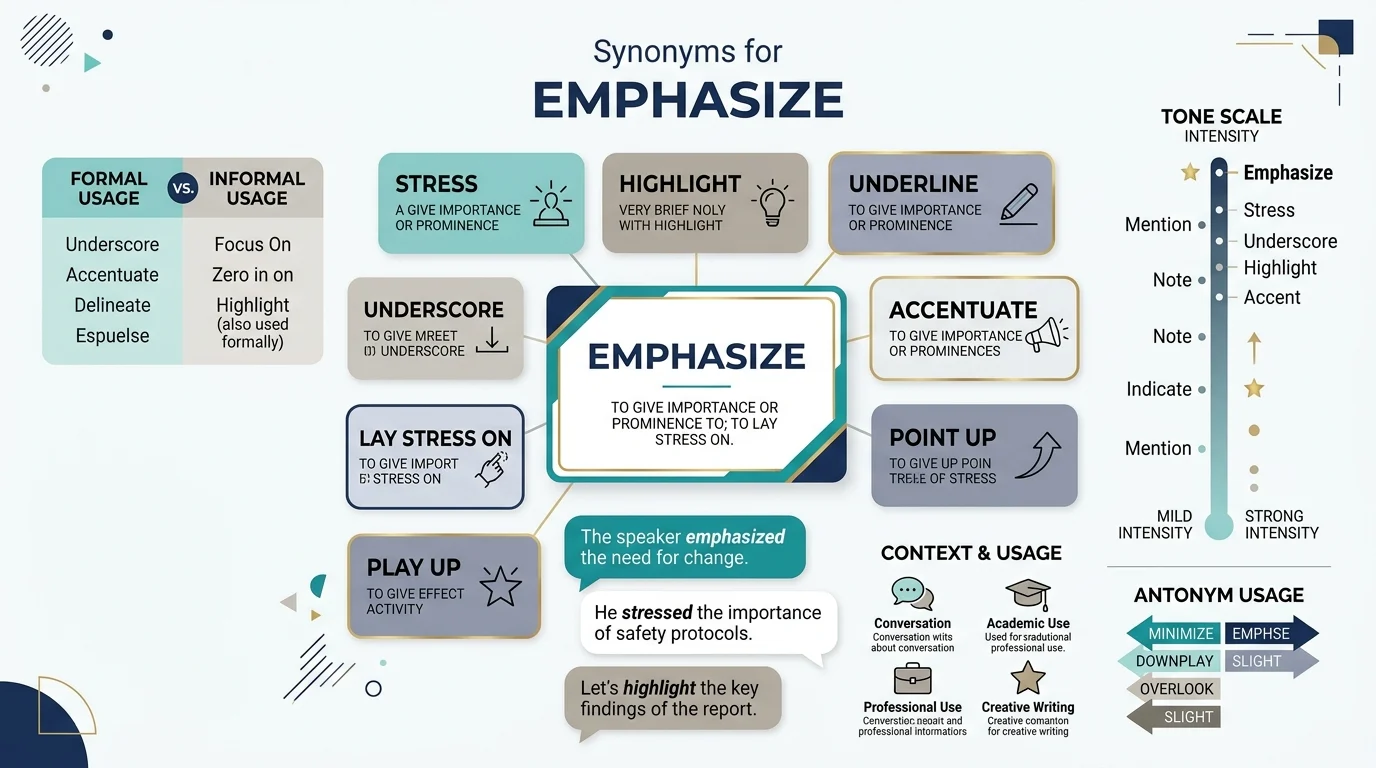
Have you ever read your own writing and noticed the word “emphasize” appearing in nearly every paragraph? You are not alone. Many writers, students, and professionals fall into the habit of repeating this useful but overused word.
Whether you are drafting an important email, crafting a persuasive essay, or polishing a presentation, varying your language makes your message more engaging and precise.
This guide will help you move beyond “emphasize” and choose the perfect synonym for every situation.
What Does “Emphasize” Mean?
Emphasize means to give special importance or prominence to something in speaking or writing. The best synonyms for emphasize depend on your context. For formal writing, use “underscore” or “accentuate.” casual conversation, try “stress” or “highlight.” professional settings, “spotlight” or “foreground” work well.
For academic work, “elucidate” or “substantiate” add precision. emotional impact, use “accent” or “dramatize.” creative writing, consider “illuminate” or “amplify.”
Meaning, Tone and Context
Simple definition: To emphasize something means to make it stand out as particularly important, noticeable, or worthy of attention.
Part of speech: Emphasize is a transitive verb. The related noun form is “emphasis.” The adjective form is “emphatic.”
Tone: Emphasize is neutral and professional. It does not carry a strongly positive or negative emotional weight. This makes it versatile but also somewhat bland when overused.
Formality level: Emphasize is moderately formal. It works well in business writing, academic essays, and professional communication. It also appears in everyday conversation, though simpler alternatives often sound more natural in casual speech.
Common use cases: Writing reports, giving presentations, editing documents, teaching concepts, persuasive writing, highlighting key points, and drawing attention to important details.
Important word forms: Emphasis (noun), emphasize (verb), emphatic (adjective), emphatically (adverb). These related forms give you additional ways to express similar ideas without repeating the same word.
When and How to Use “Emphasize”
Use “emphasize” when you want to draw attention to a specific point, idea, or detail. It works best when you need to signal that something matters more than surrounding information. However, relying on it too heavily makes your writing feel repetitive and less dynamic. Here are realistic examples showing proper usage.
Professional context: The marketing report emphasized the need for stronger customer engagement strategies.
Academic context: The professor emphasized the importance of citing primary sources in research papers.
Casual context: My mother always emphasized the value of good manners at the dinner table.
Emotional context: The speaker emphasized the urgency of climate action with visible passion in her voice.
Creative context: The author used bold imagery to emphasize the contrast between light and shadow.
Social media caption: This recipe emphasizes fresh ingredients over processed alternatives.
Email context: I want to emphasize that the deadline is firm and cannot be extended.
Resume context: My previous role emphasized cross departmental collaboration and team leadership.
Another Word for “Emphasize”
The best single replacement for “emphasize” depends entirely on your context and purpose. Here are targeted recommendations for specific situations.
Professional writing: Use “underscore” to show importance in business documents and professional correspondence.
Academic writing: Use “highlight” for essays and “substantiate” when you need to support claims with evidence.
Casual conversation: Use “stress” for everyday discussions and “point out” for conversational emphasis.
Emotional writing: Use “accent” to add emotional weight or “dramatize” for intense expression.
Creative writing: Use “illuminate” to reveal deeper meaning or “amplify” to expand on a theme.
Resume and workplace: Use “spotlight” to showcase achievements or “foreground” to prioritize key responsibilities.
Social media captions: Use “feature” to highlight content or “call out” to draw attention to something specific.
Stronger meaning: Use “accentuate” when you want to make something more noticeable or “magnify” for extreme emphasis.
Softer meaning: Use “mention” or “note” when you want to acknowledge something without making it a primary focus.
When Not to Use “Emphasize”
“Emphasize” becomes problematic when you use it too often, when you need a more precise word, or when you are writing for a casual audience. It sounds too vague when you could use a more descriptive verb. seems too formal for friendly texts or social media comments. comes across as weak when you need strong, persuasive language. It feels too generic when you want to create vivid imagery.
Here is an example of how a more precise synonym improves your sentence.
Weak use of emphasize: The report emphasizes that customer satisfaction has declined.
Improved with a precise synonym: The report underscores a troubling decline in customer satisfaction.
Another weak example: She emphasized her point during the meeting.
Improved: She drove home her point during the meeting with compelling data.
Words Commonly Confused With “Emphasize”
Several words are often confused with “emphasize” because they deal with attention, importance, or clarity. Understanding the differences helps you choose the right word every time.
Emphasize vs. Stress
“Stress” is more forceful and often implies urgency or anxiety. Emphasize is calmer and more intellectual. Use “stress” when you want to convey pressure or urgency. Use “emphasize” for neutral or academic importance.
Emphasize vs. Highlight
“Highlight” suggests picking out something that stands out from the rest. Emphasize focuses on making something important through discussion or repetition. Use “highlight” when something is visually or naturally noticeable. Use “emphasize” when you need to explain why something matters.
Emphasize vs. Accentuate
“Accentuate” means to make something more noticeable or prominent, often through contrast or addition. Emphasize focuses on importance rather than visibility. Use “accentuate” for physical or visual prominence. Use “emphasize” for conceptual or intellectual importance.
Emphasize vs. Underscore
“Underscore” suggests supporting or reinforcing a point with evidence. Emphasize is broader and does not necessarily involve support. Use “underscore” when you want to show that something is backed up by facts or reasoning.
Emphasize vs. Exaggerate
Exaggerate means to overstate or represent something as larger than it is. Emphasize means to give appropriate importance. Use “exaggerate” when the statement is not literally true. Use “emphasize” when you are drawing attention to something genuinely important.
Emphasize vs. Elaborate
Elaborate means to add more detail or explain more fully. Emphasize means to mark something as important. Use “elaborate” when you need to expand on an idea. Use “emphasize” when you need to make an idea stand out.
Best Synonym by Context for “Emphasize”
This table shows the best synonym for emphasize based on your specific situation. Each recommendation comes with a clear explanation and a realistic example.
| Context | Best Synonym | Why It Works | Example |
|---|---|---|---|
| Formal writing | Underscore | Shows support and reinforcement in official documents | The findings underscore the need for policy reform |
| Academic writing | Highlight | Clearly draws attention to key research findings | The study highlights significant correlations between variables |
| Professional business | Spotlight | Suggests strategic focus and prioritization | The quarterly review spotlights emerging market opportunities |
| Resume writing | Foreground | Positions achievements as primary and valuable | My experience foregrounds strategic planning and execution |
| Casual conversation | Stress | Sounds natural and conversational without being formal | I stress that we should arrive early for good seats |
| Creative writing | Illuminate | Adds depth and reveals meaning through description | The metaphor illuminates the character’s inner conflict |
| Emotional tone | Accentuate | Adds feeling and intensity to the message | Her tears accentuated the sadness of the farewell |
| Strong intensity | Magnify | Suggests amplification and increased importance | The crisis magnified the need for immediate action |
| Soft moderate tone | Mention | Keeps the point gentle without overemphasis | I should mention that we have limited time |
| Social media captions | Feature | Sounds modern and appropriate for digital content | This post features three key tips for productivity |
| US English usage | Emphasize | Standard American spelling and usage | We must emphasize quality over quantity |
| UK English usage | Emphasise | Standard British spelling and usage | We must emphasise quality over quantity |
Which Synonym Should You Choose?
Choosing the right synonym for emphasize depends on several factors. Here is a practical decision guide to help you make the best choice.
Consider your meaning: Think about what you actually want to express. Are you showing importance, drawing visual attention, adding detail, or creating emotional impact? Your core meaning determines the best word.
Consider your formality level: Match your word to your audience and setting. Formal reports need formal synonyms like “underscore.” Casual conversations work better with “stress” or “point out.
Consider emotional intensity: Decide how strong you want your language to be. Use “magnify” or “accentuate” for strong emphasis. Use “mention” or “note” for gentle acknowledgment.
Consider professional impact: For resumes and professional documents, choose words that sound strategic and intentional. “Foreground” and “spotlight” suggest purposeful action.
Consider sentence rhythm: Vary your word choice to keep your writing interesting. Even the best synonym becomes dull with overuse.
Real Life Examples of “Emphasize” in Sentences
Seeing synonyms for emphasize in action helps you understand how each word changes the tone and meaning of a sentence. These examples show how different contexts require different word choices.
School context: The teacher repeatedly stressed the importance of showing your work in math problems.
Workplace context: The CEO underscored the company’s commitment to sustainability during the annual address.
Writing context: The author used short, punchy sentences to accentuate the tension in the final chapter.
Conversation context: I cannot emphasize enough how grateful I am for your support during this difficult time.
Social media context: This video highlights five easy ways to reduce plastic waste at home.
Email context: I want to highlight that the attached document contains the final approved version.
Resume context: My management style foregrounds open communication and team empowerment.
Storytelling context: The dramatic music amplified the emotional impact of the final scene.
25 Synonyms for “Emphasize”
This table provides 25 accurate synonyms for emphasize, each with a unique explanation and a natural example sentence. These words cover formal, informal, academic, professional, emotional, creative, and modern usage.
| Synonym | Simple Meaning | Best Used For | Example Sentence |
|---|---|---|---|
| Accentuate | Make more noticeable through contrast | Visual or physical prominence | The bold font accentuates the headline |
| Highlight | Draw special attention to something | Drawing attention to key points | The report highlights three main findings |
| Stress | Emphasize with force or urgency | Urgent or forceful communication | I must stress the importance of safety protocols |
| Underscore | Show importance through support and evidence | Formal and professional writing | The data underscores the need for change |
| Spotlight | Focus public or strategic attention on | Business and strategic contexts | The campaign spotlights community involvement |
| Foreground | Make something the primary focus | Resumes and professional priorities | My experience foregrounds technical expertise |
| Magnify | Increase importance or significance | Intense or dramatic emphasis | The scandal magnified existing problems |
| Amplify | Make stronger or more pronounced | Creative and expressive writing | The speech amplified the crowd’s enthusiasm |
| Illuminate | Make clear through explanation | Academic and intellectual contexts | The lecture illuminated complex theories |
| Accent | Add special emphasis to | Creative and emotional writing | Her silence accented the tension in the room |
| Point out | Draw attention to something | Casual conversation and reminders | Let me point out a few important details |
| Note | Mention briefly or acknowledge | Gentle or moderate emphasis | Please note the revised schedule |
| Mention | Refer to briefly | Soft or casual emphasis | I should mention the new policy changes |
| Articulate | Express clearly and forcefully | Precise and professional communication | The statement articulates our position clearly |
| Assert | State confidently and forcefully | Persuasive and confident claims | The author asserts the theory’s validity |
| Insist | Demand or state with firmness | Strong, personal emphasis | She insists on following the original plan |
| Maintain | Keep an opinion or claim | Ongoing or defended positions | The professor maintains that grammar matters |
| Contend | Argue or state in debate | Academic and persuasive writing | Scholars contend that the evidence supports this view |
| Allege | State without proof | Legal or controversial contexts | The plaintiff alleges negligence |
| Propound | Put forward for consideration | Formal or theoretical proposals | The philosopher propounds a new ethical framework |
| Expatiate | Speak or write at length | Elaborate explanations | The expert expatiated on the subject |
| Elucidate | Make something clear through explanation | Academic and teaching contexts | The diagram elucidates the process |
| Substantiate | Support with evidence | Academic and research writing | The study substantiates the theory |
| Corroborate | Confirm with additional evidence | Legal and research contexts | The witness corroborated the statement |
| Affirm | State as true or confirm | Positive and confident statements | The survey affirms customer satisfaction |
Synonym Groups and Usage Differences
Professional vs. Personal Synonyms
Professional synonyms emphasize strategy, evidence, and clear communication. Words like “underscore,” “spotlight,” and “foreground” suggest intentional, business minded choices. Personal synonyms like “stress,” “point out,” and “insist” feel more emotional and individual. Choose professional synonyms for workplace documents and personal synonyms for conversations and personal writing.
Formal vs. Conversational Synonyms
Formal synonyms include “accentuate,” “elucidate,” “substantiate,” and “corroborate.” These words belong in research papers, legal documents, and academic journals. Conversational synonyms include “point out,” “note,” “mention,” and “stress.” These words sound natural in everyday discussions, friendly emails, and social media posts.
Academic Synonyms
Academic writing requires precision and evidence based language. “Elucidate” means to make something clearer through explanation. “Substantiate” means to support claims with evidence. “Corroborate” means to confirm findings with additional sources. “Articulate” means to express ideas clearly and coherently. These words signal careful thinking and rigorous scholarship.
Professional and Business Synonyms
Business communication benefits from strategic and results oriented language. “Underscore” suggests that data supports your argument. “Foreground” suggests intentional prioritization. “Spotlight” suggests focused attention on what matters most. “Articulate” suggests clear and persuasive expression. These words help you sound competent and strategic.
Creative or Literary Synonyms
Creative writing thrives on vivid and evocative language. “Accentuate” adds visual or emotional contrast. Illuminate” reveals hidden meaning. “Amplify” increases emotional resonance. “Accent” adds musical or rhythmic emphasis. These words help you paint pictures with words and create memorable descriptions.
Strongest vs. Weaker Synonyms
Intensity scale from mildest to strongest:
Mild: Mention, Note, Point out
Moderate: Highlight, Stress, Emphasize
Strong: Underscore, Spotlight, Articulate
Very Strong: Magnify, Amplify, Accentuate
Extreme: Insist, Assert, Contend
Emotional vs. Neutral Synonyms
Emotional synonyms add feeling and personal investment to your writing. “Insist” shows personal conviction. “Stress” conveys urgency and concern. “Magnify” amplifies emotional impact. “Accentuate” adds dramatic effect. Neutral synonyms stay factual and objective. “Highlight” simply draws attention. “Underscore” provides support. “Note” acknowledges without emotion. Choose emotional synonyms for persuasive writing and neutral synonyms for informational content.
Antonyms of “Emphasize”
This table provides 15 accurate antonyms for emphasize, each with a clear meaning and a natural example sentence.
| Antonym | Meaning | Example Sentence |
|---|---|---|
| Downplay | Make something seem less important | The manager downplayed the significance of the error |
| Understate | Present something as less important | The report understated the financial impact |
| Deemphasize | Reduce the importance given to | We need to deemphasize minor concerns |
| Minimize | Represent as less serious or important | The article minimized the risks involved |
| Neglect | Fail to give proper attention | The presentation neglected key details |
| Overlook | Fail to notice or consider | The proposal overlooked important factors |
| Ignore | Refuse to take notice of | The committee ignored the warning signs |
| Dismiss | Reject as unimportant | She dismissed the criticism without consideration |
| Trivialize | Make something seem unimportant | The media trivialized the environmental concerns |
| Underplay | Present as less significant | The actor underplayed his role in the project |
| Gloss over | Hide or minimize unpleasant aspects | The summary glossed over the failures |
| Brush aside | Refuse to consider seriously | He brushed aside the objections |
| Pass over | Avoid discussing or considering | The review passed over technical limitations |
| Soften | Reduce the force of | The revised statement softened the criticism |
| Mute | Reduce the intensity of | The background music muted the dialogue |
Comparison: Emphasize vs. Similar Words
Emphasize vs. Stress
Main difference: Stress carries more urgency and emotional weight. It often implies pressure or anxiety. Emphasize is calmer and more neutral. It focuses on intellectual importance. Which is stronger: Stress is stronger and more forceful. Which is more formal: Emphasize is more formal. Example for emphasize: The textbook emphasizes the importance of syntax in language learning. Example for stress: I must stress that we have only three days to complete this project.
Emphasize vs. Highlight
Main difference: Highlight suggests something already stands out visually or naturally. Emphasize suggests you are making something important through discussion. Which is stronger: Both are moderate, but emphasize requires more effort. Which is more formal: Emphasize is more formal. Highlight is conversational. Example for emphasize: The article emphasizes the ethical implications of the decision. Example for highlight: The chart highlights the most profitable product categories.
Emphasize vs. Accentuate
Main difference: Accentuate is about making something more noticeable through contrast or addition. Emphasize is about declaring importance. Which is stronger: Accentuate is often more visual and physical. Which is more formal: Accentuate is formal but more artistic. Example for emphasize: The report emphasizes the need for additional funding. Example for accentuate: The dark frame accentuates the painting’s colors.
Emphasize vs. Underscore
Main difference: Underscore implies support and evidence. Emphasize does not require proof. Which is stronger: Underscore is more persuasive because it involves backing up claims. Which is more formal: Underscore is highly formal. Example for emphasize: The speaker emphasized the importance of community involvement. Example for underscore: The statistics underscore the growing inequality.
Emphasize vs. Magnify
Main difference: Magnify suggests making something larger or more significant than it might otherwise seem. Emphasize suggests giving appropriate importance. Which is stronger: Magnify is much stronger. Which is more formal: Magnify is literary and descriptive. Example for emphasize: The manager emphasized the team’s contributions. Example for magnify: Social media can magnify minor controversies.
Emphasize vs. Articulate
Main difference: Articulate focuses on clear expression rather than importance. Emphasize focuses on importance rather than clarity. Which is stronger: Articulate suggests skill and precision. Which is more formal: Articulate is formal and sophisticated. Example for emphasize: The policy emphasizes safety above all else. Example for articulate: The candidate articulated her vision for the company.
Common Phrases and Expressions with “Emphasize”
1. Cannot emphasize enough
Meaning: Used to stress that something is extremely important.
Example sentence: I cannot emphasize enough how careful you must be with sensitive data.
2. Emphasize the importance of
Meaning: Highlight why something matters.
Example sentence: The training emphasizes the importance of regular security updates.
3. Emphasize the need for
Meaning: Highlight what is required.
Example sentence: The report emphasizes the need for improved infrastructure.
4. Emphasize the role of
Meaning: Highlight how something contributes.
Example sentence: The study emphasizes the role of early childhood education.
5. Emphasize the value of
Meaning: Highlight why something is worthwhile.
Example sentence: The workshop emphasizes the value of collaborative problem solving.
6. Emphasize the difference between
Meaning: Highlight how two things are distinct.
Example sentence: The comparison emphasizes the difference between the two approaches.
7. Emphasize the connection between
Meaning: Highlight how two things are related.
Example sentence: The research emphasizes the connection between diet and mental health.
Common Mistakes to Avoid
1. Overusing emphasize in a single document
Repeating emphasize multiple times in one piece of writing makes your work feel repetitive and unpolished. Vary your language with synonyms like “highlight,” “stress,” and “underscore” to keep your writing fresh.
2. Using emphasize when a more precise synonym fits better
“Do not say the report emphasizes growth when you can say the report underscores growth with evidence. Precision makes your writing stronger.
3. Confusing emphasize with exaggerate
Emphasize means giving proper importance. Exaggerate means making something seem larger than reality. Using exaggerate when you mean emphasize can make you sound dishonest or overly dramatic.
4. Using casual synonyms in formal writing
Words like “point out” and “mention” feel too casual for academic papers, legal documents, or executive reports. Save these for emails, conversations, and friendly communication.
5. Using overly dramatic synonyms for simple situations
Magnify, amplify, and accentuate add intensity. Using them for routine matters sounds excessive and unprofessional. Save strong synonyms for genuinely important points.
6. Choosing a synonym with the wrong emotional tone
Insist conveys personal conviction. Underscore conveys evidence based support. Highlight conveys visual attention. Choose the word that matches your emotional intention.
7. Using slang or overly modern synonyms in academic writing
Words like “call out” and “big up” have their place in casual speech but do not belong in formal writing. Stick to standard, professional language for academic and workplace documents.
FAQs
What is the best synonym for emphasize?
The best synonym depends on your context. “Highlight” works for most situations. “Underscore” suits formal writing. “Stress” works well for conversation. Choose based on your audience and purpose.
What is a formal synonym for emphasize?
“Underscore” and “accentuate” are excellent formal synonyms. “Elucidate” and “substantiate” work well in academic writing. “Articulate” and “propound” suit theoretical or philosophical contexts.
What is an informal synonym for emphasize?
“Stress,” “point out,” and “note” are informal synonyms. “Mention” and “highlight” work well in casual conversation. These words feel natural and conversational in everyday speech.
What is another word for emphasize in professional writing?
“Underscore,” “spotlight,” and “foreground” are professional synonyms. “Articulate” and “assert” work well in business communication. These words suggest strategic thinking and intentional communication.
What is the difference between emphasize and stress?
Stress carries more urgency and emotional weight. Emphasize is calmer and more neutral. Use stress for urgent or forceful communication. Use emphasize for academic or professional writing.
What is the opposite of emphasize?
“Downplay” and “deemphasize” are direct opposites. “Minimize” and “understate” also work. “Neglect” and “overlook” suggest failure to emphasize. Choose based on whether the lack of emphasis is intentional or accidental.
Conclusion
Emphasize is a useful and versatile word, but relying on it too heavily makes your writing feel repetitive and uninspired. The key to effective vocabulary is understanding context, tone, and audience. Formal situations call for words like “underscore” and “elucidate.” Casual conversations work better with “stress” and “point out.” Creative writing thrives on “illuminate” and “amplify.” Professional documents benefit from “spotlight” and “foreground.”
The best vocabulary tip is to read widely and pay attention to how skilled writers vary their language. Notice which words they use to draw attention to important points. Practice replacing “emphasize” with more precise alternatives. Your writing will become clearer, more engaging, and more persuasive.
Remember that definitions and usage can evolve. Verify your word choices with trusted dictionaries such as Cambridge, Oxford, Merriam Webster, Collins, or Britannica before publishing important work. This ensures your vocabulary remains accurate and effective.