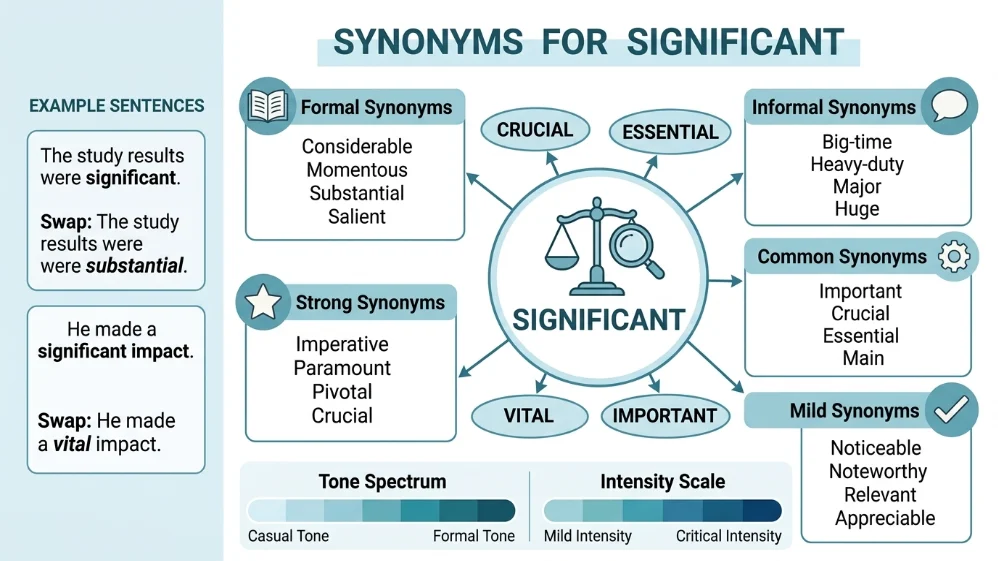
The best synonyms for significant are important, meaningful, notable, and substantial. But the right choice depends on what you’re describing a major life event, a small but meaningful gesture, or a large measurable change.
This guide covers over 100 alternatives, explains the differences between them, and helps you pick the perfect word every time.
Best Synonyms for Significant
The best synonyms for significant are important, meaningful, substantial, and notable. Use important for general value, meaningful for emotional or personal weight, substantial for measurable size or impact, and notable for things that stand out and deserve attention.
The right choice depends entirely on your context, tone, and what you’re trying to emphasize.
What Does Significant Mean?
Significant is an adjective with two main meanings.
First, it describes something important or having a major effect. A significant decision changes outcomes. A significant amount is large enough to matter. Significant event leaves a mark.
Second, it describes something that carries meaning often a hidden or implied one. A significant glance, for example, says more than words could.
Simple definition: Significant means important, meaningful, or large enough to notice.
Example sentences:
- The new policy had a significant impact on employee morale.
- She gave him a significant look that told him everything.
- There was a significant increase in sales this quarter.
Core Meaning of Significant
At its heart, significant is about mattering. Something significant is not trivial. It demands attention, changes things, or carries weight.
The word comes from the Latin significare, meaning “to signify” or “to make known.” That origin reveals something important: significant things signify something. They point to meaning. They’re not just big they’re big for a reason.
This dual nature sets significant apart from simpler words like “big” or “large.” Those words describe size. Significant describes consequence. A significant change isn’t just noticeable it affects outcomes. A significant person isn’t just famous they influence others. Significant amount isn’t just large it makes a practical difference.
Significant lives at the intersection of size, importance, and meaning. That’s why it’s so useful and why it has so many synonyms.
Grammar and Usage Notes
Part of speech: Adjective
Comparative forms: more significant, most significant
Adverbs: significantly, more significantly, most significantly
Common noun collocations:
- significant impact / effect / influence
- significant change / difference / improvement
- significant amount / number / portion
- significant event / moment / milestone
- significant other (a common phrase meaning romantic partner)
Common sentence patterns:
- [Noun] is significant. (The discovery is significant.)
- [Noun] has a significant [effect/impact] on [something]. (The weather has a significant effect on crop yields.)
- There was a significant [noun]. (There was a significant increase in traffic.)
- It is significant that [clause]. (It is significant that she arrived early.)
When to use “significant”:
Use significant when you want to emphasize that something matters either because it’s important, meaningful, or large enough to have consequences. It works in almost any context: academic writing, business reports, news articles, and everyday conversation.
When a synonym may work better:
- If you need a more casual tone, use big or major.
- If you need more formal academic language, use substantial, considerable, or momentous.
- If you’re describing emotional weight, use meaningful.
- If you’re describing something that stands out, use notable or remarkable.
Best Synonyms for Significant
| Synonym | Meaning | Tone | Best Use Case | Example Sentence |
| Important | Having great value or influence | Neutral | General use; the most direct replacement | This is an important decision for our future. |
| Meaningful | Having serious purpose or emotional weight | Warm, personal | Emotional significance, personal connections | They shared a meaningful conversation about their goals. |
| Notable | Worthy of attention or notice | Formal-neutral | Things that stand out or deserve recognition | There has been a notable improvement in her performance. |
| Substantial | Considerable in size, value, or importance | Formal | Measurable amounts, financial matters | We saw a substantial increase in sales this month. |
| Major | Large or important in effect | Neutral-casual | Decisions, events, problems | This is a major step forward for our company. |
| Considerable | Large in amount or degree | Formal | Quantities, effort, influence | They spent a considerable amount of time on the project. |
| Momentous | Of very great importance | Formal, dramatic | Historic events, life-changing decisions | The momentous decision to send in the troops changed everything. |
| Critical | Extremely important; decisive | Serious, urgent | Times when outcomes hang in the balance | The incident happened at a critical point in the campaign. |
| Crucial | Essential to success | Serious, urgent | Things that determine success or failure | It is crucial to follow safety protocols. |
| Weighty | Serious and important | Formal | Grave matters, significant decisions | Surely such weighty matters merit a higher level of debate. |
| Marked | Clearly noticeable | Formal-neutral | Changes, differences, improvements | There has been a marked increase in crimes against property. |
| Pronounced | Very noticeable or distinct | Formal | Features, differences, characteristics | Most of the exhibition has a pronounced Scottish theme. |
Common Synonyms for Significant
These are the everyday alternatives you’ll hear in normal conversation and general writing. They’re versatile, widely understood, and safe choices in most contexts.
Important
Meaning: Having great value, meaning, or influence.
Best context: The most direct and common synonym. Use it whenever you’d use “significant.”
Example: It was one of the most important legal cases of the century.
Meaningful
Meaning: Having a serious purpose or emotional importance.
Best context: When something matters on a personal or emotional level.
Example: The ceremony was deeply meaningful for everyone involved.
Notable
Meaning: Worthy of attention or remarkable.
Best context: When something stands out from the ordinary.
Example: The most notable architectural feature of the town is its castle.
Substantial
Meaning: Considerable in size, amount, or importance.
Best context: Quantities, financial matters, measurable changes.
Example: The company made a substantial profit this year.
Major
Meaning: Large or important in effect.
Best context: Decisions, events, problems, steps forward.
Example: This is a major decision, so we’d better get it right.
Considerable
Meaning: Large in amount, degree, or importance.
Best context: Time, effort, money, influence.
Example: The project required a considerable investment of resources.
Serious
Meaning: Important and not to be taken lightly.
Best context: Problems, matters, issues that demand attention.
Example: I regard this as a serious matter.
Big
Meaning: Important or considerable. (Informal)
Best context: Casual conversation, friendly writing.
Example: This is a big match tonight if we lose, we won’t be in the playoffs.
Formal Synonyms for Significant
These alternatives belong in academic papers, business reports, professional correspondence, and any setting that demands a polished, serious tone.
Consequential
Meaning: Having important results or effects.
Best context: Describing outcomes, decisions, or actions with far-reaching effects.
Example: The court’s ruling was consequential for environmental policy.
Momentous
Meaning: Of very great importance, especially historically.
Best context: Historic events, life-altering decisions, major milestones.
Example: The moon landing was a momentous achievement for humanity.
Weighty
Meaning: Serious, important, and deserving careful consideration.
Best context: Grave matters, significant responsibilities, important discussions.
Example: The committee faces weighty decisions about the future of the program.
Material
Meaning: Important to the matter at hand; relevant and significant.
Best context: Legal, financial, or business contexts where relevance matters.
Example: The company failed to disclose material information to investors.
Pronounced
Meaning: Very noticeable, distinct, and clear.
Best context: Describing clear differences, features, or trends.
Example: There is a pronounced shift in consumer behavior toward sustainable products.
Vital
Meaning: Absolutely necessary or essential; critically important.
Best context: Things that are essential for survival, success, or functioning.
Example: The blockade could cut off vital oil and gas supplies.
Eminent
Meaning: Famous, respected, and important within a particular field.
Best context: Describing people of high standing or achievement.
Example: Her father was an eminent historian.
Prominent
Meaning: Important, well-known, and easily noticed.
Best context: People, features, or roles that stand out.
Example: She was a prominent journalist who took on political corruption.
Of Note
Meaning: Important or worthy of attention. (Formal phrase)
Best context: Formal writing when mentioning something worth noticing.
Example: Did she say anything of note at the meeting?
Operative
Meaning: Effective, producing a desired effect; the most important word or factor.
Best context: Legal or technical writing, emphasizing the key element.
Example: The operative word in that contract is “immediately.”
Informal Synonyms for Significant
These casual alternatives work well in conversation, social media, personal messages, and friendly writing. They’re less formal but still effective.
Big
Meaning: Important or large in effect.
Best context: Everyday conversation, casual announcements.
Example: This is a big deal for the whole team.
Huge
Meaning: Very large or very important.
Best context: Emphasizing scale or importance in casual speech.
Example: This is a huge win for the company.
Major
Meaning: Big, important, serious.
Best context: Casual and professional settings alike.
Example: We’ve got a major problem to solve.
Serious
Meaning: Important, not trivial.
Best context: When you want to emphasize that something matters.
Example: Pollution is a serious issue today.
Stands out
Meaning: Is noticeably better or different.
Best context: Describing something that draws attention.
Example: Her performance really stands out.
Worth mentioning
Meaning: Important enough to talk about.
Best context: Pointing out something notable in conversation.
Example: His improvement is worth mentioning.
High-impact
Meaning: Having a strong effect.
Best context: Decisions, changes, or actions with clear results.
Example: It was a high-impact decision.
Really important
Meaning: Very important. (Emphatic)
Best context: Casual emphasis in conversation.
Example: It’s really important to arrive on time.
Strong Synonyms for Significant
These words carry extra weight. Use them when you need to emphasize that something is not just important, but extremely important often with dramatic, historic, or life-changing implications.
Momentous
Meaning: Of very great significance, especially in history.
When to use: Historic events, decisions that change the course of things. Use it when you want to convey that something will be remembered.
Caution: Can sound overdramatic for everyday matters.
Critical
Meaning: Extremely important, especially at a decisive point.
When to use: Situations where outcomes hang in the balance a critical moment, a critical decision.
Caution: Implies urgency and risk.
Crucial
Meaning: Absolutely essential to success.
When to use: Things that determine whether something succeeds or fails.
Caution: Often overused; reserve it for truly make-or-break situations.
Pivotal
Meaning: Central and decisive; of crucial importance.
When to use: Turning points, moments that change everything.
Example: The invention of the internet was a pivotal moment in human history.
Monumental
Meaning: Of outstanding significance; historically important.
When to use: Achievements, discoveries, events of great scale.
Caution: Best reserved for things that genuinely feel historic.
Epochal / Epoch-making
Meaning: Highly significant, marking the beginning of a new era.
When to use: Changes that fundamentally reshape things.
Example: The discovery was an epochal breakthrough in medicine.
Earthshaking / World-shaking
Meaning: Sufficiently significant to affect the whole world.
When to use: Dramatic emphasis for global or massive changes.
Caution: Often hyperbolic; use sparingly.
Consequential
Meaning: Having important, far-reaching results.
When to use: Actions or decisions with significant outcomes.
Example: The policy change was consequential for millions of people.
Grave
Meaning: Serious and important, often with ominous implications.
When to use: Serious situations, weighty matters.
Example: The country faces a grave economic crisis.
Portentous
Meaning: Of momentous or ominous significance.
When to use: Events that seem to signal something important, often foreboding.
Example: The meeting had a portentous atmosphere.
Mild Synonyms for Significant
Sometimes you want to say something matters without making it sound like the end of the world. These milder alternatives are perfect for that.
Noticeable
Meaning: Easy to see or recognize; clear enough to be observed.
Best context: Small but visible changes, subtle differences.
Example: There’s a noticeable improvement in her writing.
Appreciable
Meaning: Large enough to be noticed or measured.
Best context: Quantities, differences, effects that are detectable.
Example: There was an appreciable difference in temperature after the storm.
Measurable
Meaning: Large enough to be measured; quantifiable.
Best context: Data, statistics, changes that can be counted.
Example: We saw a measurable increase in engagement.
Perceptible
Meaning: Able to be noticed by the senses or the mind.
Best context: Subtle changes that can still be detected.
Example: There was a perceptible shift in her attitude.
Discernible
Meaning: Able to be perceived or distinguished.
Best context: Differences, patterns, or changes that are clear upon examination.
Example: There’s no discernible difference between the two products.
Modest
Meaning: Moderate in amount, not huge but still meaningful.
Best context: Small but significant changes or amounts.
Example: We made a modest but important improvement.
Of Interest
Meaning: Worth paying attention to.
Best context: Things that are noteworthy without being earth-shattering.
Example: The findings are of interest to researchers.
Synonyms for Significant by Context
Everyday Conversation
In casual conversation, keep it simple. Big, major, and important are your go-to words. They’re natural, widely understood, and don’t sound forced.
- Big: “That’s a big decision.”
- Major: “We’ve got a major issue.”
- Serious: “This is a serious matter.”
- Huge: “That’s a huge opportunity.”
Professional Writing
Business and workplace writing calls for words that sound competent without being stuffy. Substantial, considerable, major, and notable work well.
- Substantial: “We saw a substantial increase in revenue.”
- Considerable: “The project required considerable resources.”
- Major: “This is a major milestone for the team.”
- Notable: “There’s been a notable improvement in productivity.”
Academic Writing
Academics demand precision and formality. Momentous, consequential, pronounced, and material are strong choices.
- Momentous: “The discovery was momentous for the field.”
- Consequential: “The policy had consequential effects on the economy.”
- Pronounced: “There was a pronounced correlation between the variables.”
- Material: “The study found material differences between the groups.”
Creative Writing
Writers need words that paint pictures and evoke feelings. Meaningful, momentous, pivotal, and weighty add emotional and dramatic weight.
- Meaningful: “Their eyes met in a meaningful silence.”
- Momentous: “It was a momentous journey into the unknown.”
- Pivotal: “That summer was pivotal in his life.”
- Weighty: “He carried the weighty secret for years.”
Marketing Copy
Marketing needs words that grab attention and persuade. Major, substantial, remarkable, and game-changing work well.
- Major: “A major breakthrough in skincare.”
- Substantial: “Substantial savings up to 50% off.”
- Remarkable: “Remarkable results in just 30 days.”
- Game-changing: “Our game-changing new product.”
Emotional Expression
When you’re talking about feelings, relationships, or personal meaning, meaningful is your best friend. Profound, deep, and significant itself also work.
- Meaningful: “That was the most meaningful conversation we’ve ever had.”
- Profound: “The experience had a profound effect on me.”
- Deep: “We share a deep connection.”
Technical Writing
Technical and scientific writing often uses significant in a specific way to describe results that are statistically meaningful. Statistically significant, measurable, and substantial are key terms.
- Statistically significant: “The results were statistically significant.”
- Measurable: “We observed a measurable effect.”
- Substantial: “The data showed a substantial correlation.”
Personal Communication
In emails, texts, and personal messages, you want words that feel genuine and warm. Meaningful, important, and notable strike the right balance.
- Meaningful: “Thank you for the meaningful gift.”
- Important: “It’s important to me that you know this.”
- Notable: “I noticed a notable change in your attitude.”
Another Word for Significant in a Sentence
Here are 15 natural sentences using different synonyms for “significant.” Notice how each word changes the tone and emphasis.
- Important: “This is an important decision for our future.”
- Meaningful: “They shared a meaningful conversation about their goals.”
- Notable: “There has been a notable improvement in her English.”
- Substantial: “We saw a substantial increase in sales this month.”
- Major: “This represents a major step forward for our company.”
- Considerable: “The project demanded considerable time and effort.”
- Momentous: “The signing of the treaty was a momentous occasion.”
- Critical: “Getting the funding was critical to the project’s success.”
- Crucial: “Her testimony was crucial to the case.”
- Weighty: “The board faced weighty decisions about the company’s future.”
- Marked: “There was a marked difference between the two approaches.”
- Pronounced: “The new director has a pronounced impact on team morale.”
- Consequential: “The election had consequential effects on foreign policy.”
- Pivotal: “That moment was pivotal in shaping his career.”
- Remarkable: “She made remarkable progress in a short time.”
Significant Synonyms Compared
Some synonyms for “significant” are so close that choosing between them can be tricky. Here’s how to tell them apart.
| Synonym | Core Meaning | Tone | Intensity | Best Used For |
| Important | General value or influence | Neutral | Medium | Almost anything |
| Meaningful | Emotional or personal weight | Warm | Medium | Relationships, purpose |
| Notable | Stands out from the ordinary | Neutral | Medium | Things worth noticing |
| Substantial | Large in size or amount | Formal | Medium-High | Quantities, money |
| Major | Large in effect | Neutral | Medium | Events, decisions, problems |
| Momentous | Historically important | Formal | High | Life-changing events |
| Critical | Decisive; outcome depends on it | Serious, urgent | High | Make-or-break situations |
| Crucial | Essential for success | Serious | High | Things that determine success |
| Considerable | Large in amount or degree | Formal | Medium | Time, effort, quantities |
| Weighty | Serious and important | Formal | High | Grave matters, responsibilities |
Key distinction: Important is the broadest and safest choice. Meaningful adds emotional weight. Notable emphasizes that something deserves attention. Substantial emphasizes size or amount. Momentous emphasizes historical or life-changing significance. Critical and crucial both imply urgency and high stakes, but critical often refers to a specific point or moment, while crucial refers to what’s essential for success.
Words Similar to Significant
These words belong to the same semantic neighborhood as “significant,” but they’re not always exact replacements. Here’s why.
Important
This is the closest synonym. The main difference? “Important” focuses on value and influence. Significant” also carries connotations of meaning and measurable effect. In most cases, they’re interchangeable.
Meaningful
“Meaningful” emphasizes purpose and emotional significance. Something can be meaningful without being large or historically important. A small gesture can be deeply meaningful.
Substantial
“Substantial” emphasizes size, amount, or worth. It’s often used for measurable things: substantial profits, substantial evidence, substantial changes. It leans more toward quantity than quality.
Notable
“Notable” means worthy of notice. Something notable stands out, but it doesn’t necessarily change things or carry deep meaning. A notable feature is noticeable; a significant feature affects outcomes.
Considerable
“Considerable” is about size or degree. A considerable amount is large. A significant amount is large and matters. The difference is subtle but real.
Momentous
“Momentous” is “significant” turned up to eleven. It’s reserved for things of great historical or personal importance. Not every significant event is momentous but every momentous event is significant.
Critical / Crucial
These words imply high stakes. Something critical or crucial is not just important it’s essential. Use them when failure or success depends on the thing you’re describing.
Consequential
“Consequential” emphasizes results. Something consequential has important effects or outcomes. It’s a good choice when you want to highlight what happens because of something.
Remarkable
“Remarkable” means worthy of notice because it’s unusual or impressive. It doesn’t always mean important something can be remarkable (unusually strange) without being significant (important).
Antonyms of Significant
Sometimes the best way to understand a word is to look at its opposite.
| Antonym | Meaning | Example Sentence |
| Insignificant | Not important; too small to matter | The difference between the two car models is insignificant. |
| Unimportant | Lacking importance or value | These are unimportant details just get on with telling the story. |
| Trivial | Of little value or importance | Don’t waste time on trivial matters. |
| Minor | Lesser in importance or size | That’s a minor issue compared to the main problem. |
| Negligible | So small or unimportant as to be not worth considering | The cost difference is negligible. |
| Inconsequential | Not important or significant | His comment was inconsequential to the discussion. |
| Meaningless | Having no meaning or purpose | The gesture felt hollow and meaningless. |
| Petty | Of little importance; trivial | They argued over petty details. |
How to Choose the Right Synonym for Significant
Picking the right word isn’t complicated, but it does require thinking about a few things.
1. Match the context.
Are you writing a formal report, a text to a friend, or a novel? Formal contexts call for words like substantial, considerable, and momentous. Casual contexts welcome big, major, and huge.
2. Match the tone.
Do you want to sound warm and personal? Use meaningful. Serious and urgent? Use critical or crucial. Neutral and professional? Use important or notable.
3. Check the intensity.
How significant is it, really? If it’s life-changing, use momentous or pivotal. If it’s a small but real change, use noticeable, appreciable, or measurable. Don’t overstate and don’t understate.
4. Think about the reader.
Will your reader understand the word? If you’re writing for a general audience, stick with common words like important, major, and meaningful. Save portentous and epochal for specialized audiences.
5. Check whether the synonym is exact or only related.
Remarkable means worthy of notice, but it doesn’t always mean important. Substantial emphasizes size, not always importance. Make sure the word you choose actually says what you mean.
6. Keep the sentence natural.
Read your sentence aloud. Does the synonym sound right? If it feels forced or awkward, try a different word. Natural writing always wins.
7. Use simple words when clarity matters.
When in doubt, choose important. It’s the clearest, most direct synonym for “significant,” and it works in almost every situation.
Common Mistakes When Using Synonyms for Significant
Even experienced writers make these mistakes. Here’s what to watch out for.
Choosing a word with the wrong tone.
Using momentous to describe a minor scheduling change sounds ridiculous. Using big in an academic paper sounds too casual. Match the tone to the setting.
Using a synonym that is too strong.
Not every important event is momentous or earthshaking. Save the heavy hitters for things that genuinely deserve them. Overusing strong words makes them lose their power.
Using a formal word in casual writing.
If you text your friend about a “momentous” dinner plan, you’ll sound like you’re trying too hard. Keep it natural.
Using a casual word in professional writing.
“Big” and “huge” are fine in conversation, but in a business report, substantial or considerable sound more professional.
Replacing “significant” without checking meaning.
Remarkable and notable are close, but they’re not always the same. Something notable stands out; something significant affects outcomes. Make sure the synonym actually fits.
Treating related words as exact synonyms.
Substantial emphasizes size. Meaningful emphasizes emotional weight. They’re not interchangeable. Use the one that matches what you’re actually trying to say.
Making the sentence sound unnatural.
If the synonym doesn’t flow naturally in the sentence, choose a different word. Forcing a fancy synonym into a simple sentence usually backfires.
Quick Synonym List for Significant
Common Synonyms
important, meaningful, notable, substantial, major, considerable, serious, big
Formal Synonyms
consequential, momentous, weighty, material, pronounced, vital, eminent, prominent, of note, operative
Informal Synonyms
big, huge, major, serious, stands out, worth mentioning, high-impact, really important
Strong Synonyms
momentous, critical, crucial, pivotal, monumental, epochal, earthshaking, consequential, grave, portentous
Mild Synonyms
noticeable, appreciable, measurable, perceptible, discernible, modest, of interest
Related Words
influential, far-reaching, foundational, landmark, powerful, primary, principal, prominent, remarkable, outstanding
FAQs
What is the best synonym for significant?
The best synonym depends on your context, but important is the most direct and widely useful replacement. Meaningful works best for emotional significance, substantial for measurable size or impact, and notable for things that stand out.
What is another word for significant?
Common alternatives include important, meaningful, notable, substantial, major, considerable, and momentous. The right choice depends on what you’re describing and your tone.
What is a formal synonym for significant?
Formal alternatives include consequential, momentous, weighty, material, pronounced, vital, and of note. These work well in academic writing, business reports, and professional communication.
What is an informal synonym for significant?
Casual alternatives include big, huge, major, and serious. Use these in conversation, social media, and friendly writing.
What is a stronger word for significant?
Stronger words include momentous, critical, crucial, pivotal, monumental, and epochal. These carry more emotional weight and emphasize extreme importance.
What is a milder word for significant?
Milder alternatives include noticeable, appreciable, measurable, perceptible, and modest. These work when something matters but isn’t earth-shattering.
What words are similar to significant?
Words in the same semantic family include important, meaningful, substantial, notable, considerable, momentous, and influential. They share the core idea of mattering, but each has a slightly different emphasis.
What is the opposite of significant?
The main antonyms are insignificant, unimportant, trivial, minor, negligible, inconsequential, and meaningless. These describe things that don’t matter or are too small to notice.
How do I choose the right synonym for significant?
Match the context (formal or casual), match the tone (warm or serious), check the intensity (mild or strong), think about your reader, and make sure the synonym actually means what you want to say. When in doubt, use important it works almost everywhere.
Conclusion
Finding the right synonym for significant comes down to understanding what you’re really trying to say. Are you describing something important, meaningful, large, or noticeable? Are you writing formally or casually? Is the thing you’re describing mildly significant or earthshakingly so?
The best synonym is the one that fits your context, matches your tone, and sounds natural to your reader. Keep this guide handy, trust your ear, and don’t be afraid to choose a simple word when it’s the right one. After all, the most significant thing about good writing isn’t using fancy words it’s using the right words.