Have you ever written an email or a social media caption and realized you used the word “angry” three times in two sentences? You are not alone. Many writers, students, and professionals fall into the habit of repeating the same word. This makes their writing feel flat and unoriginal.
Imagine you are crafting a professional complaint letter. You want to express your frustration, but “angry” sounds too emotional. Or perhaps you are writing a novel and need a word that conveys a character’s simmering rage. The English language offers a rich vocabulary to describe anger. Using the right synonym can transform your writing, making it more precise and powerful.
This guide provides over 50 synonyms for angry. You will learn the exact meaning, tone, and context for each one. You will discover which words work best in professional settings, which are perfect for creative writing, and which to avoid in formal situations. By the end, you will never struggle to find another word for angry again.
What Does “Angry” Mean?
Angry is an adjective describing a strong feeling of displeasure or hostility. The best synonyms depend on context: use “annoyed” or “irritated” for mild situations, “furious” or “irate” for extreme anger, and “indignant” for anger about unfair treatment.
For professional writing, choose “frustrated” or “displeased”.
Meaning, Tone and Context
1. Simple definition: Angry means feeling or showing anger. It is a natural emotional response to a perceived wrong, frustration, or injustice.
2. Part of speech: Adjective. The noun form is “anger,” and the adverb is “angrily.”
3. Tone: Negative and confrontational.
4. Formality level: Neutral. It works in most situations but can feel blunt in professional or sensitive conversations.
5. Common use cases: You use “angry” in everyday conversation, personal writing, and新闻报道 to describe someone’s emotional state. It appears in phrases like “angry mob,” “angry response,” and “angry customers”.
6. Important word forms: The comparative form is “angrier,” and the superlative is “angriest”.
When and How to Use “Angry”
Use “angry” when you need a clear, direct word for displeasure. It works well in general situations where you do not need to specify the intensity or the nuance of the emotion. However, overusing it makes your writing dull. Here are examples of using “angry” in different contexts.
Professional context:
The client was angry about the delay in the project timeline.
Personal context:
My sister gets really angry when her favorite team loses.
Academic context:
The study measured how angry participants felt after receiving unfair feedback.
Emotional context:
She felt angry at herself for making such a ignorant mistake.
Creative context:
The angry sea crashed against the rocks with terrible waves.
Social media caption:
I am so angry that my flight got canceled again.
Email context:
I am angry about the service I received and expect a full refund.
Casual context:
Are you angry with me?
Another Word for “Angry”
Choosing the best single replacement depends entirely on your situation. A generic synonym might not capture the specific shade of anger you feel.
1. Professional writing: Use “frustrated.” It sounds constructive and emotionally intelligent.
2. Academic writing: Use “indignant.” It conveys anger about unfair treatment.
3. Casual conversation: Use “mad.” It is informal and widely used in US English.
4. Emotional writing: Use “furious.” It communicates extreme anger.
5. Creative writing: Use “seething.” It suggests anger that is barely controlled.
6. Resume or workplace use: Use “displeased.” It is polite and mature.
7. Social media captions: Use “heated.” It implies an argument or intense emotion.
8. Stronger meaning: Use “enraged” or “livid”.
9. Softer meaning: Use “annoyed” or “upset”.
When Not to Use “Angry”
Avoid using “angry” when you need a more precise word. It sounds too vague in professional writing. It also feels too weak when you are extremely upset. Furthermore, it can be too blunt in sensitive conversations.
Weak example: I am angry that the meeting was rescheduled.
Improved example: I am frustrated that the meeting was rescheduled without consulting the team.
The word “frustrated” explains the reason for your emotion and sounds more professional.
Weak example: He was angry when he saw the damage.
Improved example: He was livid when he saw the damage.
“Livid” conveys a much stronger, more dramatic reaction.
Words Commonly Confused With “Angry”
Understanding the subtle differences between similar words helps you choose the right one.
1. Angry vs. Mad: “Mad” is an informal synonym for angry in US English. “Angry” is neutral and works in all contexts.
2. Angry vs. Annoyed: “Annoyed” means slightly angry, often due to a minor inconvenience. “Angry” is a stronger, more intense feeling.
3. Angry vs. Furious: “Furious” means extremely angry. “Angry” is a general term that covers a range of intensity.
4. Angry vs. Indignant: “Indignant” is anger about unfair treatment. “Angry” can be about anything.
5. Angry vs. Irritated: “Irritated” suggests ongoing annoyance. “Angry” can be a sudden or lasting feeling.
6. Angry vs. Cross: “Cross” is a British term for angry, often used with children. “Angry” is more common in American English.
Best Synonym by Context for “Angry”
This table provides the best synonym for angry based on your specific situation.
| Context | Best Synonym | Why It Works | Example |
|---|---|---|---|
| Formal writing | Displeased | It is polite and measured. | The board was displeased with the quarterly results. |
| Academic writing | Indignant | It conveys anger about injustice. | The participants were indignant about the unfair test. |
| Professional or business use | Frustrated | It sounds constructive. | I am frustrated by the lack of communication. |
| Resume | Disappointed | It is a softer, more professional term. | Left the role due to being disappointed in the management. |
| Casual conversation | Mad | It is common and informal in US English. | Are you mad at me? |
| Creative writing | Seething | It suggests suppressed rage. | She drove home from work seething. |
| Emotional tone | Furious | It shows extreme emotion. | My boss was furious with me. |
| Strong intensity | Livid | It means extremely angry. | She was livid that he didn’t tell her. |
| Soft or moderate tone | Annoyed | It is mild and polite. | I was annoyed when he was late. |
| Social media captions | Heated | It implies a passionate argument. | Things got heated in the comments section. |
| US English | Mad | It is the most common informal alternative. | He is mad about the decision. |
| UK English | Cross | It is a standard term, especially for children. | I’m cross with you for not telling me. |
Which Synonym Should You Choose?
Choosing the right word requires you to consider four factors: meaning, formality, emotional intensity, and context.
First, decide the exact meaning you want to convey. Are you mildly annoyed or absolutely furious? Second, consider the formality of the situation. An email to your boss needs a different word than a text to your friend. Third, match the emotional intensity. Do not use a dramatic word like “livid” for a minor inconvenience. Fourth, think about your context. A novel allows for creative words like “wrathful,” while a business report calls for measured words like “displeased.”
Real Life Examples of “Angry” in Sentences
Seeing words in action helps you understand their usage. These examples show how to use synonyms for angry across different real life situations.
School context:
The student was frustrated by the difficult math problem.
Workplace context:
The manager was displeased with the team’s performance.
Writing context:
Her indignant letter to the editor went viral.
Conversation context:
He was annoyed when his friend canceled their plans.
Social media context:
I am so mad about the new policy changes.
Resume context:
Resolved conflicts with irate customers in a calm manner.
Email context:
I am concerned about the errors in the report, and I feel frustrated.
Storytelling context:
The king was wrathful and demanded immediate revenge.
25 Synonyms for “Angry”
This table provides 25 accurate synonyms for angry. Each one has a unique meaning and usage.
Synonym Groups and Usage Differences
Professional vs. Personal Synonyms
Professional synonyms focus on the cause of the anger. Words like “frustrated,” “displeased,” and “disappointed” are constructive. Personal synonyms like “mad,” “upset,” and “annoyed” focus on the feeling itself.
Formal vs. Conversational Synonyms
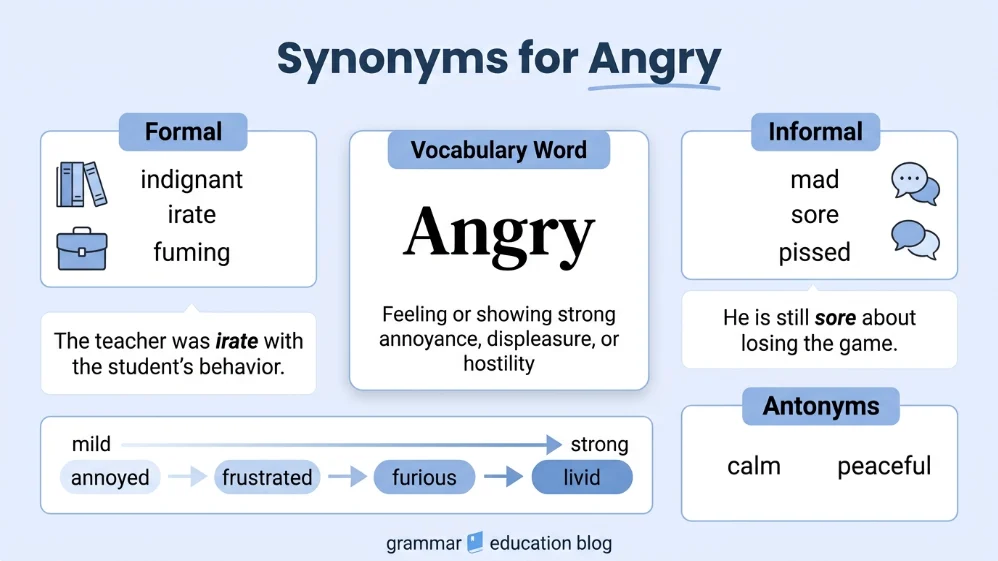
Formal synonyms include “indignant,” “irate,” and “incensed. These words work in reports, essays, and official speeches. Conversational synonyms include “mad,” “sore,” and “cross”. These are best for texts, casual writing, and everyday speech.
Academic Synonyms
Academic writing requires precise language. “Indignant” shows anger about injustice. “Exasperated” describes extreme frustration. “Hostile” describes antagonistic behavior. These words add a scholarly tone to your work.
Professional and Business Synonyms
In emails, reviews, and presentations, use “frustrated,” “displeased,” or “disappointed”. These words sound emotionally intelligent and mature. Avoid slang like “pissed off,” which is unprofessional.
Creative or Literary Synonyms
Creative writing benefits from vivid imagery. “Seething” suggests repressed anger. “Fuming” implies silent rage. “Wrathful” and “ireful” add a dramatic, old-fashioned tone. “Incandescent” describes white-hot fury.
Slang or Modern Synonyms
Slang words are acceptable in casual settings. “Mad” is common in US English. “Sore” is also used informally. “Pissed” and “pissed off” are very informal and can be offensive in professional writing.
Strongest vs. Weaker Synonyms
Here is an intensity scale from mild to strongest:
- Annoyed (mild)
- Irritated (mild to moderate)
- Frustrated (moderate)
- Mad (moderate, informal)
- Exasperated (moderate to strong)
- Furious (strong)
- Irate (strong)
- Enraged (very strong)
- Livid (very strong)
- Apoplectic (extremely strong)
Emotional vs. Neutral Synonyms
Emotional synonyms like “furious,” “livid,” and “enraged” add intense feeling. Neutral synonyms like “displeased,” “annoyed,” and “frustrated” describe the state without dramatic emotion. Choose based on whether you want to emphasize the feeling or state a fact.
Antonyms of “Angry”
Antonyms are words with opposite meanings. They help you express the absence of anger.
Comparison: Angry vs. Similar Words
Angry vs. Annoyed
Main difference: Annoyed is mild, while angry is stronger.
Which one is stronger: Angry.
Which one is more formal: Both are neutral, but annoyed is often more polite.
Example for “angry”: I am angry about the unfair treatment.
Example for “annoyed”: I am annoyed by the constant interruptions.
Angry vs. Furious
Main difference: Furious means extremely angry.
Which one is stronger: Furious.
Which one is more formal: Furious is more dramatic but can be used formally.
Example for “angry”: He was angry with his teammate.
Example for “furious”: He was furious at being taken out of the game.
Angry vs. Indignant
Main difference: Indignant is anger about unfair treatment.
Which one is stronger: Indignant is often intense but focused on injustice.
Which one is more formal: Indignant is more formal.
Example for “angry”: She was angry about the delay.
Example for “indignant”: She was indignant at the way she had been treated.
Angry vs. Irritated
Main difference: Irritated suggests ongoing annoyance.
Which one is stronger: Angry is generally stronger.
Which one is more formal: Both are neutral.
Example for “angry”: I was angry that he didn’t call.
Example for “irritated”: I was irritated that he didn’t thank me.
Angry vs. Mad
Main difference: Mad is an informal synonym for angry in US English.
Which one is stronger: They can be equal in intensity.
Which one is more formal: Angry is more formal.
Example for “angry”: Please don’t be angry with me.
Example for “mad”: She’s mad at me for being late.
Angry vs. Cross
Main difference: Cross is a British term.
Which one is stronger: They are similar in intensity.
Which one is more formal: Angry is neutral, cross is informal and British.
Example for “angry”: The angry mob attacked the building.
Example for “cross”: I’m cross with you for not telling me.
Common Phrases and Expressions with “Angry”
1. Angry with someone
Meaning: Feeling displeasure toward a person.
Example sentence: Please don’t be angry with me.
2. Angry at something
Meaning: Feeling displeasure about a situation or thing.
Example sentence: I was so angry at the way I had been treated.
3. Angry about something
Meaning: Feeling displeasure concerning a topic.
Example sentence: The people are very angry over the decision.
4. Get angry
Meaning: To become angry.
Example sentence: I started to get really angry and upset.
5. Make someone angry
Meaning: To cause someone to feel anger.
Example sentence: Her behaviour really made me angry.
6. Angry mob
Meaning: A large crowd of angry people.
Example sentence: The players were attacked by an angry mob.
7. Angry response
Meaning: A reply that shows anger.
Example sentence: The comments provoked an angry response.
8. Angry silence
Meaning: A quiet period that shows anger.
Example sentence: An angry silence filled the room.
Common Mistakes to Avoid
1. Using “angry” when a more precise synonym is better: “Angry” is a catch-all word. Use “frustrated” for workplace issues, “indignant” for injustice, and “annoyed” for minor irritations.
2. Confusing “angry” with “annoyed”: These are not interchangeable. “Annoyed” is much milder. Do not say you are “annoyed” when you are actually “enraged.”
3. Using a casual synonym in formal writing: Do not use “mad,” “pissed,” or “sore” in a business report or academic essay. Use “displeased” or “frustrated.”
4. Using an overly dramatic synonym for a simple situation: Saying you are “livid” because someone is late is an overreaction. Use “annoyed” or “irritated” for minor issues.
5. Repeating the same word too often: Variety is key. Use this guide to find different words for different sentences.
6. Choosing a synonym with the wrong emotional tone: Make sure the word matches the feeling. “Bitter” implies long-term resentment, while “furious” is a sudden, intense burst of anger.
7. Using slang in academic or professional writing: Slang like “mad,” “sore,” and “pissed off” has no place in professional communication.
FAQs
1. What is the best synonym for angry?
The best synonym depends on the context. For mild anger, use “annoyed.” For extreme anger, use “furious” or “livid.”
2. What is a formal synonym for angry?
Formal synonyms include “displeased,” “indignant,” “irate,” and “incensed.” These words are suitable for official or academic writing.
3. What is an informal synonym for angry?
Informal synonyms include “mad,” “sore,” and “cross.” “Mad” is very common in US English.
4. What is another word for angry in professional writing?
Use “frustrated,” “displeased,” or “disappointed.” These words sound constructive and emotionally intelligent.
5. What is the difference between angry and furious?
Furious means extremely angry. It is a much stronger word than angry.
6. What is the opposite of angry?
The most common opposite is “calm”. Other opposites include “peaceful,” “pleased,” and “content.”
Conclusion
Angry is a common word that describes a strong feeling of displeasure. However, the English language offers a wealth of precise alternatives. The best synonym depends on your context, tone, and the intensity of the emotion. For professional settings, use “frustrated” or “displeased.” Creative writing, use “seething” or “fuming.” For extreme anger, use “furious” or “livid.” Always consider your audience and the situation before choosing a word.
A practical vocabulary tip is to keep a list of your favorite synonyms nearby. Refer to it when you write emails, essays, or social media posts. This practice will gradually expand your vocabulary and make your communication more effective.