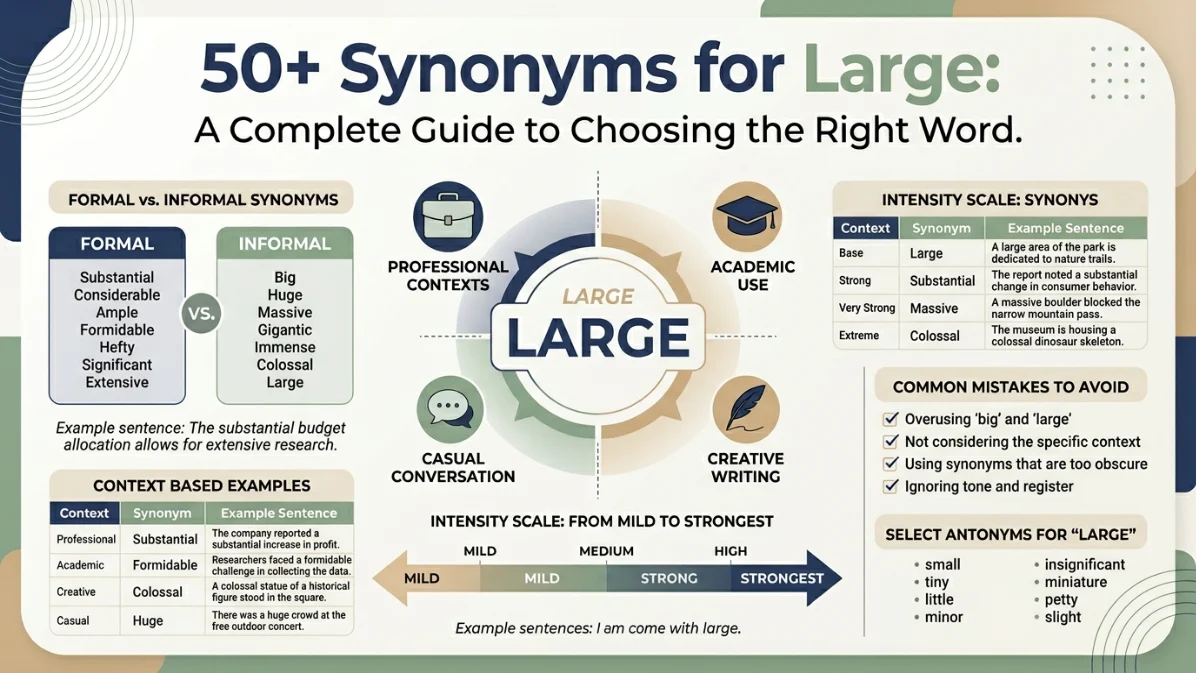
Do you find yourself using the word “large” over and over again in your writing? Perhaps you are describing a big house, a significant increase in sales, or a substantial meal. Repeating the same adjective can make your writing feel flat and uninspired.
Whether you are a student working on an essay, a professional crafting an email, or a blogger creating content, finding the right word can make all the difference. This guide explores synonyms for large. You will learn how to choose the perfect word for any situation, from formal reports to casual conversations.
What Does Large Mean?
The word “large” describes something that exceeds the average in size, amount, extent, or capacity. It is a neutral adjective that works in most situations. For formal writing, consider “substantial” or “considerable.” For casual settings, use “big” or “huge.”
Academic contexts call for “extensive” or “significant.” Creative writing benefits from “immense” or “colossal.” Professional communication often uses “major” or “sizable.”
Meaning, Tone and Context
Simple Definition
“Large” is an adjective that refers to something greater than normal in dimensions, quantity, or scope.
Part of Speech
“Large” functions as an adjective. Its comparative form is “larger,” and its superlative form is “largest.”
Tone
The tone of “large” is neutral and objective. It does not add strong emotion or judgment.
Formality Level
“Large” sits in the middle of the formality scale. It works well in both everyday conversation and professional writing.
Common Use Cases
People use “large” to describe physical objects, numbers, amounts, groups, and abstract concepts like ideas or impacts.
Word Forms
Adjective: large
Comparative: larger
Superlative: largest
Adverb: largely
The opposite of “large” is “small,” “little,” or “tiny.”
When and How to Use “Large”
You should use “large” when you need a clear, straightforward word that everyone understands. It is versatile and does not carry heavy emotional weight. Use it to describe something that is above average but not to an extreme degree. This word works best when precision is not critical and when you want to avoid sounding overly dramatic or technical.
Here are examples of “large” in different contexts.
Professional Example
Our team managed a large project with multiple stakeholders across three countries.
Academic Example
The study examined a large sample of participants from diverse socioeconomic backgrounds.
Casual Example
We ordered a large pizza with extra cheese for the game night.
Emotional Example
She felt a large sense of relief after finishing her final exams.
Creative Example
The tree cast a large shadow over the entire garden.
Resume Example
Managed a large budget of over two million dollars.
Social Media Caption
The concert drew a large crowd of enthusiastic fans.
Another Word for “Large”
Finding another word for “large” depends entirely on your context. Here are the best single replacements for different situations.
Professional Writing
Use “substantial” to describe significant amounts or important matters.
Example: The company made a substantial investment in new technology.
Academic Writing
Use “extensive” when referring to research, coverage, or study.
Example: The researcher conducted an extensive review of existing literature.
Casual Conversation
Use “big” for everyday descriptions and friendly talk.
Example: That is a big dog you have there.
Emotional Writing
Use “immense” to convey deep feelings or overwhelming experiences.
Example: He felt immense gratitude for his supportive family.
Creative Writing
Use “vast” to describe expansive landscapes or abstract concepts.
Example: The desert stretched into a vast emptiness.
Resume Use
Use “sizable” to quantify achievements and responsibilities.
Example: Oversaw a sizable team of forty employees.
Social Media Captions
Use “huge” for informal, enthusiastic descriptions.
Example: This was a huge moment for our community.
Stronger Meaning
Use “colossal” when you want to emphasize extreme scale.
Example: The corporation faced a colossal failure in its product launch.
Softer Meaning
Use “moderate” for something that is somewhat large but not excessive.
Example: They live in a moderate sized home in the suburbs.
When Not to Use “Large”
You should avoid “large” when a more specific word would provide better information. “Large” is too vague when you need to convey exact measurements, precise quantities, or distinctive qualities. It fails to capture the nuances of shape, proportion, or relative scale. Using “large” repeatedly in your writing makes it sound lazy and unpolished.
Consider this weak sentence:
The large building was damaged in the storm.
A stronger version with a more precise synonym:
The towering skyscraper sustained damage during the storm.
Here is another example of vague language:
We received a large number of applications.
A more effective statement:
We received an overwhelming number of applications.
Words Commonly Confused With “Large”
Several words often get mixed up with “large,” but they have distinct meanings and uses. Understanding these differences will improve your vocabulary.
Big
“Big” is more informal than “large” and often implies importance or significance. You can use “big” for physical size or abstract concepts.
Example: She landed a big role in the film.
Great
“Great” emphasizes magnitude and often carries a positive connotation of impressiveness. It is used for both size and quality.
Example: They showed great courage in difficult times.
Huge
“Huge” suggests something much bigger than average and adds emotional intensity. It is more dramatic than “large.”
Example: The storm created huge waves along the coast.
Giant
“Giant” compares something to a giant in size and is often used for things that are exceptionally large. It works well in descriptive writing.
Example: The giant oak tree had stood for centuries.
Massive
“Massive” implies bulk, weight, and solidity. It suggests heaviness and density.
Example: The massive boulder blocked the mountain path.
Substantial
“Substantial” refers to something considerable in size, value, or importance. It is more formal and precise.
Example: She received a substantial inheritance from her grandmother.
Best Synonym by Context for “Large”
The table below shows the best synonyms for “large” in different contexts. Each recommendation is tailored to fit the tone and formality of the situation.
| Context | Best Synonym | Why It Works | Example |
|---|---|---|---|
| Formal Writing | Substantial | It conveys importance and significant value | The committee made a substantial contribution to the fund |
| Academic Writing | Extensive | It suggests thoroughness and comprehensive coverage | The professor cited extensive research on the topic |
| Professional Business | Sizable | It provides a professional yet accessible tone | Our department manages a sizable annual budget |
| Resume Writing | Considerable | It highlights noteworthy achievements | Demonstrated considerable leadership skills |
| Casual Conversation | Big | It feels natural and friendly in everyday talk | Let us go to that big restaurant downtown |
| Creative Writing | Vast | It adds depth and imagery to descriptions | The vast ocean stretched beyond the horizon |
| Emotional Tone | Immense | It conveys deep feelings and powerful experiences | The news brought immense joy to the community |
| Strong Intensity | Colossal | It emphasizes extreme scale and magnitude | The project required a colossal effort |
| Soft Moderate Tone | Fairly Large | It downplays size while still noting it | We have a fairly large garden in the backyard |
| Social Media | Huge | It feels modern and enthusiastic for followers | This was a huge win for our team today |
| US Usage | Large | It remains the neutral standard in American English | The large truck blocked the intersection |
Which Synonym Should You Choose?
Choosing the right synonym for “large” requires you to consider several factors. Ask yourself these questions before making a selection.
What is your purpose?
If you are stating a fact, choose a neutral word like “large” or “big.” If you want to impress or persuade, select a stronger word like “substantial” or “considerable.”
What is the tone of your writing?
Formal reports call for words like “extensive” or “significant.” Personal emails and casual blogs work well with “big” or “huge.”
What level of intensity do you need?
For a mild emphasis, use “good sized” or “fairly large.” For strong impact, use “massive” or “colossal.”
What is your audience?
Think about who will read your work. Professionals expect precise, measured language. Friends and social media followers appreciate energetic, informal words.
Does the word fit the sentence?
Read your sentence aloud with the synonym. If it sounds awkward or forced, try a different option. The best word flows naturally and enhances your meaning.
Real Life Examples of “Large” in Sentences
These examples show how “large” and its synonyms appear in everyday situations. Notice how the word choice changes the tone and clarity of each sentence.
School Example
The teacher assigned a large amount of reading over the holiday break.
Alternative: The teacher assigned an extensive reading list over the holiday break.
Workplace Example
Our department handles a large volume of customer inquiries each day.
Alternative: Our department handles a substantial volume of customer inquiries each day.
Writing Example
The author described a large forest in the opening chapter.
Alternative: The author described an immense forest in the opening chapter.
Conversation Example
We need a large table for the family reunion dinner.
Alternative: We need a big table for the family reunion dinner.
Social Media Example
This bakery has a large selection of pastries.
Alternative: This bakery has a huge selection of pastries.
Resume Example
I led a large team of software developers.
Alternative: I led a sizable team of software developers.
Email Example
We request a large meeting room for the presentation.
Alternative: We request a spacious meeting room for the presentation.
Storytelling Example
The large wave crashed against the rocky shore.
Alternative: The enormous wave crashed against the rocky shore.
15 Synonyms for “Large”
This table provides 15 accurate synonyms for “large.” Each synonym has a unique meaning and is best used in a specific context.
| Synonym | Simple Meaning | Best Used For | Example Sentence |
|---|---|---|---|
| Big | More than average in size or importance | Everyday conversation | We found a big house near the lake |
| Huge | Extremely large, often dramatic | Exaggerated descriptions | The concert attracted a huge audience |
| Enormous | Very large in size or degree | Emphasizing extreme scale | The dinosaur left enormous footprints |
| Gigantic | Very large, like a giant | Creative and descriptive writing | A gigantic statue stood in the square |
| Colossal | Beyond large, almost unbelievable | Highlighting monumental scale | The corporation faced a colossal loss |
| Immense | Very large, without limits | Emotional or abstract descriptions | She felt immense relief after the exam |
| Massive | Large and heavy in mass | Describing structures or objects | The massive fortress withstood the attack |
| Vast | Large in area or extent | Describing landscapes and concepts | The vast desert stretched for miles |
| Substantial | Considerable in value or importance | Formal and professional writing | They made a substantial donation |
| Considerable | Worth noticing due to largeness | Academic and report writing | A considerable amount of time passed |
| Sizable | Fairly large in size or amount | Business and workplace contexts | The company has a sizable market share |
| Ample | Large enough to meet needs | Describing space or resources | The buffet offered ample food choices |
| Generous | Larger than usual, often positive | Describing amounts or portions | She received a generous salary increase |
| Grand | Large and impressive in scale | Formal descriptions of buildings | They stayed in a grand hotel suite |
| Extensive | Covering a wide area or range | Research and comprehensive topics | The scientist conducted extensive research |
Synonym Groups and Usage Differences
Professional vs. Personal Synonyms
Professional contexts call for measured, formal language. Words like “substantial,” “considerable,” and “sizable” show that you are serious and precise. These synonyms add credibility to reports, proposals, and business communications. They suggest that you have carefully considered the scale of something.
Personal contexts allow for more expressive language. You can use “huge,” “enormous,” or “massive” to share excitement or surprise with friends and family. These words add emotion and energy to personal stories.
Formal vs. Conversational Synonyms
Formal synonyms include words like “extensive,” “substantial,” and “ample.” These words work best in official documents, academic papers, and professional correspondence. They communicate a sense of authority and careful measurement.
Conversational synonyms include “big,” “huge,” and “giant.” These words feel approachable and friendly in everyday speech. They work well in text messages, social media posts, and casual emails.
Academic Synonyms
Academic writing values precision and clarity. “Extensive” shows thorough coverage of a subject. “Considerable” indicates a notable quantity or degree. “Ample” suggests sufficient resources for research purposes. These words sound knowledgeable and well reasoned.
Professional and Business Synonyms
Business communication requires words that balance professionalism with clarity. “Sizable” and “substantial” are excellent choices for reports and presentations. They sound impressive without being overly dramatic. “Major” and “significant” also work well to highlight important matters.
Creative or Literary Synonyms
Creative writing benefits from vivid, descriptive language. Words like “vast,” “immense,” and “colossal” paint strong mental pictures. They add drama and depth to narratives. “Gigantic” and “enormous” also help readers visualize scale and magnitude.
Slang or Modern Synonyms
Modern slang occasionally offers fresh alternatives for “large.” Words like “huge” and “massive” remain popular in casual speech. Social media often favors “big” and “huge” for their energetic feel. Avoid slang in formal settings, but embrace it in creative and conversational contexts.
Strongest vs. Weaker Synonyms
Intensity scale from mild to strongest:
Mild: fairly large, good sized, ample
Moderate: big, sizable, considerable
Strong: huge, substantial, immense
Strongest: enormous, massive, gigantic, colossal, vast
Emotional vs. Neutral Synonyms
Emotional synonyms add feeling to your description. “Huge” and “enormous” express excitement or surprise. “Immense” conveys deep personal significance. “Massive” suggests awe or intimidation. Neutral synonyms like “big” and “sizable” report facts without emotional weight. “Substantial” and “considerable” stay factual while showing importance.
Antonyms of “Large”
Understanding the opposites of “large” will expand your vocabulary and help you make better word choices. Here are accurate antonyms for different contexts.
| Antonym | Meaning | Example Sentence |
|---|---|---|
| Small | Below average in size | The cat lived in a small apartment |
| Little | Small in size or amount | She added a little sugar to her tea |
| Tiny | Very small | The tiny seed grew into a flower |
| Miniature | Much smaller than usual | He collected miniature cars |
| Minute | Extremely small | The details were minute |
| Petite | Small and delicate | She wore a petite dress |
| Compact | Small and well organized | They bought a compact car |
| Diminutive | Very small in size | The diminutive creature scurried away |
| Microscopic | So small it needs magnification | The bacteria were microscopic |
| Narrow | Small in width | The path was narrow and winding |
| Limited | Small in amount or degree | The restaurant had a limited menu |
| Modest | Not large in size or scale | They lived in a modest home |
| Insignificant | Too small to matter | The difference was insignificant |
| Slight | Small in degree | There was a slight improvement |
| Trivial | Very small and unimportant | The issue was trivial |
Comparison: “Large” vs. Similar Words
Large vs. Big
The main difference is formality. “Large” is neutral and works in any context. “Big” is more informal and conversational. “Large” is better for professional and academic writing. “Big” feels friendlier for everyday talk. Big” can also mean important, while “large” focuses on size alone. Example: We bought a large house. Example: This is a big decision.
Large vs. Huge
“Huge” is much stronger than “large” and adds emotional intensity. “Large” is factual and objective. “Huge” suggests something remarkable or surprising. “Large” is more common in formal writing. “Huge” works well for enthusiastic descriptions. Example: We sold a large number of tickets. Example: We sold a huge number of tickets.
Large vs. Enormous
“Enormous” goes beyond “large” to suggest something extraordinary. “Large” describes everyday sizes. “Enormous” signals exceptional magnitude. “Large” fits most situations. “Enormous” should be reserved for truly impressive things. Example: They served a large meal. Example: They served an enormous meal.
Large vs. Massive
“Massive” emphasizes weight and bulk, while “large” covers all dimensions. “Massive” suggests heaviness and solidity. “Large” is more general. “Massive” often describes physical objects. “Large” works for abstract concepts too. Example: They moved a large desk. Example: They moved a massive desk.
Large vs. Extensive
“Extensive” focuses on range and coverage. “Large” simply describes size. “Extensive” is better for abstract ideas like knowledge or research. “Large” is straightforward and simple. “Extensive” sounds more sophisticated and thorough. Example: The library has a large collection. Example: The library has an extensive collection.
Large vs. Substantial
“Substantial” implies value or importance beyond mere size. “Large” is neutral and objective. “Substantial” suggests meaningful quantity. “Large” works for any size. “Substantial” is better for formal and professional contexts. Example: We allocated a large budget. Example: We allocated a substantial budget.
Common Phrases and Expressions with “Large”
1. By and large
Meaning: Generally speaking, all things considered.
Example sentence: By and large, the event was a success.
2. Large as life
Meaning: Appearing clearly and unmistakably.
Example sentence: She walked in large as life to the surprise of everyone.
3. At large
Meaning: As a whole or not captured.
Example sentence: The escaped prisoner remained at large for three days.
4. Larger than life
Meaning: More impressive or exciting than ordinary people.
Example sentence: The actor had a personality that was larger than life.
5. Bulk large
Meaning: To be important or prominent.
Example sentence: Environmental issues bulk large in current political debates.
6. Writ large
Meaning: Made clear or obvious on a larger scale.
Example sentence: The challenges of the city were writ large in its housing crisis.
7. Large and in charge
Meaning: In control and confident.
Example sentence: The manager walked in large and in charge.
Common Mistakes to Avoid
Using “large” when a more precise synonym is better
Avoid relying on “large” for everything. A towering building, a vast desert, and a substantial budget each deserve a specific word. Think about what makes something large: is it height, area, quantity, or weight? Choose accordingly.
Confusing “large” with “great”
“Great” emphasizes importance and quality. “Large” focuses only on size. You can have a great accomplishment that is not large in size. You can have a large collection that is not particularly great in value. Use “large” for physical or measurable things. Use “great” for significance.
Using a casual synonym in formal writing
Avoid using words like “huge” or “massive” in academic papers or official reports. These words sound emotional and imprecise. Choose “substantial,” “considerable,” or “extensive” to maintain professionalism.
Using an overly dramatic synonym for a simple situation
Do not call a standard serving of food “colossal” or an ordinary house “enormous.” Overstatement makes your writing seem exaggerated and less believable. Save the strongest synonyms for things that truly impress.
Repeating the same word too often
Rotate your synonyms to keep your writing fresh. If you describe a large building, a large crowd, and a large budget in the same paragraph, your writing becomes dull. Vary your vocabulary to maintain reader interest.
Choosing a synonym with the wrong emotional tone
Consider how your word choice affects the reader. “Enormous” can feel overwhelming. “Ample” feels positive and adequate. “Substantial” feels professional. “Huge” can feel exciting or intimidating. Match your synonym to the feeling you want to create.
Using slang in academic or professional writing
Avoid informal expressions like “ginormous” or “mega” in serious contexts. These words undermine your credibility. Save them for social media posts and conversations with friends.
FAQs
What is the best synonym for large?
The best synonym depends on your context. For most professional writing, “substantial” is excellent. For academic work, use “extensive.” Casual situations, “big” works perfectly.
What is a formal synonym for large?
“Substantial,” “considerable,” and “ample” are formal synonyms for “large.” These words sound professional and measured.
What is an informal synonym for large?
“Big,” “huge,” and “giant” are informal synonyms. They work well in everyday conversation and social media.
What is another word for large in professional writing?
“Substantial,” “sizable,” and “significant” are strong choices for professional writing. They convey importance without being exaggerated.
What is the difference between large and big?
“Large” is more formal and objective. “Big” is more casual and can also mean important. Use “large” in academic and business contexts. Use “big” in personal conversations.
What is the opposite of large?
“Small” is the direct opposite of “large.” Other opposites include “tiny,” “little,” and “miniature.”
Conclusion
The word “large” serves as a reliable, neutral adjective for describing size, amount, and extent. You now have over fifty synonyms to choose from based on your specific needs. Professional contexts call for words like “substantial” and “considerable.” Academic writing benefits from “extensive” and “ample.” Casual conversation welcomes “big” and “huge.” Creative writing thrives on “vast,” “immense,” and “colossal.”
Tone and situation matter more than you might think. A carefully chosen synonym can transform a flat sentence into a powerful statement. It can make your resume stand out, your essays shine, and your social media posts engage readers.
Remember this practical vocabulary tip: when you write something, read it back and circle every use of “large.” Ask yourself if a more specific word would improve that sentence. Over time, you will develop a natural instinct for choosing the perfect synonym.
Keep this guide handy whenever you write. Your vocabulary will grow stronger, and your communication will become more precise and impactful.