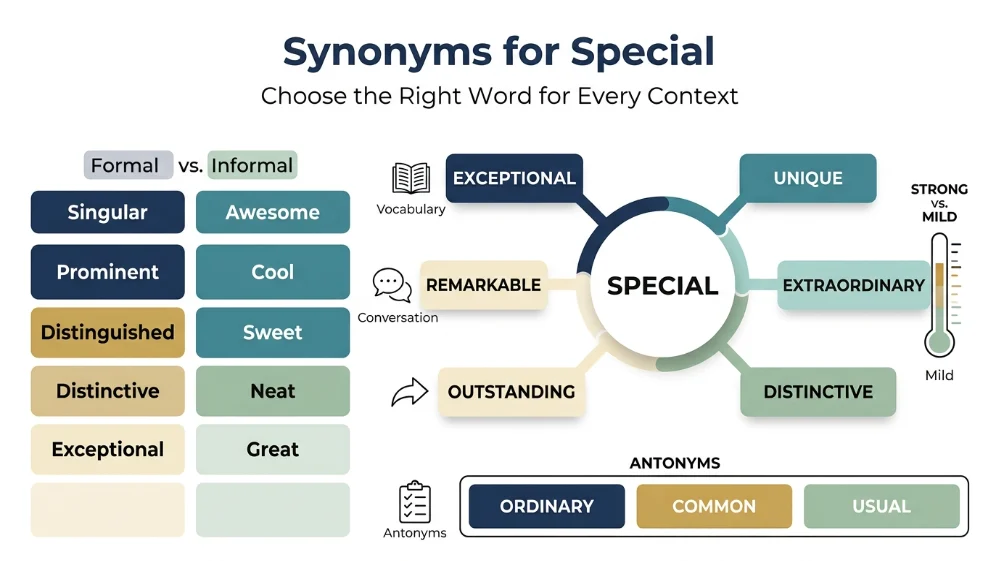
The word “special” pops up constantly in everyday conversation and writing. But sometimes it feels overused or not quite specific enough. The best synonyms for special are exceptional, unique, extraordinary, and distinctive. The right choice depends entirely on your meaning, tone, context, and the intensity you want to convey.
This guide will walk you through everything you need to know about finding the perfect alternative for “special.” You’ll learn what the word truly means, explore synonyms grouped by formality and strength, see real example sentences, and discover how to choose the right word every time.
Best Synonyms for Special
The best synonyms for special are exceptional, unique, extraordinary, and distinctive. Use exceptional when emphasizing outstanding quality, unique for one-of-a-kind status, extraordinary for something far beyond the ordinary, and distinctive for recognizable, distinguishing features. Your choice depends on tone, context, and intensity.
What Does Special Mean?
Special is an adjective that describes something better, greater, or different from what is usual. It can also mean reserved for a particular purpose, occasion, or person.
The core idea behind “special” is distinction—something stands out from the norm. This could be because of superior quality, rarity, personal significance, or a specific function.
Part of speech: Adjective (can also be used as a noun, as in “a television special”).
Simple example sentences:
- “She has a special talent for making people feel comfortable.”
- “We keep this wine for special occasions.”
- “He is a special friend I’ve known for years.”
Core Meaning of Special
At its heart, “special” signals that something or someone is not ordinary. It marks a departure from the typical, the average, or the expected. This departure can take many forms.
Sometimes “special” points to superior quality. A special meal isn’t just any meal—it’s unusually good, carefully prepared, or memorable. A special athlete isn’t just competent—they possess remarkable skill.
Other times, “special” indicates uniqueness or rarity. A special flower might be one you’ve never seen before. A special occasion doesn’t happen every day—it’s set apart on the calendar.
Special” can also mean particular or specific. A special tool is designed for a precise job. A special request is one that falls outside the usual routine.
And sometimes “special” carries emotional weight. A special person in your life isn’t just someone you know—they’re someone who matters deeply. A special memory isn’t just any recollection—it’s one you treasure.
Understanding these different shades of meaning is the first step to choosing the right synonym.
Grammar and Usage Notes
Part of speech: Primarily an adjective. Can also function as a noun (e.g., “the restaurant’s special,” “a TV special”).
Common sentence patterns:
- “She is special to me.” (predicate adjective)
- “That was a special moment.” (attributive adjective)
- “He made a special effort.” (modifying a noun)
Common collocations (words that often appear with “special”):
- special occasion
- special treatment
- special edition
- special offer
- special needs
- special interest
- special guest
- special delivery
When “special” sounds natural:
“Special” works well in everyday conversation, personal messages, and general writing. It’s versatile and widely understood. You can use it to describe people, events, objects, feelings, and situations.
When a synonym may work better:
Consider a synonym when “special” feels too vague, too overused, or when you need to convey a more precise shade of meaning. For example, in academic writing, “distinctive” or “exceptional” often sound more precise. In emotional contexts, “cherished” or “precious” might carry more weight.
Best Synonyms for Special
This table gives you a quick overview of the most useful synonyms for “special,” organized by meaning, tone, and best use case.
| Synonym | Meaning | Tone | Best Use Case | Example Sentence |
|---|---|---|---|---|
| exceptional | Unusually good; outstanding | Formal to neutral | Emphasizing superior quality or performance | “Her exceptional leadership transformed the team.” |
| unique | One of a kind; unlike anything else | Neutral | Emphasizing singularity or originality | “Each snowflake has a unique crystalline structure.” |
| extraordinary | Far beyond the ordinary; remarkable | Formal to neutral | Describing something surprising or impressive | “The rescue was an extraordinary act of bravery.” |
| distinctive | Recognizably different; characteristic | Neutral to formal | Highlighting a notable feature or quality | “The restaurant has a distinctive Mediterranean flavor.” |
| remarkable | Worthy of attention; striking | Neutral | Noting something impressive or unusual | “He made a remarkable recovery from his injury.” |
| memorable | Worth remembering; unforgettable | Neutral | Describing experiences or moments | “Their wedding was a truly memorable celebration.” |
| outstanding | Exceptionally good; prominent | Formal | Professional or academic contexts | “She received an outstanding achievement award.” |
| particular | Specific; distinct from others | Neutral to formal | Emphasizing a specific thing or person | “This particular model has better fuel efficiency.” |
| exclusive | Limited to a select group; private | Neutral | Describing restricted access or privilege | “The club offers exclusive benefits to its members.” |
| uncommon | Not often found; rare | Neutral | Describing rarity or infrequency | “That bird is an uncommon sight in this region.” |
| notable | Worthy of attention; significant | Formal | Highlighting importance or prominence | “The study produced notable results.” |
| singular | Exceptionally good or great; remarkable | Formal | Emphasizing uniqueness or excellence | “She has a singular ability to connect with audiences.” |
Common Synonyms for Special
These are the everyday synonyms you’ll hear in normal conversation and see in general writing. They’re versatile, widely understood, and work in most contexts.
Exceptional
Meaning: Unusually good; outstanding.
Best context: Describing skill, performance, quality, or talent that stands above the rest.
Example: “The young pianist gave an exceptional performance that left the audience speechless.”
Unique
Meaning: Being the only one of its kind; unlike anything else.
Best context: Emphasizing that something is truly one-of-a-kind.
Example: “Her approach to problem-solving is unique and highly effective.”
Extraordinary
Meaning: Very unusual or remarkable; far beyond the ordinary.
Best context: Describing events, achievements, or qualities that surprise or impress.
Example: “It was an extraordinary coincidence that we met again after all those years.”
Distinctive
Meaning: Having a quality that makes something recognizably different from others.
Best context: Highlighting a characteristic feature or style.
Example: “The building has a distinctive red-tiled roof that you can spot from miles away.”
Remarkable
Meaning: Worthy of attention; striking or unusual.
Best context: Noting something impressive or worth noticing.
Example: “His remarkable memory allows him to recall details from decades ago.”
Formal Synonyms for Special
These alternatives are better suited for academic writing, business reports, professional correspondence, essays, and other formal contexts. They carry more precision and gravitas.
Outstanding
Meaning: Exceptionally good; clearly superior.
Best for: Academic papers, performance reviews, awards, and professional recognition.
Example: “The candidate’s outstanding qualifications made her the obvious choice for the position.
Notable
Meaning: Worthy of attention or notice; significant.
Best for: Research papers, reports, and formal observations.
Example: “The study found a notable correlation between sleep quality and cognitive performance.”
Singular
Meaning: Exceptionally good or great; remarkable; also means unique.
Best for: Literary or formal writing where you want to emphasize rarity combined with excellence.
Example: “She possessed a singular charm that captivated everyone she met.”
Distinguished
Meaning: Recognized for excellence; marked by eminence or honor.
Best for: Describing people, careers, or institutions with established reputations.
Example: “The university invited a distinguished professor to deliver the keynote address.”
Particular
Meaning: Specific; distinct from others.
Best for: Formal writing where you need to single out one thing from a group.
Example: “This particular method has proven more effective than alternative approaches.
Especial
Meaning: Special; exceptional; noteworthy. (Less common but useful in formal writing.)
Best for: Literary or formal contexts where you want a slightly elevated tone.
Example: “The chef took especial care in preparing the dessert course.”
Informal Synonyms for Special
These casual alternatives work well in conversation, social media, friendly messages, and informal writing. They’re relaxed, approachable, and often carry warmth or enthusiasm.
One-of-a-kind
Meaning: Unique; unlike anything else.
Best for: Friendly conversation, product descriptions, or personal compliments.
Example: “That vintage jacket is one-of-a-kind—you’ll never see another like it.”
Something else
Meaning: Remarkable or impressive in an unexpected way.
Best for: Casual praise or expressing surprise.
Example: “Her homemade lasagna is something else—I’ve never tasted anything like it.”
Out of the ordinary
Meaning: Unusual; not typical.
Best for: Everyday conversation when noting something different.
Example: “I didn’t notice anything out of the ordinary about his behavior.”
Standout
Meaning: Noticeably better or more impressive than others.
Best for: Describing people, performances, or products that excel.
Example: “She was the standout performer in the entire competition.”
Top-notch
Meaning: Of the highest quality; excellent.
Best for: Informal praise or recommendations.
Example: “The service at that restaurant is top-notch.”
Strong Synonyms for Special
These synonyms carry more emotional weight, power, or intensity. Use them when you want to make a strong impression—but be careful not to overuse them.
Extraordinary
Intensity: High. This word suggests something that genuinely surprises or astounds.
When to use: For events, achievements, or qualities that truly go beyond normal expectations.
When it’s too strong: Describing routine or mildly interesting things. Your morning coffee might be good, but it’s probably not extraordinary.
Example: “The team showed extraordinary courage in the face of danger.”
Phenomenal
Intensity: Very high. Suggests something almost unbelievable or unprecedented.
When to use: For achievements that seem almost miraculous or beyond typical human capability.
When it’s too strong: Everyday accomplishments or standard quality.
Example: “The response to our campaign has been phenomenal—we exceeded our targets by 300%.”
Remarkable
Intensity: Moderate to high. Suggests something genuinely worth noticing and remembering.
When to use: For achievements, qualities, or events that stand out clearly from the norm.
When it’s too strong: For things that are merely pleasant or adequate.
Example: “Her remarkable transformation inspired everyone who knew her.”
Exceptional
Intensity: High. Implies something that is not just good but outstanding.
When to use: For performance, talent, or quality that places someone or something in a superior category.
When it’s too strong: For average or merely competent work.
Example: “The athlete demonstrated exceptional speed and agility.”
Unparalleled
Intensity: Very high. Suggests something that has no equal.
When to use: For achievements or qualities that are genuinely without peer.
When it’s too strong: For anything that has competitors or equals.
Example: “The company offers an unparalleled level of customer service.”
Mild Synonyms for Special
Sometimes you need a softer, more neutral, or more modest alternative. These synonyms tone down the intensity while still conveying that something is different or noteworthy.
Unusual
Meaning: Not common or ordinary; different from what is typical.
Tone: Neutral to mild. Simply notes difference without strong praise.
When to use: When you want to say something is different without implying it’s better or worse.
Example: “It’s unusual to see snow in this region during spring.”
Uncommon
Meaning: Not often found or seen; rare.
Tone: Neutral. Focuses on frequency rather than quality.
When to use: When rarity is the main point, not superiority.
Example: “That bird species is uncommon in urban areas.”
Notable
Meaning: Worthy of attention; noticeable.
Tone: Moderate. Suggests something worth noticing without intense praise.
When to use: When something is significant but not extraordinary.
Example: “There was a notable improvement in her grades this semester.”
Particular
Meaning: Specific; distinct from others.
Tone: Neutral to mild. Focuses on specificity rather than quality.
When to use: When you need to single out one specific thing.
Example: “Is there any particular reason you chose that color?”
Distinct
Meaning: Recognizably different; clear and unmistakable.
Tone: Neutral. Focuses on clear difference.
When to use: When the main point is that something can be clearly distinguished.
Example: “The two dialects have distinct pronunciation patterns.”
Synonyms for Special by Context
The best synonym for “special” depends heavily on where and how you’re using it. Here’s how to choose based on context.
Everyday Conversation
In casual conversation, keep it simple and natural. Unique, unusual, different, and one-of-a-kind work well. You can also use special itself—it’s not a word to avoid entirely.
“I met someone really unique at the party last night.”
“This coffee shop has a special vibe I can’t quite describe.”
Professional Writing
In emails, reports, and workplace communication, opt for more precise and professional alternatives. Notable, outstanding, exceptional, and distinctive convey professionalism without sounding stiff.
“The project delivered notable results in its first quarter.”
“Her exceptional attention to detail made her invaluable to the team.”
Academic Writing
In essays, research papers, and scholarly work, precision matters. Distinctive, singular, particular, and exceptional are strong choices. Avoid overly emotional or informal alternatives.
“The study identified a distinctive pattern in the data.”
“This particular variable had a significant impact on the outcome.”
Creative Writing
In fiction, poetry, and creative nonfiction, you have more freedom. Extraordinary, remarkable, memorable, and singular add color and emotion. You can also use more evocative words like precious, cherished, or unforgettable.
“The garden held a singular beauty that words could not capture.”
“Their love was extraordinary—the kind people write songs about.”
Marketing Copy
In advertising and promotional writing, you need words that grab attention and convey value. Exclusive, exceptional, premium, outstanding, and one-of-a-kind are all effective.
“Experience our exclusive offer available only to newsletter subscribers.”
“This exceptional product has changed the lives of thousands.”
Emotional Expression
When you’re talking about people or relationships you care about, warmer words work best. Precious, cherished, beloved, and dear convey deep emotional connection.
“Grandma’s ring is precious to me beyond measure.”
“He is a cherished friend I’ve known since childhood.”
Another Word for Special in a Sentence
Here are fifteen natural example sentences using different synonyms for “special.” Notice how each synonym changes the tone and meaning slightly.
- “The chef prepared an exceptional meal that rivaled any five-star restaurant.”
- “Her fingerprint is unique—no one else in the world has one exactly like it.”
- “The aurora borealis is an extraordinary natural phenomenon.”
- “The building’s distinctive architecture makes it instantly recognizable.”
- “His remarkable kindness touched everyone who knew him.”
- “The team made outstanding progress on the project this quarter.”
- “That was a memorable vacation we’ll talk about for years.”
- “She has a singular talent for making complex topics easy to understand.”
- “The museum offers exclusive access to its private collection for donors.”
- “Finding a parking spot in this neighborhood is uncommon at this hour.”
- “The study produced notable findings that could change treatment protocols.”
- “Their friendship is precious to both of them.”
- “He has a particular way of phrasing things that I find amusing.”
- “The distinguished professor has published over fifty research papers.”
- “She was the standout candidate in a field of highly qualified applicants.”
Special Synonyms Compared
Some synonyms for “special” are easily confused. Here’s a closer look at the differences between closely related words.
| Word Pair | Difference | Example |
|---|---|---|
| Exceptional vs. Extraordinary | Exceptional emphasizes superior quality. Extraordinary emphasizes being far beyond normal—it can be surprising or even strange. | “She’s an exceptional student” (top grades). “It was an extraordinary coincidence” (very surprising). |
| Unique vs. Distinctive | Unique means one of a kind—no others exist. Distinctive means having a recognizable feature that sets it apart, but others may be similar. | “Each person’s DNA is unique.” “The restaurant has a distinctive menu” (recognizable, but not the only one). |
| Notable vs. Remarkable | Notable means worthy of notice or attention. Remarkable means striking enough to be remembered or commented on—slightly stronger. | “There was a notable increase in sales” (worth noting). “Her recovery was remarkable” (truly striking). |
| Specific vs. Particular | Both mean relating to one thing, but specific often implies precision or exactness, while particular emphasizes being distinct from others. | “What specific time should I arrive?” (exact). “This particular model has better features” (this one vs. others). |
| Exclusive vs. Select | Exclusive emphasizes restricted access or limited availability. Select implies chosen carefully from a larger group. | “An exclusive club” (hard to get into). “A select group of experts” (carefully chosen). |
Words Similar to Special
These words belong to the same semantic field as “special” but aren’t always exact replacements. Understanding when they work—and when they don’t—will make your writing more precise.
Rare
Why it’s related: Both suggest something not commonly found.
Why it may not replace “special”: “Rare” focuses on scarcity, not quality or emotional significance. A rare stamp is valuable because few exist, not necessarily because it’s “special” in an emotional sense.
When it works: “This is a rare opportunity to see the exhibit.” (Fits because opportunity is both scarce and noteworthy.)
Precious
Why it’s related: Both can describe something valued highly.
Why it may not replace “special”: “Precious” carries stronger emotional weight and often implies sentimental or monetary value. It may sound too sentimental in neutral contexts.
When it works: “The necklace was precious to her because her grandmother gave it to her.” (Emotional value fits.)
Exclusive
Why it’s related: Both can mean restricted or limited.
Why it may not replace “special”: “Exclusive” specifically implies limited access or privilege. “Special” is broader and doesn’t always carry this meaning.
When it works: “The resort offers exclusive amenities for VIP guests.” (Limitation is the key point.)
Especial
Why it’s related: It’s essentially a less common variant of “special.”
Why it may not replace “special”: “Especial” is more formal and less common. In most contexts, “special” sounds more natural.
When it works: In formal writing: “The committee gave especial attention to the proposal.” (Sounds more formal and deliberate.)
Memorable
Why it’s related: Both can describe something worth remembering.
Why it may not replace “special”: “Memorable” specifically relates to memory. Something can be special without being particularly memorable, and vice versa.
When it works: “That was a memorable performance.” (The focus is on the lasting impression.)
Antonyms of Special
Knowing the opposites of “special” helps you understand its meaning more clearly and choose the right word when you want to contrast.
| Antonym | Meaning | Example Sentence |
|---|---|---|
| Ordinary | Common; not special or different | “It was just an ordinary Tuesday with nothing remarkable happening.” |
| Common | Found frequently; not rare | “That bird is quite common in this region.” |
| General | Not specific; applying to all | “The report gave a general overview rather than specific details.” |
| Usual | Customary; typical | “We followed our usual routine.” |
| Average | Typical; not exceptional | His performance was average—nothing to write home about. |
| Standard | Regular; not special or customized | “The standard model comes with basic features.” |
| Normal | Expected; not unusual | “Her temperature was normal for a healthy adult.” |
| Typical | Characteristic of a type; expected | “That’s a typical reaction to the news.” |
| Plain | Not decorated or elaborate; simple | “She wore a plain black dress to the event.” |
| Routine | Regular; not special | “It was just a routine checkup at the doctor’s office.” |
How to Choose the Right Synonym for Special
Choosing the right synonym isn’t complicated, but it does require thinking about a few key factors. Here’s a simple process to follow.
1. Match the context.
Where are you writing? A formal report needs different language than a text message to a friend. Academic writing favors precision; casual conversation favors warmth and simplicity.
2. Match the tone.
Are you praising someone warmly? “Exceptional” or “remarkable” work well. Are you simply noting a difference? “Unusual” or “uncommon” are better. Are you describing something exclusive? “Exclusive” or “select” are the right choices.
3. Check the intensity.
How strong do you want to sound? “Extraordinary” and “phenomenal” carry a lot of weight. “Unusual” and “different” are much milder. Choose the intensity that matches what you’re describing.
4. Think about your reader.
Who is reading? A professional colleague might appreciate “notable” or “outstanding.” A close friend will respond better to “amazing” or “one-of-a-kind.” Consider what will resonate with your audience.
5. Check whether the synonym is exact or only related.
Not every word in the thesaurus is a perfect replacement. “Precious” isn’t always right for “special.” “Rare” isn’t always right either. Make sure the synonym actually fits your meaning.
6. Keep the sentence natural.
Read your sentence aloud with the synonym in place. Does it sound right? If it feels forced or awkward, try a different word. Natural language always wins.
7. Use simple words when clarity matters.
If you’re unsure, simpler is often better. “Special” itself is a perfectly good word. Don’t force a fancy synonym if “special” does the job clearly.
Common Mistakes When Using Synonyms for Special
Even experienced writers make mistakes with synonyms. Here are the most common pitfalls to avoid.
Choosing a word with the wrong tone.
Using “extraordinary” to describe a mildly interesting fact sounds overblown. Using “cool” in a formal report sounds unprofessional. Always match the tone to the context.
Using a synonym that is too strong.
Calling a decent meal “phenomenal” diminishes the word’s power. Save strong synonyms for things that genuinely deserve them.
Using a formal word in casual writing.
“Especial” and “singular” sound out of place in a text message. Keep formal words for formal contexts.
Using a casual word in professional writing.
“Awesome” and “amazing” might be fine in conversation but rarely belong in business reports or academic papers.
Replacing “special” without checking meaning.
“Specific” is not a synonym for “special” in most contexts. “Particular” can be, but only when you mean “specific” rather than “exceptional.” Always check the definition.
Treating related words as exact synonyms.
“Rare” and “precious” are related to “special” but don’t always replace it. Make sure the word you choose actually fits your intended meaning.
Making the sentence sound unnatural.
“Forum rules: Please post your questions in the exceptional thread” sounds bizarre. “Designated” or “specific” would be much more natural. If a synonym sounds forced, it probably is.
Quick Synonym List for Special
Here’s a clean, scannable list of synonyms for “special” grouped by category.
Common Synonyms:
- exceptional
- unique
- extraordinary
- distinctive
- remarkable
- memorable
- outstanding
- particular
Formal Synonyms:
- distinguished
- notable
- singular
- especial
- particular
Informal Synonyms:
- one-of-a-kind
- something else
- out of the ordinary
- standout
- top-notch
Strong Synonyms:
- extraordinary
- phenomenal
- remarkable
- exceptional
- unparalleled
Mild Synonyms:
- unusual
- uncommon
- notable
- particular
- distinct
Related Words:
- rare
- precious
- exclusive
- select
- memorable
FAQs About Synonyms for Special
What is the best synonym for special?
The best synonym depends on your meaning. For superior quality, use exceptional. For one-of-a-kind status, use unique. Something far beyond the ordinary, use extraordinary. For recognizable distinguishing features, use distinctive.
What is another word for special?
Common alternatives include exceptional, unique, extraordinary, distinctive, remarkable, memorable, and outstanding. The right choice depends on context and tone.
What is a formal synonym for special?
Formal alternatives include distinguished, notable, singular, especial, and outstanding. These work well in academic writing, business reports, and professional correspondence.
What is an informal synonym for special?
Informal alternatives include one-of-a-kind, something else, out of the ordinary, standout, and top-notch. These are great for conversation, social media, and casual writing.
What is a stronger word for special?
Stronger words include extraordinary, phenomenal, remarkable, exceptional, and unparalleled. These carry more emotional weight and intensity.
What is a milder word for special?
Milder alternatives include unusual, uncommon, notable, particular, and distinct. These are more neutral and less intense.
What words are similar to special?
Words in the same semantic field include rare, precious, exclusive, select, and memorable. These are related but may not always be exact replacements.
What is the opposite of special?
Common antonyms include ordinary, common, general, usual, average, standard, normal, typical, plain, and routine.
How do I choose the right synonym for special?
Consider the context, tone, intensity, and your reader. Match the formality level, check the intensity, and make sure the synonym fits your exact meaning. Read your sentence aloud to make sure it sounds natural.
Conclusion
“Special” is a versatile word, but it’s not always the best choice. Sometimes you need more precision, more intensity, or a different tone. The synonyms in this guide give you the tools to choose the right word for every situation.
Remember, the best synonym depends on what you’re trying to say. Exceptional works for outstanding quality. Unique fits one-of-a-kind situations. Extraordinary describes things far beyond the ordinary. Distinctive highlights recognizable features. And there are plenty of formal, informal, strong, and mild options to match any context.
The next time you reach for “special,” take a moment to consider whether a more precise word would serve you better. Your writing will be clearer, more engaging, and more effective.