You just finished writing a heartfelt thank you email. As you read it back, you notice you used the word “kind” three times in two sentences. Your brain freezes.
You know there are better words, but nothing comes to mind. This happens to students polishing essays, professionals crafting recommendations, and writers building character descriptions. The word “kind” is warm and useful, but overusing it makes your message sound flat and unpolished.
This guide gives you precise, natural synonyms for kind, organized by real world context so you always pick the right one.
Quick Answer: What Does “Kind” Mean?
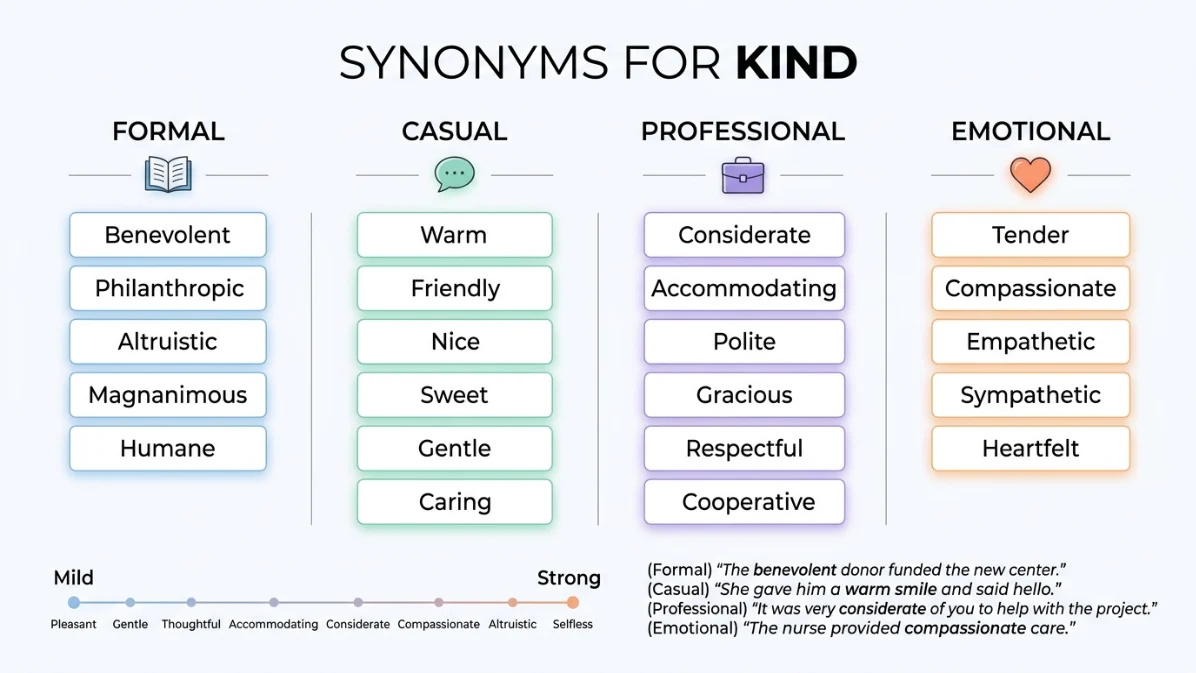
Kind describes a person, action, or word that shows a generous, considerate, and caring nature. The best synonyms depend on context: benevolent for formal writing, compassionate for emotional depth, thoughtful for everyday use, warm for personal tone, and gracious for professional communication.
Meaning, Tone and Context
Kind is an adjective with a consistently positive tone. It signals goodwill, gentleness, and a helpful spirit. You can use it in nearly any setting, from casual text messages to formal speeches.
The noun form is kindness, the adverb is kindly, and the opposite is unkind or cruel. Its broad meaning makes it flexible, but that same flexibility means a more specific synonym often strengthens your sentence.
When and How to Use “Kind”
Use kind when you want to acknowledge someone’s gentle, helpful, or considerate behavior. It fits naturally in both spoken and written English. However, because it is so common, it sometimes lacks impact in high stakes writing.
Here are realistic examples with context labels:
- Professional: Your kind feedback helped me refine the presentation before the client meeting.
- Personal: It was so kind of you to check on me while I was sick.
- Academic: The study examines how kind leadership behaviors affect team morale.
- Emotional: His kind words stayed with me long after the conversation ended.
- Social media caption: Grateful for kind souls who make the world softer.
- Email: Thank you for your kind note regarding the project launch.
- Casual: My neighbor is incredibly kind. She always waters my plants when I travel.
Another Word for “Kind”
The best single replacement depends entirely on your context. A general swap is thoughtful because it highlights considerate intention. But different situations call for different shades of meaning.
- Professional writing: Considerate or supportive
- Academic writing: Benevolent or altruistic
- Casual conversation: Sweet or nice
- Emotional writing: Compassionate or tender
- Creative writing: Gentle hearted or magnanimous
- Resume or workplace use: Supportive or collaborative
- Social media captions: Good hearted or lovely
- Stronger meaning: Selfless or noble
- Softer meaning: Pleasant or mild mannered
When Not to Use “Kind”
Kind often sounds too vague when you need to convey specific emotional depth or professional precision. Saying a manager is kind feels pleasant but weak. Saying a manager is supportive, empathetic, or fair paints a much clearer picture of leadership. In formal commendations, kind can sound too personal and informal. Choose benevolent or humanitarian for a more elevated tone. If you are describing a business decision as kind, it may confuse clarity. Use considerate, ethical, or community focused instead.
Words Commonly Confused With “Kind”
Kind overlaps with several words that carry distinct meanings. Understanding the difference helps you avoid mislabeling someone’s behavior.
Kind vs. Nice: Nice often implies politeness and agreeableness. Kind implies genuine care and helpful action. A nice person smiles. A kind person helps you carry groceries.
Kind vs. Good: Good is a broad moral term. Kind is specifically about warmth and gentleness. A person can be morally good but not outwardly warm.
Kind vs. Gentle: Gentle focuses on softness and carefulness. Kind focuses on caring intention. A doctor can be gentle with a needle but not necessarily emotionally kind.
Kind vs. Friendly: Friendly means sociable and approachable. Kind means deeply considerate. A friendly stranger chats. A kind stranger offers comfort.
Kind vs. Benevolent: Benevolent implies a desire to do good on a larger scale. Kind is more personal and everyday. A donor is benevolent. A listening friend is kind.
Kind vs. Sympathetic: Sympathetic means feeling pity or sorrow for someone. Kind means actively showing care, often without pity. Sympathy feels. Kindness acts.
Best Synonym by Context for “Kind”
| Context | Best Synonym | Why It Works | Example |
|---|---|---|---|
| Formal writing | Benevolent | Elevated tone for serious subjects | The benevolent foundation funded local shelters. |
| Academic writing | Altruistic | Precise term for selfless behavior | The study measured altruistic motivation in volunteers. |
| Professional use | Considerate | Highlights workplace respect | Her considerate approach eased team tension. |
| Resume | Supportive | Shows collaborative spirit | Fostered a supportive onboarding experience for new hires. |
| Casual conversation | Sweet | Natural and warm in speech | My neighbor is so sweet. She baked us cookies. |
| Creative writing | Tender | Adds emotional softness | He spoke in a tender voice that calmed the child. |
| Emotional tone | Compassionate | Deep, heartfelt concern | The nurse’s compassionate care comforted the family. |
| Strong intensity | Magnanimous | Generous and forgiving spirit | A magnanimous leader who credits the entire team. |
| Soft intensity | Pleasant | Mild and agreeable | We had a pleasant chat over coffee. |
| Social media captions | Good hearted | Relatable and positive | Surrounded by good hearted people on this trip. |
Which Synonym Should You Choose?
Start by asking what exactly you want to highlight. If you are describing care for someone suffering, choose compassionate. If you are describing a friendly personality, warm or sweet may fit. For professional settings, lean toward considerate or supportive. Match the emotional intensity to your message.
Using magnanimous for a small favor feels exaggerated. Using pleasant for a life changing act of generosity feels weak. Read your sentence aloud. If the synonym sounds natural and accurate in your voice, you have found the right word.
Real Life Examples of “Kind” in Sentences
School: My history teacher is remarkably patient and supportive during exam prep.
Workplace: Your considerate feedback on my draft helped me catch errors I missed.
Conversation: She is so warm. Everyone feels instantly comfortable around her.
Social media: This community is incredibly generous and uplifting.
Resume: Built a collaborative culture that increased team retention by 20 percent.
Email: I truly appreciate your gracious welcome during my first week.
Storytelling: The old bookseller was a gentle soul who remembered every customer’s name.
20 Synonyms for “Kind”
This table offers a diverse vocabulary list with clear, distinct meanings and natural example sentences.
| Synonym | Simple Meaning | Best Used For | Example Sentence |
|---|---|---|---|
| Benevolent | Well meaning and generous. | Formal and institutional goodness. | The benevolent organization provided disaster relief globally. |
| Compassionate | Showing sympathy for suffering. | Emotional and caregiving contexts. | A compassionate nurse can soothe a patient’s fear. |
| Thoughtful | Considerate of others’ needs. | Everyday actions and professional praise. | Leaving a note was a thoughtful way to show you care. |
| Supportive | Providing help and encouragement. | Resumes, management, and teamwork. | Her supportive feedback helped me grow my skills. |
| Gracious | Courteous, kind, and pleasant. | Formal thanks and hospitality. | Our host was gracious, making everyone feel at ease. |
| Warm | Enthusiastic, friendly, and approachable. | Social media and personal descriptions. | We received a warm reception at the new office. |
| Generous | Willing to give more than expected. | Describing time, money, or spirit. | He is extremely generous with both his time and advice. |
| Altruistic | Selflessly concerned for others. | Academic, ethical, and scientific writing. | Altruistic behavior is a powerful social bonding agent. |
| Tender | Showing gentleness and concern. | Romantic, parental, or intimate writing. | He placed a tender kiss on her forehead. |
| Caring | Displaying genuine concern. | Healthcare, parenting, and close relationships. | A caring teacher changes a child’s life forever. |
| Good-hearted | Fundamentally decent and kind. | Casual conversation and storytelling. | The good-hearted mechanic fixed the car for free. |
| Magnanimous | Very generous or forgiving, especially toward a rival. | Literary and historical narrative. | The magnanimous winner praised the other team’s effort. |
| Humane | Showing compassion, especially to suffering. | Ethical, legal, and animal welfare contexts. | The shelter ensures the humane treatment of all animals. |
| Decent | Conforming to standards of propriety. | Moderate, everyday respectability. | It was decent of him to apologize immediately. |
| Sweet | Pleasing and likable in a gentle way. | Casual, endearing compliments. | My grandmother is the sweetest person I know. |
| Sympathetic | Feeling pity and understanding. | Consoling and formal communication. | The manager was sympathetic to the team’s burnout. |
| Charitable | Lenient in judging others; generous. | Describing attitudes and organizations. | Try to be more charitable when interpreting their motives. |
| Gentle | Mild in disposition or action. | Describing touch, voice, or animal handling. | Use a gentle voice with the rescued animals. |
| Inclusive | Not excluding any person or group. | Modern professional and DEI vocabulary. | Creating an inclusive culture is a top leadership priority. |
| Selfless | Concerned more with others’ needs than one’s own. | Describing acts of great sacrifice. | It was a selfless decision that saved countless lives. |
25 Synonyms for “Kind”
| Synonym | Simple Meaning | Best Used For | Example Sentence |
|---|---|---|---|
| Benevolent | Well meaning and generous | Formal or charitable contexts | The benevolent donor asked to remain anonymous. |
| Compassionate | Feeling deep concern | Emotional or care settings | A compassionate response can ease someone’s pain. |
| Considerate | Thinking about others’ needs | Professional and daily use | It was considerate of you to schedule around my trip. |
| Thoughtful | Showing careful attention | Personal and reflective writing | A thoughtful note can brighten a difficult week. |
| Gentle | Soft and careful | Describing touch or manner | The teacher’s gentle correction encouraged the student. |
| Tender | Soft and affectionate | Emotional or romantic writing | He gave her a tender look before speaking. |
| Altruistic | Selflessly concerned for others | Academic or philosophical use | Altruistic actions often stem from deep empathy. |
| Charitable | Generous in judging or giving | Community or donation contexts | She is charitable with her time and encouragement. |
| Sympathetic | Showing understanding of feelings | Consoling or supportive situations | Her sympathetic ear made the conversation healing. |
| Gracious | Courteous and graceful | Professional and formal thanks | The host gave a gracious welcome speech. |
| Warm | Friendly and enthusiastic | Casual and personal description | His warm personality fills the room with ease. |
| Caring | Showing protectiveness and love | Family and close relationships | A caring mentor changes lives quietly. |
| Good hearted | Fundamentally good natured | Everyday informal speech | She is such a good hearted soul. |
| Humane | Showing human compassion | Discussions of treatment or ethics | Humane working conditions improve dignity. |
| Magnanimous | Very generous or forgiving | Describing high character | A magnanimous winner praises the opponent. |
| Selfless | Putting others first | Describing sacrifice or service | Selfless volunteers rebuilt the damaged playground. |
| Soft hearted | Easily moved by emotion | Gentle character description | Too soft hearted to watch sad movies. |
| Supportive | Providing encouragement | Workplace and personal growth | A supportive manager empowers the whole team. |
| Helpful | Ready to give assistance | Daily practical situations | The librarian was extremely helpful with my research. |
| Neighborly | Friendly and helpful locally | Community and residential life | Neighborly gestures make a street feel like home. |
| Philanthropic | Seeking to promote welfare | Large scale giving | Their philanthropic mission focuses on clean water. |
| Understanding | Tolerant and perceptive | Conflict resolution | An understanding friend listens without judgment. |
| Amiable | Pleasant and friendly | Social personality description | An amiable colleague makes meetings enjoyable. |
| Lenient | Not harsh or strict | Rules and discipline | The judge was lenient given the circumstances. |
| Big hearted | Generous and kind spirited | Warm informal description | A big hearted welcome awaited us at the inn. |
Synonym Groups and Usage Differences
Professional vs. Personal Synonyms
In the workplace, considerate, supportive, and gracious signal respect and emotional intelligence. In personal life, tender, sweet, and warm feel close and affectionate. Avoid using overly intimate synonyms like tender in a performance review. Save them for close relationships or personal storytelling.
Formal vs. Conversational Synonyms
Benevolent, magnanimous, and altruistic elevate your language for speeches, essays, and official letters. In casual texts or chats, sweet, good hearted, and warm keep your tone natural. Saying “That was magnanimous of you to share your lunch” in a cafeteria sounds stiff. “That was sweet of you” feels right.
Academic Synonyms
For essays and research, choose altruistic, humane, and benevolent. These words carry precise ethical connotations and align with analytical writing. They show you understand nuanced character judgment, which strengthens argumentation and literary analysis.
Professional and Business Synonyms
In emails, reviews, and presentations, prioritize considerate, supportive, and collaborative. These words show emotional awareness without crossing into personal territory. “Your considerate approach to client concerns” reads professionally. “Your sweet approach to client concerns” does not.
Creative or Literary Synonyms
Tender, magnanimous, gentle hearted, and soft hearted add emotional texture to characters and scenes. A tender smile or magnanimous gesture paints a vivid picture. Use these when you want the reader to feel the softness of a moment, not just understand it.
Slang or Modern Synonyms
Modern casual speech sometimes uses wholesome, pure, or golden to describe kind energy. “She has such wholesome energy” works in captions and casual posts. These words feel current and emotionally warm. Avoid them in academic or formal business writing where they can sound immature or vague.
Strongest vs. Weaker Synonyms
Intensity scale from mild to strongest: pleasant, nice, thoughtful, considerate, compassionate, benevolent, magnanimous, selfless. Pleasant describes a mild, agreeable nature. Selfless describes radical, consistent sacrifice for others. Match the intensity to the action. Calling a small polite gesture selfless dilutes the power of the word.
Emotional vs. Neutral Synonyms
Compassionate, tender, and soft hearted carry strong emotional weight. They suit personal essays, reflections, and heartfelt messages. Considerate, helpful, and amiable are more neutral and fit professional, instructional, or factual writing. Use emotional synonyms when you want the reader to feel the depth. Use neutral synonyms when you want clear, measured description.
Antonyms of “Kind”
| Antonym | Meaning | Example Sentence |
|---|---|---|
| Cruel | Causing pain intentionally | The cruel remark lingered in her mind. |
| Unkind | Lacking kindness | His unkind tone surprised everyone. |
| Mean | Purposefully unkind or nasty | That was a mean thing to say. |
| Harsh | Unpleasantly rough or severe | The critic’s harsh review felt personal. |
| Rude | Discourteous and impolite | A rude interruption broke the flow. |
| Cold | Lacking warmth or emotion | Her cold reply ended the conversation. |
| Selfish | Concerned only for oneself | Selfish decisions hurt the whole team. |
| Inconsiderate | Disregarding others’ feelings | Leaving early without notice was inconsiderate. |
| Callous | Emotionally hardened and insensitive | His callous disregard shocked the audience. |
| Hostile | Showing aggression or opposition | A hostile work environment harms morale. |
| Heartless | Completely without compassion | The heartless policy separated families. |
| Brutal | Cruelly violent or direct | The feedback was brutal but honest. |
| Unsympathetic | Lacking understanding or pity | She was unsympathetic to his struggle. |
| Malevolent | Having evil intent | The character’s malevolent smile revealed everything. |
| Pitiless | Showing no mercy | The pitiless sun beat down on the travelers. |
Comparison: Kind vs. Similar Words
Kind vs. Nice
Main difference: Kind implies genuine care and action. Nice implies pleasantness and social agreeability. Kind is stronger in moral depth. Nice is more surface level and polite. Example for kind: He gave up his weekend to help me move. Example for nice: She is always nice at parties.
Kind vs. Compassionate
Main difference: Compassionate carries deeper emotional weight and often involves suffering. Kind is broader and lighter in tone. Compassionate is stronger emotionally. Both are positive, but compassionate is more intense. Example for compassionate: Her compassionate care eased the patient’s fear. Example for kind: My neighbor’s kind wave starts every morning well.
Kind vs. Benevolent
Main difference: Benevolent suggests large scale goodwill and authority. Kind is personal and intimate. Benevolent is more formal and often used for institutions or leaders. Kind fits everyday individuals. Example for benevolent: The benevolent ruler abolished the tax. Example for kind: The kind cashier remembered my name.
Kind vs. Thoughtful
Main difference: Thoughtful emphasizes careful attention and anticipation of needs. Kind emphasizes warmth and goodwill. Thoughtful is often quieter and detail focused. Kind is broader and emotionally warmer. Example for thoughtful: Her thoughtful questions showed she really listened. Example for kind: Your kind smile put me at ease.
Kind vs. Gentle
Main difference: Gentle focuses on softness, quietness, and delicate touch. Kind focuses on the intention behind the action. A person can be kind without being gentle. Both can coexist. Example for gentle: The nurse’s gentle hands calmed the baby. Example for kind: The nurse’s kind words gave hope to the family.
Kind vs. Gracious
Main difference: Gracious implies elegance, courtesy, and often a higher social position or formal setting. Kind lacks that status nuance. Gracious is more polished. Kind is more universal. Example for gracious: Her gracious acceptance speech honored everyone. Example for kind: The stranger’s kind directions saved my trip.
Common Phrases and Expressions with “Kind”
1. Kill them with kindness
Meaning: Respond to negativity with extreme kindness to disarm someone.
Example: Instead of arguing, she killed them with kindness until the tension dissolved.
2. Kindness of strangers
Meaning: Receiving help from people you do not know.
Example: Stranded in the city, I relied on the kindness of strangers.
3. In kind
Meaning: Responding in the same manner, often with something equivalent.
Example: They repaid the favor in kind with a generous donation.
4. Kindred spirit
Meaning: A person who shares your interests, values, or deep emotional connection.
Example: We knew we were kindred spirits after one conversation.
5. A kind word
Meaning: A small but meaningful positive comment.
Example: A kind word from a mentor can change a student’s entire outlook.
6. Too kind
Meaning: An expression of grateful surprise, often used modestly.
Example: You are too kind to have brought flowers just because.
7. Be kind to yourself
Meaning: Practice self compassion and avoid harsh self judgment.
Example: After the mistake, she reminded herself to be kind to herself.
Common Mistakes to Avoid
- Using “kind” when the situation calls for a more precise word like compassionate, generous, or patient. This weakens the impact.
- Confusing “kind” with “nice” in serious writing. Nice can seem shallow when deep care is evident.
- Using “sweet” in formal documents. It sounds unprofessional and overly personal for business or academic contexts.
- Choosing “magnanimous” for small, everyday favors. It creates an exaggerated and artificial tone.
- Repeating “kind” in every paragraph of a recommendation letter. It loses meaning and shows limited vocabulary.
- Picking “soft hearted” in a performance review. It may inadvertently suggest a lack of professional resilience.
- Using modern slang like “wholesome” in a research paper. It damages credibility and formal tone.
FAQs
- What is the best synonym for kind?
The best synonym depends on context. Thoughtful works generally. Compassionate fits emotional writing. Considerate suits professional use. Gracious works well for formal recognition. - What is a formal synonym for kind?
Benevolent and magnanimous are strong formal synonyms. They suit speeches, official letters, and serious written tributes where elevated language is needed. - What is an informal synonym for kind?
Sweet and good hearted are natural informal choices. They work perfectly in casual conversation, text messages, and relaxed social media captions. - What is another word for kind in professional writing?
Considerate and supportive are ideal. They show awareness of others without sounding overly personal, making them suitable for emails, reviews, and workplace feedback. - What is the difference between kind and compassionate?
Kind is broad and warm. Compassionate is deeper and often involves recognizing and responding to suffering. Compassionate carries heavier emotional weight. - What is the opposite of kind?
Cruel and unkind are direct opposites. Cruel implies intent to harm. Unkind suggests a lack of care. Cold and callous are also strong emotional opposites.
Conclusion
Kind is a powerful, positive word, but its strength lies in accurate use. Replacing it with benevolent, compassionate, considerate, or thoughtful sharpens your message. The right choice depends entirely on tone, setting, and emotional weight. Build the habit of pausing before you write kind. Ask if a more specific word paints a truer picture. That small pause is what separates good writing from great writing.
Definitions should be verified using trusted dictionaries such as Cambridge, Oxford, Merriam Webster, Collins, or Britannica before publishing.