Have you ever written a sentence and realized you used the word “complex” three times in one paragraph? You are not alone. This happens to writers, students, and professionals every day. The word “complex” serves many purposes, but overusing it makes your writing feel repetitive and lazy.
Maybe you are drafting an important email to a client. Or perhaps you are writing a college essay and need more precise vocabulary. You might even be crafting a social media caption and want to sound more articulate. Whatever your situation, finding the right synonym for “complex” can transform your communication from basic to brilliant.
This guide will show you exactly how to choose the perfect alternative for any context. You will learn the subtle differences between similar words and discover which ones work best in professional, academic, and casual settings. By the end, you will never struggle to find another word for complex again.
What Does Complex Mean?
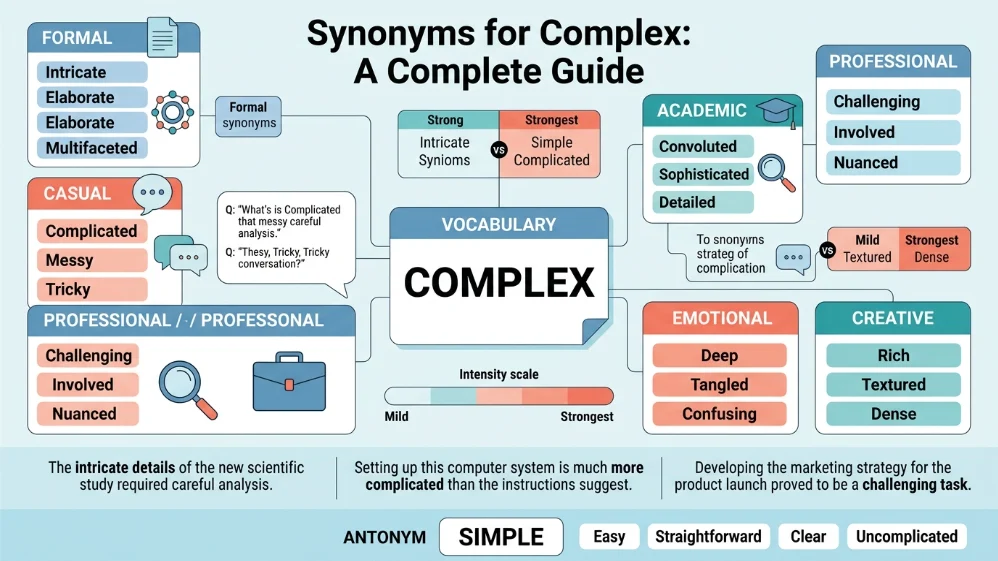
Complex means consisting of many interconnected parts or requiring deep thought to understand. The best synonyms depend on your context. For formal writing, choose “sophisticated” or “intricate.” casual conversation, “complicated” or “tricky” works well. For academic work, use “multifaceted” or “elaborate.” Professional settings often call for “nuanced” or “sophisticated.” Creative writing benefits from “convoluted” or “labyrinthine.”
Meaning, Tone and Context
1. Simple Definition
Complex describes something with many related parts or ideas that are not simple to understand. It points to depth, interconnection, and often difficulty.
2. Part of Speech
Complex is primarily an adjective. It can also function as a noun in psychology or chemistry, but this guide focuses on the adjective form.
3. Tone
Complex carries a neutral tone. It does not automatically mean good or bad. The tone depends entirely on the context and what you are describing.
4. Formality Level
Complex is standard English suitable for all formality levels. It works in casual conversation, professional emails, and academic papers equally well.
5. Common Use Cases
You will encounter complex when describing systems, problems, ideas, relationships, machinery, emotions, or situations. It appears frequently in science, business, psychology, and everyday life.
6. Important Word Forms
Complexity is the noun form. Complexities are plural. Complicated shares similar meaning but carries a more negative connotation. The verb form complexify exists but is rarely used.
When and How to Use “Complex”
Complex works best when you want to acknowledge that something has many layers or components. It serves as a safe, neutral choice that most readers will understand immediately. However, relying on it too often makes your writing feel uninspired.
Here are examples showing how to use complex effectively in different situations.
Professional
The new software system is complex and requires extensive training for all employees.
Personal
My feelings about moving to a new city are complex and hard to explain in just a few words.
Academic
The professor presented a complex theory that took us three weeks to fully understand.
Emotional
Their relationship was complex, filled with both deep love and unresolved resentment.
Creative
The labyrinth of ancient tunnels formed a complex network beneath the crumbling castle.
Social Media
Life is complex, but that does not mean we cannot find moments of pure simplicity.
Email
This project involves complex financial modeling that our team needs to review carefully.
Resume
Managed complex client relationships while balancing multiple high priority accounts.
Another Word for “Complex”
Finding the right single replacement for complex depends entirely on your situation. Here are the best alternatives organized by context.
Professional Writing
Choose “sophisticated.” This word suggests advanced development and refinement. It works perfectly for describing strategies, systems, or approaches in business contexts.
Academic Writing
Choose “multifaceted.” This word emphasizes the many different aspects or dimensions of a topic. It sounds precise and scholarly without being pretentious.
Casual Conversation
Choose “complicated.” This is the most natural replacement for everyday speech. It is slightly more negative than complex but very common in casual settings.
Emotional Writing
Choose “layered.” This word captures emotional depth and the idea that feelings have multiple levels. It is softer and more evocative than complex.
Creative Writing
Choose “intricate.” This word suggests careful detail and craftsmanship. It works beautifully for describing patterns, plots, or physical objects with many fine details.
Resume Use
Choose “multidimensional.” This emphasizes your ability to handle various aspects of a role. It sounds impressive and suggests versatility.
Social Media Captions
Choose “deep.” Short, impactful, and relatable. This word works well for captions about thoughts, feelings, or experiences.
Stronger Meaning
Choose “convoluted.” This suggests excessive complexity that is unnecessarily difficult to follow. It carries a more critical tone.
Softer Meaning
Choose “elaborate.” This emphasizes careful development without suggesting difficulty. It sounds more positive and refined.
When Not to Use “Complex”
Complex is not always the right choice. Sometimes it sounds too vague or fails to capture what you really mean. Here are situations where you should choose a more precise synonym instead.
When you want to criticize something as overly difficult
Using complex in this situation sounds too neutral. You should say “convoluted” or “overcomplicated” instead. This makes your criticism clearer and stronger.
Wrong: The instructions were complex and hard to follow.
Better: The instructions were convoluted and unnecessarily confusing.
When you want to praise something as well designed
Complex suggests difficulty, not excellence. Choose “sophisticated” or “refined” to communicate quality and thoughtful design.
Wrong: The new interface is complex and works perfectly.
Better: The new interface is sophisticated and works perfectly.
When you want to describe something with many visual details
Complex sounds abstract. Choose “intricate” or “ornate” for physical objects with fine details.
Wrong: The embroidery had a complex pattern.
Better: The embroidery had an intricate pattern.
When you want to sound more conversational
Complex feels slightly formal for everyday chat. Choose “tricky” or “tough” for casual situations.
Wrong: This recipe is complex to make.
Better: This recipe is tricky to make.
When you want to describe emotional depth
Complex feels clinical. Choose “layered” or “deep” for more emotional impact.
Wrong: Her feelings were complex.
Better: Her feelings were layered and deeply personal.
Words Commonly Confused With “Complex”
Many words seem similar to complex but carry different meanings. Understanding these differences will help you choose the right word every time.
Complex vs. Complicated
Complex means having many interconnected parts. Complicated suggests something is difficult to understand or deal with. A complex system can be easy to use. A complicated system is frustrating. Choose complex for neutral descriptions. Choose complicated when you want to emphasize difficulty.
Complex vs. Sophisticated
Complex focuses on many parts. Sophisticated focuses on refinement and advanced development. A complex machine may be poorly designed. A sophisticated machine is elegant and well engineered. Choose sophisticated when you want to praise quality.
Complex vs. Intricate
Complex suggests many parts or ideas. Intricate suggests very fine detail and careful arrangement. A complex plot has many twists. An intricate design has tiny beautiful details. Choose intricate for visual or physical details.
Complex vs. Convoluted
Complex is neutral. Convoluted is negative and suggests unnecessary twisting or confusion. A complex argument is deep. A convoluted argument is hard to follow and probably flawed. Choose convoluted when you want to criticize.
Complex vs. Elaborate
Complex emphasizes interconnection. Elaborate emphasizes careful development and detail. A complex plan has many moving parts. An elaborate plan has been carefully worked out in detail. Choose elaborate when you want to emphasize effort and thoroughness.
Complex vs. Nuanced
Complex means many parts. Nuanced means small subtle differences. A complex issue has many components. A nuanced issue requires careful attention to small distinctions. Choose nuanced when discussing subtle differences in opinion or meaning.
Best Synonym by Context for “Complex”
| Context | Best Synonym | Why It Works | Example |
|---|---|---|---|
| Formal Writing | Sophisticated | Sounds refined and professional | The sophisticated algorithm produced remarkable results. |
| Academic Writing | Multifaceted | Emphasizes multiple dimensions | The study examined the multifaceted nature of poverty. |
| Professional Business | Nuanced | Shows attention to detail | We need a nuanced approach to market segmentation. |
| Resume Writing | Multidimensional | Highlights versatility | Managed multidimensional projects across three departments. |
| Casual Conversation | Complicated | Natural and relatable | This math problem is so complicated. |
| Creative Writing | Intricate | Adds vivid imagery | The intricate tapestry told a story of ancient battles. |
| Emotional Tone | Layered | Suggests depth of feeling | Her grief was layered with moments of unexpected joy. |
| Strong Intensity | Convoluted | Adds critical force | The contract contained convoluted clauses that confused everyone. |
| Soft Moderate Tone | Elaborate | Sounds positive and careful | The elaborate proposal impressed all the stakeholders. |
| Social Media | Deep | Short and impactful | Sometimes the deepest thoughts are the hardest to share. |
| US Usage | Complex | Standard American English | The legal system is complex and demanding. |
| UK Usage | Complicated | More common in British English | This situation is terribly complicated. |
Which Synonym Should You Choose?
Choosing the right synonym for complex comes down to four key factors. Understanding these will help you make the best choice every time.
First, consider your meaning. Are you describing many parts, difficulty, refinement, or confusion? This is the most important question. Each synonym emphasizes a different aspect of complexity. Intricate focuses on detail. Convoluted focuses on confusion. Sophisticated focuses on refinement. Match your word to your exact meaning.
Second, think about formality. Professional emails and academic papers call for words like multifaceted and sophisticated. Casual conversations and social media work better with complicated or tricky. Your audience determines what sounds natural.
Third, evaluate emotional intensity. Some synonyms carry strong emotional weight. Convoluted sounds critical. Layered sounds emotional. Neutral words like elaborate sound positive. Choose words that match your intended tone.
Fourth, consider the sentence structure. Short sentences work well with short words like deep or tough. Longer sentences can handle more sophisticated choices like multidimensional or labyrinthine. The rhythm of your writing matters.
Remember that context is everything. A word that sounds perfect in a business proposal might seem pretentious in a text message. A casual synonym might weaken your authority in an academic paper. Always consider your reader and your purpose.
When in doubt, read your sentence aloud. Your ear will often tell you which word sounds right. If a synonym feels awkward or forced, try another one. The best word is the one that sounds natural and communicates your exact meaning.
Real Life Examples of “Complex” in Sentences
These examples show how synonyms for complex work in real situations. Notice how different contexts call for different word choices.
School
The teacher simplified the multifaceted concept using everyday examples that everyone could understand.
Workplace
Our team tackled the intricate supply chain problem with patience and creative thinking.
Writing
Her essay explored the nuanced relationship between social media and mental health.
Conversation
This recipe is trickier than it looks, so follow the instructions carefully.
Social Media
Life has so many deep moments that never make it to Instagram.
Resume
Developed sophisticated marketing strategies that increased engagement by forty percent.
Email
Please review the elaborate proposal before our meeting on Thursday.
Storytelling
The convoluted plot kept audiences guessing until the very last scene.
25 Synonyms for “Complex”
| Synonym | Simple Meaning | Best Used For | Example Sentence |
|---|---|---|---|
| Complicated | Hard to understand or deal with | Casual conversation | The tax forms are so complicated that I hired an accountant. |
| Intricate | Full of fine details | Visual and physical descriptions | The intricate snowflake melted before I could photograph it. |
| Sophisticated | Advanced and refined | Professional and business contexts | The sophisticated software handles millions of transactions daily. |
| Multifaceted | Having many different aspects | Academic and analytical writing | The multifaceted problem required input from several experts. |
| Convoluted | Excessively twisted or complicated | Critical descriptions | The convoluted plot made the movie impossible to follow. |
| Elaborate | Carefully developed in detail | Positive descriptions | The elaborate wedding decorations took months to plan. |
| Nuanced | Having subtle distinctions | Discussions of opinions and ideas | The nuanced debate considered perspectives from both sides. |
| Layered | Having multiple levels | Emotional and artistic contexts | The layered performance revealed new meaning with each viewing. |
| Multidimensional | Having many dimensions | Resume and professional use | Her multidimensional skills made her the perfect candidate. |
| Labyrinthine | Like a maze or labyrinth | Creative and literary writing | The labyrinthine corridors of the ancient castle confused visitors. |
| Knotty | Full of difficult problems | Problem solving contexts | The knotty issue required creative negotiation skills. |
| Tangled | Twisted together in confusion | Emotional and relationship contexts | Their tangled history made reconciliation difficult. |
| Byzantine | Excessively complicated and secretive | Critical political or bureaucratic contexts | The byzantine regulations discouraged new businesses. |
| Daedal | Skillfully made with intricate detail | Literary and artistic descriptions | The daedal carvings covered every surface of the temple. |
| Gordian | Extremely complicated or intractable | Problem solving metaphors | The gordian puzzle challenged even the brightest students. |
| Mazy | Full of confusing turns or paths | Physical and metaphorical navigation | The mazy streets of the old city delighted tourists. |
| Baroquemore | Extravagantly ornate and complex | Artistic and architectural descriptions | The baroque design featured elaborate flourishes on every surface. |
| Rarified | Understood by only a few | Intellectual and academic contexts | The rarified discussion went over most people’s heads. |
| Abstruse | Difficult to understand | Academic and philosophical writing | The abstruse theory took years to fully comprehend. |
| Recondite | Little known and hard to understand | Scholarly contexts | The recondite text was available only in a few libraries. |
| Involved | Complicated with many parts | Neutral descriptions | The involved process required approval from multiple departments. |
| Tied | Connected in complex ways | Relationship and system descriptions | Their success was tied to complex economic factors. |
| Dense | Packed with content or meaning | Intellectual and creative contexts | The dense novel rewarded careful reading. |
| Baffling | Confusing and hard to understand | Frustrating situations | The baffling instructions left everyone scratching their heads. |
| Perplexing | Causing confusion or uncertainty | Puzzling situations | The perplexing mystery remained unsolved for decades. |
Synonym Groups and Usage Differences
Professional vs. Personal Synonyms
Professional contexts call for sophisticated, nuanced, or multidimensional. These words signal competence and attention to detail. Personal contexts work better with complicated, tricky, or layered. These words feel more natural in everyday conversation and emotional exchanges.
Formal vs. Conversational Synonyms
Formal writing benefits from abstruse, recondite, and multifaceted. These words appear in academic papers, legal documents, and official reports. Conversational settings prefer complicated, tough, or tricky. These words sound natural and accessible in casual speech.
Academic Synonyms
Multifaceted, nuanced, and abstruse work exceptionally well in academic writing. They signal precision and scholarly depth. These words help you sound credible in essays, research papers, and presentations. Avoid casual synonyms like tricky or tough in academic contexts.
Professional and Business Synonyms
Sophisticated, multidimensional, and nuanced dominate professional communication. They appear in resumes, emails, presentations, and reports. These words suggest you understand complexity without being overwhelmed by it. They project competence and confidence.
Creative or Literary Synonyms
Labyrinthine, daedal, and baroque add vivid imagery to creative writing. These words evoke specific visual and emotional responses. They help you paint pictures with language. Use them in poetry, fiction, and descriptive passages.
Slang or Modern Synonyms
“Messy” has become a popular synonym in modern speech. It describes complex emotional situations or relationships. “Extra” describes unnecessarily complex behavior. These words work in casual conversation and social media. Avoid them in professional or academic writing.
Strongest vs. Weaker Synonyms
Mild synonyms include elaborate and multifaceted. These words suggest positive complexity. Stronger synonyms include convoluted, byzantine, and gordian. These words suggest excessive or frustrating complexity. Choose based on your intended emotional impact.
Emotional vs. Neutral Synonyms
Layered, tangled, and messy carry emotional weight. They describe feelings and relationships with depth. Sophisticated, elaborate, and multifaceted remain neutral and factual. They describe systems, ideas, and structures without emotional coloring.
Antonyms of “Complex”
| Antonym | Meaning | Example Sentence |
|---|---|---|
| Simple | Easy to understand or do | The simple instructions took only five minutes to follow. |
| Straightforward | Clear and uncomplicated | The straightforward process saved everyone time. |
| Basic | Fundamental and uncomplicated | The basic design worked perfectly for our needs. |
| Plain | Not decorated or complicated | The plain explanation made everything clear. |
| Clear | Easy to understand | The clear presentation answered all questions. |
| Obvious | Easily perceived or understood | The obvious solution was right in front of us. |
| Easy | Not difficult | The easy task took less than an hour. |
| Uncomplicated | Not complex or difficult | The uncomplicated system required minimal training. |
| Elementary | Simple and basic | The elementary concept was perfect for beginners. |
| Straight | Direct and uncomplicated | The straight path led directly to the solution. |
| Accessible | Easy to understand or approach | The accessible writing style appealed to everyone. |
| Understandable | Capable of being understood | The understandable explanation cleared up all confusion. |
| Apparent | Clearly visible or understood | The apparent solution was the best one. |
| Evident | Plainly seen or understood | The evident answer satisfied everyone. |
| Transparent | Easy to see through or understand | The transparent process eliminated all doubt. |
Comparison: Complex vs. Similar Words
Complex vs. Complicated
Complex describes many interconnected parts. Complicated describes something difficult to deal with. A complex puzzle has many pieces. A complicated puzzle is frustrating to solve. Complex is neutral. Complicated is more negative.
Complex Example: The human brain is an incredibly complex organ.
Complicated Example: The directions were so complicated that I got lost.
Complex vs. Sophisticated
Complex focuses on many parts. Sophisticated focuses on refinement and advancement. Complex suggests depth. Sophisticated suggests quality and elegance. Use complex for neutral descriptions. Use sophisticated for praise.
Complex Example: The complex machinery required skilled operators.
Sophisticated Example: The sophisticated design won multiple awards.
Complex vs. Intricate
Complex describes many parts. Intricate describes fine, delicate details. Complex is abstract. Intricate is often physical or visual. Choose complex for ideas. Choose intricate for objects and patterns.
Complex Example: The complex theory explained years of data.
Intricate Example: The intricate lacework impressed everyone.
Complex vs. Convoluted
Complex is neutral. Convoluted is critical. Complex suggests depth. Convoluted suggests unnecessary confusion. Use complex when you respect the subject. Use convoluted when you want to criticize.
Complex Example: The complex plot rewarded careful viewers.
Convoluted Example: The convoluted plot frustrated audiences.
Complex vs. Elaborate
Complex emphasizes interconnection. Elaborate emphasizes careful development. Complex sounds neutral. Elaborate sounds positive. Choose complex for systems. Choose elaborate for plans and designs.
Complex Example: The complex network of roads confused tourists.
Elaborate Example: The elaborate plan covered every possible scenario.
Complex vs. Nuanced
Complex describes many components. Nuanced describes subtle distinctions. Complex is broader. Nuanced is more specific. Use complex for general descriptions. Use nuanced for discussions of fine points.
Complex Example: The complex issue required extensive research.
Nuanced Example: The nuanced argument considered both perspectives carefully.
Common Phrases and Expressions with “Complex”
1. Complex System
Meaning: A system with many interconnected parts that influence each other.
Example sentence: The climate is a complex system that scientists continue to study.
2. Complex Issue
Meaning: A problem or topic with many different aspects.
Example sentence: Climate change is a complex issue requiring global cooperation.
3. Complex Relationship
Meaning: A connection between people or things with many dimensions.
Example sentence: Their complex relationship involved both business and personal ties.
4. Complex Structure
Meaning: A physical or conceptual arrangement with many parts.
Example sentence: The complex structure of the molecule amazed researchers.
5. Complex Nature
Meaning: The inherent quality of being multifaceted.
Example sentence: The complex nature of human emotions fascinates psychologists.
6. Complex Problem
Meaning: A problem with many variables and potential solutions.
Example sentence: The complex problem required input from many experts.
7. Complex Process
Meaning: A procedure with many steps or considerations.
Example sentence: The complex process took several weeks to complete.
8. Complex Emotional Response
Meaning: A reaction involving multiple feelings.
Example sentence: Her complex emotional response surprised everyone.
Common Mistakes to Avoid
1. Using “Complex” When a More Precise Synonym Is Better
Complex is a safe choice, but it is often too vague. If you mean intricate details, say intricate. If you mean sophisticated quality, say sophisticated. Precise vocabulary makes your writing stronger and more interesting.
Wrong: The painting has a complex design.
Better: The painting has an intricate design.
2. Confusing “Complex” with “Complicated”
Complex emphasizes many parts. Complicated emphasizes difficulty. Use complex for neutral descriptions of interconnected things. Use complicated when you want to say something is hard to handle. The distinction matters in professional writing.
Wrong: The complicated ecosystem supported many species.
Better: The complex ecosystem supported many species.
3. Using a Casual Synonym in Formal Writing
Words like tricky and messy have no place in academic papers or professional reports. These words sound too informal. Choose sophisticated, multifaceted, or nuanced instead. Your credibility depends on word choice.
Wrong: The tricky problem required creative solutions.
Better: The nuanced problem required creative solutions.
4. Using an Overly Dramatic Synonym for a Simple Situation
Words like labyrinthine and byzantine sound dramatic and literary. They are out of place when describing everyday situations. Save these words for creative writing or when you truly need strong imagery.
Wrong: The labyrinthine recipe confused the beginner cook.
Better: The complicated recipe confused the beginner cook.
5. Repeating the Same Word Too Often
Repeating any synonym makes your writing feel lazy. Vary your vocabulary throughout your document. Use complex once, then switch to sophisticated, intricate, or multifaceted. Your readers will appreciate the variety.
6. Choosing a Synonym with the Wrong Emotional Tone
Convoluted sounds critical. Elaborate sounds positive. Layered sounds emotional. Make sure your word matches your intended tone. Using convoluted when you mean elaborate can offend your reader.
Wrong: Your convoluted proposal impressed the committee.
Better: Your elaborate proposal impressed the committee.
7. Using Slang in Academic or Professional Writing
Words like messy and extra have no place in serious writing. These words sound immature and unprofessional. Choose standard vocabulary for academic and professional contexts. Save modern slang for social media and casual conversations.
FAQs
1. What is the best synonym for complex?
The best synonym depends on your context. Use sophisticated for professional writing, multifaceted for academic work, and complicated for casual conversation. Always match your word to your situation.
2. What is a formal synonym for complex?
Multifaceted, abstruse, and recondite are formal synonyms. These words work well in academic papers, legal documents, and scholarly articles. They signal precision and intellectual depth.
3. What is an informal synonym for complex?
Complicated, tricky, and tough are informal synonyms. These words work well in casual conversation, text messages, and social media posts. They sound natural and approachable.
4. What is another word for complex in professional writing?
Sophisticated, nuanced, and multidimensional are excellent choices for professional writing. These words suggest competence, attention to detail, and advanced understanding in business contexts.
5. What is the difference between complex and complicated?
Complex means having many interconnected parts. Complicated means difficult to understand or deal with. Complex is neutral. Complicated carries a more negative connotation.
6. What is the opposite of complex?
Simple, straightforward, and uncomplicated are opposites of complex. These words describe things that are easy to understand, follow, or accomplish.
Conclusion
Complex is a useful word, but it should not be your only option. The English language offers dozens of precise alternatives that can transform your writing. Choosing the right synonym shows attention to detail and deep vocabulary knowledge.
Remember that context determines the best word choice. Professional settings call for sophisticated and nuanced. Academic writing prefers multifaceted and abstruse. Casual conversation welcomes complicated and tricky. Creative writing benefits from intricate and labyrinthine. Match your word to your situation.
The most important vocabulary tip is to think about your reader. Consider what they need to understand and how they will receive your message. A word that sounds perfect in one context might feel completely wrong in another. Always read your writing aloud to catch awkward choices.
Start using these synonyms today. Replace one “complex” in your next email or essay with a more precise alternative. Notice how your writing becomes clearer and more engaging. With practice, choosing the perfect synonym will become second nature.