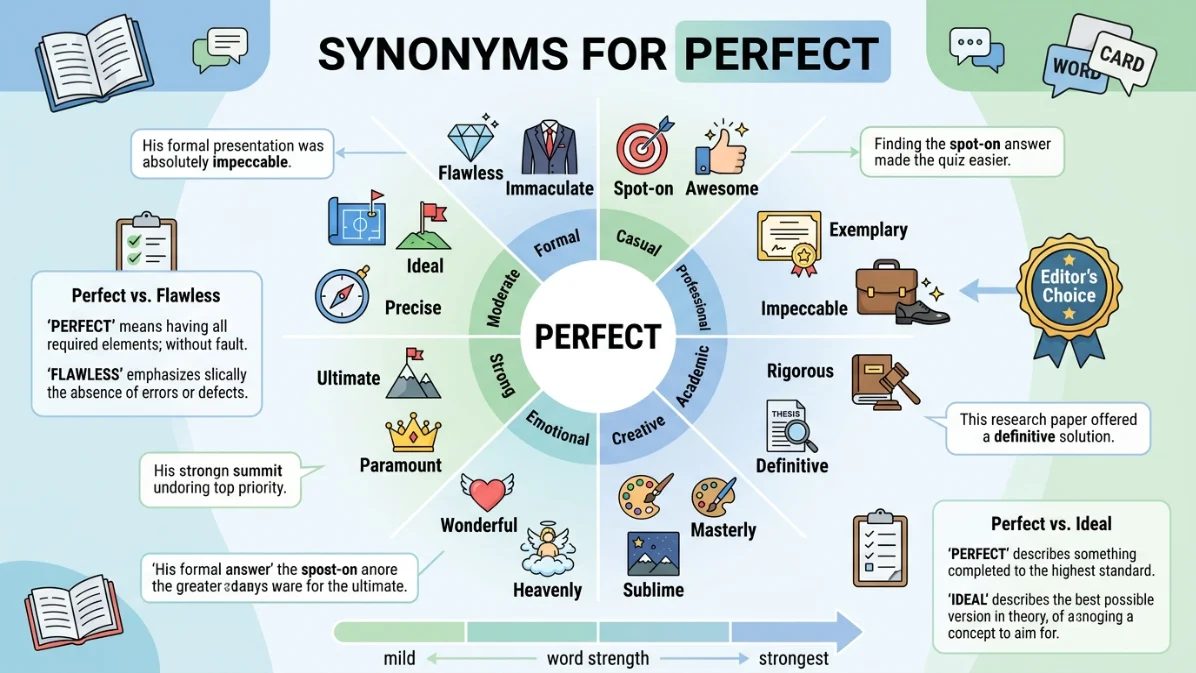
“Perfect” sounds powerful, but using it again and again can make your writing feel plain. A stronger word can change the tone of a sentence in seconds.
You may need a better choice for an essay, email, compliment, product description, speech, caption, or everyday conversation. That is where the right synonym perfect option can help. Words such as flawless, ideal, excellent, impeccable, and superb may all suggest perfection, but they do not always mean the same thing.
This guide covers 50+ perfect synonyms with clear meanings and simple examples. You will also discover useful words for perfect in formal, casual, professional, creative, and complimentary situations. Need another word for perfect that sounds more natural? You will find plenty of options here.
The goal is simple. Instead of forcing one word into every sentence, you can choose an alternative that matches your meaning, tone, and audience. Whether you want to praise someone, improve your vocabulary, or make your writing more precise, this list gives you practical choices you can use with confidence.
What Does Perfect Mean?
Perfect means having all the required elements, qualities, or characteristics without any flaws or defects. The best synonyms for perfect depend on context. Use “flawless” for creative writing, “impeccable” for professional settings, “ideal” for casual conversation, and “faultless” for academic work. Choose based on your tone and audience.
Meaning, Tone and Context
Simple Definition
Perfect describes something that is completely free from faults, errors, or deficiencies. It can also mean exactly suitable for a particular purpose or situation.
Part of Speech
Perfect is primarily an adjective. It can also function as a verb meaning to make something flawless, or as a noun referring to the perfect tense in grammar.
Tone
Perfect carries a positive tone in most contexts. However, it can sometimes sound exaggerated or unrealistic in casual conversation.
Formality Level
Perfect sits in the middle of the formality spectrum. It works in both casual and professional settings but often lacks the precision needed for formal writing.
Common Use Cases
People use perfect for describing outcomes, performances, appearances, matches, solutions, and emotional moments. It appears frequently in social media captions, workplace feedback, and everyday conversation.
Word Forms
Adjective: perfect
Verb: perfect, perfected, perfecting
Noun: perfection, perfectness
Adverb: perfectly
Opposite: imperfect
When and How to Use “Perfect”
Use “perfect” when you want to emphasize completeness or suitability. It works best when something meets every expectation without exception. Save it for moments that genuinely deserve this level of praise.
Examples of “Perfect” in Context
Professional Context
The candidate’s qualifications were a perfect match for our company’s requirements.
Personal Context
This small cafe is the perfect spot for our weekend coffee dates.
Academic Context
The experiment produced perfect results with zero deviation from the hypothesis.
Creative Context
The sunset painted a perfect orange and pink gradient across the evening sky.
Social Media Context
My morning coffee and this ocean view are the perfect start to the day.
Emotional Context
Her kind words came at the perfect moment when I needed encouragement.
Resume Context
Developed a perfect attendance record and received recognition for reliability.
Another Word for “Perfect”
The best single replacement depends entirely on your writing situation. Here are specific recommendations for different contexts.
Professional Writing
Impeccable is the strongest professional synonym. It suggests high standards and attention to detail.
Academic Writing
Faultless works best in academic contexts. It implies rigorous precision and accuracy.
Casual Conversation
Ideal serves as a natural, approachable alternative for everyday speech.
Emotional Writing
Heartfelt situations call for words like sublime or exquisite to capture deeper feelings.
Creative Writing
Flawless adds vivid imagery and descriptive power to creative work.
Resume or Workplace Use
Use accomplished for achievements and exceptional for performance reviews.
Social Media Captions
Dreamy, stunning, or gorgeous work well for visual content and lifestyle posts.
Stronger Meaning
Immaculate suggests absolute purity and perfection without any stain or flaw.
Softer Meaning
Excellent offers a strong compliment without the absolute quality of perfect.
When Not to Use “Perfect”
Avoid using “perfect” when a more precise word would communicate your meaning better. Perfect often sounds too absolute or vague.
When It Sounds Too Vague
Saying “the product is perfect” provides little useful information. Instead, say “the product is durable, efficient, and user friendly.”
When It Sounds Too Casual
In formal reports, “perfect” can seem unprofessional. Use “optimal” or “ideal” for business documents.
When It Sounds Too Weak
Describing a truly outstanding achievement as “perfect” might understate its significance. Try “exceptional” or “remarkable.”
When It Sounds Too Absolute
Calling something perfect leaves no room for improvement. Use “excellent” or “superb” when acknowledging high quality without finality.
When a Specific Descriptor Works Better
Instead of “perfect weather,” try “sunny and mild” for greater clarity and impact.
Words Commonly Confused With “Perfect”
Several words share meaning with perfect but carry distinct nuances. Understanding these differences will improve your word choice.
Perfect vs. Flawless
Perfect means having no faults. Flawless specifically means having no visible or apparent defects. Use flawless when emphasizing appearance or surface quality.
Perfect vs. Ideal
Perfect suggests absolute quality. Ideal suggests suitability for a specific purpose. Choose ideal when discussing the best possible option for a particular situation.
Perfect vs. Excellent
Perfect leaves no room for improvement. Excellent acknowledges high quality without claiming absolute perfection. Use excellent for more realistic praise.
Perfect vs. Complete
Perfect describes quality or condition. Complete describes wholeness or finishing. Use complete when discussing whether something is finished or whole.
Perfect vs. Pure
Perfect relates to quality and condition. Pure relates to being unmixed or uncorrupted. Use pure when discussing materials, motives, or intentions.
Perfect vs. Precise
Perfect suggests overall quality. Precise suggests exactness and accuracy. Use precise for measurements, instructions, or technical details.
Best Synonym by Context for “Perfect”
| Context | Best Synonym | Why It Works | Example |
|---|---|---|---|
| Formal Writing | Faultless | Implies rigorous accuracy and no errors | The research methodology was faultless in its design. |
| Academic Writing | Impeccable | Suggests scholarly precision and high standards | Her impeccable citations strengthened the paper’s credibility. |
| Professional Business | Optimal | Indicates the best possible outcome for goals | The optimal solution balanced cost and efficiency. |
| Resume Writing | Accomplished | Highlights achievements without exaggeration | Accomplished project manager with consistent results. |
| Casual Conversation | Ideal | Feels natural and approachable for everyday use | This weather is ideal for a picnic. |
| Creative Writing | Exquisite | Adds artistic depth and sensory detail | The exquisite melody lingered in the concert hall. |
| Emotional Tone | Sublime | Captures deep emotional impact and beauty | Their love story was simply sublime. |
| Strong Intensity | Immaculate | Emphasizes absolute purity and flawlessness | The athlete delivered an immaculate performance. |
| Soft or Moderate | Excellent | Offers strong praise without absolute claims | You did an excellent job on the presentation. |
| Social Media Captions | Gorgeous | Creates visual appeal and engagement | This gorgeous sunset made my evening. |
| American English | Flawless | Common and natural in US professional contexts | The team executed a flawless marketing campaign. |
Which Synonym Should You Choose?
Choosing the right synonym requires considering several factors about your writing situation.
Consider Your Meaning
Do you want to emphasize suitability, quality, appearance, or emotional impact? Each aspect calls for a different word.
Consider Your Formality
Professional documents need words like optimal and impeccable. Casual messages work better with ideal and excellent.
Consider Your Emotional Intensity
Deep emotional moments deserve words like sublime or exquisite. Everyday praise works fine with great or excellent.
Consider Your Professional Value
Resumes benefit from action oriented words like accomplished and exceptional. These convey achievement without exaggeration.
Consider Your Sentence Context
Look at the surrounding words. If you are describing appearance, use flawless. If you are describing suitability, use ideal. Match the word to what you are actually describing.
Real Life Examples of “Perfect” in Sentences
School Context
The student submitted a faultless essay that earned the highest possible grade.
Workplace Context
Her impeccable organizational skills made the entire conference run smoothly.
Writing Context
The author chose exquisite vocabulary to bring the historical setting to life.
Conversation Context
Your suggestion is ideal for solving this scheduling problem.
Social Media Context
This dreamy latte art deserves a permanent spot in my photo album.
Resume Context
Accomplished sales professional with exceptional client retention rates.
Email Context
Thank you for the excellent proposal. The team is reviewing it now.
Storytelling Context
The garden looked immaculate after the morning rain washed every leaf clean.
15 Synonyms for “Perfect”
| Synonym | Simple Meaning | Best Used For | Example Sentence |
|---|---|---|---|
| Flawless | No visible defects or mistakes | Creative writing, appearance, performances | Her flawless dance routine earned a standing ovation. |
| Impeccable | Without any faults or errors | Professional settings, formal writing | His impeccable manners made him a favorite among colleagues. |
| Ideal | Exactly right for a purpose | Casual conversation, recommendations | This quiet library is ideal for focused study sessions. |
| Faultless | Completely without error | Academic work, technical writing | The lab technician produced faultless test results. |
| Exquisite | Beautiful and finely detailed | Artistic descriptions, sensory experiences | The exquisite necklace featured tiny diamond accents. |
| Immaculate | Pure and completely unspoiled | Strong emphasis, moral or physical purity | The kitchen remained immaculate after dinner service. |
| Optimal | Best possible under the circumstances | Business writing, strategic planning | We found the optimal price point for maximum sales. |
| Accomplished | Skilled and successful | Resumes, professional profiles | The accomplished architect designed award winning buildings. |
| Exceptional | Unusually good or outstanding | Performance reviews, recommendations | The team delivered exceptional results this quarter. |
| Splendid | Magnificent and impressive | Enthusiastic praise, formal compliments | The wedding was a splendid celebration of love. |
| Superb | Of the highest quality | General professional use, recommendations | The restaurant offered superb service throughout our meal. |
| Excellent | Very good, high quality | Everyday use, moderate praise | She provided excellent support to all new employees. |
| Divine | Heavenly or godlike in quality | Emotional writing, strong admiration | The chocolate cake tasted absolutely divine. |
| Ultimate | The best or most extreme example | Emphasizing superiority, finality | This vacation package is the ultimate luxury experience. |
| A1 | Top quality, excellent | Informal conversation, casual praise | The team gave an A1 presentation to the clients. |
Synonym Groups and Usage Differences
Professional vs. Personal Synonyms
Professional settings call for precise, measured language. Impeccable and optimal show attention to quality and strategy. Personal situations allow for warmer words like wonderful and gorgeous. The difference lies in emotional distance and formality requirements.
Formal vs. Conversational Synonyms
Formal writing favors faultless, impeccable, and optimal. These words project authority and careful thought. Conversational settings welcome ideal, excellent, and even A1. The key is matching your word choice to your audience’s expectations.
Academic Synonyms
Academic writing requires precision and careful qualification. Faultless and impeccable work well for methodology and argumentation. These words suggest the writer has thoroughly checked their work. Academic readers expect this level of attention to detail.
Professional and Business Synonyms
Business communication values clarity and measurable outcomes. Optimal and exceptional signal strategic thinking. Accomplished and exceptional appear in resumes and performance reviews. These words connect directly to professional achievement.
Creative or Literary Synonyms
Creative writing benefits from vivid, evocative language. Exquisite, sublime, and splendid add sensory richness. These words paint pictures and evoke emotions. They transform simple descriptions into memorable images.
Slang or Modern Synonyms
Modern expressions like “on point” and “on fleek” appear in casual speech and social media. These terms work well for informal contexts among younger audiences. Avoid them in professional documents, academic papers, or formal correspondence.
Strongest vs. Weaker Synonyms
Mild: great, good, fine
Moderate: excellent, wonderful, superb
Strong: flawless, impeccable, faultless
Strongest: immaculate, divine, ultimate, exquisite
Choose intensity based on what you are describing. A good meal deserves “excellent.” A life changing performance deserves “divine.”
Emotional vs. Neutral Synonyms
Emotional synonyms add feeling to your writing. Sublime, exquisite, and divine carry warmth and admiration. Neutral synonyms stay factual and measured. Excellent and optimal report quality without emotional coloring. Choose based on whether you want to inform or move your reader.
Antonyms of “Perfect”
| Antonym | Meaning | Example Sentence |
|---|---|---|
| Flawed | Having imperfections or defects | The flawed design caused the product to fail. |
| Imperfect | Not perfect, containing errors | Her imperfect pronunciation improved with practice. |
| Defective | Having a fault or malfunction | The defective machine needed immediate repairs. |
| Faulty | Containing errors or defects | Faulty wiring created a serious safety hazard. |
| Inferior | Lower in quality or value | The inferior materials weakened the final product. |
| Mediocre | Average, not very good | The mediocre performance disappointed the audience. |
| Substandard | Below acceptable quality | Substandard products damaged the company’s reputation. |
| Unsatisfactory | Not meeting expectations | The unsatisfactory results required further testing. |
| Deficient | Lacking necessary qualities | The deficient report missed critical data points. |
| Inadequate | Not enough or not good enough | Inadequate preparation led to poor outcomes. |
| Patchy | Uneven in quality or coverage | The patchy paint job looked unprofessional. |
| Crude | Rough and unrefined | The crude prototype needed significant improvement. |
| Shoddy | Poorly made or done | Shoddy craftsmanship caused the furniture to break. |
| Second rate | Below the best quality | The second rate hotel did not match the photos. |
| Unfinished | Not complete or perfected | The unfinished project required more work. |
Comparison: Perfect vs. Similar Words
Perfect vs. Flawless
Main Difference
Perfect means meeting every standard. Flawless means having no visible defects.
Which One Is Stronger
Perfect is stronger because it implies no deficiencies whatsoever.
Which One Is More Formal
Perfect is slightly more formal and versatile across contexts.
Example Sentence for Perfect
The recipe produced perfect cookies with ideal texture and flavor.
Example Sentence for Flawless
Her flawless skin needed no makeup for the photoshoot.
Perfect vs. Ideal
Main Difference
Perfect describes absolute quality. Ideal describes perfect suitability for a purpose.
Which One Is Stronger
Perfect is stronger as an absolute. Ideal is more relative and practical.
Which One Is More Formal
Ideal works better in professional planning documents.
Example Sentence for Perfect
The diamond was perfect in every measurable way.
Example Sentence for Ideal
This location is ideal for our new retail store.
Perfect vs. Excellent
Main Difference
Perfect allows no room for improvement. Excellent acknowledges high quality without absolutes.
Which One Is Stronger
Perfect is stronger but less realistic in most situations.
Which One Is More Formal
Excellent works well across all formality levels.
Example Sentence for Perfect
The perfect score required answering every question correctly.
Example Sentence for Excellent
The student earned an excellent grade on the exam.
Perfect vs. Impeccable
Main Difference
Perfect is general. Impeccable specifically relates to standards and behavior.
Which One Is Stronger
Impeccable feels more specific and therefore more powerful in context.
Which One Is More Formal
Impeccable is more formal and professional.
Example Sentence for Perfect
The vacation was perfect from start to finish.
Example Sentence for Impeccable
His impeccable credentials impressed the hiring committee.
Perfect vs. Exquisite
Main Difference
Perfect is clinical. Exquisite is artistic and sensory.
Which One Is Stronger
Exquisite offers stronger emotional and sensory impact.
Which One Is More Formal
Exquisite is formal but primarily used in artistic contexts.
Example Sentence for Perfect
The data analysis produced perfect statistical results.
Example Sentence for Exquisite
The exquisite lace details transformed the wedding dress.
Perfect vs. Optimal
Main Difference
Perfect is absolute. Optimal is situation specific and practical.
Which One Is Stronger
Perfect claims more but often seems unrealistic. Optimal is more credible.
Which One Is More Formal
Optimal appears frequently in business and technical writing.
Example Sentence for Perfect
The perfect solution would satisfy everyone completely.
Example Sentence for Optimal
The optimal solution balanced budget and quality constraints.
Common Phrases and Expressions with “Perfect”
1. Practice Makes Perfect
Meaning
Repeated practice leads to mastery and improvement.
Example Sentence
She practiced her presentation daily because she believes practice makes perfect.
2. Perfect Stranger
Meaning
A person one has never met before.
Example Sentence
He asked a perfect stranger for directions to the museum.
3. Picture Perfect
Meaning
Visually flawless, like an image.
Example Sentence
The bride looked picture perfect in her elegant gown.
4. Perfect Storm
Meaning
A combination of events that creates an extreme situation.
Example Sentence
The canceled flights and hotel strike created a perfect storm for travelers.
5. Perfect Match
Meaning
Two things or people that are ideally suited for each other.
Example Sentence
The sofa and rug were a perfect match for the living room.
6. Perfect Timing
Meaning
Arriving or occurring at exactly the right moment.
Example Sentence
Her arrival was perfect timing as the meeting was about to start.
7. Perfect Gentleman
Meaning
A man who behaves with impeccable manners and courtesy.
Example Sentence
He opened doors and pulled out chairs like a perfect gentleman.
8. Perfect Day
Meaning
A day that goes exactly as hoped without problems.
Example Sentence
Warm weather, good food, and great company made a perfect day.
Common Mistakes to Avoid
1. Overusing Perfect in Writing
Repeating “perfect” makes your writing sound repetitive and lazy. Vary your vocabulary with synonyms like excellent, superb, and ideal. Your readers will appreciate the variety.
2. Using Perfect When a More Precise Word Exists
“The meal was perfect” is vague. Say “the meal was flavorful and beautifully presented” for greater impact. Specific words communicate more than absolutes.
3. Confusing Perfect with Flawless
Use flawless for appearances and surface qualities. Use perfect for overall quality and completeness. The distinction matters in professional writing.
4. Using Casual Synonyms in Formal Writing
Save words like amazing and awesome for casual contexts. Formal writing demands impeccable, faultless, and optimal. Match your vocabulary to your audience.
5. Using an Overly Dramatic Synonym for a Simple Situation
Calling a decent cup of coffee “divine” sounds exaggerated. Save strong words for truly outstanding experiences. Your praise will mean more when you use it sparingly.
6. Repeating Perfect in Resumes
Resumes need variety and action. Instead of “perfect attendance,” try “consistent attendance record.” Instead of “perfect performance,” try “exceptional results.”
7. Choosing the Wrong Emotional Tone
Use cold, precise words for technical writing. Use warm, emotional words for personal messages. The wrong tone confuses your reader and weakens your message.
FAQs
1. What is the best synonym for perfect?
The best synonym depends on context. Use “flawless” for appearances, “impeccable” for professionalism, and “ideal” for casual conversation. Choose based on your specific situation.
2. What is a formal synonym for perfect?
Faultless is an excellent formal synonym for perfect. It suggests rigorous accuracy and no errors. Impeccable also works well in professional and academic writing.
3. What is an informal synonym for perfect?
Ideal works perfectly in casual conversation. Great and excellent are also informal and widely used. A1 and on point work in very casual contexts.
4. What is another word for perfect in professional writing?
Impeccable and optimal are the best professional synonyms. They signal attention to quality and strategic thinking. Accomplished and exceptional also appear in workplace contexts.
5. What is the difference between perfect and flawless?
Perfect means completely without faults. Flawless means without visible or apparent defects. Use flawless when discussing appearances and surface quality.
6. What is the opposite of perfect?
Imperfect is the direct opposite of perfect. Other antonyms include flawed, defective, faulty, and inferior. The best choice depends on your specific meaning.
Conclusion
Perfect is a useful word, but it should not be your only choice. Understanding synonyms like flawless, impeccable, ideal, and exquisite gives you more precise language tools. Each alternative carries its own tone, intensity, and appropriate context.
The key to better vocabulary is knowing when each word fits best. Professional settings benefit from impeccable and optimal. Creative writing shines with exquisite and sublime. Everyday conversation feels natural with ideal and excellent.
Start by replacing just one “perfect” in your next email or essay. Notice how the right synonym adds precision and depth to your message. With practice, you will develop a richer vocabulary that serves you in every writing situation.
For accurate definitions and usage guidance, always verify synonyms using trusted dictionaries such as Cambridge, Oxford, Merriam Webster, Collins, or Britannica before publication.