You are writing an important email about a workplace incident. You use the word “scary” three times. The sentence feels weak and repetitive. You know there is a better word, but you cannot think of it in the moment.
This happens to English learners, students, and professionals every day. The word “scary” is useful, but it lacks precision. It cannot capture every type of fear, dread, or unease. This guide gives you over 50 synonyms for scary with clear explanations and real examples. You will learn exactly which word fits your situation.
What Does Scary Mean?
Scary means causing fear, alarm, or nervousness. The best formal synonym is “frightening.” The best casual synonym is “creepy.” For professional writing, use “alarming” or “disturbing.
For emotional impact, “terrifying” works well. Creative writing, “chilling” or “haunting” adds depth.
Meaning, Tone and Context
1. Simple Definition
Scary describes anything that makes you feel afraid, anxious, or uneasy.
2. Part of Speech
Adjective.
3. Positive, Negative, or Neutral Tone
Negative.
4. Formality Level
Informal to neutral. More formal alternatives exist for professional use.
5. Common Use Cases
Everyday conversation, casual writing, social media captions, personal stories, and informal emails.
6. Important Word Forms
Scare (verb), scared (adjective), scaring (verb), scariness (noun).
When and How to Use “Scary”
Use “scary” when the situation is genuinely frightening or unnerving but does not require a highly formal or dramatic word. It works best in casual settings and personal stories. Avoid overusing it in professional documents.
Examples:
Professional Context
The quarterly report revealed some scary numbers that worried the entire team.
Personal Context
Walking through the empty parking lot at night felt genuinely scary.
Academic Context
The research findings were scary enough to change the government’s policy approach.
Emotional Context
She told me a scary story about her childhood that stayed with me for weeks.
Creative Context
The abandoned house looked scary under the pale moonlight.
Social Media Context
This horror movie is the scariest film I have ever watched.
Email Context
I need to discuss a few scary budget issues during our meeting tomorrow.
Another Word for “Scary”
The best single replacement depends on your specific situation.
Professional Writing
Alarming. This word suggests worry without sounding dramatic.
Academic Writing
Frightening. This remains clear and precise for research papers.
Casual Conversation
Creepy. This works for uncomfortable or unsettling situations.
Emotional Writing
Terrifying. This adds real intensity to personal stories.
Creative Writing
Haunting. This suggests something that stays with you emotionally.
Resume or Workplace
Concerning. This sounds professional and measured.
Social Media Captions
Spooky. This feels playful and appropriate for light content.
Stronger Meaning
Petrifying. This means extremely terrifying.
Softer Meaning
Unsettling. This suggests mild discomfort without deep fear.
When Not to Use “Scary”
Do not use “scary” in formal reports where “alarming” or “troubling” is more appropriate. Do not use it for minor discomfort when “unsettling” captures the feeling better. Avoid “scary” in academic writing when “frightening” sounds more scholarly.
Do not use “scary” for deep emotional trauma. “Traumatic” is a stronger, more accurate word. Also avoid “scary” when you mean “creepy,” which refers to strange or unsettling behavior rather than active fear.
Example of Improvement
Weak: The job market looks scary right now.
Better: The job market looks concerning right now.
Weak: His behavior seemed scary to me.
Better: His behavior seemed unsettling to me.
Words Commonly Confused With “Scary”
Scary vs. Frightening
“Frightening” is more formal and impactful. Use “frightening” for serious situations and “scary” for casual conversation.
Scary vs. Creepy
“Creepy” refers to strange, unsettling behavior. “Scary” refers to direct fear. A person can be creepy. A situation can be scary.
Scary vs. Terrifying
“Terrifying” is much stronger. Use “terrifying” for extreme fear. Use “scary” for moderate fear.
Scary vs. Alarming
“Alarming” is professional and suggests worry. “Scary” is casual and emotional. Use “alarming” in reports and emails.
Scary vs. Spooky
“Spooky” is playful and light. “Scary” is serious. Use “spooky” for Halloween content or casual stories.
Scary vs. Haunting
“Haunting” suggests emotional depth that lasts. “Scary” suggests immediate fear. Use “haunting” for creative or emotional writing.
Best Synonym by Context for “Scary”
| Context | Best Synonym | Why It Works | Example |
|---|---|---|---|
| Formal Writing | Frightening | Sounds professional and precise | The statistics showed a frightening trend. |
| Academic Writing | Alarming | Indicates concern with evidence | The alarming data required immediate action. |
| Professional Use | Disturbing | Appropriate for workplace discussions | The disturbing report raised many questions. |
| Resume | Concerning | Shows measured awareness | Identified concerning patterns in customer feedback. |
| Casual Conversation | Creepy | Feels natural and relatable | That old house looks really creepy. |
| Creative Writing | Haunting | Adds emotional and lasting impact | The haunting melody stayed in my mind. |
| Emotional Tone | Terrifying | Expresses deep personal fear | The terrifying experience changed her life. |
| Strong Intensity | Petrifying | Communicates extreme fear | The petrifying storm lasted all night. |
| Soft or Moderate | Unsettling | Describes mild unease | His quiet stare felt unsettling. |
| Social Media | Spooky | Fun and engaging for posts | This spooky forest is perfect for photos. |
| US Usage | Scary | Standard American English | That movie was really scary. |
Which Synonym Should You Choose?
Think about your audience first. For professional emails, choose “alarming” or “concerning.” These words sound measured and intelligent.
Consider the intensity of the feeling. “Unsettling” works for mild discomfort. “Terrifying” works for deep fear. “Petrifying” works for extreme situations.
Think about the emotional impact you want. “Haunting” suggests lasting memory. “Creepy” suggests strange behavior. “Spooky” suggests fun fear.
Match your word to the formality of your writing. Academic papers need “frightening” or “alarming.” Social media posts work with “creepy” or “spooky.”
Avoid using the same word repeatedly. Vary your synonyms to keep your writing fresh and engaging.
Real Life Examples of “Scary” in Sentences
School Context
The teacher showed us a frightening video about climate change.
Workplace Context
The alarming sales figures forced the company to reconsider its strategy.
Writing Context
Her haunting descriptions made the novel unforgettable.
Conversation Context
That abandoned factory looks really creepy at night.
Social Media Context
This spooky trail is perfect for our Halloween adventure.
Email Context
The concerning feedback from clients requires our immediate attention.
Storytelling Context
The petrifying moment when the lights went out changed everything.
25 Synonyms for “Scary”
| Synonym | Simple Meaning | Best Used For | Example Sentence |
|---|---|---|---|
| Frightening | Causing fear | Formal and general use | The frightening news spread quickly through the office. |
| Terrifying | Extremely frightening | Strong emotional impact | The terrifying experience left her speechless. |
| Alarming | Causing worry or concern | Professional and academic | The alarming increase in costs worried everyone. |
| Creepy | Strange and unsettling | Casual conversation | His creepy smile made me uncomfortable. |
| Haunting | Remaining in the mind | Creative and emotional writing | The haunting image stayed with me for days. |
| Petrifying | So frightening you cannot move | Extreme situations | The petrifying scream echoed through the building. |
| Unsettling | Causing mild unease | Soft or moderate tone | The unsettling silence filled the room. |
| Spooky | Slightly scary in a fun way | Social media and casual use | The spooky decorations were perfect for the party. |
| Chilling | Causing cold fear | Creative writing | The chilling discovery changed everything. |
| Disturbing | Upsetting or worrying | Professional and formal | The disturbing report raised serious concerns. |
| Eerie | Strange and mysterious | Atmospheric descriptions | The eerie fog covered the entire town. |
| Bone-chilling | Extremely frightening | Strong emotional impact | The bone-chilling story terrified everyone. |
| Hair-raising | Causing intense fear | Strong emotional moments | The hair-raising escape was unforgettable. |
| Gory | Involving violence or blood | Horror and entertainment | The gory scenes were too intense for some viewers. |
| Horrifying | Causing extreme shock | Very strong situations | The horrifying accident made national news. |
| Intimidating | Frightening but with authority | Workplace and social contexts | His intimidating presence made everyone nervous. |
| Menacing | Threatening and dangerous | Strong negative situations | The menacing figure stood in the doorway. |
| Ominous | Suggesting something bad will happen | Atmospheric and serious | The ominous clouds signaled a coming storm. |
| Sinister | Evil or threatening | Creative and dramatic writing | The sinister plan was finally revealed. |
| Appalling | Shocking and terrible | Formal and strong reactions | The appalling conditions were unacceptable. |
| Atrocious | Horrifyingly bad | Strong negative descriptions | The atrocious crime shocked the community. |
| Dire | Extremely serious or urgent | Professional and serious contexts | The dire warnings were ignored by officials. |
| Startling | Surprising and shocking | Unexpected situations | The startling discovery changed the course of research. |
| Morbid | Unpleasant and focused on death | Dark or serious contexts | His morbid sense of humor made everyone uneasy. |
| Ghastly | Causing great horror | Strong and dramatic | The ghastly scene was impossible to forget. |
Synonym Groups and Usage Differences
Professional vs. Personal Synonyms
Professional contexts require measured language. “Alarming,” “disturbing,” and “concerning” work well in reports and emails. Personal contexts allow more emotional words like “terrifying” and “creepy.” Choose “concerning” for workplace feedback and “creepy” for describing a strange neighbor.
Formal vs. Conversational Synonyms
Formal writing favors “frightening,” “alarming,” and “disturbing.” These words appear in academic papers, business reports, and official communications. Conversational settings welcome “creepy,” “spooky,” and “scary” itself. A research paper should use “frightening trends.” A text message can describe a “creepy encounter.”
Academic Synonyms
Academic writing needs precise, neutral language. “Alarming” works for statistical findings. “Startling” works for surprising discoveries. “Concerning” works for issues requiring attention. Avoid emotional words like “terrifying” or “petrifying” unless quoting someone directly.
Professional and Business Synonyms
Business settings require measured words that show concern without panic. “Concerning” is excellent for emails. “Alarming” works for serious data. “Disturbing” suits negative feedback. “Dire” works for urgent situations. These words maintain professionalism while communicating seriousness.
Creative or Literary Synonyms
Creative writing demands vivid, emotional words. “Haunting” suggests lasting memory. “Eerie” creates atmosphere. “Chilling” evokes physical and emotional response. “Sinister” implies hidden evil. “Ominous” suggests future danger. These words add depth and imagery to stories and poems.
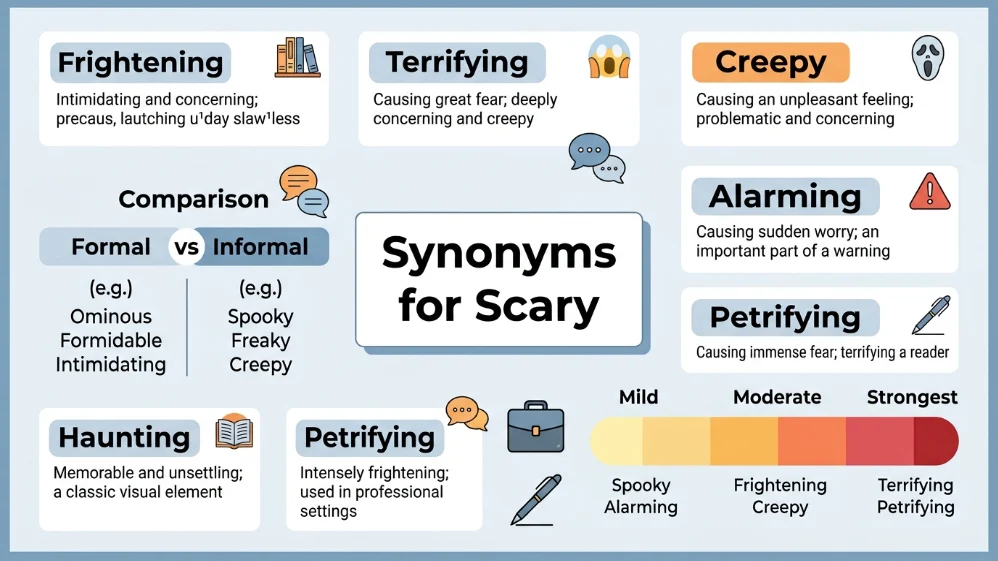
Strongest vs. Weaker Synonyms
Mildest synonyms include “unsettling” and “concerning.” Moderate synonyms include “frightening” and “alarming.” Strong synonyms include “terrifying” and “horrifying.” Strongest synonyms include “petrifying,” “bone-chilling,” and “appalling.” Choose based on the intensity you wish to convey.
Emotional vs. Neutral Synonyms
Emotional synonyms like “terrifying,” “haunting,” and “petrifying” add deep feeling. Neutral synonyms like “concerning,” “alarming,” and “startling” stay factual. Use emotional words for personal stories. Use neutral words for professional or academic writing.
Antonyms of “Scary”
| Antonym | Meaning | Example Sentence |
|---|---|---|
| Calm | Peaceful and relaxed | The calm atmosphere helped everyone feel safe. |
| Comforting | Providing comfort and reassurance | Her comforting words eased my anxiety. |
| Soothing | Reducing stress or fear | The soothing music helped me relax. |
| Safe | Free from danger | The safe neighborhood was perfect for families. |
| Peaceful | Quiet and undisturbed | The peaceful garden was a wonderful escape. |
| Reassuring | Removing doubts or fears | His reassuring smile made everything better. |
| Unthreatening | Not causing fear | The small dog looked completely unthreatening. |
| Inviting | Attractive and welcoming | The inviting cafe made us want to stay. |
| Friendly | Kind and pleasant | The friendly neighbors waved as we passed. |
| Calming | Making someone less anxious | The calming ocean view relaxed everyone. |
| Encouraging | Giving hope or confidence | The encouraging news lifted our spirits. |
| Gentle | Mild and kind | Her gentle voice made us feel at ease. |
| Pleasant | Enjoyable and agreeable | The pleasant weather made the day perfect. |
| Serene | Peaceful and untroubled | The serene lake reflected the blue sky. |
| Welcoming | Warm and hospitable | The welcoming family invited us for dinner. |
Comparison: Scary vs. Similar Words
Scary vs. Frightening
Scary is casual. Frightening is formal. Frightening sounds more serious. Use scary for everyday conversation. Use frightening for professional writing.
Scary example: That movie was scary.
Frightening example: The situation was frightening.
Scary vs. Creepy
Scary refers to fear. Creepy refers to strangeness. Creepy is more specific to uncomfortable situations. Use creepy for odd behavior. Use scary for direct fear.
Scary example: The storm was scary.
Creepy example: His stare was creepy.
Scary vs. Terrifying
Terrifying is much stronger. Terrifying suggests extreme fear. Scary suggests moderate fear. Use terrifying for life threatening situations. Use scary for less serious moments.
Scary example: The test was scary.
Terrifying example: The accident was terrifying.
Scary vs. Alarming
Alarming is professional. Alarming suggests worry. Scary is emotional. Use alarming in reports. Use scary in personal stories.
Scary example: The news was scary.
Alarming example: The data was alarming.
Scary vs. Haunting
Haunting suggests lasting emotional impact. Scary suggests immediate fear. Use haunting for memories and creative writing. Use scary for everyday fear.
Scary example: The noise was scary.
Haunting example: The song was haunting.
Scary vs. Unsettling
Unsettling suggests mild unease. Scary suggests active fear. Unsettling works for vague discomfort. Scary works for specific fears.
Unsettling example: The silence was unsettling.
Scary example: The scream was scary.
Common Phrases and Expressions with “Scary”
1. Scary Movie
Meaning: A film that causes fear or horror.
Example sentence: We watched a scary movie last night, and I could not sleep.
2. Scary Thought
Meaning: An idea that causes worry or fear.
Example sentence: The scary thought of losing my job kept me awake.
3. Scary Situation
Meaning: A context or event that feels dangerous or threatening.
Example sentence: The scary situation required quick thinking and calm action.
4. Scary Look
Meaning: A facial expression that suggests anger or threat.
Example sentence: His scary look made everyone in the room quiet.
5. Scary Story
Meaning: A narrative designed to frighten listeners or readers.
Example sentence: She told a scary story around the campfire that night.
6. Scary Noise
Meaning: A sound that causes fear or alarm.
Example sentence: The scary noise came from the basement, and we froze.
7. Scary Place
Meaning: A location that feels dangerous or threatening.
Example sentence: The abandoned factory was a scary place to explore.
8. Scary Dream
Meaning: A nightmare or fear inducing dream.
Example sentence: I woke up sweating from a scary dream about falling.
Common Mistakes to Avoid
1. Using Scary Too Often
Repeating the same word weakens your writing. Use alternatives like “frightening,” “alarming,” or “creepy” to add variety.
2. Confusing Scary with Creepy
Scary refers to active fear. Creepy refers to strange or unsettling feelings. A thunderstorm is scary. A strange neighbor is creepy.
3. Using Casual Synonyms in Formal Writing
“Creepy” and “spooky” do not belong in professional reports. Use “alarming” or “disturbing” instead.
4. Using Overly Dramatic Synonyms for Simple Situations
A slightly difficult test is not “terrifying.” It is “challenging” or “daunting.” Save strong words for truly frightening experiences.
5. Choosing the Wrong Emotional Tone
“Terrifying” suggests deep fear. “Concerning” suggests worry. Match your word to the actual intensity of the situation.
6. Using Slang in Academic or Professional Writing
Modern words like “freaky” work in casual settings but fail in formal contexts. Always consider your audience.
7. Forgetting to Vary Synonyms
Using “alarming” three times is as bad as using “scary” three times. Rotate through your vocabulary for better flow.
FAQs
1. What is the best synonym for scary?
The best synonym depends on context. “Frightening” works for formal use. “Creepy” works for casual situations. “Terrifying” works for strong emotional impact.
2. What is a formal synonym for scary?
Frightening” and “alarming” are excellent formal synonyms. They sound professional and measured.
3. What is an informal synonym for scary?
Creepy” and “spooky” are the most common informal synonyms. They work well in casual conversation and social media.
4. What is another word for scary in professional writing?
Alarming,” “disturbing,” and “concerning” are the best professional synonyms for scary.
5. What is the difference between scary and terrifying?
“Terrifying” is much stronger than “scary.” Use “terrifying” for extreme fear and “scary” for moderate fear.
6. What is the opposite of scary?
“Calm,” “safe,” “peaceful,” and “reassuring” are direct opposites of scary.
Conclusion
Scary is a useful word, but it cannot cover every situation. You now have over 50 synonyms for scary to choose from. Each word carries a specific tone, intensity, and formality level.
Remember to match your word to your audience. Use “alarming” for professional contexts. Use “creepy” for casual conversations. Select “terrifying” for intense emotional moments. Use “haunting” for creative writing.
Vary your vocabulary to keep your writing fresh and engaging. Replace overused words with precise alternatives. Your readers will notice the improvement in your communication.
One practical tip: Keep a vocabulary journal. Write down new synonyms and example sentences. Review them weekly to build your confidence and fluency.
1 thought on “50+ Synonyms for Scary| Meanings, Examples and Best Alternatives”