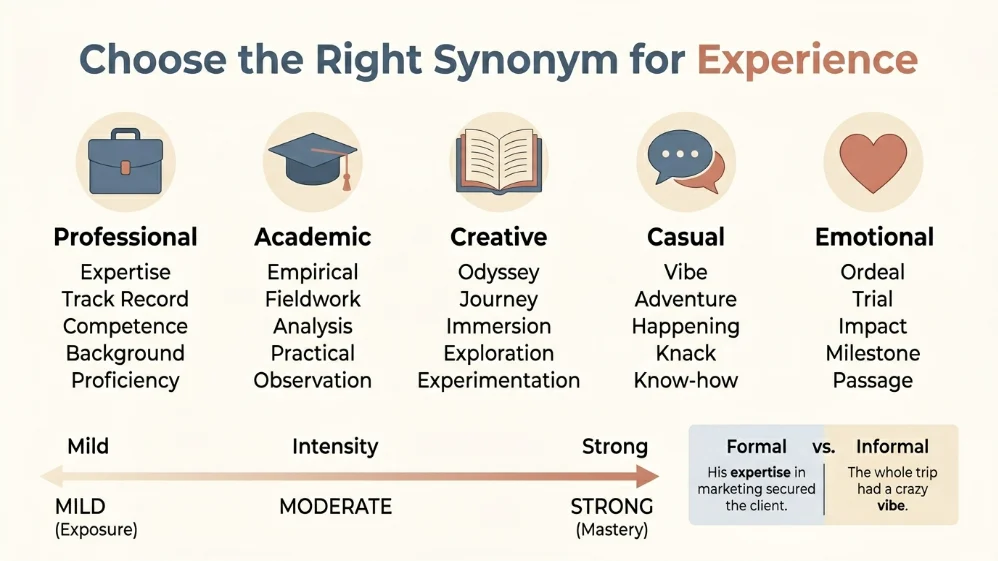
What is another word for experience? It depends on what you mean. Experience can describe knowledge gained over time, a personal event, or practical skill. Because of this, the best experience synonym changes with the context.
If you are writing an essay, resume, email, story, or professional profile, choosing the right word can make your writing clearer and more precise. You might need a formal alternative such as expertise or proficiency. In other cases, words like encounter, adventure, event, or exposure may fit better.
This guide explores synonyms for experience, experience synonyms, and synonyms of experience with simple explanations and examples. It also answers common searches such as synonym for experience, synonym experience, experiences synonym, experience other term, and other words for experience. Each option is explained by meaning and context, so you can choose the right word with confidence.
What Does “Experience” Mean?
Experience refers to the knowledge, skill, or observation gained through direct involvement in events or activities over time. The best general synonym is “background.” In a formal context, use “expertise.” For casual conversation, “know-how” works well. A more emotional synonym is “encounter,” while “proficiency” fits professional needs perfectly.
Meaning, Tone and Context
The main meaning of experience is practical contact with and observation of facts or events. It describes something that happens to you or the wisdom you gain from it.
Experience functions primarily as a noun. For example, “She has years of experience.” It can also be a verb, meaning to undergo or feel something, such as “You might experience a slight delay.”
The word carries a neutral tone by itself but gains a positive or negative charge depending on the context. Work experience is positive. A painful experience is negative. The formality level is neutral, making it suitable for both casual chats and formal reports.
You will see it used in resumes, business reviews, philosophical discussions, and personal storytelling. Key related forms include the adjective experiential and the noun inexperience, which is the direct opposite.
When and How to Use “Experience”
The word experience works best when you want to show that direct observation, not just theory, backs up a claim. It is a bridge between studying something and living it.
Here are realistic examples labeled by context:
- Resume: “I have five years of experience in digital marketing and brand strategy.”
- Academic: “The study examined the lived experience of first generation college students.”
- Casual: “My first experience with sushi was not a pleasant one.”
- Professional Email: “We value your experience on this subject and would appreciate your input.”
- Emotional: “The loss of a pet is a heartbreaking experience for any family.”
- Creative: “Her poetry captures the universal experience of longing and hope.”
- Social Media: “This vacation has been a core memory experience. Highly recommend.”
Another Word for “Experience”
The single best replacement depends entirely on whether you are talking about your track record or a moment in time. For a professional track record, use background or expertise.
For direct suggestions by situation, consider these terms.
professional writing, use expertise or proficiency. These words signal a high level of tested ability.
For academic writing, use exposure or observation. These terms suggest a controlled, study based context.
For casual conversation, use know-how. This implies practical, hands on skill without sounding stuffy.
For emotional writing, use encounter or ordeal. These words frame a specific event with a strong personal impact.
For creative writing, use brush with or taste of. These phrases create a vivid sense of immediacy.
For a resume, use track record. This implies a history of measurable success, not just time served.
For social media captions, use adventure or chapter. These words feel current and narrative driven.
A stronger synonym is mastery, which implies a level far beyond basic familiarity.
A softer synonym is familiarity, which suggests a working knowledge rather than deep expertise.
When Not to Use “Experience”
The word “experience” can sound too vague when you need to prove a specific skill. Saying “I have experience with Excel” is weak. Using the precise synonym “proficiency” or stating what you can achieve with Excel is stronger.
It can also feel too casual or informal when describing a tragic or profound event. Saying “The accident was a bad experience” downplays the gravity. “The accident was a traumatic ordeal” is more accurate and respectful.
Finally, in a resume, “experience” is a lazy category header. Replace a bland label like “Experience” with a powerful section title like “Professional Background” or “Industry Impact” to immediately show confidence.
Words Commonly Confused With “Experience”
Many words sound like they could replace experience, but they have distinct meanings. Understanding the difference will make your vocabulary razor sharp.
Experience vs. Education
Education is the structured learning of a subject. Experience is the direct application of that learning in real situations. You study accounting in school, but you balance a real budget through experience.
Experience vs. Skill
Skill is the specific ability to perform a task well. Experience is the accumulation of moments that built that skill. Driving a car is a skill. Ten years behind the wheel is experience.
Experience vs. Event
An event is a specific, single occurrence. Experience is the lasting imprint of that event or the sum of many events. The conference was an event. Attending it contributed to her professional experience.
Experience vs. Experiment
An experiment is a test to discover something new. An experience is any incident you live through, whether planned or not. A scientist runs an experiment. The result gives them an experience.
Experience vs. Qualification
A qualification is a formal certification you earn. Experience is the practical background you build. A degree is a qualification. Solving a real crisis at work is experience.
Best Synonym by Context for “Experience”
| Context | Best Synonym | Why It Works | Example |
|---|---|---|---|
| Formal Writing | Exposure | It implies a broad and comprehensive contact with a subject. | Her exposure to international markets shaped her global strategy. |
| Academic Writing | Observation | It highlights a clinical, study based, or empirical focus. | The observation of primate behavior requires immense patience. |
| Professional Use | Expertise | It conveys authority, depth, and a consultative level of knowledge. | We seek a consultant with expertise in supply chain logistics. |
| Resume Bullets | Track Record | It directly connects past actions to a history of proven results. | My track record demonstrates a consistent ability to boost sales. |
| Casual Conversation | Know-how | It suggests practical, hands on ability in a friendly way. | Do you have the know-how to fix a leaky faucet? |
| Creative Writing | Encounter | It adds a sense of mystery, drama, or significance to a meeting. | His first encounter with the ocean was a moment of pure awe. |
| Emotional Tone | Ordeal | It powerfully frames a difficult, painful, or testing time. | Surviving the hurricane was a terrifying ordeal for the community. |
| Strong Intensity | Mastery | It indicates the highest level of proficiency and command. | Her mastery of the violin is celebrated worldwide. |
| Soft Intensity | Familiarity | It signals a comfortable but not necessarily deep knowledge. | A basic familiarity with coding is helpful for this project. |
| Social Media | Journey | It frames a collection of events as a narrative of personal growth. | Grateful for every step of this incredible fitness journey. |
Which Synonym Should You Choose?
Choosing the right word is a three step mental check. First, decide if you are talking about a collection of past work or a single life moment. For past work, lean toward background, expertise, or track record. For a single moment, lean toward encounter, incident, or adventure.
Second, measure the required formality. A cover letter demands proficiency, not know-how. A text to a friend benefits from a relaxed word like chops. Using a casual word in a formal setting is a common vocabulary mistake.
Third, align the emotional intensity with the situation. If the moment was deeply challenging, use a strong word like ordeal. If it was just a routine learning moment, a neutral term like exposure is better. Overstating or understating the emotion reduces your credibility as a writer.
Real Life Examples of “Experience” in Sentences
Seeing the word in action helps solidify your understanding. Each example here could use a stronger synonym, which you will see in parentheses.
- School: “The science fair was an unforgettable experience.” (The science fair was an unforgettable learning adventure.)
- Workplace: “I want to gain more experience in client relations.” (I want to deepen my proficiency in client relations.)
- Writing: “She wrote about her experience traveling solo.” (She wrote about her transformative journey traveling solo.)
- Conversation: “Waiting in that line was quite an experience.” (Waiting in that line was quite an ordeal.)
- Social Media: “Gained so much experience this summer.” (Gained so much real world know-how this summer.)
- Resume: “Managed a team, resulting in valuable leadership experience.” (Managed a team, building a proven leadership track record.)
- Email: “I hope you find this experience helpful.” (I hope you find this exposure to the process helpful.)
35 Synonyms for “Experience”
| Synonym | Simple Meaning | Best Used For | Example Sentence |
|---|---|---|---|
| Background | A person’s past history | Resumes, professional bios | His background in finance made him the ideal candidate. |
| Expertise | Expert skill or knowledge | Consulting, business proposals | We rely on your expertise to navigate this legal challenge. |
| Proficiency | A high degree of competence | Skill assessments, resumes | Her proficiency in three languages is a major asset. |
| Know-how | Practical ability or knowledge | Casual conversation | I admire your tech know-how with these gadgets. |
| Mastery | Complete command of a subject | Performance reviews, awards | His mastery of chess strategy is fun to watch. |
| Familiarity | A comfortable acquaintance | Cover letters, networking | My familiarity with the software allows me to train others. |
| Exposure | Contact with new ideas or things | Academic, formal reports | Exposure to diverse cultures enriches a student’s mindset. |
| Track Record | A history of past performance | Sales, leadership resumes | Her track record of hitting targets is unmatched. |
| Insight | A deep, clear understanding | Thought leadership, analysis | The trip gave me fresh insight into the local economy. |
| Savvy | Shrewd practical understanding | Informal business, media | Business savvy is just as important as a degree. |
| Encounter | A brief or unexpected meeting | Storytelling, emotional writing | My encounter with the author left me feeling inspired. |
| Ordeal | A painful or horrific event | Emotional, literary writing | The long recovery was an ordeal that tested her spirit. |
| Journey | A process of personal development | Social media, motivational | Losing weight is a mental journey, not just a physical one. |
| Adventure | An exciting or daring event | Travel, casual writing | Studying abroad was the adventure of a lifetime. |
| Wisdom | Accumulated knowledge and good judgment | Philosophy, mentoring | His advice reflects wisdom gained from a life of hard work. |
| Observation | The act of watching something carefully | Science, academic writing | My observation of the classroom dynamic revealed a clear issue. |
| Involvement | Active participation in something | Project management | Her involvement in the merger was critical to its success. |
| Training | A period of structured learning | Technical fields | His formal training was in mechanical engineering. |
| Maturity | A very advanced level of development | Artistic critique, personal growth | Her latest novel shows a maturity that her early work lacked. |
| Competence | The ability to do something successfully | Performance reviews | He demonstrated his competence during the stressful launch. |
| Seasoning | Long experience in a specific role | Journalism, sports | The veteran quarterback brings seasoning to a young team. |
| Worldliness | Experience of sophisticated life | Character descriptions | His worldliness made him a fascinating dinner guest. |
| History | A continuous record of past events | Investigation, medicine | The patient has a history of excellent health. |
| Event | A thing that happens | News, objective description | The gala was a spectacular event. |
| Chapter | A distinct period in a life story | Personal essays | Moving to the city closed one chapter and opened another. |
| Feet on the Ground | Practical, direct involvement | Business, coaching | A good manager needs feet on the ground with the sales team. |
| Chops | Expert skill in a specific area | Music, casual creative | She still has the vocal chops to command the stage. |
| School of Hard Knocks | Learning from real life difficulties | Biographies, emotional | He earned his diploma from the school of hard knocks. |
| Battle Scars | Evidence of past struggles | Informal, resilience | These business failures are just battle scars now. |
| Depth | A deep level of knowledge | Artistic review, analysis | The report lacks depth in its financial projections. |
| Judgment | The ability to make considered decisions | Leadership, legal | We trust your judgment in handling the crisis. |
| Learning Curve | The rate of gaining experience | Tech, business analysis | The learning curve for this device is surprisingly short. |
| Apprenticeship | Learning a trade from a skilled worker | Skilled trades | His apprenticeship taught him more than any textbook. |
| Internship | A student work placement for experience | Career development | The summer internship provided a real taste of the industry. |
| Practicum | A practical section of a college course | Academic | The teaching practicum was the most valuable semester. |
Synonym Groups and Usage Differences
Professional vs. Personal Synonyms
Professional synonyms for experience focus on measurable ability. Words like expertise, proficiency, and track record belong in a workplace setting. They signal that you can deliver results.
Personal synonyms are about growth and feeling. Words like journey, adventure, and encounter describe what you felt and learned on a human level. You would use these when telling a story or writing a memoir, not in a project update.
Formal vs. Conversational Synonyms
Formal synonyms such as exposure, observation, and background elevate your language for reports, essays, and speeches. They sound objective, factual, and respectful.
Conversational synonyms like know-how, chops, and savvy are perfect for texts, emails to close colleagues, and casual writing. They build a friendly rapport. “I don’t have the technical know-how” is perfect for a chat. Saying “I lack technical competence” in the same chat sounds robotic.
Academic Synonyms
Academic writing demands precision and detachment. Use observation for study based findings. Use exposure to describe a controlled introduction to a stimulus or idea. Practicum and clinical experience are highly specific and correct for educational settings. Avoid emotional words like ordeal or casual words like savvy in a research paper.
Professional and Business Synonyms
In business, you are selling capability. Expertise is the most powerful word for a consultant or specialist. Track record is essential for sales, leadership, and executive roles because it links past success to future performance.
Familiarity is a modest but useful word for a skill you are still building. For a resume, use dynamic nouns. Replace a weak phrase like “experience with clients” with “a history of client success” or “proven client relations expertise.”
Creative or Literary Synonyms
Creative writing thrives on sensory and emotional language. Encounter adds a sense of fate or mystery. Ordeal injects intense tension. Journey and chapter provide a reflective, narrative arc. A phrase like brush with danger paints a far more vivid picture than “a risky experience.”
Slang or Modern Synonyms
Modern business slang includes chops, meaning a deeply practiced skill, and savvy, implying clever, practical insight. School of hard knocks is a classic idiom for experience gained through suffering.
These are acceptable in team chats, casual blog posts, and social media. They are too informal for academic papers, client proposals, or formal board presentations where they can sound unpolished.
Strongest vs. Weaker Synonyms
An intensity scale helps you see the range from mild to maximum.
- Mild: Familiarity, Exposure, Taste of
- Moderate: Background, Experience, Observation, Event
- Strong: Proficiency, Expertise, History, Track Record
- Intense: Mastery, Ordeal, Battle Scars, Wisdom
Use the intense words for transformative, defining moments or the highest levels of skill. Overusing words like mastery for basic tasks reduces their power.
Emotional vs. Neutral Synonyms
Neutral synonyms include background, observation, event, and exposure. These words state a fact without any feeling attached. They are safe for objective reporting.
Emotional synonyms include ordeal, adventure, encounter, and journey. These words inject a clear subjective feeling into the sentence. Use emotional synonyms in personal essays, reviews, and creative work. Stick to neutral synonyms in technical manuals, legal documents, and scientific reports.
Antonyms of “Experience”
| Antonym | Meaning | Example Sentence |
|---|---|---|
| Inexperience | A lack of practical knowledge | His inexperience showed during the high pressure debate. |
| Ignorance | A lack of knowledge or information | The policy was born from a place of ignorance. |
| Naivety | A lack of worldly wisdom or judgment | Her naivety about the industry was quickly corrected. |
| Greenness | A state of being new or untrained | Despite his greenness, the new recruit showed great hustle. |
| Unfamiliarity | Not having knowledge of something | Unfamiliarity with the customs led to an awkward silence. |
| Incapability | A lack of the ability to do something | The injury led to a temporary incapability to walk. |
| Incompetence | An inability to do something successfully | The project failed due to gross managerial incompetence. |
| Abstraction | A theoretical idea with no practical basis | His plan was a pure abstraction without real world testing. |
| Ineptitude | A lack of skill or clumsy ability | His technical ineptitude is a running joke in the office. |
| Newness | The quality of being recently created | The newness of the technology made it difficult to predict. |
| Theory | Abstract knowledge, not yet practiced | In theory, the plan works, but practice reveals flaws. |
| Innocence | A lack of corrupting or difficult experience | The photo shows the innocence of childhood before hardship. |
| Obliviousness | Being unaware of what is happening | His obliviousness to the social tension in the room was stunning. |
| Rustiness | A decline in skill due to a lack of practice | After a decade off, my piano playing shows serious rustiness. |
| Amateurism | A non professional level of performance | The production values suffered from noticeable amateurism. |
Comparison: Experience vs. Similar Words
Experience vs. Expertise
The main difference is depth. Experience is the amount of time spent doing something. Expertise is the advanced level of skill achieved.
Which is stronger? Expertise is stronger. It implies mastery.
Which is more formal? Both are neutral, but expertise carries more authoritative weight.
- Example: “She has 10 years of experience in baking.”
- Example: “We consulted a pastry chef with real expertise in French patisserie.”
Experience vs. Skill
Experience is the journey. Skill is the tool you pick up along the way.
Which is stronger? Skill is more specific and demonstrable in a single moment.
Which is more formal? Skill is concrete and often preferred in technical lists.
- Example: “He gained experience by working on various cars.”
- Example: “Welding is a skill that requires steady hands.”
Experience vs. Knowledge
Knowledge is theoretical understanding, or knowing that something is true. Experience is practical application, or knowing how to do it because you have done it before.
Which is stronger? Experience is often stronger in job settings because it proves you can apply the knowledge.
Which is more formal? Knowledge is an academic term. Experience is a practical term.
- Example: “I have knowledge of the highway code.”
- Example: “I have 20 years of safe driving experience.”
Experience vs. Background
Background is the specific collection of past roles and events that make up your history. Experience is the broader wisdom you gained from it.
Which is stronger? Background is a better factual descriptor for a resume.
Which is more formal? Background feels slightly more professional and structured.
- Example: “Her experience makes her a great leader.”
- Example: “Her educational background is in molecular biology.”
Experience vs. Exposure
Exposure means coming into contact with an idea or environment, often briefly. Experience implies a deeper, longer interaction.
Which is stronger? Experience is deeper and more impactful.
Which is more formal? Exposure is a formal term often used in controlled studies.
- Example: “Just one meeting was enough exposure to the toxic culture.”
- Example: “Running the department gave her true management experience.”
Experience vs. Event
An event is a point on a timeline. An experience is the internal footprint that event leaves on a person.
Which is stronger? Experience carries a subjective weight that event does not.
Which is more formal? Event is factual. Experience is interpretive.
- Example: “The concert was a ticketed event.”
- Example: “The concert was a life changing experience.”
Common Phrases and Expressions with “Experience”
1. Hands on experience
Meaning: Knowledge gained by actively doing something, not by watching or reading.
Example sentence: “The internship offers real hands on experience in a busy newsroom.”
2. A learning experience
Meaning: A polite or positive way to frame a mistake or failure.
Example sentence: “The failed product launch was a brutal but necessary learning experience.”
3. Vast experience
Meaning: A very large and wide ranging professional background.
Example sentence: “The surgeon brings vast experience to the complex procedure.”
4. Firsthand experience
Meaning: Personal, direct observation rather than a story heard from someone else.
Example sentence: “Travelers get a firsthand experience of local culture that tourists miss.”
5. Put it down to experience
Meaning: To accept a loss or mistake and decide to move forward wisely.
Example sentence: “We lost the deposit, but let’s just put it down to experience.”
6. Once in a lifetime experience
Meaning: A unique and extraordinary event that will likely never happen again.
Example sentence: “Seeing the northern lights was a true once in a lifetime experience.”
7. Bitter experience
Meaning: Wisdom gained from a painful, difficult, or disappointing event.
Example sentence: “Bitter experience has taught me never to trust a verbal promise.”
Common Mistakes to Avoid
- Using “experience” when “expertise” is needed. Saying “I have experience in Python” is vague. Saying “I have expertise in Python automation” signals a much higher value for hiring managers.
- Confusing “experience” with “event.” An event is just a timestamp. Reserve the word “experience” for the emotional or intellectual impact of that event.
- Using “know-how” in a board report. A phrase like “We lack marketing know-how” undermines your professionalism. Use “We lack marketing expertise” to sound credible.
- Using “ordeal” for a minor problem. Describing a slow Wi-Fi connection as an “ordeal” is an overstatement that makes you sound dramatic. Save it for truly hard times.
- Repeating “experience” in a single resume. Vary your language. Use “professional background,” “track record,” and “industry exposure” in different sections to hold a reader’s attention.
- Choosing a synonym with the wrong tone. Saying “My hospital adventure” sounds disrespectful when describing a serious medical treatment. A neutral word like “stay” or a formal word like “procedure” is much better.
- Using slang like “chops” in academic or formal writing. Phrases like “research chops” are too trendy and casual for a thesis. Use “research proficiency” or “analytical skill” instead.
FAQs
What is the best synonym for experience?
The best synonym depends on context. “Expertise” and “track record” are best for professional use, while “journey” works for personal storytelling.
What is a formal synonym for experience?
“Exposure” and “background” are excellent formal synonyms. “Proficiency” is also highly formal and precise for skill based statements.
What is an informal synonym for experience?
“Know-how” is the most common informal synonym. “Chops” and “savvy” are also good informal alternatives in modern conversation.
What is another word for experience in professional writing?
In professional writing, replace “experience” with “expertise,” “specialized background,” or “proficiency” to convey a higher level of authority and capability.
What is the difference between experience and expertise?
Experience is the time you have spent doing something. Expertise is the advanced, deep skill level you have reached through that experience.
What is the opposite of experience?
The direct opposite is “inexperience.” Other accurate antonyms include “unfamiliarity,” “greenness,” and “ignorance.”
Conclusion
The word experience is a foundational part of the English language, but it is also a blanket term that can hide your true meaning. By swapping it for a precise synonym like expertise, track record, ordeal, or encounter, you instantly clarify your intent. Always match the word to the tone, whether you are chasing a job, telling a story, or analyzing data.
A practical tip for building your vocabulary is to stop asking yourself, “Do I have experience?” Start asking, “Do I have the proficiency, background, or wisdom?” The more specific your internal question, the more specific and powerful your writing becomes.