Have you ever noticed how often you repeat the word “fast” in your writing? You might describe a quick email response, a rapid runner, or a speedy internet connection using the same tired word. This repetition makes your writing feel flat and less engaging.
Most writers, students, and professionals struggle to find fresh ways to express speed and quickness. The English language offers dozens of precise alternatives that can transform your communication. Each synonym carries a unique shade of meaning that can make your message clearer and more compelling.
This guide will help you choose the perfect synonym for any situation. You will learn the subtle differences between words like rapid, swift, quick, and hasty. Your vocabulary will expand, and your writing will become more vibrant and exact.
What Does “Fast” Mean?
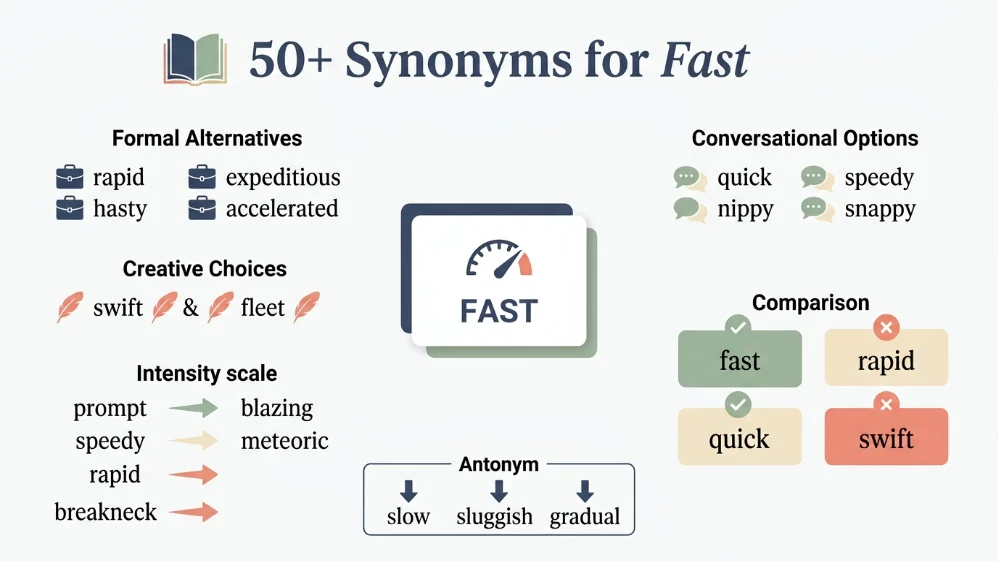
Fast describes something that moves, happens, or is done with great speed. The best synonyms depend on your context. Use rapid for professional reports, quick for everyday conversation, swift for creative writing, and express for business communication. Consider the tone and formality level of your situation before choosing your word.
Meaning, Tone and Context
The word fast primarily functions as an adjective, though it can also serve as an adverb in informal usage. It describes a high rate of movement, action, or occurrence.
The tone of “fast” is generally neutral and straightforward. It does not carry strong positive or negative emotional weight on its own. This neutrality makes it useful but also somewhat bland.
Fast sits at a middle level of formality. You can use it comfortably in most situations, from casual chats to professional emails. However, it often lacks the precision and impact that more specific synonyms provide.
Common use cases for fast include describing speed, time, action, response, movement, and progress. The word works well when you need a simple, clear description of quickness.
Word forms related to fast include faster as a comparative, fastest as a superlative, and fastness as a noun. The adverb form stays as “fast” in phrases like “drive fast.”
When and How to Use “Fast”
Use fast when you need a straightforward description of speed without extra emotional or stylistic weight. It works best in general situations where precision is not critical.
Professional context
Our team delivered the project fast to meet the client’s deadline.
Personal context
She drove fast down the highway to reach the hospital in time.
Academic context
The chemical reaction occurs fast when the temperature increases beyond the threshold.
Emotional context
His heart beat fast as he prepared to give the most important speech of his career.
Creative context
The river ran fast through the narrow canyon, carving new shapes into ancient rock.
Social media context
This new app loads so fast that you will never wait for content again.
Casual context
We ate fast because the movie was about to start.
Another Word for “Fast”
The best single replacement for fast depends entirely on your writing situation and intended meaning.
Professional writing
Rapid works best for business reports, project updates, and professional correspondence. It sounds competent and measured without being overly dramatic.
Academic writing
Rapid remains the preferred choice in academic contexts. It conveys precision and scholarly detachment while maintaining clarity.
Casual conversation
Quick feels natural and approachable. It fits perfectly in everyday dialogue and informal exchanges between friends or colleagues.
Emotional writing
Swift carries a sense of urgency and emotional weight. It works well for storytelling and personal narratives where speed matters to the emotional arc.
Creative writing
Fleet suggests graceful, effortless movement. It adds a literary quality to descriptions of motion and speed.
Resume or workplace use
Accelerated demonstrates initiative and results. It shows that you made things happen faster than expected.
Social media captions
Lightning captures attention and excitement. It creates instant impact in short form content.
Stronger meaning
Breakneck conveys extreme, almost reckless speed. Use it when the pace feels intense or dangerous.
Softer meaning
Prompt suggests speed combined with courtesy and efficiency. It softens the sense of speed with a touch of professionalism.
When Not to Use “Fast”
Fast becomes problematic when you need to convey a specific type of speed or a particular tone. Its generality can make your writing feel imprecise.
Consider this weak sentence: “The company grew fast last year.”
Now see the improvement with a precise synonym: “The company experienced rapid growth last year.
The second version sounds more professional and measured. The word rapid carries a sense of steadiness that fits business contexts better.
Fast also fails when you need to express emotion. In creative writing, “she ran fast” lacks the vivid imagery of “she ran swiftly through the forest.”
Words Commonly Confused With “Fast”
Understanding the distinctions between similar words will help you choose the right one every time.
Fast versus Quick
Fast focuses on high speed during movement or action. Quick emphasizes the short time between starting and finishing something. A car is fast on the highway. A response is quick when it arrives immediately.
Fast versus Rapid
Rapid suggests speed that happens in a series of steps or movements. It often describes processes or events that unfold quickly. The heart beats rapidly. The company experiences rapid growth. Fast feels more general.
Fast versus Swift
Swift implies smooth, graceful, and efficient speed. It carries a more elegant tone than fast. The hawk made a swift attack. The ship sailed swiftly across the ocean.
Fast versus Hasty
Hasty carries a negative meaning of excessive speed that leads to carelessness. You make a hasty decision when you rush without proper thought. Fast does not suggest poor quality.
Fast versus Expeditious
Expeditious means fast while maintaining efficiency and thoroughness. It is a formal word often used in business and legal contexts. An expeditious process saves time without cutting corners.
Fast versus Speedy
Speedy is an informal alternative that suggests cheerful or enthusiastic speed. It often appears in casual or lighthearted contexts. The speedy delivery service pleased the customer.
Best Synonym by Context for “Fast”
| Context | Best Synonym | Why It Works | Example |
|---|---|---|---|
| Formal writing | Rapid | Conveys professionalism and precision | The committee noted the rapid progress on the initiative. |
| Academic writing | Rapid | Sounds scholarly and measurable | The data showed rapid cellular regeneration. |
| Professional business | Expeditious | Implies efficiency without sacrificing quality | The team took expeditious action to resolve the issue. |
| Resume or workplace | Accelerated | Demonstrates proactive achievement | I accelerated the project timeline by three weeks. |
| Casual conversation | Quick | Feels natural and approachable | Let us grab a quick lunch before the meeting. |
| Creative writing | Swift | Adds elegance and imagery | The dancer moved with swift grace across the stage. |
| Emotional tone | Fleet | Suggests urgent, heartfelt motion | She fled with fleet steps from the burning building. |
| Strong intensity | Breakneck | Conveys extreme, urgent speed | The stock market fell at breakneck pace. |
| Soft or moderate | Prompt | Shows courtesy and efficiency | She provided a prompt response to my email. |
| Social media captions | Lightning | Grabs attention with vivid imagery | This workout gave me lightning results in just one week. |
Which Synonym Should You Choose?
Your synonym choice should begin with your audience and purpose. Professional documents demand rapid or expeditious. Academic writing requires rapid. Creative work benefits from swift or fleet.
Consider the emotional intensity you want to convey. Breakneck suggests extreme speed. Prompt suggests moderate, courteous speed. Choose based on the strength of your message.
Think about the type of speed you describe. Actions that happen quickly call for quick. Continuous processes deserve rapid. Individual movements benefit from swift.
The context of your sentence matters enormously. A fast car differs from a fast response or fast growth. Match your synonym to the specific situation.
Real Life Examples of “Fast” in Sentences
School context
The students completed the test with remarkable speed. They finished the exam in half the allotted time.
Workplace context
Our team delivered the quarterly report at an accelerated pace. The client praised our rapid turnaround on the project.
Writing context
Authors use swift pacing to keep readers engaged through action sequences. The novel moves from scene to scene without dragging.
Conversation context
She gave a quick answer when her friend asked about the weekend plans. Everyone appreciated the prompt response.
Social media context
This new platform loads content at lightning speed. Users notice the difference immediately.
Resume context
I accelerated the recruitment process and reduced hiring time by 40 percent.
Email context
Please provide a prompt reply regarding the contract details.
Storytelling context
The messenger rode swift across the dark countryside. His urgent mission could not wait until morning.
25 Synonyms for “Fast”
| Synonym | Simple Meaning | Best Used For | Example Sentence |
|---|---|---|---|
| Rapid | Happening quickly in a series of events | Professional reports | The company saw rapid expansion across three continents. |
| Swift | Smooth, graceful speed | Creative writing | The hawk made a swift dive toward its prey. |
| Quick | Happening in a short time | Everyday conversation | Let me ask you a quick question about the schedule. |
| Speedy | Fast in an enthusiastic way | Informal situations | We received speedy service at the new restaurant. |
| Hasty | Too fast and careless | Negative situations | He made a hasty decision that he later regretted. |
| Express | Deliberately faster than usual | Travel and shipping | We sent the package via express delivery. |
| Accelerated | Made to happen faster | Resume and business | I implemented accelerated training for new employees. |
| Prompt | Quick and courteous | Professional emails | The manager gave a prompt response to my inquiry. |
| Brisk | Fast with energy | Activity descriptions | She walked at a brisk pace through the park. |
| Fleet | Quick and graceful | Literary descriptions | The deer moved with fleet steps through the forest. |
| Breakneck | Dangerously fast | Extreme situations | The car raced at breakneck speed down the mountain road. |
| Lightning | Extremely fast | Attention grabbing | The storm arrived with lightning swiftness. |
| Whirlwind | Fast and chaotic | Busy periods | She had a whirlwind tour of three cities in one day. |
| Sudden | Fast and unexpected | Surprising events | The sudden change in weather caught everyone off guard. |
| Instant | Happening immediately | Digital and technology | The website provides instant access to information. |
Synonym Groups and Usage Differences
Professional vs. Personal Synonyms
Professional contexts require words like rapid, accelerated, and expeditious. These terms convey competence and efficiency. Personal situations favor quick, speedy, and brisk for their natural, approachable feel.
Formal vs. Conversational Synonyms
Formal writing demands rapid, expeditious, and accelerated. These words belong in reports, presentations, and official correspondence. Conversational settings welcome quick, speedy, and fast. They fit texts, casual emails, and everyday talk.
Academic Synonyms
Academic writing benefits from rapid and accelerated. These words sound precise and measurable. They work well in research papers, scientific reports, and scholarly articles where objectivity matters.
Professional and Business Synonyms
Business communication values expeditious, accelerated, and prompt. These words suggest efficiency and professionalism. They appear in project updates, client communications, and performance reviews.
Creative or Literary Synonyms
Creative writers choose swift, fleet, and brisk. These words add imagery and emotional depth. They create vivid pictures in readers’ minds without resorting to clichés.
Slang or Modern Synonyms
Modern conversations sometimes use words like speedy and lightning in casual contexts. These terms work well for social media and informal situations. They become too casual for professional or academic writing.
Strongest vs. Weaker Synonyms
The intensity scale from mild to strongest moves this way: prompt to quick to rapid to swift to breakneck. Consider your intended emotional impact when selecting from this range.
Emotional vs. Neutral Synonyms
Neutral synonyms include rapid, quick, and prompt. They report speed without emotional coloring. Emotional synonyms include breakneck, whirlwind, and lightning. They add excitement, urgency, or intensity to descriptions.
Antonyms of “Fast”
| Antonym | Meaning | Example Sentence |
|---|---|---|
| Slow | Moving at low speed | The turtle moved at a slow pace across the road. |
| Sluggish | Lacking energy or speed | The morning traffic was unusually sluggish. |
| Gradual | Happening slowly over time | The garden showed gradual growth through the season. |
| Leisurely | Unhurried and relaxed | They took a leisurely stroll through the park. |
| Prolonged | Extended in time | The prolonged discussion lasted well into the evening. |
| Delayed | Behind schedule | The delayed flight caused problems for travelers. |
| Lingering | Lasting longer than expected | She felt a lingering sadness after the farewell. |
| Plodding | Slow and laborious | The plodding pace of the project frustrated everyone. |
| Dawdling | Moving slowly without purpose | The children kept dawdling on their way to school. |
| Languid | Lacking vitality or energy | The languid afternoon passed without any excitement. |
| Protracted | Longer than anticipated | The protracted negotiations exhausted both parties. |
| Tardy | Late or delayed | His tardy arrival disrupted the meeting. |
| Sedentary | Involving little movement | The sedentary lifestyle contributed to his health issues. |
| Stagnant | Not flowing or moving | The stagnant water attracted mosquitoes and insects. |
| Drawn out | Extended unnecessarily | The drawn out speech bored the entire audience. |
Comparison: Fast vs. Similar Words
Fast vs. Rapid
The main difference lies in duration and continuity. Fast describes a general state of speed. Rapid suggests speed that occurs through a series of connected events.
Rapid carries more intensity than fast. It conveys that speed happens repeatedly or continuously. Rapid growth means consistent expansion over time.
Rapid feels more formal than fast. Academic and professional contexts prefer rapid for its precise, measured tone.
Fast example: The car is fast on the highway.
Rapid example: The company experienced rapid growth over five years.
Fast vs. Quick
Quick emphasizes the short time between an action’s start and finish. Fast focuses on the speed during the action itself.
Quick often feels slightly stronger than fast. It suggests immediate completion rather than ongoing speed.
Quick works well in both formal and casual contexts. It maintains professionalism while remaining accessible.
Fast example: She runs fast during track practice.
Quick example: He gave a quick answer to the difficult question.
Fast vs. Swift
Swift implies smooth, efficient, and graceful speed. Fast simply describes movement without these elegant connotations.
Swift carries a creative and literary tone. It appears more often in storytelling and descriptive writing.
Swift suggests a polished, almost artistic quality of movement. Fast remains plain and functional.
Fast example: The train traveled fast across the countryside.
Swift example: The ship sailed swift through the calm waters.
Fast vs. Hasty
Hasty has a clear negative meaning. Fast remains neutral and does not imply carelessness.
Hasty is stronger in its criticism. It suggests recklessness and poor judgment.
Hasty fits critical contexts where you want to point out mistakes. Fast works for neutral descriptions.
Fast example: He finished the project fast and correctly.
Hasty example: She regretted her hasty decision to quit the job.
Fast vs. Speedy
Speedy has an informal, cheerful tone. Fast stays neutral and straightforward.
Speedy carries a light, enthusiastic quality. It often appears in casual or commercial contexts.
Speedy sounds less professional than fast. Use it carefully in formal situations.
Fast example: The internet connection is fast today.
Speedy example: The speedy delivery service delighted the customer.
Fast vs. Brisk
Brisk suggests energetic, healthy speed. Fast simply describes pace without this positive connotation.
Brisk implies vitality and purpose. It often describes physical movement or business activity.
Brisk works well in descriptive and professional contexts. It adds a layer of positive energy.
Fast example: He walked fast to catch the bus.
Brisk example: She maintained a brisk pace during her morning workout.
Common Phrases and Expressions with “Fast”
1. Fast and Furious
Meaning: Very fast and intense activity.
Example sentence: The fast and furious action in the movie kept everyone on the edge of their seats.
2. Fast Track
Meaning: A route that speeds up progress toward a goal.
Example sentence: She was placed on the fast track for promotion at her company.
3. Fast Friends
Meaning: Close and loyal friends.
Example sentence: They became fast friends during their first year of college.
4. Hard and Fast
Meaning: Strict and unchangeable rules.
Example sentence: There are no hard and fast rules for writing good poetry.
5. Pull a Fast One
Meaning: Trick or deceive someone.
Example sentence: He tried to pull a fast one on his coworkers by taking credit for their work.
6. Fast Talker
Meaning: Someone who speaks quickly to persuade or deceive.
Example sentence: The fast talker convinced the customer to buy unnecessary upgrades.
7. Fast Lane
Meaning: A lifestyle of excitement and speed.
Example sentence: After his success, he chose to live in the fast lane.
Common Mistakes to Avoid
Mistake 1: Using fast when a more precise synonym is better
Weak: The response was fast.
Better: The response was prompt and thorough.
Precise words create clearer communication.
Mistake 2: Confusing fast with quickly
Fast describes the speed of movement or action. Quickly describes the manner of performing an action. You drive fast. You respond quickly.
Mistake 3: Using casual synonyms in formal writing
Incorrect: We need a speedy solution to this business problem.
Correct: We need an expeditious solution to this business problem.
Match your word to your audience.
Mistake 4: Using overly dramatic synonyms for simple situations
Incorrect: She walked at breakneck speed to the grocery store.
Correct: She walked briskly to the grocery store.
Choose intensity that matches the situation.
Mistake 5: Repeating the same word too often
Monotonous: The fast car went fast around the fast track.
Improved: The rapid car went swiftly around the high speed track.
Vary your vocabulary for better writing.
Mistake 6: Choosing a synonym with the wrong emotional tone
Incorrect: The good news arrived with breakneck speed.
Correct: The good news arrived with swift speed.
Positive news deserves positive tone.
Mistake 7: Using slang in academic or professional writing
Incorrect: The experiment produced lightning results.
Correct: The experiment produced rapid results.
Professional writing demands professional vocabulary.
FAQs
What is the best synonym for fast?
The best synonym depends on your context. Use rapid for professional writing, quick for conversation, and swift for creative work.
What is a formal synonym for fast?
Rapid and expeditious are excellent formal alternatives. Both sound professional and precise in business and academic writing.
What is an informal synonym for fast?
Speedy and lightning work well for casual situations. They fit social media, texts, and everyday conversation perfectly.
What is another word for fast in professional writing?
Rapid and accelerated are ideal for professional contexts. They demonstrate competence and efficiency in workplace communication.
What is the difference between fast and quick?
Fast describes speed during movement or action. Quick emphasizes the short time between starting and finishing something.
What is the opposite of fast?
Slow is the most common opposite. Other antonyms include sluggish, gradual, leisurely, and prolonged depending on your context.
Conclusion
Fast is a useful word, but it should not be your only option for describing speed. The English language offers dozens of precise alternatives that can make your writing more vivid and professional.
Your choice of synonym should match your audience, purpose, and emotional tone. Rapid works for formal contexts. Quick suits everyday conversation. Swift adds creativity and elegance. Expeditious shows professionalism.
Pay attention to the nuance of each word. Consider the type of speed you describe. Think about the intensity you want to convey. Your vocabulary will grow stronger with practice.
Start using these synonyms today. Your writing will become more engaging and precise. Your readers will notice the improvement.