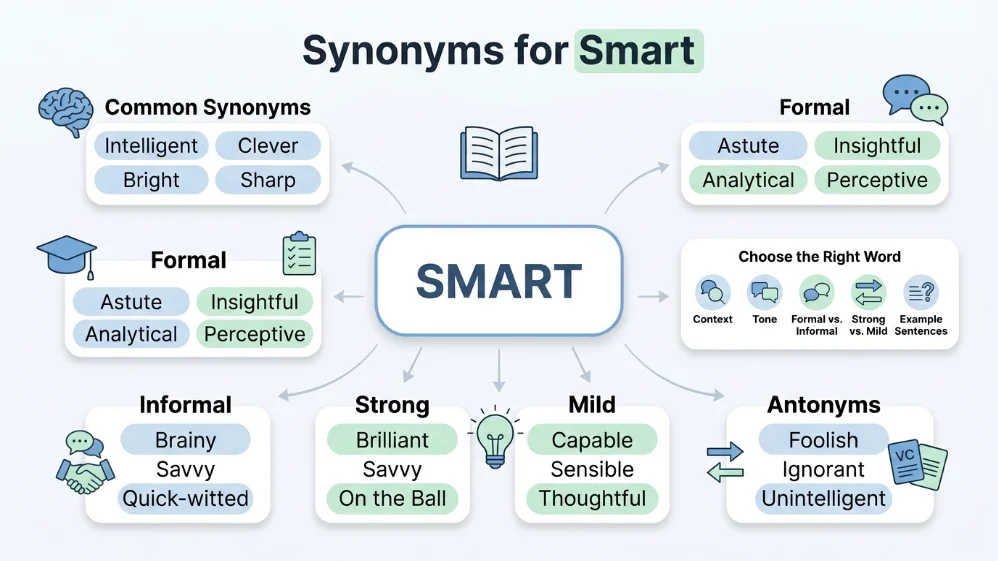
If you’re looking for synonyms for smart, the best choice depends on what you mean by smart. It can describe intelligence, quick thinking, good judgment, stylish appearance, or even advanced technology. Some of the best alternatives include intelligent, clever, bright, sharp, wise, knowledgeable, and astute. Choosing the right synonym depends on the context, tone, and level of formality.
Whether you’re writing an essay, preparing professional content, or simply expanding your vocabulary, understanding the subtle differences between these words will help you communicate more clearly and naturally.
Best Synonyms for Smart
The best synonyms for smart are intelligent, clever, bright, and sharp. Other excellent alternatives include wise, astute, knowledgeable, quick-witted, brainy, and perceptive. The right choice depends on whether you’re describing academic ability, practical judgment, creativity, or mental quickness.
What Does Smart Mean?
Smart is an adjective that usually describes someone or something with intelligence, quick understanding, or good judgment. Depending on the situation, it can also describe someone who dresses well, behaves confidently, or uses advanced technology.
Part of speech: Adjective
Common meanings of smart
- Having high intelligence
- Learning quickly
- Thinking clearly
- Solving problems effectively
- Making sound decisions
- Looking fashionable (especially in British English)
- Using advanced digital technology
Example sentences
- Maya is smart enough to solve difficult math problems in minutes.
- Buying a reusable water bottle was a smart decision.
- He wore a smart suit to the interview.
- Many homes now use smart security systems.
As you can see, not every synonym works for every meaning of smart. For example, intelligent replaces smart when talking about mental ability, but it doesn’t fit when describing clothing or technology.
Core Meaning of Smart
At its core, smart refers to the ability to think, understand, learn, and make good decisions. It often suggests that a person can process information quickly and apply knowledge effectively.
However, the word is broader than many people realize.
Depending on context, smart may describe:
- Intellectual ability
- Practical wisdom
- Fast thinking
- Creativity
- Good judgment
- Efficient problem-solving
- Modern technology
- Stylish appearance
Because it has several meanings, replacing smart with another word requires understanding exactly what you’re trying to express.
For example:
- A smart student is academically capable.
- A smart investor makes wise financial choices.
- A smart speaker is an internet-connected device.
- A smart outfit is neat and fashionable.
Understanding these distinctions helps you select more precise vocabulary.
Grammar and Usage Notes
Part of Speech
Smart is primarily used as an adjective.
Examples:
- She is smart.
- That was a smart idea.
- They made a smart investment.
Common Sentence Patterns
- smart person
- smart student
- smart decision
- smart move
- smart choice
- smart solution
- smart investment
- smart technology
- smart device
- smart appearance
Common Collocations
Some natural word combinations include:
- highly smart (less common than “highly intelligent”)
- incredibly smart
- exceptionally smart
- naturally smart
- book smart
- street smart
- smart thinking
- smart strategy
- smart planning
When “Smart” Sounds Natural
Use smart when you want a versatile, everyday word that’s easy to understand.
Examples:
- She’s smart enough to solve the problem.
- That was a smart choice.
- We need a smart marketing strategy.
When Another Synonym Works Better
Sometimes another word communicates your meaning more precisely.
Choose:
- Intelligent for academic or intellectual ability.
- Wise for experience and sound judgment.
- Astute for business or political insight.
- Clever for creative thinking.
- Bright for natural ability.
- Knowledgeable for someone with extensive information.
- Perceptive for noticing details others miss.
Selecting a more specific synonym often makes your writing stronger and more precise.
Best Synonyms for Smart
| Synonym | Meaning | Tone | Best Use Case | Example Sentence |
|---|---|---|---|---|
| Intelligent | High mental ability | Neutral | Academic, professional | Emma is an intelligent researcher. |
| Clever | Quick and creative thinking | Informal | Everyday conversation | That was a clever solution. |
| Bright | Naturally intelligent | Friendly | Students and children | Liam is a bright young student. |
| Sharp | Mentally quick | Casual | Conversation | She’s sharp during meetings. |
| Wise | Good judgment from experience | Formal | Advice and leadership | It was a wise decision. |
| Astute | Excellent insight | Professional | Business and politics | The manager made an astute investment. |
| Knowledgeable | Well-informed | Professional | Education and work | He’s knowledgeable about cybersecurity. |
| Perceptive | Notices subtle details | Formal | Analysis and observation | Her perceptive comments impressed everyone. |
| Quick-witted | Thinks and responds rapidly | Neutral | Conversation | His quick-witted reply made everyone laugh. |
| Brainy | Very intelligent | Informal | Casual speech | She’s the brainy one in our class. |
Common Synonyms for Smart
These are the alternatives you’ll hear most often in everyday English.
Intelligent
Meaning: Possessing strong intellectual ability.
Best context: School, education, professional writing.
Example:
The scientist is highly intelligent and respected worldwide.
Clever
Meaning: Creative, inventive, or mentally quick.
Best context: Problem-solving and conversation.
Example:
That was a clever way to fix the broken chair.
Bright
Meaning: Naturally intelligent with strong learning ability.
Best context: Describing children, students, and young professionals.
Example:
Our new intern is incredibly bright and eager to learn.
Sharp
Meaning: Quick to understand and react.
Best context: Business meetings, interviews, and conversations.
Example:
She remained sharp throughout the negotiation.
Wise
Meaning: Showing good judgment based on experience.
Best context: Advice, leadership, parenting, and life lessons.
Example:
It was a wise decision to save money for emergencies.
Knowledgeable
Meaning: Having a great deal of information or expertise.
Best context: Professional and educational writing.
Example:
The instructor is extremely knowledgeable about artificial intelligence.
Astute
Meaning: Able to accurately understand situations and make sound decisions.
Best context: Business, politics, finance, and leadership.
Example:
Her astute observations helped the company avoid costly mistakes.
Perceptive
Meaning: Able to notice important details that others overlook.
Best context: Psychology, literature, leadership, and communication.
Example:
His perceptive analysis revealed the root cause of the problem.
Quick-Witted
Meaning: Able to think and respond rapidly.
Best context: Humor, debates, and conversation.
Example:
Her quick-witted response made everyone laugh.
Brainy
Meaning: Very intelligent, often used casually.
Best context: Informal conversation.
Example:
Everyone considers Jake the brainy member of the team.
Formal Synonyms for Smart
When writing academic papers, business reports, professional emails, or formal presentations, smart may sound too conversational. Choosing a more precise formal synonym can make your writing clearer and more polished.
Intelligent
Best for: Academic writing, research, education, and professional communication.
Meaning: Having strong intellectual ability and the capacity to understand complex ideas.
Example:
The committee is looking for intelligent candidates with excellent analytical skills.
Astute
Best for: Business, finance, leadership, and politics.
Meaning: Showing sharp judgment and the ability to understand situations accurately.
Example:
The CEO made an astute business decision that increased profits.
Knowledgeable
Best for: Reports, resumes, professional profiles, and technical writing.
Meaning: Well-informed because of education, training, or experience.
Example:
Our consultant is highly knowledgeable about cybersecurity regulations.
Perceptive
Best for: Psychology, literature, leadership, and critical analysis.
Meaning: Able to recognize subtle details or understand situations deeply.
Example:
Her perceptive observations improved the final report.
Insightful
Best for: Essays, reviews, research, and presentations.
Meaning: Showing a deep understanding that goes beyond obvious facts.
Example:
The article offers an insightful explanation of consumer behavior.
Analytical
Best for: Science, engineering, research, and business.
Meaning: Skilled at examining information logically and systematically.
Example:
His analytical approach helped identify the source of the problem.
Discerning
Best for: Reviews, criticism, leadership, and decision-making.
Meaning: Able to judge quality or value accurately.
Example:
A discerning investor carefully evaluates every opportunity.
Judicious
Best for: Formal reports, legal writing, and leadership.
Meaning: Showing careful thought and good judgment.
Example:
The board made a judicious decision after reviewing all the evidence.
Formal Synonym Comparison
| Synonym | Best For | Tone |
|---|---|---|
| Intelligent | Education, research | Neutral formal |
| Astute | Business, finance | Professional |
| Insightful | Analysis, writing | Professional |
| Perceptive | Observation | Formal |
| Knowledgeable | Expertise | Professional |
| Analytical | Technical work | Formal |
| Discerning | Evaluation | Formal |
| Judicious | Careful decisions | Highly formal |
Informal Synonyms for Smart
In casual conversations, text messages, blogs, and social media, people often use friendlier alternatives to smart.
Clever
A common everyday word that emphasizes creative thinking.
Example:
That was a clever way to solve the puzzle.
Bright
Often used to describe children, students, or people who learn quickly.
Example:
Sophia is one of the brightest students in her class.
Sharp
Suggests someone thinks quickly and notices details.
Example:
Stay sharp during the interview.
Brainy
A playful way to describe someone who is highly intelligent.
Example:
Everyone asks the brainy guy for help with math.
Quick-Witted
Describes someone who thinks and responds very quickly, often with humor.
Example:
Her quick-witted jokes kept everyone entertained.
Savvy
Means knowledgeable and practical, especially in business or technology.
Example:
He’s a tech-savvy entrepreneur.
On the Ball
An informal expression meaning alert, prepared, and mentally quick.
Example:
Our new assistant is really on the ball.
Street Smart
Describes someone with practical knowledge gained from real-life experience rather than formal education.
Example:
He’s street smart and knows how to handle difficult situations.
Informal Synonym Comparison
| Synonym | Typical Context | Tone |
|---|---|---|
| Clever | Everyday conversation | Casual |
| Bright | School, family | Friendly |
| Sharp | Work, conversation | Casual |
| Brainy | Friends | Playful |
| Quick-witted | Humor | Casual |
| Savvy | Business, technology | Modern |
| On the ball | Conversation | Informal |
| Street smart | Real-life experience | Informal |
Strong Synonyms for Smart
Some situations call for words that express exceptional intelligence or outstanding judgment. These stronger alternatives carry more emphasis than smart.
Brilliant
Suggests extraordinary intelligence or exceptional talent.
Best use:
- Scientists
- Inventors
- Exceptional students
- Outstanding ideas
Example:
She developed a brilliant solution to the engineering challenge.
Genius
Describes someone with remarkable intellectual ability.
Use carefully because it implies an unusually high level of intelligence.
Example:
Many people consider him a mathematical genius.
Exceptional
Highlights intelligence that stands out from the average.
Example:
She has exceptional problem-solving skills.
Remarkable
Suggests intelligence that deserves admiration.
Example:
His remarkable understanding of economics impressed the audience.
Ingenious
Focuses on creativity and originality when solving problems.
Example:
The engineer created an ingenious design.
Highly Perceptive
Emphasizes deep understanding and observation.
Example:
The detective was highly perceptive during the investigation.
When Strong Synonyms Can Sound Too Strong
Avoid exaggerating by using powerful words for ordinary situations.
For example:
❌ My brother is a genius because he finished his homework early.
✅ My brother is smart because he finished his homework early.
Likewise:
❌ The meeting included several brilliant suggestions.
✅ The meeting included several thoughtful or smart suggestions.
Choosing a word that matches the situation makes your writing more believable.
Mild Synonyms for Smart
Sometimes you want to praise someone without sounding overly enthusiastic. These softer alternatives work well in everyday communication.
Capable
Emphasizes competence rather than raw intelligence.
Example:
She’s a capable project manager.
Competent
Focuses on having the necessary skills.
Example:
He’s a competent software developer.
Sensible
Highlights practical thinking and good judgment.
Example:
That sounds like a sensible plan.
Thoughtful
Shows careful consideration.
Example:
She offered a thoughtful solution.
Practical
Focuses on realistic, effective thinking.
Example:
Their practical approach saved time and money.
Reasonable
Suggests balanced judgment.
Example:
That’s a reasonable conclusion.
Mild Synonym Comparison
| Synonym | Focus | Strength |
|---|---|---|
| Capable | Ability | Mild |
| Competent | Skill | Mild |
| Sensible | Judgment | Mild |
| Thoughtful | Careful thinking | Mild |
| Practical | Real-world usefulness | Mild |
| Reasonable | Logic | Mild |
These words don’t necessarily mean someone is highly intelligent, but they often fit better when discussing decisions, work performance, or everyday situations.
Synonyms for Smart by Context
The best synonym depends on where and how you’re using the word.
Everyday Conversation
In daily speech, simple words sound the most natural.
Good choices include:
- Clever
- Bright
- Sharp
- Brainy
- Quick-witted
Example:
That was a clever idea.
Professional Writing
Business communication benefits from precise vocabulary.
Best options:
- Intelligent
- Astute
- Knowledgeable
- Analytical
- Insightful
Example:
She provided an insightful recommendation during the meeting.
Academic Writing
Academic English often favors objective language.
Recommended synonyms:
- Intelligent
- Analytical
- Perceptive
- Knowledgeable
- Insightful
Example:
The researcher presented an analytical interpretation of the data.
Creative Writing
Stories and novels often describe characters in more expressive ways.
Useful choices:
- Clever
- Sharp
- Ingenious
- Quick-witted
- Brilliant
Example:
The detective’s sharp instincts led to a breakthrough.
Marketing Copy
Marketing writing often highlights expertise and innovation.
Effective alternatives include:
- Innovative
- Clever
- Insightful
- Strategic
- Savvy
Example:
Our innovative software helps businesses work more efficiently.
Personal Communication
When complimenting friends, coworkers, or family, natural language works best.
Good options:
- Smart
- Bright
- Clever
- Sharp
- Thoughtful
Example:
That was a thoughtful way to handle the situation.
Another Word for Smart in a Sentence
Here are natural examples showing how different synonyms work in everyday writing.
- Emma is an intelligent engineer who enjoys solving complex problems.
- That was a clever response to a difficult question.
- Noah is one of the brightest students in his class.
- Her sharp observations improved the presentation.
- The lawyer offered an insightful interpretation of the case.
- It was a wise decision to invest for the long term.
- Their manager is highly knowledgeable about international markets.
- The consultant made several astute recommendations.
- Olivia gave a thoughtful answer that considered everyone’s concerns.
- The designer created an ingenious solution using fewer materials.
- His analytical mindset helps him solve technical problems quickly.
- Maya is quick-witted and always has a funny comeback.
- The detective remained perceptive throughout the investigation.
- Jake is surprisingly savvy when it comes to online marketing.
- The new employee proved to be both capable and dependable from day one.
Smart Synonyms Compared
Many synonyms for smart overlap in meaning, but they are not always interchangeable. Understanding their differences helps you choose the most natural word for your sentence.
| Word | Primary Meaning | Tone | Formality | Best Use Case |
|---|---|---|---|---|
| Smart | Generally intelligent or making good decisions | Neutral | Neutral | Everyday conversation and writing |
| Intelligent | High intellectual ability | Neutral | Formal | Academic and professional contexts |
| Clever | Creative, quick-thinking, resourceful | Positive | Informal | Problem-solving and casual conversation |
| Bright | Naturally quick to learn | Friendly | Neutral | Children, students, and learning ability |
| Sharp | Mentally alert and quick | Confident | Informal | Business, discussions, interviews |
| Wise | Good judgment based on experience | Respectful | Formal | Advice, leadership, life decisions |
| Astute | Excellent judgment and insight | Professional | Formal | Business, finance, politics |
| Perceptive | Notices subtle details | Thoughtful | Formal | Observation and analysis |
| Knowledgeable | Well-informed through study or experience | Neutral | Professional | Expertise and education |
| Insightful | Shows deep understanding | Positive | Professional | Writing, analysis, presentations |
Intelligent vs. Clever
These words are often confused.
- Intelligent emphasizes overall mental ability and learning capacity.
- Clever focuses on creativity, originality, or finding quick solutions.
Example:
- She’s intelligent enough to understand advanced physics.
- She found a clever way to organize the project.
Smart vs. Wise
Although both are positive, they highlight different qualities.
- Smart usually refers to intelligence.
- Wise emphasizes sound judgment gained through experience.
Example:
- He’s a smart engineer.
- She’s a wise leader.
Bright vs. Sharp
Both suggest quick thinking, but with different shades of meaning.
- Bright often refers to natural learning ability.
- Sharp emphasizes alertness and quick mental reactions.
Example:
- She’s a bright student.
- He’s sharp during negotiations.
Words Similar to Smart
Not every related word is an exact synonym. Some belong to the same semantic field but describe different qualities.
| Related Word | Why It’s Related | Why It’s Not Always a Synonym |
|---|---|---|
| Educated | Has received formal education | Education does not always equal intelligence. |
| Experienced | Has practical knowledge | Experience can exist without exceptional intelligence. |
| Skilled | Good at a specific task | Skill is different from overall mental ability. |
| Talented | Has natural ability | Talent may involve art, sports, or music rather than intelligence. |
| Creative | Produces original ideas | Creativity is one aspect of intelligence but not a direct replacement. |
| Innovative | Introduces new ideas | Focuses on originality rather than intelligence itself. |
| Competent | Performs tasks effectively | Highlights ability instead of intellect. |
| Logical | Reasons clearly | Refers to a thinking style rather than general intelligence. |
| Strategic | Plans effectively | Focuses on planning and decision-making. |
| Observant | Notices details | Describes attention rather than intelligence. |
These words can strengthen your writing when they match the specific quality you want to describe.
Antonyms of Smart
Antonyms express the opposite meaning of smart.
| Antonym | Meaning | Example Sentence |
|---|---|---|
| Unintelligent | Lacking intellectual ability | The test doesn’t mean someone is unintelligent. |
| Foolish | Showing poor judgment | It was foolish to ignore the warning signs. |
| Ignorant | Lacking knowledge | He wasn’t rude, only ignorant of the rules. |
| Careless | Not paying enough attention | A careless mistake delayed the project. |
| Slow-witted | Slow to understand | The puzzle wasn’t difficult, but he felt slow-witted that day. |
| Naive | Lacking experience or practical judgment | She was naive about online scams. |
| Thoughtless | Not considering others or consequences | His thoughtless comment upset the team. |
| Incompetent | Lacking the necessary skills | The report criticized the incompetent management. |
Remember: Some antonyms describe a lack of knowledge, while others describe poor judgment or carelessness. Choose the one that best matches your intended meaning.
How to Choose the Right Synonym for Smart
The best synonym isn’t always the most impressive one—it’s the one that fits naturally.
Match the Context
Ask yourself what you’re describing.
- Academic ability → Intelligent
- Practical judgment → Wise
- Creative thinking → Clever
- Business insight → Astute
- Expertise → Knowledgeable
Match the Tone
Formal writing usually benefits from precise words like analytical, perceptive, or insightful.
Casual conversations often sound more natural with smart, bright, or sharp.
Consider the Intensity
Some words express stronger praise than others.
- Mild: capable, sensible
- Neutral: smart, intelligent
- Strong: brilliant, ingenious, genius
Avoid exaggeration unless it truly fits the situation.
Think About Your Audience
Simple, familiar vocabulary often improves readability.
For general readers:
- Smart
- Clever
- Bright
For academic or professional audiences:
- Intelligent
- Analytical
- Astute
- Insightful
Check Whether It’s an Exact Synonym
A related word isn’t always interchangeable.
For example:
- Educated refers to formal learning.
- Knowledgeable refers to having information.
- Wise refers to judgment.
- Smart usually refers to overall intelligence.
Replacing one with another without checking the meaning can change your sentence.
Keep the Sentence Natural
Always read the sentence aloud.
If a synonym sounds forced or unusually formal, a simpler word may work better.
Common Mistakes When Using Synonyms for Smart
Using the Wrong Tone
Don’t replace a casual word with an overly formal one unless the context requires it.
❌ He’s an astute kid.
✅ He’s a bright kid.
Choosing a Word That’s Too Strong
Words like genius or brilliant imply exceptional intelligence.
Reserve them for situations where they’re genuinely appropriate.
Using Formal Words in Casual Writing
A text message saying someone is perceptive may sound unnatural.
Smart or clever usually fits better.
Using Casual Words in Professional Writing
Business reports often sound stronger with knowledgeable, analytical, or insightful instead of brainy.
Treating Related Words as Exact Synonyms
Words like educated, creative, or experienced are related but don’t always replace smart.
Always check whether the meaning stays the same.
Ignoring Context
The word smart has multiple meanings.
For example:
- A smart phone doesn’t mean an intelligent phone.
- A smart outfit means stylish clothing.
- A smart decision means a wise choice.
Different meanings require different alternatives.
Quick Synonym List for Smart
Common Synonyms
- Intelligent
- Clever
- Bright
- Sharp
- Wise
- Knowledgeable
- Astute
- Perceptive
Formal Synonyms
- Intelligent
- Analytical
- Insightful
- Astute
- Perceptive
- Judicious
- Discerning
- Knowledgeable
Informal Synonyms
- Clever
- Bright
- Sharp
- Brainy
- Quick-witted
- Savvy
- On the ball
- Street smart
Strong Synonyms
- Brilliant
- Ingenious
- Exceptional
- Remarkable
- Genius
Mild Synonyms
- Capable
- Competent
- Sensible
- Practical
- Thoughtful
- Reasonable
Related Words
- Educated
- Experienced
- Skilled
- Creative
- Logical
- Innovative
- Strategic
- Observant
FAQs About Synonyms for Smart
What is the best synonym for smart?
The best synonym for “smart” is “intelligent.” However, if you’re emphasizing creativity, clever may be a better choice. For good judgment, wise is often the most accurate option.
What is another word for smart?
Common alternatives include intelligent, clever, bright, sharp, wise, astute, knowledgeable, and perceptive. The best choice depends on the context.
What is a formal synonym for smart?
Intelligent, analytical, insightful, astute, and perceptive are excellent formal alternatives for academic and professional writing.
What is an informal synonym for smart?
Casual alternatives include clever, bright, sharp, brainy, savvy, and quick-witted.
What is a stronger word for smart?
If you want stronger praise, consider brilliant, ingenious, exceptional, or genius. Use these words carefully because they imply a much higher level of ability.
What is a milder word for smart?
For a softer tone, use capable, sensible, competent, practical, or thoughtful.
What words are similar to smart?
Related words include educated, creative, logical, innovative, strategic, experienced, and observant. While these words share related ideas, they don’t always replace smart directly.
What is the opposite of smart?
Depending on the context, common antonyms include unintelligent, foolish, ignorant, careless, naive, and thoughtless.
Conclusion
There isn’t a single perfect replacement for smart because the word has several meanings. Sometimes it refers to intelligence, while in other situations it highlights good judgment, creativity, quick thinking, practical knowledge, or even modern technology.
Choosing the right synonym depends on meaning, tone, context, and intensity. For everyday writing, words like intelligent, clever, bright, and sharp work well. In professional or academic settings, alternatives such as astute, insightful, analytical, and knowledgeable often provide greater precision.
Instead of searching for the most impressive word, choose the one that expresses your intended meaning naturally. Clear and accurate word choice always leads to stronger communication.