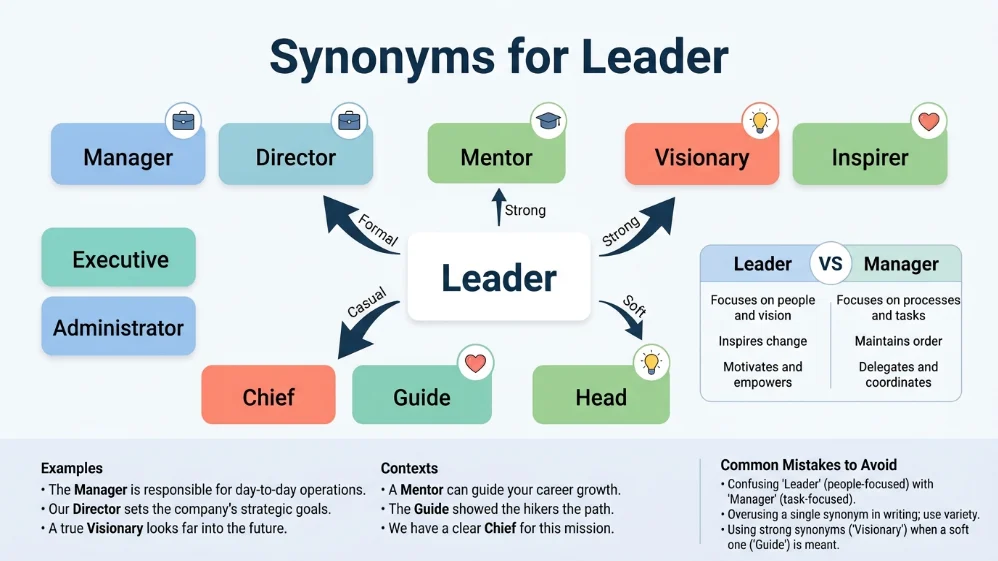
Need a better word than “leader”? The right synonym can make your writing sound sharper, more professional, or more inspiring. But not every word means exactly the same thing. A workplace manager may be a supervisor, while a respected community figure could be a guide, mentor, or influencer.
This guide gives you 50+ carefully selected leader synonyms with clear meanings and practical examples. You will see which words work best in essays, resumes, business writing, speeches, social media, and everyday conversations. We also explain subtle differences in tone, authority, and responsibility, so you can choose a word that truly fits your sentence.
Whether you are searching for a leader synonym, looking for stronger leader synonyms, or simply want another way to describe someone who guides others, this list makes the choice easier. Each alternative is explained in simple language, with examples you can use right away.
What Does “Leader” Mean?
A leader is someone who guides, directs, or influences a group toward a common goal. The best synonym depends on context. For formal writing, use “director” or “executive.” For casual conversation, try “guide” or “head.” Academic work favors “principal” or “facilitator.” Professional contexts work well with “manager” or “supervisor.” Emotional or inspiring situations call for “mentor” or “visionary.”
Meaning, Tone and Context
Simple Definition
A leader is a person who has authority, influence, or guidance over others. Leaders can be formal, like CEOs and managers, or informal, like community organizers and team mentors.
Part of Speech
“Leader” functions as a noun. Related forms include leadership (noun), lead (verb), and leading (adjective).
Tone
The tone is neutral to positive depending on usage. Most uses carry positive associations of competence and direction.
Formality Level
“Leader” works in formal, professional, and casual contexts. It is versatile but often lacks the precision that more specific terms provide.
Common Use Cases
People use “leader” in workplace settings, political discussions, educational environments, sports commentary, and personal development contexts.
Important Word Forms
Leadership describes the quality or position. To lead is the verb form. A leading figure indicates prominence.
When and How to Use “Leader”
Use “leader” when you need a general term for someone who guides others. It works best when the specific type of leadership is unimportant or already clear from context.
Professional context: Our team leader organized the project timeline and delegated tasks effectively.
Academic context: The study examined how a strong leader influences student motivation in collaborative learning environments.
Personal context: My father has always been a leader in our family, guiding us through difficult decisions.
Emotional context: She emerged as a leader during the crisis, calming everyone with her steady presence.
Creative context: The artist became a leader in the modern movement, inspiring countless followers.
Social media context: Great leaders don’t create followers, they create more leaders.
Resume context: Served as team leader for a cross functional department of 15 employees.
Casual conversation: Who is the leader of that community project you joined?
Another Word for “Leader”
The best replacement depends heavily on your specific meaning and context.
Professional Writing
Use “manager” or “executive” for corporate settings. “Supervisor” works for direct oversight roles. “Director” implies strategic control.
Academic Writing
“Principal” suggests primary authority. “Facilitator” emphasizes enabling others. “Coordinator” highlights organizational skills.
Casual Conversation
“Head” works informally. “Guide” suggests helpful direction. “Chief” is friendly but clear.
Emotional Writing
“Mentor” implies personal development. Inspiration” suggests influence through example. “Champion” shows advocacy.
Creative Writing
“Visionary” conveys forward thinking. “Pioneer” suggests trailblazing. “Architect” implies careful construction of ideas.
Resume or Workplace Use
“Team lead” is modern and approachable. “Project manager” shows specific responsibility. “Department head” indicates seniority.
Social Media Captions
“Influencer” works for digital contexts. “Trailblazer” feels inspiring. “Game changer” suggests innovation.
Stronger Meaning
“Dominant” conveys powerful control. “Commanding” suggests authority. “Authoritative” implies unquestionable knowledge.
Softer Meaning
“Advisor” suggests guidance without pressure. “Counselor” implies emotional support. “Facilitator” emphasizes enabling rather than directing.
When Not to Use “Leader”
Avoid “leader” when the specific role or type of guidance matters. The word is too general for precise communication.
Too vague example: She is a good leader in our department.
Improved version: She is an excellent mentor who develops junior staff members.
Too casual for formal writing: The leader of the committee presented the findings.
Improved version: The committee chair presented the findings.
Too weak for strong impact: He was the leader of the movement.
Improved version: He was the visionary who founded the movement.
Too general for resume: Leader of customer service team.
Improved version: Customer service manager who reduced response times by 40 percent.
Words Commonly Confused With “Leader”
Leader vs. Manager
A leader inspires and guides while a manager focuses on processes and tasks. Leaders set vision, and managers execute plans. Use “leader” for influence and “manager” for operational control.
Leader vs. Boss
A boss holds formal authority and gives orders. A leader earns respect and motivates others. Boss implies hierarchy, while leader suggests respect.
Leader vs. Director
A director sets overall strategy and vision. A leader can operate at any level. Directors are always leaders, but leaders are not always directors.
Leader vs. Guide
A guide shows the way or provides information. A leader has more authority and responsibility. Guides assist, while leaders direct.
Leader vs. CEO
CEO is a specific corporate title with legal responsibilities. Leader is a general term. Use CEO for formal business contexts, and leader for broader influence.
Leader vs. Commander
A commander has strict authority in military or hierarchical settings. A leader has broader influence. Commanders enforce, while leaders inspire.
Best Synonym by Context for “Leader”
| Context | Best Synonym | Why It Works | Example |
|---|---|---|---|
| Formal Writing | Director | Conveys official authority and responsibility | The board appointed a new director to oversee operations |
| Academic Writing | Principal | Suggests primary importance and authority | The principal investigator designed the research methodology |
| Professional Business | Executive | Implies senior decision making power | The executive presented the annual report to shareholders |
| Resume Use | Manager | Shows specific supervisory responsibilities | Managed a team of 12 sales representatives |
| Casual Conversation | Head | Informal but clearly understood | She is the head of our book club |
| Creative Writing | Visionary | Adds imagination and forward thinking | The visionary transformed the industry with bold ideas |
| Emotional Tone | Mentor | Emphasizes personal development and care | He served as a mentor to young professionals |
| Strong Intensity | Commanding | Suggests powerful, unquestionable authority | Her commanding presence silenced the room |
| Soft Moderate Tone | Advisor | Focuses on guidance without pressure | He acts as an advisor to the startup founders |
| Social Media Captions | Influencer | Modern term for digital leadership | Become an influencer in your niche community |
Which Synonym Should You Choose?
Start by identifying the primary activity the person performs. Do they direct operations, inspire people, manage processes, or guide development? Your answer points to the right word.
Consider your audience formality. Corporate reports require professional terms like executive or director. Casual conversations welcome words like head or guide. Academic work demands precision with terms like principal or facilitator.
Evaluate emotional intensity. Words like commander and dominant carry strong authority. Advisor and counselor offer softer guidance. Match intensity to your situation.
Think about the setting. Workplaces need specific roles like manager or supervisor. Personal contexts favor mentor or guide. Creative work benefits from visionary or pioneer.
Real Life Examples of “Leader” in Sentences
School setting: The student council president emerged as a natural leader who listened to everyone’s concerns.
Workplace context: Our department leader scheduled weekly check ins to ensure project progress.
Writing sample: A true leader takes responsibility for failures and shares credit for successes.
Conversation example: Who would make the best leader for this community initiative?
Social media post: Leadership is not about being in charge, it is about taking care of those in your charge.
Resume bullet: Recognized as team leader for three consecutive quarters for exceptional performance.
Email closing: As the project leader, I want to thank everyone for their dedication.
Storytelling example: The village leader gathered the community to face the approaching storm together.
25 Synonyms for “Leader”
| Synonym | Simple Meaning | Best Used For | Example Sentence |
|---|---|---|---|
| Director | Someone who manages operations or strategy | Formal business contexts | The creative director approved all advertising campaigns |
| Manager | Someone who oversees people and processes | Workplace and professional settings | The store manager handled all customer complaints |
| Executive | A senior decision maker in an organization | Corporate communications | The executive vice president announced the merger |
| Supervisor | Someone who directly oversees workers | Operational management | The shift supervisor monitored production quality |
| Commander | Someone with high authority and control | Military or strict hierarchical settings | The commander issued orders to the battalion |
| Chief | The head or top person in a group | Informal and professional contexts | The chief technology officer led the innovation team |
| Head | The person in charge of a group | Casual and professional use | She is the head of the marketing department |
| Guide | Someone who shows direction or provides assistance | Mentoring and tourism contexts | The mountain guide led us safely to the summit |
| Mentor | An experienced advisor who develops others | Personal and professional development | The mentor guided young entrepreneurs through challenges |
| Pioneer | Someone who leads in new developments | Innovation and exploration contexts | The pioneer introduced sustainable farming methods |
| Visionary | Someone with forward thinking ideas | Creative and strategic contexts | The visionary predicted market changes years in advance |
| Captain | The leader of a team or group | Sports and nautical contexts | The team captain motivated players before each match |
| Coordinator | Someone who organizes activities and people | Project management and events | The event coordinator arranged all conference details |
| Facilitator | Someone who enables group progress | Educational and collaborative settings | The facilitator encouraged every member to contribute |
| Advocate | Someone who supports or champions a cause | Social and political contexts | The advocate led efforts to protect workers rights |
| Ambassador | Someone who represents a group | Official and diplomatic contexts | The brand ambassador promoted products internationally |
| Spokesperson | Someone who speaks for an organization | Media and communications | The company spokesperson answered press questions |
| Chairperson | The leader of a committee or board | Formal meeting and governance contexts | The chairperson called the board meeting to order |
| Principal | The most important or primary figure | Academic and legal contexts | The principal architect designed the entire complex |
| Ringleader | The leader of a group, often negative | Informal and often critical contexts | The ringleader organized the protest outside city hall |
| Foreman | A supervisor of manual workers | Construction and industrial contexts | The foreman inspected each completed unit |
| Dean | The head of a university department | Academic administrative contexts | The dean approved the new curriculum changes |
| Herald | Someone who announces or proclaims | Literary and historical contexts | The herald brought news of the King’s arrival |
| Usher | Someone who leads people into a place | Event and ceremonial contexts | The usher guided guests to their seats |
Synonym Groups and Usage Differences
Professional vs. Personal Synonyms
Professional synonyms like manager, executive, and director emphasize formal roles and responsibilities. These words work in corporate reports, job descriptions, and official communications.
Personal synonyms like mentor, guide, and advisor focus on relationships and individual development. These terms suit conversations about growth, support, and personal influence.
Formal vs. Conversational Synonyms
Formal synonyms include director, executive, chairperson, and principal. These appear in legal documents, academic papers, and official announcements. They carry weight and authority.
Conversational synonyms include head, chief, and captain. These work in everyday speech, friendly emails, and casual writing. They maintain clarity without sounding stiff.
Academic Synonyms
Principal, facilitator, coordinator, and dean sound precise and suitable for research papers. These terms suggest structured leadership within educational or scholarly settings. They demonstrate professional vocabulary appropriate for academic audiences.
Professional and Business Synonyms
Manager, executive, supervisor, director, and chief work effectively in workplace communication. These words appear in resumes, presentations, performance reviews, and business proposals. They convey specific organizational roles.
Creative or Literary Synonyms
Visionary, pioneer, herald, and architect add imagery and descriptive depth. These synonyms appear in novels, poetry, and creative nonfiction. They paint vivid pictures of leadership influence and innovation.
Strongest vs. Weaker Synonyms
Mild intensity: Advisor, guide, facilitator, coordinator
Moderate intensity: Manager, director, supervisor, head
Strong intensity: Commander, chief, dominant, authoritative
Extreme intensity: Dictator, tyrant, authoritarian
Emotional vs. Neutral Synonyms
Emotional synonyms like mentor, champion, and inspiration carry warmth and personal connection. They suggest care, support, and positive influence. Neutral synonyms like manager, supervisor, and coordinator stay factual and professional without emotional overtones.
Antonyms of “Leader”
| Antonym | Meaning | Example Sentence |
|---|---|---|
| Follower | Someone who supports or obeys a leader | The follower implemented the strategies without question |
| Subordinate | Someone with lower rank or authority | The subordinate reported directly to the department head |
| Employee | A person hired to perform work | The employee completed tasks assigned by management |
| Novice | A person new to an activity or skill | The novice learned from experienced professionals |
| Apprentice | A learner who studies under a master | The apprentice observed the master craftsman carefully |
| Amateur | Someone lacking professional experience | The amateur needed guidance from experienced leaders |
| Associate | A person with equal or junior status | The associate worked alongside senior colleagues |
| Assistant | Someone who helps or supports another | The assistant managed the director’s calendar |
| Dependent | Someone who relies on others | The dependent team members needed constant direction |
| Puppet | Someone controlled by others | The puppet leader followed orders without question |
| Pawn | Someone used to advance another’s interests | The pawn was promoted to distract from real decisions |
| Servant | Someone who serves others | The servant carried out every command efficiently |
| Intern | A temporary junior worker | The intern learned leadership skills during the program |
| Minion | An unimportant follower | The minion completed tasks without independent thought |
| Underling | A person of low rank | The underling hoped to become a leader someday |
Comparison: Leader vs. Similar Words
Leader vs. Manager
A leader inspires and sets direction while a manager focuses on process and execution. Leader emphasizes influence and vision. Manager emphasizes coordination and control.
Leader example: The leader inspired the team to exceed their goals.
Manager example: The manager ensured all tasks were completed on schedule.
Leader vs. Boss
A boss has authority through position. A leader earns authority through respect. Boss implies formal power. Leader implies earned influence.
Boss example: My boss assigned the new project to me.
Leader example: My leader encouraged me to develop new skills.
Leader vs. Director
A director holds a specific role with strategic responsibility. Leader is a broader term for anyone who guides others. Directors set policy. Leaders may operate at any level.
Director example: The director approved the annual budget.
Leader example: The team leader organized daily meetings.
Leader vs. Guide
A guide shows the way or provides information. A leader has more responsibility and authority. Guides assist. Leaders direct and influence.
Guide example: The tour guide explained the historical significance.
Leader example: The community leader organized disaster relief efforts.
Leader vs. Commander
A commander has strict authority in formal hierarchies. A leader may have informal influence. Commanders issue orders. Leaders inspire action.
Commander example: The commander ordered the troops forward.
Leader example: The neighborhood leader unified residents against construction plans.
Leader vs. Mentor
A mentor focuses on personal growth and development. A leader may focus on achieving objectives. Mentors develop individuals. Leaders direct groups.
Mentor example: My mentor helped me navigate career decisions.
Leader example: The project leader delegated responsibilities effectively.
Common Phrases and Expressions with “Leader”
1. Born Leader
Meaning: Someone with natural leadership qualities
Example sentence: She is a born leader who commands respect from everyone she meets.
2. Leader of the Pack
Meaning: The best or most successful in a group
Example sentence: Their sales team became the leader of the pack after implementing new strategies.
3. Follow the Leader
Meaning: A game where people imitate the leader’s actions
Example sentence: The children played follow the leader during recess.
4. Natural Leader
Meaning: Someone who leads instinctively
Example sentence: He is a natural leader who doesn’t need formal training.
5. Team Leader
Meaning: The person who guides a team
Example sentence: The team leader coordinated all departmental activities.
6. Thought Leader
Meaning: Someone whose ideas influence others
Example sentence: She became a thought leader in sustainable business practices.
7. Leader of the Opposition
Meaning: The head of the opposing political party
Example sentence: The leader of the opposition challenged the prime minister’s decision.
8. Market Leader
Meaning: The dominant company in an industry
Example sentence: Their company remains the market leader in smartphone technology.
Common Mistakes to Avoid
1. Using “Leader” When a More Precise Synonym Exists
Saying “project leader” when “project manager” clarifies the role. Saying “team leader” when “supervisor” indicates formal authority. Choose specific terms for clarity.
2. Confusing “Leader” with “Manager”
Leaders inspire and guide. Managers oversee processes. Use “leader” for vision and “manager” for operations. The roles overlap but serve different purposes.
3. Using Casual Synonyms in Formal Writing
“Skipper” might work for a boat but not for a corporate annual report. “Chief” feels friendly but may lack gravitas in academic papers. Match formality to audience expectations.
4. Using Overly Dramatic Synonyms for Simple Situations
Not every group leader is a “visionary” or “pioneer.” Save powerful words for truly innovative or groundbreaking individuals. Ordinary contexts call for ordinary terms.
5. Repeating the Same Synonym Too Often
Alternate between leader, manager, director, and guide to maintain reader interest. Repetition makes writing feel monotonous and unprofessional.
6. Choosing a Synonym with the Wrong Emotional Tone
Calling someone a “commander” in a caring context sounds harsh. Using “guide” in a crisis may sound too passive. Match emotional weight to the situation.
7. Using Slang in Academic or Professional Writing
Words like “honcho” or “big cheese” belong in casual conversation. Avoid informal terms in resumes, reports, and professional emails. They undermine credibility.
FAQs
1. What is the best synonym for leader?
The best synonym depends on context. Use “manager” for workplace oversight, “director” for strategic roles, “mentor” for personal guidance, and “visionary” for creative leadership.
2. What is a formal synonym for leader?
“Executive,” “director,” “principal,” and “chairperson” are formal synonyms for leader. These terms work well in corporate reports and academic writing.
3. What is an informal synonym for leader?
“Head,” “chief,” and “guide” are informal synonyms for leader. These words work in casual conversations, friendly emails, and social media posts.
4. What is another word for leader in professional writing?
“Manager,” “supervisor,” “executive,” and “department head” serve as professional synonyms for leader in workplace communication and resumes.
5. What is the difference between leader and manager?
Leaders inspire and influence people while managers coordinate processes and tasks. Leaders set vision, and managers execute strategies. Both are essential for organizational success.
6. What is the opposite of leader?
“Follower,” “subordinate,” “employee,” and “assistant” are antonyms of leader. These terms describe people who support or work under leadership.
Conclusion
Leader” describes someone who guides, influences, or directs others toward a common goal. The best synonym depends entirely on your context, audience, and intended tone.
Professional settings call for terms like manager, executive, and supervisor. Academic writing benefits from principal and facilitator. Creative work shines with visionary and pioneer. Personal relationships suit mentor and guide.
Consider your audience formality. Consider the specific type of leadership you describe. Your word choice shapes how readers perceive the person you describe.
Start using these alternatives today. Notice how precise language improves your writing and communication. Expand your vocabulary to express exactly what you mean.
Vocabulary tip: Keep a list of these synonyms on your desk. Refer to it when writing emails, reports, or social media posts. Challenge yourself to use one new synonym each day.
1 thought on “50+ Synonyms for Leader | Meanings, Examples and Best Alternatives”