Have you ever found yourself writing an email, an essay, or a social media caption and realized you have used the word “nuance” three times in two paragraphs? You are not alone. Many writers, students, and professionals reach for this word when they want to describe subtle differences in meaning, tone, or feeling. But relying on the same term can make your writing feel repetitive and less precise.
That is exactly why understanding the synonyms of nuance is so valuable. When you know the right alternative for each situation, your communication becomes clearer, more engaging, and more professional. Whether you are drafting a business report, editing a college essay, or crafting a thoughtful social media post, choosing the right word makes a real difference.
What Are the Best Synonyms of “Nuance”?
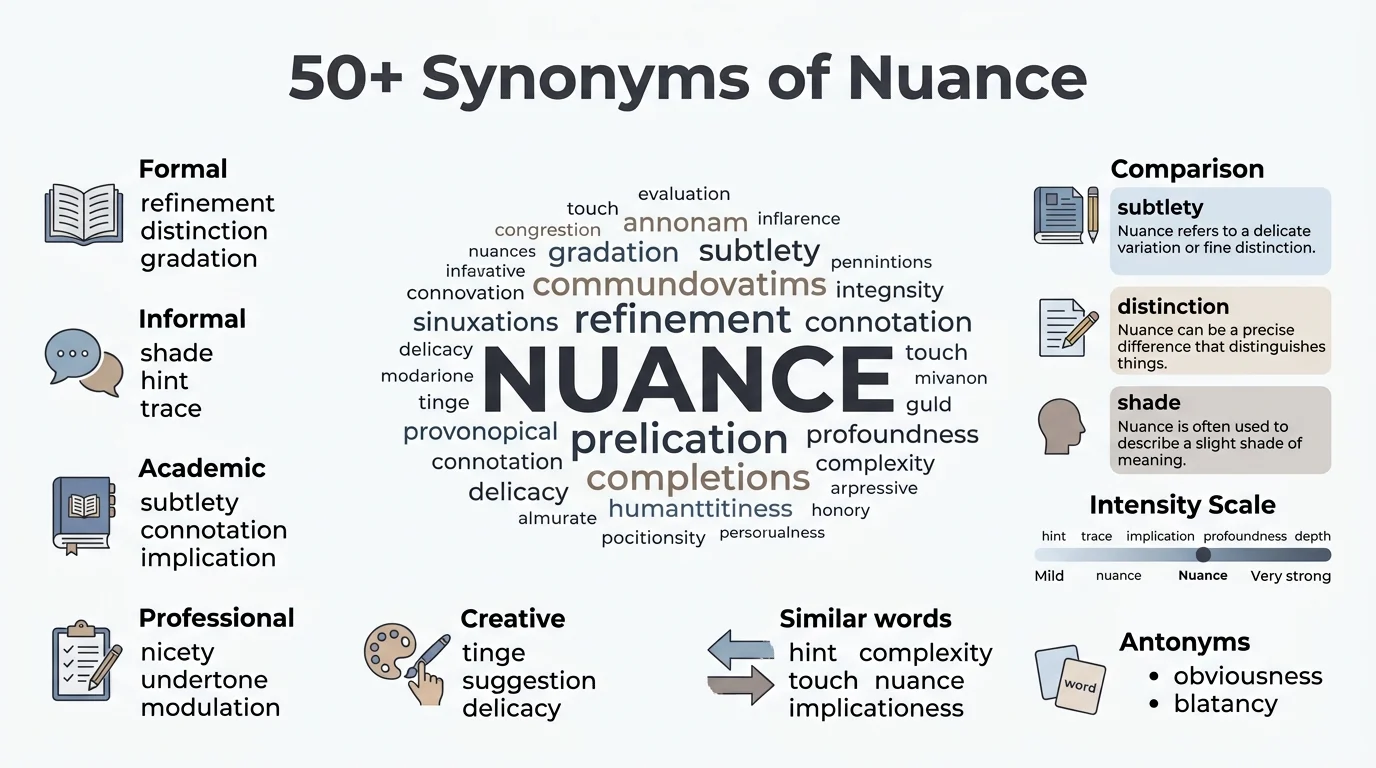
Nuance means a very slight difference in meaning, sound, color, or feeling that is not immediately obvious. The best synonyms depend on your context. For formal writing, choose “subtlety” or “refinement.” For casual conversation, try “shade” or “hint.” In academic work, “gradation” and “distinction” work well. For professional communication, “nicety” and “undertone” are strong options.
Meaning, Tone, and Context
Simple Definition
A nuance is a small, delicate difference in meaning, expression, tone, color, or feeling that is not always easy to notice.
Part of Speech
Nuance is primarily used as a noun. The adjective form is “nuanced,” which describes something that has subtle distinctions or layers of meaning.
Overall Tone
Nuance is a neutral word. It does not carry a positive or negative emotional charge on its own. The tone depends entirely on how you use it.
Formality Level
Nuance is semi-formal to formal. It appears frequently in academic writing, literary criticism, professional communication, and thoughtful journalism. It is less common in casual texting or very informal conversation.
Common Uses
Native English speakers use “nuance” most often when discussing:
- Language and word choice
- Art, music, and literature
- Social situations and interpersonal dynamics
- Political or philosophical arguments
- Professional feedback and performance reviews
Word Forms
| Form | Word |
|---|---|
| Noun | nuance |
| Adjective | nuanced |
| Adverb | nuancedly (rare) |
When and How to Use “Nuance”
Choose “nuance” when you want to draw attention to a fine distinction that might otherwise go unnoticed. It works best when you are describing something that requires careful observation or thoughtful interpretation.
Here are seven realistic examples showing how “nuance” is used in different contexts:
Professional: “The contract contains several legal nuances that our team needs to review before signing.”
Academic: “Her thesis explores the cultural nuances embedded in the novel’s dialogue.”
Workplace: “Understanding the social nuances of the office helped me build better relationships with my colleagues.”
Personal: “I appreciate the nuance in his sense of humor; it is not always obvious but always clever.”
Email: “I would like to add a small nuance to the proposal we discussed yesterday.”
Resume: “Skilled at navigating the nuanced dynamics of cross-functional team collaboration.”
Social Media: “This film rewards repeat viewing. You catch new nuances every time you watch it.”
Best Synonyms of “Nuance”
No two synonyms are identical in every situation. The best choice depends on your audience, your purpose, and the specific shade of meaning you want to convey. Here are the top recommendations for common contexts.
Professional writing: Choose “refinement.” It suggests careful attention to detail and polished execution.
Academic writing: Choose “gradation.” It emphasizes the systematic, layered nature of differences.
Business communication: Choose “nicety.” It conveys precision and attention to important details.
Casual conversation: Choose “shade” or “hint.” These words feel natural and accessible in everyday speech.
Emotional writing: Choose “undertone” or “overtone.” These words highlight feelings that exist beneath the surface.
Creative writing: Choose “tinge” or “suggestion.” These add a poetic, sensory quality to your descriptions.
Resume writing: Choose “distinction.” It signals your ability to recognize and articulate important differences.
Workplace communication: Choose “subtlety.” It emphasizes the skill of noticing or conveying fine distinctions.
Stronger meaning: Choose “refinement” or “distinction.” These words carry more weight and authority.
Softer meaning: Choose “hint” or “trace.” These words feel lighter and less formal.
When Not to Use “Nuance”
There are times when “nuance” is not the best choice. Understanding these situations will help you write more effectively.
The difference is obvious: If you are describing a clear, noticeable difference, “nuance” sounds forced and imprecise.
- Less effective: “There is a nuance between day and night.”
- Better: “There is a clear distinction between day and night.”
When you need simpler language: In very casual conversations or texts, “nuance” can feel too formal or academic.
- Less effective: “I noticed a nuance in her tone.”
- Better: “I noticed something different in her tone.”
The topic is straightforward: If you are discussing a simple, uncomplicated subject, “nuance” adds unnecessary complexity.
- Less effective: “The recipe has a nuance of garlic.”
- Better: “The recipe has a hint of garlic.”
When you want to be direct: In persuasive or urgent communication, “nuance” can make you sound evasive or overly cautious.
- Less effective: “There is some nuance to our position on this issue.”
- Better: “Our position on this issue has several important layers.”
Words Commonly Confused With “Nuance”
Nuance vs Subtlety
Difference: Nuance refers to the fine distinction itself. Subtlety refers to the quality of being indirect, delicate, or difficult to notice.
When to use each: Use “nuance” when you are talking about a specific difference or variation. Use “subtlety” when you are describing the skill or quality of being understated.
Example with nuance: “The actor captured every nuance of the character’s emotional journey.”
Example with subtlety: “The director handled the sensitive topic with remarkable subtlety.”
Nuance vs Distinction
Difference: A distinction is a clear difference between two things. A nuance is a very slight, often hard-to-notice difference.
When to use each: Use “distinction” for differences that are meaningful and relatively easy to identify. Use “nuance” for differences that require careful attention to perceive.
Example with nuance: “There is a nuance in her singing that makes it unique.”
Example with distinction: “There is a clear distinction between their musical styles.”
Nuance vs Shade
Difference: “Shade” often refers to a slight variation in color or meaning. “Nuance” emphasizes the delicacy and subtlety of the difference even more strongly.
When to use each: Use “shade” in both literal and figurative contexts. Use “nuance” when you want to stress how fine or delicate the difference is.
Example with nuance: “The poem’s meaning shifts with each nuanced reading.
Example with shade: “The painting uses many shades of blue.”
Nuance vs Gradation
Difference: Gradation refers to a series of gradual, step-by-step changes. Nuance focuses on a single fine distinction within that series.
When to use each: Use “gradation” when describing a range or spectrum of differences. Use “nuance” when focusing on one specific subtle difference.
Example with nuance: “The nuance in her argument convinced the committee.”
Example with gradation: “The colors transition through a subtle gradation from light to dark.
Nuance vs Refinement
Difference: Refinement suggests improvement, polishing, or a higher level of sophistication. Nuance simply describes a fine distinction without implying improvement.
When to use each: Use “refinement” when you want to emphasize quality, elegance, or sophistication. Use “nuance” when you are simply describing a subtle difference.
Example with nuance: “The legal document contains several important nuances.”
Example with refinement: “The legal document demonstrates remarkable refinement in its wording.”
Nuance vs Undertone
Difference: Undertone specifically refers to a subtle quality, feeling, or meaning that exists beneath the surface. Nuance is broader and can refer to any fine distinction.
When to use each: Use “undertone” when you are describing something hidden or implied. Use “nuance” for any subtle difference, whether hidden or apparent.
Example with nuance: “The speech had several nuanced arguments.”
Example with undertone: “His words had an undertone of frustration.”
Best Synonyms of “Nuance” by Context
| Context | Best Synonym | Why It Works | Example |
|---|---|---|---|
| Formal writing | Refinement | Signals sophistication and careful attention to detail | “The proposal requires further refinement.” |
| Academic writing | Gradation | Emphasizes systematic, layered differences | “The study examines gradations in social status.” |
| Professional communication | Nicety | Conveys precision and attention to important details | “We have addressed all the legal niceties.” |
| Business emails | Distinction | Clear and professional without being overly academic | “There is an important distinction to make here.” |
| Resume writing | Subtlety | Demonstrates emotional and social intelligence | “Known for navigating workplace subtleties effectively.” |
| Workplace communication | Undertone | Helps describe unspoken dynamics | “The meeting had a tense undertone.” |
| Casual conversation | Shade | Natural and easy to understand | “There is a shade of difference between them.” |
| Everyday speaking | Hint | Light and conversational | “I caught a hint of sarcasm in his voice.” |
| Creative writing | Tinge | Adds sensory, poetic quality | “Her voice had a tinge of sadness.” |
| Storytelling | Suggestion | Creates atmosphere and implication | “The story carried a suggestion of danger.” |
| Emotional writing | Overtone | Highlights feelings beyond the obvious | “The apology had overtones of resentment.” |
| Strong emphasis | Distinction | Carries weight and authority | “The distinction between the two theories is crucial.” |
| Mild tone | Trace | Very light and subtle | “There was a trace of doubt in her answer.” |
| Social media captions | Shade | Short, punchy, and visually evocative | “Every shade of emotion in this photo.” |
How to Choose the Best Synonym of “Nuance”
Choosing the right synonym comes down to four simple questions.
Who is your audience? For professors, executives, or clients, choose formal words like “refinement” or “distinction.” For friends or social media followers, choose conversational words like “shade” or “hint.”
What is your purpose? Are you analyzing, persuading, describing, or entertaining? Academic analysis calls for “gradation.” Persuasive writing benefits from “distinction.” Descriptive writing shines with “tinge” or “undertone.”
How strong should your word be? If you want to emphasize importance, choose “distinction” or “refinement.” If you want to downplay or soften your point, choose “hint” or “trace.”
Does the word sound natural in your sentence? Read your sentence aloud. If the synonym feels awkward or forced, try a different one. The best word is the one that flows naturally while communicating your intended meaning clearly.
Real Life Examples of “Nuance”
School: “My teacher encouraged us to look for nuance in the historical documents rather than accepting surface-level interpretations.”
College: “The professor praised my essay for its nuanced understanding of the philosopher’s arguments.”
Workplace: “Learning the nuances of our company culture took about six months.”
Business: “Our marketing strategy needs more nuance to appeal to different customer segments effectively.”
Email: “I appreciate the nuance you brought to our discussion yesterday. It helped clarify several points.”
Resume: “Recognized for bringing nuance and depth to client communications.”
Conversation: “There is a nuance to what she is saying that you might have missed.”
Storytelling: “The author’s genius lies in the nuances she gives to even minor characters.”
Blogging: “Traveling taught me to appreciate the cultural nuances that make each place unique.”
Social Media: “This album reveals new nuances with every listen. Absolute masterpiece.”
18 Best Synonyms of “Nuance”
| Synonym | Simple Meaning | Best Used For | Example Sentence |
|---|---|---|---|
| Subtlety | A fine, delicate, or understated quality | General use, describing skill or quality | “The subtlety of his performance impressed the critics.” |
| Refinement | A small improvement or sophisticated detail | Formal and professional writing | “The refinements in the design made it more elegant.” |
| Nicety | A fine point or detail that requires precision | Business and legal contexts | “We need to address all the legal niceties before signing.” |
| Distinction | A clear difference between similar things | Academic and analytical writing | “The distinction between the two theories is significant.” |
| Gradation | A series of gradual changes or steps | Academic and scientific writing | “The gradation in color from light to dark was beautiful.” |
| Shade | A slight variation in meaning, color, or tone | Casual and creative writing | “There is a shade of difference between their opinions.” |
| Undertone | A subtle feeling or quality beneath the surface | Emotional and descriptive writing | “Her words carried an undertone of frustration.” |
| Overtone | An additional, often subtle, quality or feeling | Emotional and analytical writing | “The speech had political overtones that were hard to miss.” |
| Hint | A slight or indirect indication | Casual conversation and everyday writing | “I detected a hint of sarcasm in his reply.” |
| Tinge | A slight trace or flavor of something | Creative and sensory writing | “The sauce had a tinge of garlic.” |
| Trace | A very small amount or sign | Describing minimal presence | “There was a trace of doubt in her voice.” |
| Suggestion | A subtle hint or indication | Storytelling and descriptive writing | “The painting carried a suggestion of melancholy.” |
| Connotation | An implied or associated meaning | Linguistic and analytical writing | “The word carries positive connotations in this context.” |
| Implication | Something suggested without being directly stated | Academic and professional writing | “The implication of her statement was clear.” |
| Variation | A slight change or difference | Scientific and general writing | “There are slight variations in the data.” |
| Modulation | A change from one state to another | Musical, technical, and formal writing | “The modulation in his voice conveyed deep emotion.” |
| Delicacy | Fineness or subtlety of texture, structure, or feeling | Literary and descriptive writing | “The delicacy of her brushwork was remarkable.” |
| Fine point | A small, precise detail | Any context requiring precision | “The fine points of the argument took time to understand.” |
Synonyms of “Nuance” by Usage
Professional vs Personal Synonyms
In professional settings, choose words that convey precision, authority, and careful thinking. “Refinement,” “distinction,” and “nicety” are excellent choices. They sound polished and demonstrate attention to detail.
In personal conversations, choose words that feel natural and approachable. “Shade,” “hint,” and “tinge” work well. They communicate the same idea without sounding overly formal or academic.
Formal vs Conversational Synonyms
Formal synonyms (reports, essays, business writing, presentations, professional emails):
- Refinement
- Distinction
- Gradation
- Nicety
- Modulation
Conversational synonyms (casual conversations, texting, friendly emails):
- Shade
- Hint
- Trace
- Tinge
- Suggestion
Academic Synonyms
For research papers, essays, reports, and academic discussions, these synonyms carry authority and precision:
- Gradation – emphasizes systematic differences
- Distinction – signals clear analytical thinking
- Subtlety – shows awareness of complexity
- Connotation – useful for linguistic and literary analysis
- Implication – demonstrates critical thinking
Professional and Business Synonyms
For resumes, interviews, meetings, presentations, performance reviews, client communication, and business emails, choose:
- Refinement – signals quality and polish
- Nicety – shows attention to important details
- Distinction – demonstrates clear thinking
- Undertone – useful for describing workplace dynamics
- Subtlety – shows emotional and social intelligence
Creative and Literary Synonyms
For storytelling, fiction, poetry, descriptive writing, and speeches, these expressive alternatives add emotion and imagery:
- Tinge – adds sensory flavor
- Suggestion – creates atmosphere
- Undertone – reveals hidden feelings
- Overtone – adds layers of meaning
- Delicacy – conveys beauty and fineness
Slang or Modern Synonyms
“Nuance” does not have widely used slang equivalents. In very casual contexts, people might say “a shade” or “a hint” instead. These are not slang but informal alternatives that sound more natural in everyday speech.
Strongest to Mildest Synonyms
Mild → Moderate → Strong → Very Strong
| Intensity | Synonyms |
|---|---|
| Mild | Hint, Trace, Tinge |
| Moderate | Shade, Suggestion, Undertone, Variation |
| Strong | Subtlety, Gradation, Connotation, Implication |
| Very Strong | Refinement, Distinction, Nicety, Delicacy |
Emotional vs Neutral Synonyms
Emotional Synonyms (express stronger feelings):
- Undertone (hidden emotion)
- Overtone (additional emotional quality)
- Tinge (emotional flavor)
- Suggestion (emotional implication)
- Delicacy (emotional sensitivity)
Neutral Synonyms (communicate information without added emotion):
- Distinction
- Gradation
- Variation
- Refinement
- Nicety
Antonyms of “Nuance”
Comparison: “Nuance” vs Similar Words
Nuance vs Subtlety
Main Difference: Nuance refers to the fine distinction itself. Subtlety refers to the quality of being indirect, delicate, or difficult to notice.
Which Is Stronger? Neither is inherently stronger. “Subtlety” often implies a higher degree of skill or craft.
Which Is More Formal? Both are formal, but “nuance” is slightly more academic in tone.
When to Use Each: Use “nuance” when describing specific differences. Use “subtlety” when describing the quality of being understated or delicate.
Examples:
- Nuance: “The actor captured every nuance of the character.”
- Subtlety: “The director handled the topic with remarkable subtlety.”
Nuance vs Distinction
Main Difference: Distinction implies a clearer, more noticeable difference. Nuance implies a very slight, hard-to-notice difference.
Which Is Stronger? “Distinction” is stronger and more emphatic.
Which Is More Formal? Both are formal, but “distinction” is more common in academic and professional writing.
When to Use Each: Use “distinction” for meaningful, identifiable differences. Use “nuance” for differences that require careful attention.
Examples:
- Nuance: “There is a nuance in her argument that changes everything.”
- Distinction: “There is a clear distinction between their political views.”
Nuance vs Shade
Main Difference: “Shade” often refers to variations in color or meaning. “Nuance” emphasizes the delicacy of the difference even more.
Which Is Stronger? “Nuance” is slightly more formal and precise.
Which Is More Formal? “Nuance” is more formal.
When to Use Each: Use “shade” in both literal and figurative contexts. Use “nuance” when you want to stress how fine or delicate the difference is.
Examples:
- Nuance: “The poem’s meaning shifts with each nuanced reading.”
- Shade: “The painting uses many shades of blue.”
Nuance vs Gradation
Main Difference: Gradation refers to a series of gradual changes. Nuance focuses on a single fine distinction.
Which Is Stronger? Neither is inherently stronger; they serve different purposes.
Which Is More Formal? Both are formal and academic.
When to Use Each: Use “gradation” for describing a range or spectrum. Use “nuance” for focusing on one specific subtle difference.
Examples:
- Nuance: “The nuance in her argument convinced the committee.”
- Gradation: “The colors transition through a subtle gradation.”
Nuance vs Refinement
Main Difference: Refinement suggests improvement or sophistication. Nuance simply describes a fine distinction.
Which Is Stronger? “Refinement” often carries a more positive, appreciative tone.
Which Is More Formal? Both are formal, but “refinement” is more common in professional contexts.
When to Use Each: Use “refinement” to emphasize quality and polish. Use “nuance” for neutral descriptions of subtle differences.
Examples:
- Nuance: “The legal document contains several important nuances.”
- Refinement: “The legal document demonstrates remarkable refinement.”
Nuance vs Undertone
Main Difference: Undertone specifically refers to a subtle quality beneath the surface. Nuance is broader.
Which Is Stronger? “Undertone” often carries more emotional weight.
Which Is More Formal? Both are formal.
When to Use Each: Use “undertone” when describing hidden feelings or implications. Use “nuance” for any subtle difference.
Examples:
- Nuance: “The speech had several nuanced arguments.”
- Undertone: “His words had an undertone of frustration.”
Common Phrases and Expressions with “Nuance”
Common Mistakes to Avoid
1: Using “nuance” when you mean “difference”
Incorrect: “There is a nuance between cats and dogs.”
Better: “There is a clear difference between cats and dogs.”
Why: Nuance describes slight, subtle differences, not obvious ones.
2: Overusing “nuance” in casual conversation
Incorrect: “I noticed a nuance in her outfit today.”
Better: “I noticed something different about her outfit today.”
Why: “Nuance” sounds overly formal for everyday observations about clothing.
3: Using “nuance” interchangeably with “subtlety”
Incorrect: “His nuance as a negotiator is impressive.”
Better: “His subtlety as a negotiator is impressive.”
Why: Subtlety refers to the skill or quality of being understated. Nuance refers to the fine distinctions themselves.
4: Choosing an overly dramatic synonym
Incorrect: “There is a monumental nuance in his argument.”
Better: “There is an important nuance in his argument.”
Why: “Monumental” contradicts the very meaning of nuance, which implies something small and subtle.
5: Using slang synonyms that do not exist
Incorrect: “That take is hella nuanced, bro.”
Better: “That is a very nuanced perspective.”
Why: “Nuance” does not have widely accepted slang equivalents. Forcing slang sounds awkward.
6: Repeating “nuance” too often in one piece of writing
Incorrect: “The nuance of the painting is remarkable. Every nuance tells a story. The nuance of color is especially striking.”
Better: “The nuance of the painting is remarkable. Every shade tells a story. The gradation of color is especially striking.”
Why: Varying your word choice keeps your writing fresh and engaging.
7: Using “nuance” in highly urgent or direct communication
Incorrect: “There is nuance to the fact that the building is on fire.”
Better: “The building is on fire. We need to evacuate immediately.”
Why: In urgent situations, direct language is more effective than subtle distinctions.
Frequently Asked Questions
1. What are the best synonyms of “nuance”?
The best synonyms depend on your context. Formal writing, choose “refinement” or “distinction.” For casual conversation, choose “shade” or “hint.” For academic work, “gradation” and “subtlety” are excellent choices.
2. What are the best formal synonyms of “nuance”?
The best formal synonyms include “refinement,” “distinction,” “gradation,” “nicety,” and “modulation.” These words are appropriate for academic papers, business reports, professional emails, and formal presentations.
3. What are common informal synonyms of “nuance”?
Common informal synonyms include “shade,” “hint,” “trace,” and “tinge.” These words sound natural in casual conversations, texting, and everyday writing while still conveying the idea of a subtle difference.
4. What is another word for “nuance” in professional writing?
In professional writing, “refinement,” “distinction,” and “nicety” are strong alternatives. “Refinement” suggests polished quality. “Distinction” signals clear analytical thinking. “Nicety” conveys attention to important details.
5. What is the difference between “nuance” and “subtlety”?
Nuance refers to the fine distinction itself. Subtlety refers to the quality of being indirect, delicate, or difficult to notice. Nuance is what you notice. Subtlety is the quality of how something is conveyed.
6. What is the opposite of “nuance”?
The opposite of nuance includes words like “obviousness,” “blatancy,” “directness,” “coarseness,” and “bluntness.” These words describe things that are clear, apparent, or lacking in subtlety.
Conclusion
Nuance is a valuable word that helps us describe the subtle differences in meaning, tone, color, and feeling that make communication rich and precise. But no single word works perfectly in every situation. The best synonym depends on your audience, your purpose, and the specific shade of meaning you want to convey.
For formal writing, choose “refinement” or “distinction.” Casual conversation, choose “shade” or “hint.” For academic work, choose “gradation” or “subtlety.” Professional communication, choose “nicety” or “undertone.”
The next time you reach for the word “nuance,” pause and consider whether one of its synonyms might serve your purpose better. Your writing will become clearer, more engaging, and more precise. And that is a refinement worth making.