You just finished a project and want to tell your team. You are updating your resume and need to describe a recent skill. Writing a caption about a fresh idea.
And every time, your brain offers the same word: new.
It is a good word. But using it too often makes your writing sound flat and repetitive. This guide gives you the right synonyms for new, organized by tone, context, and purpose, so you always have the best alternative ready.
Quick Answer: What Does “New” Mean?
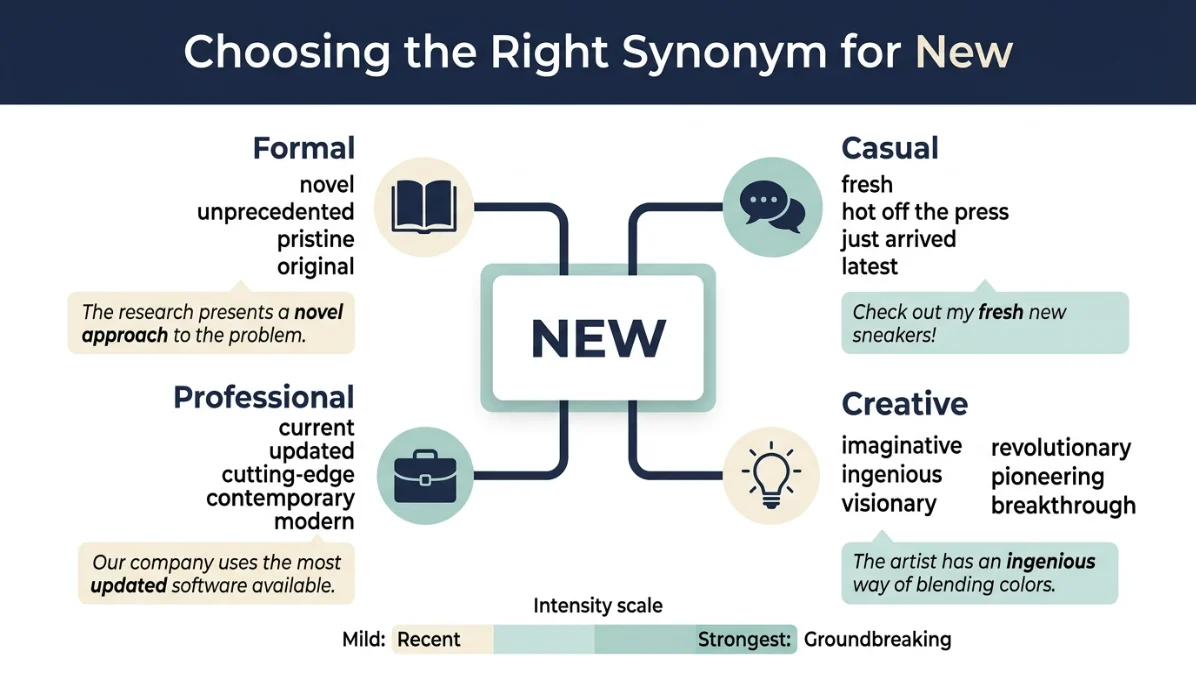
“New” means recently created, discovered, or introduced. It describes something that did not exist before or something that is replacing an older version. The best synonyms depend on context: novel for academic writing, innovative for business, fresh for casual use, and groundbreaking for strong emotional impact.
Meaning, Tone and Context
The word “new” carries a generally positive and forward looking tone. It signals change, improvement, or a fresh start.
Part of speech: Adjective
Tone: Positive, neutral, or hopeful
Formality level: Neutral, suitable for most situations
Common use cases: Describing objects, ideas, time periods, experiences, and conditions
Related forms: Newness (noun), newly (adverb), renew (verb)
In professional settings, “new” often implies progress. In personal life, it can suggest excitement or a clean slate. The word is flexible, but its very flexibility means a more specific synonym often communicates your exact meaning better.
When and How to Use “New”
Use “new” when you want a simple, universally understood word. It works when you describe something that recently came into existence, arrived, or changed ownership.
Here are realistic examples using “new” in everyday situations.
She started a new job last Monday after a long search. (professional)
The library added several new books to its history collection. (academic)
I finally tried that new coffee shop on Maple Street. (casual)
He felt a new sense of hope after their conversation. (emotional)
The artist unveiled a completely new style in her latest series. (creative)
Captions should highlight something new your audience has not seen yet. (social media)
Please review the new policy update before Friday. (email)
Another Word for “New”
If you want a single dependable replacement, “fresh” is often your best choice. It covers physical items, ideas, and experiences with a clean, appealing tone. However, the right synonym always depends on your specific situation.
For professional writing, try “recently introduced” or “updated.” For academic writing, use “novel.” In casual conversation, “brand new” or “fresh” fit naturally. For emotional writing, “renewed” or “fresh” work well. In creative writing, explore “unprecedented” or “unfolding.”
On resumes, “emerging” or “advanced” carry strong professional value. For social media captions, “just dropped” or “fresh” connect with readers. Choose “revolutionary” for a stronger meaning and “recent” for a softer one.
When Not to Use “New”
Sometimes “new” sounds too vague, too general, or simply inaccurate. Calling a three month old software update “new” in a performance review weakens your message.
The CEO announced a new strategy.
The CEO announced a revised growth strategy.
If something is merely improved or changed slightly, “updated,” “refreshed,” or “revised” reflects reality more honestly. Reserve “new” for genuine introductions rather than minor adjustments.
Words Commonly Confused With “New”
Several words overlap with “new” but carry distinct meanings. Understanding the differences prevents miscommunication.
New vs. Novel
New means recently made or discovered. Novel emphasizes originality and cleverness. A new phone model may look like last year’s. A novel phone design introduces features never seen before.
New vs. Innovative
Innovative implies introducing new methods or ideas that advance a field. New simply refers to recent existence. A new filing system might just be a different color. An innovative filing system changes how information flows.
New vs. Modern
Modern relates to the present time or recent period, not necessarily recent creation. A modern building could be 20 years old, while a new building was just completed.
New vs. Recent
Recent describes something that happened a short time ago. New describes something that just began existing. A recent study might confirm old findings, but a new study presents fresh research.
New vs. Original
Original stresses authenticity and being the first of its kind. New can describe a copy you just bought. An original painting came from the artist’s hand. A new painting could be a reproduction.
New vs. Young
Young applies to living things in early stages of life. New applies to objects, ideas, and conditions. A young teacher is early in their career, while a new teacher just started at your school.
Best Synonym by Context for “New”
| Context | Best Synonym | Why It Works | Example |
|---|---|---|---|
| Formal writing | Recently introduced | Precise and professional | The recently introduced guidelines affect all departments. |
| Academic writing | Novel | Emphasizes originality | The researcher proposed a novel framework for analysis. |
| Professional or business use | Innovative | Signals progress and value | Our innovative approach reduced costs by 20 percent. |
| Resume | Emerging | Highlights growth potential | Developed skills in emerging machine learning tools. |
| Casual conversation | Fresh | Natural and positive | Let’s find a fresh spot for lunch today. |
| Creative writing | Unprecedented | Adds drama and weight | An unprecedented silence filled the ancient hall. |
| Emotional tone | Renewed | Suggests restoration | She approached her work with renewed energy. |
| Strong intensity | Groundbreaking | Implies major impact | The groundbreaking study changed public health policy. |
| Soft or moderate tone | Recent | Simple and understated | Her recent project received positive feedback. |
| Social media captions | Just dropped | Current and engaging | Our summer collection just dropped. Link in bio. |
| US and UK usage | Brand new | Universally understood | He drove home in a brand new car. |
Which Synonym Should You Choose?
Ask yourself three quick questions. First, how formal is the situation? Choose “novel” for academic papers, “innovative” for business plans, and “fresh” for casual texts. Second, how strong should the impact be? Use “groundbreaking” for major achievements and “recent” for neutral updates. Third, does the context call for emotional warmth or cool professionalism? Let your answers guide your word selection naturally.
Real Life Examples of “New” in Sentences
Seeing synonyms in action shows how a single word swap changes the energy of a sentence.
School: The student proposed an original solution to the math problem.
Workplace: Our team adopted an updated workflow that saved hours each week.
Writing: The novel takes place in a freshly imagined world.
Conversation: I just heard about a great spot that opened recently.
Social media: Fresh content every Wednesday. Stay tuned.
Resume: Completed advanced certification in project management.
Email: Here is the revised timeline for our upcoming launch.
Storytelling: A renewed sense of purpose guided her next decision.
25 Synonyms for “New”
| Synonym | Simple Meaning | Best Used For | Example Sentence |
|---|---|---|---|
| Fresh | Clean and recently made | Casual and creative contexts | We baked a fresh batch of cookies this morning. |
| Novel | Original and unusual | Academic and formal writing | Her novel interpretation challenged established theories. |
| Innovative | Introducing new ideas | Business and technology | The startup built an innovative payment platform. |
| Recent | Happening not long ago | Neutral factual descriptions | A recent survey revealed changing consumer habits. |
| Modern | Relating to the present | Design and lifestyle | The apartment features modern appliances throughout. |
| Updated | Brought up to date | Professional and technical use | Please review the updated employee handbook. |
| Original | First and not copied | Creative and artistic work | The director’s original vision survived the final cut. |
| Latest | Most recent in a series | News and media | Her latest article covers renewable energy trends. |
| Emerging | Beginning to develop | Resumes and trend analysis | Emerging markets present exciting investment opportunities. |
| Groundbreaking | Completely new and important | Major announcements | The groundbreaking treatment offers hope to patients. |
| Unprecedented | Never known before | Historical and dramatic writing | The city faced unprecedented flooding that spring. |
| Revolutionary | Causing major change | Technology and social movements | The revolutionary design reshaped the entire industry. |
| Contemporary | Belonging to the present | Art and cultural discussion | The gallery focuses on contemporary photography. |
| Current | Happening or existing now | News and routine updates | Our current focus remains customer satisfaction. |
| Advanced | Far ahead in development | Education and technology | She enrolled in an advanced data science course. |
| Brand new | Completely new | Everyday speech and emphasis | He unboxed a brand new laptop for his first day. |
| Just released | Made available moments ago | Entertainment and products | The band’s just released single topped the charts. |
| Up to the minute | Including the very latest | Journalism and fast news | We provide up to the minute traffic reports. |
| State of the art | Using the most modern techniques | Engineering and facilities | The hospital installed state of the art imaging equipment. |
| Renewed | Given new energy or strength | Emotional and personal growth | They approached the challenge with renewed confidence. |
| Refreshed | Made to feel new again | Design and self care | The website launched with a refreshed look. |
| Remodeled | Changed in structure or form | Real estate and spaces | They moved into a fully remodeled craftsman home. |
| Altered | Changed slightly | Precise adjustments | The tailor delivered the altered suit by Tuesday. |
| Futuristic | Suggesting the future | Design and speculative work | The concept car had a futuristic dashboard. |
| Next generation | The upcoming improved version | Tech and product launches | Next generation gaming consoles promise faster load times. |
Synonym Groups and Usage Differences
Professional vs. Personal Synonyms
In professional environments, words like “updated,” “revised,” “advanced,” and “emerging” communicate precise change and growth. In personal life, “fresh,” “brand new,” and “renewed” carry warmth and emotional resonance.
Telling a friend you have a “fresh perspective” sounds supportive. Telling your boss you have an “updated strategy” sounds competent.
Formal vs. Conversational Synonyms
Formal writing rewards precision. Use “novel,” “unprecedented,” “recently introduced,” and “contemporary” in reports, essays, and speeches.
Conversational English thrives on simplicity. Words like “brand new,” “just out,” “fresh,” and “latest” keep dialogue natural and relaxed. An email to a colleague might say “fresh data,” while a board presentation uses “recently compiled data.”
Academic Synonyms
Academic writing values originality and specificity. “Novel” is your strongest academic synonym because it directly claims intellectual originality. “Recent” works for literature reviews. “Emerging” suits research trends. Avoid “brand new” or “just dropped” entirely in scholarly work.
Professional and Business Synonyms
Business communication rewards words that project confidence and forward motion. “Innovative” shows creative thinking. “State of the art” signals competitive quality. “Advanced” and “updated” demonstrate progress. On resumes, “emerging,” “advanced,” and “recent” pair effectively with specific skills and technologies.
Creative or Literary Synonyms
Creative writing benefits from synonyms that paint pictures and stir emotions. “Unprecedented” adds scale and drama. “Futuristic” paints a visual scene. “Budding” describes early growth poetically. “Dawning” works beautifully for realizations and new eras.
Slang or Modern Synonyms
Terms like “fresh,” “just dropped,” “brand spanking new,” and “next gen” energize social media and casual conversation. They are perfectly acceptable in captions, texts, and informal marketing copy. Avoid them in academic papers, formal emails, and professional reports where they undermine credibility.
Strongest vs. Weaker Synonyms
Think of new synonyms on an intensity scale from mild to strongest.
Mild: Recent, current, altered
Moderate: Fresh, updated, modern
Strong: Innovative, novel, advanced
Strongest: Groundbreaking, unprecedented, revolutionary
Match the intensity to the achievement or change you describe.
Emotional vs. Neutral Synonyms
“Renewed,” “fresh,” and “dawning” add emotional warmth and hope. “Updated,” “recent,” and “current” stay factual and neutral. Choose emotional synonyms when you want readers to feel something. Choose neutral synonyms when you need to inform without emotional framing.
Antonyms of “New”
| Antonym | Meaning | Example Sentence |
|---|---|---|
| Old | Having existed for a long time | The old bridge still stands after a century. |
| Ancient | Very old or from long ago | Archaeologists studied the ancient ruins carefully. |
| Outdated | No longer useful or current | The manual contains outdated procedures. |
| Worn | Damaged by use over time | She replaced the worn tires before winter. |
| Used | Previously owned by someone else | He bought a used car with low mileage. |
| Familiar | Well known from experience | The familiar scent of coffee filled the kitchen. |
| Established | Existing for a significant time | The established firm has served clients since 1902. |
| Traditional | Following long established customs | Traditional methods still produce the best results. |
| Classic | Judged over time to be high quality | She prefers classic literature to modern novels. |
| Antique | Old and often valuable | The antique desk belonged to her great grandmother. |
| Obsolete | No longer produced or used | Floppy disks became obsolete years ago. |
| Conventional | Based on what is generally done | His conventional approach contrasted with her innovation. |
| Stale | No longer fresh or interesting | The bread went stale after sitting out all day. |
| Pre-owned | A formal term for used | The dealership specializes in pre-owned luxury vehicles. |
| Aged | Having grown older, often gracefully | Aged cheese develops deeper flavor over time. |
Comparison: New vs. Similar Words
New vs. Novel
Main difference: New covers recent existence. Novel covers original cleverness.
Which one is stronger: Novel is stronger for intellectual and creative contexts.
Which one is more formal: Novel is more formal.
Example: The new restaurant opened yesterday. Her novel approach to hiring transformed the company culture.
New vs. Innovative
Main difference: Innovative implies useful advancement. New simply states recency.
Which one is stronger: Innovative carries much stronger professional weight.
Which one is more formal: Innovative belongs in business and academic settings.
Example: We bought a new printer for the office. Their innovative water filtration system serves entire communities.
New vs. Modern
Main difference: Modern relates to the current era. New relates to recent creation.
Which one is stronger: Neither is inherently stronger. They describe different qualities.
Which one is more formal: Modern appears more often in design and academic writing.
Example: The new building opened last month. The museum’s modern wing draws architecture students.
New vs. Original
Main difference: Original means first and authentic. New can apply to copies.
Which one is stronger: Original is stronger for creative and artistic value.
Which one is more formal: Both are neutral. Original carries more prestige.
Example: She framed the new print in her living room. The gallery displays the artist’s original sketchbooks.
New vs. Fresh
Main difference: Fresh suggests cleanliness and vibrancy in addition to recency.
Which one is stronger: Fresh is more sensory and appealing.
Which one is more formal: Neither is formal. Fresh is slightly more literary.
Example: He bought a new notebook for class. The garden smelled of fresh earth after the rain.
New vs. Recent
Main difference: Recent focuses on a short time ago. New focuses on existence or creation.
Which one is stronger: New implies a stronger break from what came before.
Which one is more formal: Recent feels more neutral and academic.
Example: The company launched a new product line. A recent study challenges that assumption.
Common Phrases and Expressions with “New”
1. A new lease on life
Meaning: Renewed energy or purpose after difficulty.
Example sentence: After recovering, she felt she had a new lease on life.
2. Turn over a new leaf
Meaning: To start behaving in a better way.
Example sentence: He turned over a new leaf and began studying every evening.
3. What’s new?
Meaning: A casual greeting asking for recent updates.
Example sentence: I saw Jamie yesterday and asked, “So, what’s new?”
4. Brand new
Meaning: Completely new and unused.
Example sentence: The charity gave brand new coats to children in need.
5. New blood
Meaning: New people who bring fresh energy to an organization.
Example sentence: The board needs some new blood to generate fresh ideas.
6. Break new ground
Meaning: To do something innovative or pioneering.
Example sentence: The research team continues to break new ground in cancer treatment.
7. Dawn of a new era
Meaning: The beginning of a significantly different period.
Example sentence: The peace agreement marked the dawn of a new era for the region.
8. New kid on the block
Meaning: Someone new to a place or organization.
Example sentence: As the new kid on the block, she observed company culture carefully at first.
Common Mistakes to Avoid
Sticking with “new” when “updated” or “revised” is more accurate weakens precision. A “new policy” implies a complete replacement, while an “updated policy” suggests thoughtful modification.
Confusing “new” with “novel” can overstate an achievement. Calling a routine report “novel” in an academic context invites scrutiny. Reserve novel for genuinely original contributions.
Using casual synonyms like “brand new” in formal business proposals reduces professional credibility. Match your vocabulary to your audience’s expectations.
Using an overly dramatic synonym for a simple situation sounds insincere. Describing a slightly changed menu as “revolutionary” creates distrust.
Repeating the same synonym across a document creates the same monotony you were trying to avoid by replacing “new.” Vary your word choice.
Choosing a synonym with the wrong emotional tone can confuse readers. “Unprecedented” carries crisis weight. Using it for a small office change may alarm rather than inform.
Using slang like “fresh” or “just dropped” in academic or legal writing damages authority. Save these for social media and casual speech.
FAQs
What is the best synonym for new?
The best synonym depends on context. “Fresh” works casually, “novel” fits academic writing, and “innovative” suits business and professional communication perfectly.
What is a formal synonym for new?
“Novel,” “recently introduced,” and “unprecedented” are strong formal synonyms. Choose “novel” for academic papers and “recently introduced” for reports and official documents.
What is an informal synonym for new?
“Fresh,” “brand new,” “just out,” and “just dropped” are effective informal synonyms. They fit naturally in conversations, texts, and social media captions.
What is another word for new in professional writing?
“Updated,” “revised,” “advanced,” and “innovative” work well in professional writing. They show precision and signal meaningful progress or improvement.
What is the difference between new and novel?
“New” means recently created or discovered. “Novel” means original, clever, and unlike anything before. “Novel” carries stronger intellectual and creative weight.
What is the opposite of new?
“Old” is the most direct opposite. Other common antonyms include “outdated,” “worn,” “familiar,” “antique,” and “obsolete,” each carrying slightly different meaning.
Conclusion
“New” is a reliable, versatile word that fits almost anywhere. But your writing becomes sharper, more engaging, and more precise when you choose synonyms that match your specific context, tone, and audience.
Keep a mental list of your favorite alternatives: “novel” for academic depth, “innovative” for business impact, “fresh” for everyday warmth, and “groundbreaking” for major achievements. Ask yourself what exactly makes something new and pick the word that names that quality directly. Small word choices create big impressions.