You are writing an important email to your boss. You want to show your skills and achievements. keep using the word “demonstrate” over and over. It feels repetitive and dull. Your message loses its impact. This happens to everyone from students to professionals.
Choosing the right synonym can transform your writing instantly. It makes your message clearer and more engaging. This guide helps you find the perfect alternative for any situation. You will learn when to use each synonym and when to avoid common mistakes. Let us explore the many ways to express the meaning of demonstrate.
What Does “Demonstrate” Mean?
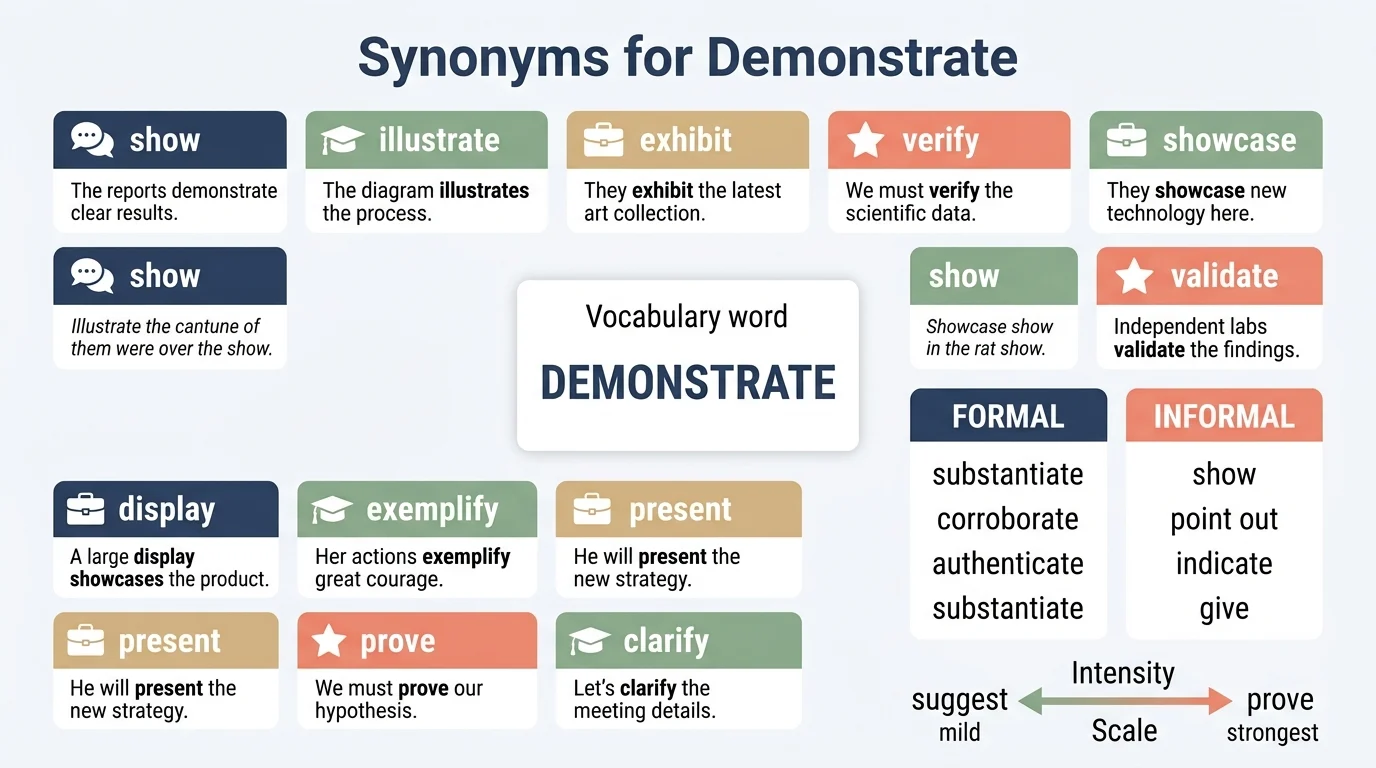
To demonstrate means to show clearly and deliberately. It involves providing evidence, proof, or a practical example. The best synonyms depend on your context. Use “prove” for factual situations, “illustrate” for explanations, “display” for showing features, “exhibit” for observable behaviors, and “show” for general use. Each synonym carries a unique tone and level of formality.
Meaning, Tone and Context
Simple definition
To demonstrate means to make something evident, clear, or obvious through evidence, reasoning, or action. It involves showing how something works or proving a point.
Part of speech
Verb. It has transitive and intransitive forms. The noun form is “demonstration.” The adjective form is “demonstrative.” The adverb form is “demonstrably.”
Tone
Neutral to positive. It conveys confidence and clarity. It can be factual, persuasive, or instructional depending on context.
Formality level
Moderately formal. It works well in professional, academic, and official settings. It is acceptable in casual conversation but can sound too stiff for everyday speech.
Common use cases
Academic writing, business presentations, job applications, scientific explanations, instructional guides, persuasive essays, and professional reports. People use it to prove points, show results, or explain procedures.
Important word forms
Demonstrate is the base verb. Demonstrates is the third person singular. Demonstrating is the present participle. Demonstrated is the past tense. Demonstration is the noun. Demonstrative is the adjective. Demonstrator is the person who demonstrates.
When and How to Use “Demonstrate”
Use demonstrate when you need to show something with clarity and purpose. It works best when you want to provide evidence or proof. It signals that you are presenting information deliberately.
Professional example
Our quarterly report demonstrates significant growth in customer engagement across all regions. This shows concrete results to stakeholders.
Academic example
The researcher demonstrated a direct correlation between sleep quality and cognitive performance in teenagers. This adds credibility to academic writing.
Personal example
My volunteer work demonstrates my commitment to community service and social responsibility. This strengthens personal statements.
Creative example
The artist demonstrates remarkable skill through the intricate details of each brushstroke. This highlights artistic ability.
Social media example
This quick tutorial demonstrates how to style a scarf in three different ways. This engages viewers with practical content.
Email example
The attached document demonstrates our progress on the project milestones. This provides clear communication in professional correspondence.
Resume example
Demonstrated leadership skills by managing a team of fifteen employees. This showcases workplace achievements.
Another Word for “Demonstrate”
Best single replacement based on meaning and context
The best replacement is “show” for general use. It is simple and clear. It works in almost every situation.
Professional writing
Use “prove” when presenting concrete evidence. Use “substantiate” when supporting claims with data. Use “validate” when confirming results.
Academic writing
Use “illustrate” for explaining concepts. Use “prove” for factual claims. “exhibit” for observable patterns. Use “confirm” for verifying hypotheses.
Casual conversation
Use “show” in everyday talk. Use “point out” when directing attention. “make clear” when explaining something simple. Use “prove” when convincing someone.
Emotional writing
Use “express” when showing feelings. Use “reveal” when exposing hidden truths. Use “manifest” when showing inner states. “display” when showing emotions openly.
Creative writing
Use “unveil” for revealing something new. Use “portray” for showing character traits. Use “depict” for visual description. “evince” for showing subtle qualities.
Resume or workplace use
Use “showcased” for achievements. Use “proved” for results. “exhibited” for skills. Use “illustrated” for capabilities.
Social media captions
Use “showing” for visual content. Use “featuring” for highlights. “spotlighting” for special elements. Use “presenting” for announcements.
Stronger meaning
Use “prove” for undeniable evidence. Use “establish” for firm conclusions. “verify” for confirmed facts. Use “authenticate” for validation.
Softer meaning
Use “suggest” for subtle indications. “hint at” for indirect showing. Use “indicate” for general pointing. Use “intimate” for gentle suggestions.
When Not to Use “Demonstrate”
Too vague
Do not use demonstrate when you need a specific action verb. Saying “I demonstrated my cooking skills” is vague. Use “prepared” or “cooked” for clarity.
Too casual
Do not use demonstrate in extremely casual settings. Saying “I demonstrated my phone to my friend” sounds unnatural. Use “showed” instead.
Too formal
Do not use demonstrate in everyday conversation. Saying “Let me demonstrate how to open this jar” is overly formal. Use “show” for natural speech.
Too weak
Do not use demonstrate when you need stronger evidence. Saying “This demonstrates my point” is weaker than “This proves my point.”
Too general
Do not use demonstrate when a more precise synonym fits better. Use “illustrate” for visual explanations. Use “prove” for factual claims.
Before improving
The data demonstrates that our sales increased.
After improving with precise synonym
The data proves that our sales increased.
Words Commonly Confused With “Demonstrate”
Demonstrate vs. Show
Show is the general and informal word. Demonstrate is the formal and deliberate word. Use “show” in everyday situations. Use “demonstrate” in professional or academic contexts. She showed me her artwork. The scientist demonstrated the experiment.
Demonstrate vs. Prove
Prove establishes absolute certainty. Demonstrate provides evidence but not necessarily proof. Use “prove” when you have conclusive evidence. Use “demonstrate” when you are showing something. He proved his theory with mathematical equations. She demonstrated her technique to the class.
Demonstrate vs. Illustrate
Illustrate focuses on visual or explanatory showing. Demonstrate focuses on practical or deliberate showing. Use “illustrate” for explaining with examples. Use “demonstrate” for practical demonstrations. The graph illustrates the trend clearly. The mechanic demonstrated how to change a tire.
Demonstrate vs. Display
Display emphasizes visual prominence and presentation. Demonstrate emphasizes showing how something works. Use “display” for showing products or art. Use “demonstrate” for showing processes. The store displayed the new collection. The chef demonstrated the recipe.
Demonstrate vs. Exhibit
Exhibit suggests showing something for observation. Demonstrate suggests active showing with explanation. Use “exhibit” for behaviors or traits. Use “demonstrate” for skills or procedures. The patient exhibited signs of recovery. The student demonstrated her knowledge.
Demonstrate vs. Evince
Evince suggests showing subtle or hidden qualities. Demonstrate suggests clear and deliberate showing. Use “evince” in literary or formal writing. Use “demonstrate” in everyday professional contexts. His writing evinces great intelligence. Her work demonstrates careful attention to detail.
Best Synonym by Context for “Demonstrate”
| Context | Best Synonym | Why It Works | Example |
|---|---|---|---|
| Formal writing | Prove | Establishes certainty with strong evidence | The study proves the hypothesis |
| Academic writing | Illustrate | Explains concepts with clear examples | The diagram illustrates the process |
| Professional business | Showcase | Highlights achievements or products | The report showcases our success |
| Resume writing | Exhibit | Shows skills through observable actions | Exhibited strong leadership abilities |
| Casual conversation | Show | Simple and natural for everyday use | Show me how you did that |
| Creative writing | Unveil | Creates drama and revelation | The story unveils a hidden truth |
| Emotional expression | Reveal | Shows feelings or hidden aspects | She revealed her true feelings |
| Strong intensity | Establish | Creates firm and undeniable proof | The evidence establishes the case |
| Soft moderate tone | Indicate | Suggests rather than proves directly | The results indicate a positive trend |
| Social media captions | Spotlight | Highlights specific features or moments | Spotlighting our new collection |
| Teaching situations | Explain | Clarifies processes and concepts | The teacher explained the formula |
| US usage | Demonstrate | Standard American English usage | The pilot demonstrated the safety procedures |
| UK usage | Demostrate | Same meaning in British English | The lecturer demonstrated the theory |
Which Synonym Should You Choose?
Consider your meaning
Think about what you truly want to say. Do you want to prove something with certainty? Use “prove.” Do you want to explain something clearly? Use “illustrate.” Do you want to show something casually? Use “show.”
Consider your formality level
Formal situations need precise and professional words. Use “prove,” “establish,” or “confirm.” Casual situations need simple and clear words. Use “show” or “point out.” Match your word to your audience.
Consider your emotional intensity
Strong emotions need stronger words. Use “reveal” or “manifest.” Neutral situations need factual words. Use “indicate” or “show.” Match your tone to your message.
Consider your professional value
Workplace writing needs action oriented words. Use “showcase” or “exhibit.” Academic writing needs evidence based words. Use “illustrate” or “prove.” Choose words that impress your specific audience.
Consider your sentence context
Look at the words around your verb. Some synonyms fit better with certain objects. You can illustrate a concept. You can prove a theory. can showcase a skill. Choose the synonym that pairs naturally with your subject.
Real Life Examples of “Demonstrate” in Sentences
School situation
The student demonstrated her understanding of algebra through problem solving.
Workplace situation
The project manager demonstrated effective delegation skills during the campaign.
Writing situation
The author demonstrates excellent storytelling technique in her latest novel.
Conversation situation
Can you demonstrate how you solved that puzzle? I want to understand your method.
Social media situation
This video demonstrates a simple recipe for homemade bread.
Resume situation
Demonstrated exceptional customer service by resolving complaints quickly.
Email situation
The attached file demonstrates our proposed budget allocation for next year.
Storytelling situation
His actions that day demonstrated genuine courage and selflessness.
25 Synonyms for “Demonstrate”
| Synonym | Simple Meaning | Best Used For | Example Sentence |
|---|---|---|---|
| Show | Make something visible or clear | General everyday use | Please show me how to use this software |
| Prove | Establish truth with evidence | Factual claims and arguments | The evidence proves his innocence |
| Illustrate | Explain with examples or visuals | Academic and teaching contexts | The textbook illustrates key concepts clearly |
| Exhibit | Display or show openly | Skills, behaviors, and traits | She exhibits exceptional writing ability |
| Reveal | Make known something hidden | Emotional or dramatic contexts | The investigation revealed shocking details |
| Display | Present prominently for viewing | Products, features, or art | The museum displays ancient artifacts |
| Showcase | Highlight qualities or products | Professional and marketing contexts | The portfolio showcases her best work |
| Evince | Show clearly or give evidence | Literary and formal writing | Her work evinces careful research |
| Manifest | Show clearly or appear | Emotional and philosophical contexts | His actions manifest true leadership |
| Unveil | Reveal something new | Creative and marketing contexts | The company will unveil its new product |
| Establish | Prove or confirm firmly | Strong, conclusive evidence | The research establishes a clear pattern |
| Confirm | Verify or make certain | Validating existing information | The tests confirmed our predictions |
| Validate | Confirm truth or accuracy | Professional and data driven contexts | The data validates our hypothesis |
| Depict | Show in a picture or description | Visual and descriptive contexts | The painting depicts rural life |
| Portray | Describe or show in a particular way | Literary and artistic contexts | The film portrays the struggle accurately |
| Indicate | Point to or suggest | General pointing or suggesting | The results indicate a need for change |
| Substantiate | Support with evidence | Legal and professional contexts | Can you substantiate your claim? |
| Corroborate | Confirm with additional evidence | Legal and research contexts | The witnesses corroborated her story |
| Clarify | Make something easier to understand | Explanatory situations | Let me clarify my main argument |
| Explain | Make clear or understandable | Teaching and instruction | Please explain the reasoning behind this |
| Express | Convey thoughts or feelings | Emotional and personal contexts | The poem expresses deep emotion |
| Highlight | Emphasize or draw attention | Presentations and writing | The report highlights key trends |
| Spotlight | Give special attention to | Marketing and social media | The article spotlights local artists |
| Embody | Represent or express an idea | Abstract and philosophical contexts | Her work embodies creativity and discipline |
| Symbolize | Represent something else | Literary and abstract contexts | The dove symbolizes peace and hope |
Synonym Groups and Usage Differences
Professional vs. Personal Synonyms
Professional synonyms focus on evidence and performance. Use words like “showcase,” “prove,” and “exhibit” in workplace settings. These words highlight skills and results clearly. Personal synonyms focus on expression and connection. Use words like “reveal,” “express,” and “share” in personal situations. These words build understanding and relationships.
Formal vs. Conversational Synonyms
Formal synonyms work in reports, essays, and speeches. Use “substantiate,” “corroborate,” and “establish” in academic or official writing. These words sound serious and credible. Conversational synonyms work in casual writing and everyday talk. Use “show,” “point out,” and “let me show you” in casual texts and emails. These words sound natural and approachable.
Academic Synonyms
Academic synonyms sound precise and suitable for scholarly writing. Use “illustrate,” “prove,” and “confirm” in essays and research papers. Use “demonstrate” itself in academic contexts. “establish” for research findings. “validate” for confirming results. These words show scholarly rigor and careful methodology.
Professional and Business Synonyms
Business synonyms work best in emails, presentations, and reports. Use “showcase” for highlighting achievements. “exhibit” for showing skills. “highlight” for drawing attention to key points. Use “prove” for showing results. Use “illustrate” for explaining data. These words sound competent and results oriented.
Creative or Literary Synonyms
Creative synonyms add imagery and descriptive depth. Use “unveil” to create drama and mystery. “portray” for character development. Use “depict” for visual description. “embody” for abstract concepts. Use “symbolize” for hidden meanings. These words enrich storytelling and artistic expression.
Slang or Modern Synonyms
Modern synonyms add casual and contemporary flavor. Use “break down” in tutorial contexts. “walk through” for step by step instructions. Use “run through” for quick explanations. “get across” for communicating ideas. These words are acceptable in casual situations. Avoid them in formal, academic, or professional writing.
Strongest vs. Weaker Synonyms
Mild to weakest
Suggest, hint at, indicate, imply, point to.
Moderate
Show, illustrate, express, portray, depict.
Strong
Demonstrate, exhibit, display, showcase, reveal.
Strongest
Prove, establish, validate, confirm, substantiate.
Choose the intensity that matches your message. A mild synonym works when you want to suggest without overcommitting. A strong synonym works when you need conviction and certainty.
Emotional vs. Neutral Synonyms
Emotional synonyms
Reveal, manifest, express, unveil, embody. These words add feeling and personal connection. Use them in storytelling, personal writing, and emotional contexts.
Neutral synonyms
Show, indicate, illustrate, exhibit, display. These words stay factual and objective. Use them in professional, academic, and scientific writing. They maintain distance and professionalism.
Antonyms of “Demonstrate”
| Antonym | Meaning | Example Sentence |
|---|---|---|
| Conceal | Hide from view | She tried to conceal her disappointment |
| Hide | Keep out of sight | The clouds hide the sun |
| Mask | Cover up or disguise | His smile masked his true emotions |
| Disprove | Prove to be false | The evidence will disprove the theory |
| Contradict | Deny or oppose | The facts contradict his claims |
| Refute | Prove wrong | The scientist refuted the argument |
| Obscure | Make unclear or hidden | The details obscure the main point |
| Cover | Put something over | The report covers up the mistakes |
| Withhold | Keep back from view | He withheld important information |
| Suppress | Prevent from being known | The government suppressed the news |
| Deny | Refuse to admit | She denied any involvement |
| Disguise | Change appearance to hide | The spy disguised his identity |
| Camouflage | Hide by blending in | The animal camouflages itself |
| Misrepresent | Give false impression | The article misrepresents the facts |
| Discredit | Damage belief in something | The scandal discredited his work |
Comparison: Demonstrate vs. Similar Words
Demonstrate vs. Show
Main difference
Show is general and informal. Demonstrate is specific and formal. Show can mean any kind of making something visible. Demonstrate means showing with purpose and evidence.
Which one is stronger
Demonstrate is stronger because it implies deliberate showing with evidence. Show can be passive or casual.
Which one is more formal
Demonstrate is more formal. Use it in professional and academic writing. Use show in everyday conversation.
Example sentence for show
Let me show you how to bake this cake.
Example sentence for demonstrate
The teacher will demonstrate the scientific method.
Demonstrate vs. Prove
Main difference
Prove establishes certainty and finality. Demonstrate provides evidence but may not achieve absolute proof. Prove ends debate. Demonstrate opens understanding.
Which one is stronger
Prove is stronger because it reaches a conclusive result. Demonstrate is moderate and explanatory.
Which one is more formal
Both are formal. Prove is more definitive. Demonstrate is more instructional.
Example sentence for prove
The DNA evidence will prove his guilt.
Example sentence for demonstrate
The experiment demonstrates the chemical reaction.
Demonstrate vs. Illustrate
Main difference
Illustrate focuses on visual or conceptual clarification. Demonstrate focuses on practical or operational showing. Illustrate shows with examples. Demonstrate shows with actions.
Which one is stronger
Demonstrate is stronger because it implies active showing. Illustrate is softer and more explanatory.
Which one is more formal
Both are formal and academic. Illustrate is more common in textbooks and lectures. Demonstrate is more common in practical instruction.
Example sentence for illustrate
The graph illustrates the population growth.
Example sentence for demonstrate
The coach will demonstrate the proper form.
Demonstrate vs. Display
Main difference
Display emphasizes visual presentation and prominence. Demonstrate emphasizes explanation and process. Display shows objects. Demonstrate shows actions.
Which one is stronger
Demonstrate is stronger because it shows active processes. Display is more passive and observational.
Which one is more formal
Both are moderately formal. Display is more common in retail and art contexts. Demonstrate is more common in educational and instructional contexts.
Example sentence for display
The gallery will display her paintings.
Example sentence for demonstrate
He will demonstrate the new software features.
Demonstrate vs. Exhibit
Main difference
Exhibit suggests showing for observation or analysis. Demonstrate suggests showing with explanation and intention. Exhibit is often passive. Demonstrate is active and deliberate.
Which one is stronger
Demonstrate is stronger because it involves active explanation. Exhibit is more detached and observational.
Which one is more formal
Both are formal. Exhibit is common in psychology and scientific contexts. Demonstrate is common in teaching and professional contexts.
Example sentence for exhibit
The patient exhibited signs of anxiety.
Example sentence for demonstrate
The student demonstrated her research methods.
Demonstrate vs. Express
Main difference
Express focuses on conveying emotions, thoughts, or opinions. Demonstrate focuses on showing evidence or actions. Express is internal to external. Demonstrate is showing something external.
Which one is stronger
Demonstrate is stronger for factual and action based contexts. Express is stronger for emotional and personal contexts. They serve different purposes.
Which one is more formal
Both are formal. Express is more common in literary and personal writing. Demonstrate is more common in professional and academic writing.
Example sentence for express
The letter expresses her gratitude beautifully.
Example sentence for demonstrate
The data demonstrates a clear improvement.
Common Phrases and Expressions with “Demonstrate”
1. Demonstrate a commitment to
Meaning
To show dedication or allegiance to a cause, value, or goal.
Example sentence
She demonstrated a commitment to environmental sustainability through her volunteer work.
2. Demonstrate the ability to
Meaning
To prove or show that one possesses a particular skill or capacity.
Example sentence
He demonstrated the ability to manage complex projects successfully.
3. Demonstrate understanding of
Meaning
To prove comprehension or knowledge of a subject or concept.
Example sentence
The essay demonstrates understanding of historical context.
4. Demonstrate a point
Meaning
To provide evidence or explanation to support an argument or idea.
Example sentence
The statistics demonstrate a point about consumer behavior.
5. Demonstrate how to
Meaning
To show the process or method for performing a task or action.
Example sentence
The tutorial demonstrates how to edit photos professionally.
6. Demonstrate value
Meaning
To show the worth, importance, or usefulness of something.
Example sentence
The project demonstrates value to both the company and its customers.
7. Demonstrate leadership
Meaning
To exhibit qualities and actions associated with leading others.
Example sentence
She demonstrated leadership by guiding her team through the crisis.
8. Demonstrate a skill
Meaning
To perform or exhibit a learned ability for others to observe.
Example sentence
The apprentice demonstrated his skill during the final exam.
Common Mistakes to Avoid
1. Using demonstrate when a more precise synonym is better
Saying “I demonstrated my cooking” is vague. Use “prepared” or “plated” instead. Choose action verbs that match what you actually did.
2. Confusing demonstrate with prove
Demonstrate shows evidence. Prove establishes absolute certainty. Do not use “prove” when you only have suggestive evidence. Use “illustrate” or “indicate” for suggestive contexts.
3. Using a casual synonym in formal writing
Saying “The results show the trend” in a research paper is too casual. Use “demonstrate,” “illustrate,” or “indicate” instead. Match your word to your audience and purpose.
4. Using an overly dramatic synonym for a simple situation
Saying “She unveiled her new haircut” is too dramatic for ordinary situations. Use “showed” or “revealed” with appropriate intensity. Save dramatic words for dramatic moments.
5. Repeating the same word too often
Using “demonstrate” four times in one paragraph creates repetition. Vary your language. Use “show,” “illustrate,” and “prove” to maintain reader interest.
6. Choosing a synonym with the wrong emotional tone
Saying “He revealed his anger” sounds like someone discovered a secret. Saying “He showed his anger” is straightforward and clear. Match emotional words to the actual emotional state.
7. Using slang in academic or professional writing
Saying “The study breaks down the process” in a research paper is too casual. Use “illustrates” or “demonstrates” instead. Save casual language for informal settings.
FAQs
What is the best synonym for demonstrate?
Show is the best all purpose synonym for general use. It works in almost every context without sounding formal or awkward.
What is a formal synonym for demonstrate?
Prove, illustrate, and substantiate are strong formal synonyms. Use them in professional reports, academic papers, and official documents.
What is an informal synonym for demonstrate?
Show is the most natural informal synonym. Use it in everyday conversation, casual emails, and social media posts.
What is another word for demonstrate in professional writing?
Showcase, exhibit, and highlight work well in professional writing. They emphasize achievements and positive results.
What is the difference between demonstrate and show?
Show is general and informal. Demonstrate is specific and formal. Demonstrate implies deliberate showing with evidence. Show can be casual and passive.
What is the opposite of demonstrate?
Conceal is a direct opposite of demonstrate. Hide, disguise, and mask are also strong antonyms. They all mean to keep something from being seen.
Conclusion
The word “demonstrate” is a powerful tool in your vocabulary. It helps you show ideas, prove points, and explain concepts. But overusing it weakens your impact. The right synonym can make your writing stronger, clearer, and more engaging.
Remember to choose your synonym based on context. Use “prove” for certainty. Use “illustrate” for explanations. “showcase” for achievements. “show” for everyday situations. Match your word to your audience and purpose.
Your vocabulary is your voice. Make it varied and precise. Start using these synonyms today and watch your communication improve. Your readers, listeners, and colleagues will notice the difference.