Have you ever described someone’s hidden talent, a disease that hasn’t shown symptoms, or a quality that hasn’t yet emerged, only to realize you keep using the same word over and over? Whether you are writing an essay, a professional email, or a creative story, repeating the same adjective can make your writing feel dull and imprecise. This is where exploring the synonyms of latent becomes incredibly useful.
Understanding the subtle differences between synonyms allows you to choose the exact word that conveys your intended meaning, tone, and level of formality. This guide will help you master the word “latent” and its many alternatives. We will explore the meaning, context, and best practices for using this word so you can communicate with greater clarity and confidence.
What Are the Best Synonyms of “Latent”?
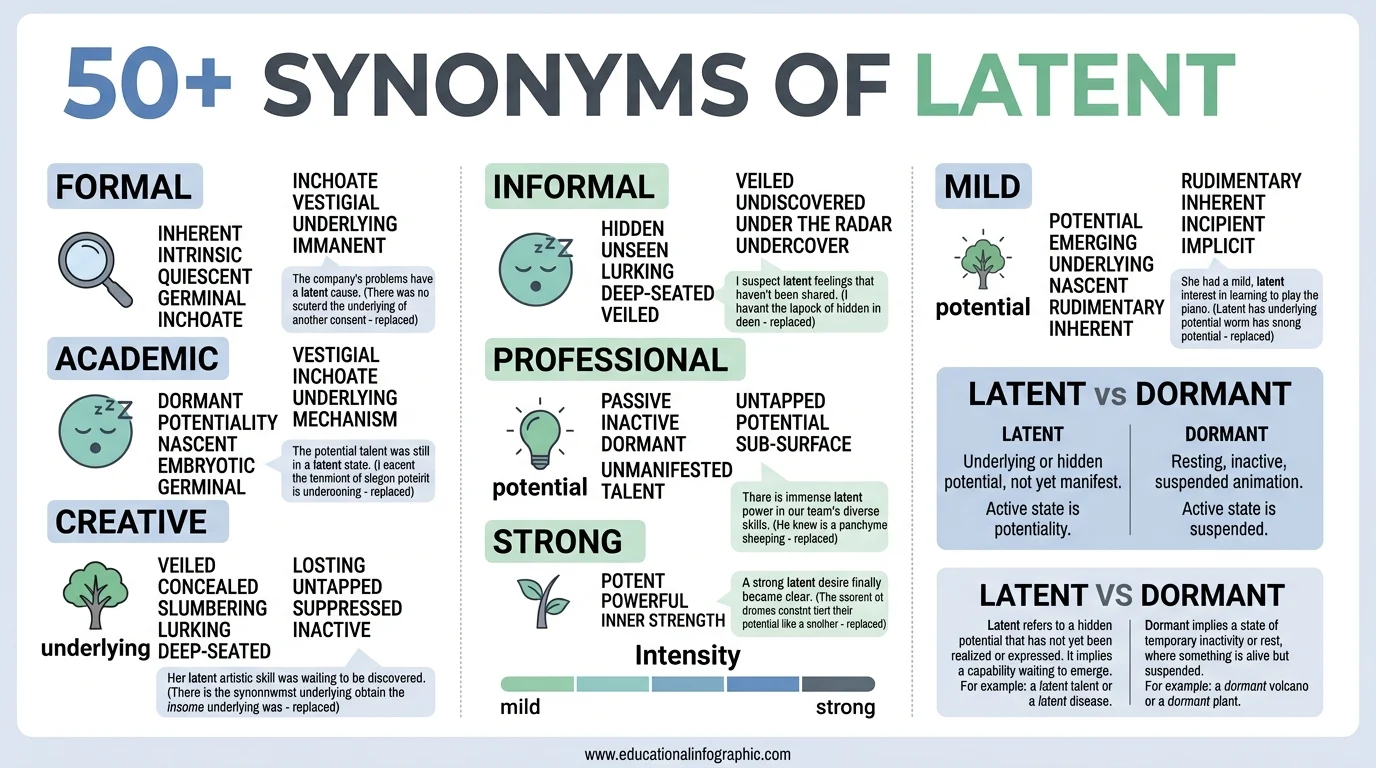
“Latent” describes something that exists but is not yet visible, active, or developed. For formal writing, use “potential” or “quiescent.” For casual conversation, “hidden” or “inactive” work well. In academic contexts, “dormant” or “underlying” are excellent choices. For professional settings, “unrealized” or “inherent” convey precision.
Meaning, Tone, and Context
Simple Definition
Something that is latent is present but not yet apparent, active, or developed. It refers to a quality, power, or condition that exists in a hidden or inactive state but has the possibility of emerging in the future.
Part of Speech
Adjective. The noun form is “latency,” and the adverb form is “latently.”
Overall Tone
“Latent” is a neutral, descriptive word. It does not carry a positive or negative connotation by itself. The tone depends entirely on what it describes. A “latent talent” is positive, while a “latent disease” is negative.
Formality Level
The word is formal and academic.
Common Uses
Native English speakers frequently use “latent” in specific contexts, including:
- Medicine: To describe diseases or infections that are present but not yet symptomatic, such as a latent virus.
- Psychology: To refer to unconscious or dormant abilities, memories, or traits that could emerge.
- Science: In physics, to describe energy or heat that is stored but not yet released, such as latent heat.
- Talent and Abilities: To describe skills or qualities a person has but has not yet shown or developed.
Word Forms
- Noun: Latency
- Adjective: Latent
- Adverb: Latently
When and How to Use “Latent”
Choose “latent” when you want to emphasize that something exists in a concealed or inactive state but has the potential to become evident or active. Here are seven realistic examples showing how to use the word in different contexts.
Professional:
“The market analysis revealed a latent demand for sustainable products that our competitors have not yet addressed.”
Academic:
“The study focused on the latent variables that influence student performance but are difficult to measure directly.”
Workplace:
“Our team has a lot of latent potential that we can unlock with the right training and mentorship program.”
Personal:
“Moving to a new city helped her discover a latent talent for painting that she never knew she had.”
Email:
“I believe there is a latent opportunity in our partnership that we should explore in our next meeting.”
Resume:
“Recognized latent inefficiencies in the supply chain and implemented solutions that reduced costs by 15%.”
Social Media:
“Sometimes the best things are the latent skills we haven’t discovered yet. What’s yours?”
Best Synonyms of “Latent”
No synonym is a perfect match for “latent” in every situation. The best choice depends on what you are describing and the tone you want to set. Here are the best synonyms for various contexts.
Professional Writing:
Unrealized is the best choice. It clearly communicates that a potential or opportunity exists but has not yet been taken advantage of.
Academic Writing:
Underlying is ideal. It suggests a foundational or hidden cause or factor that is not immediately obvious but is crucial to understanding a subject.
Business Communication:
Untapped is a strong and positive choice. It implies that a resource, market, or potential is available and ready to be used.
Casual Conversation:
Hidden is the most natural and easy-to-understand alternative. It avoids the formal tone of “latent” while clearly conveying the same basic idea.
Emotional Writing:
Suppressed or unexpressed can be used to add an emotional layer, suggesting that something is being held back or not allowed to come out.
Creative Writing:
Slumbering or dormant can add a poetic or metaphorical quality, personifying an idea or quality as if it were asleep.
Resume Writing:
Inherent is a powerful choice. It suggests that a skill or quality is a natural part of you or the role, even if it hasn’t been fully demonstrated yet.
Workplace Communication:
Inactive is a clear and direct way to describe a process, account, or status that is not currently active but could be reactivated.
Stronger Meaning:
Inherent or intrinsic suggests that the quality is a permanent and essential part of something, making it a very strong synonym.
Softer Meaning:
Possible is a softer alternative. It suggests something could exist but doesn’t carry the same weight of certainty as “latent.”
When Not to Use “Latent”
There are times when using “latent” is not the best choice. It can sound too formal, too vague, or simply the wrong word for the situation.
When the word is too formal:
In casual conversation or informal writing, “latent” can sound pretentious or out of place.
- Instead of: “I have a latent desire for pizza.”
- Use: “I have a hidden desire for pizza” or simply “I really want pizza.”
When the word is too vague:
“Latent” describes something that is not active, but it doesn’t specify why it is inactive. If you need to be more specific, choose a different word.
- Instead of: “The machine is latent.”
- Use: “The machine is inactive” or “The machine is in standby mode.”
When the word is too weak:
If you want to emphasize that a quality is a permanent, essential part of something, “latent” may not be strong enough.
- Instead of: “She has a latent ability to lead.”
- Use: “She has an inherent ability to lead.”
Always check for current usage in your field.
Words Commonly Confused With “Latent”
Many words are similar to “latent” but have distinct meanings. Understanding these differences will help you choose the right word every time.
Latent vs. Dormant
The main difference is that “latent” emphasizes concealment, while “dormant” emphasizes a temporary state of inactivity. A dormant thing is temporarily inactive but could become active again.
- When to use latent: When something is present but concealed or not yet expressed.
- When to use dormant: When something is temporarily inactive or asleep. “The volcano has been dormant for centuries.”
Latent vs. Potential
The main difference is that “latent” emphasizes the hidden or dormant state, while “potential” emphasizes the capacity for future development. A latent quality is already there but not seen. A potential quality is something that could come into being.
- When to use latent: When something exists but is not yet evident. “The disease remained latent in his system.”
- When to use potential: When something has the capacity to develop. “She is a potential candidate for the promotion.”
Latent vs. Quiescent
The main difference is that “latent” suggests something is hidden or not yet developed, while “quiescent” suggests a state of being temporarily still or at rest. “Quiescent” is often used to describe a period of inactivity.
- When to use latent: When something is present but not yet active. “The virus is latent in the body.”
- When to use quiescent: When something is temporarily quiet or inactive. “The market was quiescent over the holiday weekend.”
Latent vs. Inactive
The main difference is that “latent” implies a potential for future activity, while “inactive” simply means not active right now. Something inactive could be permanently inactive, while something latent is expected to become active eventually.
- When to use latent: When something is expected to become active. “The latent period of the disease can last for years.”
- When to use inactive: When something is simply not active. “The account has been inactive for six months.”
Latent vs. Hidden
The main difference is that “latent” implies a potential to become apparent, while “hidden” simply means not visible. Something hidden could remain hidden forever. Something latent is expected to come to light.
- When to use latent: When something will likely be revealed. “The latent conflict finally emerged during the meeting.”
- When to use hidden: When something is concealed. “They found a hidden stash of cash in the attic.”
Latent vs. Underlying
The main difference is that “latent” describes something that is not yet active, while “underlying” describes a fundamental or basic cause or layer. An underlying issue is the root cause of a problem. A latent issue is present but not yet causing problems.
- When to use latent: When something is present but inactive. “The system has a latent bug that only appears under specific conditions.”
- When to use underlying: When something is a fundamental cause. “The underlying problem was a lack of communication.”
Best Synonyms of “Latent” by Context
| Context | Best Synonym | Why It Works | Example |
|---|---|---|---|
| Formal writing | Quiescent | It has a formal, academic tone that is appropriate for official documents. | “The region remained quiescent for decades.” |
| Academic writing | Underlying | It suggests a hidden but fundamental cause or factor. | “The study identified the underlying mechanisms of the disease.” |
| Professional communication | Unrealized | It clearly states that a potential has not yet been achieved. | “Our company has a lot of unrealized potential.” |
| Business emails | Untapped | It conveys a positive opportunity that is ready to be explored. | “We have untapped markets in Asia.” |
| Resume writing | Inherent | It suggests a natural, essential quality that you possess. | “I have an inherent ability to solve complex problems.” |
| Workplace communication | Inactive | It is a clear and direct way to describe a current status. | “The project has been inactive for two months.” |
| Casual conversation | Hidden | It is simple, easy to understand, and avoids formality. | “She has a hidden talent for cooking.” |
| Everyday speaking | Possible | It is a general word that is easy to use in any conversation. | “There’s a possible issue with the plan.” |
| Creative writing | Slumbering | It adds a poetic and metaphorical quality to the description. | “The slumbering giant awoke from its long rest.” |
| Storytelling | Dormant | It creates a sense of suspense, as if something could awaken. | “The dormant evil was waiting to be unleashed.” |
| Emotional writing | Suppressed | It suggests that an emotion or feeling is being held back. | “He had suppressed anger that finally boiled over.” |
| Strong emphasis | Intrinsic | It emphasizes that a quality is a permanent, essential part. | “The intrinsic value of the artifact was immeasurable.” |
| Mild tone | Possible | It is a gentle way to suggest something might exist. | “There is a possible connection between the two events.” |
| Social media captions | Hidden | It is short, relatable, and easy for a broad audience to understand. | “Your hidden potential is waiting to be discovered. ✨” |
| American English | Latent | The word is used consistently in American English. | “He has a latent talent.” |
| British English | Latent | The word is used consistently in British English. | “He has a latent talent.” |
How to Choose the Best Synonym of “Latent”
Choosing the right synonym depends on several factors. Consider your audience, your purpose, and the specific meaning you want to convey. Follow this practical decision guide.
1. Identify what you are describing.
- A person’s ability or talent? Consider “unrealized,” “hidden,” “untapped,” or “inherent.”
- A disease or infection? Use “dormant,” “inactive,” or “quiescent” for a formal tone.
- A problem or issue? “Underlying” is the best choice.
- An emotion or feeling? Use “suppressed” or “unexpressed.”
- A resource or opportunity? Choose “untapped” or “unrealized.”
2. Consider your audience and tone.
- Formal (Academic, Professional): Use “quiescent,” “potential,” “underlying,” or “inherent.”
- Neutral (General Writing, News): Use “dormant,” “inactive,” or “hidden.”
- Informal (Conversation, Social Media): Use “hidden,” “inactive,” or “possible.”
3. Think about the emotional strength you want to convey.
- Neutral: “Possible,” “inactive,” “hidden.”
- Moderate: “Dormant,” “unrealized,” “underlying.”
- Strong: “Inherent,” “intrinsic,” “suppressed.”
4. Test the synonym in your sentence.
Read your sentence aloud with the new synonym. Does it sound natural? Does it convey the exact meaning you intend? If not, try a different option.
Real Life Examples of “Latent”
Here are realistic examples showing how to use “latent” and its synonyms in various situations. Notice how replacing “latent” with a stronger synonym can improve the sentence.
School:
“The teacher noticed a latent ability in the student that hadn’t been apparent in her previous work.”
College:
“The psychology professor explained how latent memories can influence a person’s behavior without their conscious awareness.”
Workplace:
“The project manager identified a latent risk that could derail the entire initiative if not addressed.”
Business:
“Our market research shows a latent demand for eco-friendly packaging that we could capitalize on.”
Email:
“I think there is a latent opportunity in our partnership. Let’s schedule a call to discuss it further.” (Better: “I think there is an untapped opportunity in our partnership. Let’s schedule a call to discuss it further.”)
Resume:
“Identified and resolved latent issues in the production process, resulting in a 10% increase in efficiency.” (Better: “Identified and resolved underlying issues in the production process, resulting in a 10% increase in efficiency.”)
Conversation:
“I think I have a latent talent for gardening. I just need to practice more.” (Better: “I think I have a hidden talent for gardening. I just need to practice more.”)
Storytelling:
“A latent fear of heights suddenly overcame him as he looked down from the skyscraper’s observation deck.” (Better: “A suppressed fear of heights suddenly overcame him as he looked down from the skyscraper’s observation deck.”)
Blogging:
“Many people have latent skills that they never fully explore. This post will help you discover yours.” (Better: “Many people have untapped skills that they never fully explore. This post will help you discover yours.”)
Social Media:
“Your latent potential is your greatest asset. Go out there and unlock it! 💪” (Better: “Your untapped potential is your greatest asset. Go out there and unlock it! 💪”)
18 Best Synonyms of “Latent”
Synonyms of “Latent” by Usage
Professional vs Personal Synonyms
In a professional environment, choose words that sound competent and precise, such as “unrealized,” “untapped,” “underlying,” or “inherent.” In personal conversations, simpler words like “hidden,” “inactive,” or “possible” are more natural and relatable.
Formal vs Conversational Synonyms
For formal writing like reports, essays, and business presentations, “quiescent,” “potential,” “underlying,” and “inherent” are excellent choices. For casual conversations, texts, and social media, “hidden,” “inactive,” or “possible” are much better options.
Academic Synonyms
In academic writing, precision is key. “Latent” is already an academic word, but “underlying,” “quiescent,” and “inherent” are also very suitable.
Professional and Business Synonyms
For resumes, interviews, and business communication, use “unrealized,” “untapped,” “inherent,” and “underlying”. These words convey a sense of potential and strategic thinking.
Creative and Literary Synonyms
Writers and storytellers can use “slumbering,” “dormant,” “veiled,” and “lurking” to add imagery and emotion to their work. These words create a more vivid and engaging reading experience.
Slang or Modern Synonyms
There are no common slang terms for “latent.” The word is too formal to have a casual slang equivalent. In modern English, “hidden” or “inactive” are the most common informal substitutes.
Strongest to Mildest Synonyms
Mild: Possible, Inactive, Hidden
Moderate: Dormant, Quiescent, Unrealized, Underlying
Strong: Inherent, Intrinsic, Suppressed
Very Strong: Lurking, Abeyant
Emotional vs Neutral Synonyms
Emotional Synonyms: “Suppressed,” “lurking,” and “veiled” can carry emotional weight, suggesting fear, anger, or mystery.
Neutral Synonyms: “Dormant,” “inactive,” “possible,” and “underlying” simply communicate information without adding emotion.
Antonyms of “Latent”
Comparison: “Latent” vs Similar Words
Latent vs Dormant
Main Difference
“Latent” emphasizes that something is concealed or not yet expressed. “Dormant” emphasizes a temporary state of inactivity.
Which Is Stronger?
“Latent” is often stronger because it implies the thing is already there, just hidden. “Dormant” suggests it is simply resting.
Which Is More Formal?
Both are formal, but “latent” is more common in scientific and medical contexts.
When to Use Each
Use “latent” for a hidden quality or potential. Use “dormant” for something that is temporarily inactive.
Examples
- Latent: “The latent conflict finally emerged.”
- Dormant: “The plants are dormant in winter.”
Latent vs Potential
Main Difference
“Latent” means existing but hidden. “Potential” means capable of coming into being.
Which Is Stronger?
“Latent” can be stronger because it implies the thing is already there. “Potential” is more about what could be.
Which Is More Formal?
Both are formal, but “potential” is more common.
When to Use Each
Use “latent” when something is already present but not seen. Use “potential” when something could develop.
Examples
- Latent: “The virus is latent in the body.”
- Potential: “She has the potential to be a great leader.”
Latent vs Quiescent
Main Difference
“Latent” suggests something is hidden or not yet developed. “Quiescent” suggests a state of being temporarily still.
Which Is Stronger?
“Latent” is often stronger because it implies a hidden power or issue.
Which Is More Formal?
Both are formal, but “quiescent” is less common.
When to Use Each
Use “latent” for something that could emerge. Use “quiescent” for a period of quiet or inactivity.
Examples
- Latent: “He has latent talents.”
- Quiescent: “The market was quiescent.”
Latent vs Inactive
Main Difference
“Latent” implies a potential for future activity. “Inactive” simply means not active now.
Which Is Stronger?
“Latent” implies more certainty about future activity.
Which Is More Formal?
“Latent” is more formal.
When to Use Each
Use “latent” when something is expected to become active. Use “inactive” when something is simply not active.
Examples
- Latent: “The disease can remain latent for years.”
- Inactive: “The account is inactive.”
Latent vs Hidden
Main Difference
“Latent” implies a potential to become apparent. “Hidden” simply means not visible.
Which Is Stronger?
“Latent” is stronger because it implies the thing will likely be revealed.
Which Is More Formal?
“Latent” is much more formal.
When to Use Each
Use “latent” when something will likely come to light. Use “hidden” when something is simply concealed.
Examples
- Latent: “The latent issue finally surfaced.”
- Hidden: “She keeps her feelings hidden.”
Latent vs Underlying
Main Difference
“Latent” describes something that is not yet active. “Underlying” describes a fundamental cause or layer.
Which Is Stronger?
“Underlying” is stronger because it identifies the root cause.
Which Is More Formal?
Both are formal.
When to Use Each
Use “latent” for something that is inactive. Use “underlying” for a basic cause.
Examples
- Latent: “The system has a latent bug.”
- Underlying: “The underlying problem is a lack of communication.”
Common Phrases and Expressions with “Latent”
Common Mistakes to Avoid
1: Using a vague synonym instead of a precise one
- Incorrect: “He has a possible talent for music.”
- Better: “He has a latent talent for music.”
- Why: “Possible” is too vague and doesn’t convey that the talent is already there, just hidden.
2: Confusing “latent” with “dormant”
- Incorrect: “The latent volcano could erupt at any time.”
- Better: “The dormant volcano could erupt at any time.”
- Why: A volcano is described as “dormant” (temporarily inactive), not “latent” (hidden).
3: Using an informal synonym in formal writing
- Incorrect: “The study found a hidden cause for the disease.”
- Better: “The study found an underlying cause for the disease.”
- Why: “Hidden” is too informal for academic writing. “Underlying” is more precise and formal.
4: Selecting an overly dramatic synonym
- Incorrect: “There is a lurking danger in the office.”
- Better: “There is a latent risk in the office.”
- Why: “Lurking” is too dramatic for a simple professional context.
5: Repeating the same word too often
- Incorrect: “The latent issue was latent for years. The latent problem finally emerged.”
- Better: “The latent issue was dormant for years. The underlying problem finally emerged.”
- Why: Varying your vocabulary makes your writing more engaging.
6: Choosing a synonym with the wrong emotional tone
- Incorrect: “She has a suppressed talent for painting.”
- Better: “She has an unrealized talent for painting.”
- Why: “Suppressed” suggests the talent is being held back against her will, which is likely not the intended meaning.
7: Using slang in academic writing
- Incorrect: “The virus was just chilling in his body.”
- Better: “The virus remained latent in his body.”
- Why: Slang is inappropriate for academic or professional writing.
Frequently Asked Questions
1. What are the best synonyms of “latent”?
The best synonyms depend on your context. “Dormant” and “quiescent” are excellent formal choices. “Hidden” and “inactive” are best for casual conversation. “Underlying” and “inherent” are strong for professional and academic writing.
2. What are the best formal synonyms of “latent”?
For formal writing, use “quiescent,” “potential,” “underlying,” or “inherent”. These words sound authoritative and precise, making them ideal for reports, essays, and academic papers.
3. What are common informal synonyms of “latent”?
In informal contexts, simply use “hidden,” “inactive,” or “possible”. These words are easy to understand and do not sound overly formal or pretentious in everyday conversation.
4. What is another word for “latent” in professional writing?
In professional writing, “unrealized,” “untapped,” and “underlying” are excellent choices.
5. What is the difference between “latent” and “dormant”?
Latent” means hidden or not yet expressed. “Dormant” means temporarily inactive. A latent quality is there but not seen. A dormant thing is simply resting. Use “latent” for hidden potential and “dormant” for temporary inactivity.
6. What is the opposite of “latent”?
The direct opposite of “latent” is “active,” “apparent,” “manifest,” or “obvious”. These words describe things that are clearly visible, currently active, or fully developed.
Conclusion
“Latent” is a powerful and precise word that describes something existing in a hidden or inactive state but with the potential to emerge. When you need alternatives, remember that the best synonym depends on your audience and purpose. Use “dormant” for temporary inactivity, “underlying” for root causes, “untapped” for opportunities, and “hidden” for everyday situations. No synonym works perfectly in every situation, so always consider your tone and the message you want to convey. Choosing the right word is a skill that improves with practice. Remember to explore the synonyms of latent to add variety and precision to your writing.