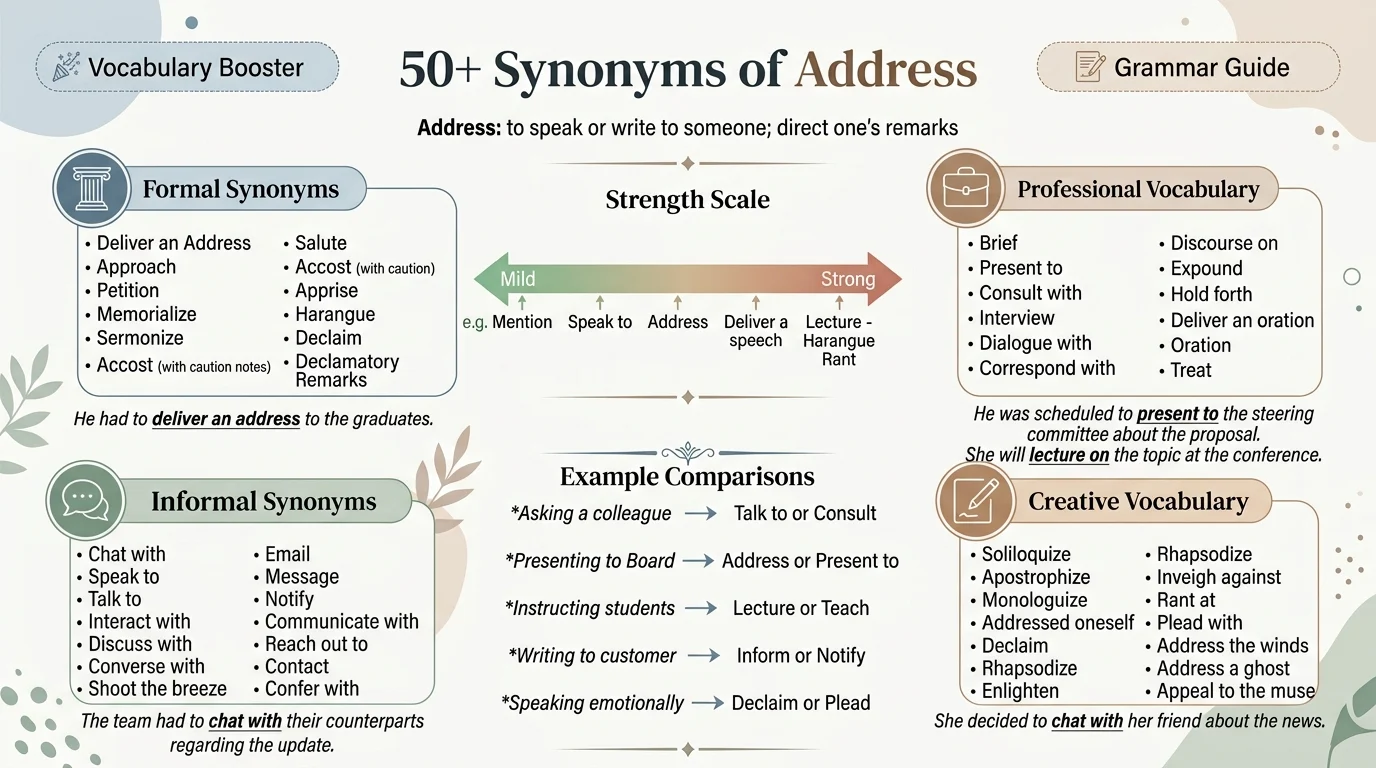
Have you ever found yourself writing an email, an essay, or a social media caption and realized you keep using the same word over and over? You type “address” once, then again, and by the third time it feels repetitive and dull. Whether you are working on a professional report, a school assignment, or a casual message, choosing the right synonym can make your writing clearer and more engaging.
Understanding the synonyms of address is essential for anyone who wants to communicate with precision and confidence. The word “address” carries multiple meanings, from describing a physical location to delivering a formal speech or handling a problem. Using the wrong synonym can confuse your reader or weaken your message. This guide will help you master every alternative so you can choose the perfect word for any situation.
What Are the Best Synonyms of “Address”?
The word “address” means a location, a formal speech, or the act of speaking to someone or dealing with an issue. For formal writing, choose “speech,” “lecture,” or “discourse.” Casual conversation, use “talk,” “speak to,” or “location.” Professional communication, select “handle,” “deal with,” or “presentation.” The best synonym depends entirely on your context, audience, and tone.
Meaning, Tone, and Context
Simple Definition
“Address” has three primary meanings. As a noun, it refers to the details of where someone lives or works, or a formal speech delivered to an audience. As a verb, it means to speak to someone, to write delivery information on mail, or to deal with a problem or issue.
Part of Speech
Noun and verb.
Overall Tone
Neutral. The word itself does not carry strong positive or negative emotion. Its tone shifts based on how you use it.
Formality Level
Neutral to formal. “Address” works in almost any setting, from casual conversation to academic writing and professional speeches. The noun form meaning “speech” leans formal, while the verb form meaning “speak to” can be neutral or formal depending on context.
Common Uses
Native English speakers use “address” in several ways. They use it to ask for someone’s location, as in “What is your address?” They use it to describe a formal talk, such as “the president’s address.” They also use it to describe handling a situation, like “We need to address this problem.” You will hear it in workplaces, schools, emails, news reports, and everyday conversation.
Word Forms
- Noun: address (location or speech)
- Verb: address (to speak to, to write on mail, to deal with)
- Adjective: addressable (capable of being addressed)
- Adverb: None commonly used
When and How to Use “Address”
Choose “address” when you need a versatile word that fits multiple contexts. It works well when you are describing a location, delivering a formal talk, or taking action on an issue. Here are realistic examples showing how to use it in different situations.
Professional
The manager will address the team’s concerns during the weekly meeting.
Academic
The professor addressed the students’ questions about the final exam format.
Workplace
We need to address the budget shortfall before the end of the quarter.
Personal
Please send your holiday cards to my new address.
Email
I would like to address the points you raised in your previous message.
Resume
Addressed customer complaints and resolved issues within 24 hours.
Social Media
The mayor addressed the crowd at the community event last night.
Best Synonyms of “Address”
No synonym is identical in every situation. The right choice depends on your meaning, audience, and tone. Here are the best synonyms for specific contexts.
Professional writing: “Handle” or “deal with.” These words sound action-oriented and competent. Use them when you are describing how you managed a task or resolved an issue.
Academic writing: “Lecture,” “discourse,” or “presentation.” These terms carry the formality and intellectual weight expected in academic settings.
Business communication: “Speak to” or “discuss.” These are clear and professional without sounding overly formal or stiff.
Casual conversation: “Talk to” or “chat with.” These sound natural and friendly in everyday interactions.
Emotional writing: “Confront” or “face.” These words add emotional weight when you are describing difficult conversations or challenging situations.
Creative writing: “Oration,” “harangue,” or “discourse.” These choices add stylistic flair and descriptive power to fiction and storytelling.
Resume writing: “Handled,” “managed,” or “resolved.” These action verbs show employers that you take initiative and get results.
Workplace communication: “Discuss” or “bring up.” These are direct and professional without sounding aggressive.
Stronger meaning: “Confront” or “tackle.” Use these when you want to emphasize courage or determination in facing a problem.
Softer meaning: “Mention” or “bring up.” These are gentler ways to introduce a topic without sounding forceful.
When Not to Use “Address”
When the word sounds too general
If you are describing a specific location, “address” can feel vague. Instead of saying “I need your address,” try “I need your mailing address” or “I need your home address” for clarity.
When the word sounds too vague in professional writing
Saying “We will address the issue” does not tell anyone what you will actually do. Use a more specific verb like “resolve,” “investigate,” or “implement a solution for.” For example, change “We will address the budget problem” to “We will resolve the budget problem by reallocating funds.”
When the word sounds too formal
In casual conversation, “address” can feel stiff. Instead of “I addressed the cashier,” say “I spoke to the cashier” or “I talked to the cashier.”
When the word sounds too informal
In academic or formal writing, using “address” to mean “talk about” can feel weak. Use “examine,” “analyze,” or “discuss” instead. For example, change “This paper addresses climate change” to “This paper examines climate change.”
When the word sounds too weak
If you are describing how you handled a serious problem, “address” may not convey enough urgency. Use “confront,” “tackle,” or “combat” to show stronger action.
When the word sounds outdated
In some contexts, “address” as a noun meaning “skill” or “dexterity” is rarely used today. Merriam-Webster notes this older usage meaning “readiness and capability for dealing skillfully and smoothly”. Most modern readers will not recognize this meaning, so avoid it.
Words Commonly Confused With “Address”
Address vs Speech
Difference: “Address” is a specific type of formal speech, often delivered to a particular audience on a special occasion. “Speech” is a broader term that can be formal or informal, public or private.
When to Use It: Use “address” for formal, prepared talks to large audiences. Use “speech” for any spoken communication, from a wedding toast to a classroom presentation.
Example: The president delivered an address to the nation. She gave a speech at her sister’s wedding.
Address vs Talk
Difference: An “address” is formal and usually prepared. A “talk” is informal and conversational.
When to Use It: Use “address” for official events. Use “talk” for casual presentations, workshops, or group discussions.
Example: The CEO gave an address at the annual shareholders’ meeting. The guide gave us a brief talk on the history of the site.
Address vs Lecture
Difference: A “lecture” is an educational talk, often given to students or trainees. An “address” can be any formal speech, not necessarily educational.
When to Use It: Use “lecture” when teaching or informing. Use “address” for speeches that inspire, persuade, or announce.
Example: The professor delivered a lecture on economic theory. The ambassador delivered an address at the United Nations.
Address vs Location
Difference: “Address” is the specific written description of a place, including numbers and street names. “Location” is a more general term for any place or position.
When to Use It: Use “address” when you need precise mailing information. Use “location” when you are describing where something is in a general sense.
Example: Please write your address on the form. The restaurant’s location is convenient for commuters.
Address vs Handle
Difference: “Address” as a verb means to deal with or start dealing with an issue. “Handle” implies successfully managing or resolving it.
When to Use It: Use “address” when you are beginning to deal with something. Use “handle” when you have taken action and achieved results.
Example: We need to address the staffing shortage. She handled the difficult client with professionalism.
Address vs Direct
Difference: “Address” can mean to aim or send something to someone. “Direct” means to guide, manage, or point toward a destination.
When to Use It: Use “address” for sending communication or remarks to someone. Use “direct” for giving instructions or managing actions.
Example: Please address your questions to the HR department. The manager directed the team to complete the project by Friday.
Best Synonyms of “Address” by Context
| Context | Best Synonym | Why It Works | Example |
|---|---|---|---|
| Formal writing | Discourse | Adds intellectual authority and academic weight | She delivered a discourse on modern democracy |
| Academic writing | Lecture | Clearly indicates educational or instructional content | The professor’s lecture covered Renaissance art |
| Professional communication | Discuss | Neutral, clear, and appropriate for most workplaces | Let’s discuss the proposal in tomorrow’s meeting |
| Business emails | Speak to | Direct yet professional without sounding cold | I will speak to the client about the contract terms |
| Resume writing | Handled | Shows action, competence, and results | Handled customer escalations and reduced complaints by 30% |
| Workplace communication | Bring up | Natural way to introduce topics in meetings | I will bring up the schedule change at the staff meeting |
| Casual conversation | Talk to | Friendly, relaxed, and natural | I need to talk to my neighbor about the noise |
| Everyday speaking | Location | Simple and clear for describing where things are | The store’s location is near the mall |
| Creative writing | Oration | Adds dramatic and stylistic flair | His oration moved the crowd to tears |
| Storytelling | Harangue | Creates vivid imagery of an intense or angry speech | The captain harangued the crew for their laziness |
| Emotional writing | Confront | Adds intensity and emotional weight | She had to confront her fears about public speaking |
| Strong emphasis | Tackle | Conveys determination and active problem-solving | The committee will tackle the housing crisis head-on |
| Mild tone | Mention | Soft, gentle way to introduce a topic | I wanted to mention the upcoming deadline |
| Social media captions | Chat with | Casual and engaging for online audiences | Join me as I chat with industry experts live |
| American English | Address | Standard in all American contexts | Please send your application to the address below |
| British English | Address | Same usage; pronunciation differs (stress on first syllable) | The address was written clearly on the envelope |
How to Choose the Best Synonym of “Address”
Choosing the right synonym starts with asking yourself a few simple questions.
What do you actually mean? Are you describing a place, giving a speech, or dealing with a problem? Your meaning determines which synonym fits.
Who is your audience? Are you writing for a professor, a boss, a friend, or a social media follower? Formal audiences require formal synonyms like “discourse” or “lecture.” Casual audiences respond better to “talk” or “chat.”
What tone do you want? Do you want to sound strong and decisive? Choose “tackle” or “confront.” Do you want to sound gentle and diplomatic? Choose “mention” or “bring up.”
How much emotional weight do you need? Neutral words like “discuss” simply communicate information. Emotional words like “harangue” or “confront” add feeling and intensity.
What is your writing purpose? Are you informing, persuading, entertaining, or instructing? Each purpose calls for a different synonym.
Does it sound natural? Read your sentence aloud. If the synonym feels forced or awkward, choose a different one. The best synonym is the one that sounds like it belongs.
Real Life Examples of “Address”
School
The teacher addressed the class about the importance of turning in assignments on time.
College
The guest speaker addressed the graduating seniors with words of encouragement and advice.
Workplace
Our team needs to address the declining sales numbers before the next board meeting.
Business
The CEO addressed the shareholders directly during the quarterly earnings call.
Email
I am writing to address the concerns you raised about the project timeline.
Resume
Addressed operational inefficiencies and streamlined workflow processes.
Conversation
“I really need to address this with my roommate,” she said with a sigh.
Storytelling
The general addressed his troops before the battle, his voice steady and strong.
Blogging
Today I want to address a question that many readers have been asking about.
Social Media
The mayor addressed the crowd at the rally, promising action on affordable housing.
18 Best Synonyms of “Address”
| Synonym | Simple Meaning | Best Used For | Example Sentence |
|---|---|---|---|
| Speech | A formal spoken communication | Public events, ceremonies, official occasions | The senator gave a speech on healthcare reform |
| Talk | An informal spoken presentation | Workshops, casual presentations, group discussions | She gave a talk on social media marketing |
| Lecture | An educational talk to students or trainees | Academic settings, training sessions, classrooms | The history lecture lasted over an hour |
| Discourse | A formal, lengthy treatment of a subject | Academic writing, intellectual discussions, scholarly work | The philosopher’s discourse on ethics was widely praised |
| Oration | A formal, eloquent public speech | Ceremonial occasions, inspiring events, historical moments | The oration at the memorial service moved everyone |
| Presentation | A talk with visual or supporting materials | Business meetings, conferences, project updates | The team gave a presentation on the new product line |
| Location | A general place or position | Everyday descriptions, travel, directions | The hotel’s location is perfect for tourists |
| Residence | A person’s home or dwelling | Formal documents, legal contexts, official records | His residence is in the downtown district |
| Domicile | A formal term for a permanent home | Legal documents, official forms, academic writing | They established their domicile in Florida |
| Abode | A literary or formal term for home | Creative writing, formal invitations, poetic contexts | Welcome to my humble abode |
| Site | A specific location, often for events or construction | Technical writing, business documents, planning | The construction site is on the corner |
| Handle | To manage or deal with successfully | Professional writing, resumes, business communication | He handled the customer complaint professionally |
| Deal with | To take action regarding an issue | Workplace communication, casual conversation, problem-solving | We need to deal with this problem immediately |
| Speak to | To talk directly to someone | Professional and casual communication | The manager will speak to the team about the changes |
| Discuss | To talk about a topic in detail | Meetings, emails, professional and academic writing | Let’s discuss the proposal over lunch |
| Confront | To face a problem or person directly | Emotional writing, difficult conversations, conflict situations | She decided to confront the issue head-on |
| Tackle | To take on a challenge with determination | Strong professional writing, action-oriented contexts | The committee will tackle climate change |
| Mention | To refer to something briefly | Gentle introductions, casual conversation, soft communication | I wanted to mention the upcoming deadline |
Synonyms of “Address” by Usage
Professional vs Personal Synonyms
In professional settings, choose words that sound competent and action-oriented. “Handle,” “resolve,” and “discuss” work well in workplace communication. In personal conversations, choose warmer, more casual words like “talk to,” “chat with,” or “bring up.” These sound friendly and approachable.
Formal vs Conversational Synonyms
For formal writing such as reports, essays, and business presentations, use “discourse,” “lecture,” “oration,” or “presentation.” These words carry authority and intellectual weight. For casual conversations, texting, and social media, use “talk,” “speak to,” or “location.” These are clear and natural without sounding stiff.
Academic Synonyms
In research papers, essays, and academic discussions, precision matters. Use “discourse” for formal intellectual discussions, “lecture” for instructional talks, and “dissertation” for lengthy written treatments of a subject. These words sound authoritative and demonstrate scholarly rigor.
Professional and Business Synonyms
For resumes, interviews, meetings, and client communication, action verbs are essential. Use “handled” to show successful management of tasks. “Resolved” to demonstrate problem-solving skills. Use “managed” to indicate leadership and responsibility. These words tell employers and clients that you get results.
Creative and Literary Synonyms
Writers and storytellers need expressive alternatives. “Oration” adds elegance and formality. “Harangue” creates vivid imagery of an intense or angry speech. “Discourse” works well for philosophical or intellectual dialogue. These words add color, emotion, and stylistic variety to fiction, poetry, and speeches.
Slang or Modern Synonyms
“Address” does not have widely used slang equivalents. However, in informal digital contexts, “addy” is a casual shortening of “address,” as in “What’s your addy?” This is acceptable in texting and social media but should never appear in professional or academic writing.
Strongest to Mildest Synonyms
Mild
Mention, bring up, location
Moderate
Talk to, speak to, discuss, site
Strong
Handle, deal with, address, lecture
Very Strong
Confront, tackle, harangue, oration
The emotional intensity increases as you move from mild to very strong. Choose milder words for gentle conversations and stronger words for urgent or dramatic situations.
Emotional vs Neutral Synonyms
Emotional Synonyms
Confront, tackle, harangue, oration. These words carry strong feelings. “Confront” suggests courage or conflict. “Harangue” suggests anger or forceful persuasion. “Oration” suggests inspiration and eloquence. Use these when you want to add emotional weight to your writing.
Neutral Synonyms
Location, site, discuss, speak to, handle. These words simply communicate information without adding emotion. Use them in professional documents, instructions, and factual writing where clarity matters more than feeling.
Antonyms of “Address”
| Antonym | Meaning | Example Sentence |
|---|---|---|
| Ignore | To pay no attention to | The manager chose to ignore the complaint instead of addressing it |
| Disregard | To treat as unimportant | She disregarded the warning signs |
| Avoid | To keep away from | He tried to avoid the difficult conversation |
| Neglect | To fail to care for properly | The company neglected the safety concerns |
| Shun | To deliberately avoid | The committee shunned the controversial topic |
| Overlook | To fail to notice or consider | The report overlooked several key issues |
| Miss | To fail to hit or reach | The proposal missed the main point entirely |
| Skip | To leave out or omit | Let’s skip that topic for now |
| Bypass | To go around or avoid | We cannot bypass this important issue |
| Dodge | To evade or avoid cleverly | He dodged the question during the interview |
| Evade | To escape or avoid by cleverness | The politician evaded the reporter’s questions |
| Abandon | To give up completely | The team abandoned the project midway |
| Forsake | To renounce or give up | She forsook her responsibilities |
| Omit | To leave out or exclude | The presentation omitted critical data |
| Dismiss | To reject as unimportant | The boss dismissed the employee’s concerns |
Comparison: “Address” vs Similar Words
Address vs Speech
Main Difference
An address is always a formal speech delivered to an audience, often on a special occasion. A speech is a broader term that includes both formal and informal spoken communication.
Which Is Stronger?
Address is more specific and formal. Speech is more general.
Which Is More Formal?
Address is more formal. Speech can be formal or informal.
When to Use Each
Use “address” for presidential talks, commencement speeches, and official announcements. Use “speech” for any spoken presentation, from a wedding toast to a classroom report.
Examples
Address: The president delivered an address to the nation.
Speech: She gave a speech at her brother’s wedding.
Address vs Talk
Main Difference
An address is formal and prepared. A talk is informal and conversational.
Which Is Stronger?
Address carries more weight and authority.
Which Is More Formal?
Address is formal. Talk is informal.
When to Use Each
Use “address” for official events and formal occasions. Use “talk” for casual presentations, workshops, and group discussions.
Examples
Address: The ambassador gave an address at the UN.
Talk: The guide gave us a talk about the local wildlife.
Address vs Lecture
Main Difference
A lecture is an educational talk, typically given to students or trainees. An address can be any formal speech, not necessarily educational.
Which Is Stronger?
Neither is inherently stronger; they serve different purposes.
Which Is More Formal?
Both are formal, but “address” is often more ceremonial.
When to Use Each
Use “lecture” when teaching or informing an audience. Use “address” when speaking on a formal or ceremonial occasion.
Examples
Address: The mayor gave an address at the city council meeting.
Lecture: The professor gave a lecture on ancient history.
Address vs Location
Main Difference
An address is the specific written description of a place, including numbers and street names. A location is a general term for any place or position.
Which Is Stronger?
Address is more precise. Location is more general.
Which Is More Formal?
Address is neutral. Location is also neutral.
When to Use Each
Use “address” when you need precise mailing or delivery information. Use “location” when you are describing where something is in a general sense.
Examples
Address: Please write your address on the application form.
Location: The new store has a great location near the highway.
Address vs Handle
Main Difference
As a verb, “address” means to begin dealing with an issue. “Handle” means to successfully manage or resolve it.
Which Is Stronger?
Handle implies successful completion. Address implies starting the process.
Which Is More Formal?
Both are neutral to formal.
When to Use Each
Use “address” when you are acknowledging or starting to deal with a problem. Use “handle” when you have taken action and achieved results.
Examples
Address: We need to address the budget shortfall.
Handle: She handled the difficult client with skill.
Address vs Direct
Main Difference
“Address” can mean to send communication or remarks to someone. “Direct” means to guide, manage, or point toward a destination.
Which Is Stronger?
Direct implies more active guidance or control.
Which Is More Formal?
Both are neutral to formal.
When to Use Each
Use “address” for sending messages, questions, or remarks to someone. Use “direct” for giving instructions, managing actions, or pointing the way.
Examples
Address: Please address your questions to the support team.
Direct: The manager directed the team to focus on quality.
Common Phrases and Expressions with “Address”
Phrase: Address the issue
Meaning: To deal with or begin handling a problem.
Example Sentence: The committee needs to address the issue of parking before the next meeting.
Phrase: Return address
Meaning: The address of the sender written on mail.
Example Sentence: Make sure you include a return address on the envelope.
Phrase: Address a crowd
Meaning: To speak formally to a large group of people.
Example Sentence: The candidate addressed the crowd at the rally.
Phrase: Mailing address
Meaning: The address where mail is delivered.
Example Sentence: Please provide your current mailing address.
Phrase: Address a letter
Meaning: To write the delivery information on an envelope.
Example Sentence: She addressed the letter carefully before mailing it.
Phrase: Address someone by name
Meaning: To speak to someone using their name or title.
Example Sentence: The teacher addressed each student by name.
Phrase: Address the needs of
Meaning: To focus on and fulfill requirements or demands.
Example Sentence: The program addresses the needs of low-income families.
Common Mistakes to Avoid
1: Choosing a vague synonym
Using “address” when a more specific word would be clearer.
Incorrect: We will address the customer’s request.
Better: We will fulfill the customer’s request.
Why: “Fulfill” tells the reader exactly what action will be taken.
2: Confusing “address” with “location”
Using “address” when you mean a general place.
Incorrect: The park’s address is beautiful.
Better: The park’s location is beautiful.
Why: A park does not have a street number in the same way a building does.
3: Using “address” too informally
Using “address” in casual conversation when a simpler word fits better.
Incorrect: I addressed my friend about the party.
Better: I talked to my friend about the party.
Why: “Talked to” sounds natural and friendly.
4: Using an overly dramatic synonym
Choosing a strong word like “confront” when a milder word is appropriate.
Incorrect: I confronted my coworker about the coffee machine.
Better: I mentioned the coffee machine issue to my coworker.
Why: “Confronted” sounds aggressive for a small issue.
5: Repeating the same word too often
Using “address” multiple times in a single paragraph.
Incorrect: We need to address the budget. Let’s address it tomorrow. The team will address it together.
Better: We need to address the budget. Let’s discuss it tomorrow. The team will tackle it together.
Why: Varying your word choice keeps writing engaging.
6: Choosing a synonym with the wrong emotional tone
Using “harangue” when you mean a calm discussion.
Incorrect: The teacher harangued the class about homework.
Better: The teacher spoke to the class about homework.
Why: “Harangued” implies anger and forcefulness.
7: Using slang in professional writing
Using “addy” in a business email or formal document.
Incorrect: Please send your addy for the shipment.
Better: Please send your shipping address.
Why: “Addy” is too casual for professional contexts.
Frequently Asked Questions
1. What are the best synonyms of “address”?
The best synonyms depend on your context. Formal speeches, use “speech,” “lecture,” or “discourse.” For locations, use “location,” “residence,” or “site.” For dealing with issues, use “handle,” “discuss,” or “tackle.”
2. What are the best formal synonyms of “address”?
Formal synonyms include “discourse,” “oration,” “lecture,” “presentation,” and “dissertation.” These words are appropriate for academic writing, official speeches, and professional presentations.
3. What are common informal synonyms of “address”?
Informal synonyms include “talk,” “speak to,” “chat with,” “location,” and “place.” These are suitable for casual conversation, texting, and social media.
4. What is another word for “address” in professional writing?
In professional writing, use “handle,” “resolve,” “discuss,” or “speak to.” For resumes, use action verbs like “handled,” “managed,” or “resolved” to demonstrate competence and results.
5. What is the difference between “address” and “speech”?
An “address” is a formal speech delivered to a specific audience on a special occasion. A “speech” is a broader term that includes both formal and informal spoken communication. All addresses are speeches, but not all speeches are addresses.
6. What is the opposite of “address”?
The opposites of “address” (as a verb meaning to deal with) include “ignore,” “disregard,” “avoid,” “neglect,” and “shun.” These words mean to pay no attention or to deliberately stay away from something.
Conclusion
The word “address” is remarkably versatile, serving as both a noun for locations and speeches and a verb for speaking and problem-solving. But no single word fits every situation. The best synonyms of address depend on your audience, your purpose, and the tone you want to strike. Formal occasions, choose “discourse” or “oration.” For casual conversations, pick “talk” or “location.” For professional writing, select “handle” or “resolve.” Remember that choosing the right synonym is not about showing off your vocabulary. It is about communicating clearly and naturally. The next time you write, pause and ask yourself which word truly belongs in that sentence. Your readers will notice the difference.
Vocabulary tip: Keep a personal list of your favorite synonyms for common words. Review it before you write. Over time, choosing the right word will become second nature.