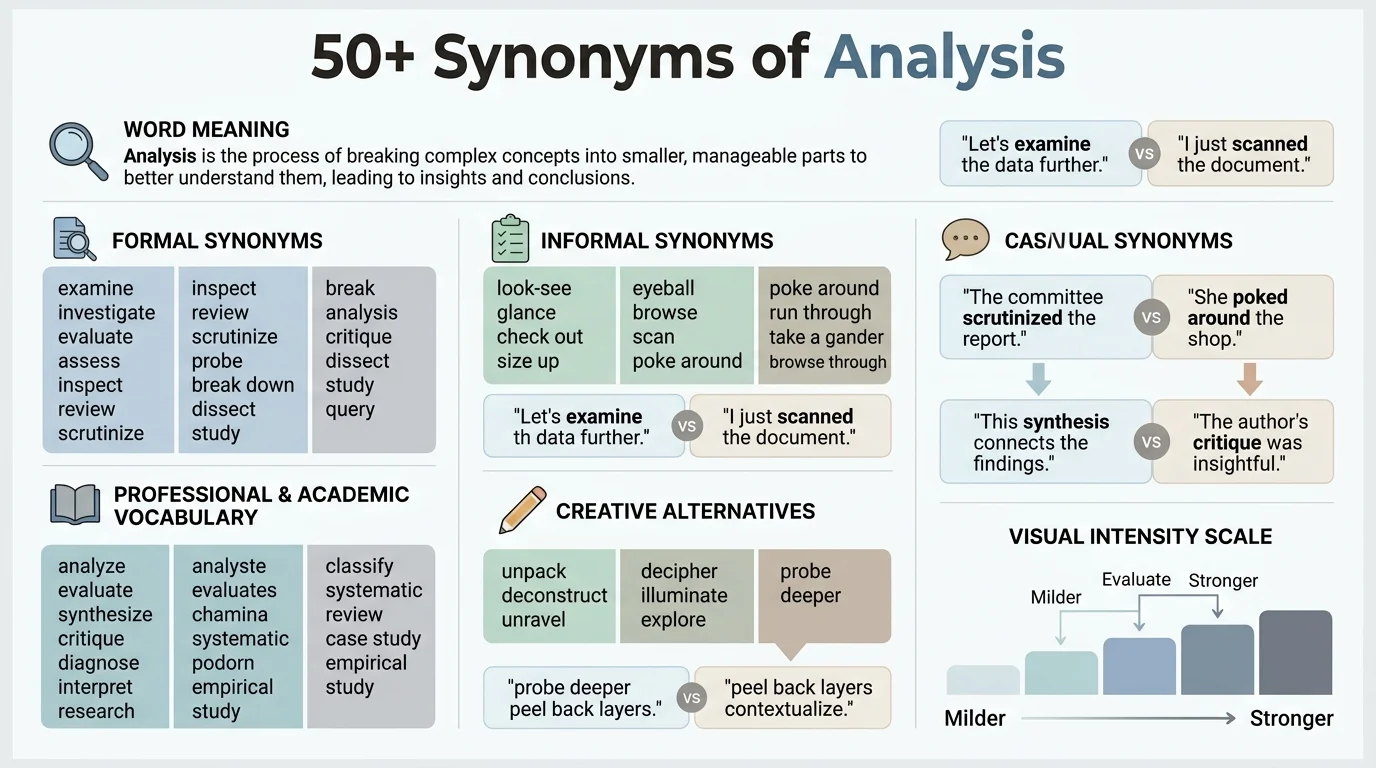
Have you ever written an email, essay, or report and realized you used the word “analysis” four times in two paragraphs? It happens to everyone. You know what you mean, but the repetition makes your writing feel flat and repetitive. Finding the right synonyms of analysis can transform your writing from repetitive to refined. The word itself is useful, but relying on it too often weakens your message. Choosing the right alternative helps you communicate more clearly, match your audience’s expectations, and sound more natural in every situation.
What Are the Best Synonyms of “Analysis”?
Analysis means the careful examination of something complex by breaking it down into its parts to understand how they work together. It is a neutral, formal word used across academic, professional, and everyday contexts. For formal writing, choose examination or evaluation. Casual conversation, use breakdown or review. For academic work, select investigation or scrutiny. professional communication, assessment works best.
Meaning, Tone, and Context
Simple Definition
Analysis is the process of studying something in detail by separating it into its individual parts to understand the whole. You look at each piece, figure out how the pieces relate to each other, and then draw conclusions about the entire thing.
Part of Speech
Analysis is a noun. The plural form is analyses. The verb form is analyze (American English) or analyse (British English). The adjective is analytical.
Overall Tone
Analysis is neutral. It does not carry a positive or negative emotional charge on its own. The tone depends entirely on how you use it. A scientific paper, it sounds precise and objective. In a business meeting, it sounds professional and thorough. In everyday conversation, it can sound overly formal or technical.
Formality Level
Analysis is formal to semi-formal. It belongs in academic papers, business reports, professional emails, and serious discussions. It is not casual. You would not say “Let me do an analysis of this pizza” unless you were joking.
Common Uses
Native English speakers use analysis in academic writing, scientific research, business reports, data evaluation, literary criticism, and problem-solving discussions. It appears in phrases like “data analysis,” “market analysis,” “critical analysis,” and “financial analysis.” It is also used in everyday situations when someone wants to sound thoughtful or thorough about a topic.
Word Forms
- Noun: analysis, analyses (plural)
- Verb: analyze (American), analyse (British)
- Adjective: analytical, analytic
- Adverb: analytically
- Related noun: analyst (a person who performs analysis)
When and How to Use “Analysis”
Choose “analysis” when you need to describe a systematic, careful examination of something complex. It works best in formal settings where precision matters. Here are seven realistic examples showing how to use it naturally.
Professional: The quarterly financial analysis revealed a ten percent increase in operational costs.
Academic: Her analysis of the novel’s themes challenged decades of literary criticism.
Workplace: We need a complete analysis of the project timeline before we commit to the deadline.
Personal: After a careful analysis of my spending habits, I realized I was wasting money on subscriptions I never used.
Email: Please send me your analysis of the client’s feedback by Friday afternoon.
Resume: Conducted data analysis that improved customer retention by fifteen percent over six months.
Social Media: My quick analysis of the comments shows that most people prefer the blue packaging over the green one.
Best Synonyms of “Analysis”
No synonym of “analysis” is identical in every situation. Each alternative carries its own shade of meaning, tone, and level of formality. Here is how to choose the best one for your specific context.
Best for Professional Writing: Evaluation
Evaluation emphasizes judging the value, quality, or effectiveness of something. It works well in business reports, performance reviews, and project assessments because it implies you are not just looking at parts but also forming a judgment about how well they work together.
Best for Academic Writing: Investigation
Investigation suggests a systematic, thorough search for facts or truth. It fits research papers, scientific studies, and scholarly articles where you need to convey careful, methodical inquiry. It sounds more active and rigorous than “analysis.”
Best for Business Communication: Assessment
Assessment focuses on estimating or judging the quality, importance, or value of something. It is widely used in business contexts like risk assessment, needs assessment, and performance assessment. It sounds professional without being overly technical.
Best for Casual Conversation: Breakdown
Breakdown is the informal way to say analysis. It means explaining something by separating it into parts. You would use it when talking with friends, writing informal emails, or explaining something simply: “Let me give you a breakdown of the costs.”
Best for Emotional Writing: Scrutiny
Scrutiny implies intense, critical, and often uncomfortable examination. It carries emotional weight because it suggests someone or something is being watched very closely, sometimes with suspicion. It works well in opinion pieces, personal essays, and dramatic writing.
Best for Creative Writing: Dissection
Dissection is a metaphor that comes from biology. It means taking something apart piece by piece to examine it in extreme detail. In creative writing, it adds vivid imagery: “The journalist dissected the politician’s speech, exposing every contradiction.”
Best for Resume Writing: Evaluation
Evaluation sounds action-oriented and results-focused. Hiring managers want to see that you can assess situations, measure outcomes, and make judgments. “Evaluated vendor contracts” sounds stronger than “Analyzed vendor contracts” because it implies you formed conclusions.
Best for Workplace Communication: Review
Review means looking over something carefully, often to check for accuracy or to summarize. It is less intense than “analysis” and works well in everyday workplace communication: “Let’s review the numbers before the meeting.”
Stronger Meaning: Dissection, Scrutiny
These words suggest an unusually thorough or intense examination. Use them when you want to emphasize depth and rigor.
Softer Meaning: Review, Overview
These words suggest a less intense examination. Use them when you want to sound less formal or when the examination is not extremely detailed.
When Not to Use “Analysis”
Sometimes “analysis” is the wrong word. Here are situations where it fails and what to use instead.
When it sounds too general: “Analysis” can be vague because it does not specify what kind of examination you mean.
Incorrect: I did an analysis of the situation.
Better: I assessed the risks and identified three major concerns.
Why: “Assessed the risks” is more specific and shows what you actually did.
When it sounds too formal: Using “analysis” in casual conversation can make you sound stiff or pretentious.
Incorrect: Can you give me an analysis of the movie?
Better: Can you give me your take on the movie?
Why: “Your take” is natural and conversational.
When it sounds too weak: Sometimes you need a stronger word to convey the intensity of your examination.
Incorrect: We did an analysis of the competitor’s strategy.
Better: We dissected the competitor’s strategy and found every weakness.
Why: “Dissected” sounds more thorough and decisive.
When you mean judgment: “Analysis” is about understanding parts. “Evaluation” is about judging value.
Incorrect: My analysis of the proposal is that we should reject it.
Better: My evaluation of the proposal is that we should reject it.
Why: “Evaluation” makes it clear you are forming a judgment, not just describing parts.
When you mean summary: “Analysis” is not the same as summarizing.
Incorrect: Here is my analysis of the report in three bullet points.
Better: Here is a summary of the report in three bullet points.
Why: A summary gives an overview. An analysis breaks things down.
Words Commonly Confused With “Analysis”
Analysis vs Examination
Difference: Examination is a broader term. It means looking at something carefully. Analysis is a specific type of examination that involves breaking something down into parts.
When to Use It: Use “examination” when you mean any careful look. Use “analysis” when you mean breaking something into parts to understand it.
Example: The doctor’s examination revealed no problems. (Careful look.) The data analysis revealed a clear pattern. (Breaking down data to find patterns.)
Analysis vs Evaluation
Difference: Analysis focuses on understanding how parts work together. Evaluation focuses on judging value or quality.
When to Use It: Use “analysis” when you want to understand. Use “evaluation” when you want to judge.
Example: The analysis showed how the marketing campaign worked. The evaluation showed that the campaign was effective.
Analysis vs Assessment
Difference: Assessment is similar to evaluation but often implies estimating or appraising something. Analysis is more about breaking down and understanding.
When to Use It: Use “assessment” when you are estimating or appraising. Use “analysis” when you are breaking down and studying.
Example: The risk assessment identified potential problems. The risk analysis explained why those problems might occur.
Analysis vs Investigation
Difference: Investigation suggests a search for facts, often to solve a mystery or uncover truth. Analysis is broader and does not always involve searching.
When to Use It: Use “investigation” when you are searching for answers. Use “analysis” when you are studying something already known.
Example: The police investigation uncovered new evidence. The data analysis confirmed the original hypothesis.
Analysis vs Scrutiny
Difference: Scrutiny implies intense, critical, and sometimes uncomfortable examination. Analysis is neutral.
When to Use It: Use “scrutiny” when the examination is intense or critical. Use “analysis” when it is neutral and systematic.
Example: His every move came under media scrutiny. The financial analysis showed steady growth.
Analysis vs Breakdown
Difference: Breakdown is the informal version of analysis. It means explaining something by separating it into parts. Analysis is the formal term.
When to Use It: Use “breakdown” in casual settings. Use “analysis” in formal settings.
Example: Let me give you a breakdown of the costs. (Casual.) The cost analysis will be presented at the board meeting. (Formal.)
Best Synonyms of “Analysis” by Context
| Context | Best Synonym | Why It Works | Example |
|---|---|---|---|
| Formal writing | Examination | Sounds precise and thorough without being overly technical | The examination of historical records revealed new insights |
| Academic writing | Investigation | Conveys systematic, methodical inquiry | The investigation focused on long-term environmental effects |
| Professional communication | Assessment | Professional, clear, and widely understood | The risk assessment identified three critical vulnerabilities |
| Business emails | Review | Less intense, collaborative, and action-oriented | Please review the attached document before our call |
| Resume writing | Evaluation | Action-oriented and results-focused | Evaluated supplier performance and reduced costs by 12% |
| Workplace communication | Review | Everyday professional language | Let’s review the quarterly numbers together |
| Casual conversation | Breakdown | Informal and easy to understand | Can you give me a breakdown of the schedule? |
| Everyday speaking | Look at | Natural and conversational | Let’s look at the pros and cons |
| Creative writing | Dissection | Vivid metaphorical imagery | The critic dissected the film frame by frame |
| Storytelling | Probing | Suggests careful, curious exploration | She kept probing the mystery, unwilling to let it go |
| Emotional writing | Scrutiny | Carries weight and intensity | The public scrutiny was unbearable |
| Strong emphasis | Dissection | Suggests extreme thoroughness | We dissected every line of the contract |
| Mild tone | Overview | Gentle and non-intimidating | Here is a quick overview of the main points |
| Social media captions | Breakdown | Casual, accessible, and engaging | Quick breakdown of my morning routine |
| American English | Analysis | Standard American usage | The data analysis was completed on schedule |
| British English | Analysis | Same spelling and usage | The data analysis was completed on schedule |
How to Choose the Best Synonym of “Analysis”
Choosing the right synonym comes down to four questions.
Who is your audience? If you are writing for academics or professionals, choose formal words like investigation, examination, or evaluation. If you are writing for friends or social media, choose casual words like breakdown or review.
What is your purpose? Are you trying to understand something? Use analysis or examination. Are you trying to judge something? Use evaluation or assessment. Are you trying to explain something simply? Use breakdown or overview.
How strong do you want to sound? Do you want to emphasize extreme thoroughness? Use dissection or scrutiny. Do you want to sound moderate and balanced? Use review or assessment.
What is the emotional tone? Do you want to sound neutral? Use analysis, examination, or study. Do you want to sound intense or critical? Use scrutiny or dissection.
The best synonym is the one that communicates your intended message most clearly to your specific audience. There is no single correct answer. Context always determines the best choice.
Real Life Examples of “Analysis”
Here are realistic examples showing how analysis and its synonyms work in different situations. Each example shows the original use of “analysis” and a stronger alternative where appropriate.
18 Best Synonyms of “Analysis”
| Synonym | Simple Meaning | Best Used For | Example Sentence |
|---|---|---|---|
| Examination | A careful, detailed look at something | Formal writing, medical contexts | The doctor’s examination revealed no serious issues |
| Evaluation | Judging the value or quality of something | Business, performance reviews | The evaluation of the training program showed positive results |
| Assessment | Estimating or appraising quality or importance | Risk management, education | The risk assessment identified several potential problems |
| Investigation | Systematic search for facts or truth | Research, journalism, law enforcement | The investigation into the incident lasted six months |
| Study | Devoting time to learning about something | Academic work, research | The study examined the effects of sleep on memory |
| Review | Looking over something carefully | Workplace, business, everyday use | Please review the document before the deadline |
| Scrutiny | Intense, critical examination | Journalism, public affairs, emotional writing | The company’s practices came under intense scrutiny |
| Dissection | Taking something apart piece by piece | Creative writing, detailed criticism | The critic dissected the novel’s themes with surgical precision |
| Breakdown | Explaining something by separating into parts | Casual conversation, social media | Let me give you a quick breakdown of the costs |
| Inquiry | Formal or careful investigation | Academic, legal, official contexts | The committee launched an inquiry into the matter |
| Inspection | Careful examination, often for quality or safety | Quality control, safety checks | The building inspection identified several code violations |
| Probe | Exploratory investigation | Journalism, research, detective work | The journalist’s probe uncovered a pattern of misconduct |
| Appraisal | Formal assessment of value or quality | Real estate, performance, business | The appraisal of the property came in higher than expected |
| Audit | Formal, systematic examination of records | Finance, accounting, compliance | The annual audit confirmed the company’s financial health |
| Interpretation | Explaining the meaning of something | Literary criticism, data analysis | Her interpretation of the data challenged conventional wisdom |
| Critique | Critical evaluation or review | Arts, literature, academic writing | The critique of the film was thoughtful and balanced |
| Diagnosis | Identifying a problem or condition | Medicine, problem-solving | The mechanic’s diagnosis pinpointed the engine failure |
| Deconstruction | Detailed unpacking of meaning | Philosophy, literary theory | The deconstruction of the text revealed hidden assumptions |
Synonyms of “Analysis” by Usage
Professional vs Personal Synonyms
In professional settings, choose words that sound competent and serious: evaluation, assessment, investigation, scrutiny, and audit. These words signal that you are thorough and reliable.
In personal settings, choose words that sound natural and approachable: breakdown, review, look, take, and overview. These words help you communicate without sounding stiff or overly formal.
Formal vs Conversational Synonyms
Formal synonyms work well in reports, essays, business writing, presentations, and professional emails: examination, evaluation, investigation, scrutiny, assessment, and appraisal.
Conversational synonyms work well in everyday conversation, texting, social media, and informal emails: breakdown, review, look, take, and overview.
Academic Synonyms
Academic writing demands precision and authority. The best academic synonyms include: investigation, examination, scrutiny, inquiry, deconstruction, critique, and interpretation. These words sound scholarly and convey rigorous thinking. They are widely used in research papers, essays, reports, and academic discussions.
Professional and Business Synonyms
Business communication requires clarity and professionalism. The strongest choices include: evaluation, assessment, review, audit, appraisal, and investigation. Evaluation works well for performance reviews. Assessment fits risk and needs analysis. Review is perfect for everyday business communication. Audit is ideal for financial and compliance contexts.
Creative and Literary Synonyms
Creative writing benefits from vivid, expressive language. The best creative alternatives include: dissection, deconstruction, probing, scrutiny, and anatomy. Dissection adds dramatic imagery. Deconstruction suggests intellectual depth. Probing conveys curiosity and exploration. Scrutiny adds emotional intensity. Anatomy suggests a thorough, almost scientific examination of something organic.
Slang or Modern Synonyms
There are no widely used slang synonyms for “analysis.” The closest informal alternative is “breakdown,” which is casual but not slang. You might also hear “take” as in “What’s your take on this?” but that is more about opinion than analysis. Avoid trying to force slang where none naturally exists.
Strongest to Mildest Synonyms
Mild → Moderate → Strong → Very Strong
Mild: overview, summary, look
Moderate: review, examination, study
Strong: evaluation, assessment, investigation
Very Strong: dissection, scrutiny, deconstruction
The emotional intensity increases as you move from mild to very strong. Overview sounds gentle and non-threatening. Scrutiny sounds intense and potentially uncomfortable. Choose the intensity level that matches your purpose and audience.
Emotional vs Neutral Synonyms
Emotional Synonyms: scrutiny, dissection, probing, deconstruction. These words carry emotional weight. Scrutiny suggests being watched critically. Dissection suggests taking something apart aggressively. Probing suggests persistent, sometimes uncomfortable questioning. Use these when you want to convey intensity, drama, or emotional stakes.
Neutral Synonyms: examination, study, review, assessment, evaluation. These words simply communicate information without adding emotion. Use them when you want to sound objective, professional, or factual.
Antonyms of “Analysis”
| Antonym | Meaning | Example Sentence |
|---|---|---|
| Synthesis | Combining parts into a whole | The synthesis of different theories created a new framework |
| Summary | A brief statement of main points | Instead of a detailed analysis, she provided a brief summary |
| Overview | A general review without details | He gave an overview rather than a detailed examination |
| Ignorance | Lack of knowledge or information | Their ignorance of the data led to poor decisions |
| Neglect | Failure to examine or care for something | The neglect of the evidence undermined the case |
| Disregard | Paying no attention to something | His disregard for the details caused the project to fail |
| Guesswork | Reaching conclusions without examination | The plan was based on guesswork, not careful analysis |
| Assumption | Something accepted as true without proof | Their assumption about customer behavior was incorrect |
| Amalgamation | The action or process of combining | The amalgamation of different ideas created something new |
| Integration | The process of combining parts into a whole | The integration of various data sources produced a complete picture |
| Combination | The act of joining things together | The combination of their expertise solved the problem |
| Fusion | The process of merging different elements | The fusion of art and science produced innovative results |
| Union | The action of joining together | The union of different perspectives enriched the discussion |
| Superficiality | Lack of depth or thoroughness | The superficiality of the report made it useless for decision-making |
| Oversight | Failure to notice or examine something | The oversight of key factors led to an inaccurate conclusion |
Comparison: “Analysis” vs Similar Words
Analysis vs Examination
Main Difference: Examination is the broader term. It means any careful look. Analysis is a specific type of examination that involves breaking something down into parts.
Which Is Stronger? Analysis is stronger because it implies more systematic work.
Which Is More Formal? Both are formal. Analysis is slightly more technical.
When to Use Each: Use “examination” for general careful looking. Use “analysis” for systematic breakdown.
Examples:
Analysis: The data analysis revealed a seasonal purchasing pattern.
Examination: The physical examination showed no signs of illness.
Analysis vs Evaluation
Main Difference: Analysis focuses on understanding how parts work together. Evaluation focuses on judging value or quality.
Which Is Stronger? Evaluation is stronger because it involves forming a judgment.
Which Is More Formal? Both are formal. Evaluation is common in business.
When to Use Each: Use “analysis” when you want to understand. Use “evaluation” when you want to judge.
Examples:
Analysis: The analysis explained why the marketing campaign succeeded.
Evaluation: The evaluation determined that the campaign was cost-effective.
Analysis vs Assessment
Main Difference: Assessment often implies estimating or appraising. Analysis is more about breaking down and studying.
Which Is Stronger? Assessment is stronger in business contexts because it implies forming conclusions.
Which Is More Formal? Both are formal. Assessment is very common in professional settings.
When to Use Each: Use “assessment” when estimating or appraising. Use “analysis” when breaking down and studying.
Examples:
Analysis: The analysis of the data took three weeks.
Assessment: The risk assessment recommended immediate action.
Analysis vs Investigation
Main Difference: Investigation suggests a search for facts, often to solve a mystery or uncover truth. Analysis is broader.
Which Is Stronger? Investigation sounds more active and urgent.
Which Is More Formal? Both are formal. Investigation is common in legal and journalistic contexts.
When to Use Each: Use “investigation” when searching for answers. Use “analysis” when studying something already known.
Examples:
Analysis: The financial analysis showed steady growth over five years.
Investigation: The investigation uncovered evidence of fraud.
Analysis vs Scrutiny
Main Difference: Scrutiny implies intense, critical, and often uncomfortable examination. Analysis is neutral.
Which Is Stronger? Scrutiny is much stronger and carries more emotional weight.
Which Is More Formal? Both are formal. Scrutiny is often used in journalism and public affairs.
When to Use Each: Use “scrutiny” when the examination is intense or critical. Use “analysis” when it is neutral and systematic.
Examples:
Analysis: The analysis of the policy showed its strengths and weaknesses.
Scrutiny: The policy came under intense scrutiny from the media.
Analysis vs Breakdown
Main Difference: Breakdown is the informal version of analysis. It means explaining something by separating it into parts.
Which Is Stronger? Analysis is more formal and sounds more serious.
Which Is More Formal? Analysis is formal. Breakdown is casual.
When to Use Each: Use “breakdown” in casual settings. Use “analysis” in formal settings.
Examples:
Analysis: The financial analysis will be presented to the board.
Breakdown: Can you give me a breakdown of the monthly expenses?
Common Phrases and Expressions with “Analysis”
| Phrase | Meaning | Example Sentence |
|---|---|---|
| In the final analysis | After considering everything; ultimately | In the final analysis, the decision came down to cost |
| Data analysis | The process of examining data to find patterns | Data analysis revealed a strong correlation between the two variables |
| Market analysis | Studying market conditions to guide business decisions | The market analysis suggested we should launch the product in spring |
| Critical analysis | Careful, detailed examination that includes judgment | Her critical analysis of the novel challenged traditional interpretations |
| SWOT analysis | Assessment of strengths, weaknesses, opportunities, and threats | The SWOT analysis helped us identify our competitive advantages |
| Cost-benefit analysis | Comparing costs and benefits to make a decision | The cost-benefit analysis showed that the investment was worthwhile |
| Under analysis | Being examined or studied | The proposal is currently under analysis by the review committee |
Common Mistakes to Avoid
Mistake 1: Choosing a vague synonym instead of a precise one
Incorrect: I did a study of the problem.
Better: I conducted a thorough investigation of the problem.
Why: “Study” is vague. “Investigation” is specific and sounds more serious.
Mistake 2: Confusing analysis with summary
Incorrect: Here is my analysis of the report in three bullet points.
Better: Here is a summary of the report in three bullet points.
Why: Analysis breaks things down. Summary gives an overview. They are not the same.
Mistake 3: Using an informal synonym in formal writing
Incorrect: The board requested a breakdown of the financial data.
Better: The board requested a detailed analysis of the financial data.
Why: “Breakdown” is casual. “Analysis” is professional and appropriate for a board meeting.
Mistake 4: Selecting an overly dramatic synonym
Incorrect: We need to dissect the quarterly sales figures.
Better: We need to review the quarterly sales figures.
Why: “Dissect” sounds dramatic and intense. “Review” is appropriate for routine business tasks.
Mistake 5: Using analysis when you mean evaluation
Incorrect: My analysis of the proposal is that we should reject it.
Better: My evaluation of the proposal is that we should reject it.
Why: Analysis is about understanding. Evaluation is about judging. Rejecting requires judgment.
Mistake 6: Repeating the same word too often
Incorrect: The analysis showed X. The analysis also showed Y. The analysis concluded Z.
Better: The analysis showed X. The evaluation also revealed Y. The assessment concluded Z.
Why: Varying your word choice keeps your writing engaging and professional.
Mistake 7: Using analysis in casual conversation
Incorrect: Can you give me an analysis of the movie?
Better: Can you give me your take on the movie?
Why: “Analysis” sounds stiff in casual conversation. “Your take” is natural and conversational.
Frequently Asked Questions
1. What are the best synonyms of “analysis”?
The best synonyms depend on context. Formal writing, use examination or investigation. For casual conversation, use breakdown or review. For business, use evaluation or assessment. Each synonym fits a specific situation.
2. What are the best formal synonyms of “analysis”?
The best formal synonyms include examination, investigation, evaluation, assessment, scrutiny, and appraisal. These words work well in academic papers, business reports, and professional correspondence.
3. What are common informal synonyms of “analysis”?
The most common informal synonym is “breakdown”. You might also use “review,” “look,” or “take” in casual conversation. These words are natural and approachable in everyday settings.
4. What is another word for “analysis” in professional writing?
In professional writing, use evaluation, assessment, review, or audit. Evaluation works for performance reviews. Assessment fits risk analysis. Review is perfect for everyday business communication. Audit is ideal for financial contexts.
5. What is the difference between “analysis” and “evaluation”?
Analysis focuses on breaking something down to understand how it works. Evaluation focuses on judging its value or quality. You analyze to understand. You evaluate to judge.
6. What is the opposite of “analysis”?
The primary opposite is synthesis, which means combining parts into a whole. Other opposites include summary, overview, amalgamation, integration, and combination.
Conclusion
Analysis is the careful process of breaking something down into its parts to understand how the whole works. It is a useful word, but it should not be your only option. The best synonyms of analysis depend entirely on your audience, purpose, and tone. Formal settings, choose examination or investigation. For business, choose evaluation or assessment. For casual conversation, choose breakdown or review. Creative writing, choose dissection or scrutiny. No synonym works perfectly in every situation. The key is to match your word choice to your context. Pay attention to who you are writing for and what you want to communicate. The right word makes all the difference.