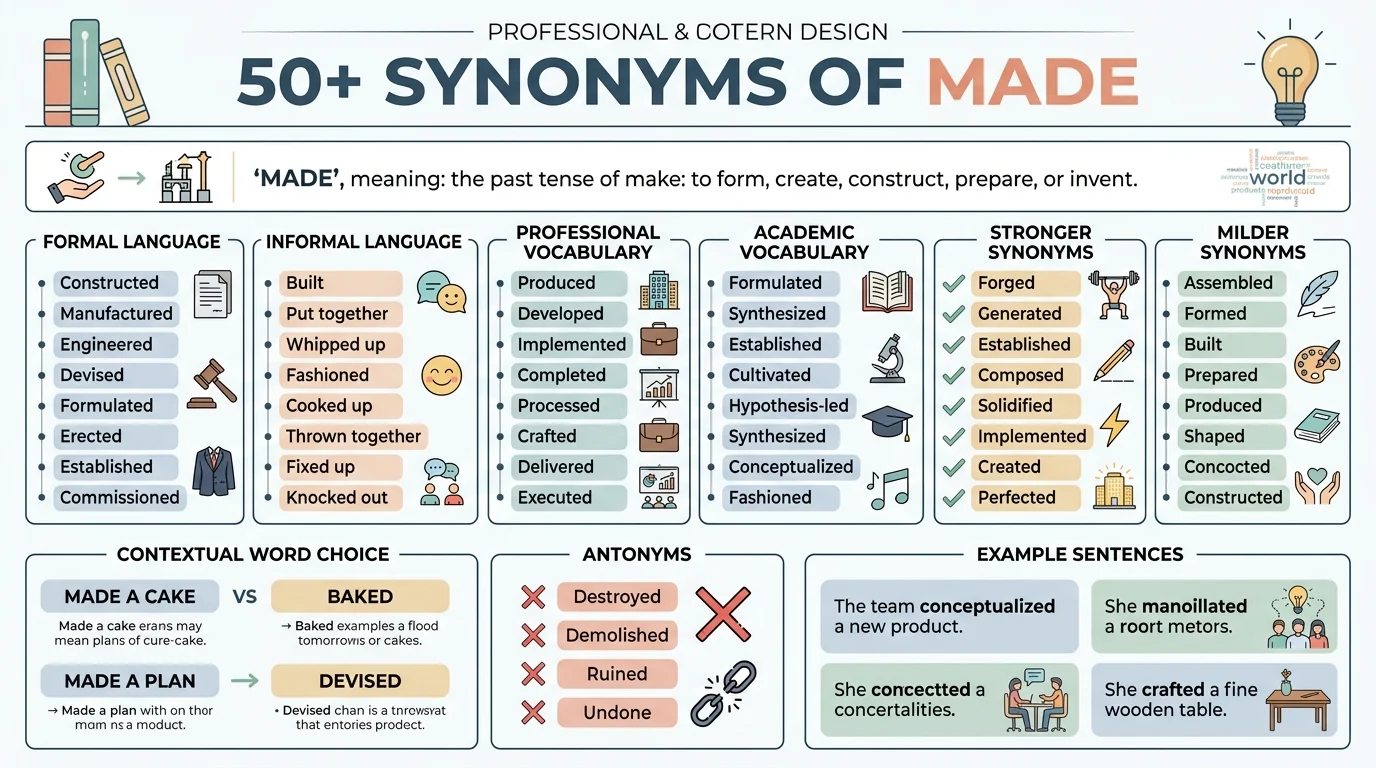
Is “made” the right word for your sentence, or are you using it because no better option comes to mind? You are not alone. “Made” is a useful word, but it has many meanings. It can describe creating something, causing an effect, earning money, preparing food, reaching a decision, or forcing an outcome. That makes choosing the right made synonym a little tricky.
This guide gives you 50+ synonyms of made with clear meanings, practical uses, and real examples. You will find simple options for everyday conversations, polished choices for essays, and stronger alternatives for professional writing. We also explain when each word works best, so you can avoid awkward or repetitive sentences.
Whether you are searching for other words for made to improve your vocabulary or need a precise replacement for a sentence, this list can help. The goal is not to replace “made” every time. It is to help you choose the word that matches your exact meaning, tone, and context.
Let’s find the best alternative for “made.”
What Are the Best Synonyms of “Made”?
“Made” means to have created, produced, or constructed something from materials or components. The best synonym depends on your context. Formal writing, choose “constructed” or “manufactured.” For casual conversation, use “put together” or “cooked up.” Academic work, select “generated” or “formulated.” For creative writing, pick “crafted” or “forged.” Professional communication, use “produced” or “developed.”
Meaning, Tone, and Context
Simple Definition
Made is the past tense and past participle of “make.” It means to have created, produced, built, or fashioned something from raw materials, components, or ideas.
Part of Speech
Verb (past tense and past participle) and adjective.
Overall Tone
Neutral. The word itself does not carry strong positive or negative emotion. Its tone is factual and straightforward.
Formality Level
Neutral to informal. “Made” is acceptable in almost any context, but more formal alternatives exist for professional and academic writing.
Common Uses
Native English speakers use “made” constantly. Use it to describe physical objects, such as “a table made of wood.” They use it to describe abstract creations, such as “made a decision.” Use it in idioms, such as “made for each other” or “made it.” It appears in everyday conversation, emails,新闻报道, and literature.
Word Forms
- Make (base form)
- Made (past tense and past participle)
- Making (present participle)
- Maker (noun, one who makes)
When and How to Use “Made”
Choose “made” when you need a simple, clear, and universally understood word. It works in almost any situation, but it shines when you do not need to emphasize the method, materials, or effort involved.
1. Professional Context
The team made significant progress on the project this quarter.
2. Academic Context
The researcher made an important discovery during the experiment.
3. Workplace Context
She made a strong impression during her first week.
4. Personal Context
My grandmother made the quilt that is on my bed.
5. Email Context
I made the changes you requested and attached the updated file.
6. Resume Context
Made strategic decisions that increased revenue by 15 percent.
7. Social Media Context
We made memories that will last a lifetime.
Best Synonyms of “Made”
No synonym is identical in every situation. The best choice depends on what you are describing, who you are writing for, and what tone you want to convey.
Professional writing: Produced
This word sounds polished and businesslike. It works well in reports, memos, and professional correspondence.
Academic writing: Generated
This word implies systematic creation, often from data or research. It sounds precise and intellectual.
Business communication: Developed
This word suggests growth, improvement, and strategic effort. It is ideal for describing products, plans, and strategies.
Casual conversation: Put together
This phrase sounds relaxed and natural. It is perfect for talking about meals, outfits, or simple projects.
Emotional writing: Crafted
This word implies care, skill, and personal attention. It adds warmth and sincerity.
Creative writing: Forged
This word suggests strength, effort, and transformation. It works well in fiction and descriptive prose.
Resume writing: Executed
This word conveys action, leadership, and results. It makes your accomplishments sound more impressive.
Workplace communication: Built
This word implies construction, teamwork, and tangible results. It is strong and active.
Stronger meaning: Constructed
This word emphasizes deliberate assembly and planning. It sounds more intentional than “made.”
Softer meaning: Created
This word is gentle and universal. It works when you want to avoid sounding mechanical.
When Not to Use “Made”
When the word sounds too general
“Made” is a broad word. In many situations, a more specific synonym communicates your meaning more clearly.
Too general: The chef made a delicious meal.
Better: The chef prepared a delicious meal.
“Prepared” suggests specific actions like chopping, cooking, and plating. It paints a clearer picture.
When the word sounds too vague
“Made” does not tell your reader how something was created. If the method matters, choose a more descriptive word.
Too vague: The company made a new product.
Better: The company manufactured a new product.
“Manufactured” implies industrial production. It gives your reader more information.
When the word sounds too informal for the context
“Made” is acceptable in most writing, but some formal contexts call for more sophisticated vocabulary.
Too informal: The committee made a new policy.
Better: The committee established a new policy.
“Established” sounds more authoritative and permanent.
When the word sounds too weak
Sometimes “made” does not convey enough effort or significance.
Too weak: She made a beautiful painting.
Better: She created a beautiful painting.
“Created” suggests originality and artistic expression.
When the word sounds outdated
“Made” is never truly outdated, but in some modern business contexts, more dynamic words are preferred.
Outdated feeling: We made a plan for the next quarter.
More dynamic: We developed a plan for the next quarter.
Words Commonly Confused With “Made”
Made vs. Maid
Difference: These words sound identical but have completely different meanings. “Made” is the past tense of “make.” “Maid” is a female domestic worker.
When to use each: Use “made” when talking about creation or production. Use “maid” when referring to a housekeeper or servant.
Example: The maid made the bed.
Made vs. Build
Difference: “Made” is a general term for creation. “Build” specifically means to construct by assembling parts.
When to use each: Use “build” for structures, teams, or systems. Use “made” for almost everything else.
Example: They built a new school. They made a donation to the school.
Made vs. Create
Difference: “Create” often implies bringing something into existence from nothing or from imagination. “Made” implies working with existing materials.
When to use each: Use “create” for art, ideas, and original works. Use “made” for physical objects and everyday items.
Example: God created the universe. The carpenter made a table.
Made vs. Manufacture
Difference: “Manufacture” specifically refers to industrial production, often on a large scale.
When to use each: Use “manufacture” for factories, machinery, and mass production. Use “made” for smaller-scale or handmade items.
Example: The company manufactures cars. The artist made a sculpture.
Made vs. Form
Difference: “Form” emphasizes shaping or molding. “Made” is more general.
When to use each: Use “form” when the shape or structure is important.
Example: She formed the clay into a bowl. She made a bowl from clay.
Made vs. Produce
Difference: “Produce” often implies a result or output, especially in farming, manufacturing, or creative work.
When to use each: Use “produce” when you want to emphasize the outcome or yield.
Example: The farm produces fresh vegetables. The chef made a fresh salad.
Best Synonyms of “Made” by Context
| Context | Best Synonym | Why It Works | Example |
|---|---|---|---|
| Formal writing | Constructed | Sounds deliberate and carefully planned | The theory was constructed over several years. |
| Academic writing | Generated | Implies systematic creation from data | The algorithm generated accurate predictions. |
| Professional communication | Produced | Polished and businesslike | The department produced a comprehensive report. |
| Business emails | Developed | Suggests growth and strategic effort | We developed a new marketing strategy. |
| Resume writing | Executed | Conveys action and results | Executed a plan that doubled sales. |
| Workplace communication | Built | Implies teamwork and tangible results | The team built a new customer database. |
| Casual conversation | Put together | Relaxed and natural | I put together a quick dinner. |
| Everyday speaking | Made | Simple and universally understood | I made coffee this morning. |
| Creative writing | Crafted | Suggests skill and personal attention | She crafted a beautiful poem. |
| Storytelling | Forged | Implies strength and transformation | The hero forged a new destiny. |
| Emotional writing | Fashioned | Adds a touch of elegance and care | He fashioned a gift with his own hands. |
| Strong emphasis | Engineered | Suggests precision and technical skill | The solution was engineered for maximum efficiency. |
| Mild tone | Created | Gentle and universal | They created a welcoming atmosphere. |
| Social media captions | Made | Short, simple, and effective | Made this for you. |
| American English | Made | The standard choice in all contexts | She made cookies. |
| British English | Made | Identical usage in British English | He made a cup of tea. |
How to Choose the Best Synonym of “Made”
Choosing the right synonym starts with understanding your purpose. Ask yourself these questions.
What are you describing?
If you are describing a physical object, consider “constructed,” “built,” or “manufactured.” If you are describing an idea, consider “developed,” “formulated,” or “generated.”
Who is your audience?
For a professional audience, choose “produced,” “executed,” or “established.” For a casual audience, choose “put together,” “cooked up,” or simply “made.”
What tone do you want?
For a formal tone, choose “constructed” or “generated.” An emotional tone, choose “crafted” or “fashioned.” For a neutral tone, choose “created” or “produced.”
How much emphasis do you need?
For strong emphasis, choose “engineered,” “forged,” or “executed.” For mild emphasis, choose “made,” “created,” or “formed.”
Does the method matter?
If the method of creation is important, choose a specific word like “manufactured,” “assembled,” or “woven.” If the method is not important, “made” works fine.
The goal is not to avoid “made” completely. The goal is to choose the word that communicates your intended message most clearly.
Real Life Examples of “Made”
School
The students made a volcano for the science fair.
Improved: The students constructed a volcano for the science fair.
College
I made a study guide for the final exam.
Improved: I created a comprehensive study guide for the final exam.
Workplace
She made a presentation for the client meeting.
Improved: She prepared a presentation for the client meeting.
Business
The company made a deal with a major supplier.
Improved: The company negotiated a deal with a major supplier.
I made some notes during the meeting.
Improved: I took some notes during the meeting.
Resume
Made improvements to the customer service process.
Improved: Implemented improvements to the customer service process.
Conversation
My dad made this bookshelf in his workshop.
Improved: My dad built this bookshelf in his workshop.
Storytelling
The wizard made a potion to cure the king.
Improved: The wizard brewed a potion to cure the king.
Blogging
I made this recipe for the first time yesterday.
Improved: I tested this recipe for the first time yesterday.
Made a new friend today.
Improved: Met a new friend today.
18 Best Synonyms of “Made”
| Synonym | Simple Meaning | Best Used For | Example Sentence |
|---|---|---|---|
| Created | Brought into existence | General use, art, ideas | She created a stunning piece of art. |
| Produced | Made or manufactured | Business, farming, creative work | The factory produced over a thousand units. |
| Constructed | Built by assembling parts | Buildings, systems, theories | They constructed a new bridge in record time. |
| Built | Constructed physically | Structures, teams, relationships | He built a successful career from nothing. |
| Manufactured | Produced on a large scale | Industrial goods, mass production | The company manufactured electronic components. |
| Crafted | Made with skill and care | Art, writing, handmade items | She crafted a beautiful narrative. |
| Fabricated | Constructed from parts | Mechanical objects, evidence | The mechanic fabricated a custom exhaust pipe. |
| Formed | Shaped or molded | Physical shaping, ideas | The committee formed a new plan. |
| Developed | Created and improved over time | Products, strategies, skills | They developed a new software application. |
| Generated | Produced systematically | Data, ideas, energy | The system generated a detailed report. |
| Fashioned | Made with care and style | Clothing, objects with design | He fashioned a walking stick from oak. |
| Assembled | Put together from parts | Furniture, teams, documents | She assembled the bookshelf in an hour. |
| Forged | Made with strength and effort | Metalwork, relationships, destinies | The blacksmith forged a sturdy sword. |
| Established | Set up on a firm basis | Organizations, rules, traditions | They established a new charity. |
| Engineered | Designed and built with precision | Technical solutions, systems | The team engineered a clever solution. |
| Formulated | Developed systematically | Plans, theories, medicines | The scientist formulated a new hypothesis. |
| Executed | Carried out with skill | Plans, strategies, projects | The general executed a flawless strategy. |
| Composed | Made up of parts or elements | Music, writing, materials | The artist composed a beautiful melody. |
Synonyms of “Made” by Usage
Professional vs Personal Synonyms
In professional settings, choose words that sound competent and action-oriented. “Executed,” “developed,” and “implemented” are excellent choices. In personal conversations, simpler words like “made,” “put together,” and “created” feel more natural and warm.
| Professional | Personal |
|---|---|
| Executed | Made |
| Developed | Put together |
| Implemented | Created |
| Produced | Did |
| Established | Set up |
Formal vs Conversational Synonyms
Formal writing, such as reports, essays, and business documents, benefits from sophisticated vocabulary. “Constructed,” “generated,” and “formulated” sound authoritative. Conversational writing, such as texts, social media posts, and casual emails, calls for simpler words. “Made,” “did,” and “put together” are perfectly appropriate.
| Formal | Conversational |
|---|---|
| Constructed | Made |
| Generated | Did |
| Formulated | Put together |
| Manufactured | Built |
| Established | Set up |
Academic Synonyms
Academic writing demands precision and authority. These synonyms of made are particularly suitable for research papers, essays, and scholarly discussions.
- Generated: Implies creation from data or systematic processes.
- Formulated: Suggests careful development of theories or plans.
- Constructed: Implies deliberate building of arguments or frameworks.
- Derived: Suggests creation from existing sources or data.
- Compiled: Implies gathering and organizing information.
Professional and Business Synonyms
These synonyms strengthen resumes, interviews, meetings, and client communications.
- Executed: Conveys action and successful completion.
- Developed: Suggests growth, improvement, and strategic thinking.
- Implemented: Implies putting a plan into action.
- Engineered: Suggests technical skill and precision.
- Established: Implies creating something lasting and significant.
Creative and Literary Synonyms
These expressive alternatives add emotion, imagery, and artistry to storytelling, fiction, and poetry.
- Crafted: Suggests skill, care, and personal attention.
- Forged: Implies strength, effort, and transformation.
- Fashioned: Adds elegance and a sense of style.
- Wrought: An old-fashioned word suggesting careful, intricate work.
- Composed: Suggests harmony and deliberate arrangement.
Slang or Modern Synonyms
“Made” does not have many widely used slang synonyms. In informal contexts, people might say “cooked up” to mean invented or devised. This phrase is acceptable in casual conversation but should be avoided in professional or academic writing.
Strongest to Mildest Synonyms
This scale shows how emotional intensity and emphasis change across synonyms.
| Intensity | Synonym |
|---|---|
| Mild | Made |
| Mild | Created |
| Moderate | Produced |
| Moderate | Built |
| Moderate | Developed |
| Strong | Constructed |
| Strong | Manufactured |
| Very Strong | Engineered |
| Very Strong | Forged |
| Very Strong | Executed |
Emotional vs Neutral Synonyms
Emotional Synonyms
These words express care, effort, or personal investment.
- Crafted
- Forged
- Fashioned
- Composed
Use these when you want to convey warmth, dedication, or artistic expression.
Neutral Synonyms
These words communicate information without adding emotion.
- Produced
- Generated
- Manufactured
- Constructed
Use these when you want to remain factual and objective.
Antonyms of “Made”
| Antonym | Meaning | Example Sentence |
|---|---|---|
| Unmade | Not made or created | The bed remained unmade all morning. |
| Destroyed | Completely ruined | The storm destroyed the old barn. |
| Dismantled | Taken apart piece by piece | They dismantled the equipment for storage. |
| Demolished | Torn down or destroyed | The city demolished the unsafe building. |
| Ruined | Damaged beyond repair | The flood ruined the crops. |
| Broken | Separated into pieces | She broke the vase by accident. |
| Disassembled | Taken apart | He disassembled the engine to find the problem. |
| Undone | Not done or completed | The work remained undone. |
| Canceled | Called off or stopped | They canceled the event due to rain. |
| Abolished | Formally ended | The government abolished the outdated law. |
| Eradicated | Completely removed | The vaccine eradicated the disease. |
| Eliminated | Removed or gotten rid of | The team eliminated all errors. |
| Dissolved | Broken down or ended | The company dissolved the partnership. |
| Annihilated | Completely destroyed | The army annihilated the enemy forces. |
| Obliterated | Wiped out completely | The explosion obliterated the building. |
Comparison: “Made” vs Similar Words
Made vs Created
Main Difference
“Made” generally means working with existing materials. “Created” often implies bringing something into existence from nothing or from imagination.
Which Is Stronger?
“Created” is slightly stronger because it suggests originality and innovation.
Which Is More Formal?
Both are neutral, but “created” is more common in academic and artistic contexts.
When to Use Each
Use “made” for everyday objects and routine actions. Use “created” for art, ideas, and original works.
Examples
- Made: The baker made a loaf of bread.
- Created: The artist created a masterpiece.
Made vs Built
Main Difference
“Made” is a general term. “Built” specifically means to construct by assembling parts.
Which Is Stronger?
“Built” is stronger because it implies physical labor and construction.
Which Is More Formal?
Both are neutral. “Built” is more specific.
When to Use Each
Use “made” for almost anything. Use “built” for structures, machines, and systems.
Examples
- Made: She made a salad for lunch.
- Built: He built a treehouse for his kids.
Made vs Manufactured
Main Difference
“Manufactured” specifically refers to industrial production, often on a large scale.
Which Is Stronger?
“Manufactured” is stronger because it implies machinery, factories, and mass production.
Which Is More Formal?
“Manufactured” is more formal and technical.
When to Use Each
Use “made” for handmade or small-scale items. Use “manufactured” for factory-produced goods.
Examples
- Made: She made a ceramic bowl.
- Manufactured: The company manufactured thousands of ceramic bowls.
Made vs Formed
Main Difference
“Formed” emphasizes shaping or molding. “Made” is more general.
Which Is Stronger?
Neither is inherently stronger. “Formed” is more specific about the process.
Which Is More Formal?
Both are neutral. “Formed” is often used in scientific or technical contexts.
When to Use Each
Use “formed” when the shape or structure is important. Use “made” for general creation.
Examples
- Made: He made a cake.
- Formed: She formed the dough into a ball.
Made vs Produced
Main Difference
“Produced” often implies a result or output, especially in farming, manufacturing, or creative work.
Which Is Stronger?
“Produced” is slightly more formal and result-oriented.
Which Is More Formal?
“Produced” is more formal, especially in business contexts.
When to Use Each
Use “made” for everyday items. Use “produced” when you want to emphasize the outcome.
Examples
- Made: The chef made a delicious soup.
- Produced: The farm produced a bountiful harvest.
Made vs Crafted
Main Difference
“Crafted” implies skill, care, and personal attention. “Made” is neutral.
Which Is Stronger?
“Crafted” is much stronger emotionally. It suggests artistry and dedication.
Which Is More Formal?
“Crafted” is more formal and artistic.
When to Use Each
Use “made” for routine items. Use “crafted” for items that required special skill or effort.
Examples
- Made: She made a necklace.
- Crafted: She crafted a necklace from silver and gemstones.
Common Phrases and Expressions with “Made”
Made of
Meaning: Composed or constructed from a particular material.
Example Sentence: The table is made of solid oak.
Made from
Meaning: Created using a particular substance that has been transformed.
Example Sentence: Paper is made from wood pulp.
Made for each other
Meaning: Two people who are perfectly suited to each other.
Example Sentence: Sarah and Tom are made for each other.
Made it
Meaning: Succeeded or arrived at a destination.
Example Sentence: Despite the challenges, she made it to the top.
Made up
Meaning: Invented or fabricated.
Example Sentence: He made up an excuse for being late.
Made sure
Meaning: Confirmed or verified something.
Example Sentence: I made sure the doors were locked.
Made a difference
Meaning: Had a significant impact.
Example Sentence: Your donation made a difference to the community.
Have it made
Meaning: To be in a very good position or situation.
Example Sentence: With his new job, he has it made.
Common Mistakes to Avoid
1. Choosing a vague synonym instead of a precise one
Using “made” when a more specific word would be better weakens your writing.
Incorrect: The team made a new strategy.
Better: The team developed a new strategy.
“Developed” implies research, planning, and refinement. It sounds more professional.
2. Confusing “made” with “maid”
These words sound identical but have completely different meanings.
Incorrect: The made cleaned the room.
Better: The maid cleaned the room.
“Maid” is a person. “Made” is the past tense of “make.”
3. Using an informal synonym in formal writing
Some synonyms of made are too casual for professional or academic contexts.
Incorrect: The researcher cooked up a new theory.
Better: The researcher formulated a new theory.
“Cooked up” sounds slangy and unprofessional.
4. Selecting an overly dramatic synonym
Choosing a word that is too strong can make your writing sound exaggerated.
Incorrect: She forged a sandwich for lunch.
Better: She made a sandwich for lunch.
“Forged” implies strength and effort. It is too dramatic for making a sandwich.
5. Repeating the same word too often
Using “made” repeatedly makes your writing feel repetitive and unpolished.
Incorrect: I made breakfast. Then I made my bed. Then I made a phone call.
Better: I prepared breakfast. Then I made my bed. Then I placed a phone call.
Varying your word choice keeps your writing fresh and engaging.
6. Choosing a synonym with the wrong emotional tone
Different synonyms carry different emotional weight.
Incorrect: The factory crafted thousands of plastic bottles.
Better: The factory manufactured thousands of plastic bottles.
“Crafted” implies care and artistry. It does not fit mass production.
7. Using slang in academic or professional writing
Slang synonyms like “cooked up” or “threw together” have no place in formal writing.
Incorrect: The committee threw together a new policy.
Better: The committee established a new policy.
“Threw together” sounds careless. “Established” sounds authoritative.
Frequently Asked Questions
1. What are the best synonyms of “made”?
The best synonyms of made depend on your context. Formal writing, use “constructed” or “generated.” For casual conversation, use “put together.” For professional writing, use “produced” or “developed.”
2. What are the best formal synonyms of “made”?
The best formal synonyms of made include “constructed,” “generated,” “manufactured,” “established,” and “formulated.” These words sound authoritative and precise.
3. What are common informal synonyms of “made”?
Common informal synonyms of made include “put together,” “cooked up,” “threw together,” and “whipped up.” These phrases are natural in casual conversation but should be avoided in formal writing.
4. What is another word for “made” in professional writing?
In professional writing, strong alternatives include “executed,” “developed,” “implemented,” “produced,” and “established.” These words convey action, competence, and results.
5. What is the difference between “made” and “created”?
“Made” generally means working with existing materials. “Created” often implies bringing something into existence from nothing or from imagination. “Created” is more common in artistic and academic contexts.
6. What is the opposite of “made”?
The opposite of made includes “unmade,” “destroyed,” “dismantled,” “demolished,” and “ruined.” These words describe things that have been taken apart, damaged, or completely eliminated.
Conclusion
“Made” is a simple, versatile word that every English speaker uses daily. It means to have created, produced, or constructed something. But relying on it too often makes your writing feel flat and repetitive. The best synonyms of made add precision, color, and impact to your sentences. professional contexts, choose “developed” or “executed.” For academic writing, choose “generated” or “formulated.” For creative work, choose “crafted” or “forged.” No synonym works perfectly in every situation. The right choice depends on your audience, your tone, and your purpose. The next time you write, pause before you type “made.” Ask yourself if a more specific word would communicate your meaning more clearly. Your readers will notice the difference.