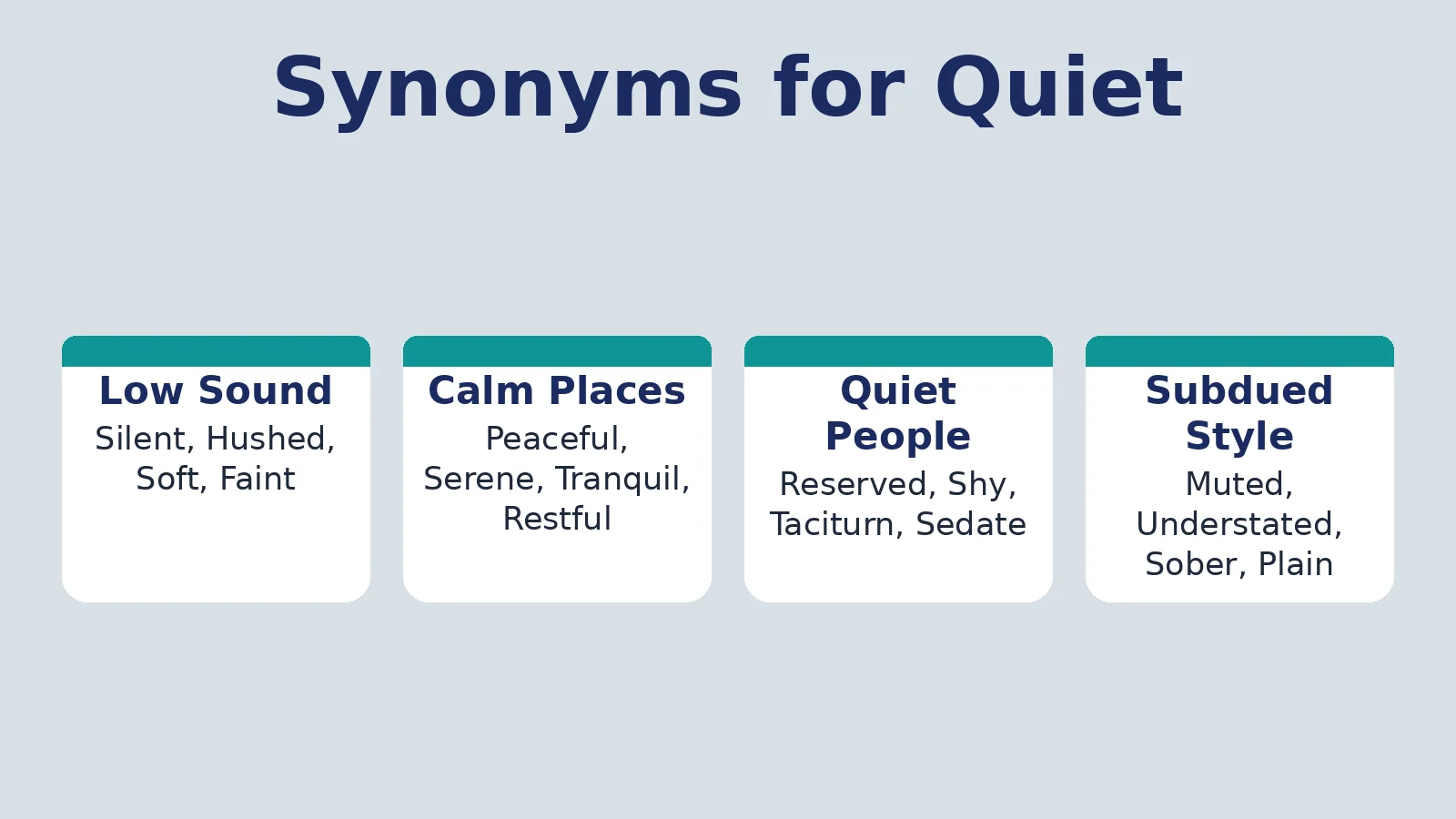
Quiet is one of the hardest-working words in English, and also one of the vaguest. A quiet voice, a quiet village, and a quiet child paint three very different pictures, yet we reach for the same plain word every time. The most useful synonyms for quiet include silent, hushed, soft, peaceful, serene, tranquil, secluded, sleepy, reserved, and subdued, and each one fits a different job. Silent removes sound completely, while hushed lowers it to a murmur. Peaceful describes a place that rests the mind, and reserved describes a person who simply says little.
This guide sorts more than 90 synonyms for quiet by sense, so the right word is easy to find. Every entry carries a short meaning, and the key words add an example sentence. Whether you are describing a library, a coastline, or a colleague, you will leave with the exact word your sentence needs.
Top Synonyms for Quiet: Quick Reference
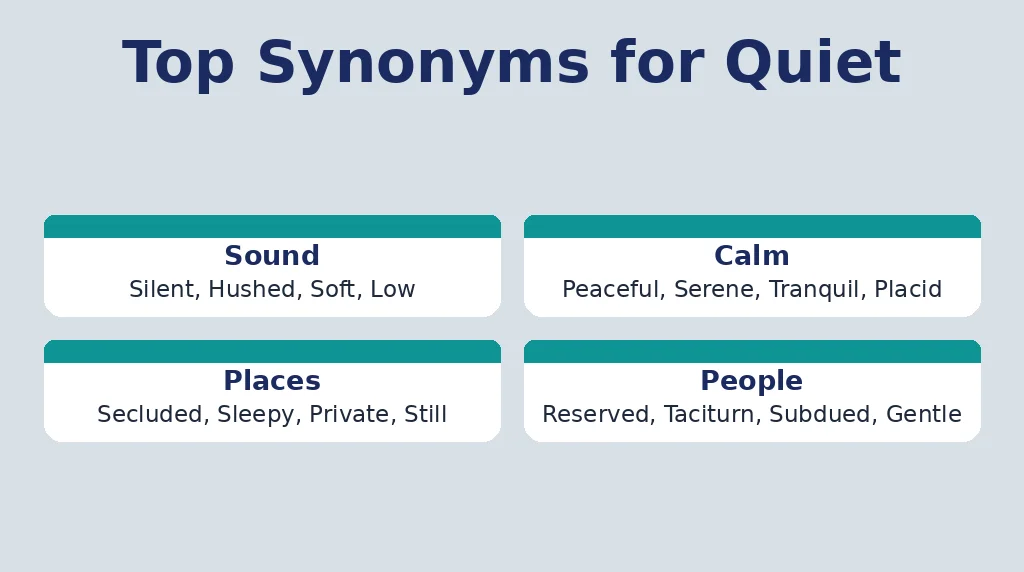
The table below gathers the 28 synonyms readers reach for most often. Use it for a fast swap, then read the grouped sections for finer shades of meaning.
| Word | Meaning in one line | Best for |
|---|---|---|
| Silent | Making no sound at all | Total absence of noise |
| Hushed | Lowered to a soft murmur | Voices, crowds, courtrooms |
| Soft | Gentle and low in volume | Voices, music, sounds |
| Low | Quiet in pitch or volume | Voices, hums, background noise |
| Faint | Barely audible | Distant or weak sounds |
| Muffled | Blocked or wrapped, so unclear | Sounds through walls or cloth |
| Muted | Toned down on purpose | Sounds, colors, reactions |
| Still | Without sound or movement | Scenes, nights, held breath |
| Peaceful | Free from disturbance | Places, weekends, moods |
| Calm | Relaxed and untroubled | People, seas, atmospheres |
| Serene | Clear, calm and untroubled | Faces, skies, settings |
| Tranquil | Deeply calm and peaceful | Gardens, lakes, retreats |
| Placid | Smoothly calm, hard to ruffle | Lakes, temperaments |
| Restful | Giving rest to body or mind | Breaks, rooms, holidays |
| Noiseless | Producing no noise | Machines, footsteps |
| Soundless | Completely without sound | Depths, falls, movements |
| Secluded | Hidden away from people | Cottages, beaches, lanes |
| Sleepy | Slow and drowsy, little happening | Villages, towns, afternoons |
| Reserved | Holding back in speech and manner | Colleagues, guests, students |
| Shy | Nervous around other people | Children, new arrivals |
| Taciturn | Saying very little, by habit | Elders, officials, characters |
| Subdued | Kept low in energy or brightness | Lighting, colors, moods |
| Understated | Elegant because it avoids show | Style, design, praise |
| Gentle | Soft and mild, never harsh | Voices, people, breezes |
| Untroubled | Free from worry or disturbance | Sleep, minds, villages |
| Private | Not open to the public or to view | Talks, lanes, moments |
| Motionless | Not moving at all | Figures, water, air |
| Quietude | A state of calm stillness (noun) | Formal and literary writing |
What Does Quiet Mean?
At its core, quiet means making little or no noise. Cambridge sums the idea up as a lack of noise or activity, and Collins calls it an absence of noise. That plain core stretches surprisingly far, though. The same word describes a lowered voice, an empty street, a calm sea, and a child who rarely speaks.
Because one word covers so much, context does the heavy lifting. A quiet engine barely makes a sound. A quiet office has few people and little going on. A quiet life is free from stress and drama. Readers understand each version instantly, yet a precise synonym makes the picture sharper every time.
Quiet also comes in degrees, which the synonyms below respect. A voice can drop from normal to low, then to hushed, then to silence, and each step down changes what the listener expects. English marks the steps with comparative forms too: quieter and quietest are everyday words, and a request like “a little quieter, please” is softer than any command to stop. Good synonym choice is often just picking the right step on that ladder.
Quiet also works as a noun and a verb. As a noun it names the state itself, in words like quietness, quietude, peace, serenity, and repose. As a verb it means to make something quieter, as in quieting a crowd. One boundary is worth fixing early: quiet allows a little sound, while silent allows none. The noun side of that line has its own family of words, covered in our guide to synonyms for silence.
How Quiet Is Quiet? A Scale of Sound
Before the detailed groups, it helps to see the sound sense as a single scale. At the top sit the words for reduced noise. In the middle are the words for voices and rooms under control. At the bottom lies the complete absence of sound.
- Low and soft describe ordinary volume turned down: a radio playing low, a soft knock at the door.
- Faint and muffled describe sound that struggles to reach you, either weak at the source or blocked on the way.
- Hushed describes people choosing quiet together, as in a theatre or a place of worship.
- Silent and soundless describe the floor of the scale, where nothing reaches the ear at all.
Writers who keep this ladder in mind rarely overstate a scene. A bedroom at night is usually hushed or low with small sounds, not silent, unless the point is how unnatural the stillness feels.
Synonyms for Quiet That Mean Low Sound
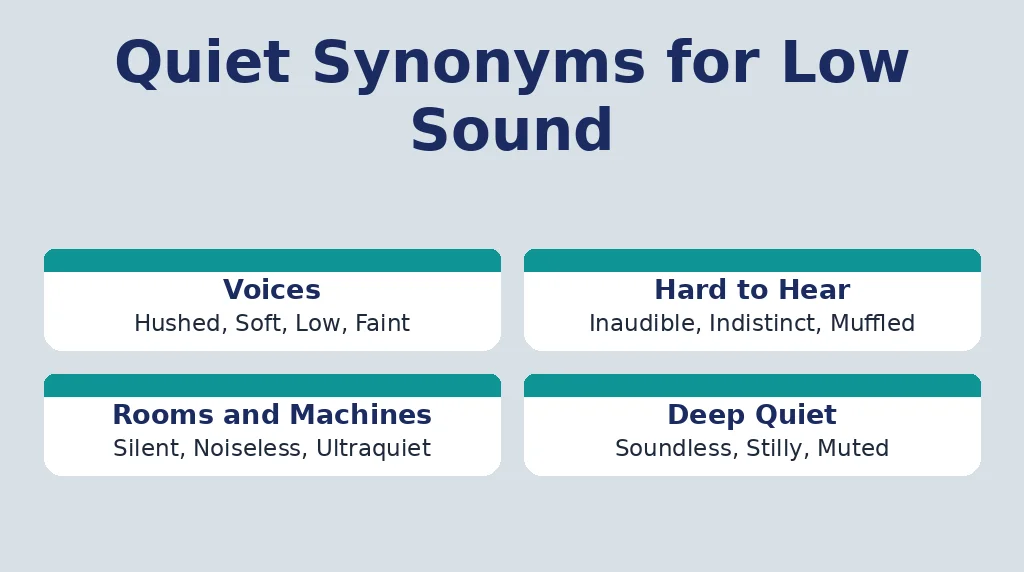
Sound is the home sense of quiet, so it comes first. These words describe voices, rooms, and machines that barely register on the ear. Some lower the volume a little, while others remove sound altogether.
Voices and Speech
Speech gives us the richest set of low-sound words. Each one hints at why the speaker is quiet, which is exactly the detail plain quiet leaves out.
- Hushed: lowered to a soft, respectful murmur. Example: The audience spoke in hushed voices as the lights dimmed.
- Soft: gentle and low, never harsh. Example: She answered in a soft voice so the baby kept sleeping.
- Low: quiet in volume or pitch. Example: He kept his voice low during the meeting.
- Faint: so weak it is hard to catch. Example: A faint reply came from the back of the hall.
- Gentle: soft and mild in tone. Example: Her gentle voice calmed the nervous patient.
- Muffled: blocked by something, so the words blur. Example: Muffled voices drifted through the closed door.
- Inaudible: too quiet to hear at all. Example: His answer was almost inaudible over the wind.
- Indistinct: too faint or muffled to make out. Example: An indistinct murmur rose from the crowd.
Rooms, Machines and Streets
Places and objects have their own quiet vocabulary. These words suit engines, appliances, libraries, and any space where sound drops away.
- Silent: making no sound whatsoever. Example: The engine ran silent after the repair.
- Noiseless: producing no noise while working. Example: The new fan is powerful yet noiseless.
- Soundless: completely without sound, often literary. Example: The owl made a soundless dive toward the field.
- Muted: deliberately toned down. Example: A muted television played in the corner of the cafe.
- Dull: muffled and flat, used of thuds and blows. Example: The box landed with a dull thump.
- Stilly: quiet and still, an old literary word. Example: The stilly night settled over the harbor.
- Ultraquiet: engineered to be extremely quiet, common for appliances. Example: They chose an ultraquiet dishwasher for the open-plan kitchen.
- Quieted: brought to quiet, describing a result rather than a state. Example: The quieted hall waited for the speaker to begin.
One caution runs through this whole group. Most of these words lower sound rather than delete it, so they pair naturally with sources that still exist: hushed voices, a muted television, a noiseless fan. When a scene truly has no source at all, silent and soundless are the honest choices.
Calm and Peaceful: Synonyms for Quiet Places and Moments
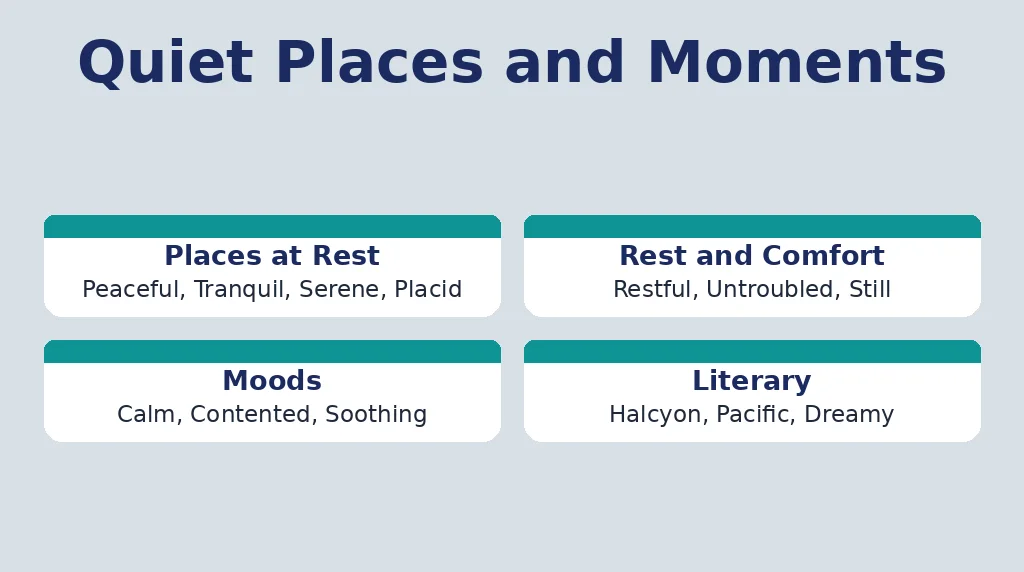
Often quiet says nothing about decibels at all. Instead it describes freedom from disturbance, the feeling a place or moment gives you. These words carry that calm, settled quality.
Places That Feel at Rest
Writers reach for these words when a setting itself seems to breathe slowly. They suit gardens, lakes, villages, and rooms that welcome rest.
- Peaceful: free from disturbance or conflict. Example: They spent a peaceful week beside the lake.
- Tranquil: deeply calm and still. Example: The tranquil garden sat behind high stone walls.
- Serene: clear and untroubled, often with light or sky. Example: A serene bay opened beyond the dunes.
- Placid: smoothly calm, rarely disturbed. Example: The placid river slid past the meadow.
- Restful: giving rest to the body or mind. Example: The hotel offered a restful room away from the road.
- Still: without movement or sound. Example: The still air of the valley held the morning mist.
- Untroubled: free from worry or interruption. Example: An untroubled village slept through the storm.
Moods, Weather and Moments
Feelings and weather borrow the same vocabulary. These words describe inner calm and gentle conditions rather than places.
- Calm: relaxed and free from agitation. Example: She stayed calm through the whole delay.
- Contented: quietly satisfied with what you have. Example: He felt contented by the fire with his book.
- Pacific: peaceful in the oldest sense, formal. Example: The valley kept its pacific mood all summer.
- Halcyon: calm and idyllic, a literary word for golden days. Example: They remembered the halcyon summers of their youth.
- Dreamy: soft, calm, and slightly unreal. Example: A dreamy haze hung over the evening fields.
- Soothing: actively calming to hear or feel. Example: The soothing rain on the roof helped her sleep.
- Motionless: not moving at all, frozen in place. Example: The heron stood motionless at the water’s edge.
Register separates the polished members of this group from the everyday ones. Peaceful, calm, and restful suit any audience, from a hotel review to a school essay. Halcyon, pacific, and stilly belong to poetry and literary prose, where their age is part of their charm. Used once, they lift a paragraph. Used everywhere, they turn a scene into a costume.
Not Busy: Synonyms for Quiet Days, Streets and Towns
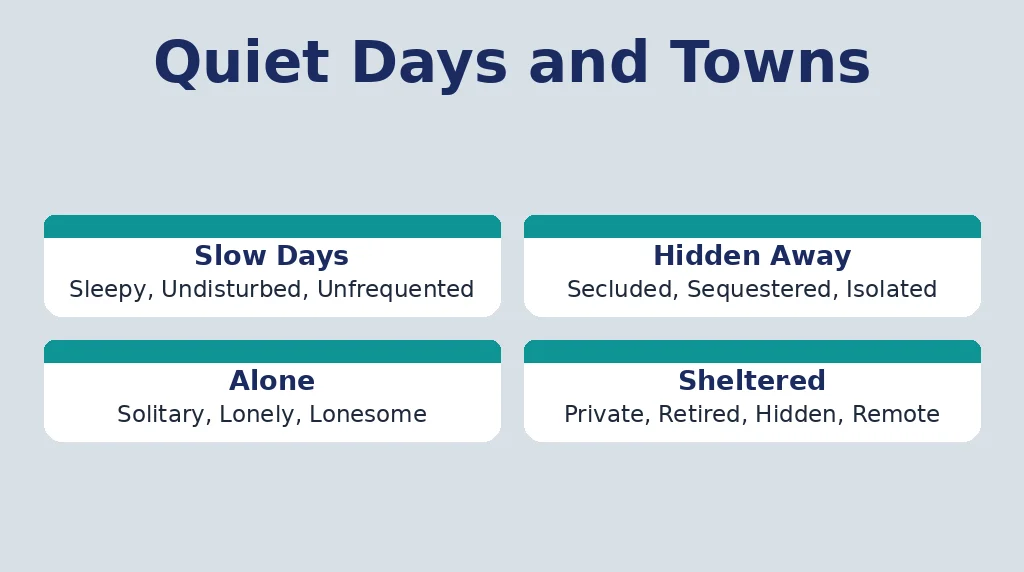
A quiet day at work has nothing to do with volume. It means few customers, few calls, and little to do. This sense covers slow periods as well as places the crowds never reach.
Slow Days and Slow Seasons
Shops, offices, and resorts all live by this sense of quiet. The words below describe trade and activity dropping to a gentle minimum.
- Sleepy: slow and drowsy, with little happening. Example: They retired to a sleepy fishing village.
- Undisturbed: left alone, with nobody arriving. Example: The archive room stayed undisturbed for years.
- Unfrequented: rarely visited, formal. Example: An unfrequented path crossed the far side of the hill.
- Private: closed to the public or kept from view. Example: The members enjoyed a private beach below the club.
- Every slow period is temporary, of course. Even the quietest shop expects the rush to return by Friday.
Secluded Spots and Empty Streets
Some places are quiet because people are absent, not because anyone lowered their voice. These words stress distance, shelter, and solitude.
- Secluded: hidden away from other people. Example: A secluded cove lay beyond the headland.
- Sequestered: set apart in a secluded place, formal. Example: The jury stayed in a sequestered hotel during the trial.
- Isolated: far from others, sometimes lonely. Example: An isolated farmhouse stood at the end of the track.
- Retired: withdrawn from public life or view, literary. Example: He lived a retired life in the hills.
- Sheltered: protected from wind, weather, or attention. Example: A sheltered bench faced the walled garden.
- Hidden: kept out of sight. Example: A hidden courtyard opened behind the bookshop.
- Solitary: alone, with nobody else present. Example: One solitary walker crossed the empty square.
- Lonely: empty of people, with a sad edge. Example: The lonely platform waited for the last train.
- Lonesome: the warmer, more American cousin of lonely. Example: A lonesome whistle sounded far down the line.
- Cloistered: shut away like a monastery, literary. Example: She led a cloistered life among her books.
- Remote: far from towns and help. Example: The remote lighthouse took supplies once a month.
Notice how this sense of quiet is really about tempo and company. On a quiet afternoon, even time seems to travel at a slow pace, errands stretch out, and nobody minds. The words above keep that mood without pretending the place is silent, which is why travel writing leans on them so heavily.
Synonyms for a Quiet Person
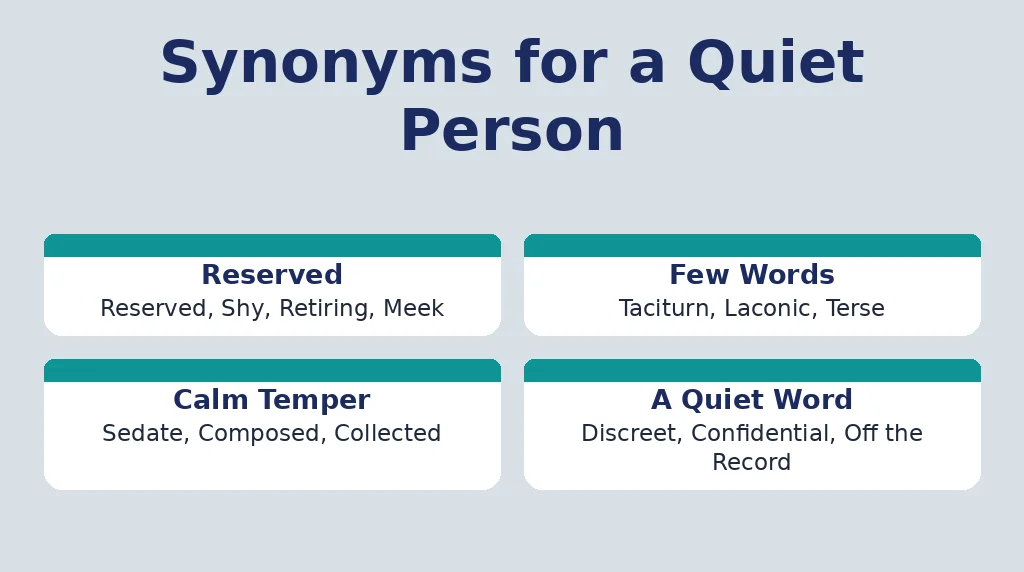
When quiet describes a person, it judges speech and manner, not volume alone. Some quiet people are nervous, some are thoughtful, and some simply see no reason to fill the air. The groups below keep those shades apart.
Shy, Reserved and Self-Contained
These are the everyday words for people who hold back. Most are neutral or kind, which makes them safe for reports, references, and fiction alike.
- Reserved: holding back feelings and words until trust grows. Example: The new manager is reserved but fair.
- Shy: nervous or timid around other people. Example: The shy student hid at the back of the class.
- Retiring: preferring to stay out of the spotlight. Example: For a famous singer, she is surprisingly retiring.
- Meek: gentle and unwilling to push back, sometimes too much so. Example: His meek reply surprised nobody in the room.
- Sedate: calm, dignified, and unhurried in manner. Example: The sedate judge listened without interrupting.
- Docile: easy to manage and gentle by nature. Example: The docile horse suited first-time riders.
- Composed: calm and in control of yourself. Example: She remained composed through the angry questions.
- Collected: calm because you have gathered yourself. Example: His collected answer ended the argument.
- Gentle: kind and soft in manner. Example: A quiet colleague is often also kind, patient, and easy to work beside.
- Mild: gentle and not intense in temperament. Example: The mild teacher rarely raised his voice.
People of Few Words
A second group says little because words feel precious. These terms suit elders, officials, and fictional characters who speak only when it counts.
- Taciturn: habitually saying very little. Example: The taciturn farmer answered with a nod.
- Laconic: using the fewest words possible, formal. Example: His laconic reply filled exactly one line.
- Terse: brief to the point of coolness, so handle with care. Example: Her terse email ended the discussion.
- Peaceable: liking peace and avoiding arguments. Example: The peaceable guard talked the men down calmly.
- Phlegmatic: calm and unemotional, slow to react. Example: His phlegmatic manner steadied the whole crew.
- Unflappable: impossible to ruffle under pressure. Example: The unflappable nurse kept working through the alarm.
- Imperturbable: never visibly disturbed, formal. Example: Imperturbable as ever, she finished her tea first.
- Equable: steady and even in temper. Example: An equable host keeps every guest comfortable.
- Even-tempered: not easily angered. Example: Even-tempered referees earn respect quickly.
A modern note is worth adding here. Quietness in a person is often a strength rather than a gap: the quiet colleague may be listening harder than anyone else in the room. Words like composed, collected, and unflappable let you say exactly that, crediting calm control instead of implying something is missing.
A Quiet Word: The Discreet Sense
One idiom deserves its own note. To have a quiet word with someone means a private, discreet conversation, usually about something sensitive.
- Discreet: careful not to attract attention or reveal secrets. Example: Be discreet, and mention it to no one else.
- Confidential: shared in trust, not for repeating. Example: The report stays confidential until Friday.
- Secret: kept from general knowledge. Example: They held a secret meeting before dawn.
- Unofficial: not part of the formal record. Example: An unofficial chat settled the roster problem.
- Off the record: spoken so it cannot be quoted, journalistic. Example: Off the record, the coach expects a hard season.
Subdued and Understated: The Quiet Look
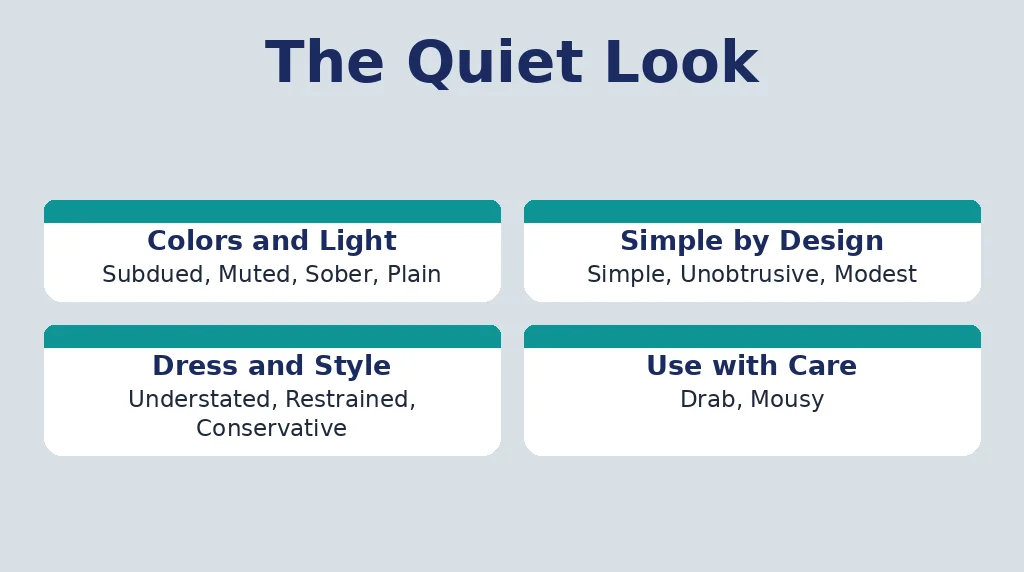
Designers, dressers, and critics use quiet for things that refuse to shout. A quiet color, a quiet suit, or a quiet room design attracts no attention on purpose. The praise in this group is real, because restraint takes confidence.
Colors, Light and Rooms
- Subdued: lowered in brightness, energy, or force. Example: The room used subdued lighting and gray walls.
- Muted: softened in color or tone. Example: The painting glowed in muted greens and browns.
- Plain: simple, without decoration. Example: The plain cover hides a remarkable book.
- Sober: serious and plain in color or mood. Example: Sober gray suits filled the boardroom.
- Simple: free of fuss or ornament. Example: A simple wooden table anchored the kitchen.
- Unobtrusive: not noticeable unless you look. Example: An unobtrusive camera sat above the door.
Dress, Design and Manner
- Understated: elegant precisely because it avoids show. Example: Her understated dress drew more praise than the gowns.
- Restrained: held back on purpose, showing control. Example: The restrained design lets the product speak.
- Conservative: traditional and cautious in style. Example: He wore a conservative suit to the hearing.
- Modest: not drawing attention to itself. Example: The modest facade gives no hint of the garden inside.
- Unpretentious: honest and without show. Example: The unpretentious cafe serves the best soup in town.
- Tasteful: showing good judgment in style. Example: The tasteful renovation kept every original beam.
- Refined: polished and free of anything crude. Example: Refined manners marked the whole ceremony.
Two words in this family carry a warning. Drab means dull and cheerless, as in a drab corridor that needs paint. Mousy describes dull brown hair or color and sounds unkind about people. Both belong in criticism, never in praise.
This is also the one sense where loud works as praise in reverse. Fashion writers call a print loud when it shouts for attention, so a quiet wardrobe is the deliberate opposite. If your sentence is about style and you reach for noisy, you have probably picked the wrong antonym.
Quiet as a Verb: To Calm, Hush and Settle
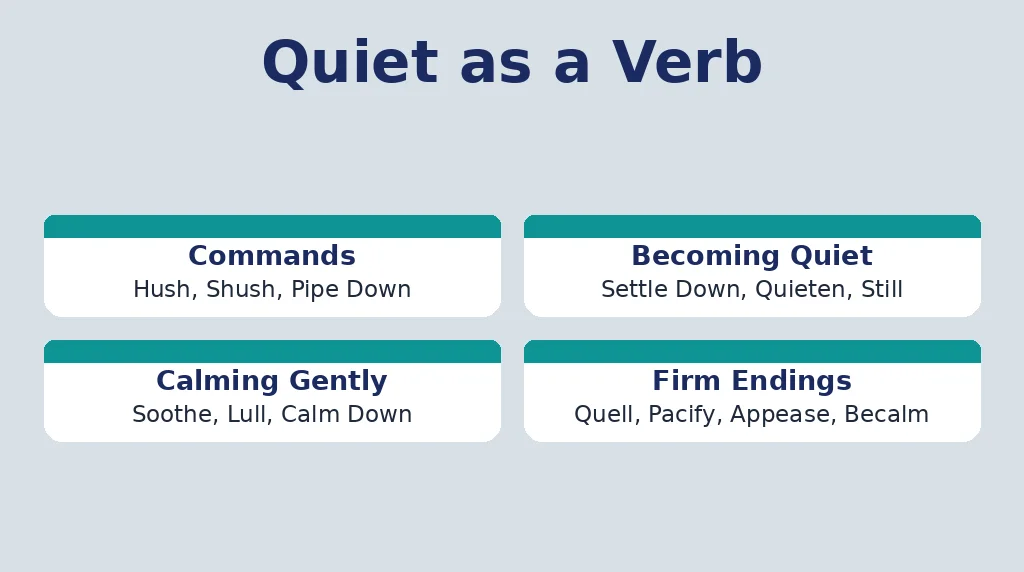
Quiet is also something you do. As a verb it means to make a person, animal, or noise quieter, or to become quieter yourself. The right verb depends on how gentle or firm the action is.
Telling Someone to Quiet Down
These are the direct commands and quick actions. Some are kind, some are blunt, so match the word to the relationship.
- Hush: ask or cause to be silent, gentle. Example: She hushed the children with a story.
- Shush: tell someone to be quiet, informal and direct. Example: The librarian shushed the giggling table.
- Silence: stop noise or speech completely. Example: One raised hand silenced the whole hall.
- Pipe down: stop talking or making noise, informal command. Example: Pipe down, both of you, the baby is asleep.
- Still: make quiet and calm, literary as a verb. Example: He stilled the crowd by simply standing up.
- Quieten: make or become quieter, standard in British English. Example: The rain quietened the streets by midnight.
- Settle down: become calm and quiet after noise or excitement. Example: The class settled down once the test began.
Calming People, Animals and Fears
The gentler verbs do not order anyone. Instead they remove the worry or pain that caused the noise in the first place.
- Soothe: comfort until calm returns. Example: Music soothed the frightened dog.
- Lull: bring to rest with gentle, repeated sound or motion. Example: The waves lulled her to sleep.
- Calm down: relax or help someone relax. Example: He calmed down after hearing the full story.
- Pacify: calm someone who is angry or upset. Example: The refund pacified the furious customer.
- Appease: calm by giving what was demanded. Example: The offer appeased the striking workers.
- Quell: put an end to noise, fear, or unrest, firm and formal. Example: The announcement quelled the rumors at last.
- Becalm: make calm, an old sailing word now literary. Example: Becalmed at noon, the fleet waited for wind.
A dialect note helps here. American English usually quiets a room or watches it quiet down, while British English happily uses quieten as the standard verb. Neither is wrong, but mixing pipe down into a formal report would be. Match the verb to the audience, as with every other group in this guide.
How to Choose the Right Synonym for Quiet
Start with one question: what exactly is quiet here? A sound, a place, a schedule, a person, or a design? Each answer opens a different shelf of words, and most mistakes come from grabbing a word off the wrong shelf.
Paired examples make the differences concrete:
- The library was silent. No sound at all reached you.
- The library was hushed. People whispered, and pages turned softly.
- The village was sleepy. Little ever happened there, and that was the charm.
- The village was secluded. You had to want to find it.
- The manager is reserved. She warms up slowly and speaks with care.
- The manager is taciturn. Even warmed up, she will say ten words a day.
Notice how each swap changes the facts, not just the flavor. Silent is a claim about decibels. Secluded is a claim about geography. Taciturn is a claim about character. Precise writers check which claim they actually mean before choosing.
The same test works at the office. Describe a manager as reserved and the reader pictures someone thoughtful who warms up slowly. Describe her as shy and the reader pictures nerves instead. Describe her as subdued and the reader assumes bad news or a bad week. Three quiet words, three different employees, and only one of them matches the person you actually know.
A Quick Picker for Common Situations
The quick picker below matches common situations to strong first choices.
| Situation | Strong first choice |
|---|---|
| A voice dropping in volume | Soft or hushed |
| A room with no sound at all | Silent |
| A village with little going on | Sleepy |
| A hidden holiday cottage | Secluded |
| A shy new colleague | Reserved |
| Colors that refuse to shout | Subdued |
| A crowd you need to calm | Hush or settle |
Quiet in Essays, Stories and Professional Writing
Formal writing rewards the measured members of this family. Essays and reports lean on subdued, restrained, and understated for style, and on reserved for people. Fiction can go further, using stilly, halcyon, or becalm for a deliberately old or poetic flavor.
Workplace writing needs extra care with people words. Calling an employee quiet in a reference sounds neutral, even positive. Calling the same person shy or meek can read as a criticism of confidence. When the subject is performance rather than personality, describe the behaviour instead: speaks rarely in meetings, listens carefully, prepares thoroughly.
Antonyms for Quiet
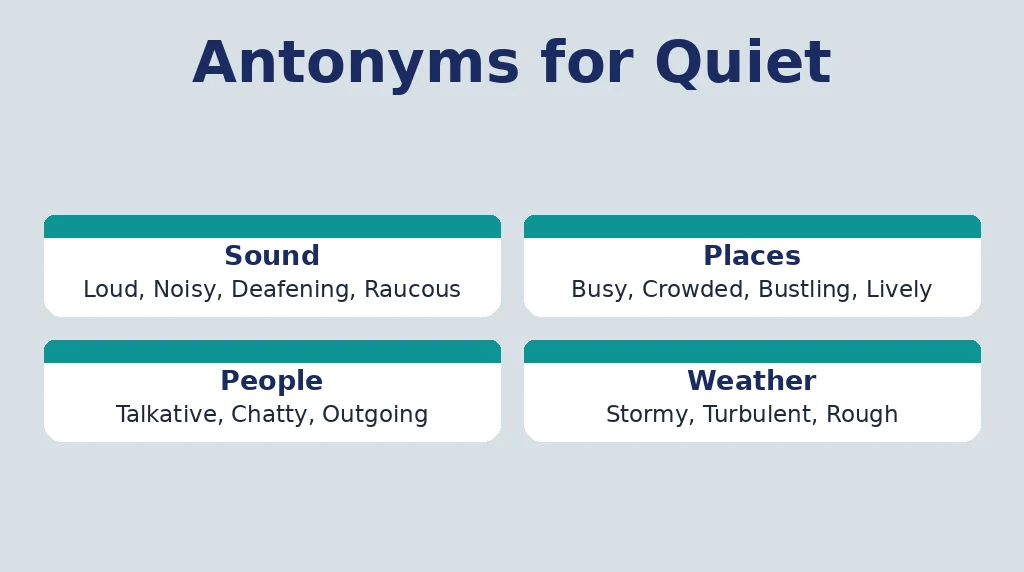
The opposites of quiet split along the same lines as the synonyms. For sound, the core antonyms are loud, noisy, deafening, booming, raucous, and clamorous. A loud voice carries; a deafening one hurts. Raucous adds rowdy human energy, while clamorous suggests many voices demanding attention at once.
For places and schedules, the opposites are busy, crowded, bustling, and lively. A busy platform and a bustling market are quiet’s natural enemies in this sense. Notice that lively is a compliment, so the antonym of a sleepy village can sound like praise.
For people, the opposites are talkative, chatty, outgoing, and, in formal writing, loquacious. Weather and scenes borrow stormy, turbulent, and rough. Keep each antonym on its own shelf, and your contrasts will stay accurate.
A few pairs are worth memorizing as pairs, because they appear together so often in real writing. Quiet streets face busy streets. Quiet confidence answers loud boasting. A quiet life is the opposite of a hectic one, and a quiet word is the opposite of a public announcement. Learning the pairs teaches the senses faster than any single list can.
Common Mistakes: Words That Are Not True Synonyms for Quiet
Silent is a true synonym only at full strength. Silence means no sound at all, while a quiet room can hold whispers, footsteps, and rain on the glass. Writers who swap them freely end up claiming more than the scene delivers.
Still is about movement first. A still pond may sit beside a loud road, and a still suspect may be shouting. Use still for sound only when the scene is motionless too.
Shy names a feeling, not a volume. Shyness involves nervousness about other people, while many quiet people feel perfectly calm and simply prefer listening. A confident speaker can be a quiet person between speeches.
Curt and abrupt appear in thesaurus lists for people of few words, but both imply rudeness. A curt reply is a small act of hostility. Laconic and taciturn describe the same brevity without the insult, so reach for those instead.
Boring fails the test completely. Boring judges interest, not sound or activity, and plenty of quiet evenings are the best part of a week. Finally, spelling traps more writers than any synonym does: quite means fairly or completely, and quit means to leave or stop. Neither one describes sound at all.
Frequently Asked Questions
What is the best synonym for quiet?
There is no single best word, because quiet covers sound, places, schedules, and people. For voices, soft and hushed cover most needs. For places, peaceful and tranquil lead, and for people, reserved is the safest everyday choice. If you can only remember three, take hushed, peaceful, and reserved.
What is the difference between quiet and silent?
Quiet allows a little sound, while silent allows none. A quiet library still has whispers and turning pages. A silent one would feel almost unreal, because complete silence is rare outside studios and deserts.
Quiet or quite: what is the difference?
Quiet, spelled with the e before the t, means making little noise. Quite means fairly or completely, as in quite good or quite finished. A third trap is quit, which means to leave or stop doing something.
What is a formal word for quiet?
For descriptions, hushed, subdued, and restrained sound formal without sounding stiff. For people, reserved and taciturn work well in reports. As a verb, quieten is the standard formal choice, especially in British English.
What is a word for a quiet person?
Reserved is the neutral everyday word. Taciturn describes someone who habitually says very little, and laconic suits a person whose few words are chosen sharply. Shy adds nervousness, so use it only when feelings are part of the picture.
What is the opposite of quiet?
It depends on the sense. The opposite of a quiet sound is loud or noisy, and of a quiet place, busy or bustling. For a quiet person, the natural opposite is talkative or outgoing.
What does it mean to have a quiet word with someone?
It means a short, private conversation, usually about something sensitive or unofficial. A manager who asks for a quiet word wants privacy, not low volume. Discreet and off the record describe the same kind of talk.
What is a good synonym for a quiet place?
Secluded fits a place hidden away from people. Tranquil and peaceful describe the calm such a place gives you, while sleepy suits a village or town where very little happens from one day to the next.
Final Thoughts
Quiet looks like one small word, yet it quietly runs five different jobs at once. Once you sort its synonyms by sound, calm, activity, character, and style, the right choice usually picks itself. Lower a voice to hushed, hide a cottage with secluded, and let a reserved colleague keep her dignity, all with a single well-chosen word.
The habit worth keeping is simple. Before you write quiet, ask what is actually quiet in the scene, then borrow the word built for that job. Your sentences will sound more exact, and your readers will feel the difference without knowing why.
For an even deeper list with related words and near-synonyms, the Merriam-Webster Thesaurus entry for quiet is a reliable next step. Keep this guide bookmarked, and your quiet scenes will never sound flat again.