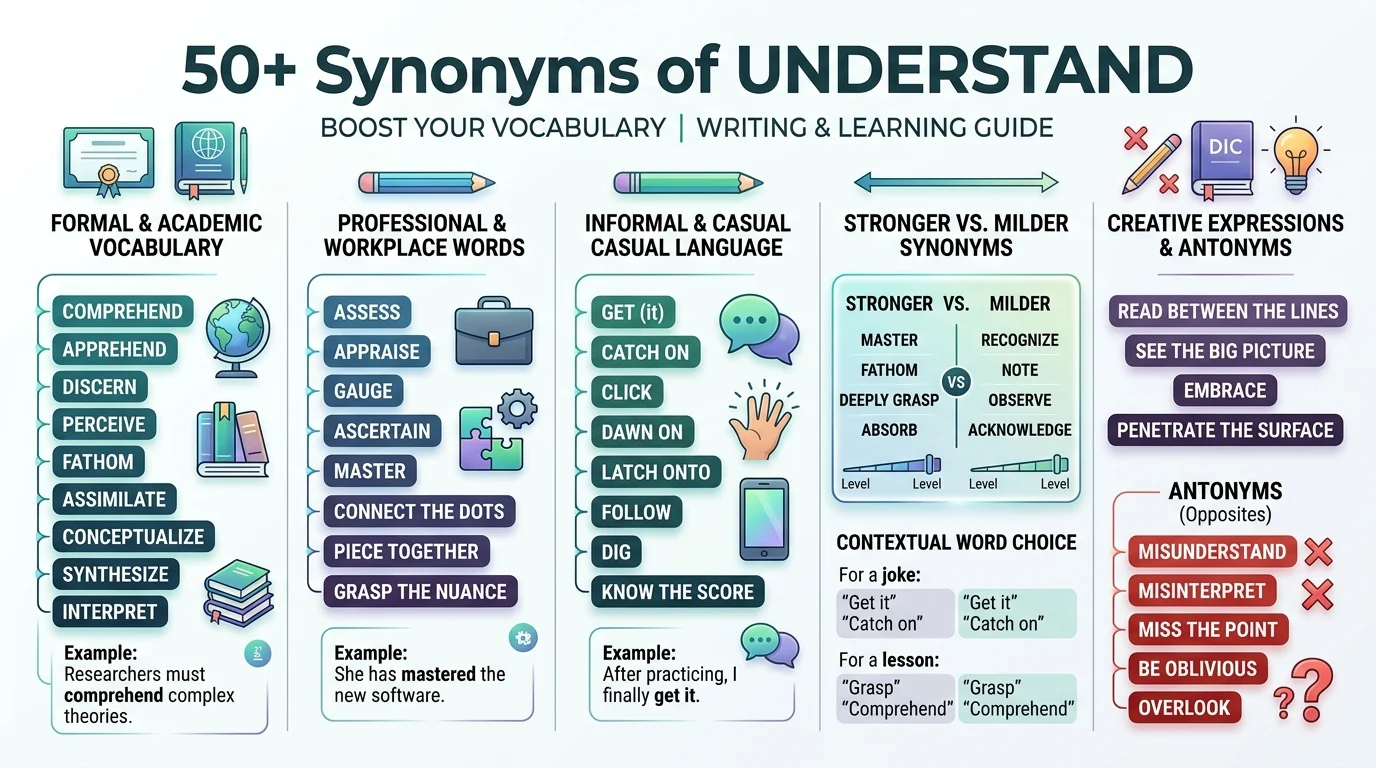
Have you ever written an email, an essay, or a social media post and realized you used the word “understand” five times in three sentences? It happens to everyone. Repeating the same word makes your writing feel flat and uninspired. The good news is that English offers a rich collection of alternatives. Finding the right synonyms of understand can transform your communication from repetitive to remarkable. This guide will help you choose the perfect word for every situation.
What Are the Best Synonyms of “Understand”?
The word “understand” means to know the meaning of something or to grasp how it works. For formal writing, choose “comprehend.” For casual conversation, use “get.” In professional settings, “appreciate” or “recognize” work well. For emotional depth, try “empathize” or “relate to.” Creative writing benefits from “fathom” or “discern.” No single synonym fits every context.
Meaning, Tone, and Context
Simple Definition
To understand something is to know its meaning, grasp its significance, or be aware of how it works or why it happens.
Part of Speech
Verb (transitive and intransitive)
Overall Tone
Neutral. “Understand” is a versatile, everyday word that works in almost any context without adding strong emotion.
Formality Level
Neutral. The word “understand” is appropriate for formal documents, casual conversations, and everything in between.
Common Uses
Native English speakers use “understand” constantly. You hear it in classrooms, workplaces, emails, and everyday conversations. It appears when people discuss concepts, feelings, instructions, and situations. It is one of the most frequently used verbs in the language.
Word Forms
- Noun: understanding
- Verb: understand, understands, understood, understanding
- Adjective: understandable
- Adverb: understandably
- Opposite: misunderstand
When and How to Use “Understand”
Choose “understand” when you need a clear, neutral word that everyone will recognize. It works in every context and with every audience. Here are realistic examples showing how the word fits naturally into different situations.
Professional: The team understands the new software update and will implement it by Friday.
Academic: Researchers are still trying to understand the long-term effects of this treatment.
Workplace: I understand your concern about the deadline, and I will address it immediately.
Personal: My parents finally understand why I chose this career path.
Email: Please let me know if you understand the instructions before we proceed.
Resume: Demonstrated ability to understand complex client needs and deliver tailored solutions.
Social Media: I finally understand why everyone loves this restaurant. The food is incredible.
Best Synonyms of “Understand”
No two synonyms are identical. Each alternative carries its own tone, level of formality, and emotional weight. Here are the best synonyms for different writing situations.
Professional writing: “Recognize” works best because it shows awareness and acknowledgment without sounding overly academic.
Academic writing: “Comprehend” is the top choice for research papers and scholarly work because it implies deep, thorough understanding.
Business communication: “Appreciate” fits perfectly when you need to acknowledge someone’s position or the gravity of a situation.
Casual conversation: “Get” is the most natural and widely used informal option.
Emotional writing: “Empathize” conveys emotional connection and shared feelings.
Creative writing: “Fathom” adds a sense of mystery and depth, making it ideal for literary work.
Resume writing: “Grasp” suggests quick, confident understanding of complex material.
Workplace communication: “Follow” works well when discussing ongoing conversations or instructions.
Stronger meaning: “Discern” implies careful, perceptive understanding that goes beyond the surface.
Softer meaning: “Realize” suggests a gentler, more gradual coming to understanding.
When Not to Use “Understand”
Sometimes “understand” is not the best choice. Here are situations where you should choose a more precise word.
When the Word Sounds Too General
If you are writing about complex, technical, or nuanced topics, “understand” can feel vague.
Less effective: The students understand quantum physics.
Better: The students grasp the fundamental principles of quantum physics.
Why: “Grasp” suggests a firmer, more confident hold on difficult material.
When the Word Sounds Too Weak
For situations requiring strong conviction or deep insight, “understand” may not carry enough weight.
Less effective: I understand the risks involved.
Better: I fully appreciate the risks involved.
Why: “Appreciate” implies recognizing the full value or seriousness of something.
When the Word Sounds Too Formal
In casual conversations or text messages, “understand” can feel stiff.
Less effective: I understand what you mean.
Better: I get what you mean.
Why: “Get” is the natural choice for informal communication.
When the Word Sounds Too Informal
In formal reports, legal documents, or academic papers, “understand” may not sound authoritative enough.
Less effective: The committee understands the proposal.
Better: The committee comprehends the full scope of the proposal.
Why: “Comprehend” adds formality and suggests thorough intellectual engagement.
When the Word Sounds Outdated
“Understand” never sounds outdated, but some synonyms like “apprehend” can feel old-fashioned in everyday use. Use “apprehend” sparingly and only in formal or legal contexts.
Words Commonly Confused With “Understand”
Several words are often confused with “understand” because they share similar meanings. Here is how to tell them apart.
Comprehend
- Difference: “Comprehend” is more formal and suggests a deeper, more complete understanding.
- When to Use It: Use “comprehend” in academic writing, formal reports, or when discussing complex subjects.
- Example: She could not comprehend the complexity of the legal argument.
Grasp
- Difference: “Grasp” implies a firm, confident hold on an idea, often suggesting sudden or decisive understanding.
- When to Use It: Use “grasp” when you want to emphasize successfully understanding something difficult.
- Example: He quickly grasped the main points of the presentation.
Appreciate
- Difference: “Appreciate” means to recognize the full value, worth, or seriousness of something.
- When to Use It: Use “appreciate” when acknowledging someone’s situation or the importance of a fact.
- Example: I appreciate how much effort this project requires.
Perceive
- Difference: “Perceive” involves becoming aware of something through the senses or the mind.
- When to Use It: Use “perceive” when describing awareness or interpretation rather than full comprehension.
- Example: She perceived a change in his attitude.
Discern
- Difference: “Discern” means to recognize or distinguish subtle differences or details.
- When to Use It: Use “discern” when you want to highlight careful observation and differentiation.
- Example: It was difficult to discern his true intentions.
Realize
- Difference: “Realize” often describes becoming suddenly or gradually aware of something.
- When to Use It: Use “realize” when describing a moment of coming to understand.
- Example: I suddenly realized I had met her before.
Best Synonyms of “Understand” by Context
| Context | Best Synonym | Why It Works | Example |
|---|---|---|---|
| Formal writing | Comprehend | Adds authority and suggests thorough intellectual engagement | The board comprehends the full implications of the decision. |
| Academic writing | Comprehend | Implies deep, rigorous understanding suitable for scholarly work | Students must comprehend the underlying theories. |
| Professional communication | Recognize | Shows awareness and acknowledgment in a business setting | We recognize the challenges this presents. |
| Business emails | Appreciate | Conveys understanding with a tone of respect and acknowledgment | I appreciate your concerns and will address them. |
| Resume writing | Grasp | Suggests quick, confident understanding of complex material | Grasped complex client requirements and delivered solutions. |
| Workplace communication | Follow | Works well for ongoing discussions and instructions | I follow your logic on this point. |
| Casual conversation | Get | Natural, friendly, and widely used in everyday speech | I get what you are saying. |
| Everyday speaking | See | Simple and conversational | I see your point. |
| Creative writing | Fathom | Adds mystery and depth to literary work | She could not fathom the depths of his grief. |
| Storytelling | Discern | Suggests careful perception and insight | He discerned a hidden meaning in her words. |
| Emotional writing | Empathize | Conveys emotional connection and shared feeling | I empathize with what you are going through. |
| Strong emphasis | Perceive | Implies deep awareness and interpretation | He perceived the true nature of the problem. |
| Mild tone | Realize | Suggests gentle, gradual coming to understanding | I realize this is difficult for you. |
| Social media captions | Get | Short, punchy, and relatable | Finally get why this place is so popular. |
How to Choose the Best Synonym of “Understand”
Choosing the right synonym comes down to understanding your audience and your purpose. Here is a practical decision guide.
Consider your audience. Are you writing for a professor, a colleague, a friend, or a customer? Formal audiences expect words like “comprehend” and “appreciate.” Informal audiences respond better to “get” and “see.”
Consider your tone. Do you want to sound authoritative, empathetic, casual, or creative? Each synonym carries a different emotional weight.
Consider the complexity of the subject. Simple topics work well with “understand” or “get.” Complex, difficult topics deserve “grasp,” “fathom,” or “comprehend.”
Consider the strength of your message. If you want to emphasize deep understanding, choose “discern,” “perceive,” or “appreciate.” If you want to downplay the intensity, choose “realize” or “see.”
Consider naturalness. The best synonym is the one that sounds most natural in your sentence. Read your sentence aloud. If it sounds forced or awkward, try a different word.
Real Life Examples of “Understand”
Here are realistic examples showing how to replace “understand” with stronger synonyms in different situations.
School: Instead of “The teacher wants us to understand the formula,” write “The teacher wants us to grasp the formula.”
College: Instead of “I understand the theory,” write “I comprehend the theory.”
Workplace: Instead of “I understand your position,” write “I appreciate your position.”
Business: Instead of “We understand the market,” write “We perceive the market dynamics.”
Email: Instead of “I understand your concerns,” write “I recognize your concerns.”
Resume: Instead of “Able to understand client needs,” write “Able to grasp client needs quickly.”
Conversation: Instead of “I understand what you mean,” write “I get what you mean.”
Storytelling: Instead of “She understood his pain,” write “She fathomed his pain.”
Blogging: Instead of “Readers understand the concept,” write “Readers grasp the concept.”
Social Media: Instead of “I understand the hype,” write “I finally get the hype.”
18 Best Synonyms of “Understand”
| Synonym | Simple Meaning | Best Used For | Example Sentence |
|---|---|---|---|
| Comprehend | To understand fully and deeply | Formal writing, academic work | He cannot comprehend the scale of the disaster. |
| Grasp | To seize and hold an idea firmly | Professional contexts, difficult concepts | She quickly grasped the main points. |
| Appreciate | To recognize full value or seriousness | Business communication, acknowledging situations | I appreciate how difficult this decision is. |
| Perceive | To become aware of through senses or mind | Emotional writing, descriptive contexts | He perceived a change in her mood. |
| Discern | To recognize subtle differences or details | Creative writing, careful observation | She discerned the truth behind his words. |
| Fathom | To understand something mysterious | Literary writing, deep emotional subjects | I cannot fathom why he left. |
| Realize | To become suddenly or gradually aware | Everyday writing, gentle understanding | I realized I had made a mistake. |
| Recognize | To acknowledge or identify | Professional settings, formal acknowledgment | We recognize the need for change. |
| Follow | To understand as something is being said | Workplace communication, ongoing discussions | I could not follow his argument. |
| Get | To understand informally | Casual conversation, social media | I do not get the joke. |
| Digest | To understand after taking time | Reading comprehension, complex material | This chapter is difficult to digest. |
| See | To understand in a simple way | Everyday conversation | I see what you mean. |
| Apprehend | To understand in a formal or legal sense | Legal writing, formal contexts | The jury apprehended the complexity of the case. |
| Empathize | To understand through emotional connection | Emotional writing, personal relationships | I empathize with your situation. |
| Relate to | To understand through personal connection | Personal writing, conversations | I can relate to what you are going through. |
| Cotton on | To begin to understand informally | British English, casual conversation | He finally cottoned on to what was happening. |
| Twig | To understand suddenly in British English | British English, informal contexts | She twigged that he was lying. |
| Get the picture | To understand the overall situation | Informal contexts, summarizing | I get the picture. No need to explain more. |
Synonyms of “Understand” by Usage
Professional vs Personal Synonyms
In professional settings, choose words that convey competence and authority. “Comprehend,” “appreciate,” and “recognize” work well in workplace emails, reports, and presentations. In personal conversations, “get,” “see,” and “realize” sound more natural and friendly.
Formal vs Conversational Synonyms
Formal writing like reports, essays, and business documents benefits from “comprehend,” “apprehend,” and “appreciate.” Conversational writing like texts, social media posts, and casual emails calls for “get,” “see,” and “follow.”
Academic Synonyms
For research papers, essays, and academic discussions, choose “comprehend,” “grasp,” and “perceive.” These words sound authoritative and suggest rigorous intellectual engagement.
Professional and Business Synonyms
For resumes, interviews, meetings, and client communication, use “grasp,” “recognize,” and “appreciate.” These words convey confidence, awareness, and professionalism.
Creative and Literary Synonyms
For storytelling, fiction, poetry, and descriptive writing, choose “fathom,” “discern,” and “perceive.” These words add depth, emotion, and imagery to your writing.
Slang or Modern Synonyms
“Get” is the most common informal synonym and works in almost any casual context. “Cotton on” and “twig” are British slang terms that are less common in American English but still understood. Use slang only in informal settings and avoid it in professional or academic writing.
Strongest to Mildest Synonyms
Mild: realize, see, follow
Moderate: understand, get, recognize
Strong: grasp, comprehend, appreciate
Very Strong: fathom, discern, perceive
The emotional intensity increases as you move from mild to very strong. Choose milder words for gentle conversations and stronger words for emphasis and depth.
Emotional vs Neutral Synonyms
Emotional Synonyms: empathize, relate to, fathom, appreciate. These words express feelings, connection, and personal engagement.
Neutral Synonyms: comprehend, grasp, recognize, perceive. These words simply communicate understanding without adding emotional weight.
Use emotional synonyms when writing about personal relationships, feelings, or situations requiring empathy. Use neutral synonyms for factual, objective, or professional communication.
Antonyms of “Understand”
| Antonym | Meaning | Example Sentence |
|---|---|---|
| Misunderstand | To interpret incorrectly | I misunderstood his instructions. |
| Misinterpret | To explain or understand wrongly | She misinterpreted his silence as anger. |
| Misconceive | To understand wrongly | He misconceived the purpose of the meeting. |
| Confuse | To make unclear or difficult to understand | The complicated instructions confused everyone. |
| Mistake | To identify or understand incorrectly | I mistook her meaning entirely. |
| Overlook | To fail to notice or consider | He overlooked an important detail. |
| Ignore | To refuse to acknowledge | She ignored the warning signs. |
| Disregard | To pay no attention to | He disregarded their advice. |
| Neglect | To fail to care for or attend to | They neglected to consider the consequences. |
| Miss | To fail to understand or notice | I missed the point of his argument. |
| Misapprehend | To understand incorrectly | She misapprehended the situation. |
| Misread | To interpret wrongly | He misread her intentions. |
| Misconstrue | To interpret wrongly | His comments were misconstrued. |
| Misjudge | To form an incorrect opinion | She misjudged his character. |
| Mishear | To hear incorrectly | I misheard what she said. |
Comparison: “Understand” vs Similar Words
Understand vs Comprehend
Main Difference: “Comprehend” is more formal and suggests deeper, more thorough understanding.
Which Is Stronger: “Comprehend” is stronger because it implies complete mental grasp.
Which Is More Formal: “Comprehend” is more formal and更适合 academic and professional writing.
When to Use Each: Use “understand” in everyday situations. Use “comprehend” when discussing complex or serious subjects.
Examples:
Understand vs Grasp
Main Difference: “Grasp” suggests a firm, confident hold on an idea, often implying sudden understanding.
Which Is Stronger: “Grasp” is stronger because it emphasizes successful understanding of difficult material.
Which Is More Formal: “Understand” is neutral. “Grasp” is slightly more informal but still professional.
When to Use Each: Use “understand” for general situations. Use “grasp” when you want to emphasize confidently understanding something challenging.
Examples:
Understand vs Appreciate
Main Difference: “Appreciate” means to recognize the full value, worth, or seriousness of something.
Which Is Stronger: “Appreciate” is stronger because it adds a layer of value judgment.
Which Is More Formal: “Appreciate” is more formal and works well in business and professional contexts.
When to Use Each: Use “understand” for basic comprehension. Use “appreciate” when acknowledging someone’s situation or the importance of a fact.
Examples:
- Understand: I understand your point.
- Appreciate: I appreciate how difficult this is for you.
Understand vs Perceive
Main Difference: “Perceive” involves becoming aware of something through the senses or the mind.
Which Is Stronger: “Perceive” is stronger because it implies a more active, aware form of understanding.
Which Is More Formal: “Perceive” is more formal and often used in academic or literary contexts.
When to Use Each: Use “understand” for general comprehension. Use “perceive” when describing awareness, interpretation, or sensory understanding.
Examples:
- Understand: I understand the situation.
- Perceive: She perceived a change in his attitude.
Understand vs Discern
Main Difference: “Discern” means to recognize or distinguish subtle differences or details.
Which Is Stronger: “Discern” is stronger because it implies careful, perceptive observation.
Which Is More Formal: “Discern” is more formal and often used in literary or sophisticated writing.
When to Use Each: Use “understand” for general comprehension. Use “discern” when highlighting careful differentiation or insight.
Examples:
- Understand: I understand his motives.
- Discern: It was difficult to discern his true intentions.
Understand vs Realize
Main Difference: “Realize” often describes becoming suddenly or gradually aware of something.
Which Is Stronger: “Realize” is milder and suggests a gentler coming to understanding.
Which Is More Formal: “Realize” is neutral and works in both formal and informal contexts.
When to Use Each: Use “understand” for established knowledge. Use “realize” when describing a moment of becoming aware.
Examples:
Common Phrases and Expressions with “Understand”
Phrase: I understand
Meaning: A simple statement of comprehension or acknowledgment.
Example Sentence: I understand your concerns and will address them.
Phrase: Do you understand?
Meaning: A question asking for confirmation of comprehension.
Example Sentence: Do you understand the instructions I just gave?
Phrase: I understand that…
Meaning: A phrase used to acknowledge a fact or situation.
Example Sentence: I understand that you have been working on this project for months.
Phrase: Make yourself understood
Meaning: To communicate clearly so others comprehend you.
Example Sentence: She struggled to make herself understood in the foreign language.
Phrase: Give someone to understand
Meaning: To make someone believe or think something.
Example Sentence: He gave me to understand that the meeting was canceled.
Phrase: It is understood that…
Meaning: Something is accepted as true or agreed upon.
Example Sentence: It is understood that all employees will follow the safety guidelines.
Phrase: I don’t understand
Meaning: A statement of confusion or lack of comprehension.
Example Sentence: I don’t understand why he would say that.
Common Mistakes to Avoid
1: Choosing a vague synonym instead of a precise one.
Incorrect: I understand the complexity of the issue.
2: I appreciate the complexity of the issue.
Why: “Appreciate” adds the nuance of recognizing value and seriousness, making your statement more precise.
3: Confusing “understand” with “comprehend” in casual conversation.
Incorrect: I comprehend what you are saying. (Sounds overly formal)
Better: I get what you are saying.
Why: “Get” is the natural choice for casual conversation and sounds more friendly.
4: Using an informal synonym in formal writing.
Incorrect: The board gets the proposal.
Better: The board comprehends the proposal.
Why: “Comprehend” is more appropriate for formal contexts and adds authority.
5: Selecting an overly dramatic synonym.
Incorrect: I fathom your simple question. (Overly dramatic)
Better: I understand your simple question.
Why: “Fathom” is best reserved for mysterious or deep subjects.
6: Repeating the same word too often.
Incorrect: I understand the problem. I understand the solution. I understand the implications.
Better: I grasp the problem. I recognize the solution. I appreciate the implications.
Why: Varying your word choice keeps your writing fresh and engaging.
7: Choosing a synonym with the wrong emotional tone.
Incorrect: I empathize with your spreadsheet error. (Too emotional for a minor mistake)
Better: I understand your spreadsheet error.
Why: “Empathize” is for emotional situations, not minor workplace errors.
8: Using slang in academic or professional writing.
Incorrect: The researchers cottoned on to the pattern.
Better: The researchers discerned the pattern.
Why: Slang has no place in academic or professional writing.
Frequently Asked Questions
1. What are the best synonyms of “understand”?
The best synonyms depend on your context. Formal writing, choose “comprehend.” For casual conversation, use “get.” For professional settings, “appreciate” and “recognize” work well. Creative writing, try “fathom” or “discern.”
2. What are the best formal synonyms of “understand”?
The best formal synonyms are “comprehend,” “appreciate,” and “apprehend.” “Comprehend” is the most common formal choice and implies deep, thorough understanding.
3. What are common informal synonyms of “understand”?
Common informal synonyms include “get,” “see,” and “follow.” “Get” is the most widely used informal option in American English.
4. What is another word for “understand” in professional writing?
In professional writing, use “recognize,” “appreciate,” or “grasp.” These words convey awareness, acknowledgment, and confident understanding of complex material.
5. What is the difference between “understand” and “comprehend”?
“Comprehend” is more formal and suggests deeper, more complete understanding. “Understand” is neutral and used in all contexts. Choose “comprehend” for academic or formal writing and “understand” for everyday use.
6. What is the opposite of “understand”?
The most common opposite is “misunderstand.” Other antonyms include “misinterpret,” “misconceive,” “confuse,” “overlook,” and “ignore.”
Conclusion
“Understand” is one of the most useful and frequently used words in English. It means to know the meaning of something or to grasp how it works. But no single word works perfectly in every situation. The best synonyms of understand depend on your audience, your purpose, and your tone. Formal writing, choose “comprehend.” For casual conversation, use “get.” Professional settings, “appreciate” and “recognize” are excellent choices. For creative and emotional writing, try “fathom,” “discern,” or “empathize.”
The key to great vocabulary is not knowing more words. It is knowing which word fits each situation. Next time you write, pause and ask yourself: Is “understand” the best word for this moment? If not, choose a synonym that communicates your message more clearly and naturally. Your readers will notice the difference.
Definitions, meanings, and usage recommendations should be verified with trusted language references before publication. Recommended sources include Cambridge Dictionary, Oxford English Dictionary, Merriam Webster, Collins Dictionary, and Britannica.