What if the word “convey” is making your writing sound repetitive, vague, or too formal?
That small word can become a big writing problem. Using “convey” too often may make your sentences feel repetitive. Replacing it with the wrong synonym can also change your meaning or tone.
That is why choosing the right convey synonym matters.
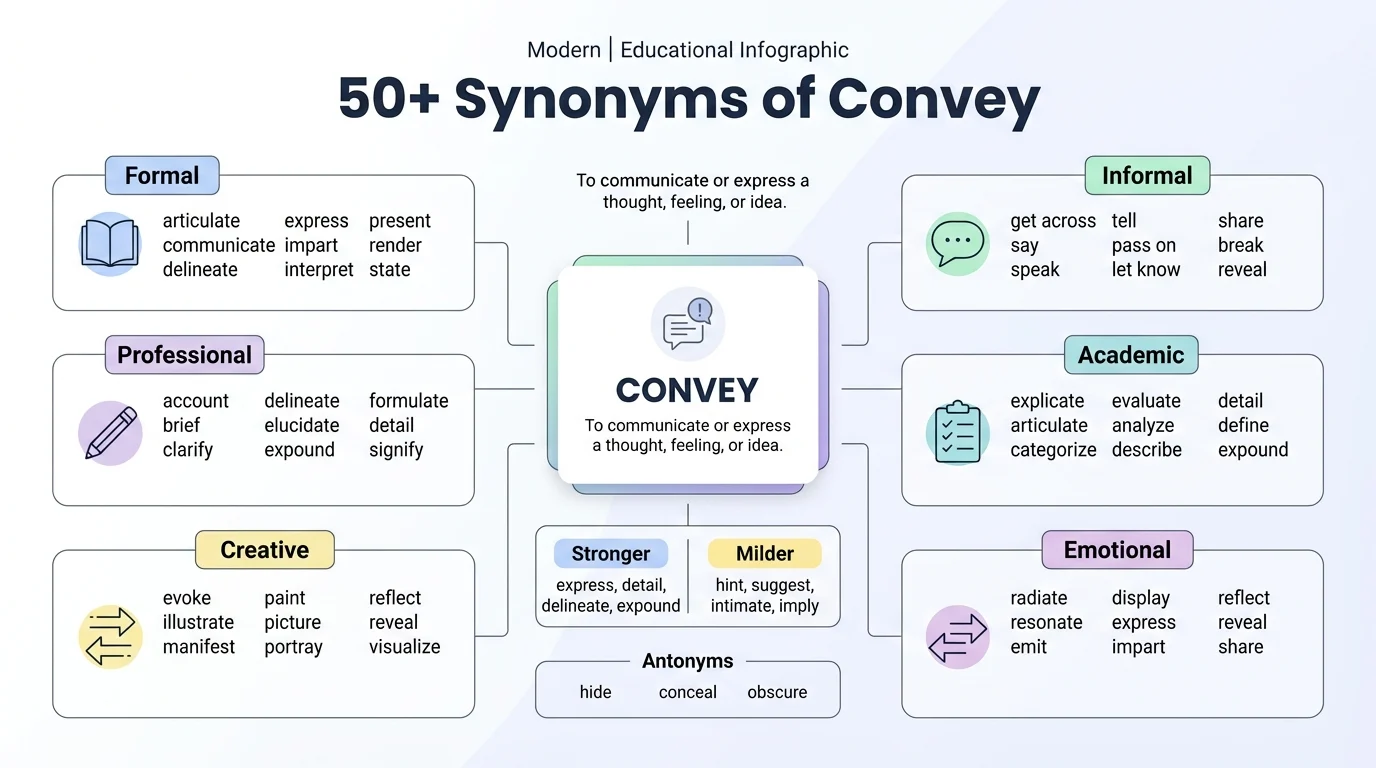
In this guide, you will discover 50+ synonyms of convey, including the most useful other words for convey in everyday, academic, professional, and creative writing. You will find simple alternatives such as communicate, express, share, deliver, explain, show, reveal, transmit, and articulate, along with clear meanings and real examples.
Each synonym has a slightly different use. For example, express often works for feelings or opinions, while communicate is better for sharing ideas or information. Deliver may fit a message, speech, or statement.
The goal is simple. Help you choose the best alternative without losing your original meaning. Whether you need a synonym for an essay, email, report, conversation, or creative piece, this guide makes the choice easier.
What Are the Best Synonyms of “Convey”?
“Convey” means to communicate information, express a feeling, or transport something from one place to another. The best synonym depends on your context. Formal writing, use “communicate” or “impart.” For casual conversation, try “get across” or “pass on.” Professional settings, choose “deliver” or “transmit.” For emotional expression, “express” works best. Creative writing, consider “portray” or “evoke.” Each alternative carries a slightly different tone, so choose the one that fits your audience and purpose.
Meaning, Tone, and Context
Simple Definition
To convey something means to make it known, to carry it from one place to another, or to serve as a means of expressing something.
Part of Speech
Verb (transitive). Forms: convey, conveys, conveyed, conveying.
Overall Tone
Neutral. The word itself does not carry strong positive or negative emotion. Its tone depends entirely on what is being conveyed and the surrounding context.
Formality Level
Semi-formal to neutral. “Convey” is appropriate in professional writing, academic papers, and everyday conversation. It is not overly casual, but it is also not stiff or archaic.
Common Uses
Native English speakers use “convey” in three main ways:
- To communicate information or ideas. Example: “Please convey my gratitude to your team.”
- To transport physical items. Example: “The pipeline conveys water to the city.”
- To express emotions or qualities indirectly. Example: “Her tone conveyed disappointment.”
Word Forms
- Noun: conveyance (the act of conveying) or conveyor (a person or thing that conveys)
- Verb: convey, conveys, conveyed, conveying
- Adjective: conveyable (capable of being conveyed)
When and How to Use “Convey”
Choose “convey” when you need a reliable, neutral verb that works across many contexts. It is a safe choice when you are unsure which synonym to pick. However, for more impact, consider a more specific alternative.
Here are seven realistic examples showing how “convey” fits different situations.
Professional
The marketing presentation must convey the company’s core values to potential investors.
Academic
The researcher used statistical data to convey the significance of her findings.
Workplace
Please convey this update to the entire department before the end of the day.
Personal
I struggled to convey how grateful I was for their support during a difficult time.
Email
I am writing to convey my sincere appreciation for your assistance with the project.
Resume
Developed clear reports that convey complex data to non-technical stakeholders.
Social Media
The short video conveys the excitement of the event better than any photograph could.
Best Synonyms of “Convey”
No synonym is identical in every situation. The best choice depends on your audience, purpose, and the specific shade of meaning you want to express.
- Professional writing: Communicate. This is the most direct and widely understood alternative. It sounds polished without being pretentious.
- Academic writing: Impart. This word suggests transferring knowledge or wisdom, which fits scholarly contexts well.
- Business communication: Deliver. It implies a clear, successful transmission of a message or item.
- Casual conversation: Get across. This phrasal verb is informal and easy to understand.
- Emotional writing: Express. This word focuses on conveying feelings or personal thoughts.
- Creative writing: Evoke. This suggests bringing out emotions, memories, or images in the reader’s mind.
- Resume writing: Articulate. This shows you can express ideas clearly and effectively.
- Workplace communication: Relay. This implies passing information from one person to another.
- Stronger meaning: Impress upon. This suggests making someone fully understand the importance of something.
- Softer meaning: Hint at. This suggests conveying something indirectly or subtly.
When Not to Use “Convey”
When It Sounds Too General
“Convey” can feel vague if you need a more specific verb.
Instead of: The report conveys the data.
Use: The report summarizes the data. (If the report condenses information)
Or: The report illustrates the data. (If the report uses visuals)
When It Sounds Too Formal
In casual texts or social media comments, “convey” can feel stiff.
Instead of: I just wanted to convey that I had a great time.
Use: I just wanted to say I had a great time.
When It Sounds Too Weak
If you need strong, vivid language, “convey” may lack impact.
Instead of: The painting conveys sadness.
Use: The painting radiates sadness. (For a stronger emotional effect)
When You Mean Something More Specific
If you are talking about physical movement, a more precise verb may be better.
Instead of: The truck conveys the goods.
Use: The truck transports the goods. (More standard for physical movement)
Words Commonly Confused With “Convey”
Convey vs. Communicate
Difference: “Convey” often implies a one-way transmission of information or a feeling that may be unintentional. “Communicate” generally suggests a two-way exchange with some intentionality.
When to Use It: Use “convey” when focusing on the message itself. Use “communicate” when focusing on the interaction between people.
Example: Her silence conveyed more than words ever could. We need to communicate our concerns to the manager.
Convey vs. Express
Difference: “Express” emphasizes putting feelings or thoughts into words or actions deliberately. “Convey” is broader and can include transporting physical items or communicating indirectly.
When to Use It: Use “express” for personal feelings or opinions. Use “convey” for information, ideas, or physical objects.
Example: He expressed his anger through a loud outburst. The data conveys a clear trend.
Convey vs. Transmit
Difference: “Transmit” often refers to sending signals, diseases, or electronic data. “Convey” is more general.
When to Use It: Use “transmit” for technical or scientific contexts involving signals or diseases. Use “convey” for general communication or transport.
Example: The radio tower transmits signals across the valley. The teacher conveys knowledge to her students.
Convey vs. Impart
Difference: “Impart” suggests giving a portion of something, like knowledge or a quality. “Convey” is more neutral.
When to Use It: Use “impart” when sharing wisdom, skills, or a particular quality.
Example: She imparted her cooking skills to her children. He conveyed the message to the entire staff.
Convey vs. Relay
Difference: “Relay” specifically means to pass along information that has been received from someone else.
When to Use It: Use “relay” when you are acting as an intermediary.
Example: Please relay this information to the marketing team.
Best Synonyms of “Convey” by Context
| Context | Best Synonym | Why It Works | Example |
|---|---|---|---|
| Formal writing | Communicate | It is clear, professional, and widely understood. | The report communicates the key findings effectively. |
| Academic writing | Impart | It suggests the transfer of knowledge or wisdom. | The lecture imparted a deep understanding of the subject. |
| Professional communication | Deliver | It implies a successful and complete transmission. | The presentation delivered our message to the clients. |
| Business emails | Relay | It is precise for passing along information. | Please relay this update to the sales team. |
| Resume writing | Articulate | It shows the ability to express ideas clearly. | Articulated complex strategies to executive leadership. |
| Workplace communication | Convey | The original word is appropriate and neutral. | I need to convey this deadline to the entire team. |
| Casual conversation | Get across | It is informal and easy to understand. | I finally got my point across to my friend. |
| Everyday speaking | Pass on | It sounds natural and conversational. | Pass on my regards to your family. |
| Creative writing | Evoke | It suggests bringing out emotions or images. | The scene evokes a sense of nostalgia. |
| Storytelling | Portray | It suggests describing or representing something vividly. | The author portrays the character as a hero. |
| Emotional writing | Express | It is the most direct word for sharing feelings. | She expressed her joy through tears. |
| Strong emphasis | Impress upon | It shows urgency and importance. | I must impress upon you the seriousness of this matter. |
| Mild tone | Hint at | It suggests something subtly. | The letter hinted at a possible change in plans. |
| Social media captions | Show | It is simple and direct. | This photo shows the beauty of the sunset. |
How to Choose the Best Synonym of “Convey”
Choosing the right synonym starts with understanding your message, audience, and purpose. Follow this practical decision guide.
- Identify the meaning: Are you communicating information, transporting a physical object, or expressing an emotion?
- Consider your audience: Who will read or hear your message? Formal or informal language?
- Determine the tone: Do you want to sound professional, casual, emotional, or neutral?
- Assess the emotional strength: Do you need a strong, impactful word or a mild, subtle one?
- Match the writing purpose: Are you writing a report, a story, a text message, or a resume?
Choose the synonym that communicates your intended message most clearly and naturally for your specific context.
Real Life Examples of “Convey”
School
The student used a diagram to convey the water cycle to her classmates.
College
His essay conveyed a sophisticated understanding of post-modern philosophy.
Workplace
The manager conveyed the new policy changes during the morning meeting.
Business
The advertisement conveys a sense of luxury and exclusivity to potential customers.
Email
I wanted to convey my sincere thanks for your generous support.
Resume
Conveyed project updates to cross-functional teams on a weekly basis.
Conversation
He struggled to convey his excitement about the upcoming trip.
Storytelling
The author conveyed the character’s desperation through short, fragmented sentences.
Blogging
This post aims to convey the importance of sustainable living.
Social Media
The short clip conveys the energy of the live concert perfectly.
18 Best Synonyms of “Convey”
| Synonym | Simple Meaning | Best Used For | Example Sentence |
|---|---|---|---|
| Communicate | To share information or ideas | General professional and everyday use | The manager communicated the new policy to all staff. |
| Express | To put thoughts or feelings into words | Emotional or personal expression | She expressed her gratitude with a warm hug. |
| Impart | To make knowledge or a quality known | Academic or formal sharing of wisdom | The book imparts valuable life lessons to its readers. |
| Deliver | To bring or hand over something | Business, logistics, or completing a task | The courier delivered the package this morning. |
| Transmit | To send or pass on signals or data | Technical, scientific, or electronic contexts | The device transmits data to the central server. |
| Relay | To pass along information from one person to another | Passing messages or news | Please relay my apologies to the team leader. |
| Get across | To make someone understand something | Casual conversations and informal writing | I finally got my point across to my colleagues. |
| Pass on | To give something to someone else | Everyday communication and sharing | Pass on my best wishes to your parents. |
| Portray | To describe or represent something in a particular way | Creative writing, storytelling, and art | The film portrays the struggles of a young artist. |
| Evoke | To bring out a feeling or memory | Creative writing and emotional expression | The music evokes memories of my childhood. |
| Articulate | To express ideas clearly and effectively | Professional writing, resumes, and speeches | The candidate articulated her vision for the company. |
| Bring | To take or carry something to a place | Physical transport in everyday speech | Please bring the documents to the meeting. |
| Carry | To hold or move something from one place to another | Physical transport and general use | These pipes carry water to the entire building. |
| Transport | To move people or goods from one place to another | Formal physical movement and logistics | The airline transports cargo across the globe. |
| Transfer | To move something from one place or person to another | Official or formal movement of items or rights | She transferred the files to her new computer. |
| Show | To make something visible or clear | Simple, direct communication | The data shows a clear increase in sales. |
| Indicate | To point out or show something | Formal or technical writing | The results indicate a need for further research. |
| Reveal | To make something known that was previously secret | Disclosing information | The investigation revealed the truth about the incident. |
Synonyms of “Convey” by Usage
Professional vs Personal Synonyms
In workplaces, choose words that sound competent and clear. “Communicate,” “deliver,” and “articulate” are strong professional choices. In personal conversations, “get across” and “pass on” sound more natural and friendly.
Formal vs Conversational Synonyms
“Impart,” “transmit,” and “reveal” fit formal writing like reports, essays, and business presentations. For casual conversations, texting, and social media, use “get across,” “pass on,” or simply “say.”
Academic Synonyms
For research papers and essays, use precise vocabulary like “impart,” “indicate,” “demonstrate,” or “articulate.” These words sound more authoritative and scholarly.
Professional and Business Synonyms
“Deliver,” “relay,” “communicate,” and “articulate” are powerful choices for resumes, interviews, meetings, and client communication. They project confidence and clarity.
Creative and Literary Synonyms
“Evoke,” “portray,” “suggest,” and “conjure” add emotion and imagery to storytelling, fiction, and descriptive writing. They help paint vivid pictures in the reader’s mind.
Slang or Modern Synonyms
“Get across” and “put across” are informal phrasal verbs commonly used in modern American English. They are acceptable in casual conversation but should be avoided in academic or professional writing.
Strongest to Mildest Synonyms
Mild: Hint at, suggest
Moderate: Convey, communicate, express
Strong: Impress upon, drive home
Very Strong: Hammer home, instill
Emotional vs Neutral Synonyms
Emotional Synonyms: Express, evoke, reveal, portray. These words carry feelings and personal expression.
Neutral Synonyms: Communicate, transmit, relay, deliver. These words focus on the transfer of information without added emotion.
Antonyms of “Convey”
| Antonym | Meaning | Example Sentence |
|---|---|---|
| Withhold | To refuse to give or share something | The company decided to withhold the information from the public. |
| Suppress | To prevent something from being known or expressed | She tried to suppress her anger during the meeting. |
| Conceal | To hide or keep something secret | He attempted to conceal his true identity from the authorities. |
| Retain | To keep or hold something | The bank will retain the funds until the investigation is complete. |
| Keep | To have or continue to have something | Please keep this document confidential. |
| Hide | To put something where it cannot be seen | She hid the gift so her husband would not find it. |
| Obscure | To make something unclear or difficult to see | The fog obscured the view of the mountains. |
| Take | To remove something from a place | Please take your personal belongings with you. |
| Receive | To get or accept something | I received your email this morning. |
| Hold | To have or keep something in your hand or possession | He held the keys tightly in his hand. |
| Misunderstand | To fail to interpret correctly | I think you misunderstand my point. |
| Ignore | To pay no attention to something | He chose to ignore the warning signs. |
| Neglect | To fail to care for or pay attention to something | She neglected to mention the deadline. |
| Misrepresent | To give a false or misleading account of something | The article misrepresents the facts of the case. |
| Distort | To twist or change the meaning of something | The media distorted his words to create controversy. |
Comparison: “Convey” vs Similar Words
Convey vs Communicate
Main Difference: “Convey” can be one-way and sometimes unintentional. “Communicate” usually involves a two-way exchange.
Which Is Stronger? “Communicate” implies more active engagement.
Which Is More Formal? Both are formal, but “communicate” is slightly more common in professional settings.
When to Use Each: Use “convey” for a message or feeling. Use “communicate” for an interaction.
Examples:
- Convey: The painting conveys a sense of peace.
- Communicate: We need to communicate our strategy to the entire team.
Convey vs Express
Main Difference: “Express” is more direct and personal, often involving emotions.
Which Is Stronger? “Express” is stronger for personal feelings.
Which Is More Formal? Both are formal, but “convey” is slightly more formal.
When to Use Each: Use “express” for personal feelings. Use “convey” for general information.
Examples:
- Convey: The report conveys the quarterly sales figures.
- Express: I want to express my sincere condolences.
Convey vs Transmit
Main Difference: “Transmit” is often technical, referring to signals, diseases, or data.
Which Is Stronger? “Transmit” implies a more forceful or mechanical action.
Which Is More Formal? “Transmit” is more formal and technical.
When to Use Each: Use “transmit” for technical contexts. Use “convey” for general use.
Examples:
- Convey: The teacher conveys knowledge to her students.
- Transmit: The antenna transmits radio waves.
Convey vs Impart
Main Difference: “Impart” suggests giving a part of something, like knowledge or a quality.
Which Is Stronger? “Impart” suggests a more generous or meaningful transfer.
Which Is More Formal? “Impart” is more formal and literary.
When to Use Each: Use “impart” for sharing wisdom or skills. Use “convey” for neutral transfer.
Examples:
- Convey: He conveyed the message to the staff.
- Impart: She imparted her wisdom to the next generation.
Convey vs Relay
Main Difference: “Relay” specifically means to pass along information received from someone else.
Which Is Stronger? Both are neutral.
Which Is More Formal? Both are semi-formal.
When to Use Each: Use “relay” when you are an intermediary.
Examples:
- Convey: The manager conveyed the new policy.
- Relay: Please relay this information to the project manager.
Convey vs Deliver
Main Difference: “Deliver” often implies a physical action or completing a promise.
Which Is Stronger? “Deliver” suggests a more concrete result.
Which Is More Formal? Both are professional.
When to Use Each: Use “deliver” for physical items or promises. Use “convey” for abstract ideas.
Examples:
- Convey: The speech conveyed a message of hope.
- Deliver: The courier delivered the package on time.
Common Phrases and Expressions with “Convey”
Phrase: Convey my regards
Meaning: To send greetings or good wishes to someone.
Example Sentence: Please convey my regards to your family when you see them.
Phrase: Convey a message
Meaning: To deliver or communicate information.
Example Sentence: Can you convey this message to the marketing department?
Phrase: Convey an idea
Meaning: To make an idea understood.
Example Sentence: The diagram is used to convey a complex idea simply.
Phrase: Convey emotion
Meaning: To express or communicate a feeling.
Example Sentence: The actor’s performance conveyed deep emotion.
Phrase: Convey meaning
Meaning: To make the meaning of something clear.
Example Sentence: The choice of words conveys the exact meaning.
Phrase: Convey information
Meaning: To pass on facts or data.
Example Sentence: The report conveys important information about the project.
Phrase: Convey a sense of
Meaning: To create a particular feeling or impression.
Example Sentence: The design conveys a sense of luxury and elegance.
Common Mistakes to Avoid
Mistake 1: Choosing a Vague Synonym
Using “say” or “tell” when a more precise word would be better.
Incorrect: The report says the data.
Better: The report conveys the data clearly.
Why: “Conveys” is more professional and specific.
Mistake 2: Confusing “Convey” with “Convince”
“Convey” means to communicate. “Convince” means to persuade.
Incorrect: I tried to convey him to accept the offer.
Better: I tried to convince him to accept the offer.
Why: You convince a person, not convey a person.
Mistake 3: Using an Informal Synonym in Formal Writing
Using “get across” in a business report.
Incorrect: The presentation got across our main points.
Better: The presentation conveyed our main points.
Why: “Conveyed” is more professional and appropriate for formal documents.
Mistake 4: Selecting an Overly Dramatic Word
Using “proclaim” when a neutral word would fit better.
Incorrect: The memo proclaimed the new policy.
Better: The memo conveyed the new policy.
Why: “Proclaim” suggests a public announcement, which is too strong for a routine memo.
Mistake 5: Repeating the Same Word Too Often
Using “convey” multiple times in one paragraph.
Incorrect: The article conveys the main idea. The author conveys it through examples. The conclusion conveys the final message.
Better: The article conveys the main idea. The author illustrates it through examples. The conclusion summarizes the final message.
Why: Varying your word choice makes writing more engaging.
Mistake 6: Using a Synonym with the Wrong Emotional Tone
Using “impart” in a casual text message.
Incorrect: I just wanted to impart that I had fun.
Better: I just wanted to say I had fun.
Why: “Impart” is too formal for a casual conversation.
Mistake 7: Using Slang in Academic Writing
Using “get across” in an academic essay.
Incorrect: The researcher got across the importance of the study.
Better: The researcher conveyed the importance of the study.
Why: “Get across” is informal and not suitable for academic writing.
Frequently Asked Questions
What are the best synonyms of “convey”?
The best synonyms include “communicate,” “express,” “impart,” “deliver,” “transmit,” and “relay.” The ideal choice depends on your context, audience, and the specific shade of meaning you wish to express.
What are the best formal synonyms of “convey”?
For formal writing, use “communicate,” “impart,” “transmit,” or “articulate.” These words sound professional, precise, and authoritative in academic papers, business reports, and official documents.
What are common informal synonyms of “convey”?
Common informal synonyms include “get across,” “pass on,” and “put across.” These phrasal verbs are widely used in everyday conversation, text messages, and casual social media posts.
What is another word for “convey” in professional writing?
In professional writing, strong alternatives include “communicate,” “deliver,” “relay,” and “articulate.” These words project clarity and competence in resumes, emails, presentations, and business communication.
What is the difference between “convey” and “communicate”?
“Convey” often implies a one-way transmission of information or a feeling that may be unintentional. “Communicate” generally suggests a two-way exchange with intentionality. Use “convey” for the message itself and “communicate” for the interaction.
What is the opposite of “convey”?
Common antonyms include “withhold,” “suppress,” “conceal,” “retain,” and “hide.” These words describe the act of keeping information, feelings, or objects from being shared or transported.
Conclusion
“Convey” is a versatile verb that means to communicate information, express a feeling, or transport something from one place to another. The best synonym depends on your audience, tone, and purpose. For professional settings, choose “communicate” or “deliver.” Emotional expression, use “express” or “evoke.” For casual conversation, “get across” or “pass on” work well. No single synonym works perfectly in every situation, so always consider your context. The next time you write, think about the exact meaning you want to convey and select the word that best fits your message.
Definitions, meanings, and usage recommendations should be verified with trusted language references before publication. Recommended sources include Cambridge Dictionary, Oxford English Dictionary, Merriam Webster, Collins Dictionary, and Britannica.