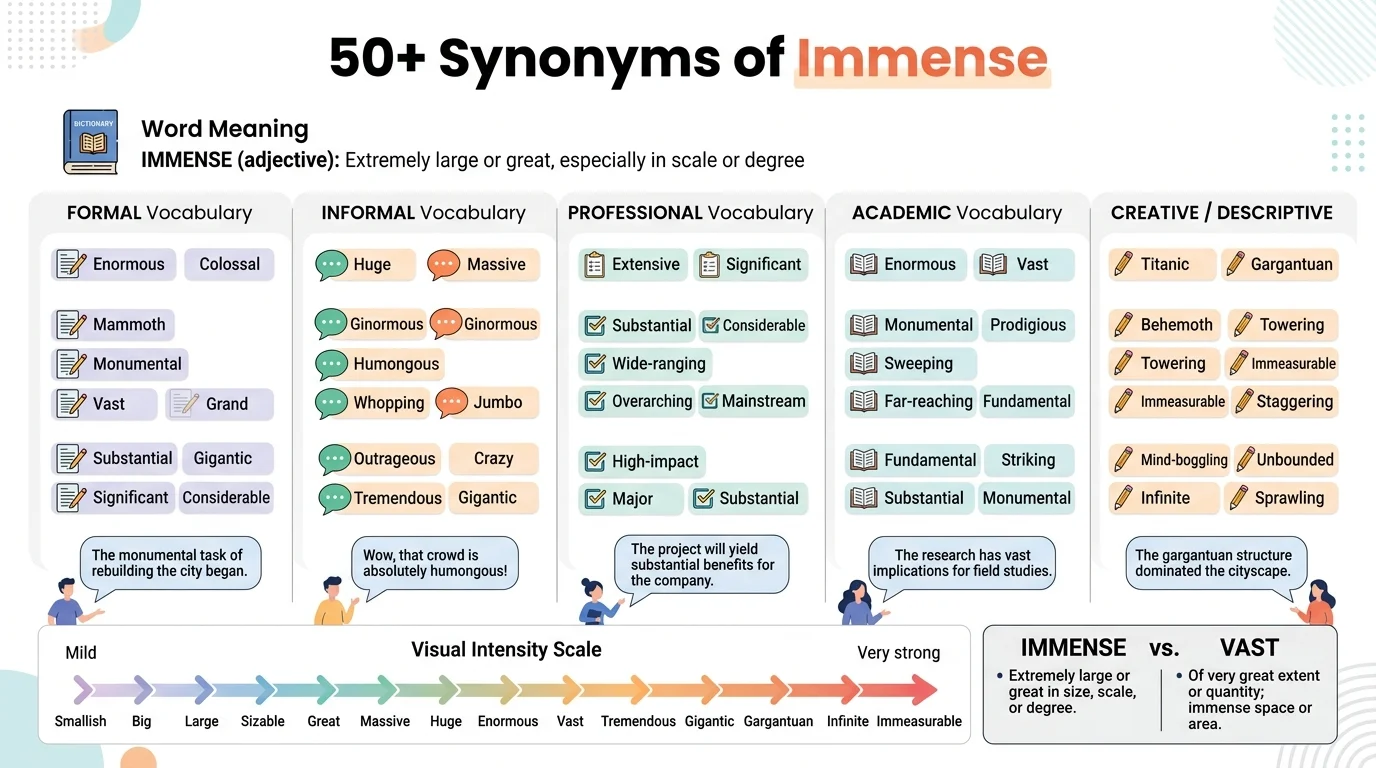
Need a stronger word than “immense”? Choosing the right synonym can be harder than it looks. Words such as enormous, vast, gigantic, and massive all suggest great size, but they do not always fit the same sentence. Some sound formal. Others feel dramatic or conversational. The best choice depends on what you are describing and how strong you want the meaning to feel.
In this guide, you will find 50+ synonyms of immense with clear meanings, practical examples, and usage tips. It will help you find a better word for essays, emails, reports, creative writing, conversations, and everyday English. We also explain which alternatives work best for physical size, amount, impact, importance, or emotional intensity.
So, whether you are searching for a synonym for immense, another word for something extremely large, or a more polished alternative for your writing, this list makes the choice easier. You will learn not just what each word means, but when to use it naturally.
What Are the Best Synonyms of “Immense”?
Immense” means extremely large in size, amount, or degree. Formal writing and business communication, choose “enormous,” “vast,” or “substantial.” Casual conversation, “huge,” “massive,” or “ginormous” work well. Academic or professional contexts, “colossal,” “gigantic,” and “tremendous” add precision and authority.
Meaning, Tone, and Context
Simple Definition
Immense describes something extraordinarily large in size, amount, or degree. It goes beyond ordinary largeness and suggests something that is almost overwhelming in scale.
Part of Speech
Adjective
Overall Tone
Neutral to positive. The word itself does not carry strong negative or positive emotion. It simply describes extreme size or degree. However, the context in which you use it can shift the tone. For example, “immense wealth” sounds positive, while “immense pressure” sounds challenging.
Formality Level
Semi-formal to formal. “Immense” is more formal than “huge” but less formal than “prodigious” or “immeasurable.” It fits comfortably in academic writing, professional communication, and journalism.
Common Uses
Native English speakers use “immense” to describe:
- Physical size: an immense building, an immense ocean
- Amount or quantity: immense wealth, immense resources
- Degree or intensity: immense relief, immense pressure
- Importance or significance: immense value, immense impact
- Talent or ability: immense talent, immense potential
Word Forms
- Adjective: immense
- Adverb: immensely
- Noun: immensity
- Related adjective: immeasurable
When and How to Use “Immense”
Choose “immense” when you want to emphasize that something is not just large but extraordinarily large. It works best when you need a formal yet accessible word that conveys scale without sounding overly dramatic.
Here are seven realistic examples showing how to use “immense” in different contexts.
Professional Context
The new software update has brought immense improvements to our workflow efficiency.
Academic Context
The study revealed an immense gap in the existing research on climate adaptation strategies.
Workplace Context
Our team faced an immense challenge during the merger, but we successfully navigated the transition.
Personal Context
Moving to a new city felt like an immense step, but it turned out to be the best decision I ever made.
Email Context
I want to express my immense gratitude for your support throughout this project.
Resume Context
Managed an immense inventory system spanning 12 warehouses across three states.
Social Media Context
The view from the summit was absolutely immense. I have never seen anything like it.
Best Synonyms of “Immense”
No synonym perfectly matches “immense” in every situation. Each alternative carries its own nuance, tone, and level of formality. Here are the best synonyms of immense for specific contexts.
Professional Writing: Choose “substantial” or “considerable.” These words sound polished and measured without exaggeration.
Academic Writing: Choose “vast” or “enormous.” These terms are precise and widely accepted in scholarly work.
Business Communication: Choose “significant” or “major.” These words convey importance without sounding overly emotional.
Casual Conversation: Choose “huge” or “massive.” These are the most natural choices for everyday speech.
Emotional Writing: Choose “tremendous” or “overwhelming.” These words add emotional weight and intensity.
Creative Writing: Choose “colossal” or “gigantic.” These words create vivid imagery and dramatic effect.
Resume Writing: Choose “substantial” or “significant.” These words highlight your achievements without sounding boastful.
Workplace Communication: Choose “major” or “considerable.” These words are professional yet approachable.
Stronger Meaning: Choose “prodigious,” “stupendous,” or “immeasurable.” These words suggest something beyond normal comprehension.
Softer Meaning: Choose “sizeable,” “good-sized,” or “respectable.” These words suggest largeness without overwhelming intensity.
When Not to Use “Immense”
Using “immense” is not always the best choice. Here are situations where you should choose a different word.
When the word sounds too general: “Immense” can feel vague if you do not specify what you mean. Instead of saying “an immense amount,” try “an immense amount of data” or “an immense sum of money.”
When the word sounds too vague: If you are describing something that is only moderately large, “immense” is an overstatement. Use “large” or “big” instead.
When the word sounds too formal: In casual conversations or text messages, “immense” can feel stiff and unnatural. Use “huge” or “massive” instead.
When the word sounds too informal: In academic papers or official documents, “immense” is acceptable but sometimes less precise than “vast” or “enormous.”
When the word sounds too weak: If you need to emphasize extreme scale, “immense” may not be strong enough. Use “colossal,” “gigantic,” or “prodigious” instead.
When the word sounds too strong: If you are describing something that is only slightly above average, “immense” is an exaggeration. Use “sizeable” or “considerable” instead.
When the word sounds outdated: “Immense” is not outdated, but some older synonyms like “monstrous” or “elephantine” may sound old-fashioned in modern writing.
Incorrect: The project required an immense amount of work. (Vague)
Better: The project required an immense amount of data processing. (Specific)
Incorrect: The coffee shop had an immense selection of pastries. (Overstatement)
Better: The coffee shop had a large selection of pastries. (More accurate)
Words Commonly Confused With “Immense”
Many words overlap with “immense” in meaning, but each has a distinct usage. Here are five commonly confused words.
Immense vs Enormous
Difference: Both mean very large, but “enormous” often suggests something abnormally large or exceeding normal expectations. “Immense” emphasizes vastness of space or scale.
When to Use It: Use “enormous” when you want to highlight abnormality. Use “immense” when you want to highlight sheer size.
Example (Immense): The Grand Canyon is an immense natural wonder.
Example (Enormous): The corporation made an enormous profit this quarter.
Immense vs Vast
Difference: “Vast” primarily refers to horizontal space, area, or range. “Immense” can refer to size, amount, or degree in any dimension.
When to Use It: Use “vast” for landscapes, distances, or collections. Use “immense” for size, amount, or intensity.
Example (Immense): She has immense talent as a musician.
Example (Vast): The vast plains stretched for hundreds of miles.
Immense vs Huge
Difference: “Huge” is more informal and commonly used in everyday speech. “Immense” is more formal and carries a sense of grandeur.
When to Use It: Use “huge” in casual conversation. Use “immense” in professional or academic writing.
Example (Immense): The project has immense implications for the industry.
Example (Huge): We had a huge party for her birthday.
Immense vs Massive
Difference: “Massive” emphasizes bulk, weight, or solidity. “Immense” emphasizes scale or extent.
When to Use It: Use “massive” for physical objects with weight. Use “immense” for abstract concepts or scale.
Example (Immense): The decision had immense consequences.
Example (Massive): The massive boulder blocked the road.
Immense vs Gigantic
Difference: “Gigantic” suggests something unusually large, almost mythical in scale. “Immense” is more neutral and factual.
When to Use It: Use “gigantic” for dramatic or vivid descriptions. Use “immense” for straightforward statements of size.
Example (Immense): The company faced an immense challenge.
Example (Gigantic): A gigantic wave crashed against the shore.
Best Synonyms of “Immense” by Context
| Context | Best Synonym | Why It Works | Example |
|---|---|---|---|
| Formal writing | Enormous | Precise and widely accepted in formal contexts | The committee faced an enormous responsibility. |
| Academic writing | Vast | Emphasizes scope and range, ideal for research | The vast literature on this topic is overwhelming. |
| Professional communication | Substantial | Suggests meaningful size without exaggeration | We made substantial progress on the project. |
| Business emails | Significant | Conveys importance clearly and professionally | This is a significant opportunity for our team. |
| Resume writing | Considerable | Highlights achievements with measured confidence | Managed considerable budgets exceeding $5 million. |
| Workplace communication | Major | Clear and direct without sounding overly formal | This is a major priority for the quarter. |
| Casual conversation | Huge | Natural, conversational, and universally understood | That was a huge relief to hear. |
| Everyday speaking | Massive | Common in spoken English, easy to understand | We have a massive amount of work to do. |
| Creative writing | Colossal | Creates vivid, dramatic imagery | The colossal statue towered over the city. |
| Storytelling | Gigantic | Adds excitement and visual impact | A gigantic creature emerged from the shadows. |
| Emotional writing | Tremendous | Adds emotional weight and intensity | I felt tremendous gratitude for their help. |
| Strong emphasis | Prodigious | Suggests something remarkable and extraordinary | She demonstrated prodigious talent at a young age. |
| Mild tone | Sizeable | Suggests largeness without overwhelming intensity | They made a sizeable donation to the charity. |
| Social media captions | Massive | Engaging and relatable for online audiences | Massive vibes at the concert last night! |
How to Choose the Best Synonym of “Immense”
Choosing the right synonym depends on several factors. Here is a practical decision guide to help you select the most accurate word.
Consider your meaning: Are you describing physical size, amount, degree, or importance? Choose a synonym that matches your specific meaning. Physical size, try “vast” or “gigantic.” For amount, try “substantial” or “considerable.” For degree, try “tremendous” or “overwhelming.”
Consider your tone: Do you want to sound formal, casual, emotional, or neutral? Match your synonym to your desired tone. Formal tone, choose “enormous” or “substantial.” For casual tone, choose “huge” or “massive.” For emotional tone, choose “tremendous” or “overwhelming.”
Consider your audience: Who is reading your writing? Professionals expect formal language. Friends expect casual language. Teachers expect precise language. Choose accordingly.
Consider emotional strength: How strong do you want your statement to be? For mild emphasis, choose “sizeable” or “considerable.” For strong emphasis, choose “colossal” or “prodigious.”
Consider writing purpose: Are you writing to inform, persuade, entertain, or describe? Each purpose benefits from different word choices. Informative writing benefits from precise words like “vast” or “substantial.” Persuasive writing benefits from emotional words like “tremendous” or “overwhelming.”
Consider natural sounding usage: Does the synonym sound natural in your sentence? Read your sentence aloud. If it sounds forced or awkward, choose a different word.
The goal is not to use the biggest word. The goal is to use the most accurate word for your specific situation.
Real Life Examples of “Immense”
Here are realistic examples showing how “immense” and its synonyms appear in everyday situations.
School Assignment
The history project required an immense amount of research, but the final presentation was worth the effort.
College Essay
My semester abroad gave me an immense appreciation for different cultures and perspectives.
Workplace Meeting
We have an immense opportunity to expand into new markets, but we need to act quickly.
Business Report
The company experienced immense growth in the fourth quarter, driven by strong consumer demand.
Professional Email
I want to express my immense appreciation for your guidance throughout this process.
Resume Bullet Point
Led a team of 50 employees and managed immense operational budgets exceeding $10 million.
Casual Conversation
“Did you see the size of that burger?” “Yeah, it was immense. I could barely finish half.”
Storytelling
The immense castle loomed on the hilltop, its towers scraping the gray clouds above.
Blogging
The response to our latest product launch has been immense, with thousands of orders coming in within hours.
Social Media
The energy at the stadium was immense tonight. What an incredible game!
Stronger Synonym Replacement
Original: The storm caused immense damage.
Improved: The storm caused colossal damage to the coastal communities.
Milder Synonym Replacement
Original: The project required immense effort.
Improved: The project required considerable effort from everyone involved.
18 Best Synonyms of “Immense”
| Synonym | Simple Meaning | Best Used For | Example Sentence |
|---|---|---|---|
| Enormous | Abnormally large in size or degree | Formal writing, academic contexts | The enormous stadium held over 80,000 fans. |
| Vast | Extremely wide or extensive in area | Describing spaces, ranges, or collections | The vast desert stretched for miles in every direction. |
| Huge | Very large in size or amount | Casual conversation, everyday writing | We have a huge amount of work to finish today. |
| Massive | Large and solid or heavy | Describing physical objects or quantities | The massive building took three years to construct. |
| Gigantic | Extremely large, often dramatically so | Creative writing, vivid descriptions | A gigantic wave crashed against the cliffs. |
| Colossal | Exceptionally large, almost beyond belief | Dramatic emphasis, storytelling | The colossal statue was visible from miles away. |
| Tremendous | Extremely large or powerful | Emotional writing, expressing intensity | I felt tremendous relief when I heard the news. |
| Substantial | Considerable in size or importance | Professional and business writing | We made a substantial investment in new technology. |
| Considerable | Large enough to be important or noticeable | Professional and academic writing | The project required considerable time and resources. |
| Prodigious | Remarkably or impressively large | Strong emphasis, exceptional achievements | She has a prodigious memory for facts and figures. |
| Stupendous | Astonishingly large or impressive | Dramatic emphasis, awe-inspiring situations | The stupendous fireworks display left everyone speechless. |
| Immeasurable | Too large to be measured | Abstract concepts, emotional depth | His contribution to the field is immeasurable. |
| Mammoth | Extremely large, like a woolly mammoth | Describing large tasks or projects | Organizing the event was a mammoth undertaking. |
| Gargantuan | Enormous, often in appetite or scale | Informal but vivid descriptions | He has a gargantuan appetite for adventure. |
| Monumental | Great in importance or size | Describing achievements or historical significance | The discovery was a monumental breakthrough in science. |
| Boundless | Without limits or boundaries | Abstract concepts, potential, or imagination | The child’s imagination was boundless. |
| Infinite | Limitless or endless in space or time | Philosophical or abstract contexts | The universe is infinite in its complexity. |
| Limitless | Without any limits | Describing potential, possibilities, or resources | The opportunities in this field are limitless. |
Synonyms of “Immense” by Usage
Professional vs Personal Synonyms
Professional synonyms work best in workplaces, business settings, and formal communication. These words sound polished and measured: substantial, considerable, significant, major, and enormous.
Personal synonyms sound better in everyday conversations with friends and family. These words feel natural and approachable: huge, massive, gigantic, and ginormous.
Recommendation: In professional emails, use “substantial” or “significant.” In personal messages, use “huge” or “massive.”
Formal vs Conversational Synonyms
Formal synonyms fit reports, essays, business writing, presentations, and professional emails: enormous, vast, substantial, considerable, prodigious, and immeasurable.
Conversational synonyms fit casual conversations, texting, and social media: huge, massive, gigantic, ginormous, and humongous.
Recommendation: Match your synonym to your medium. Formal writing demands formal words. Casual writing welcomes casual words.
Academic Synonyms
Academic writing requires precise, authoritative vocabulary. These synonyms are suitable for research papers, essays, reports, and academic discussions:
- Vast: Ideal for describing extensive research or literature
- Enormous: Suitable for describing significant findings or effects
- Substantial: Perfect for describing meaningful contributions or evidence
- Considerable: Works well for describing notable differences or amounts
- Prodigious: Appropriate for describing exceptional talent or achievement
These words sound more authoritative because they are commonly used in peer-reviewed journals and academic publications.
Professional and Business Synonyms
Business communication demands clarity and professionalism. These synonyms are the strongest choices for resumes, interviews, meetings, presentations, performance reviews, client communication, and business emails:
- Substantial: Conveys meaningful size or importance without exaggeration
- Significant: Emphasizes importance and impact
- Major: Direct and clear for highlighting priorities
- Considerable: Suggests notable size or effort
- Enormous: Appropriate for describing exceptional growth or success
Why they fit: These words are professional without sounding pretentious. They communicate confidence and competence.
Creative and Literary Synonyms
Creative writing benefits from expressive, vivid alternatives. These synonyms add emotion and imagery to storytelling, fiction, poetry, descriptive writing, and speeches:
- Colossal: Creates a sense of awe and grandeur
- Gigantic: Adds visual impact and excitement
- Tremendous: Conveys emotional weight and intensity
- Prodigious: Suggests something remarkable and extraordinary
- Stupendous: Evokes astonishment and wonder
- Monumental: Adds historical or cultural significance
These words help paint pictures in the reader’s mind and evoke emotional responses.
Slang or Modern Synonyms
While “immense” does not have many widely accepted slang equivalents, a few informal options exist:
- Ginormous: A blend of “gigantic” and “enormous,” used informally to mean extremely large
- Humongous: Informal American English meaning very large
- Mega: Informal prefix or adjective meaning very large or impressive
Where it is acceptable: Casual conversations, social media, texting, and informal writing.
Where it should be avoided: Academic papers, professional reports, business emails, and formal presentations.
Strongest to Mildest Synonyms
Here is an intensity scale showing how emotional strength changes across synonyms.
| Intensity | Synonym | Emotional Weight |
|---|---|---|
| Very Mild | Sizeable | Suggests largeness without intensity |
| Mild | Considerable | Suggests noticeable size or importance |
| Moderate | Substantial | Suggests meaningful size or value |
| Moderate-Strong | Enormous | Suggests abnormally large size |
| Strong | Vast | Suggests extensive scale or range |
| Stronger | Tremendous | Adds emotional weight and intensity |
| Very Strong | Colossal | Suggests almost unbelievable scale |
| Very Strong | Gigantic | Creates vivid, dramatic imagery |
| Extremely Strong | Prodigious | Suggests remarkable, extraordinary size |
| Extremely Strong | Stupendous | Evokes astonishment and awe |
| Maximum | Immeasurable | Suggests size beyond measurement |
Emotional vs Neutral Synonyms
Emotional Synonyms
These words express stronger feelings and add emotional weight to your writing:
- Tremendous: Conveys powerful emotion (tremendous joy, tremendous relief)
- Overwhelming: Suggests being emotionally or physically overcome
- Stupendous: Evokes wonder and astonishment
- Prodigious: Suggests admiration and awe
- Colossal: Creates a sense of grandeur and drama
Best used for: Personal stories, emotional writing, speeches, and persuasive content.
Neutral Synonyms
These words simply communicate information without adding emotion:
- Vast: Describes extent without emotional coloring
- Substantial: Describes size or importance factually
- Considerable: Describes notable size objectively
- Enormous: Describes large size without emotional weight
- Massive: Describes physical size or quantity neutrally
Best used for: Reports, academic writing, business communication, and factual descriptions.
Antonyms of “Immense”
| Antonym | Meaning | Example Sentence |
|---|---|---|
| Tiny | Extremely small | The tiny kitten fit in the palm of my hand. |
| Small | Below average in size | We live in a small apartment in the city. |
| Minute | Extremely small or insignificant | The minute details were hard to see without a microscope. |
| Petite | Small and delicate, often used for people | She wore a petite dress that fit her perfectly. |
| Little | Small in size or amount | I only have a little time before my meeting. |
| Miniature | Very small, often a smaller version | The miniature model of the building was incredibly detailed. |
| Microscopic | So small it can only be seen with a microscope | The microscopic organisms were invisible to the naked eye. |
| Insignificant | Too small or unimportant to matter | The error was insignificant and did not affect the results. |
| Negligible | So small or unimportant that it can be ignored | The difference in cost was negligible. |
| Paltry | Small and inadequate | He received a paltry sum for his hard work. |
| Meager | Lacking in quantity or quality | The meager portions left everyone still hungry. |
| Scant | Barely sufficient or not enough | The scant evidence was not enough to convict him. |
| Limited | Restricted in size or amount | We have limited resources for this project. |
| Bounded | Having limits or boundaries | The bounded area was clearly marked on the map. |
| Finite | Having limits or an end | The finite resources of the planet must be conserved. |
Comparison: “Immense” vs Similar Words
Immense vs Enormous
Main Difference: “Enormous” often suggests something abnormally large or exceeding normal expectations. “Immense” emphasizes vastness of space or scale.
Which Is Stronger? “Enormous” can feel slightly stronger because it implies abnormality.
Which Is More Formal? Both are formal, but “immense” is slightly more formal.
When to Use Each: Use “enormous” for surprising or abnormal size. Use “immense” for sheer scale or extent.
Examples:
Immense: The immense ocean stretched to the horizon.
Enormous: The enormous profit surprised everyone.
Immense vs Vast
Main Difference: “Vast” primarily refers to horizontal space, area, or range. “Immense” can refer to size, amount, or degree in any dimension.
Which Is Stronger? Both are strong, but “vast” emphasizes breadth while “immense” emphasizes overall size.
Which Is More Formal? Both are formal.
When to Use Each: Use “vast” for landscapes, distances, or collections. Use “immense” for size, amount, or intensity.
Examples:
Immense: She has immense talent as a musician.
Vast: The vast plains stretched for hundreds of miles.
Immense vs Huge
Main Difference: “Huge” is more informal and commonly used in everyday speech. “Immense” is more formal and carries a sense of grandeur.
Which Is Stronger? Both are similar in strength, but “immense” feels more weighty.
Which Is More Formal? “Immense” is more formal.
When to Use Each: Use “huge” in casual conversation. Use “immense” in professional or academic writing.
Examples:
Immense: The project has immense implications for the industry.
Huge: We had a huge party for her birthday.
Immense vs Massive
Main Difference: “Massive” emphasizes bulk, weight, or solidity. “Immense” emphasizes scale or extent.
Which Is Stronger? Both are strong, but “massive” feels more physical.
Which Is More Formal? Both are formal.
When to Use Each: Use “massive” for physical objects with weight. Use “immense” for abstract concepts or scale.
Examples:
Immense: The decision had immense consequences.
Massive: The massive boulder blocked the road.
Immense vs Gigantic
Main Difference: “Gigantic” suggests something unusually large, almost mythical in scale. “Immense” is more neutral and factual.
Which Is Stronger? “Gigantic” often feels more dramatic.
Which Is More Formal? “Immense” is more formal.
When to Use Each: Use “gigantic” for dramatic or vivid descriptions. Use “immense” for straightforward statements of size.
Examples:
Immense: The company faced an immense challenge.
Gigantic: A gigantic wave crashed against the shore.
Immense vs Colossal
Main Difference: “Colossal” suggests something exceptionally large, often beyond normal comprehension. “Immense” is more grounded and factual.
Which Is Stronger? “Colossal” is stronger and more dramatic.
Which Is More Formal? Both are formal, but “colossal” is more literary.
When to Use Each: Use “colossal” for dramatic emphasis or creative writing. Use “immense” for professional or academic contexts.
Examples:
Immense: The team faced an immense workload.
Colossal: The colossal statue dominated the skyline.
Common Phrases and Expressions with “Immense”
Immense gratitude
Meaning: Extreme thankfulness or appreciation.
Example Sentence: I want to express my immense gratitude for your support during this difficult time.
Immense relief
Meaning: A powerful feeling of release from worry or stress.
Example Sentence: To my immense relief, the test results came back negative.
Immense value
Meaning: Great worth or importance.
Example Sentence: The training program has immense value for new employees.
Immense potential
Meaning: Great possibility for future success or development.
Example Sentence: The young athlete has immense potential to become a champion.
Immense pressure
Meaning: Extreme stress or force, often from expectations or circumstances.
Example Sentence: The CEO faced immense pressure to deliver better quarterly results.
Immense popularity
Meaning: Widespread and intense public approval or fame.
Example Sentence: Her movies continue to enjoy immense popularity worldwide.
Immense wealth
Meaning: Great financial resources or riches.
Example Sentence: He inherited an immense fortune from his grandfather.
Immense talent
Meaning: Exceptional natural ability or skill.
Example Sentence: She is an artist of immense talent.
Common Mistakes to Avoid
1: Choosing a vague synonym instead of a precise one
Incorrect: The project required a huge amount of data analysis.
Better: The project required a substantial amount of data analysis.
Why: “Substantial” is more precise and professional than “huge” in this context.
2: Confusing “immense” with “enormous”
Incorrect: The immense profits surprised the investors. (If “enormous” better fits the context of abnormality)
Better: The enormous profits surprised the investors.
Why: “Enormous” emphasizes abnormality, which fits the surprising nature of the profits.
3: Using an informal synonym in formal writing
Incorrect: The study revealed a massive gap in the research.
Better: The study revealed a considerable gap in the research.
Why: “Considerable” sounds more academic and measured than “massive.”
4: Selecting an overly dramatic synonym
Incorrect: We had a colossal meeting yesterday.
Better: We had an important meeting yesterday.
Why: “Colossal” is too dramatic for describing a routine meeting.
5: Repeating the same word too often
Incorrect: The immense building was immense in size and had immense windows.
Better: The colossal building was vast in size and had gigantic windows.
Why: Varying your word choice makes your writing more engaging and less repetitive.
6: Choosing a synonym with the wrong emotional tone
Incorrect: I felt tremendous sadness at the news. (If “tremendous” suggests positive intensity)
Better: I felt overwhelming sadness at the news.
Why: “Overwhelming” better fits the emotional weight of sadness.
7: Using slang in academic or professional writing
Incorrect: The research had a ginormous impact on the field.
Better: The research had a substantial impact on the field.
Why: “Ginormous” is too informal for academic writing.
Frequently Asked Questions
1. What are the best synonyms of “immense”?
The best synonyms depend on your context. Formal writing, use “enormous” or “vast.” For casual conversation, use “huge” or “massive.” For emotional emphasis, use “tremendous” or “colossal.”
2. What are the best formal synonyms of “immense”?
The best formal synonyms include “enormous,” “vast,” “substantial,” “considerable,” and “prodigious.” These words are widely accepted in academic papers, business reports, and professional correspondence.
3. What are common informal synonyms of “immense”?
Common informal synonyms include “huge,” “massive,” “ginormous,” and “humongous.” These words are best suited for casual conversations, texting, and social media posts.
4. What is another word for “immense” in professional writing?
In professional writing, choose “substantial,” “significant,” or “considerable.” These words convey importance and scale without sounding exaggerated or overly emotional.
5. What is the difference between “immense” and “enormous”?
“Enormous” often suggests something abnormally large or exceeding normal expectations. “Immense” emphasizes vastness of space or scale. Use “enormous” for surprising size and “immense” for sheer scale.
6. What is the opposite of “immense”?
The opposite of “immense” includes “tiny,” “small,” “minute,” “petite,” and “insignificant.” The best choice depends on the degree of smallness you want to convey.
Conclusion
Immense” is a powerful word that describes something extremely large in size, amount, or degree. Its synonyms offer a rich palette of alternatives for every writing situation. From the formal precision of “enormous” and “vast” to the casual familiarity of “huge” and “massive,” the best synonyms of immense help you communicate with clarity and confidence.
No synonym works perfectly in every situation. The right choice depends on your audience, your tone, and your purpose. By understanding the subtle differences between these words, you can choose the most accurate synonym for every context.
Vocabulary improvement tip: Keep a list of synonyms for words you use frequently. When you write, review your list and choose the word that best fits your specific meaning and tone. Over time, this practice will expand your vocabulary and sharpen your communication skills.
Definitions, meanings, and usage recommendations should be verified with trusted language references before publication. Recommended sources include Cambridge Dictionary, Oxford English Dictionary, Merriam Webster, Collins Dictionary, and Britannica.
1 thought on “50+ Synonyms of Immense | Meanings, Uses, Examples, and Best Alternatives”