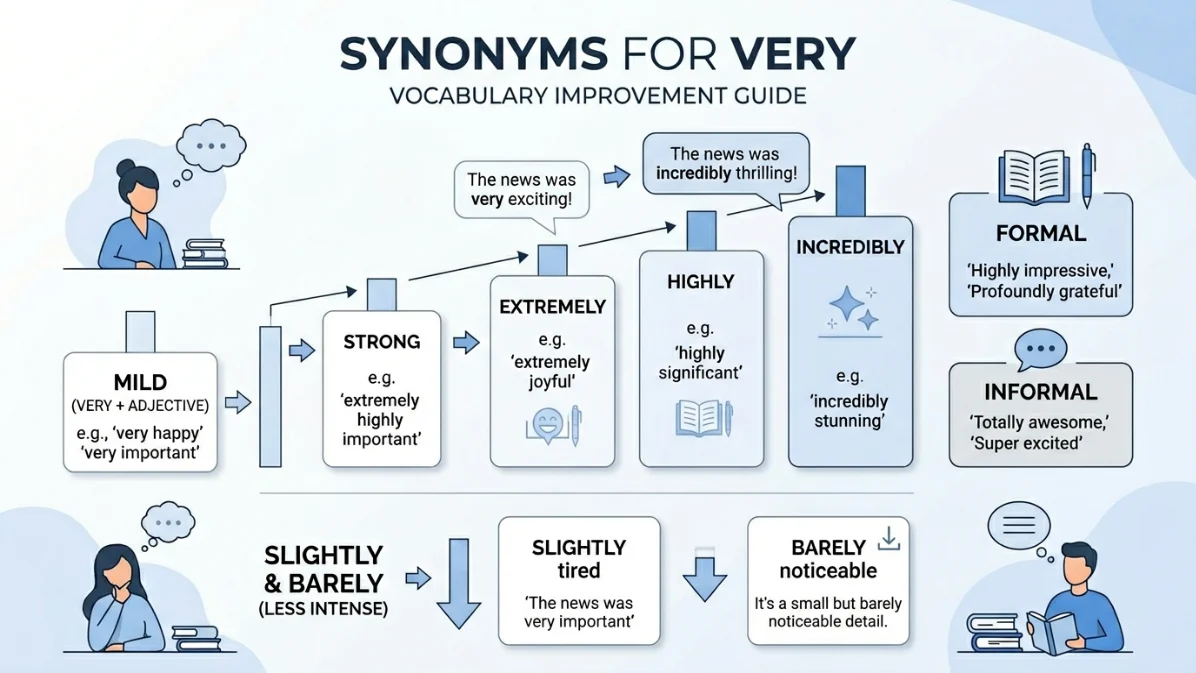
“Very” is one of the most common intensifiers in English, used to strengthen adjectives and adverbs. When people search for synonyms for very, they usually want stronger, more precise, or more natural alternatives like “extremely,” “highly,” or “incredibly.” The best replacement depends on tone, context, and how strong you want the expression to sound. In formal writing, “very” often feels weak or repetitive, so better word choices can make your writing clearer and more expressive.
Best Synonyms for Very
The best synonyms for very are extremely, highly, really, incredibly, and exceptionally. The right choice depends on tone, context, and intensity.
What Does Very Mean?
“Very” is an adverb of degree used to increase the intensity of an adjective or another adverb. It does not have a concrete meaning on its own but changes the strength of a word it modifies.
It is commonly used in everyday speech and writing.
Examples:
- She is very happy today.
- The exam was very difficult.
In both cases, “very” increases the level of happiness or difficulty.
Core Meaning of Very
At its core, “very” is used to show a high degree of something. It acts like a volume knob that turns up the strength of a description.
However, English offers richer alternatives that can replace “very + adjective” with a single stronger word:
- very tired → exhausted
- very happy → delighted
- very angry → furious
These replacements often sound more natural and expressive.
Grammar and Usage Notes
- Part of speech: Adverb (intensifier)
- Common pattern: very + adjective / very + adverb
- Example structure:
- very + adjective → very cold, very smart
- very + adverb → very quickly
When “very” sounds natural:
- Casual conversation
- Simple writing
- Basic descriptions
When a synonym works better:
- Academic writing
- Professional reports
- Creative storytelling
- Formal communication
Best Synonyms for Very
| Synonym | Meaning | Tone | Best Use Case | Example Sentence |
|---|---|---|---|---|
| Extremely | Very high degree | Neutral/Formal | General strong emphasis | The weather is extremely cold today. |
| Highly | Strong degree of quality | Formal | Professional writing | She is highly skilled in design. |
| Incredibly | Hard to believe intensity | Informal/Emphatic | Emotional speech | That movie was incredibly good. |
| Exceptionally | Above normal level | Formal | Academic/business writing | He is exceptionally talented. |
| Really | Strong but casual | Informal | Everyday conversation | I’m really tired after work. |
| Absolutely | Total intensity | Strong | Emphasis in speech | I’m absolutely sure about it. |
| Remarkably | Notably high degree | Formal | Descriptive writing | The results were remarkably consistent. |
| Terribly | Strong negative emphasis | Informal | Negative situations | I feel terribly sorry. |
Common Synonyms for Very
These are everyday alternatives used in normal speech and writing:
- Really
Meaning: Strong casual emphasis
Example: I’m really happy to see you. - So
Meaning: Informal emotional intensity
Example: She is so kind. - Quite
Meaning: Moderate to strong (context dependent)
Example: The task was quite difficult. - Pretty
Meaning: Mild informal emphasis
Example: It’s pretty cold outside.
These words are common but less formal than “extremely” or “highly.”
Formal Synonyms for Very
Formal writing often avoids “very” because it weakens precision. Better choices include:
- Extremely – Strong and professional
- Highly – Used for skills, qualities, or standards
- Exceptionally – Above-average performance or quality
- Considerably – Noticeable degree of change
- Substantially – Large or significant amount
When to use:
- Essays
- Reports
- Academic papers
- Business communication
Example:
- He is highly qualified for the position.
Informal Synonyms for Very
Casual language often uses more expressive or emotional intensifiers:
- Really – Common everyday speech
- So – Emotional emphasis
- Super – Friendly and informal
- Totally – Strong casual agreement
Example:
- That game was super fun.
Strong Synonyms for Very
Stronger alternatives replace “very” with more powerful intensity:
- Incredibly – Extremely surprising or strong
- Absolutely – Complete emphasis
- Terribly – Strong emotional intensity (often negative)
- Utterly – Total or complete degree
- Extraordinarily – Beyond normal limits
When to use:
- Emotional writing
- Storytelling
- Strong opinions
Be careful: These can sound exaggerated if overused.
Mild Synonyms for Very
Mild alternatives reduce intensity slightly:
- Somewhat – Partial intensity
- Fairly – Moderate level
- Kind of – Informal softening
- Slightly – Small degree
- A bit – Light emphasis
When to use:
- Polite writing
- Balanced tone
- Soft criticism
Example:
- I’m slightly tired, not exhausted.
Synonyms for Very by Context
Everyday Conversation
- really, so, pretty, super
Used for casual communication where natural flow matters more than precision.
Professional Writing
- highly, extremely, exceptionally
Used for clarity and formality.
Academic Writing
- substantially, considerably, significantly
Used for analytical tone and precision.
Creative Writing
- incredibly, utterly, remarkably
Used for emotional impact and storytelling.
Marketing Copy
- extremely, absolutely, incredibly
Used to create persuasive emphasis.
Emotional Expression
- so, really, deeply, terribly
Used to express feelings naturally.
Another Word for Very in a Sentence
Here are natural examples using different alternatives:
- She is extremely intelligent.
- He is highly respected in his field.
- I’m really excited for the trip.
- The food was incredibly delicious.
- She is exceptionally talented at music.
- I’m absolutely sure about this decision.
- The results were remarkably accurate.
- He felt terribly sad after the news.
- The task was fairly simple.
- I am so tired right now.
- The view is utterly beautiful.
- She is slightly confused about the rules.
- The project was highly successful.
- It was pretty cold last night.
- He is considerably better at math now.
Very Synonyms Compared
| Word | Strength | Tone | Best Use |
|---|---|---|---|
| Very | Neutral | Basic | Everyday writing |
| Extremely | Strong | Neutral | General emphasis |
| Highly | Strong | Formal | Professional context |
| Incredibly | Very strong | Emotional | Speech and storytelling |
| Exceptionally | Strong | Formal | Academic/business writing |
Small differences matter:
- “Highly skilled” sounds professional.
- “Very skilled” sounds basic.
- “Incredibly skilled” adds emotional tone.
Words Similar to Very
These are related intensifiers but not exact replacements:
- Almost – near but not complete
- Totally – complete agreement or state
- Completely – full extent of something
- Enough – sufficient level
- Quite a bit – moderate emphasis
They relate to intensity but don’t always replace “very” directly.
Antonyms of Very
- Slightly – small degree
Example: She is slightly tired. - Barely – almost not at all
Example: He barely passed the exam. - Somewhat – moderate level
Example: I am somewhat confused. - Moderately – middle level
Example: The weather is moderately warm.
How to Choose the Right Synonym for Very
- Match the context (formal vs informal)
- Match the tone (neutral, emotional, professional)
- Check the intensity level
- Think about your audience
- Avoid replacing every “very” mechanically
- Prefer stronger single words when possible
- Keep sentences natural and readable
Common Mistakes When Using Synonyms for Very
- Using overly strong words in simple sentences
- Mixing formal and informal tone
- Overusing intensifiers like “incredibly”
- Replacing “very” without checking meaning
- Making sentences sound unnatural
- Using emotional words in technical writing
- Treating all synonyms as equal in strength
Quick Synonym List for Very
Common synonyms:
- really, so, pretty, quite
Formal synonyms:
- extremely, highly, exceptionally, substantially
Informal synonyms:
- super, totally, really
Strong synonyms:
- utterly, absolutely, incredibly, extraordinarily
Mild synonyms:
- slightly, somewhat, fairly, a bit
Related words:
- completely, almost, enough, moderately
FAQs About Synonyms for Very
What is the best synonym for very?
The best synonyms for very are extremely, highly, really, and incredibly, depending on tone and context.
What is another word for very?
Another word for very could be extremely, exceptionally, or really, depending on how strong the emphasis needs to be.
What is a formal synonym for very?
Formal synonyms include highly, extremely, exceptionally, and substantially, commonly used in academic or business writing.
What is an informal synonym for very?
Informal synonyms include really, so, super, and totally, which are common in everyday speech.
What is a stronger word for very?
Stronger words include incredibly, utterly, and absolutely, which add more emotional or dramatic emphasis.
What is a milder word for very?
Milder words include slightly, somewhat, fairly, and a bit, which reduce intensity.
What words are similar to very?
Words similar to very include intensifiers like really, extremely, highly, and so, but each varies in strength and tone.
What is the opposite of very?
The opposite of very includes slightly, barely, somewhat, and moderately, which reduce intensity instead of increasing it.
Conclusion
“Very” is simple and common, but it is not always the strongest or most precise choice. The best synonyms for very depend on context, tone, and intensity. Words like “extremely,” “highly,” and “incredibly” can make your writing clearer and more expressive, while milder options like “slightly” or “somewhat” help soften meaning. Choosing the right word helps your writing sound more natural and professional.