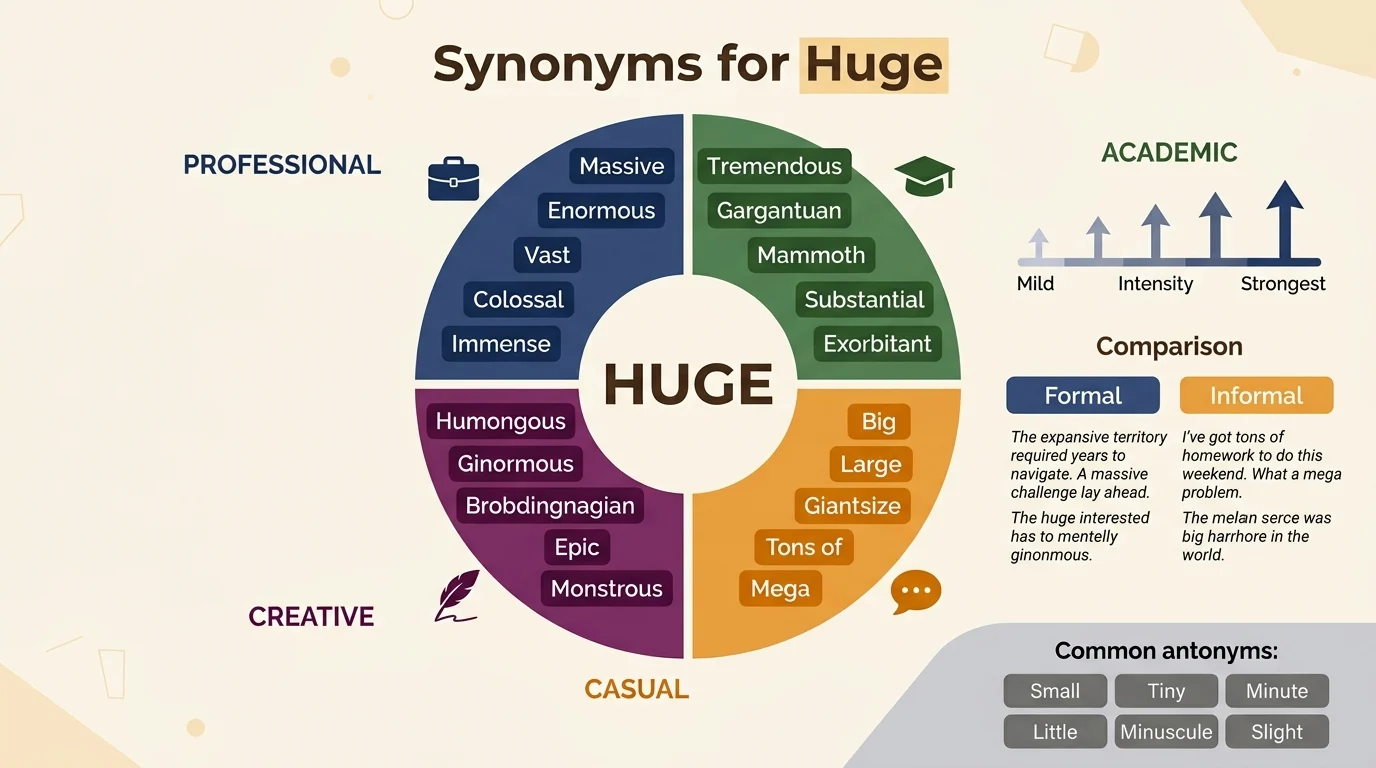
Do you keep using the word “huge” for everything? That large pizza, your massive project, that enormous responsibility at work. When every big thing becomes “huge,” your writing loses its edge. Your readers stop paying attention. Your vocabulary feels flat and repetitive.
Here is the truth. The English language offers dozens of precise alternatives for “synonyms for huge.” Each one carries a different weight, tone, and emotional impact. Learning these alternatives will transform your writing and speaking in ways you never expected.
Whether you are writing an important email, crafting a compelling resume, describing a breathtaking view, or explaining a complex concept, the right word makes all the difference. This guide will help you choose the perfect word for every situation.
What Does “Huge” Mean?
Huge means extremely large in size, amount, scale, or importance. The best synonyms for huge depend on your context. In formal writing, try “substantial” or “considerable.” For casual conversation, “massive” or “enormous” work well. Academic writing often prefers “significant” or “extensive.” Creative writing benefits from “colossal,” “titanic,” or “immense.”
Meaning, Tone and Context
Huge is an adjective that describes something remarkably large in physical size, quantity, degree, or importance.
Simple definition: Very large or extensive. Much bigger than average.
Part of speech: Adjective
Tone: Neutral. Huge does not carry strong positive or negative emotional weight. It simply describes size or magnitude.
Formality level: Semi-formal. Huge works in most everyday situations. It appears in casual conversation, business emails, news articles, and even academic writing. However, some formal contexts prefer more precise alternatives.
Common use cases:
- Describing physical objects like buildings, animals, or spaces
- Talking about numbers, amounts, or quantities
- Referring to significant events or achievements
- Expressing importance or impact
- Sharing feelings about something impressive or overwhelming
Important word forms:
- Huge (adjective)
- Hugeness (noun)
- Hugely (adverb)
When and How to Use “Huge”
Huge works best when you need a general, widely understood word for something very large. It fits many situations without sounding overly dramatic or academic. However, using it too often makes your writing feel lazy.
Here are examples showing how to use huge across different situations.
Professional Context
The quarterly earnings report showed a huge increase in international sales.
Personal Context
We had a huge celebration for my grandmother’s 80th birthday.
Academic Context
The research revealed a huge gap in our understanding of climate patterns.
Emotional Context
I felt a huge wave of relief when I received the acceptance letter.
Creative Context
The ancient tree cast a huge shadow across the entire meadow.
Social Media Context
This new coffee shop has a huge outdoor patio perfect for summer mornings.
Resume Context
I managed a huge budget of over five million dollars for three consecutive years.
Email Context
Thank you for your huge contribution to the team’s success this quarter.
Another Word for “Huge”
Choosing the best single replacement depends entirely on your situation. The perfect alternative makes your meaning clearer and your writing more precise.
Professional Writing
“Substantial” works best in professional contexts. It sounds serious and credible. Our company made substantial investments in renewable energy.
Academic Writing
“Significant” carries the right weight for research and scholarly work. The study showed a significant correlation between exercise and cognitive function.
Casual Conversation
“Massive” feels natural in everyday speech. That burger was absolutely massive.
Emotional Writing
“Overwhelming” captures feelings of being deeply affected. The support from my community was overwhelming.
Creative Writing
“Colossal” adds drama and visual impact. The colossal waves crashed against the cliff.
Resume or Workplace
“Considerable” shows professionalism and precision. I developed a considerable network of industry contacts.
Social Media Captions
“Enormous” works well for eye catching posts. This sunset view is absolutely enormous in scale.
Stronger Meaning
“Titanic” suggests monumental size with a hint of epic drama. The titanic effort saved the entire project.
Softer Meaning
“Sizeable” offers a more moderate alternative. We have a sizeable collection of antique furniture.
When Not to Use “Huge”
Huge becomes problematic when you need precision. It is too vague for scientific measurements, financial reports, or any situation where exact numbers matter.
Consider this weak sentence:
The company experienced a huge loss last year.
How huge is huge? Ten thousand dollars? Ten million? The reader has no idea.
A precise alternative improves the sentence dramatically:
The company experienced a substantial loss of two million dollars last year.
Huge also fails in formal academic writing. Professors and researchers expect specific, measurable language. “A huge number of participants” sounds amateurish. “A significant sample size of 500 participants” sounds professional.
Similarly, avoid huge in legal documents, technical manuals, or medical reports. These fields demand exact terminology.
Do not use huge to describe something that is only slightly above average. This makes you sound dramatic or unreliable. A 10 percent increase is not huge. It is moderate or modest.
Words Commonly Confused With “Huge”
Several words seem similar to huge but carry different meanings. Understanding these differences will make your word choices more accurate.
Huge vs. Large
Large is more general and less intense than huge. Large simply means above average in size. Huge suggests something remarkably or surprisingly big. A large pizza feeds two people. A huge pizza feeds six people.
Huge vs. Massive
Massive emphasizes weight, density, and solid physical presence. Huge focuses more on overall size or scale. A massive boulder feels heavy and solid. A huge stadium feels spacious and expansive.
Huge vs. Enormous
Enormous suggests something abnormally or unexpectedly large. Huge describes something notably large but not necessarily surprising. The enormous spider startled everyone. The huge shopping mall had three hundred stores.
Huge vs. Immense
Immense suggests size that is difficult to measure or comprehend. Huge describes size that is easy to recognize. The immense universe contains billions of galaxies. The huge building had forty floors.
Huge vs. Gigantic
Gigantic suggests size that resembles a giant, often in a dramatic way. Huge is more straightforward and less imaginative. The gigantic statue towered over the city. The huge statue attracted many visitors.
Huge vs. Vast
Vast describes something spread over a great area or encompassing many things. Huge focuses on the size of a single thing or amount. The vast desert stretched for hundreds of miles. The huge sand dune stood fifty feet tall.
Best Synonym by Context for “Huge”
| Context | Best Synonym | Why It Works | Example |
|---|---|---|---|
| Formal Writing | Substantial | Sounds credible and measured | The committee made substantial progress on the new policy. |
| Academic Writing | Significant | Indicates meaningful results | The data showed a significant difference between groups. |
| Professional Business | Considerable | Shows careful evaluation | We allocated considerable resources to this initiative. |
| Resume or Workplace | Extensive | Highlights broad experience | I developed extensive expertise in digital marketing. |
| Casual Conversation | Massive | Feels natural and conversational | That party was absolutely massive. |
| Creative Writing | Colossal | Adds dramatic visual impact | The colossal mountains rose against the golden sky. |
| Emotional Tone | Overwhelming | Captures deep feeling | The kindness of strangers was overwhelming. |
| Strong Intensity | Titanic | Suggests epic, monumental scale | The titanic effort saved the endangered species. |
| Soft or Moderate | Sizeable | Offers a balanced description | They donated a sizeable amount to the charity. |
| Social Media Captions | Enormous | Grabs attention visually | This view from the top is enormous. |
| US Usage | Massive | Common and widely understood | The stadium drew a massive crowd. |
| UK Usage | Massive or Enormous | Both are equally common | The garden was enormous by London standards. |
Which Synonym Should You Choose?
Choosing the right synonym starts with understanding your situation. Ask yourself these questions before you write.
What is your audience? Professional colleagues expect words like substantial or considerable. Friends and family respond better to massive or enormous. Academic readers want significant or extensive.
What is your purpose? Are you describing physical size, emotional impact, or numerical quantity? Physical size fits words like immense and colossal. Emotional impact calls for overwhelming or profound. Numbers and amounts work with substantial and significant.
How intense should your word be? Mild situations require moderate words like sizeable or large. Strong impact needs powerful words like titanic, colossal, or monumental.
What is your sentence structure? Some words flow better in certain positions. “The project required a substantial investment” sounds natural. “The project required a titanic investment” sounds dramatic.
Consider the emotional tone. Do you want to sound neutral, impressed, overwhelmed, or professional? Each synonym carries a different emotional weight.
Finally, think about variety. Even the best word becomes boring when repeated. Vary your choices to keep your writing fresh and engaging.
Real Life Examples of “Huge” in Sentences
These examples show how to use huge and its synonyms across different real world situations.
School Context
The history project required a substantial amount of research, but the results were worth it.
Workplace Context
My manager gave me a considerable amount of responsibility after I completed the training program.
Writing Context
The novelist described the immense landscape with such vivid detail that readers felt transported.
Conversational Context
We had a massive thunderstorm last night that knocked down several trees in our neighborhood.
Social Media Context
This new trail offers an enormous view of the entire valley. You have to see it in person.
Resume Context
I managed an extensive portfolio of clients across three different countries.
Email Context
Thank you for your significant contribution to the quarterly report. Your analysis was invaluable.
Storytelling Context
The colossal waves crashed against the ancient lighthouse while the storm raged on.
Personal Context
I felt overwhelming gratitude when my friends organized a surprise party for me.
Business Context
The company announced a substantial expansion that will create two hundred new jobs.
25 Synonyms for “Huge”
| Synonym | Simple Meaning | Best Used For | Example Sentence |
|---|---|---|---|
| Massive | Very large and solid | Physical objects, crowds, amounts | The massive rock formation blocked the entire path. |
| Enormous | Extremely large, often surprisingly so | Anything unexpectedly big | We saw an enormous whale breach the water. |
| Immense | So large it is hard to measure | Vast spaces, abstract concepts | The project required immense patience and skill. |
| Colossal | Huge in a dramatic, impressive way | Creative writing, dramatic descriptions | The colossal statue dominated the city square. |
| Substantial | Large in a solid, meaningful way | Formal writing, professional contexts | They made a substantial donation to the hospital. |
| Considerable | Large enough to be important | Business, professional communication | She has considerable experience in marketing. |
| Significant | Large and important | Academic, research, professional | The results showed a significant improvement. |
| Extensive | Covering a large area or scope | Resumes, descriptions of experience | He had extensive knowledge of ancient history. |
| Vast | Spreading over a large area | Landscapes, knowledge, resources | The vast ocean stretched to the horizon. |
| Gigantic | Resembling a giant in size | Imaginative or dramatic writing | The gigantic sunflower towered over the garden. |
| Titanic | Very large with epic connotations | Strong, dramatic descriptions | The titanic effort required incredible teamwork. |
| Monumental | Huge and historically important | Achievements, events, efforts | The construction was a monumental undertaking. |
| Tremendous | Very large in a powerful way | Impact, success, effort | She showed tremendous courage during the crisis. |
| Stupendous | Huge and amazing | Impressive achievements | The acrobat performed a stupendous leap. |
| Prodigious | Remarkably large | Academic, literary contexts | The author displayed prodigious talent. |
| Oversized | Larger than standard size | Products, clothing, items | He bought an oversized chair for his living room. |
| Sizable | Large but not excessive | Balanced, moderate descriptions | We have a sizable collection of vintage records. |
| Ample | Large enough for the purpose | Space, supplies, resources | The kitchen has ample storage space. |
| Grand | Large and impressive | Buildings, events, visions | The grand staircase made a stunning first impression. |
| Magnificent | Large and beautiful | Descriptions of impressive things | The magnificent castle stood on the hill. |
| Epic | Large and heroic in scale | Stories, adventures, achievements | The journey was an epic adventure. |
| Large | Bigger than average | General, neutral descriptions | The large room accommodated fifty guests. |
| Bulk | Large in mass or volume | Physical mass, cargo | The bulk of the shipment arrived yesterday. |
| Jumbo | Very large, often for consumer items | Products, portions, packaging | She ordered the jumbo popcorn bucket. |
| Whopping | Surprisingly large | Informal, conversational contexts | He received a whopping bonus this year. |
Synonym Groups and Usage Differences
Professional vs. Personal Synonyms
Professional contexts demand words that sound credible and measured. Use substantial, considerable, significant, and extensive in workplace settings. These words show that you think carefully about size and importance.
Personal contexts allow more expressive language. Use massive, enormous, and tremendous when talking to friends and family. These words add energy and enthusiasm to casual conversations.
Formal vs. Conversational Synonyms
Formal writing works best with substantial, significant, extensive, and considerable. These words appear in reports, academic papers, business proposals, and official documents.
Conversational contexts welcome more dramatic and energetic words. Try massive, enormous, gigantic, and whopping in casual speech. These words add personality without sounding unprofessional.
Academic Synonyms
Academic writing requires precision and measured language. Significant and substantial appear frequently in research papers and scholarly articles. Extensive works well for literature reviews and broad studies. Considerable fits discussions of data sets and sample sizes.
Professional and Business Synonyms
Substantial shows that an amount matters. Considerable suggests careful evaluation. Extensive indicates broad coverage. Significant implies meaningful results. These words build credibility in emails, presentations, and business reports.
Creative or Literary Synonyms
Colossal, titanic, prodigious, and stupendous add dramatic flair to creative writing. These words create vivid images and evoke strong emotions. Epic and magnificent work well for grand descriptions and heroic narratives.
Slang or Modern Synonyms
Whopping works well in casual conversation but not in formal writing. Jumbo appears in advertising and consumer contexts. These words are acceptable in social media, blogs, and casual emails. Avoid them in academic or professional documents.
Strongest vs. Weaker Synonyms
Intensity scale from mild to strongest:
Mild: Large, sizeable, ample
Moderate: Substantial, considerable, extensive
Strong: Massive, enormous, immense
Very Strong: Gigantic, colossal, titanic
Extremely Strong: Monumental, prodigious, stupendous
Emotional vs. Neutral Synonyms
Neutral synonyms simply describe size. Large, sizeable, substantial, and extensive carry little emotional weight. They report facts without commentary.
Emotional synonyms add feeling to your descriptions. Tremendous suggests admiration. Colossal implies awe. Overwhelming expresses being deeply affected. Magnificent adds beauty and appreciation.
Antonyms of “Huge”
| Antonym | Meaning | Example Sentence |
|---|---|---|
| Small | Below average in size | We found a small cafe hidden in the alley. |
| Tiny | Extremely small | The tiny kitten fit in the palm of my hand. |
| Little | Small in size or amount | She added a little salt to the recipe. |
| Minute | Very, very small | The minute details required a magnifying glass. |
| Miniature | Very small scale version | He collected miniature model cars. |
| Microscopic | So small it requires a microscope | The microscopic organisms were invisible to the eye. |
| Diminutive | Unusually small | The diminutive cottage had charming features. |
| Petite | Small and delicate | She wore a petite dress that fit perfectly. |
| Compact | Small and efficiently arranged | The compact apartment had everything we needed. |
| Mini | Small version of something | We bought a mini refrigerator for the office. |
| Teeny | Very small (informal) | She gave me a teeny piece of cake. |
| Slight | Small in degree or amount | There was only a slight difference in color. |
| Modest | Small or moderate in size | They lived in a modest house with a garden. |
| Limited | Small in extent or amount | We had limited time to finish the project. |
| Insignificant | Too small to be important | The cost was insignificant compared to the benefits. |
Comparison: Huge vs. Similar Words
Huge vs. Large
Large is the default word for anything above average. Huge is significantly more intense. Large describes a standard increase in size. Huge describes something that stands out because of its size.
Large works in every context without drawing attention. Huge adds emphasis. Use large for general descriptions. Use huge when you want to emphasize exceptional size.
Large: We booked a large conference room for the meeting.
Huge: We booked a huge conference room that could fit two hundred people.
Huge vs. Enormous
Enormous suggests size that surprises or even shocks you. Huge is expected and ordinary. Something enormous makes you pause. Something huge is just notably big.
Enormous carries a hint of excess. Huge is more neutral. Use enormous when you want to express surprise. Use huge for straightforward size descriptions.
Huge: The warehouse had a huge inventory of products.
Enormous: The warehouse had an enormous inventory that took weeks to count.
Huge vs. Massive
Massive emphasizes weight, density, and solid physical presence. Huge focuses on overall size. Massive things feel heavy and substantial. Huge things feel spacious and extensive.
Massive suggests raw physical mass. Huge suggests scale and scope. Use massive for things that are heavy or solid. Use huge for things that are large in any dimension.
Huge: The stadium had a huge capacity of 80,000 people.
Massive: The stadium was built with massive concrete pillars.
Huge vs. Immense
Immense suggests size that is difficult to fully understand or measure. Huge is easy to comprehend. Immense things overwhelm your ability to perceive them. Huge things are simply large.
Immense carries an awe inspiring quality. Huge is more practical. Use immense for the biggest things in the universe. Use huge for everyday large things.
Huge: The company faced a huge challenge this year.
Immense: The company faced an immense challenge that required global cooperation.
Huge vs. Tremendous
Tremendous suggests size combined with power or impact. Huge simply describes size. Tremendous things affect you. Huge things are just big.
Tremendous carries energy and force. Huge is static. Use tremendous for achievements, efforts, and impacts. Use huge for measurements and quantities.
Huge: We made a huge profit last quarter.
Tremendous: We made a tremendous profit that exceeded all expectations.
Huge vs. Colossal
Colossal suggests size that is almost unbelievable or mythical. Huge is realistic and everyday. Colossal things seem like they belong in legends. Huge things belong in real life.
Colossal adds drama and imagination. Huge adds nothing extra. Use colossal for creative writing and dramatic descriptions. Use huge for regular communication.
Huge: The building was huge, with fifty floors.
Colossal: The building was colossal, towering over the entire city.
Common Phrases and Expressions with “Huge”
1. Huge fan
Meaning: Someone who greatly admires or supports someone or something.
Example: I am a huge fan of independent bookstores and their unique selections.
2. Huge success
Meaning: An achievement that is exceptionally positive and impactful.
Example: The marketing campaign was a huge success, doubling our sales in one month.
3. Huge impact
Meaning: A significant effect on something or someone.
Example: Her mentorship had a huge impact on my career development.
4. Huge difference
Meaning: A very noticeable change or contrast.
Example: Adding fresh herbs makes a huge difference in the flavor of this dish.
5. Huge potential
Meaning: Great possibility for future success or development.
Example: The new technology has huge potential in the healthcare industry.
6. Huge relief
Meaning: Great comfort or ease after worry or stress.
Example: It was a huge relief to hear that everyone was safe.
7. Huge responsibility
Meaning: A significant duty or obligation.
Example: Being a parent comes with a huge responsibility that never ends.
8. Huge appetite
Meaning: Desire or capacity for a large amount of food or activity.
Example: After the long hike, we all had a huge appetite for dinner.
Common Mistakes to Avoid
Mistake 1: Using Huge for Everything
Repeating huge in your writing or speaking makes you sound lazy and imprecise. The English language offers dozens of alternatives. Use them to add variety and precision. Instead of “a huge house,” try “a massive mansion” or “a spacious residence.” Instead of “a huge problem,” try “a significant challenge” or “a considerable obstacle.”
Mistake 2: Using Huge in Formal Academic Writing
Academics and researchers expect precise, measurable language. Huge sounds vague and amateurish in scholarly contexts. Use significant, substantial, extensive, or considerable instead. Your credibility will improve immediately.
Mistake 3: Confusing Huge with Gigantic
Gigantic suggests something that resembles a giant. It works best in creative or dramatic writing. Huge is more neutral and practical. Using gigantic for a slightly large object sounds silly and exaggerated.
Mistake 4: Using a Casual Synonym in Formal Writing
Words like whopping, jumbo, and massive belong in casual conversation. They can damage your professional reputation in formal writing. Choose substantial, considerable, or significant instead.
Mistake 5: Using an Overly Dramatic Synonym for a Simple Situation
Calling a 10 percent increase “colossal” or “titanic” makes you sound unreliable. Save these powerful words for genuinely impressive things. Moderate situations deserve moderate words like sizeable or modest.
Mistake 6: Choosing the Wrong Emotional Tone
Words carry emotional weight. Tremendous sounds positive and energetic. Massive sounds neutral. Colossal sounds dramatic. Overwhelming sounds potentially negative. Choose words that match your intended emotional tone.
Mistake 7: Using Slang in Academic or Professional Writing
Words like jumbo and whopping have no place in formal documents. They sound unprofessional and careless. Stick with standard academic and professional vocabulary in these contexts.
FAQs
1. What is the best synonym for huge?
The best synonym depends on your context. Substantial works for professional writing. Massive fits casual conversation. Significant works for academic contexts. Colossal adds creative drama.
2. What is a formal synonym for huge?
Substantial, considerable, and significant are excellent formal synonyms. These words appear in business reports, academic papers, and official documents.
3. What is an informal synonym for huge?
Massive, enormous, and whopping work well in casual conversation. Jumbo also appears in informal contexts, especially for consumer products.
4. What is another word for huge in professional writing?
Substantial is the best professional synonym. Considerable also works well. These words sound credible and measured in workplace communication.
5. What is the difference between huge and enormous?
Enormous suggests surprising or abnormal size. Huge is more neutral. Enormous things make you pause. Huge things are just notably big.
6. What is the opposite of huge?
Small is the most common opposite. Tiny, minute, and microscopic are stronger opposites. Modest and limited work for amounts and degrees.
Conclusion
Huge is a versatile and useful word, but it should never be your only option for describing something large. The English language offers a rich variety of synonyms that add precision, emotional depth, and professional polish to your writing and speaking.
Remember that context determines the best word choice. Professional situations call for substantial and considerable. Academic writing benefits from significant and extensive. Creative work thrives with colossal and titanic. Casual conversation welcomes massive and enormous.
Understanding the subtle differences between synonyms will make you a more confident and effective communicator. You will sound more intelligent, more precise, and more engaging. Your readers and listeners will appreciate the variety and clarity.
The next time you reach for the word huge, pause and think. Is there a better, more precise alternative? Almost certainly. Choose wisely, and your communication will transform.